We Deliver Airguns Directly To Your Door
SKU N/A Category

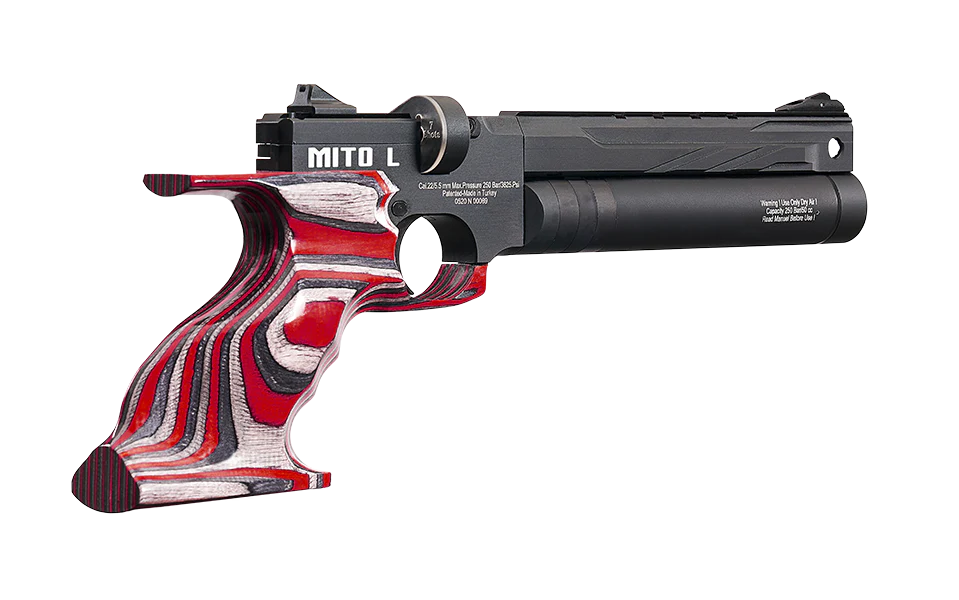
Reximex Mito Laminate Pistol

$530.00

The Reximex Mito Laminate Pistol is a regulated PCP pistol which is perfect for either close range pest control or target shooting.

The Pistol comes well presented in a sturdy soft case and also has a beautifully finished laminate stock. The Mito is perfectly balanced and has an ambidextrous palm swell grip. The action features an 11mm dovetail rail so sights can be easily fitted.

Reximex Mito Laminate Pistol Features:

  • 2 x Multi-Shot Magazine
  • Single Shot Tray
  • Filler Probe
  • 1/2″ UNF Silencer Adapator
  • Open Sights


Reximex Mito Laminate Pistol Specifications:

  • Magazine capacity – 9 (.177) / 7 (.22)
  • Length – 36cm
  • Power – 4.7ft/lbs
  • Tube Size – 50cc
  • Weight – 0.55kg

Reximex Mito Laminate Pistol

precision is delivered in a compact, regulated PCP platform that is built for shooters who want consistency, comfort, and presence in one package. Outstanding shot-to-shot stability is produced by an integrated regulator, while a striking laminate palm-swell grip is finished so that both left-handed and right-handed users are accommodated. Consequently, target work, plinking, and close-range pest control are handled with equal confidence.

Furthermore, a beautifully layered laminate stock is presented so that durability and visual impact are combined. Meanwhile, a perfectly balanced chassis is engineered so that fatigue is reduced during longer sessions. In addition, an 11 mm dovetail rail is machined along the top so that open sights, a compact red dot, or a small optic can be fitted without fuss. As a result, the Reximex Mito Laminate Pistol is prepared for use straight from the case or after a quick sight upgrade.

Compact Regulated Performance That Stays Consistent

A 50 cc air reservoir is filled to 250 bar so that a usable shot string is maintained. Subsequently, velocity is held steady by the onboard regulator until pressure falls toward the lower working range. Therefore, groups are kept tight and trajectory remains predictable at typical pistol distances. Moreover, a 200 mm rifled barrel is employed so that pellet spin and accuracy are supported in both .177 and .22.

Likewise, a short, positive side-lever action is used so that cycling stays smooth and effortless. In contrast to many unregulated compact pistols, output is kept even across the fill. Hence, paper punching, informal practice, and careful close-range work can all be approached with the same platform. Notably, UK-legal power in the region of 4.7–5.5 ft/lbs is typically delivered, so recreational and training use remains straightforward where sub-6 ft/lb limits apply.
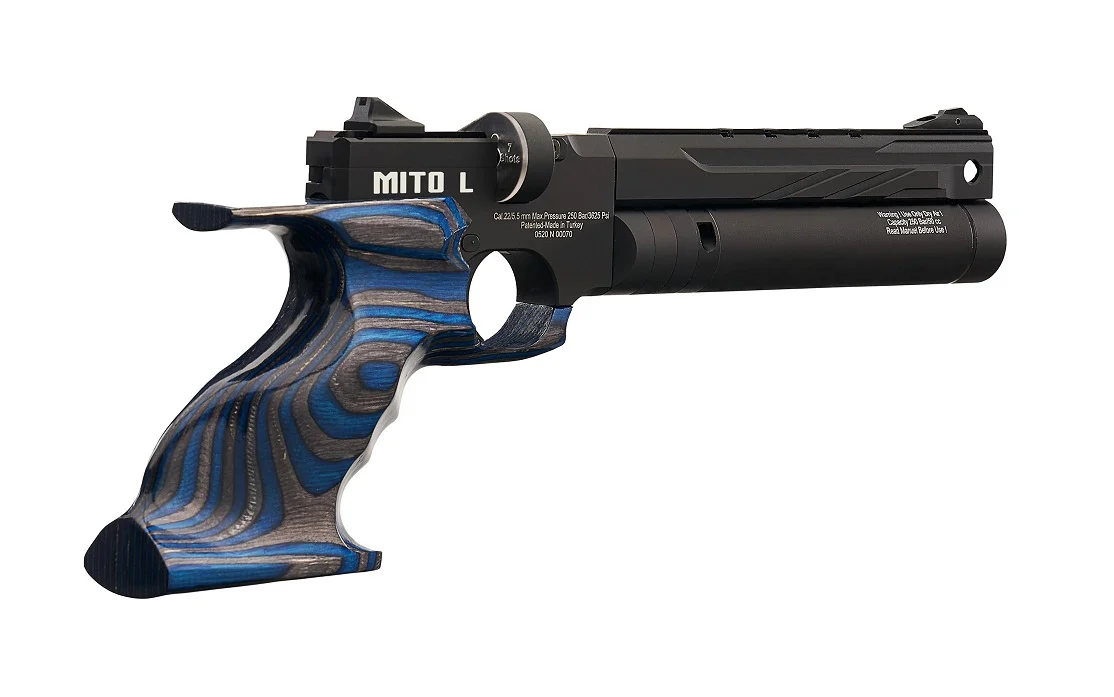
Ergonomics, Balance, and Inclusive Handling

An ambidextrous laminate palm swell is shaped so that a secure hold is offered to a wide range of hand sizes. Additionally, the grip texture and swell are arranged so that control is improved without harsh edges. Consequently, extended practice is made more comfortable. At the same time, overall length of approximately 360–370 mm and a light, well-centred mass (commonly around 0.9 kg for laminate versions) are combined so that the pistol can be carried and aimed with ease.

Furthermore, a two-stage adjustable match-style trigger is fitted so that take-up and break can be tailored. Meanwhile, a simple push-through safety is positioned above the trigger so that the action can be locked when required. In addition, removable open sights are supplied, and vertical or windage needs can later be addressed with aftermarket sights if preferred. Thus, both new and experienced pistol shooters are given a workable starting point.

Highlighted Product Listings and Core Kit

The following items are typically included so that the Reximex Mito Laminate Pistol can be put to work immediately:

  • 2 × multi-shot rotary magazines — commonly specified around 9 rounds in .177 and 7 in .22 on many laminate listings (higher-capacity magazines are also referenced on some reviews)
  • Single-shot tray — provided for deliberate, one-pellet loading
  • Filler probe — supplied for charging the 50 cc tube
  • ½” UNF silencer adaptor — included so that a compact moderator can be fitted
  • Removable open sights — fitted so that shooting can begin without extra optics
  • Sturdy padded soft case — supplied so that the pistol and accessories are protected in transit

Moreover, a colour-coded pressure gauge is located on the cylinder so that fill status can be checked at a glance. Likewise, spare seals and basic tools are often packed so that routine care is simplified.

Calibres, Power, Accessories, and Optics Ready Design

.177 is frequently chosen when a flatter trajectory and tighter target groups are desired. Conversely, .22 is selected when slightly heavier pellets and close-range impact are preferred. In either case, regulated output is maintained so that consistency is not sacrificed. Additionally, the 11 mm dovetail accepts compact optics, while the threaded adaptor accepts a moderator when noise needs to be reduced.

Therefore, a red-dot or low-profile optic can be added for faster acquisition. Subsequently, a compact silencer can be attached for garden or club use where neighbours or range rules matter. Ultimately, the same compact frame remains easy to store, transport, and handle.

Practical Use: Target, Plinking, and Close-Range Work

Paper targets at 10 metres and typical air-pistol distances are engaged with confidence because the regulator and rifled barrel work together. Furthermore, plinking sessions stay enjoyable because the side lever is short and the grip stays planted. In addition, careful close-range pest control is supported where local law and power limits allow, provided ethical shot placement and legal compliance are observed.

Meanwhile, the laminate finish is chosen not only for looks but also for a solid, wood-like feel that many shooters prefer over plain polymer. As a result, the Reximex Mito Laminate Pistol stands out on the bench and in the hand. Nevertheless, responsible storage, eye protection, and safe backstops remain essential. Accordingly, the pistol is best treated as a precision tool rather than a toy.

Calibres, FAC, Power and Accessories

Calibre choice, legal power and supporting kit are arranged so that this compact regulated PCP pistol can be matched to paper, practice and carefully planned close-range work. Consequently, .177 and .22 are both offered so that trajectory, pellet weight and magazine capacity can be selected without a change of platform. Furthermore, factory output in many markets is held in the recreational band so that everyday ownership remains straightforward where sub-6 ft/lb air pistols are permitted. Meanwhile, accessories are packed and rail space is provided so that filling, moderation and aiming aids can be added without a full rebuild. Therefore, the shooting package is completed by informed calibre selection, honest power expectations and a short list of useful extras.

Calibres and How Each Is Typically Used

A flatter flight path and tighter groups at typical pistol distances are usually favoured when .177 is chosen. Subsequently, lighter pellets are driven at a useful recreational velocity so that holdover stays modest on 10-metre cards and similar ranges. In addition, rotary magazines in this calibre commonly carry more rounds than their .22 counterparts, so follow-up shots on the range are kept convenient. Conversely, a heavier pellet and a different impact character are preferred by some users when .22 is selected. Likewise, wind drift at short pistol distances remains small in either calibre, yet pellet behaviour at the target still differs enough that testing is worthwhile.

Moreover, the same 200 mm rifled barrel length is retained across both options, so handling and sight radius are not altered by the pellet size. Hence, the decision is driven by intended use rather than by a change in chassis. Additionally, grouping is improved when a preferred pellet brand and weight are matched to the barrel; cheap mixed tins often open groups even when the regulator is doing its job. As a result, a small accuracy test with two or three quality pellets is recommended before a large stock is bought. Ultimately, both calibres remain suitable for inclusive club use and home practice when local rules and a safe backstop are observed.

FAC Status, Legal Power and Responsible Limits

A Firearms Certificate is not required in the United Kingdom for a standard factory pistol that remains at or below 6 ft/lbs. Consequently, this platform is typically supplied in the region of 4.7–5.5 ft/lbs so that it sits inside the unlicensed air-pistol band. Furthermore, energy figures vary slightly with pellet weight, temperature and how far cylinder pressure is allowed to fall, so a chronograph check is wise after any work on the valve or hammer. In contrast, an air pistol that is tuned above 6 ft/lbs becomes an FAC item in the UK; that step is not assumed for the standard regulated specification described here.

Meanwhile, other countries apply different joule limits, age rules and transport laws. Therefore, local regulations are checked before purchase, shipping or travel. In addition, public carry and brandishing remain restricted even when the pistol is legally owned, because an air pistol can be mistaken for a firearm. Likewise, pest use is undertaken only where it is lawful, humane and appropriate for the modest energy on tap. Hence, power is treated as a legal and ethical boundary, not as a figure to be chased. As a result, recreational target work and short-range practice remain the roles for which this output is designed.
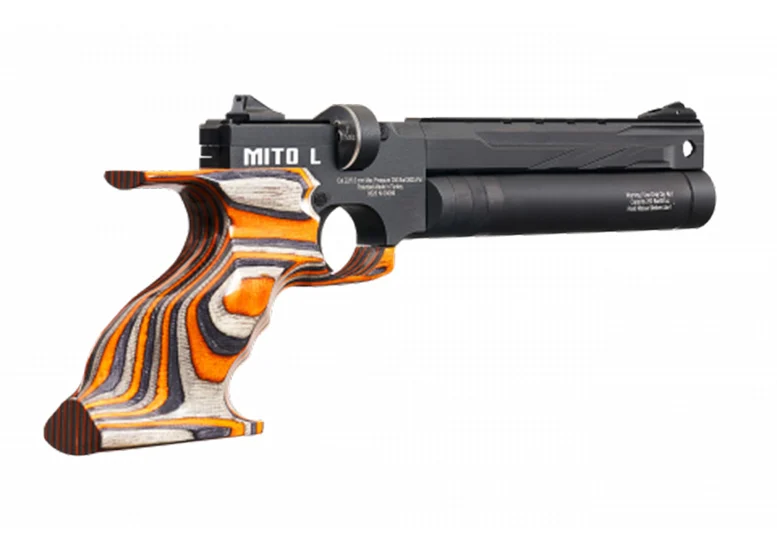
A regulated 50 cc cylinder filled to 250 bar is used so that velocity is held steadier across the useful part of the shot string. Subsequently, several dozen consistent shots are commonly obtained before pressure approaches the regulator’s lower working range. Moreover, the last good shots stay closer in speed to the first than on many unregulated compact pistols. Nevertheless, running the tube flat is avoided, because consistency fades once the regulator is starved. Thus, the gauge is read and a refill is planned while the string is still even.

Accessories, Optics, Filling and Sound Reduction

The following items are typically supplied so that first use can begin without a second order:

  • Two multi-shot rotary magazines — extra capacity is provided so that one magazine can be loaded while the other is in the action
  • Single-shot tray — deliberate one-pellet loading is supported when maximum care is wanted
  • Filler probe — the 50 cc reservoir is charged through the supplied probe
  • ½” UNF silencer adaptor — a compact moderator can be fitted where rules allow
  • Removable open sights — shooting can start before an optic is chosen
  • Padded soft case — the pistol and small kit are protected in transit

Additionally, an 11 mm dovetail is machined along the top so that a compact red-dot or a low, light pistol optic can be mounted. Subsequently, the factory open sights can be removed if a clearer sight picture is needed. In contrast, a full-size rifle scope is a poor match; excess weight and height spoil balance on a compact frame. Therefore, optics are kept small and the rail is used with purpose.

Furthermore, a compact moderator is attached via the UNF adaptor when the unmoderated report would disturb neighbours or club rules. Meanwhile, thread protection is retained whenever no moderator is fitted so that the crown is not damaged. In addition, a quality hand pump or a regulated bottle-and-hose set is paired with the probe; 250 bar is not exceeded. Likewise, PCP-safe chamber oil is applied sparingly to breech seals on a modest schedule rather than after every tin.

Moreover, aftermarket single-shot loaders and replacement magazines are popular once the pistol is known, because a smoother loader can improve careful grouping. Nevertheless, heavy tactical add-ons are avoided; they fight the light, inclusive handling that the laminate palm-swell grip is built to provide. Consequently, accessories are chosen to solve filling, aiming, feeding or noise—not to decorate the rail. Ultimately, calibre, legal power and a short, well-chosen kit are combined so that this regulated compact pistol stays accurate, compliant and ready for the next card.

Why This Laminate PCP Pistol Converts Interest Into Ownership

Value is concentrated in a regulated action, match-oriented trigger, optics rail, magazines, adaptor, and case. Consequently, extra purchases can be kept to a minimum at first. Moreover, left- and right-handed users are included by the ambidextrous grip design. Likewise, both casual and more serious pistol shooters can find a role for the same platform.

In summary, consistent velocity is produced, handling is refined, and presentation is elevated by the laminate grip. Therefore, the Reximex Mito Laminate Pistol is positioned as a compact PCP that rewards careful shooting and rewards those who want a distinctive, ready-to-use package. When legal power limits, local rules, and safe practice are respected, a versatile regulated pistol is ready to be put on the range or into a well-planned close-range role.

Bintac, AEA Airguns, PCP Platforms and Model Terminology

Bintac and AEA Airguns are names commonly associated with large-caliber PCP airgun discussions, including models and search terms such as bintac t9, bintac, bintac llc, bin tac, bintacllc, aea airguns, bintac t 50, bintac m50, bintac mcar, bintac t50, and bintac s45.

Enthusiasts researching these platforms may also encounter terminology including bintac t9 full auto, bintac mcar air rifle, bintac mcar 457, bintac m50 pistol, bintac t50 extreme, bintac m50 pump action, aea bintac t50 extreme, and automatic air gun. These terms generally describe particular configurations, operating systems, calibers, or model families and should always be understood in the context of applicable local airgun laws and safe handling requirements.

AEA Harpoon and Related Search Terms

The AEA Harpoon family is frequently discussed alongside phrases such as bintac aea harpoon, aea harpoon, aea harpoon magnum, aea harpoon gun, aea harpoon cartridge, aea .50 harpoon, aea harpoon air gun, harpoon air gun, and the commonly mistyped aa harpoon.

Because specifications can differ between generations and configurations, prospective researchers should verify caliber, energy output, compatible air systems, ammunition type, and manufacturer documentation rather than relying solely on model-name searches.

AEA Megalodon and Large-Caliber PCP Airguns

Another commonly researched platform is the AEA Megalodon, appearing under terms including aea megalodon, megalodon air rifle, aea megalodon 58 cal, aea megalodon .58 cal, aea megalodon air rifle, and aea megalodon 50 caliber.

Large-caliber PCP platforms are also associated with broader terms such as air powered 50 cal rifle, air tank for pcp airguns, and airgun shotgun. Because high-powered PCP equipment can store substantial compressed-air pressure and generate significant projectile energy, tanks, fittings, valves, and charging equipment should be used only within their certified operating limits.

AEA Defender and Terminator Platforms

Other AEA terminology includes aea defender, aea defender 2, aea defender 3, aea terminator, aea terminator gen 3, and the broader phrase aea guns. Different generations may vary substantially in action type, dimensions, magazine arrangement, air capacity, caliber, and operating pressure.

Anyone comparing these systems should therefore check the exact model designation and generation before comparing technical specifications.

Reximex Mito Laminate Pistol

PCP Air Systems and Supporting Equipment

PCP airguns depend on compressed-air storage systems. Search terms such as anti air tanks and air tank for pcp airguns may refer to high-pressure cylinders or charging equipment. Only pressure-rated equipment designed for the intended system should be used.

Other broad search phrases, including bee bee gun rifle, airgun shotgun, and automatic air gun, describe different categories of air-powered equipment rather than one standardized product type.

Additional Large-Caliber Airgun Terminology

Researchers may also encounter terms including zeus 72 cal air rifle, b&w m50, bintac t9, bintac m50, bintac t50, bintac s45, and bintac mcar. Model names alone do not establish compatibility, legality, operating pressure, caliber, or performance, so manufacturer documentation remains the appropriate source for technical specifications.

For all Bintac, AEA Airguns, and large-caliber PCP systems, safe storage, responsible handling, appropriate protective equipment, and compliance with local laws should remain central considerations.

Frequently Asked Questions

Is this compact regulated pistol suitable for both target work and close-range use?

Target shooting at typical air-pistol distances is supported because a regulated PCP system is used so that velocity remains predictable from shot to shot. Consequently, groups on paper are kept tighter than would be expected from many unregulated compact platforms. Furthermore, close-range pest work is approached with the same consistency when local law, power limits, and ethical shot placement are observed. Meanwhile, a short overall length is retained so that handling in confined spaces stays practical. In addition, a well-centred balance point is engineered so that aim can be held without unnecessary strain. Therefore, recreational plinking, formal practice, and carefully planned close-range tasks can all be assigned to one platform. Likewise, both newer and more experienced shooters are given a usable starting point because the trigger and grip are arranged for control rather than show. As a result, a single compact pistol can be relied upon across several roles when safety rules and legal limits are respected.

How is consistency maintained across a fill?

Shot-to-shot consistency is produced by an integrated regulator that is fitted so that output is held steady until cylinder pressure falls toward the lower working range. Subsequently, a 50 cc reservoir is charged to a maximum of 250 bar so that a usable string of shots is available before a refill is required. Moreover, velocity variation is reduced compared with unregulated compact pistols, so trajectory remains easier to read. In contrast, platforms without regulation often show a rising then falling power curve; that pattern is avoided here. Hence, pellet choice and aim can be trusted for longer. Additionally, a colour-coded gauge is placed on the cylinder so that remaining pressure can be checked at a glance. Therefore, a fill is managed with less guesswork. Ultimately, predictable energy is delivered for paper, practice, and short-range work when quality pellets and a clean barrel are used.

Which calibre should be chosen?

A flatter trajectory and tighter groups at pistol distances are often favoured when .177 is selected. Conversely, a slightly heavier pellet and a different impact character are preferred by some users when .22 is chosen. In either case, regulated output is maintained so that consistency is not sacrificed for calibre preference. Furthermore, magazine capacity typically differs by calibre, with more rounds commonly carried in .177 than in .22 on the rotary magazines supplied. Meanwhile, barrel length remains the same, so the handling package is not changed by the pellet size. Additionally, legal power in many markets is kept in the recreational sub-6 ft/lb region, so calibre choice is more about trajectory and pellet behaviour than raw energy. Therefore, the intended use—precision paper, informal plinking, or careful close-range work—should guide the decision. Likewise, pellet brand and weight should be tested, because grouping is improved when a preferred pellet is matched to the barrel.

How is the action cycled, and how are pellets loaded?

A short side-lever is operated so that the action is cocked and a pellet is chambered with modest effort. Subsequently, a rotary multi-shot magazine is indexed so that follow-up shots can be taken without single loading every round. In addition, a single-shot tray is included so that one pellet at a time can be seated when maximum care is wanted. Moreover, the lever stroke is kept compact so that the pistol can remain on aim more easily than with a long, awkward cocking motion. Nevertheless, the magazine must be seated correctly; resistance is felt if alignment is poor, so the magazine is pressed fully home before the lever is closed. Consequently, feeding stays reliable when the magazine lips and the loading block are kept clean. Furthermore, two magazines are typically supplied so that one can be loaded while the other is in use. As a result, range time is spent shooting rather than fumbling with pellets.

Can a silencer or optic be fitted?

A ½” UNF adaptor is supplied so that a compact moderator can be attached when local rules allow. Subsequently, report is reduced for garden practice or club use where a loud crack would be unwelcome. Moreover, an 11 mm dovetail runs along the top so that a compact red-dot or a small scope can be mounted. In addition, the factory open sights can be removed if a clearer sight picture is wanted with an optic. Nevertheless, cheek weld and eye alignment must be considered; pistol optics should remain low and light so that balance is not ruined. Furthermore, a heavy rifle scope is generally a poor match for a compact pistol, so a purpose-built red-dot is usually preferred. Therefore, the platform is optics-ready without extra rail adapters in most cases. Likewise, thread protection should be kept on when no moderator is fitted, so the muzzle crown remains undamaged.aea megalodon for sale.zeus 72 cal air rifle price.bintac t9 amazon.aea megalodon 50 cal price.bintac t50 for sale.bintac m50 for sale.aea harpoon price.bintac s45 for sale.aea harpoon for sale.bintac t9 price

Stock

Red laminate, Blue Laminate, Orange Laminate

caliber

.177, .22

Reviews

There are no reviews yet.

Be the first to review “Reximex Mito Laminate Pistol”

Related Products

FAQ

  • Spring-Piston (Break-Barrel or Underlever): Cock by compressing a spring. Reliable, no external air source needed, but can have more recoil (“spring twang”) and require technique to shoot accurately.
  • Pre-Charged Pneumatic (PCP): Filled from a scuba tank, compressor, or pump. High power, low recoil, multiple shots per fill. Popular for precision and hunting.
  • CO₂: Powered by disposable cartridges. Good for pistols and semi-auto/repeaters, but performance drops in cold weather.
  • Multi-Pump Pneumatic: Hand-pumped to build pressure. Versatile but requires effort.
  • Gas Ram (Nitro Piston): Uses compressed gas instead of a metal spring. Smoother than traditional springers.

Calibers: Most common are .177 (4.5mm) for speed/flat trajectory and general use, and .22 (5.5mm) for better hunting knockdown power. Larger “big bore” (.25, .30, .357+) exist for hunting bigger game where legal.

Yes, many modern PCP and springers deliver enough energy for small game (rabbits, squirrels, birds) and even larger game in some areas. Muzzle energy (in ft-lbs or joules) matters more than velocity alone. Always match caliber, pellet weight, and energy to the game and check local hunting regs.

Treat every airgun as if it is loaded.

  • Always point the muzzle in a safe direction.
  • Keep your finger off the trigger until ready to shoot.
  • Know your target and what is beyond it (pellets can ricochet or travel far).
  • Wear eye protection.
  • Store unloaded, out of reach of children/untrained users, and ideally locked.
  • Never shoot at hard surfaces or in areas where pellets could escape your property.

Follow these rules strictly—airguns cause real injuries.

Laws differ dramatically by country, state/province, and even city. Always verify current local laws before buying, owning, transporting, or using an airgun. Age restrictions (often 18+) are common.

Examples (summaries only; check official sources):

  • UK: Air rifles ≤12 ft-lbs (16.3 joules) and pistols ≤6 ft-lbs generally do not require a license (FAC needed above that).
  • USA: Varies by state. Some treat powerful airguns as firearms; others do not. Many states now allow big-game hunting with air rifles.
  • Canada: Some airguns classified as firearms if they exceed velocity/energy thresholds.
  • Australia: Often treated as firearms; licensing/registration required in most states.
  • EU/France/Belgium/etc.: Varies; many allow low-power (<20J) guns freely to adults, with higher power needing permits. Germany has strict ~7.5J limits in some contexts.
  • Other countries: Some have no restrictions below certain energies; others ban or heavily regulate them.

Resources: Wikipedia “Air gun laws”, airgun forums, or official government sites. For travel, research transit laws carefully.

Consider:

  • Purpose: Plinking/backyard → lower power springer or CO₂. Hunting/precision → PCP.
  • Budget: Entry-level springers are affordable; PCPs need a fill system (extra cost).
  • .177 vs .22: .177 easier for beginners/targets; .22 better for hunting.
  • Power source: Convenience vs performance.
  • Test pellets in your gun—accuracy varies.

Buy from reputable dealers and consider warranties.

  • Clean barrel periodically (especially if accuracy drops) with patches and appropriate tools/solvents. Avoid over-oiling.
  • Lubricate moving parts and seals with airgun-specific oil (not general gun oil). Springers need piston seal oil occasionally.
  • Check screws, seals for leaks (PCP), and safety mechanisms regularly.
  • Store in a cool, dry place, ideally in a case. Avoid leaving cocked for long periods.

Follow your model’s manual. Basic care extends life significantly.

International shipping may be available for select products. Customers are responsible for understanding and complying with their local import laws and regulations before ordering.

Yes. Customers are required to confirm their order number through WhatsApp or Live Chat before orders are processed and shipped.

If local laws prevent shipment to your area, your order may be canceled and refunded according to our store policy.

Processing typically takes 1–3 business days after payment confirmation. Delivery times vary depending on destination, carrier, and product availability.


  • Wrong pellets for your barrel/caliber.
  • “Death grip” or poor shooting form (especially with springers—let the gun recoil naturally).
  • Loose scopes or mounts.
  • Ignoring safety or local laws.
  • Over-oiling or shooting with obstructions.


Pellets are the most common projectile (lead or lead-free). Match them to your gun, caliber, and purpose—test several brands as accuracy varies by barrel.

  • Domed (Round-Head): Best all-rounder. Excellent accuracy, ballistic coefficient, and energy retention. Ideal for target shooting, field target, and general hunting (e.g., JSB Exact, Air Arms Diabolo Field, H&N Field Target Trophy).
  • Wadcutter (Flat-Head): Clean holes in paper. Best for close-range target/plinking (under 20-25 yards).
  • Hollow Point: Expands on impact for better energy dump. Good for small game hunting (e.g., Predator Polymag, H&N Terminator).
  • Pointed: More penetration, but often less accurate than domed.
  • Slugs: Heavier, more aerodynamic for high-power PCPs at longer ranges (better for big game where legal).

Tips: Heavier pellets in .22/.25 for hunting (better momentum). Lighter in .177 for speed/flat trajectory. Always check head size fit (e.g., 4.51-4.53mm variants).

Muzzle energy (ft-lbs or joules) matters more than velocity. Ethical shots require precise placement (head/heart-lung) within effective range.

Rough Guidelines (adjust for distance, pellet, and local laws):

  • Small game (squirrels, rabbits, birds): 9-20+ FPE, .177/.22.
  • Medium (raccoons, etc.): 25+ FPE, .22/.25 recommended.
  • Larger game: 40-100+ FPE in .30+ calibers (up to big bore for deer/hogs where permitted).

PCPs dominate serious hunting due to power and shot count. Springers/gas rams work well for small game but require skill. Always prioritize clean kills and check seasons/species rules.

  • Barrel Cleaning: Use a pull-through kit or rod with patches. Avoid brushes that could damage rifling. Clean when accuracy drops or after 500-1000 shots.
  • Lubrication: Airgun-specific silicone oil for seals/O-rings (sparingly—excess causes dieseling in springers). Springers may need piston lube periodically.
  • PCP Specific: Check for leaks (soapy water test), monitor regulator/hammer settings, and keep fill systems clean. Don’t exceed rated pressure.
  • General: Tighten stock screws, inspect for wear, store properly. Chronograph shots to track consistency.

Common Issues:

  • Inconsistent velocity → dirty barrel, bad pellets, or seal problems.
  • Spring “twang” → tuning or proper hold.
  • Low power → worn seals or under/over-pumping.

Toggle Content

  • Scopes: Airgun-rated (hold zero under recoil). 3-9x or 4-12x common.
  • Fill Systems: Hand pumps, compressors, or tanks for PCPs.
  • Safety Gear: Eye/ear protection, targets with backstops.
  • Noise: Airguns quieter than firearms, but moderators help further.

Budget Tip: Start with a quality springer (~$150-400) before investing in PCP setup.

Airgunning offers endless depth—from backyard plinking to precision competition and ethical hunting. Prioritize safety, legality, and practice. If you want specifics (e.g., recommendations for a country, budget, hunting small game, or a particular type like PCP vs springer), let me know for more targeted info! Shoot responsibly.

Tuning improves accuracy, reduces noise/recoil, or increases power (within legal limits).

  • Springers: Lighter springs, guides, seals, or custom tuning kits for smoother shot cycle. “V-Mach” or similar professional tunes popular.
  • PCPs: Regulator tuning, hammer spring adjustments, valve work for efficiency and shot count. Some add electronic systems.
  • Accessories: Suppressors (often unregulated on airguns), better triggers, stocks, and scopes.

Caution: Check laws—power increases may reclassify your gun. DIY only if experienced; professional tuners recommended.

You must be at least 18 years old to purchase any airgun or related accessories from our store. By placing an order, you confirm that you meet the legal age requirements in your state or country.

Yes. Orders may require age verification before processing and shipping. In some cases, we may request a valid government-issued ID to confirm eligibility.