Weihrauch Air Rifles, PCP Platforms, Spring-Piston Systems, and Related Airgun Terminology
Enthusiasts researching premium German airgun engineering frequently encounter models and search terms such as Weihrauch HW100X Karbine, Thumbhole PCP Air Rifle, hw35, h 45, german air rifle, accurate air rifles, hw97k, hw 70, hw35e for sale, hw40, weihrauch hw30, weihrauch hw80, weihrauch hw 95, hw100, hw 97k, hw35 air rifle, hw50 s, weihrauch hw45, weihrauch english, weihrauch hw98, weihrauch englisch, hw77 air rifle, weihrauch hw50s, compressed air rifles, air rifle makes, spring piston, what are air rifles, weihrauch hw44, air shot gun, sk x rifles, weihrauch hw50, hw30s, hw 30, what are air pistols, hw50, and rifles de aire.
Within the Weihrauch lineup, the Weihrauch HW77 air rifle is widely recognized as a traditional fixed-barrel underlever platform. Related terminology includes HW77 Green Laminate rifle, Weihrauch underlever air rifle, HW77 spring piston air rifle, Weihrauch HW77 for sale, and German precision air rifle. Researchers comparing versions may also encounter phrases such as buy Weihrauch HW77 Green Laminate online, Weihrauch HW77 Green Laminate price and specs, Weihrauch HW77 accuracy review, HW77 Green Laminate vs HW97 comparison, is Weihrauch HW77 good for beginners, precision shooting airgun, high quality German airguns, best price Weihrauch HW77, where to buy Weihrauch HW77, Weihrauch HW77 in stock, affordable premium air rifle, and top rated underlever air rifle.
Technical comparison searches commonly include Weihrauch HW77 vs HW97, HW77 vs break barrel air rifle, best Weihrauch air rifles, most accurate air rifle for target shooting, air rifle with low recoil, durable air rifle for outdoor use, and reliable air rifle for long term use. These phrases generally reflect interest in operating systems, mechanical durability, handling characteristics, consistency, and the differences between fixed-barrel underlever designs, break-barrel rifles, and PCP platforms.
Other Weihrauch-related terminology includes air pistols, hw100 airgun, weihrauch hw95, weihrauch hw 30, weihrauch hw90, hw 44, hw 40, hw 98, and weihrauch hw100. The HW100 family represents the PCP side of Weihrauch’s catalog, while models such as the HW30, HW50, HW80, HW90, HW95, HW97, and HW98 are associated with spring-powered or gas-ram-style sporting airgun platforms depending on the specific model and configuration. By contrast, the HW44 is commonly discussed as a PCP air pistol.
The broader airgun market also includes search terminology connected with alternative PCP manufacturers and modern platforms. Examples include 25 karma, pcp bb gun, karma eq air rifle, karma red panda, panda guns, full auto pcp, karma sls compact, air karma, red panda hat, eq air, karma sls, eq magazine, air pcp, and karma airguns. These terms may refer to specific products, product families, accessories, community terminology, or unrelated search phrases that appear alongside airgun research.
Reximex is another name frequently encountered in PCP discussions. Related search phrases include reximex airguns, reximex rp, reximex throne gen 2, reximex mito, reximex rpa, sbs12, reximex mitos, reximex lieva, reximex accura pcp air rifle, and reximex throne gen2. Model naming can vary slightly between retailers, regions, and search listings, which explains variations such as “Throne Gen 2” and “Throne Gen2” or “Mito” and “Mitos.”
Airgun research also involves understanding velocity and energy. Searches such as fps to joules calculator, fps to ft lbs, and airgun calculator relate to converting projectile velocity and mass into kinetic-energy measurements. These calculations are commonly used for technical comparison, range evaluation, regulatory research, and understanding how different compressed-air or spring-powered platforms perform within their intended specifications.
More general discovery terms can include gunseek and yivli av tüfeği, alongside broader international phrases such as rifles de aire. Because airgun terminology varies considerably between English, German, Spanish, and Turkish-speaking markets, researchers may encounter several different naming conventions for comparable sporting, target, and recreational airgun platforms.
Taken together, terms ranging from Weihrauch HW100X Karbine and Thumbhole PCP Air Rifle to HW77 Green Laminate rifle, spring piston, compressed air rifles, karma airguns, and reximex airguns illustrate the diversity of modern airgun technology. Weihrauch remains particularly associated with German engineering, fixed-barrel underlever rifles, traditional spring-powered designs, precision PCP systems, and air pistols, while Karma and Reximex represent additional names encountered when comparing contemporary PCP platforms and associated airgun technology.
Calibres, FAC Considerations, Power Output and Accessories for the Reximex Lyra Walnut PCP Air Rifle
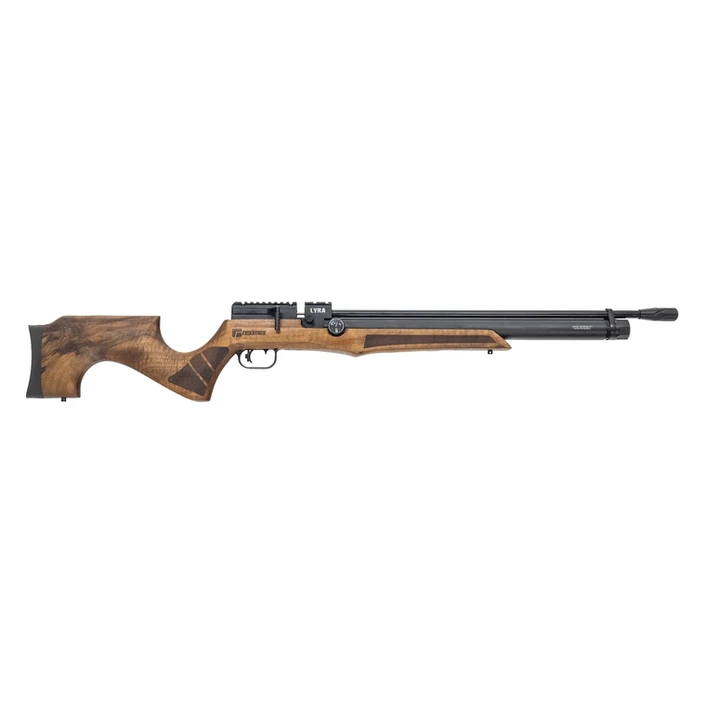
Multiple calibre options are offered so that the Reximex Lyra Walnut PCP Air Rifle can be matched to different shooting goals. Furthermore, legal power limits and accessory compatibility are designed into the platform so that both restricted and higher-output configurations can be used where regulations allow. Consequently, a single family of rifles serves target work, pest control and recreational shooting without forcing a one-size-fits-all choice.
Available Calibres and Magazine Capacities
Three popular pellet calibres are produced for the Reximex Lyra Walnut PCP Air Rifle. Moreover, rotary magazine capacity is scaled to pellet diameter so that reliable feeding is maintained.
Highlighted calibre details are presented below:
- .177 (4.5 mm): Fourteen-shot rotary magazines are supplied. Flat trajectories and high pellet counts per fill are typically delivered, making this option well suited to target practice and precision work at moderate ranges.
- .22 (5.5 mm): Twelve-shot rotary magazines are included. A balanced mix of energy transfer and shot count is provided, so this calibre is frequently selected for general field use and pest control.
- .25 (6.35 mm): Ten-shot rotary magazines are fitted. Greater down-range energy is generated, so this option is preferred when extra knockdown is required and local power limits permit.
Additionally, a single-shot tray is packed with every rifle so that longer or specialty pellets can be loaded one at a time when grouping tests or competition-style shooting are planned. Therefore, both rapid magazine fire and deliberate single loading remain available in every calibre.
FAC Status, Legal Power and Market Versions
Sub-12 ft/lbs (approximately 16 joules) versions are commonly supplied for the United Kingdom and other markets where that limit applies. As a result, a Firearms Certificate is not required for those configurations when they remain within the legal threshold. Furthermore, the rifle is engineered so that consistent performance is still delivered at this restricted output.
Nevertheless, higher-power FAC or unrestricted versions are produced for territories where elevated energy is lawful. Moreover, published figures for unrestricted examples have indicated muzzle energies approaching 50 joules in .22 and 55 joules in .25 when the platform is set to full output. Consequently, local legislation must always be checked before a high-power example is ordered or imported.
In addition, a power-adjustment facility is fitted on many Reximex Lyra Walnut PCP Air Rifle examples. Therefore, output can be reduced for shorter ranges, indoor ranges or quieter sessions even when a higher-power action is present. Likewise, a built-in pressure gauge is provided so that remaining air can be monitored and shots can be taken only within the recommended working band.
Responsible ownership is expected at every power level. Hence, safe storage, correct filling procedures and compliance with national and regional airgun laws should be observed before the first shot is fired.
Power Delivery and Shot Consistency
Compressed air is stored in a 280 cc tube filled to 200 bar. Furthermore, approximately 80–110 usable shots at optimal velocity are typically obtained between fills, with exact count varying by calibre, pellet weight and power setting. Moreover, a non-regulated air curve is present on standard models, yet shot-to-shot consistency remains tight enough for practical field and range use when pellets are matched to the barrel.
Additionally, a 580 mm rifled barrel is employed so that spin and stability are imparted to the pellet. In addition, a 1/2″ UNF male thread is cut at the muzzle so that a sound moderator can be fitted when report reduction is desired. Consequently, neighbours and quarry are less disturbed while the same accuracy potential is retained.
A power curve is still present because a regulator is not fitted as standard. Therefore, the most consistent string is usually taken from the upper portion of the fill. Likewise, chronograph testing with several pellet weights is recommended so that the sweet spot for each calibre can be identified.
Accessories Included and Compatible Upgrades
A comprehensive starter kit is supplied with the Reximex Lyra Walnut PCP Air Rifle so that shooting can begin once a scope is mounted.
Highlighted included items are listed below:
- Two calibre-specific rotary magazines
- Single-shot tray insert
- Foster-style fill probe / adaptor
- Extra short Picatinny accessory rail for the forend
- Spare O-rings, Allen keys and basic tools
- Instruction manual
Moreover, a 22 mm Picatinny rail is machined on the receiver so that virtually any modern air-rifle optic can be attached. In addition, sling swivel studs are fitted so that a carrying sling can be added for longer walks. Likewise, the 1/2″ UNF muzzle thread accepts a wide range of moderators, muzzle brakes and thread protectors.
Compatible upgrades that are frequently chosen include:
- Quality 3–12× or 4–16× air-rifle scopes with appropriate mounts
- Compact sound moderators matched to the 1/2″ UNF thread
- Bipods attached to the supplied forend rail
- Aftermarket magazines or extra single-shot trays
- Protective hard or padded cases sized for a 1070 mm rifle
- High-quality pellets in the chosen calibre for grouping and hunting use
Furthermore, a compressor or charging bottle with a Foster female connector is required for filling. Consequently, existing PCP owners can often use equipment already on hand. In addition, the ambidextrous walnut stock accepts both right- and left-handed shooters without extra parts, so inclusive use is supported from the outset.
As a result, the Reximex Lyra Walnut PCP Air Rifle can be specified in the calibre that matches the intended task, set to legal power for the destination market, and completed with optics and accessories that turn a well-specified action into a ready-to-shoot system.
Practical Use Scenarios in the Field and on the Range
Everyday shooting tasks are supported by a well-balanced walnut-stocked PCP when the platform is matched to realistic distances, legal power and suitable pellets. Furthermore, consistent results are obtained when fill pressure, pellet choice and shooting position are treated as a single system rather than isolated details. Consequently, the same rifle can be taken from a quiet range session to a permission walk without a complete change of technique.
Quiet Range Sessions and Group Development
Controlled grouping work is best begun from a rested position so that barrel harmonics and pellet preference can be isolated. Moreover, a solid rest or bipod attached to the forend rail is employed so that human wobble is reduced while the first magazine is expended. Additionally, several pellet brands and weights are tested at 20, 30 and 40 yards so that the tightest combination is identified before any field trip is planned.
A side-lever action is cycled between shots so that rhythm is maintained without breaking cheek weld. Furthermore, the single-shot tray is inserted when extra-long or experimental pellets are evaluated, because magazine feed is not required for grouping tests. In addition, a quality optic with fine click values is used so that small adjustments can be recorded in a notebook. Therefore, a reliable zero is established before standing practice begins.
Highlighted steps that are followed during range development include:
- Confirmation that the cylinder has been filled to the recommended working pressure
- Selection of three pellet types in the chosen calibre
- Five-shot groups from a rest at two or three distances
- Notation of point of impact relative to point of aim
- Adjustment of the trigger reach and pull so that surprise breaks are obtained
- A second string after a brief cooling pause so that heat shift can be observed
Nevertheless, wind flags or natural indicators are watched even on a sheltered range. As a result, flyers caused by a sudden gust are not blamed on the rifle. Likewise, the pressure gauge is checked after each magazine so that the usable portion of the fill is understood before the cylinder is allowed to drop too far.
Standing and Kneeling Practice for Field Readiness
Field shots are rarely taken from a bench. Consequently, standing and kneeling drills are introduced once a reliable zero has been confirmed. Moreover, the ambidextrous walnut stock is brought to the shoulder so that both left- and right-handed shooters can practise the same sequence. In addition, a sling is attached to the factory studs so that the supporting arm can be locked against the body during longer holds.
A compact moderator is often fitted for these drills so that report does not startle the shooter or nearby animals. Furthermore, follow-up shots are taken only after the side lever has been fully closed and the sight picture has been rebuilt. Therefore, haste is avoided and each pellet is sent with a deliberate trigger press.
Kneeling positions are practised on uneven ground so that the rubber butt pad can settle into the shoulder pocket. Additionally, the profiled cheek piece is used to keep the eye aligned with the scope without neck strain. Likewise, breathing is paused at the natural respiratory pause so that the crosshair settles rather than floats.
Pest Control on Permission Ground
Humane pest control is conducted only where lawful permission has been granted and local energy limits are observed. Moreover, distances are kept inside the range at which the chosen pellet still delivers adequate energy and accuracy. Furthermore, a rest is taken whenever a fence post, bag or bipod can be used, because a supported shot is more reliable than an unsupported one.
Dawn and dusk sessions are planned when quarry is most active. Consequently, a scope with good low-light transmission is preferred so that vital zones remain visible. In addition, a moderator is almost always fitted so that the first shot does not educate every animal on the ground. Therefore, a second opportunity is more likely to remain available if a follow-up is required.
Highlighted field habits that improve success include:
- Pre-dawn filling of the cylinder so that the full usable shot string is available
- Quiet approach routes that keep the sun or wind in a favourable quarter
- Confirmation of a clear backstop before the safety is moved
- A single, well-aimed first shot rather than a rushed magazine dump
- Immediate retrieval and respectful disposal of any animal taken
- A second fill only when the gauge shows that the working band has been left
Nevertheless, weather is respected. Rain-soaked walnut is wiped after the session so that the finish is preserved, and cold hands are warmed before the trigger is touched. As a result, a clean, ethical outcome is more likely than a wounded animal and a long search.
Recreational Plinking and Family Introduction
Relaxed backyard or club plinking is enjoyed when a safe backstop and local rules are confirmed. Moreover, the inclusive ambidextrous stock allows different family members to share the same rifle without extra parts. Furthermore, the adjustable trigger can be set slightly heavier for newer shooters so that premature releases are reduced.
Paper targets, spinning targets and reactive cans are used so that instant feedback is given. Additionally, the two supplied magazines are loaded in advance so that time is spent shooting rather than fumbling pellets. In addition, the single-shot tray is reserved for coaching moments when each pellet must be watched from chamber to target.
A lower power setting, where the adjustment knob is present, is selected for close-range fun so that pellet splash and noise remain modest. Consequently, neighbours are less disturbed and younger or newer participants remain comfortable. Likewise, eye and ear protection are worn by everyone on the firing line, inclusive of observers.
Hunter Field Target Style Practice
Simulated field-target courses are used to build hold-over knowledge and positional variety. Moreover, kill-zone sized targets are placed at unknown distances so that range estimation and trajectory knowledge are tested together. Furthermore, the Picatinny rail accepts a scope with a mil or MOA reticle so that hold-offs can be applied without turret spinning between every lane.
Kneeling, sitting and standing lanes are rotated so that muscle memory is built in all three. Additionally, a sling and the rubber butt pad work together to steady the rifle during the longer standing holds. Therefore, the same platform that groups well from a bench also teaches real-world field craft.
Wind reading is practised on every lane. Consequently, the first shot on a new target is treated as a sighter when conditions are changeable. In addition, magazine changes are rehearsed so that a mid-course reload does not break concentration.
Travel, Storage and Session Planning
Transport is simplified when a padded case sized for a 1070 mm rifle is used. Moreover, the magazines, fill probe and spare seals travel in a small pouch so that nothing is left behind. Furthermore, the cylinder is stored at a reduced pressure when the rifle will not be used for several weeks, following the manufacturer’s guidance.
A session plan is written before leaving home. Additionally, pellet tins are labelled by weight and brand so that the proven combination is not mixed with untested stock. In addition, a small notebook records fill pressure at the start, number of shots taken and any shift in point of impact. Therefore, the next outing begins with data rather than guesswork.
Highlighted packing items that keep a trip productive include:
- Charged cylinder or a portable filling solution
- Proven pellets in a sealed tin
- Moderator and thread protector
- Spare magazine and single-shot tray
- Lens cloth and a small bottle of stock oil
- Hearing and eye protection for every participant
- Written permission documents where they are required
Nevertheless, fatigue is managed. Long walks are broken so that the 3.45 kg unscoped weight does not produce a shaky last shot of the day. Likewise, hydration and a brief rest restore a steady hold before the final magazine is fired.
Seasonal and Weather Adaptations
Summer heat can raise cylinder pressure slightly after a vehicle journey. Consequently, the gauge is checked after the rifle has sat in the shade for a few minutes. Moreover, dark walnut furniture is kept out of prolonged direct sun so that finish and bedding remain stable.
Winter sessions require extra attention to seals and lubricant. Furthermore, gloves that still allow a clean trigger press are worn, and the first few shots are used to confirm that velocity has not dropped more than expected in the cold. In addition, condensation on the scope is wiped before the first aiming period begins.
Wet weather is not an automatic cancellation. Therefore, a moderator and a simple rain cover for the optic keep the session usable. Afterwards, metal surfaces are dried and a light protective film is applied to the walnut so that moisture is not trapped in the grain.
Building Confidence Across Skill Levels
Newer shooters are introduced with a rest and a large target so that success is experienced early. Moreover, the side lever is demonstrated slowly until the motion becomes automatic. Furthermore, inclusive language and unhurried coaching keep the atmosphere constructive for every participant, regardless of age, stature or handedness.
Experienced marksmen use the same rifle to refine hold-over charts and to test new pellets. Additionally, the adjustable trigger is fine-tuned until the break matches the shooter’s preference. Consequently, the platform grows with the owner rather than being outgrown after a single season.
A closing habit is adopted after every outing. The safety is applied, the magazine is removed, and the cylinder pressure is noted. As a result, the next practical session begins from a known, safe state and the rifle remains ready for whatever lawful task is planned next.
Frequently Asked Questions
Common questions about this walnut-stocked side-lever PCP are answered below so that buying, setting up and shooting decisions can be made with clearer information. Furthermore, legal power, calibre choice and accessory fitment are explained in practical terms. Consequently, both first-time PCP owners and experienced shooters can find the detail that matches their intended use.
Which calibres are offered and how should one be chosen?
Three pellet calibres are manufactured so that different trajectories and energy levels can be selected. Moreover, magazine capacity is scaled to pellet size so that reliable feeding is maintained.
Highlighted calibre guidance is summarised as follows:
- .177 is often selected when flatter flight and higher pellet counts per fill are preferred for target work.
- .22 is frequently chosen when a balance of energy and shot count is required for general field use.
- .25 is typically reserved for situations in which extra down-range energy is lawful and desired.
Additionally, a single-shot tray is supplied so that longer or specialty pellets can be tested without depending on the rotary magazine. Therefore, grouping trials can be completed before a favourite hunting or range pellet is committed to in quantity. Likewise, local power limits should be confirmed first, because the same action may be supplied in restricted or higher-output form depending on the destination market.
Is a Firearms Certificate required?
A certificate is not required in jurisdictions where the supplied energy remains at or below the local unlicensed threshold. Furthermore, many examples are factory-set for sub-12 ft/lbs markets so that they can be purchased and used under ordinary airgun rules. Nevertheless, higher-power versions exist for territories in which elevated energy is lawful. Consequently, the exact specification of the rifle that will be delivered must be checked against national and regional law before an order is placed.
In addition, storage, transport and age restrictions still apply even when a certificate is not needed. Therefore, a lockable cabinet and a safe carrying case are recommended regardless of power level. Inclusive access is supported by the ambidextrous stock, yet legal ownership remains subject to the rules of the country in which the rifle will be kept.
How many shots are typically obtained from one fill?
Approximately 80 to 110 usable shots at optimal velocity are commonly reported, with the exact figure depending on calibre, pellet weight and power setting. Moreover, a 280 cc tube filled to 200 bar supplies the air. Furthermore, a built-in gauge is fitted so that remaining pressure can be read without extra tools.
A regulator is not fitted as standard. Consequently, the most consistent string is usually taken from the upper portion of the fill. Additionally, a power-adjustment knob is present on many examples so that output can be reduced when shorter ranges or quieter sessions are planned. Therefore, shot count can be extended when full power is not required.
Nevertheless, the first and last shots of a fill should be confirmed on a chronograph or at a known target if maximum consistency is needed. Likewise, the cylinder should not be run down to empty in the field if a follow-up shot may still be required.
What is included in the box?
A practical starter kit is packed so that shooting can begin once an optic has been mounted.
Highlighted items that are typically supplied include:
- Two rotary magazines matched to the chosen calibre
- A single-shot tray insert
- A Foster-style fill probe
- An extra short Picatinny accessory rail for the forend
- Spare O-rings, Allen keys and basic tools
- An instruction booklet
A scope is not included. Moreover, mounts must be selected to suit the 22 mm Picatinny rail. In addition, a moderator is not supplied as standard, although the 1/2″ UNF muzzle thread accepts a wide range of aftermarket silencers. Consequently, budget should be reserved for glass, rings and, where desired, sound reduction.
Can a sound moderator be fitted?
A 1/2″ UNF male thread is cut at the muzzle so that a compatible moderator or muzzle brake can be attached. Furthermore, a thread protector can be used when the muzzle is left bare. Additionally, report is reduced substantially once a correctly sized moderator is fitted, which is especially useful on permissions and in gardens where neighbours are close.
Nevertheless, overall length increases when a moderator is added, so case size and vehicle storage should be considered. Likewise, the extra weight at the muzzle can slightly alter balance, yet many shooters find the change beneficial for steady holds.
Is the stock suitable for left-handed shooters?
An ambidextrous Turkish walnut sporter stock is used so that both left- and right-handed shooters can share the same rifle. Moreover, a profiled cheek piece and rubber butt pad are fitted so that a consistent weld and comfortable recoil absorption are obtained from either side. Furthermore, sling swivel studs are present on both ends of the furniture.
The side lever remains on one side of the action. Consequently, left-handed users may need a short period of familiarisation, yet cycling remains smooth once the motion is practised. Inclusive use is therefore supported without a dedicated left-hand action or extra stock.
What are the length and weight figures that affect carry and storage?
An overall length of 1070 mm and an unscoped weight of approximately 3.45 kg are specified. Moreover, a 580 mm barrel is fitted. Therefore, the rifle remains compact enough for a standard padded case while still offering a useful sight radius and barrel length for accuracy.
Additionally, the under-barrel air tube contributes to a forward balance that many shooters describe as steady rather than muzzle-heavy. In addition, a sling can be attached when longer walks are planned so that fatigue is reduced. Consequently, all-day carry on a permission remains realistic for most adults.
How is the rifle filled and what equipment is needed?
A Foster-style male fill port is fitted so that a standard female snap connector can be used. Furthermore, a 200 bar fill is specified, with a minimum working pressure commonly recommended around 100 bar. Moreover, the onboard gauge should be watched during filling so that the cylinder is not over-pressurised.
A compressor, a charging bottle or a manual pump with the correct adaptor can be employed. Additionally, the supplied fill probe is kept clean and lightly lubricated according to the manual. Therefore, seal life is extended and leaks are less likely. Inclusive household use is possible once one filling source is owned, because multiple rifles with the same connector can share it.
Is the trigger adjustable and how should it be set?
A 4-way adjustable trigger is fitted so that pull weight, reach and blade angle can be tailored. Furthermore, a manual safety in the trigger guard is provided so that the action can be made safe between strings. Moreover, a slightly heavier setting is often chosen when newer shooters are introduced, while a lighter, crisper break is preferred by experienced marksmen.
Adjustments should be made with the rifle unloaded and pointed in a safe direction. Consequently, small incremental changes are tested on paper before the new setting is trusted in the field. Likewise, the chosen setting should be re-checked after travel, because vibration can occasionally shift a screw.




Reviews
There are no reviews yet.