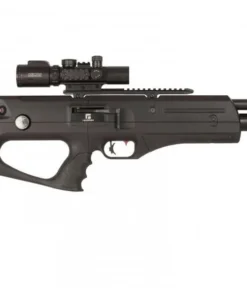
The Reximex Regime is presented as a compact semi-bullpup PCP that combines tactical styling with everyday usability.
Compact dimensions are delivered alongside a feature set that is usually reserved for higher-priced rifles. Consequently, a balanced platform is offered to target shooters, pest controllers, and hunters who value adjustability, quiet operation, and consistent accuracy. Furthermore, an ambidextrous layout is incorporated so that left- and right-handed users are equally accommodated. In addition, legal-limit performance in the UK and similar markets is maintained while a useful shot count is still provided from a 310 cc reservoir.
Compact Semi-Bullpup Design of the Reximex Regime
A short overall length of approximately 810–850 mm is achieved despite an 480 mm (18.9 in) barrel. As a result, a handy package is created that remains easy to carry in cover or transport in a vehicle. Moreover, a modest unscoped weight of around 3 kg (6.6 lb) is recorded, so fatigue is reduced during longer sessions. Meanwhile, a synthetic stock with textured grip areas is fitted, and an adjustable rubber butt pad is included so that length of pull and cheek alignment can be tailored. Therefore, a secure hold is promoted for shooters of varying builds.
Ambidextrous Operation and Ergonomics
An interchangeable biathlon-style side lever is supplied and can be swapped from one side to the other in a few minutes. Consequently, cocking effort is kept light and consistent for either shoulder. Likewise, the magazine is recessed so that it does not sit against the face. In addition, an easy-access manual safety lever is positioned inside the trigger guard. Thus, safe handling is simplified without breaking the shooting position. Furthermore, a two-stage adjustable trigger with a match-style shoe is fitted; height, angle, and pull can be refined so that a clean break is obtained.
Key Features Highlighted for the Reximex Regime
- 310 cc unregulated air cylinder – a 250 bar maximum fill is accepted; a more conservative 200 bar charge is commonly used so that component stress is reduced while a generous shot string is still delivered.
- Power adjustment screw – output can be lowered for close-range work or raised toward the 11.3 ft/lbs legal limit, so versatility across plinking, pest control, and hunting is gained.
- Adjustable Weaver/Picatinny rail with integrated bubble levels – scope mounting flexibility is provided and cant can be monitored, especially at longer ranges.
- Shrouded barrel with efficient integrated moderator – muzzle report is tamed without the need for an extra can on many examples; later models also receive a ½” UNF thread.
- Two rotary magazines included – 14-shot capacity in .177, 12-shot in .22, and 10-shot in .25 is offered so that follow-up shots are readily available.
- Quality ABS hard case, fill probe, and tools – the complete package is supplied ready for the range or field.
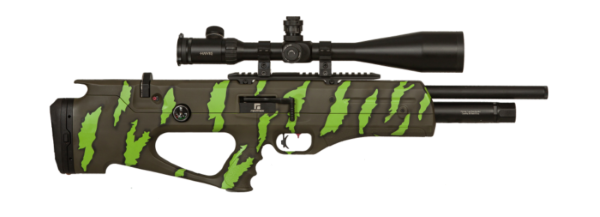
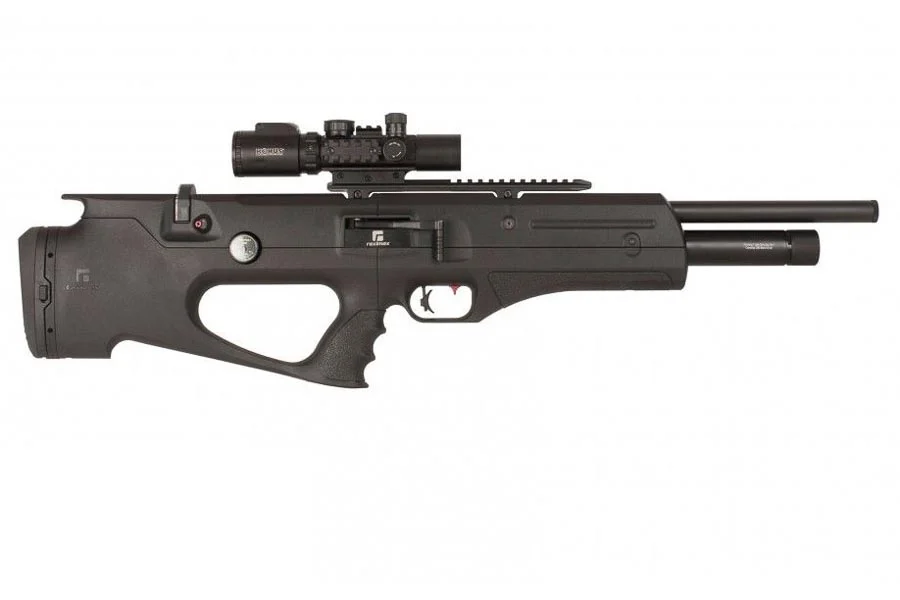
Additionally, synthetic colour options such as black, Green Leaf, and Snow are available so that personal preference and environment can be matched.
Calibres, Power, and Shot Performance
Three popular calibres are offered so that the intended use can be matched. .177 is favoured when flatter trajectory and high shot count are required. Meanwhile, .22 remains the most common choice for hunting and general field work. .25 is also listed by some retailers for extra punch at closer ranges. Unregulated behaviour is exhibited, yet a usable power curve is observed. Consequently, a sweet spot between roughly 190 and 130 bar is often identified, after which velocity spread remains modest. Typical UK-legal energy of approximately 11.2–11.5 ft/lbs is recorded on the higher setting.
Shot counts vary with calibre, pellet, and fill pressure. Approximately 150–170 shots in .177 and 150 shots in .22 are commonly quoted from a 200 bar fill; some sources note over 200 usable shots when power is managed. Accuracy is described as pellet-friendly, with tight groups at 30–40 metres being regularly achieved using quality diabolo pellets. Therefore, consistent results are obtained once a suitable pellet is selected and the rifle is zeroed.
Practical Field Use and Maintenance
Pest control around buildings is facilitated because power can be reduced to limit ricochet risk while humane dispatch is still achieved. Likewise, hunting of small game at sensible ranges is supported by the compact length and quiet shroud. Target and HFT-style practice is equally well served thanks to the adjustable trigger and rail. Regular filling via the probe (protected by a rotating cap) is required; a side-mounted gauge is provided on many examples so that remaining pressure can be monitored. Periodic lubrication of the probe O-rings and inspection of the magazines keep the action reliable.
Why the Reximex Regime Appeals to a Wide Range of Shooters
Value is delivered because a feature-rich, well-balanced semi-bullpup is offered at an accessible price point. Inclusive design is emphasised through the reversible lever, ambidextrous stock, and adjustable pad, so that shooters of different statures and dominant hands are welcomed. Engaging handling is combined with informative adjustability: rail height, trigger geometry, power level, and length of pull can all be refined. Conversion is encouraged because the rifle arrives with magazines, case, and fill probe, allowing shooting to begin quickly once a suitable optic is mounted.
Ultimately, a modern, compact PCP that punches above its price is presented. Precision, quietness, and adaptability are packaged together so that both new and experienced airgunners can enjoy consistent performance. Responsible, legal use within local power limits is always expected; when those conditions are observed, the Reximex Regime is ready to become a dependable companion on the range or in the field.
Calibres, FAC Considerations, Power Settings, and Accessories for the Reximex Regime
A choice of three popular pellet diameters is offered so that the Reximex Regime can be matched to the intended discipline. Consequently, versatility is provided for target work, pest control, and hunting within legal limits. Furthermore, magazine capacity, trajectory, and energy delivery are all influenced by the selected calibre. Inclusive use is supported because left- and right-handed shooters, as well as users of different physical stature, are accommodated by the same adjustable platform regardless of calibre.
Available Calibres and Magazine Capacities
.177 (4.5 mm) is frequently selected when a flatter trajectory and a higher shot count are desired. A 14-shot rotary magazine is supplied in this diameter, so follow-up shots can be taken with minimal interruption. Meanwhile, .22 (5.5 mm) remains the most widely chosen option for general field use; a 12-shot magazine is included and a useful balance of energy and pellet weight is delivered. In addition, .25 (6.35 mm) is listed by many retailers when extra impact at closer ranges is preferred; a 10-shot magazine is then provided. Therefore, pellet choice and intended range should be considered together so that grouping and humane performance are both achieved.
Quality diabolo pellets from established makers are generally well accepted by the barrel. As a result, tight groups at 30–40 metres are regularly reported once a suitable brand and weight have been identified. Single-shot trays in .177 and .22 are also available as aftermarket items, so bench or precision practice can be conducted without a magazine if preferred.
Power Output, Adjustment, and FAC Status
An unregulated 310 cc cylinder is fitted and a maximum fill of 250 bar is accepted. A more conservative 200 bar charge is commonly recommended so that component stress is reduced while a practical shot string is still obtained. Typical UK-legal energy of approximately 11.3 ft/lbs (around 16 J) is recorded on the higher setting of standard examples. Consequently, the rifle is sold in many markets as a sub-12 ft/lbs airgun that does not require a Firearm Certificate (FAC) in Great Britain when kept within that limit.
A recessed power-adjustment screw is located near the breech. The removable handle of the biathlon lever can be used to turn the screw, so output can be lowered to roughly 4–5 ft/lbs for close-range plinking or raised toward the legal ceiling for hunting. Thus, ricochet risk around buildings can be reduced without sacrificing a clean dispatch when power is managed correctly. A usable sweet spot between approximately 190 and 130 bar is often identified; within that window, velocity spread remains modest and consistent groups are maintained.
FAC or high-power versions of other Reximex models are advertised in some export markets. Similar higher-energy configurations of the Reximex Regime may therefore be available by special order where local law permits. However, ownership, storage, and transport of any air rifle exceeding 12 ft/lbs in the UK require a valid FAC, and all applicable regulations must be observed. Legal compliance is the responsibility of the owner; advice from a registered firearms dealer should be sought before any power increase is contemplated.
Shot counts vary with calibre, pellet weight, fill pressure, and power setting. Approximately 150–170 shots in .177 and around 150 shots in .22 are commonly quoted from a 200 bar fill; some sources note over 200 usable shots when output is moderated. Stretching the string further increases velocity variation, so a practical working range is best established with a chronograph.
Accessories Supplied and Recommended Additions
A complete starter package is included with most rifles so that shooting can begin promptly.
- Two rotary magazines matched to the chosen calibre are supplied.
- A Foster-style fill probe and rotating port cover are provided for charging from a pump, bottle, or compressor.
- A quality ABS hard case is furnished for storage and transport.
- A short Picatinny accessory rail and fixing hardware are included so that a bipod, light, or laser can be attached to the forend.
- An adjustable Weaver/Picatinny scope rail with built-in bubble levels is already fitted, allowing cant to be monitored and extra elevation to be added if required.
Scopes and mounts are sold separately, so an optic suited to the intended ranges can be chosen freely. Later production examples are fitted with a ½” UNF end cap, allowing a compact moderator such as the Reximex Silent Force (short or long) to be added if extra quietness is desired. Earlier shrouded barrels without a factory thread can often accept aftermarket adapters. Spare magazines, extra probes, O-ring kits, and single-shot trays are readily available so that reliability in the field is maintained.
An inclusive, conversion-focused setup is therefore created: the same rifle can be configured for quiet garden practice, pest work around farm buildings, or longer-range hunting once the correct calibre, power setting, and accessories have been selected. Responsible, legal use within local limits is always expected. When those conditions are met, the Reximex Regime is equipped to deliver consistent, adaptable performance for a wide community of shooters.
Practical Use Scenarios in the Field and at the Range
A compact semi-bullpup PCP is readily pressed into service across several everyday shooting tasks. Consequently, a single platform can be adapted from quiet garden practice to close-range pest work and then to measured hunting at sensible airgun distances. Furthermore, an ambidextrous layout, an adjustable pad, a reversible side lever, and a power screw are combined so that shooters of different stature, dominant hand, and experience level are included. In addition, a shrouded barrel and a modest overall length allow the rifle to be carried through cover without drawing unnecessary attention. Therefore, practical value is realised when each scenario is planned with safety, legality, and pellet choice in mind.
Quiet Pest Control Around Buildings and Farm Yards
Rats, feral pigeons, and similar pests around barns, outbuildings, and grain stores are frequently addressed with a reduced-power setting. A lower energy level of a few foot-pounds is selected so that ricochet risk against tin, slate, or concrete is reduced while a humane strike is still delivered at short range. Meanwhile, the integrated shroud keeps muzzle report low, so livestock and neighbours are less likely to be disturbed. An easy-access safety inside the trigger guard can be applied between shots, and the recessed magazine stays clear of the cheek when the rifle is mounted quickly from a doorway or vehicle window.
Follow-up shots are cycled with the biathlon lever without the action being brought far from the shoulder. As a result, a second opportunity is often available before the pest moves out of the kill zone. A .22 pellet of moderate weight is commonly preferred for this work because energy transfer at 10–25 metres remains adequate. Likewise, a .177 pellet may be chosen when a flatter line and extra shots from the cylinder are wanted. Lighting inside sheds is often poor; therefore a compact lamp on the short forend rail can be fitted so that the target is identified before the shot is taken. Legal permission from the landowner and local rules on airgun use must always be observed.
Small-Game Hunting at Sensible Airgun Distances
Rabbits and similar small quarry on the edge of woodland or along field margins are engaged from a compact, well-balanced rifle that can be carried for hours. A higher power setting approaching the local legal limit is typically selected so that sufficient energy is available at 25–35 metres. Consequently, a well-placed shot to the vital area is expected when range has been judged and a suitable pellet has been chosen. The adjustable butt pad is raised or lowered until the scope sits naturally with the eye, and the bubble levels on the rail are checked so that cant is avoided on uneven ground.
A sitting or kneeling position is often adopted because the short length does not snag on vegetation. Moreover, the point of balance between grip and trigger guard helps the muzzle stay steady during the brief pause before the shot. After the first magazine is emptied, a spare magazine is swapped in seconds; the side lever will not close fully when the last pellet has been fired, so an empty chamber is not mistaken for a loaded one. Shot count is managed by watching the side gauge and by staying within the known sweet band of the unregulated curve. A 200 bar fill is frequently used rather than a maximum 250 bar charge so that the most consistent portion of the string is enjoyed first.
Wind and light are read before the shot. A light breeze across a rabbit warren can move a light pellet, so a slightly heavier .22 or a carefully selected .177 is preferred according to conditions. Inclusive practice is encouraged: a left-handed shooter simply relocates the lever to the opposite side, and a shorter or taller user adjusts the pad until the same sight picture is obtained. Ethical hunting requires a clear backstop, a confirmed zero, and the willingness to pass on a shot that is not certain.
Target Practice and Positional Shooting
Zeroing and group testing are conducted at 20, 30, and 40 metres so that confidence is built before any live quarry is approached. Paper or metal targets are used, and several pellet brands are compared until the tightest combination is identified. The two-stage trigger is refined so that the first stage is taken up cleanly and the second stage breaks without disturbance. Height and angle of the shoe can be altered; consequently a consistent finger placement is achieved for both bench and field positions.
HFT-style courses that mix standing, kneeling, and supported shots benefit from the short overall length and the adjustable rail. Extra elevation can be introduced on the rail if a compact scope runs out of adjustment at longer knockdowns. Meanwhile, the shroud keeps the report neighbour-friendly on club ranges that sit near housing. A bipod on the short accessory rail steadies prone or sitting groups, yet the rifle remains light enough to be lifted quickly into a standing shot. Inclusive clubs welcome both new and experienced members; the same rifle can be shared after a brief explanation of the safety lever and the magazine orientation.
Reduced-Power Sessions in Gardens and Enclosed Spaces
Plinking and skill-building in a private garden are made safer when output is wound down. A few foot-pounds is sufficient to punch paper or topple spinners at 10–15 metres, and the quieter report is appreciated in built-up areas. A pellet catcher with a thick backstop is placed so that every shot is contained. Children and novices, when legally permitted and supervised, can be introduced to safe handling because the rifle can be made less intimidating without losing the feel of a proper PCP action.
The same power screw that is used in the field is simply turned the other way. No tools beyond the lever handle are required. After the session, the rifle is discharged to a safe pressure or left with a modest charge according to the owner’s storage routine. Transport to and from the garden is simplified by the supplied hard case; the fill probe and spare magazines travel in the same box so that nothing is forgotten.
Carry, Vehicle Use, and Movement Through Cover
A weight of around three kilograms unscoped allows the rifle to be slung or carried at the trail for long walks. The compact profile slips between hedgerows and into the footwell of a vehicle without the barrel protruding. When a farm track is driven, the case can remain closed until the permission ground is reached; on arrival the rifle is assembled, charged if needed, and checked for zero with a few confirmation shots. A rotating collar protects the fill port from mud, and the side gauge can be read at a glance before the first magazine is loaded.
Movement through woodland is quieter when clothing does not scrape a long barrel. The synthetic stock shrugs off drizzle and light knocks. An extra magazine in a pocket keeps the action fed during a productive evening. Inclusive access is considered: a shooter with reduced strength benefits from the light cocking stroke, and a user who shoots from a seated vehicle position benefits from the short length that stays inside the window frame.
Managing Air, Power, and Maintenance During a Session
An unregulated cylinder produces a recognisable power curve. The first shots after a high fill may sit slightly above the average; the middle band is the most consistent; the last shots drop as pressure falls. Consequently, a hunting outing is often planned around the known sweet section rather than the last gasp of air. A portable pump or a small bottle can be carried if a full day is expected, yet many users find that a single 200 bar fill covers a morning’s pest work or a club card.
The probe O-rings are inspected before filling, and a drop of appropriate oil is applied when the seal feels dry. Magazines are kept free of grit; a ridge on the rear of the magazine must align with the groove in the action so that feeding remains reliable. After wet weather the exterior is wiped and the muzzle cap or thread is checked. None of these tasks requires workshop facilities; they can be completed on the tailgate or at the kitchen table.
Optics, Illumination, and a Discreet Approach
A variable-power scope in modest magnification is commonly mounted because the rail already carries bubble levels and can be raised for extra elevation. High mounts may be needed so that a comfortable head position is obtained on the adjustable pad. At dusk a small lamp or a low-power illuminator on the forend rail identifies eyeshine or a sitting rabbit without flooding the whole field. The shroud already reduces crack; an additional compact moderator can be added on threaded examples when even greater discretion is required.
A quiet approach is completed by clothing that does not rustle and by a path that keeps the skyline broken. The rifle is brought up only when the shot is offered. After the shot the safety is applied, the scene is observed, and the quarry is recovered promptly. Inclusive fieldcraft is taught the same way to every newcomer: identify, confirm the backstop, mount, breathe, and only then release the shot.
Seasonal Changes and Shared Use
Winter coats change length of pull; the pad is readjusted so that the same sight picture returns. Summer heat can raise pressure slightly in a full cylinder, so fills may be kept a little below maximum. Autumn leaf fall creates new lanes and new hiding places for pests; the compact rifle is ideal for those short windows. A household or club that shares equipment benefits from the reversible lever and the clearly marked safety. Each user returns the rifle to a known state—magazine out, safety on, power setting noted—so the next person is not surprised.
Across all of these situations the same principles apply. Permission is obtained, local power limits are respected, a safe backstop is confirmed, and a pellet that groups well is used. When those conditions are met, a compact, adjustable, quiet PCP becomes a practical tool rather than a range toy. Confidence is built through repetition at known distances, then transferred to the field. The result is consistent, responsible shooting that can be enjoyed by a wide community of users, from the first supervised session in the garden to a carefully taken shot at last light on permitted ground.
Weihrauch Air Rifles, PCP Platforms, Spring-Piston Systems, and Related Airgun Terminology
Enthusiasts researching premium German airgun engineering frequently encounter models and search terms such as Weihrauch HW100X Karbine, Thumbhole PCP Air Rifle, hw35, h 45, german air rifle, accurate air rifles, hw97k, hw 70, hw35e for sale, hw40, weihrauch hw30, weihrauch hw80, weihrauch hw 95, hw100, hw 97k, hw35 air rifle, hw50 s, weihrauch hw45, weihrauch english, weihrauch hw98, weihrauch englisch, hw77 air rifle, weihrauch hw50s, compressed air rifles, air rifle makes, spring piston, what are air rifles, weihrauch hw44, air shot gun, sk x rifles, weihrauch hw50, hw30s, hw 30, what are air pistols, hw50, and rifles de aire.
Within the Weihrauch lineup, the Weihrauch HW77 air rifle is widely recognized as a traditional fixed-barrel underlever platform. Related terminology includes HW77 Green Laminate rifle, Weihrauch underlever air rifle, HW77 spring piston air rifle, Weihrauch HW77 for sale, and German precision air rifle. Researchers comparing versions may also encounter phrases such as buy Weihrauch HW77 Green Laminate online, Weihrauch HW77 Green Laminate price and specs, Weihrauch HW77 accuracy review, HW77 Green Laminate vs HW97 comparison, is Weihrauch HW77 good for beginners, precision shooting airgun, high quality German airguns, best price Weihrauch HW77, where to buy Weihrauch HW77, Weihrauch HW77 in stock, affordable premium air rifle, and top rated underlever air rifle.
Technical comparison searches commonly include Weihrauch HW77 vs HW97, HW77 vs break barrel air rifle, best Weihrauch air rifles, most accurate air rifle for target shooting, air rifle with low recoil, durable air rifle for outdoor use, and reliable air rifle for long term use. These phrases generally reflect interest in operating systems, mechanical durability, handling characteristics, consistency, and the differences between fixed-barrel underlever designs, break-barrel rifles, and PCP platforms.
Other Weihrauch-related terminology includes air pistols, hw100 airgun, weihrauch hw95, weihrauch hw 30, weihrauch hw90, hw 44, hw 40, hw 98, and weihrauch hw100. The HW100 family represents the PCP side of Weihrauch’s catalog, while models such as the HW30, HW50, HW80, HW90, HW95, HW97, and HW98 are associated with spring-powered or gas-ram-style sporting airgun platforms depending on the specific model and configuration. By contrast, the HW44 is commonly discussed as a PCP air pistol.
The broader airgun market also includes search terminology connected with alternative PCP manufacturers and modern platforms. Examples include 25 karma, pcp bb gun, karma eq air rifle, karma red panda, panda guns, full auto pcp, karma sls compact, air karma, red panda hat, eq air, karma sls, eq magazine, air pcp, and karma airguns. These terms may refer to specific products, product families, accessories, community terminology, or unrelated search phrases that appear alongside airgun research.
Reximex is another name frequently encountered in PCP discussions. Related search phrases include reximex airguns, reximex rp, reximex throne gen 2, reximex mito, reximex rpa, sbs12, reximex mitos, reximex lieva, reximex accura pcp air rifle, and reximex throne gen2. Model naming can vary slightly between retailers, regions, and search listings, which explains variations such as “Throne Gen 2” and “Throne Gen2” or “Mito” and “Mitos.”
Airgun research also involves understanding velocity and energy. Searches such as fps to joules calculator, fps to ft lbs, and airgun calculator relate to converting projectile velocity and mass into kinetic-energy measurements. These calculations are commonly used for technical comparison, range evaluation, regulatory research, and understanding how different compressed-air or spring-powered platforms perform within their intended specifications.
More general discovery terms can include gunseek and yivli av tüfeği, alongside broader international phrases such as rifles de aire. Because airgun terminology varies considerably between English, German, Spanish, and Turkish-speaking markets, researchers may encounter several different naming conventions for comparable sporting, target, and recreational airgun platforms.
Taken together, terms ranging from Weihrauch HW100X Karbine and Thumbhole PCP Air Rifle to HW77 Green Laminate rifle, spring piston, compressed air rifles, karma airguns, and reximex airguns illustrate the diversity of modern airgun technology. Weihrauch remains particularly associated with German engineering, fixed-barrel underlever rifles, traditional spring-powered designs, precision PCP systems, and air pistols, while Karma and Reximex represent additional names encountered when comparing contemporary PCP platforms and associated airgun technology.
Frequently Asked Questions
Which shooters are best served by this compact PCP?
A wide range of users is accommodated because an ambidextrous stock, a reversible side lever, and an adjustable butt pad are fitted as standard. Consequently, left- and right-handed shooters, as well as people of different height and reach, can obtain a comfortable mount. Newcomers are not excluded: the safety lever sits inside the trigger guard and can be learned quickly under supervision. Experienced hunters and club shooters are equally well served because a two-stage trigger, an adjustable rail, and a usable power curve are provided. Inclusive use is therefore encouraged, provided local age and ownership rules are followed.
Which pellet diameters can be selected?
Three common sizes are offered so that the intended task can be matched. .177 is frequently chosen when a flatter trajectory and a higher shot count are wanted. Meanwhile, .22 remains the most popular compromise for pest control and small-game work. In addition, .25 is listed by many suppliers when extra impact at closer ranges is preferred. Magazine capacity changes with diameter: fourteen shots are typically supplied in .177, twelve in .22, and ten in .25. Therefore, pellet weight, range, and local power limits should be considered together before a calibre is chosen.
Is a Firearm Certificate required?
Standard examples sold in Great Britain are set near 11.3 ft/lbs, which sits below the 12 ft/lbs threshold. As a result, an FAC is not required for those legal-limit rifles when they are used and stored in accordance with airgun law. Higher-energy versions of related models are advertised in some export markets, and similar configurations may be available where local rules allow. However, any air rifle that exceeds 12 ft/lbs in the UK must be held on a valid Firearm Certificate. Legal advice from a registered dealer should be sought before any power increase is contemplated. Ownership remains the responsibility of the user.
How is power changed, and is the action regulated?
An unregulated 310 cc cylinder is used. A recessed screw near the breech allows output to be raised or lowered; the removable handle of the cocking lever can be employed as a tool. Consequently, a few foot-pounds can be selected for close-range garden work, or energy can be brought up toward the local legal limit for hunting. A recognisable power curve is produced: the middle band of a fill is usually the most consistent. A side-mounted gauge helps remaining pressure to be monitored. Regulation is not fitted on the standard model, yet a practical sweet spot between roughly 190 and 130 bar is often identified with a chronograph.
How many shots can be expected from one fill?
Shot count depends on calibre, pellet, fill pressure, and the power setting that has been chosen. Approximately 150–170 shots in .177 and around 150 shots in .22 are commonly quoted from a 200 bar fill. Some users record more than 200 usable shots when output is moderated. A maximum fill of 250 bar is accepted, but a more conservative 200 bar charge is frequently preferred so that component stress is reduced and the most consistent portion of the string is used first. Stretching the cylinder to empty increases velocity spread; therefore a working range is best established by testing rather than by using the last few shots on quarry.
How is the cylinder filled, and what fittings are needed?
A probe-style inlet at the front of the cylinder is protected by a rotating collar. A Foster-type fill probe is supplied in the box, so a pump, diving bottle, or compressor that already carries a compatible fitting can be connected directly. The collar is turned to reveal the port, the probe is inserted, and filling is carried out to the chosen pressure while the rifle gauge and the filling-equipment gauge are both observed. After filling, the probe is withdrawn and the collar is closed. O-rings on the probe should be inspected and lightly lubricated so that a reliable seal is maintained.
Can the rifle be used by left-handed shooters?
Yes. The biathlon-style lever is designed to be swapped from one side to the other in a few minutes. The stock itself is ambidextrous, and the magazine sits in a recess so that it does not press against the face. Consequently, a left-handed user is not forced into an awkward cocking motion or an uncomfortable cheek weld. The safety remains reachable inside the guard from either shoulder. Inclusive design is therefore built in rather than added as an afterthought.
What trigger and safety features are provided?
A two-stage match-style trigger is fitted. Height and angle of the shoe can be adjusted on many examples so that a consistent finger position is obtained. Pull weight can be refined within a sensible range. An in-guard manual safety is moved forward for fire and rearward for safe. The lever will not return fully after the last pellet in a magazine has been fired, which helps an empty action to be recognised. Safe handling still depends on the user: the muzzle is kept pointed in a safe direction, the safety is applied between shots, and a backstop is confirmed before every discharge.
How is a scope mounted, and are iron sights included?
A length of Weaver or Picatinny rail sits on top of the action and can be adjusted for extra elevation. Two bubble levels are built into the rail so that cant can be checked, especially at longer distances. Iron sights are not normally supplied; an optic is expected. High or medium mounts are chosen according to the scope’s objective size and the height of the adjustable pad. A short accessory rail for the forend is included so that a bipod, lamp, or laser can be added. Scopes and rings are sold separately so that magnification and reticle can be matched to the intended use.
Is the barrel threaded for a moderator?
A full-length shroud with an integrated moderator is fitted and is described as effective at taming muzzle crack. Early examples were often supplied without an external thread. Later production is frequently listed with a ½” UNF end cap so that a compact additional silencer can be fitted if extra quietness is required. Aftermarket adapters are available for shrouds that were not threaded at the factory. Local rules on sound moderators should be checked before an extra can is purchased.
What is included in the box?
Two rotary magazines, a fill probe, a short Picatinny accessory rail with fixing hardware, and a quality ABS hard case are typically supplied. Tools for basic adjustment and an instruction leaflet are also included. A scope is not part of the standard package. Spare magazines, single-shot trays in .177 and .22, extra probes, and O-ring kits can be obtained separately. The case protects the rifle during transport and keeps the probe and magazines together so that nothing is left behind on a morning outing.
How large and heavy is the rifle when carried?
An overall length of roughly 810–850 mm is recorded despite a barrel of about 480 mm. Unscoped weight is approximately 3 kg (around 6.6 lb). Consequently, the package remains handy in cover, in a vehicle, and on a long walk. The point of balance sits between the pistol grip and the trigger guard, which helps the muzzle stay steady when a standing or kneeling shot is taken. Synthetic colour options such as black and various camo patterns are offered so that the stock can be matched to the environment.
Which pellets group well, and how is accuracy described?
The barrel is generally described as pellet-friendly. Quality diabolo pellets from established makers are regularly reported to produce tight groups at 30–40 metres once a suitable weight has been identified. A chronograph and paper targets at known distances remain the best way to confirm both energy and grouping. Wind, temperature, and the portion of the fill being used all influence results. A consistent hold, a refined trigger, and a properly zeroed optic matter as much as the pellet brand.
What routine care is required?
The exterior is wiped after wet weather. Probe O-rings are checked before each fill. Magazines are kept free of grit, and the locating ridge on the rear of the magazine is aligned with the groove in the action so that feeding is not damaged. The power screw and lever pivot can be kept lightly lubricated according to the maker’s notes. Storage is safest with the magazine removed, the safety applied, and pressure reduced if the rifle will not be used for a long period. None of these tasks requires specialist workshop equipment.
Can the same rifle be used for garden practice and hunting?
Yes, provided power is adjusted and local rules are respected. A low setting is selected for paper, spinners, and close-range work in a private garden with a proper pellet catcher. The same rifle is then turned up toward the legal limit for permitted pest control or small-game hunting at sensible distances. Inclusive households and clubs can share the rifle after each user notes the power setting and returns the safety to the on position. Conversion from one task to the other takes only a minute with the lever handle used as a screwdriver.
What should be considered before purchase?
Local airgun law, storage requirements, and the need for a scope and pellets should be reviewed first. Permission from landowners is required for hunting or pest work. A chronograph is useful for mapping the power curve. An optic that matches the rail and the shooter’s eye relief should be budgeted. When those points are settled, a compact, adjustable, quiet PCP can be put to work across garden, range, and field. Responsible, legal use is expected at every stage so that the rifle remains a practical tool for the whole shooting community.

Reviews
There are no reviews yet.
