Reximex IXIA Stands Out
A factory-fitted regulator is employed so that consistent pressure is maintained behind each pellet. As a result, velocity variation is reduced across a long string of shots. Furthermore, a power-adjustment system is provided so that muzzle energy can be tuned to local conditions, pellet choice, or shot-count priorities. Meanwhile, a reversible side lever is fitted, allowing the action to be operated comfortably from either side without a separate left-hand model being purchased.
Additionally, an adjustable butt pad is included so that cheek weld and length of pull can be tailored. Therefore, a stable sight picture is encouraged even during extended sessions. Likewise, a dual-rail system is incorporated, combining Picatinny/Weaver and dovetail mounting so that optics, bipods, and accessories can be fitted with minimal compromise.
Compact Bullpup Architecture
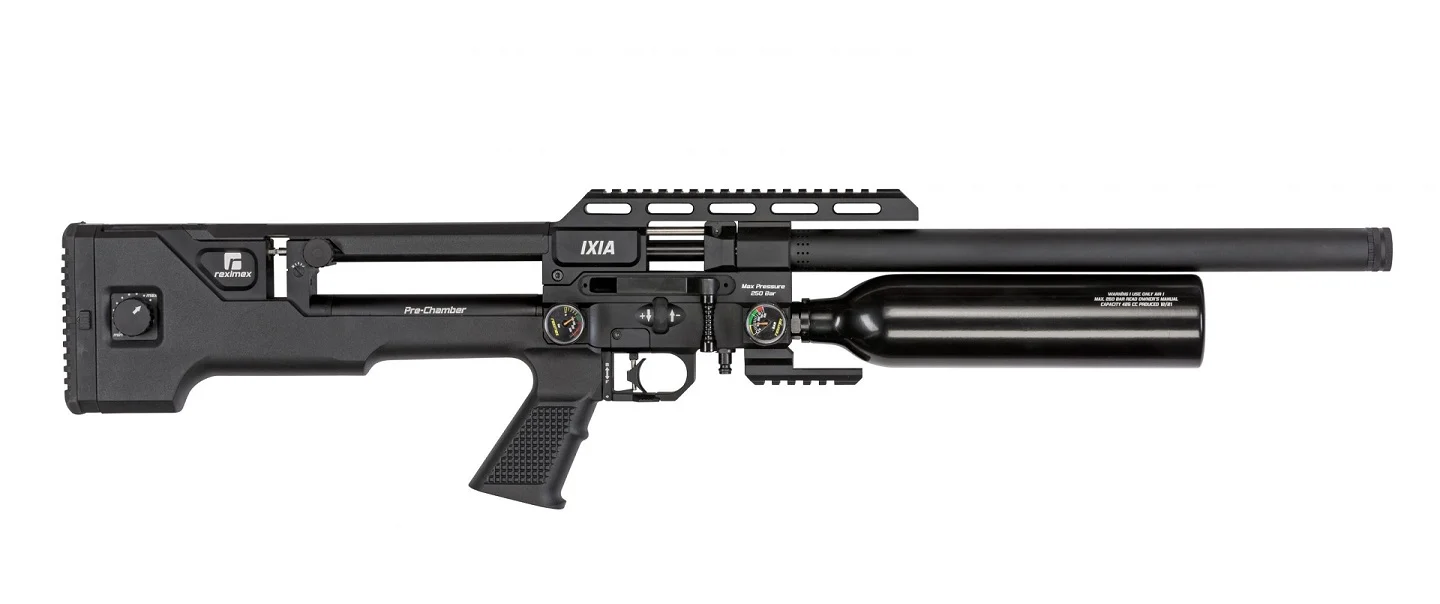
Overall length is kept to approximately 875 mm on the standard Reximex IXIA, while a useful barrel length of around 580 mm is retained. Consequently, balance is improved and carry weight remains practical at roughly 3.5–3.75 kg unscoped. In addition, a 425 cc aluminium buddy bottle is used, and a maximum fill of up to 250 bar is accepted. Spare bottles can therefore be swapped quickly when extra capacity is needed.
Moreover, an integrated shroud with ½” UNF threading is fitted so that a moderator can be added when quieter shooting is required. Thus, discreet pest control and backyard practice are supported without the rifle becoming cumbersome.
Core Features of the Reximex IXIA
Highlighted specifications and inclusions are listed below for quick comparison:
- Action: Regulated multi-shot PCP with reversible side lever
- Calibres available: .177 (4.5 mm), .22 (5.5 mm), and .25 (6.35 mm)
- Magazine capacity: 14-shot (.177), 12-shot (.22), 10-shot (.25)
- Air reservoir: 425 cc aluminium buddy bottle (swap-ready)
- Typical fill: Up to 250 bar
- UK legal-limit power: Approximately 11.3–11.5 ft/lbs (FAC versions also produced)
- Trigger: Two-stage adjustable match-style (post-and-shoe)
- Safety: Manual, integrated with the trigger guard
- Rails: Dual MILSPEC Picatinny/Weaver and 9–11 mm dovetail
- Muzzle: ½” UNF threaded, baffled shroud
- Stock: Ambidextrous tactical synthetic with adjustable butt pad
- Typical package: Rifle, two rotary magazines, fill probe, tools, manual, and hard case
Subsequently, shot counts in the region of 140–200+ regulated shots per fill are commonly reported, depending on calibre, pellet weight, and selected power setting. Hence, a full hunting or range session can often be completed from a single charge when the power wheel is used thoughtfully.
Regulator, Power Control, and Consistency
Steady output is achieved because incoming air is metered by the onboard regulator before it reaches the valve. In addition, a hammer-spring or power wheel is provided so that energy can be reduced when extra shots or lower indoor velocities are preferred. Consequently, ricochet risk can be lowered during close-range pest work, while maximum legal power can still be restored when longer shots are taken.
Furthermore, both reservoir and regulator gauges are usually visible, so remaining air and set pressure can be monitored at a glance. Therefore, unexpected drop-off is avoided and planning for a refill becomes straightforward.
Practical Use Across Disciplines
Hunting and pest control are supported because the compact bullpup profile is easily carried through cover and from a vehicle. Meanwhile, target and HFT-style practice benefit from the regulated consistency and adjustable trigger. Likewise, backyard or club plinking remains comfortable because the shroud and optional moderator keep report modest.
Moreover, left- and right-handed shooters are both accommodated without extra cost, since the side lever can be swapped and the stock remains ambidextrous. Inclusive design is therefore built in rather than added later. Additionally, the raised yet relatively low rail allows a sensible-sized scope to be mounted close to the bore, so cheek weld is preserved.
Calibres, Magazines, and Accessories
.177 is often chosen when flatter trajectory and high shot count are priorities. Conversely, .22 is frequently selected for extra downrange energy on small game. .25 is offered where extra punch is desired and local regulations allow. Rotary magazines are supplied in pairs, and a single-shot tray is commonly included so that testing or slug use can be explored.
In addition, the underside accessory rail accepts a bipod, while the threaded muzzle accepts a silencer. Optics from compact variables to larger hunting scopes can be mounted on the dual rail. As a result, the Reximex IXIA can be configured as a lightweight hunter or a more fully equipped range rifle without a different chassis being required.
Build Quality and Ownership Experience
A synthetic tactical stock is used so that weather resistance and low maintenance are achieved. Simultaneously, metal components at the action, bottle, and rails provide rigidity where it is needed. Consequently, the rifle remains serviceable in typical field conditions when basic care is applied.
Furthermore, a hard case is normally supplied, protecting the rifle and magazines during transport. Tools, seals, and a fill adaptor are included so that first filling and basic setup can be completed immediately. Therefore, time from unboxing to first accurate group is reduced.
Nevertheless, local airgun laws, FAC requirements, and safe handling practices must always be observed. Responsible ownership is expected, and legal power limits must be respected wherever the rifle is used.
Who the Reximex IXIA Suits
Shooters seeking a first regulated bullpup are well served because consistency is delivered without an extreme price. Experienced users who want a compact spare or a dedicated pest rifle will also find the power adjuster and bottle-swap capability useful. Likewise, clubs and families benefit from the reversible lever and inclusive stock design.
In summary, versatility is combined with regulated performance in a package that remains portable. Accuracy potential is high when suitable pellets are matched to the barrel, and shot-to-shot stability is maintained across a useful fill. For anyone comparing compact PCPs that offer real adjustability, the Reximex IXIA deserves serious consideration.
Ready for a regulated, ambidextrous bullpup that can be tuned to the day’s conditions? The Reximex IXIA is prepared to deliver consistent shots, comfortable handling, and a complete starting kit in one well-specified platform.
Calibres, FAC Ratings, Power Options, and Accessories
Choice of calibre, legal power, and supporting equipment is guided by intended quarry, local regulations, and the shooting environment. Consequently, a single regulated bullpup platform can be specified for club use, pest control, or higher-output field work where a Firearms Certificate is held. Furthermore, accessories are readily added because dual rails, a threaded muzzle, and a swap-ready bottle are already provided. Inclusive setup is supported, since lever side and stock fit can be adapted for different users after the rifle itself has been selected.
Available Calibres and Magazine Capacity
Three pellet calibres are offered so that trajectory, energy, and magazine capacity can be matched to the task. .177 (4.5 mm) is frequently selected when a flatter flight path and a higher shot count are preferred. Meanwhile, .22 (5.5 mm) is widely chosen when extra downrange energy on small game is required. In addition, .25 (6.35 mm) is produced for applications where greater impact is wanted and local rules allow that option.
Magazine capacity is reduced as pellet diameter increases. Therefore, a 14-shot rotary magazine is supplied in .177, a 12-shot magazine is supplied in .22, and a 10-shot magazine is typically supplied in .25. Two magazines are normally included in the package, so a spare can be kept loaded. Likewise, a single-shot tray is commonly provided for testing, zeroing, or occasional slug use.
Highlighted calibre notes are summarised below:
- .177: Higher magazine count, flatter trajectory, efficient air use for target and close pest work
- .22: Balanced energy and capacity for general hunting and permission work
- .25: Greater pellet mass where extra authority is needed and regulations permit
- Magazines: 14 / 12 / 10 shots respectively, with a second magazine included
- Loading options: Rotary multi-shot plus single-shot adaptor
Pellet preference still varies from barrel to barrel. Consequently, a short comparison session is recommended before a hunting zero is locked in. Moreover, consistent pellet weight and head size help feeding remain reliable through the rotary magazine.
Legal-Limit Power and FAC Configurations
UK-legal examples are generally set around 11.3–11.5 ft/lbs so that they remain within the 12 ft/lbs air-rifle limit. As a result, they can be owned without a Firearms Certificate in Great Britain, subject to other legal duties. Power is further refined on the rifle itself by a hammer-spring or power wheel, so muzzle energy can be reduced when extra shots or quieter close-range work are desired.
FAC versions are also manufactured. Higher outputs in the region of 18 ft/lbs, 30 ft/lbs, and, in some .25 examples, around 40 ft/lbs have been listed by distributors. Therefore, certificate holders can specify a more powerful action where lawful hunting distances or larger quarry justify it. Regulator behaviour remains central: consistent pressure is delivered behind each shot so that velocity does not wander as the bottle empties toward the set threshold.
Fill pressure is typically accepted up to 250 bar in a 425 cc aluminium buddy bottle on the standard-length rifle. Compact variants use a smaller carbon-wrapped bottle. Spare bottles can be carried and exchanged, so a second regulated string can be started without a compressor being present. Shot count depends on calibre, pellet weight, and the selected power setting; figures in the region of 120–200+ usable shots per fill are commonly reported on legal-limit guns.
Legal compliance must always be verified in the country and region of use. Export, import, and transport rules differ, and FAC conditions are specific to the certificate holder. Responsible storage, safe backstops, and permission requirements remain essential regardless of power level.
Power Adjustment in Everyday Use
A dual approach to tuning is provided on many examples: a multi-position power wheel and hammer-spring adjustment. Subsequently, energy can be dropped for indoor lofts, short barn shots, or high shot-count practice, then restored for longer outdoor work. In addition, lower power can reduce ricochet risk on hard surfaces when rats or feral pigeons are taken at close range.
Gauges for reservoir pressure and regulator pressure are usually visible. Hence, remaining air and the set working pressure can be checked at a glance. Overfilling beyond the marked maximum should be avoided, because seals and the regulator can be damaged. After a fresh fill, a small number of settling shots are often fired before a hunting or group string is begun.
Accessories, Rails, and Supporting Equipment
A dual-rail system combining Picatinny/Weaver and 9–11 mm dovetail is fitted, so a wide range of scopes, red dots, and mounts can be installed. The rail height is moderate for a bullpup, allowing a sensibly sized optic to sit reasonably close to the bore. An underside accessory rail accepts a bipod or light, which is useful for supported pest work and range bags.
The muzzle is ½” UNF threaded behind a baffled shroud. Consequently, a moderator can be added when quieter shooting is required. A thread protector is typically supplied. Optics, mounts, slings, and spare magazines are natural additions; a spare buddy bottle extends time away from a compressor.
Highlighted package and upgrade items include:
- Hard ABS case for transport and storage
- Two rotary magazines and single-shot tray
- Fill probe or foster-style connector, tools, and spare seals
- Dual top rail plus underside accessory rail
- ½” UNF moderator thread and integrated shroud
- Adjustable butt pad and reversible side lever
- Optional spare 425 cc (or compact) bottle
- Compatible scopes, bipods, slings, and silencers
Inclusive use is helped by the reversible lever and adjustable pad, so left- and right-handed shooters can share accessories on the same chassis. Trigger reach can be refined on the two-stage match-style unit, which further supports different hand sizes.
When calibre, legal or FAC power, and a practical accessory set are chosen together, the rifle can be configured as a compact legal-limit hunter, a quiet permission gun, or a higher-output certificate rifle. Matching those three elements to local law and intended use remains the most reliable path to consistent, responsible performance.
Practical Use Across Real Field Conditions
Confidence in the field is built when a compact regulated bullpup is carried through cover, over fences, and from a vehicle without excess bulk being felt. Consequently, longer stalks can be completed with less fatigue because overall length is kept modest while a useful barrel is retained. Furthermore, a stable cheek weld is encouraged once the butt pad has been adjusted, so first-shot placement is supported when a sudden opportunity appears. Meanwhile, remaining air is monitored on the visible gauges, and a refill can therefore be planned before consistency is lost.
Moreover, shot-to-shot variation is reduced by the regulator, so holdover remains predictable after the first few clearing shots. As a result, ranging errors are less likely to be compounded by changing velocity. In addition, power can be lowered when close indoor or loft work is undertaken, and energy can later be restored when longer outdoor shots are required. Hence, one platform can be adapted to several tasks without a second rifle being packed.
Pest Control Around Buildings and Farmyards
Quiet, controlled shots are often needed around barns, yards, and outbuildings. Therefore, the baffled shroud is relied upon, and a moderator can be added on the threaded muzzle so that report is further reduced. Subsequently, disturbance of livestock and neighbours is limited. Additionally, ricochet risk can be lowered because muzzle energy is dialled down for short ranges, while still remaining effective on typical farm pests.
Compact handling is especially valued in tight alleys, between parked machinery, and when a rifle must be carried one-handed for a moment. Likewise, an underside rail allows a bipod or light to be fitted when supported shots from a wall or gate are taken. In contrast, unsupported standing shots remain practical because balance is concentrated close to the body. Consequently, a humane first shot is more readily achieved when time is short.
Rotary magazines are kept loaded and swapped quickly so that follow-up opportunities are not missed. Nevertheless, a single-shot tray can be used when a particular pellet or slug is being tested at close range. Inclusive use is supported because the side lever can be reversed, allowing either shoulder to be employed from awkward angles beside a doorway or vehicle.
Small-Game Hunting in Woodland and Hedgerows
Movement through undergrowth is made easier when overall length does not catch on branches. For this reason, a bullpup layout is preferred on woodland edges, along hedgerows, and in young plantations. Simultaneously, a useful barrel length still contributes to stability and velocity, so mid-range shots remain realistic. Furthermore, an adjustable pad lets the rifle be set for thick clothing in winter or lighter layers in summer.
Regulated output helps when distances change rapidly from 15 to 40 metres. Accordingly, a single zero can often be trusted across a typical hunting window once pellets have been matched to the barrel. Moreover, spare bottles can be carried and swapped if a long day is planned, so a second fill does not require a return to the vehicle. Thus, more time is spent in position rather than on logistics.
Ambidextrous handling matters when a shot must be taken around the opposite side of a tree. Therefore, the lever can be set to the preferred side in advance, and either eye can be used without a different stock being needed. Additionally, optics sit on a dual rail, so a compact variable or a lightweight hunting scope can be mounted low enough that cheek contact remains natural.
Weather resistance of the synthetic furniture is relied upon in damp dawn conditions. Meanwhile, metal rails and action parts keep rigidity where it is needed. After a wet outing, a simple wipe-down and a check of seals are usually sufficient. Consequently, the rifle can be made ready again without specialist tools being carried in the field.
Club Ranges, Zeroing, and Skill Practice
Group testing is supported by consistent regulator behaviour across a long string. As a result, pellet comparison becomes more meaningful because mechanical variation is reduced. Furthermore, the two-stage trigger can be refined so that release is predictable during slow-fire practice. Subsequently, bad habits from a heavy or inconsistent pull are less likely to be reinforced.
Power adjustment is useful when a club imposes different indoor and outdoor limits, or when lighter practice loads are preferred to save pellets. In addition, magazines can be emptied and reloaded between strings without the action being difficult to access. Likewise, a single-shot adaptor allows careful loading when slugs or unusual projectiles are evaluated.
Inclusive range sessions are easier because left- and right-handed shooters can share the same rifle after the lever is swapped. Therefore, coaching and family practice do not require two separate guns. Moreover, the compact profile stores neatly in a club locker or range bag, and the supplied hard case protects magazines and the fill probe during travel.
At longer club distances, holdover remains more trustworthy because velocity is held steadier than on an unregulated plenum-only design. Hence, learning trajectory becomes faster. Nevertheless, each barrel still prefers certain pellets, so a short testing session is recommended before match or hunting use is planned.
Backyard, Garden, and Permission Work
Short-range work in gardens and on private permissions benefits from lower power settings and a moderator. Consequently, over-penetration and noisy reports are reduced. At the same time, enough energy can be restored when a slightly longer shot across a paddock is required. Thus, one fill and one zero can cover mixed tasks on the same property.
Carrying the rifle between outbuildings is simplified by the short overall length. Additionally, a bipod on the accessory rail steadies shots from a picnic table, wall, or truck bed. Meanwhile, gauges show when a top-up will soon be needed, so a session is not cut short unexpectedly.
Safety habits remain essential: backstops are confirmed, angles are checked, and local rules are followed. Inclusive language and shared equipment matter here as well, because more than one household member may use the same rifle after a brief lever change and pad adjustment. Therefore, the platform can serve several users without repeated fitting sessions.
Travel, Hide Use, and Vehicle-Based Work
Transport is simplified when a hard case is supplied and overall length stays modest. Subsequently, the rifle can be moved legally and securely between permissions when regulations allow. Furthermore, a spare bottle and extra magazines fit easily beside the case, so a full day away from a compressor is realistic.
From a hide or high seat, the compact action is less likely to snag canvas or branches. In addition, the raised rail still allows a scope to be used without an extreme comb height. As a result, a natural head position can be maintained during long waits. Power can be left at a hunting setting, or reduced if close shots inside a barn-like hide are expected.
Vehicle-based pest rounds benefit from quick shouldering after a short carry. Likewise, the reversible lever helps when a shot must be taken from the opposite window or around a gate post. Consequently, fewer opportunities are lost to awkward mounting.
Seasonal and Weather Adaptations
Winter clothing changes length of pull and cheek height. Therefore, the butt pad is readjusted so that the same optic alignment is recovered. Moreover, cold reduces perceived trigger weight for some shooters, so a small trigger tweak may be preferred after the first outing. Condensation on gauges should be wiped so readings remain clear.
Summer heat can raise fill pressures slightly after a bottle sits in a vehicle. Hence, fills are best completed in shade and allowed to settle before a hunting string is started. Additionally, lighter clothing may require the pad to be shortened again so that mount height stays consistent.
Rain and mud are managed by keeping the fill port capped and the action wiped after use. Seals and the probe should be inspected before the next fill. In this way, reliability is preserved across seasons without complex field stripping.
Matching Tasks to Power, Calibre, and Accessories
Close pest work is often paired with reduced power and a moderator. Mid-range hunting typically uses full legal-limit output and a pellet already proven in that barrel. Club practice may mix both settings so that recoil feel and pellet cost can be managed. .177 is frequently chosen when trajectory and shot count are priorities; .22 is often selected when extra energy on small game is wanted; .25 is considered where regulations and intended quarry make it appropriate.
Optics should remain proportionate to the compact chassis so that balance is not shifted too far forward. A bipod helps supported pest and range work; a sling aids longer walks. Magazines are best kept clean and loaded with a consistent pellet so that feeding remains reliable.
Inclusive setup means the lever side, pad height, and trigger reach are recorded for each regular user. Thereafter, changeover between shooters takes only a minute. Conversion-focused ownership follows naturally: fewer missed shots, longer sessions per fill, and one rifle covering several roles reduce the need for extra purchases.
Responsible use is always expected. Local laws, permission conditions, and safe backstops must be observed. When those foundations are in place, a compact regulated bullpup with adjustable power, reversible operation, and a swap-ready bottle becomes a practical companion from first light in a hedgerow to last light on a farmyard gate.
Weihrauch Air Rifles, PCP Platforms, Spring-Piston Systems, and Related Airgun Terminology
Enthusiasts researching premium German airgun engineering frequently encounter models and search terms such as Weihrauch HW100X Karbine, Thumbhole PCP Air Rifle, hw35, h 45, german air rifle, accurate air rifles, hw97k, hw 70, hw35e for sale, hw40, weihrauch hw30, weihrauch hw80, weihrauch hw 95, hw100, hw 97k, hw35 air rifle, hw50 s, weihrauch hw45, weihrauch english, weihrauch hw98, weihrauch englisch, hw77 air rifle, weihrauch hw50s, compressed air rifles, air rifle makes, spring piston, what are air rifles, weihrauch hw44, air shot gun, sk x rifles, weihrauch hw50, hw30s, hw 30, what are air pistols, hw50, and rifles de aire.
Within the Weihrauch lineup, the Weihrauch HW77 air rifle is widely recognized as a traditional fixed-barrel underlever platform. Related terminology includes HW77 Green Laminate rifle, Weihrauch underlever air rifle, HW77 spring piston air rifle, Weihrauch HW77 for sale, and German precision air rifle. Researchers comparing versions may also encounter phrases such as buy Weihrauch HW77 Green Laminate online, Weihrauch HW77 Green Laminate price and specs, Weihrauch HW77 accuracy review, HW77 Green Laminate vs HW97 comparison, is Weihrauch HW77 good for beginners, precision shooting airgun, high quality German airguns, best price Weihrauch HW77, where to buy Weihrauch HW77, Weihrauch HW77 in stock, affordable premium air rifle, and top rated underlever air rifle.
Technical comparison searches commonly include Weihrauch HW77 vs HW97, HW77 vs break barrel air rifle, best Weihrauch air rifles, most accurate air rifle for target shooting, air rifle with low recoil, durable air rifle for outdoor use, and reliable air rifle for long term use. These phrases generally reflect interest in operating systems, mechanical durability, handling characteristics, consistency, and the differences between fixed-barrel underlever designs, break-barrel rifles, and PCP platforms.
Other Weihrauch-related terminology includes air pistols, hw100 airgun, weihrauch hw95, weihrauch hw 30, weihrauch hw90, hw 44, hw 40, hw 98, and weihrauch hw100. The HW100 family represents the PCP side of Weihrauch’s catalog, while models such as the HW30, HW50, HW80, HW90, HW95, HW97, and HW98 are associated with spring-powered or gas-ram-style sporting airgun platforms depending on the specific model and configuration. By contrast, the HW44 is commonly discussed as a PCP air pistol.
The broader airgun market also includes search terminology connected with alternative PCP manufacturers and modern platforms. Examples include 25 karma, pcp bb gun, karma eq air rifle, karma red panda, panda guns, full auto pcp, karma sls compact, air karma, red panda hat, eq air, karma sls, eq magazine, air pcp, and karma airguns. These terms may refer to specific products, product families, accessories, community terminology, or unrelated search phrases that appear alongside airgun research.
Reximex is another name frequently encountered in PCP discussions. Related search phrases include reximex airguns, reximex rp, reximex throne gen 2, reximex mito, reximex rpa, sbs12, reximex mitos, reximex lieva, reximex accura pcp air rifle, and reximex throne gen2. Model naming can vary slightly between retailers, regions, and search listings, which explains variations such as “Throne Gen 2” and “Throne Gen2” or “Mito” and “Mitos.”
Airgun research also involves understanding velocity and energy. Searches such as fps to joules calculator, fps to ft lbs, and airgun calculator relate to converting projectile velocity and mass into kinetic-energy measurements. These calculations are commonly used for technical comparison, range evaluation, regulatory research, and understanding how different compressed-air or spring-powered platforms perform within their intended specifications.
More general discovery terms can include gunseek and yivli av tüfeği, alongside broader international phrases such as rifles de aire. Because airgun terminology varies considerably between English, German, Spanish, and Turkish-speaking markets, researchers may encounter several different naming conventions for comparable sporting, target, and recreational airgun platforms.
Taken together, terms ranging from Weihrauch HW100X Karbine and Thumbhole PCP Air Rifle to HW77 Green Laminate rifle, spring piston, compressed air rifles, karma airguns, and reximex airguns illustrate the diversity of modern airgun technology. Weihrauch remains particularly associated with German engineering, fixed-barrel underlever rifles, traditional spring-powered designs, precision PCP systems, and air pistols, while Karma and Reximex represent additional names encountered when comparing contemporary PCP platforms and associated airgun technology.
Frequently Asked Questions
Clear answers are provided below so that calibre choice, legal power, filling, accessories, and everyday handling can be understood before a purchase is completed. Consequently, fewer surprises are encountered after the case is opened. Furthermore, inclusive use is addressed because lever side, pad height, and trigger feel can be adapted for different shooters. Local laws must always be checked, because ownership rules differ by country and region.
Power, Legal Limits, and Certificates
Is a certificate required for legal-limit versions?
In Great Britain, air rifles that remain at or below 12 ft/lbs are generally owned without a Firearms Certificate, provided other legal duties are met. Therefore, many examples are supplied around 11.3–11.5 ft/lbs. However, higher-output versions are manufactured for certificate holders. FAC ratings in the region of 18 ft/lbs, 30 ft/lbs, and, in some larger calibres, around 40 ft/lbs have been listed. Certificate conditions, storage rules, and permitted use must be followed exactly.
Can muzzle energy be changed after purchase?
A power wheel and hammer-spring adjustment are fitted on many rifles. As a result, energy can be reduced for close pest work, indoor practice, or extra shot count, then restored for longer outdoor shots. UK legal-limit models typically have regulator adjustment disabled so that the 12 ft/lbs ceiling is not exceeded. Tampering with sealed FAC or legal-limit settings can void warranty and may create a legal offence. Professional advice should be sought before any internal change is considered.
How consistent is velocity across a fill?
A factory regulator is used so that working pressure remains steadier as the bottle empties. Consequently, holdover stays more predictable after a few settling shots. Variation of only a small number of feet per second across long strings has been reported in independent tests. Nevertheless, pellet choice, temperature, and the selected power setting still influence results.
Calibres, Magazines, and Pellets
Which calibres are offered?
.177, .22, and .25 are produced. .177 is often chosen when a flatter trajectory and a higher magazine count are wanted. Meanwhile, .22 is widely selected for a balance of energy and capacity on small game. In addition, .25 is considered where extra pellet mass is desired and regulations allow it.
How many shots are held in each magazine?
Capacity is typically 14 pellets in .177, 12 in .22, and 10 in .25. Two rotary magazines are normally included. A single-shot tray is commonly supplied for zeroing or slug testing. Magazines should be loaded evenly and kept clean so that feeding remains reliable.
Must a specific pellet brand be used?
No single pellet is mandated. Accuracy is barrel-dependent, so a short comparison at the intended distance is recommended. Quality domed hunting or match pellets in a consistent weight are usually preferred. Slugs may be tried with the single-shot tray, but not every barrel groups them well.
Highlighted calibre reminders:
- .177: More shots per magazine and per fill; flatter flight for targets and close pests
- .22: Popular all-round choice for permissions and small game
- .25: Greater mass where lawful and appropriate
- Mags: Two included; capacities fall as calibre rises
- Testing: Groups should be confirmed before a hunting zero is trusted
Filling, Bottles, and Shot Count
What fill pressure is accepted?
A maximum of 250 bar is commonly specified. Overfilling should be avoided because seals and the regulator can be damaged. A foster-style or probe connector is used, depending on the exact variant. The port is usually capped when not in use.
How many shots are obtained from one fill?
Shot count depends on calibre, pellet weight, power setting, and bottle size. Legal-limit rifles with a 425 cc aluminium bottle frequently deliver figures in the region of 120–200+ usable regulated shots. Compact models with a smaller carbon bottle produce fewer shots. Lowering the power wheel increases count. Gauges should be watched so that the regulator threshold is not passed mid-session.
Can the air bottle be swapped?
Yes. A buddy-bottle design is used so that a spare cylinder can be exchanged when extra capacity is needed. Consequently, a long day afield can be completed without a compressor being carried. Bottles must be in good condition and filled only to the marked limit.
Are both reservoir and regulator pressures shown?
Two gauges are typically fitted: one for onboard air and one for regulator pressure. Therefore, remaining capacity and working pressure can be read at a glance. Condensation should be wiped away so markings stay visible in cold weather.
Handling, Stock, and Inclusive Use
Can the rifle be used from either shoulder?
An ambidextrous synthetic stock is fitted, and the side lever can be moved from right to left. As a result, left- and right-handed shooters can share the same chassis. The butt pad is adjustable so that cheek weld and length of pull can be tailored for different body sizes and clothing layers.
Is the trigger adjustable?
A two-stage match-style trigger with a post-and-shoe design is used. Weight and travel can usually be refined. Inclusive use is helped because reach and break can be set for smaller or larger hands. A manual safety is integrated with the trigger guard on many examples.
How heavy and long is the rifle?
Unscoped weight is typically about 3.5–3.75 kg on the standard-length model, with overall length around 875 mm and a barrel near 580 mm. Compact variants are shorter and use a smaller bottle. Balance remains close to the body because of the bullpup layout.
Rails, Moderators, and Accessories
What optics can be mounted?
A dual rail combining Picatinny/Weaver and 9–11 mm dovetail is provided. Scope height is moderate for a bullpup, so a compact or mid-size variable can sit reasonably close to the bore. An underside rail accepts a bipod or lamp.
Can a silencer be fitted?
The muzzle is ½” UNF threaded behind a baffled shroud. Therefore, a moderator can be added when quieter shooting is required. A thread cap is normally supplied. Additional suppression is useful around buildings and livestock.



Reviews
There are no reviews yet.