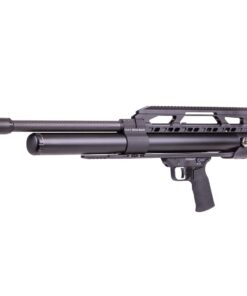
Macavity Arms Agility MA2 Standard PCP Air Rifle
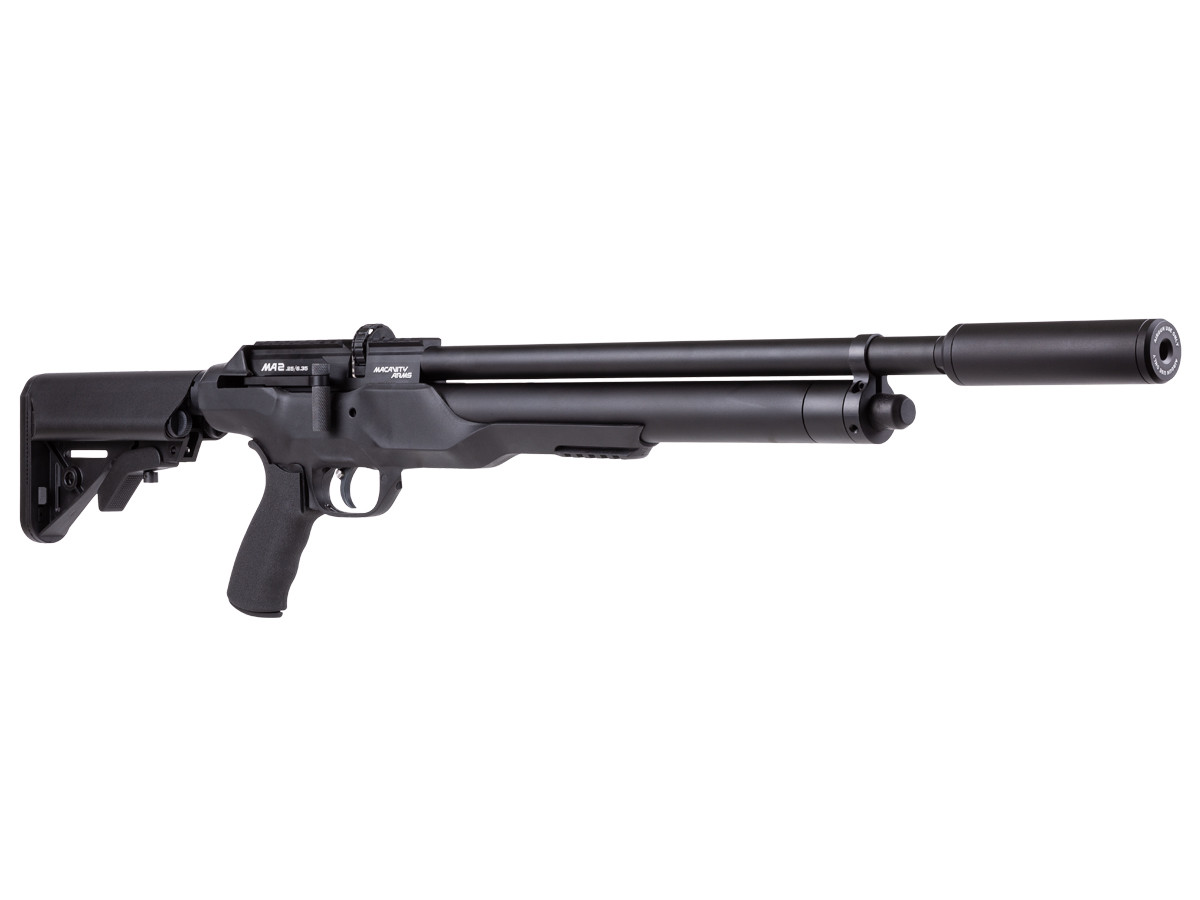
The Macavity Arms Agility MA2 Standard combines compact dimensions, adjustable performance, modern ergonomics, and precision-focused engineering in one versatile PCP platform. Designed around a lightweight tactical configuration, this air rifle gives shooters a practical balance between maneuverability, shot consistency, adjustability, and comfortable handling.
Rather than relying on unnecessary bulk, the MA2 Standard uses an efficient 196cc air cylinder and an 18-inch precision barrel to maintain a compact overall profile. Furthermore, its sidelever action provides smooth cycling between shots, while the internally adjustable regulator helps maintain consistent air delivery. As a result, the platform offers a refined shooting experience for recreational range use, target practice, and other lawful airgun applications.
Available in several popular calibers, the Macavity Arms Agility MA2 Standard also provides users with the flexibility to choose a configuration appropriate for their preferred shooting discipline. Its tactical AR-style furniture, adjustable stock, Picatinny mounting surfaces, dual pressure gauges, and two-stage adjustable trigger further contribute to a highly adaptable platform.
Macavity Arms Agility MA2 Standard Performance
Consistency plays an important role in any quality PCP air rifle. Therefore, the Macavity Arms Agility MA2 Standard incorporates an internally adjustable regulator that manages the air supplied for each shot. Combined with an adjustable hammer spring, this configuration provides a platform that can be tuned while also arriving factory pre-tuned for straightforward use.
Meanwhile, its maximum operating pressure reaches approximately 250 BAR or 3,625 PSI. Air is stored inside a 196cc reservoir, creating a compact air system without making the rifle unnecessarily heavy or cumbersome.
Performance differs according to caliber and setup. Published specifications list maximum lead-pellet velocities of approximately 890 FPS in .177, 870 FPS in .22, 890 FPS in .25, and 880 FPS in .30 caliber. Likewise, published maximum energy figures vary significantly between caliber configurations.
Because ammunition weight, regulator settings, environmental conditions, and individual rifle configuration can affect actual results, real-world velocity and shot count may differ from published maximum figures.
Precision 18-Inch Shrouded Barrel
Accuracy starts with a well-designed barrel system. Consequently, the Macavity Arms Agility MA2 Standard uses an 18-inch rifled, choked, tensioned, and shrouded barrel. Each feature contributes to the rifle’s overall performance characteristics.
Rifling stabilizes the projectile during flight, while the choked barrel design supports consistent pellet engagement near the muzzle. At the same time, barrel tensioning provides additional structural support. Finally, the integrated shroud surrounds the barrel and contributes to the rifle’s streamlined exterior profile.
Despite carrying a full 18-inch barrel, the Standard version maintains an overall length of approximately 36.8 inches, making it noticeably more compact than many traditional full-length PCP rifles.
Lightweight Tactical Configuration
Handling has clearly been prioritized throughout the MA2 Standard design. At approximately 5.95 lb, the rifle remains relatively lightweight before optics and accessories are installed.
Furthermore, its adjustable tactical AR-15-style stock allows the length of pull to be changed according to shooter preference. This adaptability can prove especially useful when different shooters use the same rifle or when shooting positions change.
A soft rubber AR-style pistol grip further improves contact with the rifle, while the rubber buttpad provides a stable shoulder interface. Consequently, the platform combines familiar tactical ergonomics with the operating characteristics of a modern PCP air rifle.
Smooth Sidelever Action
Instead of a traditional bolt-action arrangement, the Macavity Arms Agility MA2 Standard uses a sidelever cocking system. This arrangement keeps operation straightforward while supporting rapid and consistent magazine-fed cycling.
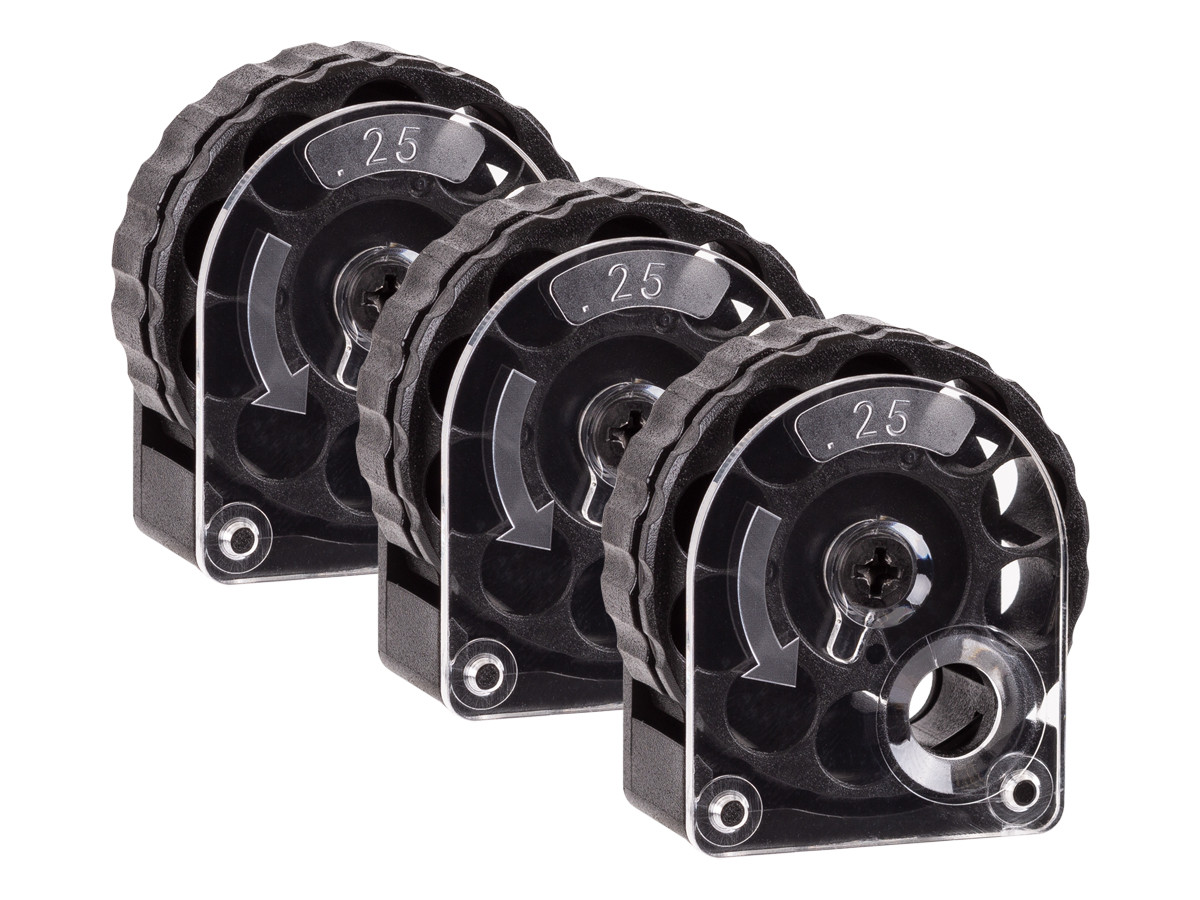
The repeater configuration is complemented by detachable magazines, with capacity depending on caliber. Published capacities are 13 rounds for .177, 11 rounds for .22, 10 rounds for .25, and 8 rounds for .30 caliber.
Moreover, three magazines are listed among the supplied accessories, reducing the need to purchase additional magazines immediately.
Adjustable Two-Stage Trigger
Trigger feel can strongly influence practical accuracy. For that reason, a two-stage adjustable trigger is fitted to the MA2 Standard. This design allows the firing interface to be configured according to personal preference while providing a predictable two-stage operation.
A manual trigger safety is also incorporated into the rifle. Nevertheless, normal safe handling practices should always be followed whenever the air rifle is handled, transported, stored, filled, or used.
Dual Pressure Gauges for Easier Monitoring
PCP shooters regularly need to monitor both reservoir pressure and regulated operating pressure. Therefore, the Macavity Arms Agility MA2 Standard incorporates dual gauges.
One gauge provides information regarding the air reservoir, while the second allows regulator pressure to be monitored. This setup makes the rifle’s air system easier to understand at a glance and provides useful information during filling or performance adjustment.
Additionally, a Foster-style male quick-disconnect fill connection is used, helping simplify connection to compatible PCP filling equipment.
Picatinny Rails and Accessory Compatibility
Modern optics form an important part of many PCP setups. Accordingly, the MA2 Standard includes a Picatinny optics rail, providing a widely used mounting interface for compatible scopes and other lawful sighting equipment.
A Picatinny accessory section is also incorporated into the forend. Therefore, compatible shooting accessories can be mounted without requiring an entirely proprietary attachment system.
The tactical configuration provides considerable flexibility while keeping the rifle’s basic design straightforward.
Macavity Arms Agility MA2 Standard Key Features
Product highlights include:
- Pre-charged pneumatic PCP operating system
- Smooth sidelever cocking action
- Internally adjustable regulator
- Adjustable hammer spring
- Factory pre-tuned configuration
- 196cc air reservoir
- Maximum 250 BAR / 3,625 PSI fill pressure
- 18-inch rifled, choked, tensioned and shrouded barrel
- Two-stage adjustable trigger
- Manual safety
- Adjustable tactical AR-15-style stock
- Soft rubber AR-style pistol grip
- Rubber buttpad
- Dual pressure gauges
- Picatinny optics mounting rail
- Picatinny forend accessory rail
- Foster quick-disconnect filling system
- Approximately 36.8-inch overall length
- Approximately 5.95 lb base weight
- Multiple caliber configurations
- Three magazines supplied according to published package specifications
- Tools and replacement O-rings included
- Three-year limited warranty listed by major retailers
Efficient Air Management
Efficiency changes considerably according to caliber because different projectile sizes require different amounts of compressed air. Published maximum shot counts list up to approximately 150 shots in .177, 60 in .22, 30 in .25, and 16 in .30 caliber under the manufacturer’s listed configurations.
Therefore, shooters can select a caliber based not simply on velocity but also on factors such as desired shot count, projectile availability, energy level, and the requirements of their lawful shooting activity.
The adjustable regulator and hammer spring further distinguish the platform by allowing experienced users to optimize performance within appropriate manufacturer guidance.
Compact Design Without Sacrificing Adjustability
Many PCP rifles force users to choose between compact handling and extensive adjustment. In contrast, the Macavity Arms Agility MA2 Standard brings both characteristics together.
Its 18-inch barrel and 36.8-inch overall length produce a relatively compact package. Meanwhile, the adjustable stock, regulator, hammer spring, trigger, and accessory rails provide considerable configuration flexibility.
Consequently, the rifle can be adapted to different shooters and different range setups without losing the straightforward ergonomics that make a compact PCP attractive.
Why Choose the Macavity Arms Agility MA2 Standard?
For shooters looking for a lightweight PCP platform with modern styling and substantial adjustability, the Macavity Arms Agility MA2 Standard offers a compelling combination of features. Its regulated air system supports consistency, the sidelever simplifies operation, and the precision-oriented barrel design provides a solid foundation for repeatable shooting.
Additionally, practical features such as dual gauges, multiple magazines, an adjustable stock, Picatinny rails, and commonly used filling hardware make the platform easier to configure around individual preferences.
Whether the priority is recreational target shooting, range practice, or another lawful airgun discipline, the MA2 Standard provides a versatile foundation with performance characteristics that can be tailored to different needs.
Macavity Arms Agility MA2 Standard – Modern PCP Versatility
Ultimately, the Macavity Arms Agility MA2 Standard brings together compact proportions, low weight, regulated PCP performance, tactical ergonomics, and user-adjustable features. Rather than focusing on a single characteristic, the rifle has been developed as a balanced platform capable of serving shooters who value both simplicity and customization.
From its 18-inch shrouded barrel and adjustable two-stage trigger to its internally adjustable regulator and tactical AR-style stock, every major component contributes to a modern and adaptable shooting system.
For customers searching for a compact, magazine-fed PCP air rifle with extensive adjustment potential and practical accessory compatibility, the Macavity Arms Agility MA2 Standard deserves consideration as a well-equipped option within the contemporary PCP market.
Air Rifles, PCP Systems, Calibers, Target Shooting and Popular Models
The world of air arms, air guns, and precision shooting equipment covers everything from recreational target shooting to sporting applications. For newcomers asking what is an air gun, what is an air rifle, what is air rifle, what is a air rifle, what is a airgun, what is an airgun, or what are airguns, the basic principle is straightforward. An air gun uses compressed gas or air to propel a projectile rather than relying on the combustion system associated with conventional firearms.
Understanding how does an air gun work, how does air gun work, how do air guns work, how does an air rifle work, how does air rifle work, and how do air rifle work can help buyers distinguish between the different operating systems available. Depending on the design, power can be supplied by a spring piston, compressed air cylinder, CO2 cartridge, or another pneumatic mechanism.
PCP Air Rifles and Compressed-Air Systems
One of the most popular categories is the pre-charged pneumatic platform. Searches such as what is a pcp air rifle, what is a pcp airgun, what is pcp air rifle, what is a pcp air gun, what is a pcp rifle, what is pcp rifle, what are pcp air rifles, and what is a pre charged pneumatic air rifle all relate to the same fundamental technology. A PCP rifle stores compressed air inside a reservoir and releases a controlled quantity each time the rifle is fired.
For shoppers researching pcp gun meaning, pcp rifle meaning, or pcp air rifle meaning, PCP simply refers to a pre-charged pneumatic system. Air is normally added using a pcp hand pump, dive cylinder, or pcp air compressor. Consequently, an air compressed gun or air compressor rifle can deliver consistent performance without requiring the shooter to manually compress a spring before every shot.
Some searches also include pcp bb gun, although many PCP platforms are primarily designed around pellets rather than traditional BB ammunition. Understanding the intended ammunition is therefore important before selecting accessories, magazines, or loading equipment.
.177 Caliber, .22 Caliber and Pellet Selection
Caliber choice is one of the most frequently researched subjects among airgun buyers. The .177 caliber remains extremely popular for recreational shooting and precision target applications. Products described as a 177 air rifle, 177 bullet, or even 177 cal darts may appear during searches, although ammunition compatibility always needs to be checked against the manufacturer’s specifications.
Questions including 177 or 22, 177 cal vs 22, 177 caliber vs 22, .177 caliber vs .22, .177 pellet vs .22 pellet, and .22 vs .177 pellet generally focus on differences in projectile size, trajectory, energy, and intended use. A smaller .177 pellet is commonly chosen for paper targets and precision shooting, whereas larger calibers may be selected for applications where additional projectile mass is desired.
Understanding bb gun pellet sizes is equally important because BBs and pellets are not automatically interchangeable. Before purchasing ammunition, shooters should confirm the caliber and projectile type specified for their particular pellet rifle, pellet pistol, or bb gun.
Air Arms Rifles and Popular Models
Among established manufacturers, air arms products remain widely searched by enthusiasts interested in precision PCP and spring-powered platforms. Well-known searches include air arms s510, s510, air arms s410, aa s400, pro sport air arms, prosport air arms, tx 200, and tx200.
Variations such as air arm and airarm are also commonly entered by shoppers searching for the brand. Buyers looking specifically for regulated sporting configurations may encounter the air arms s510 ultimate sporter .177 sub 12, a phrase frequently associated with UK-oriented searches for the S510 platform.
Each Air Arms model has its own action, stock design, power configuration, caliber options, and intended shooting environment. Therefore, specifications should always be checked against the exact version being considered rather than assumed from another model in the same family.
FX Impact M3, FX Maverick and Modern PCP Platforms
Premium PCP research frequently includes the fx maverick and the fx impact m3. Buyers may also search for fx impact mk3, fx m3 airgun, fx m3, impact m3, or fx impact m3 air rifle while comparing generations and configurations.
More specific searches such as fx impact m3 .22cal air rifle. 600mm barrel focus on caliber and barrel-length combinations. Meanwhile, international shoppers may search fx impact m3 precio, fx impact m3 precio en usa, or fx impact m3 price when researching current market pricing.
Because FX platforms can be produced in multiple barrel lengths, calibers, power settings, and regional configurations, buyers should verify the exact specification offered in their country before ordering.
Break-Barrel Air Rifles
Another major category is the break barrel air rifle. Anyone asking what is a break barrel air rifle or what is a break barrel pellet gun is usually referring to a rifle in which the barrel is hinged downward to cock the internal powerplant and expose the breech for loading.
Break-barrel designs remain popular because they can provide a self-contained shooting system without an external compressor or air bottle. Models such as a gamo pellet gun are frequently encountered by buyers exploring this category.
Learning how to load pellet gun equipment properly is particularly important. Pellets should match the manufacturer’s recommended caliber and should be loaded in accordance with the owner’s manual while the rifle is pointed in a safe direction and handled under normal shooting-range safety procedures.
CO2, Pellet Pistols and Other Airgun Types
Not every airgun uses PCP or spring power. A co2 powered pellet rifle, for example, uses replaceable CO2 cartridges as its propellant source. CO2 systems can be found in rifles and handguns intended for recreational shooting, training, and target use.
People researching air pistol uses or general pellet gun uses will encounter equipment intended for target practice, recreational plinking, skills training, competition, and other lawful sporting activities. A pellet pistol can offer a compact platform, while rifles generally provide a longer sight radius and additional stability.
Search terms such as pelet guns are also common misspellings of pellet guns and can still represent useful search intent when website content is designed to answer frequently asked buyer questions naturally.
Target Shooting and Airgun Practice
One of the most established uses of airguns is target shooting with air rifles. Dedicated air guns for target shooting may emphasize accuracy, adjustable stocks, match triggers, regulated air delivery, and compatibility with precision optics.
Likewise, airgun target practice and airgun for target practice are common search topics among people looking for an accessible way to develop shooting fundamentals. Proper backstops, eye protection, safe handling practices, and suitable ranges should always be used.
The practical range of air rifle equipment varies considerably according to caliber, muzzle energy, projectile selection, environmental conditions, and the rifle itself. As a result, buyers should use manufacturer specifications and local range rules rather than assuming that every air rifle performs identically.
Hunting Air Rifles and Appropriate Use
Some shooters research air rifles for hunting, hunting air rifles, best air rifle for hunting, pellet gun for rabbits, or even the informal phrase rats gun when looking for equipment designed for lawful pest-control or hunting applications.
Suitability depends heavily on local law, caliber, projectile energy, quarry species, shot placement requirements, and humane hunting standards. Questions such as can a bb gun kill a fox should therefore not be treated simply as equipment-selection questions. Legal restrictions and animal-welfare requirements should be checked first, and low-powered BB guns are not appropriate substitutes for equipment legally and ethically suitable for a particular species.
Similarly, searches for air rifles for deer hunting and big game hunting with air rifle involve specialized legal and ballistic requirements. Large-bore systems such as a 72 caliber air rifle or products associated with bluegrass big bore illustrate how different big-bore pneumatic platforms can be from conventional small-caliber pellet rifles. Local hunting regulations must determine whether such equipment may legally be used.
Licensing and UK Airgun Regulations
Legal requirements differ considerably by jurisdiction. UK-oriented searches frequently include do you need a licence for air rifle, air rifle certificate uk, and 22 rifle uk license. However, the rules governing air rifles, conventional .22 firearms, certificates, age restrictions, possession, transportation, and power limits are not identical.
Consequently, buyers should confirm current legislation with the relevant licensing authority before purchasing or using any regulated equipment. Particular attention should also be paid to whether a rifle is configured below or above applicable power thresholds.
Sportsman, Gamo and Other Popular Searches
Beyond specialist PCP manufacturers, buyers may encounter products such as the sportsman 900 while comparing recreational air rifles. Searches for a gamo pellet gun are also common because Gamo offers numerous spring-powered and pneumatic models across different price points and configurations.
The broader search for best air guns can include everything from affordable recreational platforms to sophisticated regulated PCP rifles. Rather than treating one design as universally superior, buyers should compare caliber, intended application, weight, stock ergonomics, power source, shot capacity, charging equipment, availability of spare parts, and local legal requirements.
Airgun Safety, Home Use and Responsible Ownership
Searches for air guns for home defense do appear online, but an airgun should not automatically be assumed to be suitable for defensive use. Laws vary significantly, and airguns can cause serious injury. Secure storage, lawful ownership, training, safe handling, and avoidance of unnecessary confrontation remain essential.
Whether someone owns an air rifle, pellet rifle, bb gun, or PCP platform, the equipment should always be treated as capable of causing injury. A secure backstop should be used for recreational shooting, the muzzle should remain pointed in a safe direction, and manufacturer instructions should be followed carefully.
Ultimately, understanding the differences between PCP rifles, break-barrel systems, CO2 equipment, caliber choices, and individual models makes it easier to compare the extensive range of modern airguns. From Air Arms platforms to FX rifles and recreational pellet guns, careful specification checking, responsible handling, lawful use, and suitable ammunition selection remain central to getting the right equipment for the intended purpose.
Macavity Arms Agility MA2 Standard Calibres, FAC, Power and Accessories
The Macavity Arms Agility MA2 Standard is offered in several calibre configurations, allowing the rifle to be matched more closely to different legal shooting applications, ammunition preferences, and performance expectations. Depending on market availability, the rifle is commonly listed in .177, .22, .25, and .30 calibre versions. Each calibre provides a different balance of velocity, projectile weight, air consumption, magazine capacity, and muzzle energy.
Because the rifle is built around an adjustable regulated PCP system, performance can also vary according to factory specification, ammunition choice, regulator setting, hammer spring adjustment, and local legal restrictions. Therefore, buyers should always select the version that is appropriate for their intended use and jurisdiction.
.177 Calibre
The .177 calibre Macavity Arms Agility MA2 Standard is generally the lightest-projectile configuration in the range. Because .177 pellets are smaller and lighter, higher velocities can typically be achieved with relatively efficient air use.
This calibre can be well suited to target shooting, precision practice, plinking, and applications where a flatter trajectory is valued. In addition, the lighter projectile and reduced air demand can contribute to a higher shot count per fill when compared with larger-calibre variants.
Published specifications for the platform commonly list magazine capacity at approximately 13 rounds in .177 calibre.
For shooters who prioritize pellet availability, economical practice, and lower air consumption, the .177 version can be an attractive choice.
.22 Calibre
The .22 calibre version offers a useful middle ground between projectile weight, air efficiency, and practical energy.
Compared with .177, a .22 pellet is heavier and wider. As a result, greater momentum can generally be retained at similar power levels, while air consumption remains more manageable than with larger calibres.
Magazine capacity is commonly listed at approximately 11 rounds in .22 calibre.
Because .22 ammunition is widely available and offered in a broad range of pellet weights and profiles, this version can be especially versatile. It is often chosen by shooters who want a balanced PCP configuration without moving immediately into the higher air requirements associated with .25 or .30 calibre rifles.
.25 Calibre
For users seeking heavier projectiles and increased energy potential, the .25 calibre Macavity Arms Agility MA2 Standard provides another option.
The larger projectile allows more mass to be carried downrange, although additional compressed air is generally required to maintain comparable velocity. Consequently, shot count will normally be lower than that of equivalent .177 or .22 configurations.
The .25 version is commonly specified with a magazine capacity of approximately 10 rounds.
When correctly matched with suitable ammunition, the .25 calibre configuration can provide an effective balance between projectile weight and manageable rifle size.
.30 Calibre
At the larger end of the range, the .30 calibre version is designed around substantially heavier projectiles.
Because more energy is required to accelerate a heavier pellet, the .30 configuration generally consumes more air per shot. As a result, fewer shots can normally be expected from the 196cc reservoir before another fill is required.
Magazine capacity is commonly listed at approximately 8 rounds in .30 calibre.
This version may appeal to experienced PCP users who specifically want the benefits associated with a larger projectile and understand the corresponding increases in ammunition cost, air consumption, and legal considerations.
FAC and Power Considerations
Power classification for the Macavity Arms Agility MA2 Standard depends heavily on the country in which the rifle is owned or used.
In the United Kingdom, for example, air rifles above the statutory energy threshold generally require a Firearm Certificate, or FAC. By contrast, lower-powered versions may fall within non-FAC airgun rules, subject to the applicable legislation in the relevant part of the UK.
Therefore, the term FAC version typically refers to a higher-powered configuration that exceeds the unrestricted air-rifle limit in that jurisdiction.
Because laws differ considerably between countries and even between regions within the same country, buyers should verify the legal classification of their exact calibre and factory power setting before purchase or use.
The MA2 Standard is equipped with an adjustable regulator and adjustable hammer spring, so power characteristics can vary between configurations. However, these adjustments should not be treated as a way to bypass legal restrictions. Any tuning or servicing should remain within manufacturer specifications and applicable firearm or airgun legislation.
Published specifications for the platform show that maximum velocity varies according to calibre and ammunition. Velocity alone should not be treated as a complete measurement of power because projectile weight is also required when calculating muzzle energy.
Air System and Power Delivery
A 196cc high-pressure air cylinder is incorporated into the Macavity Arms Agility MA2 Standard.
The reservoir is rated to approximately 250 BAR, or 3,625 PSI, depending on the manufacturer specification for the version being used.
An internally regulated air system helps control the pressure supplied to the firing valve. Consequently, greater shot-to-shot consistency can be achieved across the useful pressure range of the cylinder.
Dual pressure gauges are also provided. One gauge can be used to monitor reservoir pressure, while the other provides regulator-related information.
Because larger calibres and higher-power configurations consume more air, shot count decreases as energy demand rises. This trade-off should be considered when choosing between maximum power and maximum efficiency.
Recommended Accessories
Several accessories can be used to complement the Macavity Arms Agility MA2 Standard, provided they are compatible with the rifle and lawful in the user’s location.
Useful accessory options include:
- PCP hand pump rated for the rifle’s required fill pressure
- High-pressure compressor suitable for PCP airgun charging
- Carbon-fibre or aluminium fill bottle
- Compatible Foster quick-disconnect fill fitting
- Rifle scope for precision aiming
- Picatinny-compatible scope mounts
- Red-dot sight for short-range target work
- Bipod for supported shooting
- Shooting bags or front rests
- Spare magazines
- Pellet storage cases
- Cleaning equipment suitable for airgun barrels
- Replacement O-rings and seal kits
- Chronograph for lawful performance monitoring
- Protective rifle case
- Eye protection
- Compatible sling hardware where supported
Optics and Mounting Accessories
A Picatinny optics rail is provided on the MA2 Standard, allowing a wide range of compatible scopes and red-dot sights to be installed.
For longer-range target shooting, a variable-magnification scope may be preferred. Conversely, a compact red-dot optic may better suit short-range recreational use.
Mount height should be selected carefully so that comfortable cheek placement can be maintained with the adjustable stock.
Filling Equipment
Because the rifle operates at high pressure, suitable PCP filling equipment is essential.
A hand pump may be practical for occasional use, particularly with smaller fill volumes. However, a dedicated PCP compressor or charging cylinder can make repeated filling considerably easier.
Whatever filling method is selected, the equipment must be rated for the required working pressure and compatible with the rifle’s filling connection.
Choosing the Right Configuration
Ultimately, the ideal Macavity Arms Agility MA2 Standard calibre and power configuration depends on the user’s priorities.
The .177 version emphasizes efficiency and lightweight ammunition, while .22 provides a balanced all-round configuration. Meanwhile, .25 and .30 offer progressively heavier projectiles at the cost of increased air consumption.
By combining the appropriate calibre with compatible optics, filling equipment, magazines, and support accessories, the MA2 Standard can be configured into a practical and adaptable PCP setup while remaining within the manufacturer’s specifications and all applicable legal requirements.
Practical Use Scenarios
A modern PCP air rifle becomes far more valuable when its features translate effectively into real shooting situations. Rather than being judged only by specifications on paper, practical performance is shaped by handling, consistency, adjustability, shot capacity, ergonomics, and the ability to adapt to different environments. Because this platform combines a regulated action, compact dimensions, adjustable controls, magazine-fed operation, and accessory compatibility, it can be configured for several legitimate recreational and sporting applications.
Whether a shooter spends most of their time at a target range, practices from a supported bench position, works on accuracy drills, or needs a compact setup for lawful field shooting, the rifle can be adapted around those requirements. Moreover, different calibers, optics, and shooting supports can be selected according to the intended purpose.
Recreational Target Shooting
For informal target shooting, predictable handling can make every session more enjoyable. Paper targets, reactive targets designed for airguns, and steel targets rated appropriately for pellet rifles can all be incorporated into a recreational shooting setup where local rules permit.
Because a regulated PCP system is used, air delivery can remain comparatively consistent over the useful portion of the fill. As a result, shooters can concentrate on breathing, sight alignment, trigger control, and follow-through rather than constantly compensating for dramatic changes in velocity.
A multi-shot magazine also makes recreational sessions more convenient. Instead of manually loading a pellet after every shot, several rounds can be prepared in advance. Consequently, more time can be spent shooting and less time can be spent handling individual pellets.
The sidelever action further supports this style of use. Cycling between shots can be completed smoothly while the rifle remains substantially positioned on target. Therefore, repeated target strings can be practiced efficiently.
For newer PCP users, this arrangement can provide an accessible introduction to regulated pneumatic shooting. Experienced users, meanwhile, can use the same platform to experiment with ammunition selection, optic setup, shooting position, and carefully controlled adjustments.
Benchrest and Supported Accuracy Practice
Supported shooting is one of the most effective ways to evaluate the mechanical consistency of an air rifle and the suitability of particular pellets.
From a shooting bench, the rifle can be placed on an appropriate rest or supported by a compatible bipod. With much of the shooter’s movement reduced, attention can then be placed on group size, point-of-impact consistency, and ammunition performance.
A Picatinny rail allows a suitable telescopic sight to be installed for this purpose. Depending on the range being used, magnification can be selected to provide a clear aiming reference without making the setup unnecessarily heavy.
Meanwhile, the adjustable trigger can be configured within manufacturer guidelines according to individual preferences. A predictable trigger break is especially useful during precision shooting because unnecessary movement immediately before the shot can be minimized.
Pellet Testing and Group Comparison
Not every barrel performs identically with every pellet. Therefore, structured ammunition testing can be worthwhile.
A practical test session might involve shooting several five-shot or ten-shot groups using different pellet designs while keeping the distance, fill pressure, shooting rest, and environmental conditions as consistent as possible.
Group sizes can then be compared.
Pellet weight can also influence trajectory, retained energy, and velocity. Consequently, heavier ammunition should not automatically be assumed to provide better accuracy, while the fastest pellet should not automatically be considered the most suitable.
Instead, actual target results should guide ammunition selection.
Once a preferred pellet has been identified, additional testing can be conducted across different distances. This process helps the shooter understand how the rifle behaves beyond a single zero distance.
Zeroing and Scope Setup
An adjustable PCP platform provides a practical foundation for learning proper optic setup.
After a suitable scope has been mounted securely, the rifle can initially be zeroed at a relatively short distance. Adjustments can then be made gradually until the point of impact corresponds with the selected point of aim.
Afterward, confirmation groups can be fired at the intended primary shooting distance.
Because pellet trajectories are curved rather than perfectly flat, impact height will change as distance increases or decreases. Therefore, understanding trajectory is essential when a rifle will be used across multiple distances.
Shooters can record:
- Primary zero distance
- Pellet type and weight
- Average point of impact
- Scope adjustment settings
- Approximate shot count per fill
- Relevant regulator or rifle settings
- Weather conditions during testing
Keeping basic records can make future setup changes much easier to evaluate.
Practicing from Different Shooting Positions
Bench shooting demonstrates what a rifle can achieve under controlled conditions, but practical marksmanship also requires stability from less-supported positions.
Once a reliable zero has been established, practice can be expanded to standing, kneeling, seated, and supported field positions.
The adjustable stock becomes particularly useful in this context. Length of pull can be changed so the rifle interfaces more naturally with the shooter’s shoulder and shooting stance.
When shooting from a bench, a slightly different stock position may feel comfortable compared with standing or kneeling. Similarly, heavy outdoor clothing may require a different adjustment from lightweight range clothing.
Because the rifle can be adapted quickly, a consistent cheek position and comfortable shoulder placement can be maintained more easily.
Longer Range Target Practice
As skills develop, targets can gradually be moved farther away within the safe limits of the shooting facility.
Longer-distance airgun shooting introduces several variables that may be less noticeable at short range. Pellet drop becomes increasingly important, while crosswinds can influence lightweight projectiles substantially.
Therefore, longer-range practice can help shooters develop a more detailed understanding of external ballistics.
Rather than simply increasing magnification and aiming directly at the center of every target, shooters can learn how pellet weight, velocity, atmospheric conditions, and distance interact.
This type of practice is especially useful for experienced users who enjoy technical precision shooting.
A stable regulated powerplant can support the process because velocity variation is reduced compared with an unregulated system operating across a wide pressure range. Nevertheless, real-world results should always be confirmed at the range rather than being based entirely on theoretical ballistic calculations.
Chronograph Testing and Performance Evaluation
A chronograph can provide useful information when evaluating a PCP air rifle.
By measuring pellet velocity over a series of shots, shooters can observe consistency throughout the fill cycle. Average velocity, extreme spread, standard deviation, and the approximate number of useful shots can all be evaluated.
When several pellet weights are being tested, chronograph results can also help explain changes seen on the target.
For example, one pellet may produce a slightly lower velocity but significantly tighter groups. Another may travel faster but show greater variation.
Consequently, velocity should be considered alongside accuracy instead of being treated as the only indicator of performance.
Managing the Air Supply During Range Sessions
PCP rifles require a reliable source of high-pressure air. Therefore, range preparation differs somewhat from shooting a spring-powered air rifle.
Before leaving for a shooting session, cylinder pressure should be checked and the appropriate filling equipment should be prepared. Depending on the shooter’s setup, refilling may be completed from a dedicated high-pressure hand pump, carbon-fiber air tank, or suitable PCP compressor.
The rifle should only be filled using equipment designed for the required pressure.
Pressure gauges also allow the available air supply to be monitored throughout a session. Once pressure falls outside the rifle’s optimal regulated operating range, refilling can be performed before accuracy or velocity consistency begins to deteriorate noticeably.
This process quickly becomes part of normal PCP ownership.





Reviews
There are no reviews yet.