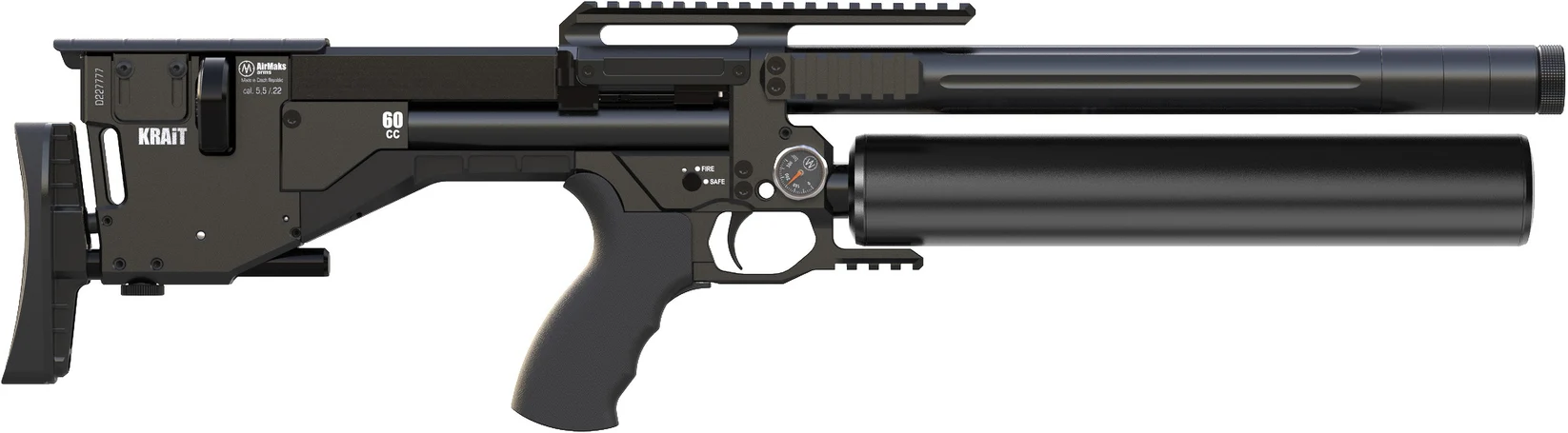
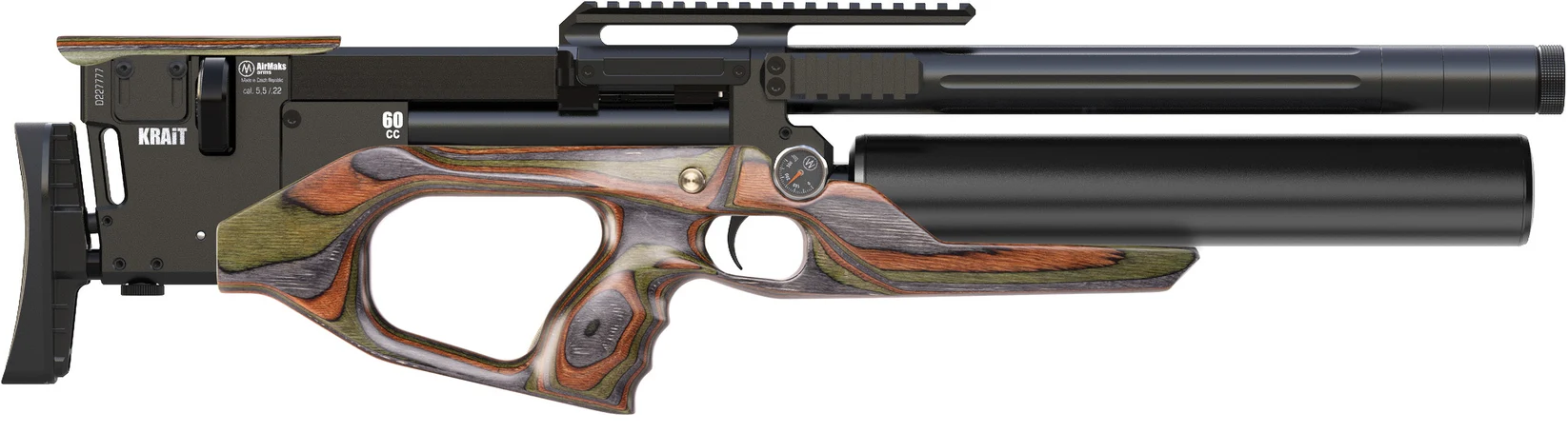
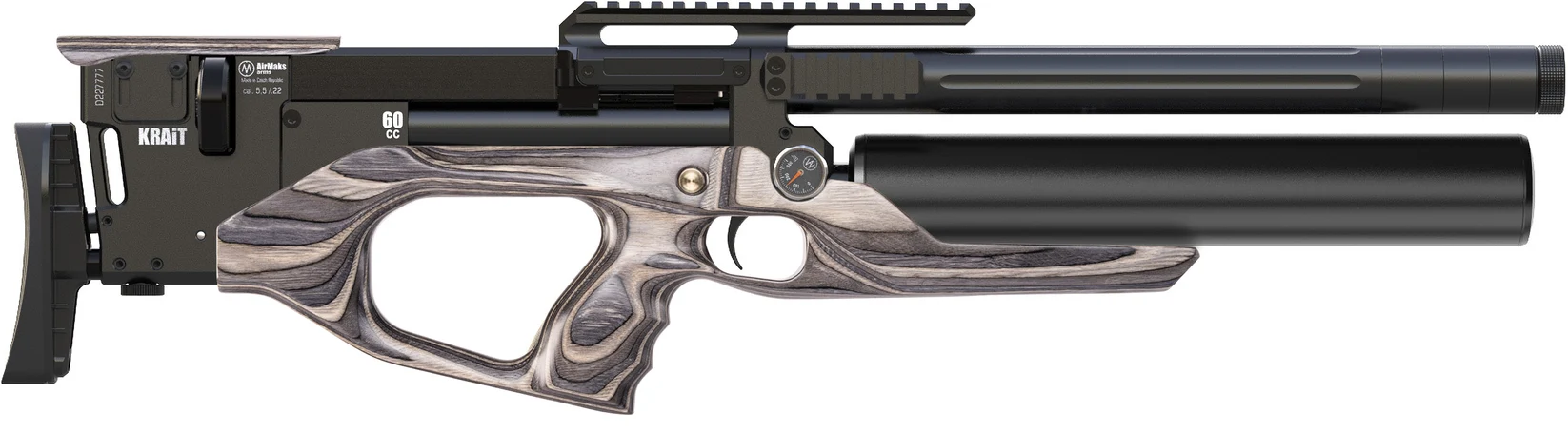
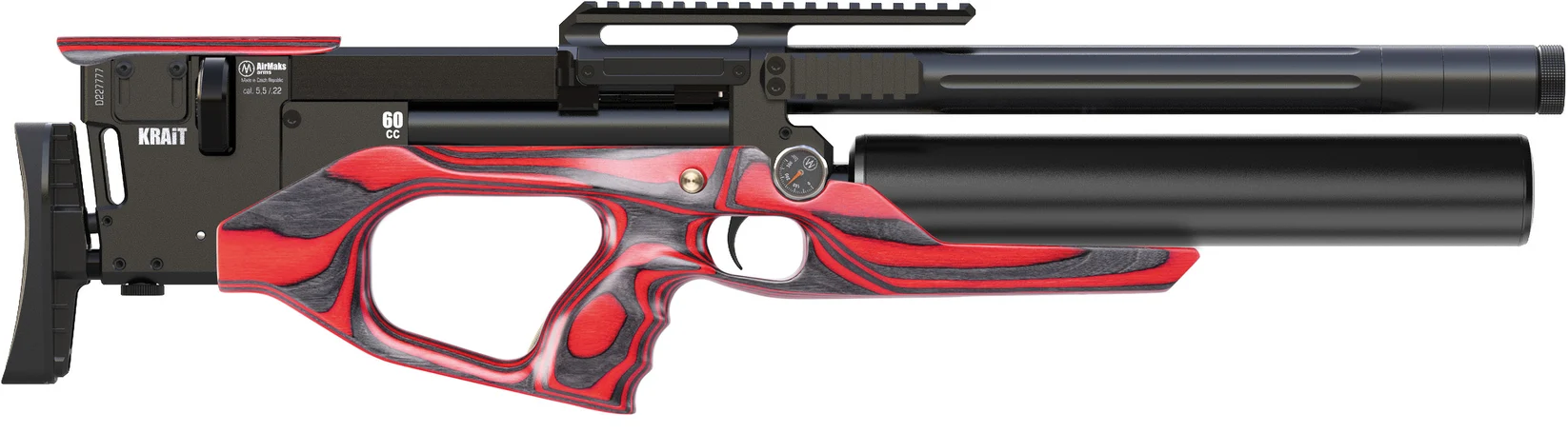
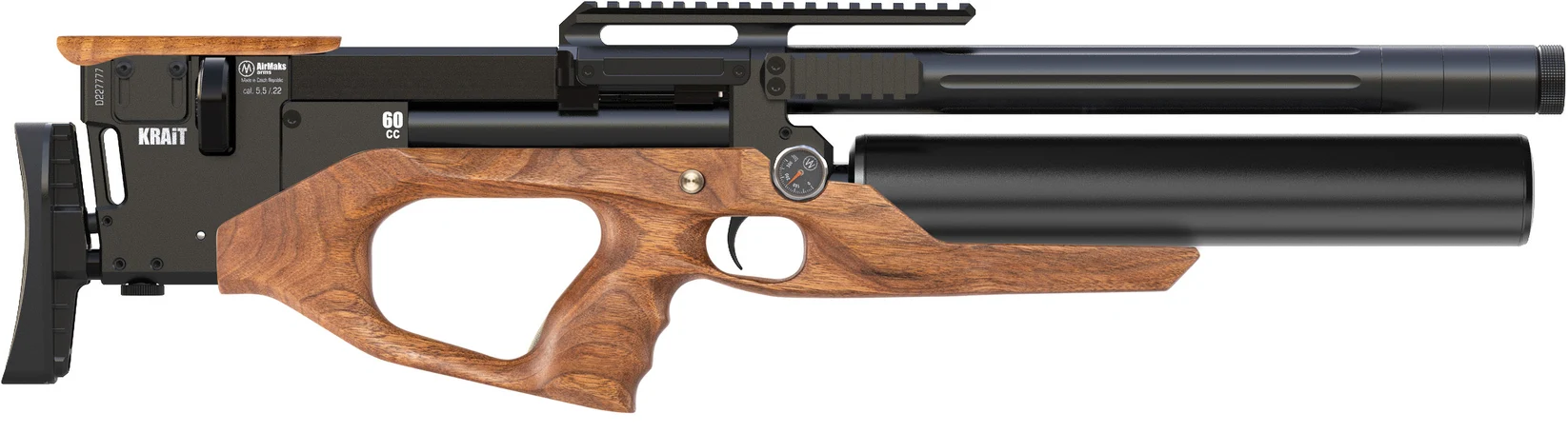
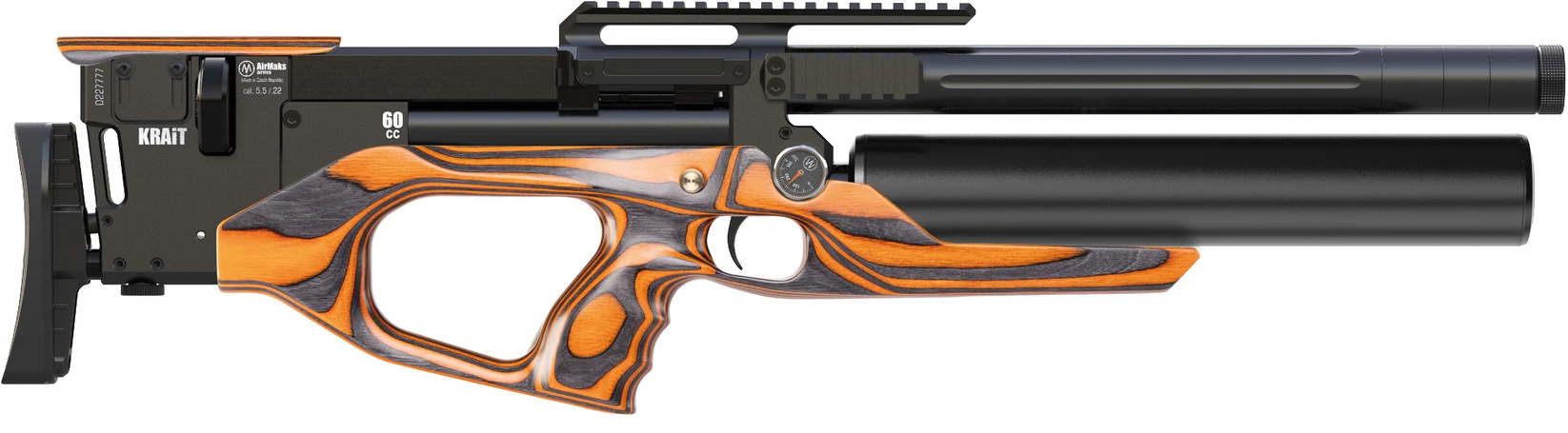
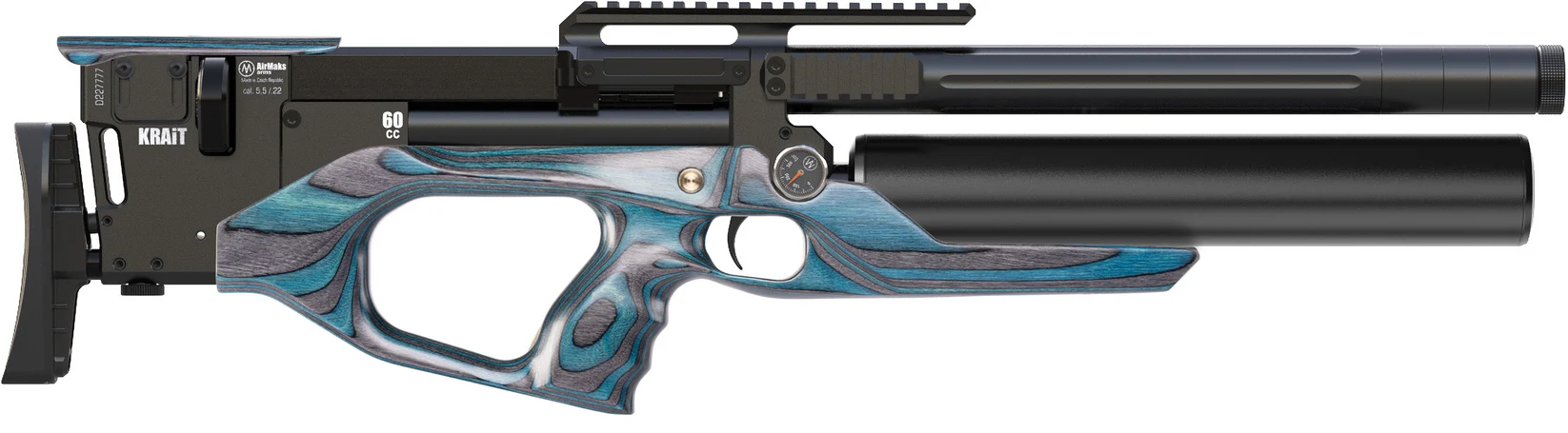
AirMaks Arms KRAiT-T Long High Power.
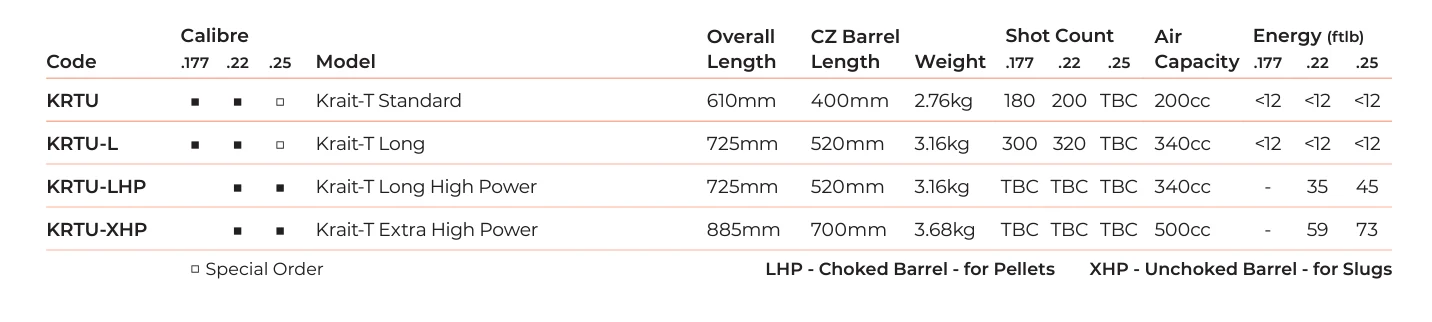
The AirMaks Arms KRAiT LT HP – Long Tube High Power is a regulated PCP air rifle configuration developed around a long barrel, tube-style air cylinder, compact bullpup architecture, and an adjustable operating system. Rather than being configured as the conventional pellet-oriented LT version, the HP model is fitted with a non-choked barrel and is offered in larger calibres intended for users who require the corresponding high-power configuration.
Built around the KRAiT platform, the rifle combines a 520 mm barrel with a compact overall layout. Consequently, substantial barrel length can be retained without requiring the overall dimensions normally associated with a traditionally configured rifle. According to AirMaks Arms, the standard KRAiT LT HP measures approximately 725 mm overall, weighs about 3.16 kg, and incorporates a 340 cc air cylinder. The currently listed Lite LT HP differs slightly in dimensions and capacity, so specifications should always be confirmed for the exact production version being considered.
AirMaks Arms KRAiT LT HP Design
A bullpup configuration has been used for the KRAiT platform. Therefore, the action is positioned farther toward the rear of the rifle while a comparatively long barrel can still be accommodated within a relatively short overall package.
Because of this arrangement, the rifle can remain manageable when being transported, positioned on a shooting bench, or handled in locations where excessive overall length would otherwise become inconvenient.
Furthermore, the KRAiT platform has been designed with an ambidextrous layout. The cocking lever can be configured on either the right or left side, allowing the operating arrangement to be adapted to different users.AirMaks Arms KRAiT-T Long High Power
520 mm High-Power Barrel Configuration
A 520 mm barrel is incorporated into the long high-power configuration. On current HP versions, a non-choked barrel is specified by AirMaks Arms.
Accordingly, the HP configuration can be distinguished from several pellet-oriented KRAiT models that use choked barrels.
Barrel configuration can significantly affect ammunition compatibility, consistency, and external ballistic behaviour. Therefore, ammunition should always be selected according to the exact calibre, barrel specification, manufacturer guidance, and applicable local regulations.
Available Calibres
The KRAiT LT HP platform is listed in the following high-power calibres:
- 5.5 mm / .22 calibre
- 6.35 mm / .25 calibre
- 7.62 mm / .30 calibre
Magazine capacity varies according to calibre. On the current Lite LT HP specification, capacities are listed as 16 rounds in .22, 14 rounds in .25, and 12 rounds in .30.
Because specifications can be revised between generations or regional configurations, owners should verify the magazine supplied with their particular rifle.AirMaks Arms KRAiT-T Long High Power
Regulated PCP Operating System
As a pre-charged pneumatic rifle, the KRAiT LT HP operates from compressed air stored within its cylinder.
A regulated system is incorporated into the platform. Consequently, air delivery can be controlled more consistently across the usable pressure range than would normally be possible with a completely unregulated system.
The current KRAiT LT HP family also incorporates external adjustments associated with valve operation and hammer-spring tension. These components form part of the rifle’s factory-designed pneumatic system.
Any adjustment should be carried out strictly within manufacturer guidance, legal power limits, and safe operating specifications.
High-Pressure Air Cylinder
The standard KRAiT LT HP is listed by AirMaks Arms with approximately 340 cc of air capacity, while the newer Lite LT HP uses a 300 cc tube rated to a maximum pressure of 300 bar.
A tube cylinder gives the rifle a comparatively straight profile underneath the barrel.
Moreover, pressure should always be monitored using the installed gauge, and only compatible high-pressure filling equipment should be used. The maximum pressure specified for the exact rifle should never be exceeded.
Adjustable Ergonomics
Comfort and repeatable positioning can be important when a PCP rifle is being used for controlled sporting or target applications.
For that reason, adjustment has been incorporated into several areas of the KRAiT architecture.
Adjustable Cheekpiece and Butt Pad
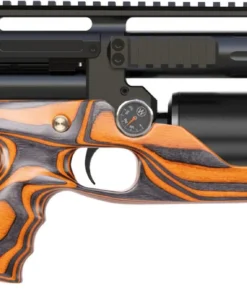
The cheekpiece can be adjusted vertically, allowing the shooter’s eye position to be better aligned with the installed optic.
Similarly, the butt pad can be adjusted for height and length on the relevant current configurations.
These adjustments can help accommodate different body proportions, shooting positions, and optic heights without fundamentally changing the rifle’s basic architecture.AirMaks Arms KRAiT-T Long High Power
An AR-style pistol grip is also incorporated into the platform.
Two-Stage Adjustable Trigger
A two-stage adjustable trigger is fitted to the KRAiT LT HP.
A two-stage system separates initial trigger movement from the final release stage. Therefore, the point immediately before release can be identified more predictably once the user has become familiar with the trigger.
Any trigger adjustment should remain within manufacturer specifications, while all normal handling and safety procedures should continue to be followed.AirMaks Arms KRAiT-T Long High Power
Side-Lever Cocking System
A side-lever mechanism is used for cocking and indexing the magazine.
Importantly, the lever can be repositioned for right- or left-side operation. Consequently, both right-handed and left-handed users can configure the rifle around their preferred handling arrangement.
The mechanism should be operated smoothly and kept clean according to the maintenance guidance supplied by AirMaks Arms.
Optics and Accessory Mounting
A 20 MOA Picatinny optics rail is incorporated into the rifle.
Therefore, compatible scopes and optical equipment can be mounted using commonly available Picatinny-style mounts.
An additional lower Picatinny rail is provided on the current Lite LT HP, allowing compatible sporting accessories to be attached when appropriate.
The barrel assembly also incorporates a 1/2-inch UNF thread on current specifications. Any muzzle-mounted equipment must be legal in the user’s jurisdiction and compatible with the rifle.
Key Technical Highlights
- Regulated pre-charged pneumatic operating system
- Long 520 mm barrel configuration
- Non-choked HP barrel specification
- .22, .25 and .30 calibre options
- Tube-style compressed-air reservoir
- Maximum filling pressure dependent on exact model
- Multi-shot magazine system
- Reversible right/left side-lever operation
- Two-stage adjustable trigger
- Adjustable cheekpiece
- Adjustable butt pad
- Ambidextrous architecture
- AR-style pistol grip
- 20 MOA Picatinny optics rail
- Lower accessory rail
- Integrated pressure gauge
- 1/2-inch UNF muzzle thread
Practical Ownership Considerations
Before the rifle is used, the exact operating manual for the particular production version should be reviewed.
Compressed-air systems operate at very high pressure. Therefore, cylinders, filling connectors, hoses, gauges, and compressors should be maintained correctly and inspected regularly.
Furthermore, ammunition should be matched to the rifle’s calibre and manufacturer recommendations. Safe storage should also be maintained so that unauthorized users cannot access the rifle or compressed-air equipment.
Because airgun classifications differ considerably between countries and regions, the legal status of a high-power PCP rifle should also be confirmed before acquisition, transport, modification, or use.
Depending on the jurisdiction, licensing, registration, power restrictions, age requirements, storage standards, hunting restrictions, or approved shooting locations may apply.
AirMaks Arms KRAiT LT HP Overview
The AirMaks Arms KRAiT LT HP – Long Tube High Power combines a long 520 mm barrel with a compact bullpup layout and tube-style PCP air reservoir.
Meanwhile, adjustment has been integrated throughout the platform through its configurable cheekpiece, butt pad, side lever, trigger system, and pneumatic architecture.
The result is a technically configurable PCP platform intended for users who specifically require the long-tube, high-power KRAiT configuration.
For accurate product identification, however, the exact model generation should always be checked. AirMaks currently lists several closely related versions—including the KRAiT LT HP, KRAiT Lite LT HP, KRAiT L HP and newer MK2/Pro configurations—and dimensions, air capacity, stock design, regulator arrangement, and other specifications can differ between them.AirMaks Arms KRAiT-T Long High Power
Calibres, FAC, Power and Accessories for the AirMaks Arms KRAiT-T Long High Power
The AirMaks Arms KRAiT-T Long High Power is configured around the larger-calibre, high-power side of the KRAiT platform. In the manufacturer’s current long-tube high-power specification, the rifle is offered in 5.5 mm (.22), 6.35 mm (.25), and 7.62 mm (.30). The HP version is distinguished from the standard pellet-oriented models by its non-choked 520 mm barrel and its emphasis on higher-output configurations.
Available Calibres
The .22 calibre provides the smallest bore size in the current HP range. It is commonly selected where a balance between projectile weight, magazine capacity, air consumption, and manageable external ballistics is required. The current KRAiT Lite LT HP specification provides a 16-shot magazine in .22 calibre.
The .25 calibre increases projectile diameter and mass while reducing magazine capacity slightly. On the current long-tube HP configuration, the .25 version uses a 14-shot magazine. This calibre sits between .22 and .30 and is often considered by users who want a larger projectile format without moving directly to the biggest calibre offered in this version.
The .30 calibre is the largest option currently listed for the KRAiT LT HP family. Its magazine capacity is listed at 12 shots, reflecting the increased physical size of the ammunition. Because the projectile is larger and generally heavier, legal restrictions can become more significant depending on jurisdiction.
Unlike several standard KRAiT models, the HP configuration is not currently listed in .177 calibre. AirMaks instead reserves .177 for a number of its conventional choked-barrel configurations.
FAC and Legal Power Classification
The term FAC is commonly associated with the United Kingdom and refers to a Firearm Certificate. For air rifles in Great Britain, rifles producing energy above the statutory non-FAC threshold may require certification, while the exact legal framework differs in Northern Ireland and other jurisdictions.
Consequently, a product described as High Power should not automatically be assumed to be legal for unrestricted ownership in every market.
The same rifle family can be supplied, restricted, configured, or classified differently depending on the destination country, distributor, calibre, and applicable legislation. Therefore, the legal status of the rifle should always be verified locally before purchase, possession, transportation, modification, or use.
Power regulations are particularly important with high-output PCP rifles because energy levels can vary substantially between configurations.
High-Power PCP Architecture
The AirMaks KRAiT LT HP operates as a regulated pre-charged pneumatic rifle. Compressed air is stored inside the tube cylinder and released through the regulated firing system.
On the current Lite LT HP model, AirMaks specifies a 300 cc cylinder rated to a maximum working pressure of 300 bar. The action also incorporates an internal pressure regulator, externally adjustable valve, and an external velocity regulation screw acting through the hammer-spring system.
These systems allow the rifle to be engineered around stable air delivery and consistent operating behaviour.
However, power adjustment should not be treated simply as a way to maximize output. Settings affect air consumption, consistency, projectile compatibility, noise, mechanical stress, and legal classification.
For that reason, adjustments should remain within the manufacturer’s guidance and within the legal energy limit that applies in the user’s jurisdiction.
Non-Choked 520 mm Barrel
A 520 mm non-choked barrel is used on the long high-power version. AirMaks specifically distinguishes this HP barrel from the choked barrels fitted to several standard KRAiT models.
This distinction matters because barrel configuration influences ammunition compatibility and performance characteristics.
Projectile selection should consequently be approached carefully. The correct calibre must always be used, and ammunition should be selected according to the rifle manufacturer’s specifications.
Optical Accessories
The rifle incorporates a 20 MOA Picatinny top rail, providing a standardized mounting interface for compatible optics.
Depending on the intended lawful sporting application, this rail can accommodate compatible telescopic sights and other legal optical equipment.
The 20 MOA inclination can also provide additional adjustment range within a suitable optic, although the practical benefit depends on the optic, mounting system, ammunition, zero distance, and intended use.
Any optic should be installed using mounts designed for the relevant Picatinny interface and properly secured according to the optic manufacturer’s instructions.
Lower Accessory Rail
A bottom Picatinny rail is also incorporated into the current KRAiT Lite LT HP specification.
This provides a standardized attachment point for compatible sporting accessories.
Typical non-weapon-specific accessories may include a stable shooting rest interface, sling attachment hardware, or other lawful equipment designed for Picatinny mounting.
The overall weight and balance of the rifle should still be considered when accessories are added.
Adjustable Stock Components
The rifle includes several ergonomic adjustments.
The cheekpiece is height adjustable, while the butt pad can be adjusted for both height and length. An AR15-style grip is also used, and the stock architecture is ambidextrous.
These features allow the rifle to be adapted to different body sizes and shooting positions.
A properly positioned cheekpiece can support repeatable head placement behind the optic, while the adjustable butt pad can assist with consistent shoulder placement.
Reversible Side Lever and Trigger
The rifle uses a side-lever action that can be configured for either right- or left-side operation. This provides additional flexibility for both right-handed and left-handed users.
A two-stage adjustable trigger is also fitted.
Trigger adjustments should always remain within the manufacturer’s recommended limits. Safe function should be confirmed after any authorized adjustment, and the rifle should never be handled with reliance on the trigger mechanism or safety alone.
Muzzle and Additional Compatibility
A 1/2-inch UNF muzzle thread is included on the current configuration.
Any compatible muzzle-mounted device must comply with local law. Regulations relating to sound moderators or similar devices can differ considerably between countries.
Overall, the AirMaks Arms KRAiT-T Long High Power combines .22, .25, and .30 calibre options with a regulated PCP system, a long non-choked barrel, adjustable ergonomics, standardized accessory interfaces, and high-pressure air storage. Because it is a high-power platform, correct calibre selection, safe pressure handling, manufacturer-approved setup, and compliance with local FAC or equivalent licensing requirements remain especially important.
AirMaks Krait, Katran PCP Air Rifles, Umarex Airguns, Pest Control and Shooting Systems
The world of AirMaks Krait, AirMaks Katran, PCP air rifles, and modern airgun systems continues to attract shooters interested in precision, hunting, target practice, and pest control applications. Buyers searching for what is a PCP air rifle, what does PCP air rifle mean, what is a PCP airgun, what is a PCP air gun, or what are PCP air rifles are generally looking for information about pre-charged pneumatic technology. A PCP air rifle uses stored compressed air to deliver consistent power, accuracy, and repeatable shot performance compared with traditional spring-powered systems.
AirMaks Krait PCP Air Rifle and Katran Air Rifle Platforms
The AirMaks Krait is a modern PCP platform designed for shooters who want accuracy, compact handling, and adjustable performance. Searches such as AirMaks Krait, Air Max Krait, AirMaks Krait .22, AirMaks Krait .22 official, AirMaks Krait PCP, AirMaks Krait air rifle, and Krayt30 are commonly associated with this rifle family.umarex glock 19 gen3 .177 caliber bb gun air pistol
The AirMaks Katran represents another popular PCP air rifle platform from AirMaks. Search terms including AirMaks Katran, AirMaks Katran .22, Katran air rifle, Katran PCP rifle, and Katran LLC relate to shooters researching compact and high-performance pneumatic rifles. These platforms are often compared by buyers looking for precision shooting, hunting capability, and reliable air delivery systems.
PCP Air Rifles, Compressed Air Systems and Technology
A PCP rifle works by storing compressed air inside an onboard reservoir before releasing controlled air pressure to propel a pellet. Searches such as PCP rifle meaning, PCP air rifle meaning, PCP guns, PCP rifle, compressed air rifle, compressed air guns, air powered rifle, and komprimiran zrak all relate to pneumatic shooting technology.
Charging equipment is also an important part of PCP ownership. Many shooters search for PCP hand pump, PCP air compressor, air compressor rifle, and accessories designed to refill PCP reservoirs safely and efficiently.
Air Rifle Pest Control and Vermin Control Applications
Many shooters research air rifle for pest control, air rifle pest control, pest control with air rifles, best air rifle for pest control, pellet gun for pest control, and best pellet gun for pest control when looking for suitable equipment for lawful pest management.
Products such as AirMaks Krait and AirMaks Katran may appear in searches related to vermin control guns, vermin control air rifles, and accurate pellet shooting platforms because PCP rifles can offer consistent velocity, adjustable power settings, and precision accuracy when used responsibly.glock airsoft gas
Umarex Airguns, Air Rifles and CO2 Platforms
The Umarex brand is widely searched by enthusiasts looking for recreational airguns, training platforms, and replica-style products. Popular searches include Umarex USA, UmarexUSA, Umarex airguns, Umarex air rifles, Umarex Notos, Umarex Gauntlet, Umarex Gauntlet 2, Umarex Gauntlet 30, Umarex Hammer, Umarex Hammer .50 caliber, and Umarex Hammer Carbine.
Other frequently searched Umarex models include Umarex Origin, Umarex Primal 20, Umarex Zelos, Umarex Fusion 2, Umarex Komplete, Umarex Komplete NCR .22, Umarex Air Saber, Umarex Airsaber, Umarex Trevox, Umarex MP40, Umarex MP5, Umarex Legends, Umarex T4E, Umarex HDR 50, and Umarex TR50.
BB Guns, Pellet Pistols and Airsoft Replica Searches
Alongside rifles, many customers search for compact air-powered platforms including BB guns, BB gun pistols, pellet pistols, and CO2 pellet pistols. Related searches include metal BB gun, CO2 pistol replica, airsoft pistol, airsoft Glock, airsoft Glock 17, airsoft Glock 19, Glock BB gun, Glock airsoft gun, and Glock air pistol.loading umarex trevox break barrel .177.umarex notos carbine
Umarex replica searches frequently include Umarex Glock, Umarex Glock 17, Umarex Glock 17 Gen 5, Umarex Glock 19, Umarex Glock 19X, Glock 19 BB gun, and Glock 19X BB gun.czech gun manufacturers,airsoft pistol.umarex dx17.max air gun.umarex hk heckler.umarex smith.hamster with gun.arm max
Practical Use Scenarios
A high-power regulated PCP platform can be used across several lawful sporting, recreational, and technical shooting environments where consistency, stability, adjustable ergonomics, and controlled air delivery are important. Because the platform is designed around a compact bullpup layout, a long barrel, a regulated pneumatic system, and adjustable controls, it can suit users who want a rifle that remains relatively compact while still providing the characteristics associated with a longer barrel and larger-calibre configuration.
Precision Target Shooting
One of the most natural applications is structured target shooting. On a properly managed range, repeatability becomes more important than speed. Therefore, the adjustable cheekpiece, butt pad, two-stage trigger, and optics rail can all contribute to establishing a consistent shooting position.
A shooter can begin by adjusting the stock so that the eye naturally aligns with the scope when the rifle is shouldered. Once the head position is repeatable, the same cheek weld can be maintained from shot to shot. Consequently, unnecessary movement can be reduced, and the shooter can concentrate more effectively on breathing, trigger control, sight alignment, and follow-through.
The regulated pneumatic system is also useful in this environment. Because regulated air delivery is intended to maintain a more stable operating cycle over the usable pressure range, shot-to-shot behaviour can remain more predictable when the rifle is correctly set up and maintained.
For bench shooting, the relatively compact overall format can also be convenient. A longer barrel is retained without requiring the same overall length as a traditional full-length rifle. Therefore, positioning the rifle on a bench or shooting rest can remain comparatively straightforward.
Target sessions can also be used to evaluate ammunition compatibility. Different projectile weights and designs can produce noticeably different results from the same barrel. Accordingly, accuracy testing should be conducted methodically, using safe backstops and controlled conditions.
Benchrest Practice
Benchrest shooting places emphasis on consistency, equipment stability, and repeatable technique. Here, the rifle can be supported at the front and rear while the shooter concentrates on maintaining identical positioning between shots.
The lower accessory rail can be useful for attaching compatible support equipment where legally permitted. However, excessive pressure against the rifle should be avoided because changes in support technique can alter point of impact.
During a benchrest session, groups can be recorded at several distances. Rather than immediately changing multiple settings, it is generally more useful to establish one baseline configuration and then alter only one variable at a time.
For example, one projectile type may be tested over several groups before another type is evaluated. Likewise, optic adjustments should be made carefully so that ammunition performance is not confused with changes to sight settings.
Because the rifle uses compressed air, cylinder pressure should also be monitored throughout the session. If pressure falls outside the recommended operating range, the rifle should be refilled according to manufacturer procedures before further testing is carried out.
Recreational Range Shooting
Not every shooting session needs to be focused on formal competition. Recreational range use can provide an opportunity to become familiar with the rifle’s controls and handling characteristics in a controlled environment.
The reversible side lever can be particularly useful when several authorized users with different dominant hands are using the same rifle. Because the lever can be configured for either side, the rifle can be adapted to suit individual handling preferences.
Similarly, adjustable stock components can help accommodate users of different sizes. The butt pad can be repositioned, while cheekpiece height can be set to suit the installed optic.
During recreational shooting, safe handling remains essential. The muzzle should remain pointed in a safe direction, the trigger should remain untouched until a shot is intended, and the rifle should be treated as loaded whenever its status is uncertain.
A suitable backstop must also be present. High-energy airgun projectiles can retain significant energy, so improvised targets or unsuitable backgrounds should never be relied upon.
Long-Session Shooting
High-pressure PCP rifles are often chosen by users who prefer shooting without the repeated cocking effort associated with spring-powered systems.
In a longer range session, the combination of a multi-shot magazine and stored compressed air can make the shooting process more continuous. Nevertheless, the rifle should still be handled deliberately, with each shot treated as a separate firing action.
The available air capacity can support repeated shooting before refilling is required, although actual shot count depends on calibre, pressure settings, projectile weight, environmental conditions, and the rifle’s configuration.
For that reason, shooters who plan extended sessions can benefit from monitoring starting pressure, remaining pressure, and the number of shots fired. This information can help establish an approximate working shot count for a particular setup.
That figure should not be assumed to remain identical after changes are made to calibre, projectile type, regulator settings, or other operating variables.
Optics Setup and Zeroing
The integrated optics rail makes the platform suitable for users who want to install a telescopic sight for controlled target work.
During initial setup, scope position should be chosen so that a natural sight picture is obtained without stretching the neck or moving the head excessively. Ring spacing, eye relief, and cheekpiece height should be checked before final tightening.
Once the optic is mounted, zeroing should begin at an appropriate safe distance. A large target and secure backstop should be used so that initial impacts can be located easily.
Small adjustments can then be made until the desired point of impact is established.
The inclined rail can offer additional adjustment range in compatible optics, although the usefulness of this feature depends on the scope and intended shooting distance.
After zeroing, confirmation groups should be fired rather than relying on a single shot. This reduces the chance of adjusting the scope based on an isolated flyer or an inconsistent hold.
Ammunition Evaluation
A practical use scenario can also involve systematic ammunition testing.
Even projectiles of the same nominal calibre can differ in weight, length, shape, manufacturing tolerance, and ballistic behaviour. Therefore, the most consistent option for one rifle may not necessarily be the most consistent choice for another.
Testing should be conducted under controlled conditions. Several groups can be fired with one projectile type, followed by another, while the rifle configuration is kept unchanged.
Group size, point of impact, feeding reliability, and overall consistency can then be compared.
Magazine compatibility should also be checked. Longer projectiles may not fit every rotary magazine even when the calibre itself is correct.
Only ammunition suitable for the specific rifle and magazine should be used.
Training and Technique Development
The adjustable ergonomics make the platform suitable for structured technique development.
Users can practice consistent shoulder placement, sight alignment, breathing control, trigger movement, and follow-through on an established shooting range.
Because the trigger uses a two-stage design, users can learn to recognize the first stage before reaching the final release point.
However, trigger adjustment should always remain within manufacturer specifications. An extremely light or improperly adjusted trigger can create an unsafe condition.
Dry handling practice may also be useful for learning controls, but whether dry firing is permitted should be confirmed in the manufacturer’s manual.
If dry firing is not specifically approved, alternative training methods should be used.
Supported Field-Style Target Shooting
Where local regulations and range rules allow it, the rifle can also be used for field-style target courses.
These courses may involve targets positioned at varying distances and shooting positions such as standing, seated, kneeling, or supported.
The compact bullpup configuration can be beneficial when transitioning between safe shooting positions because overall length is reduced compared with many traditional layouts.
At the same time, muzzle awareness remains essential. The shorter overall package should never encourage careless handling.
When moving between positions, the rifle should be kept safe according to range rules, and the finger should remain outside the trigger guard.
Pest-Control Context Where Lawfully Authorized
In some jurisdictions, appropriately licensed and experienced users may legally use certain air rifles for pest-control purposes.
Such use should only take place where local law specifically permits it, where the shooter has permission from the landowner, and where the chosen equipment is appropriate for the species and circumstances.
The main considerations should be humane standards, legal compliance, a secure backstop, and avoidance of risk to people, domestic animals, buildings, roads, and neighbouring property.
Users should not assume that a larger calibre or higher energy automatically makes a particular application lawful or appropriate.
Local wildlife regulations, hunting laws, energy restrictions, permitted species lists, and licensing requirements can all apply.
Where uncertainty exists, the relevant authority should be consulted before the rifle is used.
Equipment Familiarization
Another practical application is learning how to manage a regulated PCP system correctly.
The owner can become familiar with safe filling procedures, cylinder pressure monitoring, magazine loading, optic mounting, stock adjustment, and routine inspection.
This is particularly important for users moving from spring-powered airguns to high-pressure pneumatic equipment.
A PCP cylinder operates at very high pressure. Therefore, filling equipment must be compatible, properly maintained, and connected correctly.
The rifle should never be filled beyond its manufacturer-rated pressure.
Likewise, damaged hoses, connectors, gauges, or cylinders should not be used.
Maintenance-Oriented Use
Regular range sessions can also provide valuable information about the rifle’s mechanical condition.
Changes in consistency, abnormal air consumption, unusual sounds, magazine indexing issues, or unexplained shifts in point of impact can indicate that inspection is required.
External surfaces can be cleaned after use, while the barrel and action should be maintained according to manufacturer recommendations.
Only suitable lubricants should be used, particularly because petroleum-based products can be inappropriate around high-pressure air systems.
Seals and O-rings should also be inspected periodically.
If internal servicing is required, work should be performed according to manufacturer guidance or by a qualified technician.
Travel to an Authorized Range
The compact dimensions can be useful when transporting the rifle to an approved range.
Nevertheless, transportation laws vary considerably.
The rifle should normally be unloaded, secured in an appropriate case, separated from ammunition where required, and transported in accordance with local regulations.
Compressed-air cylinders and charging equipment may also be subject to transport requirements.
Before travelling across regional or national borders, users should verify whether permits, declarations, certificates, or other documentation are required.
Responsible Ownership
Ultimately, the most appropriate practical use scenarios are those that combine controlled conditions, correct equipment setup, legal compliance, and safe handling.air arm
Whether the rifle is being used for precision targets, benchrest practice, recreational range sessions, ammunition evaluation, field-target activities, or another lawful sporting purpose, consistent procedures remain essential.
The rifle’s adjustable ergonomics, long-barrel configuration, regulated PCP system, multi-shot operation, and standardized mounting interfaces provide considerable flexibility. However, those features should always be used within the manufacturer’s operating limits.
Pressure should be monitored, the correct calibre should be used, compatible ammunition should be selected, and all adjustments should remain within safe and legally permitted limits.airrams
When these requirements are respected, the platform can be incorporated into a wide range of controlled sporting and training environments while maintaining the disciplined handling expected of any high-pressure air rifle.
Air Rifle Shooting, Accuracy and Performance
Modern shooters compare airguns based on accuracy, power delivery, ammunition compatibility, and intended use. Searches for accurate pellet rifle, powerful air rifle, air rifle online, air rifle dealers, air gun makers, air gun manufacturers, and best airguns reflect the growing interest in precision pneumatic systems.amazon umarex browning 800 express.umarex pistol break barrel.umarex bb gun
Whether researching an AirMaks Krait, AirMaks Katran, Umarex air rifle, or another PCP platform, buyers should consider caliber selection, air capacity, regulator performance, barrel quality, available accessories, maintenance requirements, and local regulations before choosing a system.umarex t4e smith.umarex shotgun.umarex synergis elite.50 cal air rifle.max arms.umarex p2p dr50 how many joules.uramax.airmaxsex.air marks.bbgun.gunmax.mav max.akatran
Frequently Asked Questions
What type of air rifle is this?
This model is a regulated pre-charged pneumatic air rifle built around a compact bullpup-style layout. Instead of relying on a spring or gas-ram mechanism, compressed air is stored inside an onboard cylinder and released in controlled amounts when the rifle is fired. The regulated system is designed to provide more consistent air delivery throughout the usable pressure range, which can help maintain stable performance during target sessions.
Which calibres are available?
The high-power long configuration is generally offered in .22, .25, and .30 calibre. Each calibre provides different characteristics in terms of projectile weight, magazine capacity, air consumption, trajectory, and intended lawful use. The correct calibre should always be selected according to the rifle specification, local regulations, and the type of shooting activity for which the rifle will be used.
Is .177 calibre available?
The high-power version is normally focused on larger calibres rather than .177. Other models within the same family may be offered in .177, but buyers and owners should always verify the exact configuration before ordering ammunition or accessories. Different variants can have different barrel specifications, magazine capacities, cylinder sizes, and legal classifications.
What does PCP mean?
PCP stands for pre-charged pneumatic. A PCP rifle stores compressed air inside a cylinder or bottle. When the trigger is operated, a controlled quantity of that stored air is released to propel the projectile. Because the air is already compressed before shooting begins, no spring has to be compressed between every shot. This operating system can provide smooth firing characteristics and allows the use of multi-shot magazines on compatible models.
What is the purpose of the regulator?
The regulator is designed to control the pressure of the air delivered to the firing valve. Rather than allowing reservoir pressure to act directly on the firing system, the regulator creates a more controlled working pressure. This helps reduce variations between shots when the rifle is operating within its intended pressure range.
Consistency can still be affected by projectile choice, temperature, maintenance condition, fill pressure, and other setup factors. Therefore, the regulator should be viewed as one part of the complete pneumatic system rather than a guarantee of identical performance in every condition.
What does the high-power designation mean?
The high-power designation identifies a configuration intended for higher-output operation than certain restricted or lower-powered variants. Actual muzzle energy depends on calibre, factory configuration, market version, ammunition, and applicable legal restrictions.
Users should never assume that a high-power model is unrestricted simply because it is an air rifle. In many jurisdictions, energy thresholds determine whether licensing, registration, or other legal requirements apply.
Does this version require an FAC?
That depends entirely on the jurisdiction in which the rifle is owned or used. The term FAC, or Firearm Certificate, is mainly associated with the United Kingdom.
In areas where air rifles above a specific energy threshold require certification, a high-power model may fall within that category. However, legal limits vary between countries and even between regions within the same country.
Owners should verify current local legislation before purchasing, transporting, modifying, or using the rifle.
How long is the barrel?
The long configuration uses a barrel of approximately 520 mm. This provides a comparatively long barrel while the bullpup layout keeps overall rifle length more compact than would normally be expected from a conventional stock arrangement.
Exact dimensions can vary between production versions, so the specification sheet for the individual rifle should always be checked.
What is a non-choked barrel?
A non-choked barrel does not use the narrowed muzzle section commonly found in some pellet-focused barrels.
Different barrel designs can interact differently with projectile types. For that reason, ammunition testing should always be conducted carefully and only with projectiles of the correct calibre and type recommended for the rifle.
What magazine capacity does the rifle have?
Magazine capacity depends on calibre.
Typical capacities for current configurations are approximately:
- .22 calibre – 16 rounds
- .25 calibre – 14 rounds
- .30 calibre – 12 rounds
The larger the projectile diameter, the fewer rounds can generally be accommodated within a magazine of similar dimensions.
Owners should always confirm the magazine supplied with their specific rifle because capacities can change between versions.
Can the rifle be used by left-handed shooters?
The platform includes several ambidextrous features. Most notably, the side-lever arrangement can be configured to suit right- or left-side operation on compatible versions.
The stock layout and grip arrangement also allow the rifle to be used comfortably by a wider range of shooters.
Proper adjustment remains important because body proportions and preferred shooting positions differ from person to person.
Is the cheekpiece adjustable?
Yes. The cheekpiece can be adjusted so that eye alignment with the optic can be improved.
Correct cheekpiece height helps the shooter achieve a consistent head position without excessive neck movement. This can be particularly useful when different scope mounts or optic heights are being used.
Can the butt pad be adjusted?
Compatible versions feature an adjustable butt pad. Height and length adjustments can help the rifle fit different body sizes and shooting positions.
A properly adjusted butt pad can contribute to a more repeatable shoulder position, especially during longer target sessions.
Adjustments should be made while the rifle is unloaded and handled safely.
What type of trigger is fitted?
A two-stage adjustable trigger is fitted to the platform.
The first stage provides initial movement, while the second stage represents the final release point. This allows the shooter to distinguish between initial take-up and the point immediately before the shot is released.
Any trigger adjustment should remain within the manufacturer’s recommended limits.
Does the rifle include a safety mechanism?
The exact safety arrangement should be confirmed in the manual supplied with the specific model.
Regardless of the mechanical safety system, normal safe-handling rules remain essential. The muzzle should always be kept pointed in a safe direction, the trigger should not be touched until a shot is intended, and the rifle should be treated as loaded whenever its status is uncertain.
What type of optics can be fitted?
A Picatinny-style top rail is provided for mounting compatible optics.
Depending on lawful intended use, users may install suitable telescopic sights or other approved optical equipment.
Mounts should be matched correctly to both the optic and rail, and screws should be tightened according to the manufacturer’s instructions rather than overtightened.
What does a 20 MOA rail mean?
A 20 MOA rail incorporates a slight angle into the mounting surface.
This can provide additional elevation adjustment range in compatible scopes. It can be useful in some longer-distance target applications, although actual benefit depends on the optic, projectile, zero distance, and shooting environment.
It does not automatically increase accuracy.
Is there an accessory rail underneath?
Current configurations can include a lower Picatinny-style rail. This provides a standardized mounting point for compatible sporting accessories.
Accessories should be selected carefully so that unnecessary weight is not added to the front of the rifle.
Any mounted equipment must also be permitted under local law and suitable for the intended lawful activity.
Can a moderator be attached?
Current configurations may include a 1/2-inch UNF muzzle thread for compatible muzzle-mounted equipment.
However, regulations concerning sound moderators vary significantly between jurisdictions. In some places they are unrestricted, while elsewhere they can require separate authorization or may be prohibited.
Compatibility and legal status should therefore be confirmed before any muzzle device is installed.
What pressure is used to fill the rifle?
The exact maximum fill pressure depends on the specific version. Some current tube-cylinder configurations are rated up to approximately 300 bar.
The number printed on the rifle, cylinder, and official manual should always take priority over general product information.
A cylinder should never be filled beyond its rated pressure.
What equipment is required for filling?
A compatible high-pressure hand pump, diving cylinder, or approved compressor may be used, depending on the manufacturer’s filling system.
All connectors, hoses, gauges, and filling equipment should be rated for the required pressure.
Damaged or questionable high-pressure equipment should never be used.
How many shots can be fired from one fill?
There is no single shot-count figure that applies to every setup.
Shot count varies according to calibre, projectile weight, regulator setting, hammer setting, cylinder size, operating pressure, temperature, and power configuration.
Higher-output settings generally consume more air per shot than lower-output configurations.
A practical shot count can be established by recording pressure and shot numbers during controlled range use.
Can the power be adjusted?
Some versions include externally accessible controls associated with the valve, regulator, or hammer-spring system.
These controls should only be adjusted according to the manufacturer’s instructions.
Changing power settings may affect accuracy, air consumption, reliability, noise, and legal classification.
Users should never increase output beyond the legal limit applicable in their jurisdiction.
Does changing calibre increase power?
Not automatically.
A larger calibre generally uses a heavier projectile, but muzzle energy depends on several interacting factors, including projectile mass, velocity, air delivery, barrel characteristics, and factory configuration.
Calibre alone should not be treated as a direct measurement of power.
What ammunition should be used?
Only ammunition of the correct calibre and suitable dimensions should be used.
Different projectile weights and shapes can perform differently from the same barrel. Therefore, users may need to test several manufacturer-approved options under controlled range conditions to identify which one provides the most consistent results.
Magazine length must also be considered because unusually long projectiles may not fit properly.
Is this suitable for target shooting?
Yes, where local regulations and range rules permit.
The regulated PCP system, adjustable stock, optics rail, two-stage trigger, and multi-shot magazine can all support controlled target shooting.
For best results, the rifle should be properly fitted to the user, and shooting should take place with an appropriate backstop and safe range procedures.
Can it be used for pest control?
In some jurisdictions, certain air rifles may legally be used for pest control by authorized individuals.
Such use depends on local wildlife law, landowner permission, calibre and energy requirements, permitted species, and safe shooting conditions.
A secure backstop and humane standards are essential. Local regulations should always be verified before any field use is considered.
How should the rifle be stored?
The rifle should be unloaded, depressurized only if recommended by the manufacturer, and stored securely where unauthorized users cannot access it.
Local law may require a locked cabinet, secure storage device, separation from ammunition, or other specific precautions.
High-pressure filling equipment should also be stored safely and inspected periodically.
How often should maintenance be performed?
Routine inspection should be carried out regularly, especially if the rifle is used frequently.
External surfaces should be kept clean, seals should be monitored for air leakage, and mounting hardware should be checked periodically.
Only lubricants specifically recommended for PCP systems should be used.
Internal servicing should be performed according to manufacturer instructions or by a suitably qualified technician.
What should be checked before each shooting session?
Before use, owners should confirm that the rifle is in safe mechanical condition, the barrel is unobstructed, the correct ammunition is available, the optic is secure, and cylinder pressure is within the approved operating range.
The shooting area should also have a safe backstop, clear firing direction, and adequate separation from people, animals, roads, buildings, and other hazards.
Is this suitable for beginners?
A high-pressure PCP rifle can be used safely by a properly supervised and legally permitted beginner, but its operating system requires understanding and discipline.
New users should receive instruction in safe handling, high-pressure filling procedures, correct ammunition selection, range etiquette, and legal responsibilities before independent use.
Because high-power variants can be subject to additional regulation, legal requirements should be confirmed first.
Why is the exact model version important?
Several closely related versions can exist within the same product family.
Differences may include barrel type, cylinder capacity, overall dimensions, regulator design, stock components, magazine capacity, weight, and power configuration.
Therefore, replacement parts, magazines, seals, accessories, and technical specifications should always be matched to the exact model designation and production version rather than selected from the family name alone.






Reviews
There are no reviews yet.