Daystate, Delta Wolf, Alpha Wolf and Premium PCP Air Rifle Accessories
For shooters researching premium PCP platforms, daystate blackwolf, daystate redwolf, delta wolf, huntsman daystate, and daystate alpha wolf frequently appear among the most searched Daystate-related terms. Whether someone searches for wolf delta, day state, daystate delta wolf, blackwolf, deltaw, daysta, or wants to understand the delta wolf meaning, these rifles are commonly associated with modern PCP engineering, electronic control systems, adjustable configurations, and high-end airgun performance.
People asking what is a delta wolf are generally researching the electronic Daystate platform and how it differs from conventional PCP rifles. Related searches often include electronic wolves, firing cycle, lock time, lock timing, short cocking, cocking ball, index pin, and pin magazine. Searches may also focus on configuration-specific components such as an alpha wolf barrel, stock walnut, safari stock, dima stock, stock replacement, rimfire stocks, or a rifle butt pad.
Daystate Red Wolf, Alpha Wolf and Wolverine Searches
The daystate redwolf family remains closely connected with searches for daystate redwolf price, red alpha wolf, alpha red wolf, and the newer daystate blackwolf platform. Some shoppers may also compare these rifles with the daystate wolverine sapphire, wolverine gun, wolveriner, wolf gun, wolfpack armory wolverine, or even search unusual phrases such as can wolverine go on planes while researching transport rules.
Accessories frequently searched alongside these platforms include a rubber butt, rubber butt pad, butt pad rifle, bradley cheek riser, gecko grips, picatinny bag rider, and buddy bottle cover. Cosmetic or clothing-related search phrases such as red bodywarmer and black snood may also appear alongside broader brand searches.
Magazine-related searches include 177 magazine, mag 177, and 25 magazine, while ammunition research can include 177 pellets types, 5.0 mm pellets, and slug pellet. Because pellet suitability depends on the rifle, barrel, legal power level, and intended range use, compatible ammunition should always be selected according to the manufacturer’s specifications.
PCP Air Systems, Moderators and Thread Accessories
Many enthusiasts researching Daystate rifles also search for air rifle compressed air, compressed air rifle, what are pcp air rifles, and what is a pre charged pneumatic air rifle. These searches relate to the fundamental operating principle of PCP systems, in which stored compressed air is used to power each shot.
Common accessory searches include air gun pc, air gun suppressor, air gun suppressors, airgun moderator, air rifle moderator, 0db, 0db moderator, and 0 db moderator. Buyers may also encounter searches for a hogan decimeater silencer, silencer thread adapter, thread protector rifle, and muzzle thread protector when comparing muzzle accessories and compatible threaded components. Local regulations should always be checked before purchasing or fitting sound-moderating equipment.
Maintenance-related searches often include pcp o ring kit, while tuning-oriented users may look for an ats tuner. Search terms such as unfend can also appear in broad airgun keyword datasets, even when the intended product or meaning is unclear.
M-LOK, Picatinny and Rifle Sling Accessories
Accessory compatibility is another major area of interest. Common searches include mlok to picatinny rail adapter, best m-lok to picatinny rail adapter, m-lok to picatinny adapter, and picatinny m lok adapter. These adapters are often researched by users who want to mount compatible optics, rests, bipods, bags, or other permitted accessories on an appropriate rail system.
Sling-related searches include riffle sling, rigle sling, how to put a gun sling on a rifle, how to put a rifle sling on, how to install a rifle sling, how to put sling on rifle, installing a rifle sling, and attaching a sling to a rifle. Because attachment arrangements differ between stocks, rails, swivels, and chassis systems, the correct mounting points should always be confirmed from the manufacturer’s documentation.
Other general mechanical or unrelated search phrases found within broader keyword datasets include how to put extinguisher call back together, weatherby vanguard trigger adjustment, and 3.55kg in lbs. While these terms may appear in search data, they are not necessarily specific to Daystate PCP rifles.
BRK, Brocock and XR Air Rifle Searches
Alongside Daystate products, many buyers compare models produced under the Brocock and BRK families. Popular searches include brocock ltd, brocock sniper xr, brocock commander xr, pathfinder xr, brk ghost, brocock airguns, brocock commander, brk ghost air rifle, and brk sniper xr.
The brocock sniper xr is often researched by shooters comparing compact PCP platforms, while the brocock commander xr and brocock commander searches generally relate to larger tactical-style PCP configurations. Meanwhile, brk ghost and brk ghost air rifle searches reflect growing interest in BRK-branded PCP systems.
Those comparing local purchasing options may also search fx airgun dealer near me, even when their primary interest is Daystate or Brocock. This reflects the way many airgun shoppers compare several premium manufacturers before deciding which PCP platform, stock configuration, calibre, regulator setup, magazine system, and accessory package best matches their intended sporting use.
Additional Daystate and Airgun Search Terms
Broader searches surrounding these rifles may include model alpha gun, griffin gun, and general comparisons involving a wolf gun or other premium PCP platform. Buyers may also investigate different stock materials, rail systems, moderators, magazines, barrel options, butt pads, cheek risers, thread protectors, and compressed-air accessories before completing a build.
Whether someone begins with daystate redwolf, explores the daystate alpha wolf, compares a daystate delta wolf, investigates the daystate blackwolf, or considers a daystate wolverine sapphire, the most useful approach is to verify model compatibility, calibre, pressure specifications, local regulations, and manufacturer-supported accessories before purchasing replacement components or upgrades.
Practical Use Scenarios
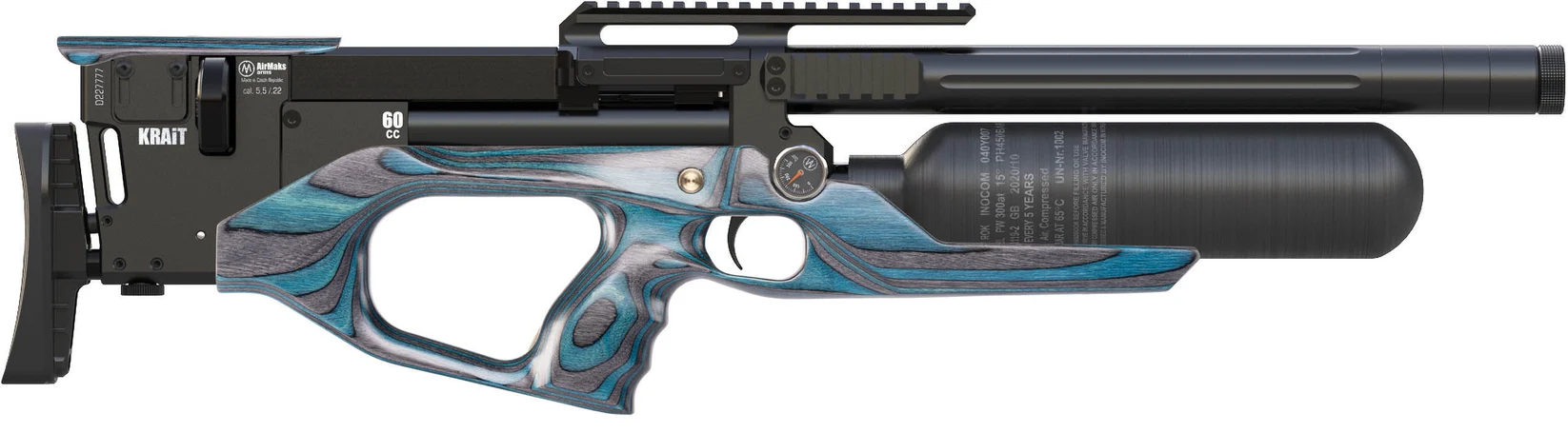
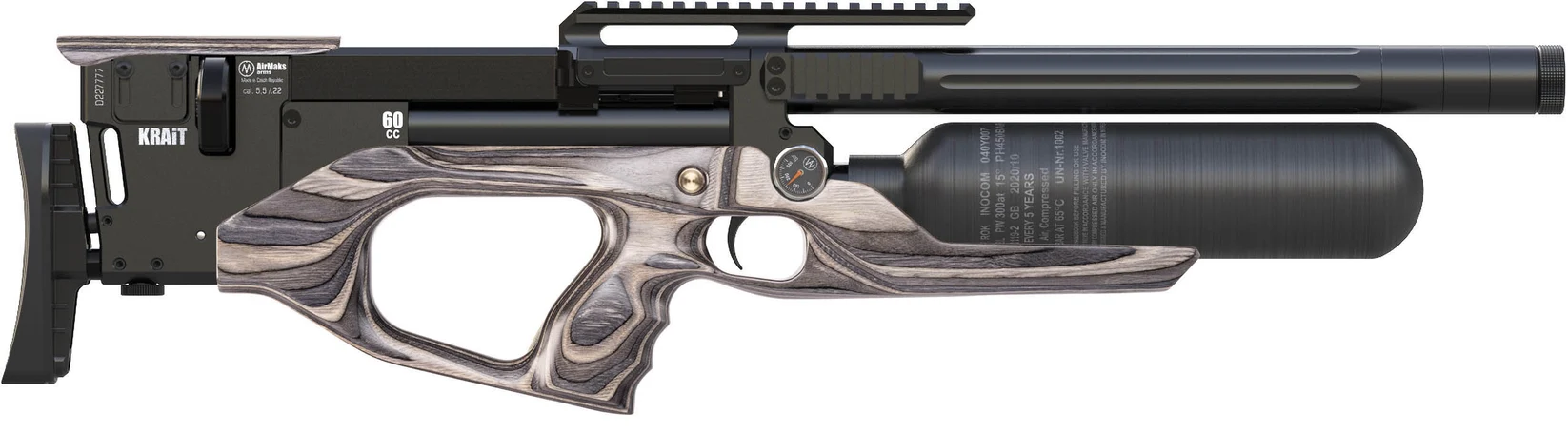
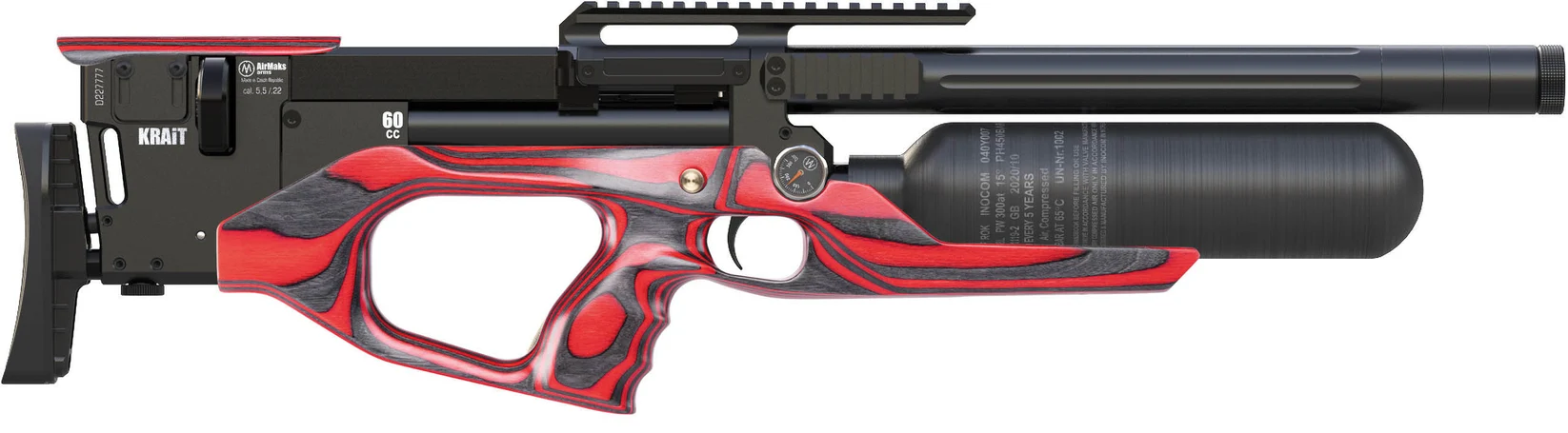
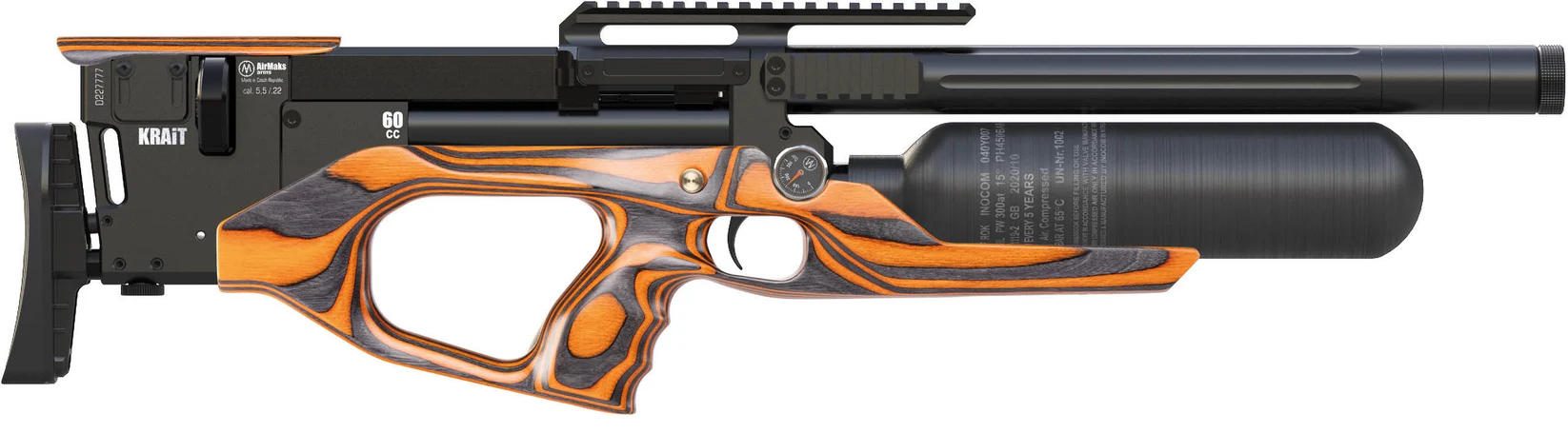
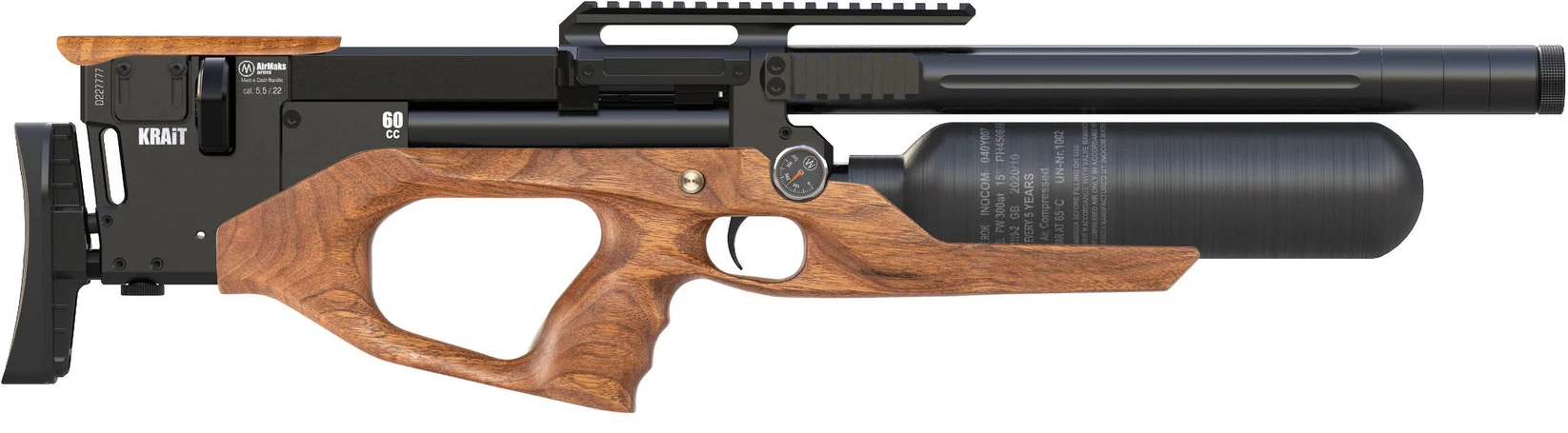
The AirMaks Arms KRAiT Long High Power is designed around a combination of compact dimensions, a long barrel, substantial air capacity, regulated operation, and adaptable ergonomics. Those characteristics make it suitable for several controlled airgun disciplines and practical shooting environments where consistency, stability, handling, and repeatable setup matter more than portability alone.
Because the platform is available in multiple calibres and may be supplied in different energy configurations depending on the market, practical use should always be matched to the rifle’s legal specification, the ammunition being used, the shooting environment, and the applicable local regulations. High-powered PCP rifles should also be operated only where an adequate backstop and safe firing area are available.
Benchrest and Precision Target Shooting
One of the most natural environments for this platform is precision shooting from a supported position.
The relatively long barrel, regulated pneumatic system, substantial reservoir capacity, and rigid bullpup layout can all contribute to a stable shooting platform when the rifle is placed on a bench, front rest, or appropriately fitted bipod.
In a benchrest setting, the shooter is able to reduce much of the movement that is normally introduced while firing from standing, kneeling, or unsupported positions. As a result, greater attention can be given to consistent trigger control, sight alignment, breathing technique, and ammunition evaluation.
The adjustable cheek-piece is particularly useful in this type of application. By setting the cheek-piece to match the height of the optic, the shooter can establish a more repeatable head position. This helps reduce inconsistency in eye alignment behind the scope.
Likewise, the adjustable butt section can help the rifle sit more naturally against the shoulder. Small ergonomic improvements can become increasingly important when repeated groups are being fired over an extended session.
Bench shooting can also be useful when comparing different projectile types. Rather than changing several variables at once, a controlled shooting position makes it easier to observe how different ammunition behaves through the same rifle configuration.
For this reason, benchrest use is often one of the most suitable environments for evaluating the mechanical consistency of a regulated PCP platform.
Paper Target Practice
Routine paper-target shooting is another practical application.
Paper targets provide a straightforward method for observing grouping consistency, point-of-impact changes, sight adjustment, and shooting technique. They can also be used at different distances to better understand how a particular rifle and projectile combination behaves.
For responsible target practice, the target should always be positioned in front of a secure backstop capable of safely containing the projectile. A visible paper target alone is not a sufficient stopping system.
When used in a controlled range environment, the rifle can be fired from a bench, supported kneeling position, prone setup, or other permitted position depending on the facility.
The multi-shot magazine can make repeated target practice more convenient, although shooters should still maintain disciplined handling between shots. The rifle should remain pointed toward the designated impact area, and the safety procedure of the specific range should always be followed.
Paper-target sessions can also be used to establish repeatable sight settings for a particular legal configuration without altering the rifle beyond manufacturer-approved parameters.
Outdoor Range Shooting
A regulated high-capacity PCP platform can also be well suited to organized outdoor range use.
Outdoor environments introduce variables that are less prominent indoors, including wind, temperature changes, variable lighting, and more substantial shooting distances.
These conditions can make outdoor practice valuable because they require the shooter to understand how environmental conditions influence projectile flight.
Wind, for example, does not affect every calibre or projectile in exactly the same way. Heavier projectiles may behave differently from lighter ones, while velocity and projectile shape also influence the amount of drift observed.
Rather than relying only on theoretical figures, controlled range practice allows these effects to be observed under safe conditions.
The 580 cc air reservoir also means that the rifle can support extended range sessions without requiring constant refilling, although usable shot count will vary with calibre and factory configuration.
Before any session, reservoir pressure should be checked, and the rifle should never be filled beyond the manufacturer’s maximum pressure specification.
Long-Range Airgun Target Shooting
Within the limits imposed by local law and the specifications of the rifle, the KRAiT Long High Power architecture is also suitable for longer-distance target shooting on ranges designed for that purpose.
Longer-distance shooting places greater emphasis on consistent rifle setup, accurate range measurement, stable support, and a clear understanding of projectile trajectory.
As distance increases, small errors in rifle cant, trigger input, rest position, or sight alignment become increasingly noticeable on the target.
A stable optic mounting system therefore becomes particularly important. The rifle’s upper rail allows compatible optics to be securely installed, while the adjustable cheek support can help the shooter maintain a consistent viewing position.
Long-range practice should always take place in a designated area with a reliable backstop and an unobstructed firing zone.
Because projectiles can retain substantial energy beyond the intended target, shooting into open terrain without a known stopping area should be avoided.
Supported Prone Shooting
The rifle’s bullpup design and accessory mounting interfaces can also make it practical for supported prone shooting.
A bipod or other legal support accessory can be fitted where appropriate, allowing the rifle to rest securely at the front while the shooter maintains shoulder contact and rear support.
This position can offer excellent stability while remaining closer to a field-style shooting posture than a traditional bench setup.
The short overall length of the bullpup layout can be particularly useful when the shooter is working within a limited shooting position because the rifle does not project as far behind or in front of the shooter as some conventional long-stock platforms.
However, stable prone shooting still depends on correct body alignment. The rifle should not be forced into position. Instead, the shooting position should be adjusted so that the sights naturally settle toward the target.
This reduces unnecessary muscular tension and can improve consistency over repeated shots.
Controlled Pest Management Where Legal
In jurisdictions where air rifles may legally be used for pest management, an appropriately configured PCP rifle may have an agricultural or land-management role.
This use is highly dependent on local regulations, landowner authorization, species restrictions, calibre rules, energy limits, and humane-dispatch requirements.
For that reason, suitability should never be assumed solely from the rifle’s power classification.
Any pest-management application should be carried out only by a competent operator who is legally permitted to do so and who understands safe backstop selection, target identification, and the risk of projectiles travelling beyond the intended area.
Buildings, roads, livestock, public paths, and neighbouring properties must be taken into account before any shot is considered.
A high-capacity regulated rifle can offer consistency where repeated controlled shots are legally required, but safety and legality remain more important than the mechanical capabilities of the rifle.
Farm and Rural Property Use
On private rural property, a PCP rifle may also be used for lawful target practice or other authorized purposes.
The compact bullpup design can be convenient in areas where a full-length rifle would be less manageable, while the long barrel still provides the pneumatic characteristics associated with the High Power configuration.
However, rural surroundings should not be treated as automatically safe shooting areas.
Fields, woodland edges, farm buildings, vehicles, animals, and public access routes can all create hazards.
A suitable impact zone should therefore be planned before the rifle is used. Earthen banks and professionally designed pellet traps are examples of controlled stopping systems when they are properly constructed and appropriate for the rifle’s energy level.
The shooter should also consider the direction in which a projectile could travel if the intended target were missed completely.
Informal Recreational Target Sessions
For experienced airgun users, recreational target shooting can be another practical application when performed in an authorized environment.
Targets such as paper cards, approved reactive targets, or purpose-built airgun target systems can provide a less formal alternative to competition shooting.
Reactive targets should be specifically designed for the energy level of the rifle. Improvised hard surfaces can create unpredictable ricochets and should be avoided.
Glass, rocks, water surfaces, thin metal sheets, and other unsuitable materials should not be used as targets.
The rifle’s magazine system can make recreational sessions more fluid, but every shot should still be treated individually. Safe muzzle direction and awareness of what lies behind the target remain essential throughout the session.
Ammunition Evaluation and Accuracy Testing
Another useful scenario is structured projectile testing.
Different rifles can show measurable preferences for particular projectile diameters, weights, or designs. A controlled testing session allows the shooter to compare these variables systematically.
The most meaningful comparisons are usually made when the rifle configuration remains unchanged and only one ammunition variable is altered at a time.
A stable bench setup, consistent reservoir pressure range, measured distance, and identical target format can all help produce more useful results.
Groups should be evaluated over several strings rather than from a single unusually good or poor result.
This process can help identify which factory-compatible ammunition produces the most repeatable performance without requiring unnecessary changes to the rifle itself.
Optic Setup and Zero Confirmation
The rifle can also be used in dedicated optic-setup sessions.
After an optic is installed, a controlled range session allows the mount position, eye relief, cheek-piece height, and point of impact to be checked.
The optic should be mounted according to the mount manufacturer’s instructions and should remain securely attached without being over-tightened.
Once alignment is confirmed, the shooter can use paper targets to verify that the point of impact remains consistent.
Periodic confirmation is useful because mounts can shift, screws can loosen, and changes in ammunition may alter the point of impact.
Zero confirmation should always be performed in a safe range environment rather than in an improvised location.
Extended Training Sessions
The combination of a regulated system and a large reservoir makes the platform practical for longer training sessions.
During extended use, the shooter can work on consistent loading, shoulder placement, trigger control, follow-through, and sight picture without needing to interrupt the session as frequently for air refilling.
However, reservoir pressure should still be monitored throughout use. A PCP rifle does not necessarily maintain identical performance all the way from maximum fill pressure to an almost empty cylinder.
Remaining within the rifle’s normal regulated operating range can help preserve consistency.
Extended sessions are also useful for identifying ergonomic issues. If the cheek-piece, butt-pad, optic position, or grip angle feels uncomfortable after repeated use, those observations can guide safe ergonomic adjustments.
Training New Shooters Under Proper Supervision
Where local regulations permit, a PCP rifle may also be used for structured instruction, although a high-power configuration is generally more appropriate for competent users than complete beginners.
New shooters should first understand safe muzzle direction, trigger discipline, loading procedures, safe storage, and the function of the rifle’s safety system.
Initial instruction should take place under close supervision in a controlled environment.
The adjustable stock components can help accommodate different body sizes, but the rifle should never be handed to an inexperienced shooter without explaining the controls and the potential energy of the projectile.
For basic marksmanship instruction, lower-powered equipment may often be more appropriate.
Equipment Compatibility Testing
The platform’s accessory interfaces also allow the rifle to be used when evaluating compatible optics, bipods, slings, mounts, and other permitted equipment.
An accessory should be selected based on its mechanical compatibility, durability, weight, and intended function.
Adding too much equipment can alter the balance of the rifle and make the compact design unnecessarily heavy.
For this reason, accessory testing should focus on whether a component genuinely improves usability rather than simply whether it can physically be mounted.
After any accessory is installed, the rifle should be checked to ensure that controls, magazine access, filling points, and safe handling are not obstructed.
Competition-Oriented Practice
Depending on competition rules, calibre limits, and energy restrictions, the rifle may also be useful for informal practice related to certain precision airgun disciplines.
Not every competition permits high-power configurations, and equipment rules can vary considerably.
Before preparing the rifle for any organized event, shooters should consult the official regulations for the specific discipline.
Where permitted, consistent regulator performance, adjustable ergonomics, and a rigid shooting platform can be useful characteristics during repeated precision shooting.
However, competitive suitability is determined by the rules of the event rather than by the rifle’s specifications alone.
Practical Use in Summary
The AirMaks Arms KRAiT Long High Power is best understood as a configurable PCP platform capable of supporting a variety of controlled shooting activities.
Its practical strengths are most noticeable in situations where compact handling, a long barrel, substantial air capacity, stable regulation, adjustable ergonomics, and accessory compatibility are beneficial.
Typical lawful applications can include benchrest practice, paper-target shooting, organized outdoor range use, supported prone shooting, ammunition testing, optic setup, extended training sessions, and other controlled airgun activities.
Where hunting or pest-management use is legally permitted, additional requirements may apply and should always be confirmed before the rifle is used for that purpose.
Regardless of the application, safe backstop selection, positive target identification, correct filling procedures, appropriate ammunition, responsible storage, and compliance with local regulations remain essential.
Frequently Asked Questions
What is the AirMaks Arms KRAiT Long High Power?
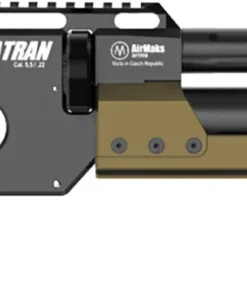
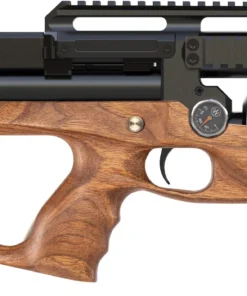
The AirMaks Arms KRAiT Long High Power is a regulated pre-charged pneumatic air rifle built around a compact bullpup layout, a long barrel, a large compressed-air reservoir, and an adjustable shooting platform. It belongs to the higher-output side of the KRAiT family and is designed differently from the standard Long configuration.
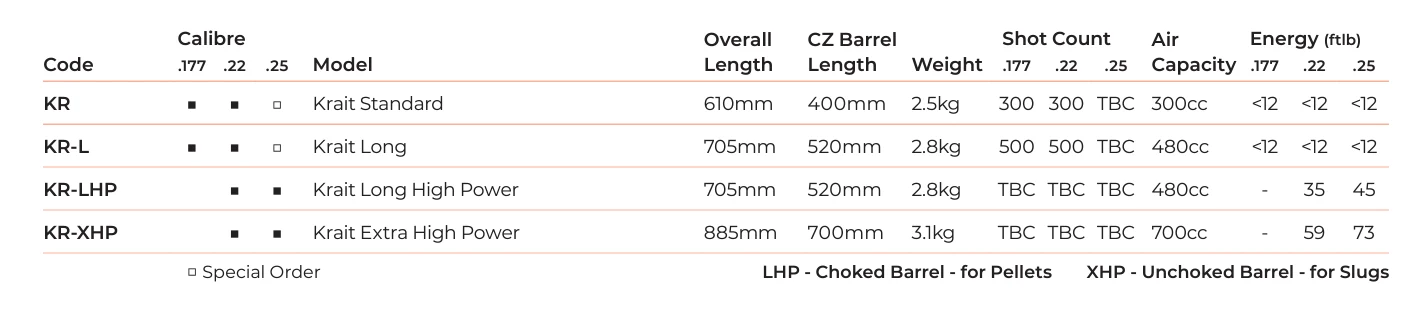
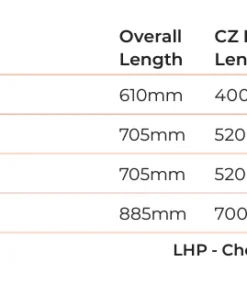
The High Power version is commonly associated with larger calibre options, a non-choked 520 mm barrel, and pneumatic components intended to support heavier projectiles. Because specifications may differ between generations and markets, the exact configuration of an individual rifle should always be verified from its model designation and factory documentation.
Which calibres are available?
The Long High Power platform is generally offered in .22, .25, and .30 calibre configurations.
The .22 version uses the smallest projectile diameter in the range and is often selected where a balance between projectile weight, air consumption, and trajectory characteristics is desired. The .25 version increases projectile diameter and mass, while the .30 configuration represents the largest standard calibre offered in this platform.
Magazine capacity can vary by calibre and model generation because larger projectiles require more magazine space.
What does High Power mean in the model name?
High Power identifies a specific configuration within the KRAiT family rather than one universal energy figure.
The designation generally reflects the use of a different barrel arrangement, larger calibre options, increased pneumatic capacity, and system components intended for higher-output operation compared with standard variants.
Actual muzzle energy can vary according to calibre, projectile weight, market restrictions, regulator setup, and factory configuration. Therefore, a single performance figure should not be assumed to apply to every rifle carrying the High Power designation.
What does FAC mean?
FAC stands for Firearm Certificate in the United Kingdom.
The term is frequently used when discussing air rifles that exceed the legal energy threshold for unrestricted ownership under UK law. However, FAC is a legal classification, not a technical feature of the rifle itself.
Licensing requirements differ between countries and sometimes between regions within the same country. A rifle that requires licensing in one jurisdiction may be classified differently elsewhere. Users should therefore confirm the applicable laws before possessing, transporting, or operating any high-output PCP air rifle.
Is the rifle regulated?
Yes, the platform uses a regulated PCP system.
A regulator helps control the pressure delivered from the main reservoir to the firing system. This can help maintain more consistent pneumatic behaviour over a useful portion of the reservoir’s pressure range.
Consistency is important in precision shooting because changes in pressure can affect projectile velocity and therefore point of impact. A regulator is only one part of the overall system, though. Barrel characteristics, projectile consistency, valve behaviour, and environmental conditions also influence performance.
What size air reservoir does it use?
The Long High Power configuration uses a large carbon-fibre air reservoir, with current versions commonly specified at approximately 580 cc.
The reservoir is designed to store high-pressure compressed air for the PCP system. A larger reservoir can reduce the frequency of refilling during longer range sessions, although the actual number of usable shots will depend heavily on calibre, operating pressure, projectile weight, and rifle configuration.
The reservoir must never be filled beyond the manufacturer’s specified maximum pressure.
What is the maximum filling pressure?
Current Long High Power configurations are commonly rated to a maximum of 300 bar.
Only filling equipment specifically designed for high-pressure PCP use should be connected to the rifle. This includes compatible cylinders, compressors, hoses, connectors, and pressure gauges.
The maximum pressure rating should never be treated as a target that must always be reached. Users should follow the rifle manufacturer’s filling instructions and ensure that all connected equipment is rated appropriately.





Reviews
There are no reviews yet.