AirMaks Arms Katran Pro Long Extra High Power – Precision-Oriented High-Power PCP Performance
The AirMaks Arms Katran Pro Long Extra High Power is designed for experienced airgun users who want a long-format PCP platform with advanced adjustability, substantial air capacity, and a configuration oriented toward high-energy shooting. Built around the Katran architecture, the rifle combines an adjustable PRS-style stock, a long CZ barrel, a regulated pneumatic system, and extensive accessory mounting space.
Although the exact retail name “Katran Pro Long Extra High Power” is not currently used on AirMaks’ official website, the closest factory configurations are the Katran NL HP long high-power model and the longer Katran NX HP extra-high-power model. The Katran NX HP, for example, uses a 700 mm non-choked CZ barrel, 285 cc cylinder, 120 cc plenum, and .22, .25, and .30 caliber options.
Built Around a Serious High-Power Platform
From the first shoulder position, a purposeful design can be recognized. Instead of being configured as a lightweight recreational air rifle, the platform has been developed around stability, adjustability, and high-output PCP performance.
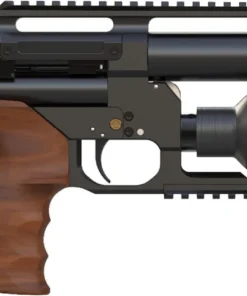
Furthermore, a rigid aluminium chassis is paired with an adjustable stock system so that a repeatable shooting position can be established. The cheek piece and butt pad can be repositioned to accommodate different users, optics, and supported shooting positions.
Additionally, the folding stock provides more convenient transport without requiring the long-barrel architecture to be sacrificed.
Because ergonomics can strongly affect consistency, numerous contact points can be adjusted rather than forcing every user into the same shooting position.
Long CZ Barrel Configuration
One of the defining characteristics of the Extra High Power configuration is its long barrel.
On the official Katran NX HP, a 700 mm non-choked CZ barrel is fitted. It has specifically been configured around higher-power applications and heavier projectiles. Meanwhile, the Katran NL HP uses a 520 mm non-choked CZ barrel.
Consequently, the longer configuration can be particularly attractive where higher projectile energy and extended-range performance are desired.
Rather than simply increasing the overall dimensions of the rifle, the longer architecture is combined with the pneumatic system, plenum, regulator, and hammer adjustment to produce a complete high-power platform.
Highlighted Product Features
- High-power PCP configuration
- Long precision CZ barrel architecture
- Available in .22, .25 and .30 caliber on factory HP models
- Regulated pneumatic operating system
- External velocity adjustment through the hammer-spring system
- Adjustable aluminium PRS-style stock
- Folding and length-adjustable stock system
- Height-adjustable cheek piece
- Height-adjustable butt pad
- Ambidextrous ergonomic grip
- Reversible side-lever cocking
- Ambidextrous AR15-style safety
- Fully adjustable sporting trigger on Pro configurations
- 20 MOA Picatinny optics rail
- ARCA/M-LOK accessory mounting capability
- Threaded muzzle for compatible moderator installation
- Large high-pressure air system
- Designed around stable supported shooting
Factory Katran HP specifications vary by model, so caliber, barrel length, cylinder capacity, plenum size, weight, and accessory configuration should always be matched to the exact version being sold.
High-Capacity Regulated PCP System
Power becomes more useful when it can be delivered consistently. Therefore, the pneumatic system forms an important part of the AirMaks Arms Katran Pro Long Extra High Power concept.
On the Katran NX HP, a 285 cc duralumin cylinder is rated for filling to 300 bar, while a substantial 120 cc plenum operates within a manufacturer-listed 150–200 bar range. The Katran NL HP instead combines a 200 cc cylinder with an 80 cc plenum.
This regulated architecture has been created to provide the controlled airflow required by high-power configurations.
Moreover, external velocity adjustment is provided through hammer-spring regulation. As a result, the platform offers a significant degree of setup flexibility.
Any tuning should, however, remain within manufacturer recommendations and applicable local law.
.22, .25 and .30 Caliber Capability
For AirMaks’ dedicated Katran HP platforms, three larger calibers are offered:
.22 / 5.5 mm
The .22 configuration provides a versatile combination of projectile selection, manageable air consumption, and higher-power capability.
Magazine capacity on the current Katran HP specifications is 16 rounds.
.25 / 6.35 mm
A larger .25 projectile can be selected when additional projectile mass is required.
Factory magazine capacity is listed at 14 rounds.
.30 / 7.62 mm
For the largest factory caliber offered on these Katran HP models, .30 caliber provides substantial projectile mass.
Magazine capacity is specified at 12 rounds.
Because local classifications and power restrictions differ significantly between countries, buyers should verify caliber and energy regulations before purchasing or operating any high-power PCP air rifle.
PRS-Inspired Adjustable Ergonomics
Comfort and repeatability have also been emphasized.
An aluminium folding stock is fitted to the Pro-style Katran HP configurations, while stock length can be altered to better suit the user’s shooting position. Furthermore, both the cheek piece and butt pad are height adjustable.
Therefore, positioning behind a large optic can be refined more precisely.
Similarly, an ambidextrous grip arrangement makes the platform suitable for both right- and left-handed users.
Rather than limiting the action to one operating side, the side lever can also be changed from right to left. The AR15-style safety is likewise reversible.
Fully Adjustable Trigger System
Precise shooting depends heavily on predictable trigger control.
For this reason, the Pro HP platform is equipped with an adjustable sporting trigger rather than a basic fixed mechanism. Trigger positioning and characteristics can consequently be tailored to user preference within the manufacturer’s recommended adjustment range.
A clean and repeatable trigger interface can be particularly valuable during supported precision shooting, where small disturbances can affect point of impact.
Moreover, the trigger system complements the rifle’s adjustable stock, cheek piece, butt pad, and pistol grip to create a highly configurable interface.
Optics and Accessory Integration
Modern PCP platforms are often configured around scopes, bipods, rests, and other shooting accessories. Accordingly, considerable mounting space has been incorporated.
A 20 MOA Picatinny rail is supplied on the Katran HP Pro models. This provides an optics mounting platform particularly suited to scopes intended for extended-distance adjustment.
Meanwhile, the long aluminium ARCA-style fore-end provides numerous M-LOK mounting points.
Consequently, compatible accessories can be positioned where they best suit the shooter’s setup.
Depending on configuration, equipment such as the following may be mounted:
- Scope
- Bipod
- Shooting rest interface
- Sling hardware
- Rail-mounted accessories
- M-LOK-compatible attachments
- ARCA-compatible support equipment
This modularity allows the rifle to be configured around different sporting and target disciplines.
High-Power Construction With Practical Adjustability
Despite its substantial performance orientation, user adjustability has not been overlooked.
The rifle’s balance can be supported through the longer fore-end, while the adjustable stock enables shoulder position to be refined. Furthermore, a supported shooting position can be established through ARCA or bipod equipment.
On the Katran NX HP, overall length is approximately 1,210 mm, reducing to about 965 mm when folded, while weight is listed at approximately 4.1 kg.
Therefore, the platform is more naturally suited to deliberate supported shooting than ultra-lightweight carrying.
For users who want a somewhat shorter HP platform, the Katran NL HP measures approximately 1,035 mm overall and 785 mm folded.
Threaded Muzzle and Moderator Compatibility
A 1/2-inch UNF muzzle thread is provided on the current Katran HP configurations. Therefore, compatible moderators can be fitted where their use is lawful.
Accessory legality varies by jurisdiction, however, so any moderator or related equipment should be selected and used in accordance with applicable regulations.
Designed for Experienced PCP Users
The AirMaks Arms Katran Pro Long Extra High Power concept is particularly well suited to experienced PCP shooters who value:
- Adjustable ergonomics
- Larger calibers
- High-pressure regulated operation
- Long-barrel performance
- Supported shooting stability
- Extensive accessory compatibility
- Ambidextrous controls
- High-energy factory configurations
Furthermore, the combination of a reversible cocking lever, adjustable stock, adjustable cheek piece, configurable butt pad, modular fore-end, and precision-oriented trigger creates a platform that can be adapted rather than merely accepted in one factory position.
A Premium Long-Format Katran Configuration
Ultimately, the AirMaks Arms Katran Pro Long Extra High Power brings together the qualities that define AirMaks’ long high-power Katran architecture: strong pneumatic capacity, large-caliber compatibility, precision CZ barrels, advanced ergonomics, and comprehensive adjustment.
Instead of focusing solely on maximum output, the platform has been engineered so that power can be combined with control and repeatability.
For buyers seeking a serious long-format PCP platform, the Katran HP family provides an extensive set of features while preserving the modular character for which the Katran series is known.
Whether a .22, .25, or .30 configuration is selected, the result is a sophisticated PCP platform designed around precision-oriented shooting, substantial adjustability, and high-power capability.
Important: exact specifications should be listed according to the precise factory variant being sold, because AirMaks currently separates its long HP models into configurations such as the Katran NL HP and Katran NX HP, rather than listing one model under the exact phrase “Katran Pro Long Extra High Power.”
AirMaks Arms Katran Pro Long Extra High Power Calibres, FAC, Power and Accessories
The AirMaks Arms Katran Pro Long Extra High Power has been developed around larger-calibre PCP performance, substantial pneumatic capacity, and a highly configurable accessory platform. Rather than being limited to one shooting format, the rifle can be configured around different projectile weights, optics, shooting supports, and ergonomic requirements. Consequently, experienced PCP users are provided with a platform that combines considerable power potential with practical adjustment and precision-oriented control.
Available Calibres
The high-power Katran platform is offered in three principal calibres: 5.5 mm (.22), 6.35 mm (.25), and 7.62 mm (.30). These larger calibres distinguish the HP configuration from lower-powered Katran variants, where .177 calibre may also be offered.
.22 / 5.5 mm Calibre
The .22 calibre provides a versatile balance between projectile weight, air consumption, trajectory, and magazine capacity. It can therefore be considered an adaptable choice for precision target shooting and other lawful sporting applications.
A 16-shot magazine is specified by AirMaks for the .22 Katran HP configuration.
Because numerous pellet and slug weights are available in .22 calibre, projectile selection can be matched to the intended shooting discipline and the rifle’s approved setup.
.25 / 6.35 mm Calibre
For users requiring increased projectile mass, the .25 calibre provides another factory-supported option. Additional retained energy can be achieved through heavier ammunition, while the rifle’s large plenum and regulated air system have been designed to support high-power operation.
The factory magazine accommodates 14 rounds in .25 calibre.
This calibre can be particularly appealing to shooters seeking a middle ground between the versatile .22 configuration and the substantially heavier .30-calibre platform.
.30 / 7.62 mm Calibre
At the upper end of the Katran HP range, .30 calibre provides the greatest projectile diameter and typically accommodates much heavier ammunition.
A 12-shot magazine is provided for the .30 configuration.
Because larger projectiles generally require considerably more compressed air, the rifle’s enlarged pneumatic architecture becomes especially important when this calibre is selected.
FAC and High-Power Configuration
The term FAC is commonly used in markets where air rifles above a specified legal energy threshold require firearm-style licensing or additional authorization. However, the actual legal definition and permitted energy level depend entirely on the jurisdiction in which the rifle is possessed or used.
Therefore, an AirMaks Arms Katran Pro Long Extra High Power should never be assumed to have one universal FAC specification.
Instead, the rifle should be supplied and operated according to the legislation applying in the buyer’s country or region.
The HP versions are factory-engineered specifically for elevated power output. For example, AirMaks equips the Katran NX HP with a 700 mm non-choked CZ barrel, a 285 cc air cylinder, and a substantial 120 cc plenum. The shorter NL HP uses a 520 mm non-choked barrel, 200 cc cylinder, and 80 cc plenum.
These components provide the pneumatic foundation required for larger calibres and heavier projectiles.
Power Delivery and Regulation
A regulated PCP system is used so compressed air can be delivered in a controlled manner.
On the Katran NX HP, the air cylinder is rated to a maximum filling pressure of 300 bar, while its 120 cc plenum operates within AirMaks’ stated 150–200 bar range.
Furthermore, external velocity regulation is provided through the hammer-spring adjustment system.
This feature allows the rifle’s performance to be matched appropriately to the approved ammunition and legal configuration. However, adjustment should always remain within manufacturer specifications and applicable regulations.
The long non-choked CZ barrel is another important element of the Extra High Power design. Unlike a barrel optimized exclusively around conventional pellets, the non-choked configuration is specifically associated by AirMaks with heavier-projectile and high-power applications.
Optics and Scope Accessories
A 20 MOA Picatinny optics rail is supplied on the Katran HP platform.
Consequently, a broad selection of compatible optical equipment can be fitted, including:
- Precision telescopic sights
- Variable-magnification scopes
- Picatinny scope rings
- Scope levels
- Compatible rangefinding equipment
- Optical sunshades
- Lens protection accessories
Correct mounting should always be maintained so the optic remains secure and appropriately aligned.
ARCA and M-LOK Accessories
Accessory compatibility is one of the major advantages of the Pro configuration.
The Katran NX HP uses an aluminium ARCA rail with 30 M-LOK slots, creating extensive space for shooting-support equipment and other compatible accessories.
Suitable additions can include:
- ARCA-compatible bipods
- M-LOK bipod adapters
- Shooting-rest attachments
- Sling mounting hardware
- Hand stops
- Rail sections
- Support bags and bag riders
- Compatible shooting-tripod interfaces
Because accessory placement can be adjusted, overall balance and shooting position can be personalized.
Moderator Compatibility
A 1/2-inch UNF muzzle thread is provided by AirMaks on the Katran NX HP and NL HP.
Where legally permitted, this allows a compatible airgun moderator to be attached.
Thread compatibility, projectile clearance, calibre rating, and local restrictions should always be confirmed before any muzzle accessory is installed.
Additional Recommended Accessories
A complete setup can also be supported by practical PCP equipment such as:
- High-pressure filling cylinder
- Suitable PCP compressor
- Correct filling adapter
- Spare magazines
- Protective rifle case
- Pellet or slug storage containers
- Cleaning equipment approved for airgun barrels
- Scope covers
- Shooting bags
- Bipod or tripod
- Sling
- Chronograph for lawful performance verification
- Replacement O-rings and manufacturer-approved service items
Ultimately, the AirMaks Arms Katran Pro Long Extra High Power combines .22, .25, and .30 calibre capability with a large regulated pneumatic system and an extensive accessory interface. Its long non-choked CZ barrel, 300-bar air system, adjustable operating architecture, 20 MOA optics rail, ARCA fore-end, and M-LOK mounting points make it a highly adaptable high-power PCP platform for experienced users who require precision, modularity, and configuration flexibility.
AirMaks Krait, Katran PCP Air Rifles, Umarex Airguns, Pest Control and Shooting Systems
The world of AirMaks Krait, AirMaks Katran, PCP air rifles, and modern airgun systems continues to attract shooters interested in precision, hunting, target practice, and pest control applications. Buyers searching for what is a PCP air rifle, what does PCP air rifle mean, what is a PCP airgun, what is a PCP air gun, or what are PCP air rifles are generally looking for information about pre-charged pneumatic technology. A PCP air rifle uses stored compressed air to deliver consistent power, accuracy, and repeatable shot performance compared with traditional spring-powered systems.
AirMaks Krait PCP Air Rifle and Katran Air Rifle Platforms
The AirMaks Krait is a modern PCP platform designed for shooters who want accuracy, compact handling, and adjustable performance. Searches such as AirMaks Krait, Air Max Krait, AirMaks Krait .22, AirMaks Krait .22 official, AirMaks Krait PCP, AirMaks Krait air rifle, and Krayt30 are commonly associated with this rifle family.
The AirMaks Katran represents another popular PCP air rifle platform from AirMaks. Search terms including AirMaks Katran, AirMaks Katran .22, Katran air rifle, Katran PCP rifle, and Katran LLC relate to shooters researching compact and high-performance pneumatic rifles. These platforms are often compared by buyers looking for precision shooting, hunting capability, and reliable air delivery systems.
PCP Air Rifles, Compressed Air Systems and Technology
A PCP rifle works by storing compressed air inside an onboard reservoir before releasing controlled air pressure to propel a pellet. Searches such as PCP rifle meaning, PCP air rifle meaning, PCP guns, PCP rifle, compressed air rifle, compressed air guns, air powered rifle, and komprimiran zrak all relate to pneumatic shooting technology.
Charging equipment is also an important part of PCP ownership. Many shooters search for PCP hand pump, PCP air compressor, air compressor rifle, and accessories designed to refill PCP reservoirs safely and efficiently.amazon umarex browning 800 express
Air Rifle Pest Control and Vermin Control Applications
Many shooters research air rifle for pest control, air rifle pest control, pest control with air rifles, best air rifle for pest control, pellet gun for pest control, and best pellet gun for pest control when looking for suitable equipment for lawful pest management.
Products such as AirMaks Krait and AirMaks Katran may appear in searches related to vermin control guns, vermin control air rifles, and accurate pellet shooting platforms because PCP rifles can offer consistent velocity, adjustable power settings, and precision accuracy when used responsibly.max arms
Umarex Airguns, Air Rifles and CO2 Platforms
The Umarex brand is widely searched by enthusiasts looking for recreational airguns, training platforms, and replica-style products. Popular searches include Umarex USA, UmarexUSA, Umarex airguns, Umarex air rifles, Umarex Notos, Umarex Gauntlet, Umarex Gauntlet 2, Umarex Gauntlet 30, Umarex Hammer, Umarex Hammer .50 caliber, and Umarex Hammer Carbine.hamster with gun
Other frequently searched Umarex models include Umarex Origin, Umarex Primal 20, Umarex Zelos, Umarex Fusion 2, Umarex Komplete, Umarex Komplete NCR .22, Umarex Air Saber, Umarex Airsaber, Umarex Trevox, Umarex MP40, Umarex MP5, Umarex Legends, Umarex T4E, Umarex HDR 50, and Umarex TR50..umarex pistol break barrel.umarex hk heckler
BB Guns, Pellet Pistols and Airsoft Replica Searches
Alongside rifles, many customers search for compact air-powered platforms including BB guns, BB gun pistols, pellet pistols, and CO2 pellet pistols. Related searches include metal BB gun, CO2 pistol replica, airsoft pistol, airsoft Glock, airsoft Glock 17, airsoft Glock 19, Glock BB gun, Glock airsoft gun, and Glock air pistol.czech gun manufacturers.airmaxsex
Umarex replica searches frequently include Umarex Glock, Umarex Glock 17, Umarex Glock 17 Gen 5, Umarex Glock 19, Umarex Glock 19X, Glock 19 BB gun, and Glock 19X BB gun.arm max.umarex notos carbine
Practical Use Scenarios
A high-performance PCP platform can be valuable across several lawful shooting environments because its adjustable ergonomics, stable chassis, substantial air capacity, and modular accessory system allow it to be configured for different users and disciplines. Rather than being limited to one type of shooting, the rifle can be adapted for recreational target work, formal range practice, precision-oriented sessions, equipment testing, and other sporting applications where local regulations permit its use.
Because the rifle is built around a longer platform, a regulated pneumatic system, and extensive adjustment options, it is especially well suited to shooters who prefer deliberate, supported shooting rather than lightweight snap shooting. Consequently, its strongest practical applications are generally found where stability, repeatability, consistency, and careful shot placement are prioritized.
Precision Target Shooting
One of the most natural applications is precision target shooting.
When a shooter is working from a bench, shooting table, supported rest, or similar stable position, the rifle’s adjustable stock and fore-end configuration can help establish a consistent shooting posture. A repeatable cheek position can be maintained, while the butt pad can be adjusted so the rifle sits more naturally against the shoulder.
Furthermore, an optic can be positioned to provide comfortable eye relief without forcing the shooter’s head into an awkward position.
This type of setup can be particularly useful during longer target sessions because small ergonomic improvements can reduce unnecessary movement and help the shooter maintain a more consistent position.
A bipod, shooting bag, or compatible rest can also be incorporated where permitted. As a result, the rifle can be supported more effectively while groups are being evaluated at different distances.
Target shooting can also be used to assess different legal projectile options. Rather than changing several variables at once, shooters can compare accuracy on paper targets while maintaining the same supported position and shooting conditions.
Benchrest-Style Shooting
Benchrest-style use is another practical scenario where the rifle’s longer format can be advantageous.
Because the rifle is intended to be used with a stable pneumatic system and adjustable shooting interface, it can be positioned securely on front and rear supports. This allows the shooter to concentrate more closely on sight picture, breathing, trigger control, and consistency.
The fore-end can be supported with a compatible shooting bag or rest, while the adjustable rear section can be configured around the individual shooter’s preferred body position.
When repeatability is the objective, reducing unnecessary movement becomes especially important. Therefore, a structured bench setup can be used to evaluate how consistently the rifle and ammunition combination performs over repeated strings.
For recreational shooters, this style of use can also provide a useful way to develop disciplined shooting habits before progressing to more demanding unsupported positions.
Long-Range Recreational Target Practice
Where appropriate facilities and local laws allow it, the rifle can also be used for extended-distance recreational target shooting.
A longer-range target session generally places greater emphasis on understanding projectile behavior, environmental conditions, stable positioning, and accurate range estimation. Therefore, a precision optic, stable shooting support, and clearly defined target area can become particularly useful.
Steel targets, paper targets, and reactive targets designed specifically for airgun use can all provide feedback during these sessions, provided that the shooting area is properly managed and suitable backstops are used.
As distance increases, consistency becomes more important because small variations in hold, wind, ammunition, or shooting position can produce more visible changes at the target.
For this reason, extended-distance practice can be used as a controlled training environment where the shooter develops better consistency without relying on unnecessary speed.
Formal Range Use
A dedicated shooting range is one of the safest and most structured environments in which the rifle can be used.
At an organized range, established firing points, target lanes, backstops, and safety procedures are normally provided. Consequently, the shooter can focus on technique while operating within a controlled setting.
Before shooting begins, range rules should be reviewed carefully because individual facilities may have different restrictions concerning muzzle energy, projectile types, moderators, filling equipment, target materials, or shooting distances.
The rifle’s adjustable controls can make it suitable for different range formats. A more compact support arrangement can be used for standard paper targets, while a bipod or rest may be selected for precision-oriented lanes.
Because the platform can be adapted to different shooting positions, it can also be useful for shooters who participate in structured practice sessions involving seated, kneeling, standing, or supported positions where those disciplines are permitted.
Recreational Plinking
Although the rifle is built around serious performance characteristics, it can also be used for responsible recreational plinking.
Safe reactive targets can make informal target sessions more engaging while still requiring careful control and disciplined shot placement.
Suitable airgun-rated targets can be placed in front of a secure backstop, and shooting distances can be adjusted according to the available range and legal requirements.
Because the rifle can support optics and accessories, casual shooting does not have to mean poorly controlled shooting. Instead, recreational practice can be used to improve fundamentals while keeping the session enjoyable.
Targets should always be positioned so that projectiles cannot leave the designated shooting area. Hard, unpredictable surfaces should be avoided because ricochet risks can be increased.
Equipment and Ammunition Evaluation
Another practical use involves systematic equipment testing.
Different projectiles, magazines, optics, shooting supports, and ergonomic settings can be compared under controlled conditions. When one variable is changed at a time, the shooter can better understand which configuration produces the most comfortable and repeatable results.
For example, a shooter may compare how different approved pellet or slug designs group on paper while maintaining the same shooting position and distance.
Likewise, different scope positions, cheek-piece settings, or rear-stock adjustments can be tested until a natural sight picture is achieved.
Accessory placement can also be evaluated. A bipod positioned too far forward or too far rearward may affect comfort and balance, while a sling or support attachment may need to be repositioned to suit the user’s preferred stance.
This type of structured testing can help create a setup that feels natural rather than one that simply uses every available accessory.
Chronograph and Consistency Testing
A chronograph can be used as a diagnostic tool to evaluate the consistency of a PCP air rifle.
During lawful range testing, a series of shots can be measured to determine whether velocity is being delivered consistently. This information can be helpful when assessing ammunition compatibility, maintenance requirements, or whether the rifle is operating within the legal limit applicable to the shooter’s location.
Chronograph testing is especially useful after routine servicing or when a different approved projectile is introduced.
However, the purpose should be verification and safe operation rather than exceeding legal or manufacturer-defined limits.
Records can be kept so that unusual changes are easier to identify over time. If performance suddenly becomes inconsistent, professional inspection may be appropriate.
Club Shooting and Organized Practice
The rifle can also fit naturally into an organized club environment.
Shooting clubs often provide structured practice conditions, experienced supervision, established safety procedures, and opportunities to compare techniques with other shooters.
Because the rifle offers adjustable ergonomics, it can be configured for different shooting positions without permanently modifying the platform.
A shooter may therefore use one configuration for supported precision practice and another for a more traditional seated or standing position.
Club environments can also be particularly useful for new owners of high-powered PCP equipment because experienced shooters can provide guidance on range etiquette, safe handling, maintenance routines, and filling procedures.
Developing Consistent Shooting Technique
Regular practice can be used to develop several fundamental skills.
Trigger control can be refined by concentrating on smooth operation rather than sudden movement. Breathing technique can also be practiced so that shots are released during a stable part of the breathing cycle.
Similarly, a repeatable cheek position and shoulder contact can be developed.
These fundamentals become especially important when precision is being pursued because even a highly capable rifle cannot compensate for inconsistent technique.
A stable shooting platform therefore works best when it is paired with disciplined handling and regular practice.
Supported Field-Style Target Practice
Where legal and safely organized, field-style target courses can provide another useful environment.
Targets can be placed at different distances and heights so that the shooter must adapt position and optic use while remaining within a controlled shooting lane.
Natural-looking target environments can make practice more interesting without requiring live quarry.
A bipod, shooting sticks, or other legal support equipment can be incorporated depending on the rules of the range or competition.
This type of practice can help shooters become more comfortable moving between different shooting positions while maintaining safe muzzle control and awareness of the target area.
Lawful Pest-Control Contexts
In some jurisdictions, suitable air rifles may be legally used by authorized people for certain pest-control tasks. However, such use is highly dependent on local law, landowner permission, species regulations, licensing requirements, minimum competence standards, and appropriate equipment selection.
Where pest control is legally permitted, humane shot placement, positive identification, a safe backstop, and realistic distance limitations become critical.
The rifle should never be selected merely because it is powerful. Instead, the equipment, projectile, distance, and shooting position must all be appropriate to the lawful task being performed.
Local wildlife and firearms regulations should therefore be confirmed before any pest-control activity is considered.
Training With Different Shooting Positions
The adjustable design can also be useful for position-based training.
Bench, seated, prone, kneeling, and standing positions place different demands on the shooter. By practicing several positions, a more complete understanding of balance and stability can be developed.
The rifle’s stock adjustments can be refined so that the same fundamental sight alignment is maintained across different positions.
This can be especially helpful for shooters who participate in competitions or structured club events where multiple firing positions are required.
Optics Setup and Familiarization
A newly installed scope often requires practical familiarization.
Rather than immediately using the rifle for challenging shooting, the user can begin with controlled paper-target sessions.
Eye relief, reticle visibility, magnification preference, turret operation, and general comfort can be evaluated during these sessions.
The goal should be a natural shooting position where the shooter can obtain a full sight picture without excessive head movement.
Once the optic has been properly mounted and verified, repeated practice can help the user become familiar with its controls.
Recreational Competition
The rifle may also be used in competitive environments where its configuration complies with the relevant rules.
Different competitions impose different restrictions regarding power, calibre, optics, rifle dimensions, weight, supports, and accessories.
Therefore, the rulebook for the specific discipline should always be checked before the rifle is configured.
Competition can provide a structured way to measure progress because results can be compared over time.
Rather than focusing only on equipment, competitive practice encourages better preparation, concentration, timing, and shooting discipline.
Training New PCP Users
Experienced shooters may also use the platform in a controlled environment to introduce another competent adult to PCP shooting.
Before live firing begins, safe handling, loading procedures, air-system precautions, muzzle awareness, trigger discipline, and range commands should be explained clearly.
The rifle’s adjustable ergonomics can then be adapted to the new user’s body size and preferred position.
However, high-powered configurations should only be handled by people who are legally permitted, properly supervised where required, and familiar with the additional responsibilities associated with greater projectile energy.
Maintenance Verification Sessions
After cleaning, seal replacement, professional servicing, or other routine maintenance, a short verification session can be carried out.
Paper targets can be used to confirm that accuracy remains stable, while a chronograph can be used to check consistency and legal compliance.
The rifle should also be inspected for secure fasteners, proper magazine operation, reliable safety function, and correct accessory mounting.
A maintenance verification session is particularly useful because small mechanical or mounting issues can be identified before a longer shooting session begins.
Practical Ownership and Responsible Use
Ultimately, the most effective practical use of a high-powered PCP rifle depends on disciplined ownership.
A suitable case should be used for transport, while ammunition and accessories should be stored responsibly. Compressed-air filling equipment must also be handled according to manufacturer instructions because high-pressure systems require appropriate care.
Before every session, local laws, land permissions, range rules, and safe shooting conditions should be confirmed.
When used responsibly, the rifle can serve as a versatile platform for precision target practice, recreational shooting, competition preparation, equipment testing, chronograph verification, club shooting, and other lawful sporting activities.
Its greatest advantage lies not simply in power, but in the ability to combine adjustability, stability, modularity, and repeatability within one adaptable PCP platform.
Air Rifle Shooting, Accuracy and Performance
Modern shooters compare airguns based on accuracy, power delivery, ammunition compatibility, and intended use. Searches for accurate pellet rifle, powerful air rifle, air rifle online, air rifle dealers, air gun makers, air gun manufacturers, and best airguns reflect the growing interest in precision pneumatic systems.airrams.uramax
Whether researching an AirMaks Krait, AirMaks Katran, Umarex air rifle, or another PCP platform, buyers should consider caliber selection, air capacity, regulator performance, barrel quality, available accessories, maintenance requirements, and local regulations before choosing a system.akatran.mav max.umarex glock 19 gen3 .177 caliber bb gun air pistol.max air gun.gunmax
Frequently Asked Questions
What type of air rifle is this?
This is a high-performance pre-charged pneumatic air rifle designed around a regulated compressed-air system. It is built for shooters who want substantial adjustability, strong pneumatic capacity, long-barrel performance, and compatibility with modern optics and shooting accessories. Its configuration is particularly well suited to precision-oriented recreational shooting, target work, and other lawful sporting applications.
What calibres are available?
The high-power configurations are commonly offered in .22 / 5.5 mm, .25 / 6.35 mm, and .30 / 7.62 mm. Each calibre provides a different balance of projectile weight, air consumption, magazine capacity, and intended shooting characteristics.
The .22 version generally offers the highest magazine capacity and broad ammunition availability. The .25 version provides a useful middle ground, while the .30 version is intended for shooters who prefer heavier projectiles and a larger bore.
Actual calibre availability can vary according to market and dealer stock.
Is this an FAC or high-power model?
Yes. This configuration is intended as a high-power version rather than a low-energy or sub-limit model.
However, the legal meaning of FAC varies by country. In the United Kingdom, for example, an air rifle exceeding the statutory power threshold generally requires the appropriate firearm certificate. Other countries use different licensing systems, classifications, or power restrictions.
Therefore, buyers should always confirm the legal requirements that apply in their own jurisdiction before ordering, possessing, transporting, or using the rifle.
Is there one fixed power level?
No. A single universal power figure should not be assumed.
Performance can vary according to calibre, projectile type, projectile weight, regulator setup, factory configuration, environmental conditions, and the specific market version being supplied.
Because of these variables, the most reliable approach is to check the specification of the exact rifle being offered rather than relying on a generic power claim.
Is the rifle regulated?
Yes. A regulated pneumatic system is used to help control the delivery of compressed air between shots.
Regulation can contribute to more consistent shot strings because pressure supplied to the firing system is managed rather than being drawn directly from the full cylinder pressure.
Consistency remains dependent on correct maintenance, suitable ammunition, proper filling, and an appropriate factory setup.
What is the maximum fill pressure?
High-power Katran configurations can use air cylinders rated for filling pressures of up to 300 bar, depending on the exact model.
Only suitable high-pressure filling equipment should be used. The fill system, hose, fittings, and charging source must all be rated appropriately.
The manufacturer’s recommended filling procedure should always be followed because compressed-air systems operate under substantial pressure.
Can it be filled using a PCP compressor?
Yes, provided that a suitable high-pressure PCP compressor is used.
The compressor should be capable of safely reaching the required pressure and should incorporate appropriate moisture management and filtration.
A high-pressure air cylinder can also be used when it is equipped with compatible fittings and has been properly tested and maintained.
Ordinary workshop air compressors are not suitable for filling PCP rifles because they are not designed to provide the pressure required.
Does it use a long barrel?
Yes. Long high-power variants are built around extended barrel configurations.
The longer barrel supports the overall performance-oriented design while also contributing to the rifle’s extended physical profile.
Exact barrel length depends on the specific version, so buyers should verify whether they are purchasing a Long HP, NX HP, NL HP, or another factory configuration.
Is the barrel choked?
High-power long configurations may use a non-choked CZ barrel.
This type of barrel arrangement is associated with the manufacturer’s higher-power platforms and can be compatible with a broad range of suitable projectiles.
Projectile compatibility should nevertheless be tested carefully because different rifles can show preferences for particular pellet or slug designs.
Can pellets and slugs both be used?
Depending on the calibre and exact barrel configuration, both pellets and suitable airgun slugs may be compatible.
However, not every projectile will perform equally well in every rifle.
Different projectile weights, diameters, materials, and profiles can produce noticeably different accuracy and consistency.
For this reason, testing should be carried out using safe paper targets and controlled shooting conditions.
How many shots does the magazine hold?
Magazine capacity depends on calibre.
Typical high-power configurations use approximately:
- 16 rounds in .22 / 5.5 mm
- 14 rounds in .25 / 6.35 mm
- 12 rounds in .30 / 7.62 mm
Capacity can vary if different magazine generations or accessories are used, so the supplied magazine should be checked before purchase.
Is the cocking lever reversible?
Yes. The side-lever system can be configured for right- or left-side operation on compatible versions.
This feature is particularly useful for left-handed shooters or anyone who prefers a different loading arrangement.
A reversible action also contributes to the rifle’s adaptable design because the operating controls can be better matched to the individual user.
Is it suitable for left-handed shooters?
Yes. Several ergonomic features make the platform suitable for both right- and left-handed use.
The side lever can be repositioned, while the grip and stock design are intended to provide a relatively ambidextrous shooting interface.
Individual comfort can be improved further through adjustment of the stock, cheek piece, and butt pad.
Is the stock adjustable?
Yes. Pro-style configurations typically feature a highly adjustable aluminium stock.
Length can be altered, while the cheek piece and butt pad can also be repositioned.
These adjustments allow the rifle to be better matched to the shooter’s body size, optic height, shooting position, and preferred shoulder placement.
A properly adjusted stock can improve comfort and help promote a repeatable head position.
Does the stock fold?
Yes. Folding stock capability is available on the relevant high-power Pro configurations.
The folding mechanism can make the rifle more convenient to transport and store because its overall length is substantially reduced when folded.
The rifle should always be unloaded and handled according to local transport and storage laws.
What type of scope can be fitted?
A wide range of precision optics can be fitted using the integrated Picatinny mounting system.
Variable-magnification scopes are commonly chosen because they provide flexibility across different target distances.
The correct ring height should be selected so that the shooter can obtain proper eye relief while maintaining comfortable contact with the cheek piece.
Very large optics can increase overall weight, so balance should also be considered when building the setup.
What does the 20 MOA rail do?
A 20 MOA rail introduces a slight built-in angle between the rifle and optic.
This can provide additional elevation adjustment for shooters using scopes over extended target distances.
It does not automatically increase accuracy. Instead, it gives the optic greater usable adjustment range when properly configured.
Can a bipod be attached?
Yes. Bipods can be mounted through compatible ARCA, M-LOK, or adapter systems depending on the exact configuration.
A bipod can be particularly useful for bench shooting, supported target practice, and other situations where a stable front support is desired.
The bipod should be mounted securely without interfering with the barrel, air cylinder, or controls.
Does it support M-LOK accessories?
Yes. Pro-style fore-ends can provide multiple M-LOK mounting positions.
Compatible accessories may include bipod adapters, sling points, rail sections, hand stops, and other shooting-support equipment.
Only accessories that are suitable for airgun use and compliant with local regulations should be installed.
What is the ARCA rail used for?
The ARCA-style fore-end allows the rifle to interface with compatible shooting rests, bipods, tripods, and precision-support equipment.
One of its advantages is that supported accessories can often be repositioned along the rail without requiring permanent modifications.
This makes it useful for shooters who regularly switch between bench, tripod, and bipod configurations.
Can a moderator be fitted?
Compatible high-power models can include a 1/2-inch UNF threaded muzzle, allowing an appropriately rated airgun moderator to be attached where legal.
The moderator must be suitable for the chosen calibre and must provide adequate projectile clearance.
Because moderator laws vary widely between jurisdictions, local regulations should be checked before purchase or installation.
Is it suitable for long-range target shooting?
It can be well suited to extended-distance target shooting when used in an appropriate environment.
The long barrel, adjustable ergonomics, optics mounting system, stable chassis, and supported shooting options can all contribute to precision-oriented use.
However, performance at distance depends heavily on ammunition selection, environmental conditions, optic setup, user skill, and consistent technique.
A safe shooting range and adequate backstop are essential.
Is it suitable for benchrest shooting?
Yes. Benchrest-style shooting is one of the environments where the rifle’s design can be particularly useful.
Its adjustable stock, long fore-end, accessory mounting options, and compatibility with bipods or shooting bags can help establish a stable position.air arm.50 cal air rifle
For repeatable accuracy, the same shoulder pressure, head position, trigger technique, and support arrangement should be maintained from shot to shot.
Can it be used for competition?
Potentially, yes.
Whether it can be used in a specific competition depends entirely on the rules of that discipline.
Some competitions restrict calibre, muzzle energy, rifle dimensions, overall weight, optics, bipods, or other accessories.
The applicable rulebook should therefore be checked before the rifle is configured for competitive use.
Is it suitable for recreational plinking?
Yes, provided that an appropriate shooting environment is used.
Airgun-rated targets, paper targets, and suitable reactive targets can be used in front of a secure backstop.
Because high-power PCP rifles can carry considerably more energy than basic recreational airguns, casual shooting still requires disciplined handling and careful target placement.air marks
Can it be used for pest control?
That depends on local law, licensing requirements, species regulations, landowner permission, and whether the rifle and projectile are appropriate for the lawful task.umarex smith
Where pest control is permitted, humane shot placement and a safe backstop are essential.
The rifle’s power alone should never be treated as justification for taking an unsuitable shot or engaging an inappropriate species.
How loud is it?
Sound levels vary according to calibre, power configuration, projectile type, barrel length, and whether a suitable moderator is legally fitted.
High-power PCP rifles can produce a noticeable muzzle report.
Shooters using indoor or enclosed ranges should follow the facility’s hearing-protection guidance.
Is a chronograph recommended?
Yes. A chronograph can be useful for checking consistency and confirming that the rifle remains within applicable legal limits.
It can also help identify unusual changes in performance after maintenance or when a different projectile is introduced.
The chronograph should be treated as a verification tool rather than as a means of chasing maximum output.
What accessories should be considered essential?
A practical setup may include a suitable scope, compatible mounts, filling equipment, spare magazines, a protective rifle case, approved projectiles, and basic maintenance supplies.
A bipod, chronograph, shooting bags, sling, scope covers, and additional rail accessories may also be useful depending on the intended application.
Accessory selection should be based on function rather than simply adding unnecessary weight.
Is maintenance difficult?
Routine ownership is generally straightforward when the manufacturer’s recommendations are followed.
External surfaces should be kept clean and dry, the barrel should only be cleaned when necessary, seals should be inspected periodically, and the air system should be treated carefully.umarex t4e smith.umarex bb gun
Complex internal work should be carried out by a competent technician because regulated high-pressure systems require specialized knowledge.airsoft pistol.umarex dx17
How should it be stored?
The rifle should be unloaded, depressurized only when the manufacturer recommends it, and stored securely in accordance with local law.
A padded hard or soft case can protect the finish during transport, while long-term storage should take place in a dry environment.
Access should be restricted where required by law, particularly in households where unauthorized people could otherwise reach the rifle.
Who is this rifle best suited to?
It is best suited to experienced PCP users who value adjustability, larger-calibre options, precision-oriented ergonomics, modern accessory compatibility, and substantial pneumatic capacity.umarex synergis elite.umarex shotgun.bbgun
The platform can be particularly appealing to shooters interested in target shooting, benchrest-style practice, recreational competition, equipment testing, and other lawful high-performance airgun applications.umarex p2p dr50 how many joules.loading umarex trevox break barrel .177.glock airsoft gas
For newer shooters, professional instruction or experienced supervision can be beneficial before operating a high-power PCP platform.




Reviews
There are no reviews yet.