AirMaks Arms KRAiT Lite Standard – Lightweight PCP Air Rifle Overview
The AirMaks Arms KRAiT Lite Standard has been developed as a compact, lightweight PCP air rifle that combines adjustable ergonomics, regulated pneumatic operation, and a highly configurable design. Rather than being built around excessive bulk, the platform has been designed so that comfortable handling and adaptable positioning can be maintained across different sporting and target-shooting environments.
At the heart of the rifle, a pre-charged pneumatic system is used. Consequently, compressed air is stored and managed through a regulated system so consistent operation can be supported from shot to shot. Furthermore, a Huma-Air regulator has been incorporated into the design, while a 60 cc plenum configuration is featured.
Because the AirMaks Arms KRAiT Lite Standard has been produced with both right- and left-handed operation in mind, several controls can be repositioned. As a result, the rifle can be adapted more easily to different users without forcing everyone into exactly the same operating position.
AirMaks Arms KRAiT Lite Standard Design and Construction
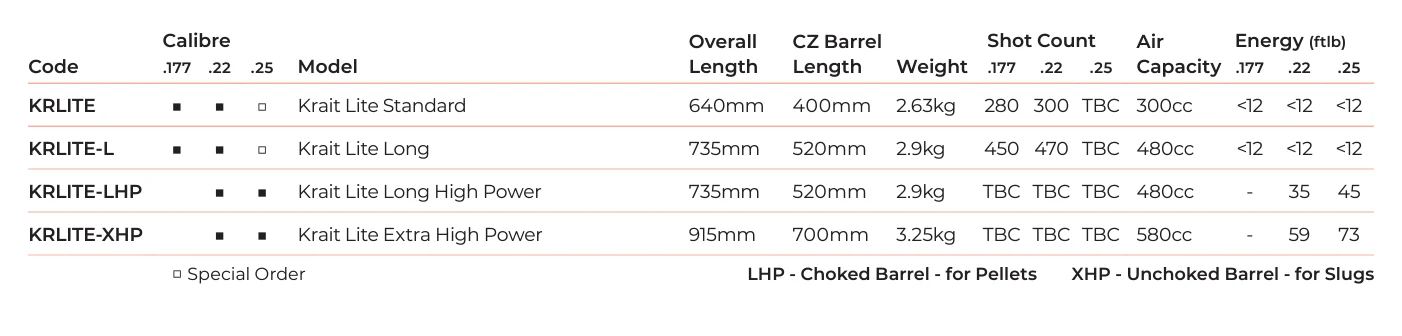
A compact overall configuration has been chosen for the KRAiT Lite Standard. Its overall length is commonly listed at approximately 640 mm, while its weight is approximately 2.63 kg. A 400 mm barrel is also listed for the Standard configuration.
Therefore, a relatively short and manageable PCP platform is provided without removing the principal adjustment features expected from the KRAiT series.
A walnut stock is specified by several current retailers, and an ambidextrous configuration has been incorporated. In addition, the cheekpiece can be adjusted in height. The butt pad can also be adjusted for both height and length, allowing the contact points between the rifle and user to be configured more precisely.
Comfort is further supported by an AR15-style grip arrangement.
Adjustable Ergonomics
Instead of relying on one fixed stock position, several ergonomic adjustments have been provided.
These include:
- Height-adjustable cheekpiece
- Length-adjustable butt pad
- Height-adjustable butt pad
- Ambidextrous stock configuration
- AR15-style grip
- Changeable right- or left-side cocking lever
- Changeable right- or left-side safety control
- Two-stage adjustable trigger
Accordingly, a repeatable head position and shoulder position can be established more easily.
PCP System and Regulated Performance
Compressed air is used as the power source in the AirMaks Arms KRAiT Lite Standard. Because the rifle belongs to the PCP category, an air reservoir is filled before use rather than being compressed individually for every shot.
A Huma-Air regulator is fitted to the platform. Meanwhile, a 60 cc plenum is incorporated into the Lite configuration. Together, these components are intended to support controlled air delivery and consistent performance.
Moreover, an external velocity regulation screw is listed as part of the rifle’s configuration. Any adjustment should, however, be undertaken only in accordance with the manufacturer’s documentation and the legal energy limits applying in the user’s jurisdiction.
Different markets can be subject to significantly different airgun regulations. Consequently, locally applicable licensing, ownership, transport, storage, power-limit, and permitted-use requirements should always be checked before the rifle is used.
Side-Lever Cocking System
Convenient cycling has been supported through a side-lever mechanism positioned close to the trigger area. Importantly, the lever can be changed from one side to the other.
As a result, right-handed and left-handed users can be accommodated more effectively.
An anti-double-feed system has also been incorporated. Therefore, accidental loading of a second pellet while one is already positioned in the firing cycle is intended to be reduced.
This arrangement contributes to a more controlled loading sequence while maintaining the compact architecture of the rifle.
CZ Barrel and Optical Mounting System
A CZ-manufactured barrel is listed for the AirMaks Arms KRAiT Lite Standard, with a 1:17.7 twist specification reported by current retailers. The barrel unit on the Standard model is commonly listed at 400 mm.
Above the action, a 20 MOA Picatinny rail is provided for compatible optical equipment.
Consequently, appropriate optics can be mounted using compatible Picatinny rings and hardware. The elevated rail geometry can also provide additional adjustment range depending on the optic and intended lawful sporting application.
A 1/2-inch UNF muzzle thread is additionally specified for compatible muzzle accessories where such accessories are lawful.
Magazine Capacity
Magazine capacity varies according to calibre.
Current specifications commonly list:
- .177 calibre – 18-shot magazine
- .22 calibre – 16-shot magazine
- .25 calibre – 14-shot magazine on configurations where that calibre is offered
Market availability can differ, however. Therefore, the exact calibre offered by a particular distributor should be confirmed against the regional specification.
Lightweight Format for Target and Sporting Environments
One of the defining characteristics of the AirMaks Arms KRAiT Lite Standard is its reduced physical footprint. At roughly 640 mm in overall length and around 2.63 kg in listed weight, the platform can be handled without the dimensions associated with many conventional full-length PCP rifles.
That characteristic can be particularly relevant during organised target sessions where equipment may need to be moved between shooting positions.
Likewise, the adjustable cheekpiece and butt pad allow the rifle to be configured around different shooting positions. Consequently, bench-supported, seated, standing, or other lawful sporting positions can be accommodated more comfortably when appropriate range procedures are followed.
Two-Stage Adjustable Trigger
A two-stage trigger system is incorporated into the rifle.
Furthermore, external adjustment is provided. This allows the trigger characteristics to be configured within the manufacturer’s approved parameters.
Consistency is particularly important in precision-oriented target shooting. Therefore, being able to establish a predictable trigger feel can help users maintain a repeatable technique.
Adjustments should nevertheless be carried out carefully and only according to AirMaks guidance. Safety checks should always be completed afterward.
Accessory Compatibility
Accessory flexibility has also been incorporated into the platform.
Depending on the exact regional configuration, compatible equipment may include:
- Picatinny-mounted optics
- Suitable scope mounts and rings
- Compatible bipod or support equipment
- Approved AR-style grip alternatives
- Compatible magazines
- Air-filling equipment
- Protective transport equipment
- Model-specific rail accessories
- Legally permitted muzzle accessories
An optional ARCA rail designed specifically for the KRAiT Lite Standard is also available from specialist accessory suppliers, giving the platform additional mounting flexibility for supported sporting configurations.
Practical Maintenance Considerations
As with any PCP platform, proper maintenance should be prioritised.
Before use, seals, filling components, mounting hardware, and the air reservoir should be inspected according to manufacturer guidance. Likewise, only filling equipment rated for the required operating pressure should be used.
The bore should be maintained with appropriate airgun-safe equipment, while aggressive solvents should be avoided unless specifically approved by the manufacturer.
In addition, the regulator and internal pneumatic components should generally be serviced only by suitably qualified personnel.
When the rifle is not being used, secure storage should be provided in accordance with local legislation. Pellets and other shooting equipment should also be stored responsibly.
Key Features of the AirMaks Arms KRAiT Lite Standard
For quick reference, the main characteristics can be summarised as follows:
- PCP operating system
- Compact Standard configuration
- Approximately 640 mm overall length
- Approximately 2.63 kg listed weight
- 400 mm barrel
- CZ barrel construction
- Huma-Air regulator
- 60 cc plenum
- Ambidextrous configuration
- Adjustable cheekpiece
- Adjustable butt pad
- Reversible side lever
- Reversible AR-style safety
- Two-stage adjustable trigger
- Anti-double-feed system
- 20 MOA Picatinny optics rail
- 1/2-inch UNF muzzle thread
- Multi-shot magazine system
- External velocity regulation
- Protective case supplied on listed configurations
AirMaks Arms KRAiT Lite Standard Overview
Ultimately, the AirMaks Arms KRAiT Lite Standard is characterised by its combination of compact dimensions, regulated PCP architecture, adaptable controls, and adjustable ergonomics.
Rather than being defined by one individual feature, the platform is distinguished by the way multiple adjustment systems have been integrated into a relatively lightweight chassis. The cheekpiece can be repositioned, the butt pad can be adjusted, the side lever can be moved between sides, and optical equipment can be installed on the Picatinny rail.
Meanwhile, controlled compressed-air delivery is supported through the Huma-Air regulator and plenum system. A multi-shot magazine, anti-double-feed arrangement, and two-stage trigger are also provided.
For users researching a compact PCP platform for lawful sporting or target-shooting activities, the AirMaks Arms KRAiT Lite Standard therefore represents an example of a modern, highly adjustable air-rifle configuration.
Exact calibre, power output, permitted accessories, licensing requirements, and lawful applications vary by country and region. Accordingly, local regulations and the manufacturer’s current specifications should always be confirmed before ownership or use.
AirMaks, Umarex, PCP Air Rifles and Modern Airgun Options
The modern airgun market offers an increasingly broad selection of platforms for recreational shooting, target practice, sporting applications, and lawful pest-management duties. Buyers researching premium European PCP rifles frequently encounter names such as airmaks krait, airmaks, airmak, air marks, and air max krait. These search terms are commonly associated with compact, regulated PCP designs that emphasize accuracy, adjustability, handling, and efficient use of compressed air.
Airgun enthusiasts researching European terminology may also encounter komprimiran zrak, a phrase connected with compressed-air equipment in several European-language searches. Other related searches include airrams, airma, arm max, max arms, max air gun, gunmax, mav max, uramax, and even less conventional terms such as airmaxsex. Although these phrases may represent different manufacturers, spelling variations, or exploratory searches, they demonstrate the wide range of terminology people use when researching modern air-powered equipment online.
AirMaks KRAiT and Katran PCP Platforms
Among shooters comparing contemporary Czech PCP designs, the airmaks krait family attracts attention because of its compact configuration and adaptable shooting platform. Searches such as airmaks krait .22 official often come from buyers specifically researching the .22-calibre configuration, manufacturer specifications, or authorized product information.
Another search variation, krayt30, may appear when users are researching particular KRAiT configurations or calibre-related information. Because specifications can differ according to market, configuration, and local legislation, individual product details should always be checked against current manufacturer documentation.
AirMaks is also closely associated with the Katran platform. Searches including airmaks katran, airmaks katran .22, katran, katran air rifle, akatran, and katran llc indicate strong interest in this family of PCP rifles. The Katran line is generally researched by shooters interested in lightweight construction, adjustable features, compact handling, and PCP performance.
The popularity of these platforms also highlights the reputation of czech gun manufacturers, particularly within the European precision-airgun sector. Czech engineering has become increasingly visible among enthusiasts looking for well-machined components, regulated actions, ergonomic stocks, and modern PCP configurations.
What Does PCP Air Rifle Mean?
For newcomers asking what does pcp air rifle mean, PCP stands for pre-charged pneumatic. A PCP air rifle stores compressed air in an onboard reservoir. When the trigger is operated, a measured quantity of stored air is released to propel the pellet.
Unlike spring-powered designs, PCP rifles do not require a large spring or gas ram to be compressed before every shot. Consequently, recoil can be relatively low, while repeatability and shooting comfort can be improved. The exact performance depends heavily on the rifle, calibre, regulator, projectile, pressure settings, and applicable legal restrictions.
Manufacturers and air gun makers now offer PCP equipment ranging from compact recreational platforms to sophisticated sporting rifles. Buyers may also come across air arm in searches while comparing manufacturers and product categories.
Air Rifles for Pest and Vermin Management
One important area of airgun research involves pest control with air rifles. Where local law permits it, an appropriately powered and accurately configured air rifle may be used for certain pest-management applications. However, humane dispatch, a safe backstop, correct projectile selection, suitable energy, landowner authorization, and compliance with local hunting or pest-control regulations remain essential.
People searching for an air rifle for pest control often prioritize accuracy and consistency rather than power alone. Similarly, searches for air rifle pest control typically focus on equipment that can deliver predictable shot placement at appropriate distances.
Choosing the best air rifle for pest control therefore depends on the intended quarry, legal power limits, shooting distance, calibre, environment, and shooter competence. The same principle applies when comparing vermin control guns. There is no universally ideal configuration because legal and practical requirements vary significantly between jurisdictions.
A pellet gun for pest control should be selected only when its power and accuracy are suitable for the lawful intended application. Buyers searching for the best pellet gun for pest control should place particular emphasis on reliable precision, appropriate ammunition, and responsible shot selection rather than simply choosing the highest available muzzle energy.
Umarex Airguns and Popular Platforms
Beyond AirMaks, umarex airguns represent one of the most extensively searched categories in recreational and sporting airguns. American buyers frequently search umarex usa or umarexusa when looking for product information, support, specifications, and locally available models.
The broader range of umarex air rifles includes PCP, CO2, spring-powered, and other air-powered platforms. One popular compact PCP search is umarex notos, while umarex notos carbine and the shorter search term notos are regularly used by people comparing compact PCP configurations.
Larger PCP platforms generate searches such as umarex gauntlet, umarex gauntlet 2, and umarex gauntlet 30. Other PCP-related searches include umarex origin, umarex zelos, and the cartridge-based umarex komplete. More specifically, buyers researching its .22 configuration may search umarex komplete ncr .22.
At the higher-energy end of the airgun market, search terms include umarex hammer, umarex hammer .50 caliber, umarex hammer carbine, and the general category 50 cal air rifle. Another specialized search is umarex primal 20, which relates to large-calibre airgun equipment intended for markets where such equipment is legally permitted.
Umarex Pistols, BB Guns, and Replica Platforms
Umarex is equally well known for replica pistols and CO2-powered recreational equipment. General phrases such as umarex bb gun, bb gun, bbgun, bb gun pistol, metal bb gun, pellet pistol, and co2 pellet pistols are frequently used by buyers comparing different recreational shooting formats.
Glock-licensed models produce particularly strong search interest. Examples include umarex glock, umarex glock 17, umarex glock 17 gen 5, umarex glock 19, and the highly specific umarex glock 19 gen3 .177 caliber bb gun air pistol. Related searches include glock 19 bb gun and glock 19x bb gun, while umarex glock 19x is often searched by enthusiasts wanting a replica inspired by the crossover Glock configuration.
Airsoft users employ similar terminology, including airsoft glock, airsoft glock 19, glock 17 airsoft, airsoft glock 17, glock airsoft gun, glock airsoft gas, and the unusual combined search phrase airsoft pistol.umarex dx17. Although BB and airsoft platforms can look similar externally, their ammunition, operating systems, intended uses, and performance characteristics can differ substantially.
T4E and Training-Oriented Airgun Searches
The umarex t4e family represents another significant product category. Searches such as umarex tr50, umarex hdr 50, and umarex t4e smith are frequently associated with training-oriented or recreational marker platforms, depending on local classification and regulations.
Technical searches can become very specific. For example, umarex p2p dr50 how many joules reflects buyers attempting to determine the muzzle-energy rating of a particular platform. Energy specifications should always be confirmed for the exact regional version because manufacturers may offer different configurations for different legal markets.
Another search phrase, umarex smith, may be used by customers researching Smith & Wesson-licensed replicas distributed through Umarex.
Break-Barrel and Sporting Airguns
Traditional break-barrel designs remain popular because they do not require a separate high-pressure filling system. The umarex trevox is one example frequently researched by pistol enthusiasts. Searches for loading umarex trevox break barrel .177 generally come from owners wanting to understand the basic loading process and calibre configuration.
A related category is umarex pistol break barrel, which helps shoppers distinguish manually cocked designs from CO2 and PCP pistols. Another product appearing in searches is amazon umarex browning 800 express, commonly associated with buyers comparing Browning-branded break-barrel air pistols and retailer availability.
The umarex fusion 2 is another airgun searched by recreational shooters, while umarex synergis elite attracts attention among buyers researching repeating pellet-rifle systems.
Specialty Umarex Models and Replica Equipment
Umarex’s catalog extends well beyond conventional pellet rifles. Historical-style replica searches include umarex mp40 and umarex legends, while modern firearm-inspired replicas generate searches such as umarex mp5 and umarex hk heckler.
Other categories include the umarex shotgun, although the exact meaning can differ according to the model and regional catalog. Likewise, searches for umarex h may be incomplete or exploratory searches entered by customers looking for a particular H-series or Hammer-related product.
Specialized arrow-launching platforms are commonly searched under both umarex airsaber and umarex air saber. These are distinct from ordinary pellet rifles and should always be evaluated according to their intended sporting application and applicable regulations.
Understanding Buyer Search Terms
Not every search phrase represents an established product. Terms such as hamster with gun may represent novelty searches, memes, images, or unrelated content rather than a recognized airgun model. Consequently, shoppers should verify product names before assuming every search result refers to genuine equipment.
Likewise, variations in spelling are common throughout the airgun industry. Whether someone searches for AirMaks products, Umarex equipment, PCP systems, replicas, or traditional pellet guns, reliable manufacturer information remains more valuable than relying solely on loosely matched search terms.
Ultimately, choosing the right airgun should involve examining intended use, calibre, ergonomics, accuracy, legal classification, available power level, ammunition compatibility, servicing, and manufacturer support. Whether the search begins with a premium Czech PCP rifle or a recreational Umarex platform, an informed comparison provides a much stronger foundation for selecting equipment that fits the shooter’s lawful needs.
Frequently Asked Questions
What type of air rifle is this model?
This model is a pre-charged pneumatic, or PCP, air rifle. Instead of relying on a spring or gas ram, compressed air is stored in an onboard reservoir and released in controlled amounts when the rifle is fired. Consequently, the firing cycle is typically smoother than that of many spring-powered designs. The PCP system also supports repeatable operation and allows several shots to be taken before the air cylinder requires refilling.
Because compressed air is used as the power source, suitable filling equipment is required. Depending on the user’s setup, this may include a PCP hand pump, diving cylinder, or high-pressure compressor rated for airgun use.
What makes the Lite Standard configuration different?
The Lite Standard configuration is designed around compact dimensions and reduced overall weight while retaining the principal adjustment features associated with the platform.
A shorter overall format can make the rifle easier to handle in confined shooting positions, on a target bench, or while being transported in an appropriate case. At the same time, adjustable components such as the cheekpiece and butt pad remain available so the rifle can be adapted to different body sizes and shooting positions.
Therefore, the Lite Standard version generally suits users who prefer a more compact PCP layout without moving to an extremely short configuration.
Is this rifle suitable for left-handed users?
Yes. The design includes several ambidextrous features intended to accommodate both right-handed and left-handed shooters.
For example, the cocking lever can be repositioned to either side of the action on supported configurations. Similarly, the safety arrangement is designed to provide adaptable operation.
This flexibility can be particularly useful in shared sporting environments where one rifle may be configured for different users. Nevertheless, all adjustments should be performed according to the manufacturer’s instructions.
Does the rifle use a regulator?
Yes. A regulated pneumatic system is incorporated into the design.
The regulator helps manage the pressure of air being delivered from the reservoir to the firing system. As a result, more consistent air delivery can be maintained over a useful portion of the fill cycle.
Consistency is especially important in target shooting because variations in air pressure can influence point of impact. A properly functioning regulator therefore contributes to predictable operation, although ammunition choice, barrel condition, environmental factors, and shooter technique also influence overall accuracy.
What is a plenum and why does it matter?
The plenum is an air chamber positioned within the pneumatic system. A measured volume of regulated air is stored there before each shot.
When the firing valve is activated, air from the plenum is released to propel the pellet through the barrel. Consequently, plenum volume forms part of the overall tuning and efficiency characteristics of a PCP air rifle.
Users should avoid making internal modifications unless they have appropriate technical knowledge and are legally permitted to do so. Factory settings are generally the safest reference point for normal sporting use.
What barrel length is used?
The Standard configuration is commonly listed with a barrel length of approximately 400 mm.
A barrel of this length helps maintain a compact overall profile while still providing sufficient length for efficient pellet acceleration within the intended operating range.
Barrel length alone, however, does not determine accuracy. Pellet quality, barrel condition, regulator performance, pressure stability, optic setup, and shooter technique can all affect results.
Does it have an adjustable trigger?
Yes. A two-stage adjustable trigger system is incorporated into the rifle.
A two-stage trigger provides an initial movement followed by a more defined second stage before the shot is released. For many target shooters, this arrangement can make the firing sequence easier to predict.
Trigger adjustments should always be carried out cautiously. If excessive adjustment is made, reliability or safe operation could be affected. Therefore, manufacturer guidance should be followed and the safety function should be checked after any approved adjustment.
What type of optics can be fitted?
A Picatinny-style optics rail is provided on the rifle.
Compatible scope mounts, red-dot systems, and other lawful optical devices can therefore be fitted using suitable mounting hardware.
Before attaching an optic, users should ensure that the rings match the rail specification and that adequate clearance is provided around the magazine and action. Mounting screws should also be tightened according to the optic manufacturer’s specifications rather than overtightened.
Once installed, the optic should be properly zeroed in a safe and lawful shooting environment.
What does the 20 MOA rail mean?
A 20 MOA rail incorporates a slight forward inclination into the mounting platform.
This design can provide additional elevation adjustment for certain optical systems, particularly when shooting at longer target distances where additional scope elevation may be useful.
However, the practical benefit depends on the optic, pellet trajectory, distance, and power level involved. For ordinary short-range target shooting, users may not need to use the full adjustment range offered by the rail.
Is the cheekpiece adjustable?
Yes. The cheekpiece can be adjusted in height.
A correctly positioned cheekpiece helps establish a consistent relationship between the shooter’s eye and the optic. Consequently, repeated head positioning can become easier.
Consistency in head placement can contribute to more repeatable target shooting because the user is less likely to change their viewing angle through the scope between shots.
The ideal position varies between users depending on facial structure, optic height, and shooting stance.
Can the butt pad be adjusted?
Yes. The butt pad is designed to allow adjustment.
Depending on the configuration, both height and length can be changed. These adjustments help the rifle accommodate different body proportions and shooting positions.
For example, one user may prefer a slightly longer setup for supported shooting, while another may require a shorter configuration for comfortable shoulder placement.
After adjustment, all fasteners should be secured correctly before the rifle is used.
What magazine capacities are available?
Magazine capacity depends on calibre.
Smaller-calibre versions generally accommodate more pellets per magazine because each pellet occupies less space. Larger calibres therefore tend to have a slightly lower magazine capacity.
Exact capacity should always be confirmed for the specific calibre being used, as regional configurations can vary.
Users should also inspect magazines periodically for contamination or damage because reliable pellet indexing depends on smooth magazine operation.
Can the rifle be used as a single-shot platform?
That depends on the accessories supplied or available for the specific configuration.
Some PCP platforms support single-shot trays in addition to rotary magazines. Where a compatible tray is available, it may be preferred by certain target shooters who want to load one pellet at a time.
Only manufacturer-approved or properly compatible components should be used to avoid feed problems or damage to the breech area.
What is an anti-double-feed system?
An anti-double-feed system is designed to reduce the chance of loading a second pellet when one has already been chambered.
Double-loading can cause poor performance, inconsistent accuracy, or potential obstruction issues. Therefore, systems intended to prevent accidental double feeding add a useful operational safeguard.
Even with such a mechanism, normal loading procedures should still be followed carefully.
Is external power adjustment provided?
Certain configurations include an external adjustment system associated with power or velocity settings.
Any such adjustment must be approached carefully. Local laws often impose strict limits on airgun muzzle energy, licensing, ownership, or permitted use.
Therefore, users should never change settings merely to increase power. Manufacturer recommendations and the applicable legal limits in the country or region should always take priority.
Which calibres are commonly available?
Availability varies by market, but common PCP calibres may include .177, .22, and, in certain configurations, .25.
Each calibre has different characteristics.
The smaller .177 calibre is widely used for target shooting because of its relatively flat trajectory at typical airgun distances. The .22 calibre uses a larger and heavier pellet. Meanwhile, .25 calibre versions, where legally available, generally use heavier projectiles and may require different power levels.
The best calibre therefore depends on local regulations and the intended lawful use.
Is it suitable for target shooting?
Yes. The combination of a regulated PCP system, adjustable stock components, Picatinny optics rail, and two-stage trigger makes the platform well suited to lawful recreational and precision target shooting.
The adjustable cheekpiece and butt pad can help establish a repeatable shooting position. Meanwhile, the regulator helps support consistent air delivery.
Accuracy nevertheless depends heavily on ammunition selection, optic setup, shooting technique, environmental conditions, and proper maintenance.
Can a bipod be fitted?
A bipod may be fitted when a suitable compatible mounting solution is available.
Depending on the configuration and accessories used, mounting may be achieved through a rail system or appropriate adapter.
Before fitting any support accessory, users should confirm compatibility and ensure that mounting hardware does not interfere with the air reservoir, barrel, or other components.
What type of grip is used?
The rifle uses an AR-style grip configuration.
This approach allows a familiar hand position while also giving users the possibility of selecting compatible alternatives where permitted and mechanically appropriate.
Grip geometry can influence trigger reach, wrist angle, and general comfort. Therefore, it forms an important part of the rifle’s overall ergonomic setup.
How should the rifle be filled with air?
Only filling equipment designed for high-pressure PCP systems should be used.
A correctly rated hand pump, diving cylinder, or compressor can be suitable depending on the setup. Before filling, the user should confirm the manufacturer’s recommended working pressure and inspect the fill connection for dirt or damage.
Air should be introduced gradually rather than rapidly because excessive heat can be generated during fast filling.
Importantly, oxygen or inappropriate industrial gases should never be used.
How often should the rifle be serviced?
Service frequency depends on usage, storage conditions, and the manufacturer’s recommendations.
Routine user maintenance normally includes checking seals, inspecting fasteners, keeping the barrel and action clean, and monitoring the air system for leaks.
Internal regulator, valve, or high-pressure servicing should generally be performed by competent technicians.
If a noticeable pressure loss, irregular firing cycle, or mechanical issue develops, the rifle should be inspected before further use.
How should the barrel be cleaned?
Barrel cleaning should be performed using products appropriate for air rifles.
Excessive cleaning is usually unnecessary. Instead, the barrel should generally be cleaned when accuracy begins to deteriorate or when contamination is suspected.
A suitable pull-through system or other manufacturer-approved method may be used.
Harsh firearm solvents should not automatically be applied because some chemicals may affect seals or other airgun components.
Does pellet choice affect accuracy?
Yes. Pellet selection can significantly influence accuracy.
Even pellets of the same calibre can differ in weight, head diameter, skirt design, and manufacturing consistency. Because every barrel may respond differently, testing several quality pellets can help identify which performs most consistently.
The goal should not necessarily be to select the heaviest or fastest pellet. Instead, the pellet that produces the smallest and most repeatable groups at the intended target distance is generally the most appropriate choice.
How should the rifle be stored?
The rifle should be stored securely, unloaded, and in compliance with local laws.
Access by unauthorised users should be prevented. Depending on local regulations and household circumstances, secure cabinets or locked storage systems may be required.
The rifle should also be protected from moisture because prolonged exposure can affect metal components, fasteners, and the stock.
Pellets and related equipment should likewise be stored responsibly.
Can accessories from other PCP rifles be used?
Some universal accessories may be compatible, particularly equipment designed around standard interfaces such as Picatinny rails.
However, model-specific parts should never be assumed to fit automatically.
Magazines, air-system components, stock hardware, internal parts, and certain rail accessories can be highly specific. Therefore, compatibility should be confirmed using manufacturer documentation or reputable technical references before installation.
Is the rifle suitable for beginners?
A new PCP user can operate this type of rifle after receiving proper safety instruction and learning how the high-pressure air system works.
However, PCP rifles require additional knowledge compared with simpler spring-powered designs. Filling pressure, regulator behaviour, magazine loading, optic setup, secure storage, and routine seal inspection all need to be understood.
For that reason, supervised instruction can be particularly helpful for someone entering PCP shooting for the first time.
What should be checked before every shooting session?
Several basic checks should be completed before use.
The rifle should first be confirmed to be in safe mechanical condition. The air pressure should be within the manufacturer’s permitted operating range, while optic mounts and stock components should be secure.
The barrel should be unobstructed, and the magazine should be loaded correctly.
Finally, the shooting environment must provide a safe backstop and comply with all local rules and legal requirements.
Why is an adjustable stock useful?
An adjustable stock allows the rifle to be configured around the individual rather than forcing every shooter to use the same fixed dimensions.
Changes to cheekpiece height, butt-pad position, and length of pull can improve alignment with the optic and help establish a comfortable shoulder position.
As a result, shooting technique can become more repeatable, especially during extended target sessions.
The adjustment range is therefore valuable for both individual users and shared sporting equipment.
What should users know about local airgun laws?
Airgun regulations vary significantly between countries and, in some cases, between states, provinces, or regions within the same country.
Rules may apply to power limits, ownership age, licensing, transportation, storage, hunting, target shooting, suppressors, and where an air rifle may legally be discharged.
For this reason, users should verify the laws that apply specifically to their location rather than relying on regulations from another country.
Where uncertainty exists, an appropriate licensing authority, recognised shooting organisation, or qualified legal source should be consulted before use.
Calibres, FAC, Power and Accessories
The AirMaks Arms KRAiT Lite Standard is offered in several common PCP air-rifle calibres, allowing the platform to be configured for different lawful target and sporting applications. According to the manufacturer, the Standard Lite configuration is available in 4.5 mm (.177), 5.5 mm (.22), and 6.35 mm (.25). Each calibre presents different projectile characteristics, magazine capacity, and regulatory considerations.
Available Calibres
The .177 calibre is the smallest option offered in the Standard configuration. Because lighter pellets are normally associated with this calibre, it is widely encountered in recreational and formal target shooting. A relatively flat trajectory can also be achieved within typical airgun distances, depending on the pellet, legal power setting, and environmental conditions.
Magazine capacity is especially generous in this configuration. The manufacturer lists an 18-shot magazine for .177 calibre, making it the highest-capacity magazine among the three available calibres.
Moving upward, .22 calibre provides a larger projectile diameter and generally accommodates heavier pellets. It is one of the most common PCP calibres because a broad range of pellet designs and weights is available. On this model, the .22 magazine is listed with a 16-shot capacity.
Meanwhile, .25 calibre uses a larger and typically heavier projectile. Consequently, its ballistic characteristics differ from both .177 and .22. The magazine capacity is correspondingly lower, with the manufacturer specifying a 14-shot magazine for this calibre.
Regardless of calibre, suitable ammunition should always be selected in accordance with the manufacturer’s recommendations.
Understanding FAC and Legal Power Categories
The term FAC is most commonly associated with the United Kingdom, where certain air rifles above the applicable legal energy threshold require a Firearm Certificate.
Therefore, the designation should not be interpreted as a universal international specification. Different countries regulate airgun power in different ways, and some jurisdictions use licensing systems that do not use the term FAC at all.
A rifle sold in a lower-power configuration may consequently be treated differently from the same platform supplied at a higher energy level.
For that reason, users should verify:
- The permitted muzzle-energy limit in their country
- Whether licensing or registration is required
- Minimum ownership-age requirements
- Transportation and storage rules
- Restrictions relating to land use or target shooting
- Whether specific accessories require separate authorisation
The manufacturer lists an external velocity-adjustment screw based on hammer-spring tension, together with an externally adjustable valve. However, adjustments should remain within the manufacturer’s approved parameters and the user’s applicable legal limits.
Regulated PCP Power System
Compressed air is stored in a 300 cc cylinder, with the manufacturer listing a maximum filling pressure of 300 bar for the Standard Lite configuration.
An internal pressure regulator is also incorporated into the system. Rather than exposing the regulator for routine external adjustment, the Lite version uses an internally regulated arrangement that is set during manufacture.
This regulated architecture is designed to manage air delivery as reservoir pressure gradually decreases.
Consequently, shot-to-shot behaviour can remain more predictable through a useful portion of the fill cycle.
An externally adjustable valve and velocity-adjustment screw are also listed. Nevertheless, these controls should not be treated simply as methods for obtaining maximum power. Correct setup involves balancing lawful energy output, efficiency, consistency, pellet compatibility, and manufacturer specifications.
Where an air rifle is subject to a legal muzzle-energy limit, any adjustment should be checked with suitable measurement equipment and handled only by a knowledgeable person.
Barrel Configuration
A 400 mm choked barrel is fitted to the Standard Lite configuration.
A choked airgun barrel incorporates a slightly constricted section toward the muzzle. This arrangement is commonly used with pellet-based air-rifle platforms because it can support consistent projectile alignment as the pellet exits the bore.
Nevertheless, barrel design alone does not determine precision. Pellet quality, barrel cleanliness, regulator consistency, optic setup, weather conditions, and shooter technique all influence practical accuracy.
Optics and Top-Rail Accessories
One of the principal accessory interfaces is the 20 MOA Picatinny rail mounted above the action.
This standardised rail can support compatible optical equipment such as:
- Telescopic sights
- Suitable scope rings
- Compact red-dot sights
- Approved sighting accessories
A 20 MOA inclination is built into the rail geometry. Consequently, additional elevation range may be available when a compatible telescopic sight is installed.
Users should always make sure that mounting hardware matches the rail specification and does not interfere with magazine operation.

Bottom Picatinny Accessory Rail
A separate bottom Picatinny rail is also provided. The manufacturer specifically identifies it as an accessory mounting point.
Depending on local regulations and the intended sporting setup, compatible equipment can include a bipod or other support accessory.
Because only correctly fitting components should be attached, dimensions and mounting standards should be checked before installation.
Muzzle Thread and Compatible Equipment
The rifle is also specified with a 1/2-inch UNF muzzle thread.
This thread standard is commonly encountered on air rifles and may accept compatible muzzle equipment. However, the legality of moderators and similar accessories varies considerably between jurisdictions.
Accordingly, users should confirm local requirements before fitting any regulated muzzle device.
Filling and Maintenance Accessories
Because this is a high-pressure PCP system, suitable filling equipment is essential.
Common support equipment may include:
- PCP-rated hand pump
- High-pressure compressor
- Diving or charging cylinder
- Compatible filling connection
- Pressure-rated hoses and fittings
- Protective transport case
- Cleaning equipment suitable for airgun barrels
- Spare manufacturer-approved seals
- Appropriate eye protection
Only equipment rated for the required pressure should be used.
Furthermore, the manufacturer’s maximum reservoir pressure should never be exceeded.
Accessory Compatibility and Responsible Setup
Although the platform supports standard interfaces, not every accessory is automatically compatible.
Optic height, magazine clearance, rail dimensions, grip compatibility, and muzzle-thread specifications should all be checked before equipment is fitted.
Likewise, internal pneumatic parts, magazines, seals, and valve components should be treated as model-specific unless compatibility has been confirmed.
Ultimately, the calibre and accessory configuration should be chosen around lawful use, correct fit, safe handling, and the manufacturer’s technical specifications rather than maximum power alone.






Reviews
There are no reviews yet.