Reximex Lieva Lever-Action PCP Air Rifle
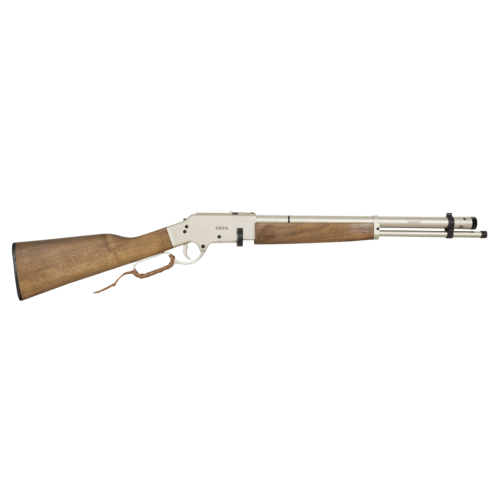
A distinctive blend of classic lever-gun styling and modern pre-charged pneumatic engineering is offered by the Reximex Lieva. Traditional Winchester-inspired lines are combined with a regulated PCP powerplant, so a characterful field rifle is delivered without the limitations of CO2 replicas. Lightweight handling, consistent velocity, and multi-shot convenience are therefore provided for target work, plinking, and lawful small-game or pest control.
Classic Lever Action With a Modern PCP Twist
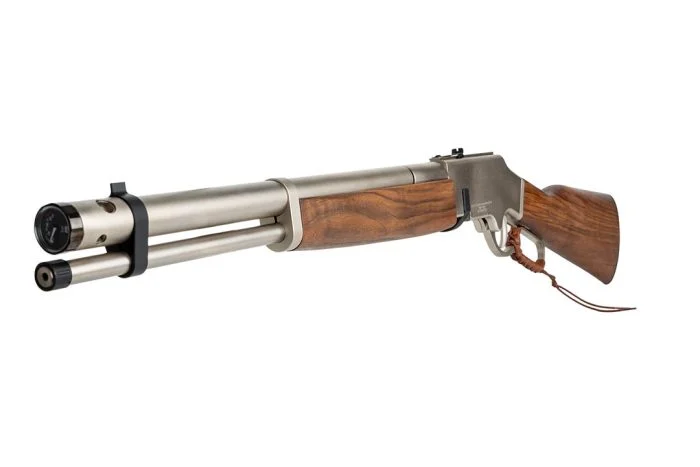
An inverted layout is used so the slim air cylinder is placed above the barrel. As a result, the silhouette of a traditional tube-magazine lever rifle is recreated while a genuine high-pressure air system is retained. Smooth cycling is achieved through the under-lever, and a handmade leather wrap is fitted on many examples so comfort during repeated operation is improved.
Consequently, follow-up shots can be taken quickly once the action is learned. Moreover, a magnetic catch is incorporated on selected versions so the lever is held securely when the rifle is carried or stored. Meanwhile, an ambidextrous Turkish walnut stock is fitted, so left- and right-handed shooters are equally well served. Furthermore, a compact overall length of about 970 mm (38.6 in) is maintained, and a ready-to-shoot weight in the 2.2–2.9 kg (4.85–6.4 lb) range is achieved depending on specification. Therefore, all-day handling is made easier in the field or on the range.
Calibres, Power, Regulator and Accessories
Three popular calibres are offered so the platform can be matched to local law and intended use.
Highlighted product features
- Calibres available: .177 (4.5 mm), .22 (5.5 mm), and .25 (6.35 mm)
- Magazine capacity: 14 shots in .177, 12 shots in .22, and 10 shots in .25
- Action: Lever / under-lever multi-shot PCP
- Powerplant: Regulated pre-charged pneumatic
- Air cylinder: Slim 105 cc tube mounted above the barrel
- Typical fill pressure: 200 bar on UK-legal examples; up to 250 bar / 3,625 PSI on higher-output export versions
- Regulator: Factory-set (commonly around 100 bar / 1,450 PSI) for even shot-to-shot velocity
- Approximate shot count: Around 60 shots in .177; roughly 40–60 in .22 and .25, depending on pellet, power setting, and fill
- UK-legal energy: Typically around 10.8–11.8 ft·lb where sub-12 ft·lb specification is required
- Higher-output examples: Up to about 15 ft·lb in .177, 22–23 ft·lb in .22, and around 23.8 ft·lb in .25 where permitted
- Barrel: Rifled, approximately 500–520 mm (19.7–20.4 in)
- Sights: Adjustable rear and front blade iron sights as standard
- Optics rail: 11 mm dovetail
- Muzzle: ½” UNF thread after the protective cap is removed (slim-neck moderators or collared adaptors are often required because the cylinder sits close to the barrel)
- Stock: Ambidextrous Turkish walnut with rubber butt pad
- Finishes: Black or silver / nickel-style metalwork
- Safety: Manual
- Trigger: Adjustable single- or two-stage design, depending on market specification
- Included extras (typical): Two rotary magazines, single-shot tray or adapter, fill probe
Additionally, a power-adjustment screw is provided on some UK-spec rifles so muzzle energy can be reduced for short-range garden use. In contrast, export models are often supplied at higher factory output for hunting where local law allows. Either way, consistency across the useful pressure band is supported by the onboard regulator.
Accessories are readily added. Open sights can be used immediately, yet a compact scope or red-dot can be mounted on the dovetail when more precision is required. Likewise, a suitable moderator can be fitted once thread clearance is confirmed. Fill equipment is kept simple: a probe is inserted at the front of the cylinder, and remaining pressure is read from the forward-facing gauge.
Practical Handling and Field Use
Pointability similar to a light shotgun is frequently noted because balance is concentrated along the slim tube-and-barrel line. Consequently, the rifle can be carried for long periods and mounted quickly on unexpected quarry. Moreover, the lever stroke is short and positive, so a steady rhythm is established during pest sessions or informal target strings.
Accuracy is supported by the rifled barrel and regulated air supply. Therefore, tight groups at typical airgun distances can be produced once a favoured pellet is identified. In addition, the rotary magazines are loaded from the front of the action block and are usually colour-coded for easy counting in poor light. A single-shot tray is also supplied on many packages so bench or zeroing work can be completed without a magazine in place.
Responsible use remains essential. Local airgun laws, FAC or equivalent licensing, and safe backstops must always be observed. Where higher-energy versions are sold, humane ranges and appropriate pellet choice should be respected for small-game work.
Why the Reximex Lieva Stands Out
Novelty alone is not the story. Instead, a regulated PCP is packaged inside a lever-action form that most shooters have only seen in CO2 replicas. As a result, weather-stable power, multi-shot capacity, and genuine hunting-capable energy (where legal) are obtained together with old-west character.
Furthermore, the walnut furniture and engraved or finished receiver give the rifle a premium appearance at a mid-market price. Meanwhile, the light weight and compact length make the Lieva approachable for a wide range of shooters. Transitioning from open sights to a low-mounted optic is straightforward, so the same platform can serve backyard practice one day and field craft the next.
Finally, two magazines and a single-shot option are commonly included, so time on the range is maximised from the first outing. Combined with the regulator, the 105 cc cylinder, and the distinctive inverted layout, a memorable and practical PCP is delivered.
Weihrauch Air Rifles, PCP Platforms, Spring-Piston Systems, and Related Airgun Terminology
Enthusiasts researching premium German airgun engineering frequently encounter models and search terms such as Weihrauch HW100X Karbine, Thumbhole PCP Air Rifle, hw35, h 45, german air rifle, accurate air rifles, hw97k, hw 70, hw35e for sale, hw40, weihrauch hw30, weihrauch hw80, weihrauch hw 95, hw100, hw 97k, hw35 air rifle, hw50 s, weihrauch hw45, weihrauch english, weihrauch hw98, weihrauch englisch, hw77 air rifle, weihrauch hw50s, compressed air rifles, air rifle makes, spring piston, what are air rifles, weihrauch hw44, air shot gun, sk x rifles, weihrauch hw50, hw30s, hw 30, what are air pistols, hw50, and rifles de aire.
Within the Weihrauch lineup, the Weihrauch HW77 air rifle is widely recognized as a traditional fixed-barrel underlever platform. Related terminology includes HW77 Green Laminate rifle, Weihrauch underlever air rifle, HW77 spring piston air rifle, Weihrauch HW77 for sale, and German precision air rifle. Researchers comparing versions may also encounter phrases such as buy Weihrauch HW77 Green Laminate online, Weihrauch HW77 Green Laminate price and specs, Weihrauch HW77 accuracy review, HW77 Green Laminate vs HW97 comparison, is Weihrauch HW77 good for beginners, precision shooting airgun, high quality German airguns, best price Weihrauch HW77, where to buy Weihrauch HW77, Weihrauch HW77 in stock, affordable premium air rifle, and top rated underlever air rifle.
Technical comparison searches commonly include Weihrauch HW77 vs HW97, HW77 vs break barrel air rifle, best Weihrauch air rifles, most accurate air rifle for target shooting, air rifle with low recoil, durable air rifle for outdoor use, and reliable air rifle for long term use. These phrases generally reflect interest in operating systems, mechanical durability, handling characteristics, consistency, and the differences between fixed-barrel underlever designs, break-barrel rifles, and PCP platforms.
Other Weihrauch-related terminology includes air pistols, hw100 airgun, weihrauch hw95, weihrauch hw 30, weihrauch hw90, hw 44, hw 40, hw 98, and weihrauch hw100. The HW100 family represents the PCP side of Weihrauch’s catalog, while models such as the HW30, HW50, HW80, HW90, HW95, HW97, and HW98 are associated with spring-powered or gas-ram-style sporting airgun platforms depending on the specific model and configuration. By contrast, the HW44 is commonly discussed as a PCP air pistol.
The broader airgun market also includes search terminology connected with alternative PCP manufacturers and modern platforms. Examples include 25 karma, pcp bb gun, karma eq air rifle, karma red panda, panda guns, full auto pcp, karma sls compact, air karma, red panda hat, eq air, karma sls, eq magazine, air pcp, and karma airguns. These terms may refer to specific products, product families, accessories, community terminology, or unrelated search phrases that appear alongside airgun research.
Reximex is another name frequently encountered in PCP discussions. Related search phrases include reximex airguns, reximex rp, reximex throne gen 2, reximex mito, reximex rpa, sbs12, reximex mitos, reximex lieva, reximex accura pcp air rifle, and reximex throne gen2. Model naming can vary slightly between retailers, regions, and search listings, which explains variations such as “Throne Gen 2” and “Throne Gen2” or “Mito” and “Mitos.”
Airgun research also involves understanding velocity and energy. Searches such as fps to joules calculator, fps to ft lbs, and airgun calculator relate to converting projectile velocity and mass into kinetic-energy measurements. These calculations are commonly used for technical comparison, range evaluation, regulatory research, and understanding how different compressed-air or spring-powered platforms perform within their intended specifications.
More general discovery terms can include gunseek and yivli av tüfeği, alongside broader international phrases such as rifles de aire. Because airgun terminology varies considerably between English, German, Spanish, and Turkish-speaking markets, researchers may encounter several different naming conventions for comparable sporting, target, and recreational airgun platforms.
Taken together, terms ranging from Weihrauch HW100X Karbine and Thumbhole PCP Air Rifle to HW77 Green Laminate rifle, spring piston, compressed air rifles, karma airguns, and reximex airguns illustrate the diversity of modern airgun technology. Weihrauch remains particularly associated with German engineering, fixed-barrel underlever rifles, traditional spring-powered designs, precision PCP systems, and air pistols, while Karma and Reximex represent additional names encountered when comparing contemporary PCP platforms and associated airgun technology.
Practical Use Scenarios
Everyday shooting is supported by a compact lever-action PCP that can be carried, mounted, and cycled without fuss. Because the air cylinder is placed above the barrel, a familiar western silhouette is presented while consistent regulated power is retained. Consequently, sessions that range from quiet garden practice to lawful pest work can be completed with the same platform. Inclusive handling is further assisted by the ambidextrous walnut stock, so left- and right-handed users are equally well served.
Quiet Garden and Backyard Practice
Short-range practice is often the first role assigned to this rifle. A modest fill is introduced at the front of the cylinder, after which remaining pressure is read from the forward gauge. Thereafter, magazines are loaded at a bench and a safe backstop is confirmed. Because iron sights are already fitted, zeroing can begin immediately. Alternatively, a compact optic may be mounted on the 11 mm dovetail when finer aiming is preferred.
Power can be reduced on examples that include an adjustment screw, so pellet flight over a short lawn or paddock is kept civil. Meanwhile, the regulator holds velocity even as the tube pressure falls, therefore group size is less likely to wander mid-session. Moreover, two rotary magazines are typically supplied, so reloading pauses are kept brief. A single-shot tray may also be used when each pellet is to be placed with extra care.
Noise remains moderate for a PCP of this class. Even so, a slim-neck moderator is sometimes added after the muzzle cap is removed, provided thread clearance under the cylinder is checked first. Neighbours and household members are thereby considered. After shooting, the lever is returned and the manual safety is applied before the rifle is cased. In this way, regular practice is made convenient without a trip to a formal range.
Club Range and Group-Size Work
Formal target sessions benefit from the same regulated supply and rifled barrel. Once a favoured pellet is identified, ten-shot strings can be fired with little change in point of impact across the useful pressure band. Consequently, hold-over notes are easier to trust. The lever stroke is short, so a repeatable cadence is established between shots. Because dry-firing is generally permitted on this design, trigger feel can be rehearsed before a live magazine is inserted.
Standing, kneeling, and bench positions are all practical. The overall length stays near 970 mm, and the ready weight remains light enough that fatigue is delayed during a long card. Furthermore, the walnut furniture gives a warm, stable cheek weld. When open sights are used, the adjustable rear notch is set for the chosen distance. When a scope is fitted, a low mount is usually preferred so the classic line of the rifle is not lost and the comb still supports the face.
Range bags stay simple. A fill probe, pellets matched to calibre, the spare magazine, and a small toolkit are normally sufficient. After the session, residual air may be left in the tube or the rifle may be stored according to the owner’s usual PCP routine. Either approach is supported provided seals are kept clean and the fill port remains capped.
Pest Management Around Buildings and Holdings
Lawful pest control is a natural second role. The compact profile allows the rifle to be carried along fence lines, around outbuildings, and through orchards without snagging. Because the action is cycled by the lever rather than a side bolt, the shooting hand can stay near the grip while the support hand steadies the forend. Follow-up shots are therefore available if a first pellet is deflected by vegetation.
Calibre choice is matched to local rules and quarry size. Lighter .177 pellets are often selected for close, precise work on small pests where a flat trajectory is useful. Mid-weight .22 pellets are widely chosen where a balance of energy and shot count is wanted. Heavier .25 pellets may be preferred where extra momentum is required and local energy limits allow it. In every case, humane ranges, a safe backstop, and positive identification of the target remain mandatory.
Magazine capacity of fourteen, twelve, or ten shots, depending on calibre, covers a typical walk around a holding. Additional magazines can be pre-loaded at the vehicle so a second circuit is completed without a return to the filling station. The pressure gauge is glanced at before each outing so an unexpected empty tube is avoided. After use, the rifle is made safe, the magazine is removed, and the lever is closed before it is placed in a slip.
Fieldcraft, Stalking, and Small-Game Opportunities
Where hunting with air rifles is permitted, the same handling traits support careful fieldcraft. The rifle points much like a light shotgun, so it can be brought up quickly from a trail carry. Because weight is modest, it can be held ready for longer than many full-sized bottle PCP sporters. Meanwhile, the inverted cylinder layout keeps the visual profile slim when the shooter is seated against a hedge or kneeling at a gate.
Shots are taken only after range is judged and a clear backstop is confirmed. The regulated output helps keep pellet energy predictable from the first shot of a fill to the later ones, which matters when a second opportunity appears after a miss or a follow-up is required. Open sights remain usable at typical airgun hunting distances; an optic is added when light is poor or when smaller aiming marks are needed.
Terrain varies. On farmland, the walnut stock is wiped after wet grass contact so finish is preserved. In woodland, the lever’s leather wrap, where fitted, reduces slip if gloves are damp. Across all settings, the magnetic lever catch found on some examples keeps the action closed while the rifle is slung or laid on a bag. After the outing, moisture is dried from metalwork and the fill port is inspected before storage.
Legal compliance is never optional. Licensing, energy limits, close seasons, and landowner permission must be observed in every jurisdiction. Higher-output export specifications are used only where the law allows; UK-legal examples remain within the sub-12 ft·lb class unless a certificate authorises more.
Shared Use, Coaching, and Newer Shooters
Inclusive design makes shared sessions straightforward. The ambidextrous stock does not force a change of rifle when shooters of different dominant hands take turns. Length of pull is conventional rather than extreme, so a wide range of statures can mount the comb without strain. Recoil is negligible, which helps newcomers watch the sight picture through the shot.
Coaching is simplified by the visible lever cycle. The sequence—load, close the lever, settle, fire, open and repeat—can be demonstrated slowly and then sped up. Because two magazines and a single-shot tray are commonly supplied, a coach can keep one magazine in reserve while a learner works from the tray. Trigger weight can later be refined on the adjustable unit once basic safety is established.
Garden zeroing with reduced power, where that screw is present, gives a gentle introduction. Later, full legal output is restored for longer cards. Throughout, eye and ear protection, a defined firing line, and a rule that the muzzle stays downrange are enforced. In this way the same rifle serves both experienced owners and those who are still building confidence.
Matching Calibre and Session Type
Daily use is easier when calibre is chosen with the session in mind. High shot count and a flatter line are typically associated with .177 during informal plinking and paper punching. A middle path is offered by .22 for mixed pest and target days. Extra authority at closer humane ranges is associated with .25 where regulations and pellet supply support it. Magazine capacity changes with calibre, so spare rotors are packed accordingly.
Pellet testing remains worthwhile. Several well-known weights should be tried at the distances that will actually be used. Once a match is found, that lot is reserved for field work and a cheaper practice tin is kept for the garden. Because the barrel is rifled and of useful length, consistency is available; it is simply revealed by methodical testing rather than assumed.
Fill strategy also changes with the day. A full 200 bar or 250 bar charge, according to the rifle’s marked limit, is used when a long walk is planned. A partial fill may be preferred for a short backyard session so the regulator is not asked to work from an unnecessarily high starting pressure. The gauge at the front of the cylinder makes that decision visible before the first shot is fired.
Carry, Weather, and End-of-Day Routine
Transport is simple. The rifle fits many standard slips despite the overhead cylinder. Magazines are stored separately so they are not crushed. A small bottle or pump plus the supplied probe covers topping up at a club or in a vehicle. Because the fill point sits between the barrel band and the gauge, connection is quick once the protective cover is moved aside.
Wet weather is managed rather than avoided. The walnut is wiped, metal is dried, and the leather lever wrap is allowed to air if it has taken on moisture. Dust from farm tracks is brushed from the action before the next fill. Periodic inspection of the probe O-rings and the magazine rotors prevents the small faults that interrupt an otherwise good day.
At the close of a session the sequence is kept the same: magazine out, action cycled to confirm an empty chamber where procedure requires it, safety applied, lever closed, rifle cased. Notes on pellet, distance, and remaining pressure can be written for the next outing. Over time those notes turn casual use into reliable performance.
From First Fill to Last Shot of the Day
A typical day might begin with a check of the gauge and a top-up if the needle has settled. Magazines are then charged at the tailgate. A brief confirmation shot is taken at a known mark so zero has not shifted. After that, the rifle is carried with the lever closed and the safety on until a target is identified.
During pest rounds, pauses are used to scan with binoculars rather than to fidget with the action. When a shot is presented, the rifle is mounted, the lever is already home from the previous cycle, and the trigger is pressed only when the picture is steady. If a second shot is needed, the lever is run through its arc without the muzzle leaving the safe area. On the range the same rhythm produces tight groups because the regulator and barrel are allowed to do repeatable work.
Evening storage completes the loop. Air may be left in the cylinder within the maker’s guidance, or the rifle may be depressurised if that is the household rule. Either way, the Lieva remains ready for the next lawful outing—garden card, club bench, or a quiet walk around the holding—because the practical features that define it are used the same way every time.
Calibres, FAC, Power and Accessories
Power output, legal class, and supporting kit are chosen together so the rifle matches the ground on which it will be used. Three chamberings are offered, a factory regulator is fitted, and a compact accessory set is supplied as standard. Additional optics, moderators, and filling gear can then be added once local rules and barrel-thread clearance have been checked.
Available Calibres and Magazine Capacities
Three popular pellet sizes are provided so trajectory, energy, and shot count can be balanced.
Calibre options at a glance
- .177 (4.5 mm): Fourteen-shot rotary magazine; typically the flattest line and the highest shot count from the 105 cc tube
- .22 (5.5 mm): Twelve-shot rotary magazine; a widely chosen middle path for mixed target and pest work
- .25 (6.35 mm): Ten-shot rotary magazine; extra pellet mass where lawful energy and humane ranges support it
A second magazine is commonly included, and a single-shot tray or adapter is often packed as well. Consequently, bench zeroing can be completed without a rotary magazine in place, while field strings remain quick to reload. Bright rotor colours on many Reximex magazines further assist counting in low light.
Pellet selection still matters. Several established weights should be tested at the distances that will actually be used. Once a match is found, that lot can be reserved for serious work and a practice tin kept for informal sessions. Because the barrel is rifled and of useful length (about 500–520 mm), consistency is available after that testing is done.
Legal Power, FAC and Regional Specifications
Energy class is set by market, not by calibre alone. In the United Kingdom, examples are normally supplied within the sub-12 ft·lb airgun limit, with published figures commonly around 10.8–11.8 ft·lb. A power-adjustment screw is present on some of those rifles, so muzzle energy can be lowered for short garden ranges. FAC (Firearms Certificate) status is therefore not required for standard UK-legal versions, provided the rifle remains within the statutory limit and is used in accordance with national and local law.
By contrast, export and North American specifications are frequently released at higher output. Published figures in that class include roughly 15 ft·lb in .177, about 22–23 ft·lb in .22, and around 23.8 ft·lb in .25, with listed velocities in the region of 900 fps, 750 fps, and 650 fps respectively, depending on pellet. Those higher-energy rifles must be owned and used only where licensing, age, and hunting rules allow. Inclusive advice is simple: the same platform can serve club plinking or field work, yet the legal wrapper around it must be confirmed before purchase and before the first hunting shot.
Fill pressure also varies with specification. UK-oriented listings often quote a 200 bar fill. Many export listings quote 250 bar / 3,625 PSI. The regulator is typically factory-set (often near 100 bar / 1,450 PSI) and is not user-adjustable on the exterior. Shot counts therefore depend on calibre, pellet, starting pressure, and whether the rifle is run in the low-power or high-output tune. Approximate yields of around sixty shots in .177 and forty to sixty shots in .22 and .25 are widely quoted; they should be treated as guidance rather than a guarantee.
Power Delivery and What the Regulator Does
Consistency across a fill is the practical benefit of the regulated 105 cc cylinder. Velocity is held more evenly from the first shot down toward the regulator floor, so hold-over notes remain usable for longer. Variation of about 11 fps over a short string has been recorded on UK-legal test rifles, which is adequate for cards and for humane pest ranges when the pellet is matched.
Power is not “one number.” It is the combination of calibre, pellet mass, tune, and remaining pressure. Garden use may favour a reduced setting where that screw exists. Club cards may use the full legal tune. Field use, where permitted at higher energy, relies on that extra momentum only inside lawful distance and with a safe backstop. In every case the manual safety is applied between strings, and the chamber is treated as loaded until proven otherwise.
Accessories, Sights and Fitment Notes
A usable kit is supplied in the box, and further items can be added with a few caveats.
Standard and recommended accessories
- Two rotary magazines sized to the chosen calibre
- Single-shot tray or adapter for precision loading
- Fill probe for the front cylinder port
- Adjustable rear sight and front blade
- 11 mm dovetail rail for a compact scope or red-dot
- ½” UNF muzzle thread after the protective cap is removed
- Turkish walnut ambidextrous stock with rubber butt pad
- Black or silver / nickel-style metalwork
- Manual safety and adjustable trigger
Open sights allow the rifle to be used on the day it arrives. When an optic is fitted, a low mount is usually preferred so the comb still supports the face and the lever-action outline is not crowded. Moderator fitment needs extra care. The air cylinder sits directly above the barrel, so only slim-neck silencers or collared designs (Weihrauch-style collars are often cited) clear the tube. A generic bulky moderator may not seat. Advice from the retailer should be taken before a silencer is ordered.
Filling gear stays simple: a stirrup pump, portable compressor, or bottle with the correct probe. The gauge at the front of the cylinder shows remaining pressure between the barrel band and the inlet. O-rings on the probe should be inspected regularly. Spare magazines, a small tin of the proven pellet, and a slip that accepts the overhead cylinder complete a field kit.
Finishes are chosen for taste rather than function. Black metalwork reads as understated; silver or nickel-style work emphasises the western lines against the walnut. Neither finish changes legal class or regulator behaviour. What does change performance is correct calibre choice, honest observance of FAC or airgun limits, and accessories that actually fit the inverted layout. When those three are aligned, the rifle is ready for the use it was designed to serve.







Reviews
There are no reviews yet.