Reximex Nyx Compact PCP Airgun
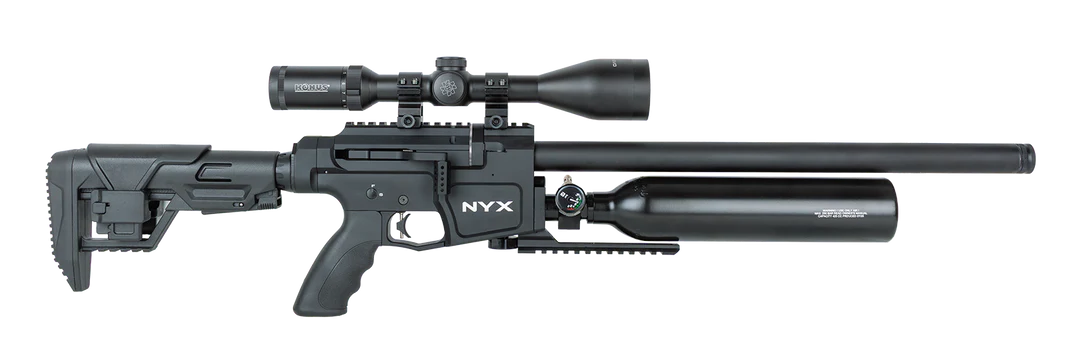
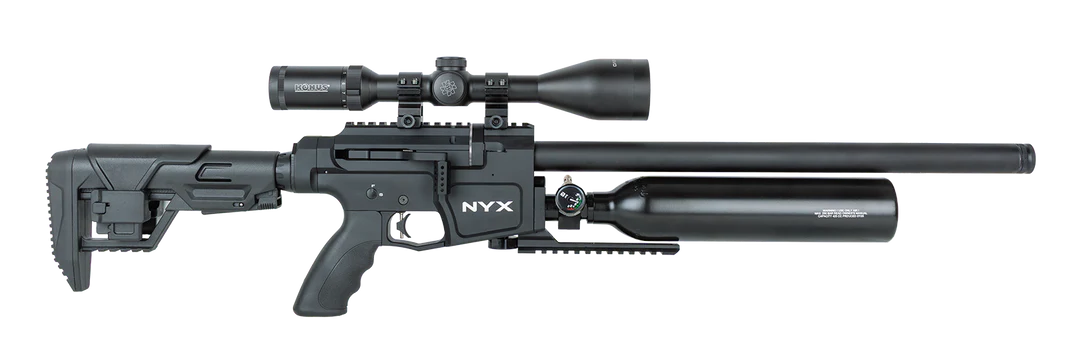
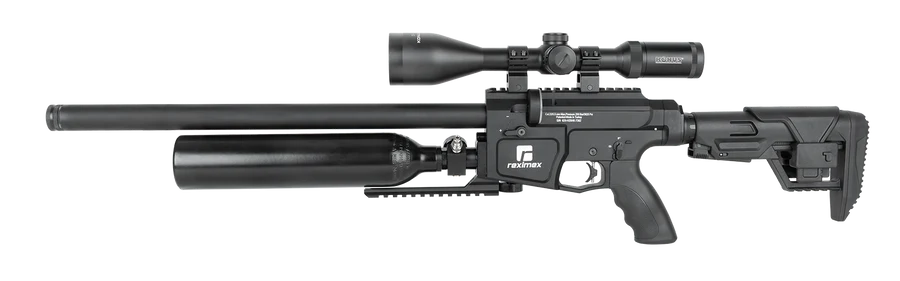
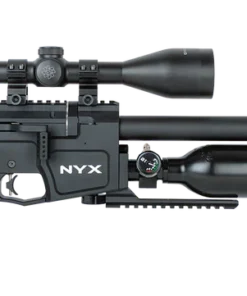
A compact tactical platform is presented by the Reximex Nyx Compact PCP Airgun, and a regulated pre-charged pneumatic system is combined with AR-inspired adjustability so that precision can be pursued by shooters of every experience level. Maneuverability is prioritized by the shortened chassis, while consistent power, multi-shot convenience, and field-ready mounting options are still retained. Consequently, pest control, small-game hunting, plinking, and range practice can all be approached with one adaptable rifle.
Moreover, a modern sidelever action is employed so that follow-up shots can be cycled smoothly. Meanwhile, an adjustable regulator and an external valve power knob are provided so that output can be tuned to pellet choice, distance, and local power limits. Therefore, the same platform can be configured for sub-12 ft-lbs environments or, where lawful, for higher-energy FAC use.
Key Features of the Reximex Nyx Compact PCP Airgun
The following capabilities are built into the rifle so that handling, consistency, and accessory flexibility can be maximized:
- A regulated PCP action is used, and shot-to-shot consistency is supported across the usable pressure band.
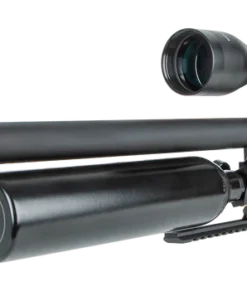
- A precision-rifled barrel with an integrated moderator is fitted, and extra 1/2″ UNF muzzle threading is retained for an additional silencer when quieter shooting is required.
- A removable 425 cc aluminum air bottle is installed, and a maximum fill of 3,625 PSI / 250 bar is supported.
- Approximately 75 shots at optimal velocity are delivered in .22 and .25 when pressure is kept between 3,625 PSI and 1,595 PSI (250–110 bar).
- Magazine capacities of 14 rounds (.177), 12 rounds (.22), and 10 rounds (.25) are supplied, and two magazines are included so that reloads can be completed quickly.
- Lead-pellet velocities of up to 900 fps in .22 and 800 fps in .25 are published for high-power configurations, and muzzle energies of up to 32.6 fpe (.22) and 36.09 fpe (.25) are listed for FAC-legal setups.
- An externally adjustable valve power knob is located on the action so that output can be reduced or increased without tools being opened inside the receiver.
- A two-stage adjustable trigger is fitted, and a crisp, predictable break can be dialed in for each shooter.
- An AR-compatible textured pistol grip and a telescoping buttstock are used, and an elevation-adjustable cheekpiece is included so that length of pull and eye alignment can be customized.
- A Picatinny optics rail is mounted on top, and additional Picatinny rails are placed under the bottle and under the buttstock so that bipods, lights, and other accessories can be attached.
- A manual safety, a bottle pressure gauge, and a male Foster quick-disconnect fill fitting are provided, and a matching female Foster adapter is included in the box.
- A compact overall length of approximately 31.5–34.5 inches (about 800–880 mm, depending on stock setting) is achieved, and a barrel length of 14.96 inches (380 mm) is used.
- An approximate weight of 7.7 lb (3.5 kg) is maintained so that the rifle can be carried for extended sessions without unnecessary bulk.
In addition, a single-shot tray is commonly supplied with Reximex magazines, so precision work from a rest can be practiced when magazine feeding is not preferred.
Calibers, Power, and FAC Considerations
Caliber choice is offered in .177, .22, and .25 so that the Reximex Nyx Compact PCP Airgun can be matched to the intended task. Target work and high shot counts are often favored in .177, while a practical balance of trajectory and energy is typically selected in .22. Meanwhile, extra downrange authority for small game and tougher pests is provided by .25 where regulations allow.
Furthermore, factory power is market-dependent. Sub-12 ft-lbs output is commonly supplied in UK-legal examples, and shot counts in those configurations are frequently quoted in the 130–150 range depending on caliber and tune. Conversely, higher-energy FAC versions are listed with the 900 / 800 fps and 32.6 / 36.09 fpe figures above. Accordingly, local airgun laws, licensing, and energy limits must always be verified before a configuration is ordered or used.
Likewise, the external power knob and regulator work together so that velocity can be lowered for closer work or raised for longer shots. As a result, pellet wastage is reduced and grouping can be tightened once a preferred ammunition is found.
Ergonomics, Stock Adjustment, and Optics Ready Layout
Comfort for a wide range of body types is supported by the telescoping AR-style stock. Length of pull can be changed in seconds, and cheek height can be raised or lowered until a consistent sight picture is obtained. Subsequently, fatigue is reduced during longer sessions because the rifle can be fitted to the shooter rather than the reverse.
Moreover, the textured grip is designed for a secure hold in wet or gloved conditions. In the same way, accessory rails allow a bipod to be mounted under the bottle for prone or bench work, while a sling, monopod, or other support can be attached at the rear rail. Therefore, the same compact chassis can be used from a vehicle window, a hide, or an open range without a second rifle being required.
Notably, the Picatinny top rail accepts a wide choice of scopes, red dots, and compact optics. Because no iron sights are fitted, an optic is recommended from the first outing so that the accuracy potential of the rifled barrel can be realized.
Practical Use of the Reximex Nyx Compact PCP Airgun
Field handling is simplified by the short overall length. Tight woodland paths, farm buildings, and vehicle-based pest routes can be negotiated more easily than with a full-length bottle rifle. Meanwhile, the integrated moderator keeps report at a medium level, and an extra 1/2″ UNF can is still available when even quieter shooting is needed around livestock or dwellings.
Additionally, the sidelever can be operated without the rifle being taken far off the shoulder, so follow-up shots on multiple pests can be taken promptly. After the magazine is emptied, a second loaded magazine can be inserted so that the session is not interrupted. Consequently, time on target is increased and air is used more efficiently across the 75-shot optimal window (high-power figures) or the higher counts of legal-limit tunes.
On the range, the adjustable trigger and regulator allow groups to be refined with JSB-class pellets in the published test weights (approximately 18.13 gr in .22 and 25.39 gr in .25 for the high-power data). Consistency within a few feet per second over a short string has been reported on regulated examples, provided dry air and a correct fill are used. Therefore, zero can be trusted from the first shot of a session to the last usable pressure on the gauge.
Responsible use remains essential. Safe backstops must be confirmed, local regulations must be followed, and dry compressed air only must be used at or below the 250 bar maximum. In addition, the bottle should be protected from extreme heat, and fill equipment with a working gauge should always be employed.
Filling, Maintenance, and What Is Included
Filling is completed through the Foster quick-disconnect interface. After the rifle is placed on safe and unloaded, the supplied female adapter can be connected to a hand pump, compressor, or scuba setup rated for 250 bar. Subsequently, pressure is monitored on the onboard bottle gauge so that overfilling is avoided.
Routine care is straightforward. The barrel and O-rings benefit from periodic light lubrication with airgun-safe oil, magazines should be kept clean and dry, and the regulator and valve should not be disassembled by untrained hands. Likewise, threads on the muzzle cap should be checked before an extra moderator is fitted so that alignment is preserved.
Two magazines, the Foster fill adapter, and the threaded muzzle cap are typically included so that the Reximex Nyx Compact PCP Airgun can be put into service immediately after an optic is mounted and a zero is established.
Why This Compact PCP Belongs in the Kit
Value is concentrated in a short, regulated, AR-adjustable package. Power can be tuned, magazines can be swapped quickly, and accessories can be added without aftermarket chassis work. Ultimately, a capable all-rounder is offered to hunters, pest controllers, and recreational shooters who want modern handling without a full-size bottle rifle being carried.
When lawful ownership, safe storage, and correct filling practices are observed, dependable performance can be expected from the first fill to the last regulated shot. The Reximex Nyx Compact PCP Airgun is therefore ready to be specified with the caliber and power level that match your ground, your local rules, and your preferred style of shooting
Calibres, FAC, Power and Accessories for the Reximex Nyx Compact PCP Airgun
Calibre selection is offered on the Reximex Nyx Compact PCP Airgun so that trajectory, energy, and magazine capacity can be matched to the intended use. Meanwhile, power output is market-dependent, and both legal-limit and FAC configurations are supplied. Consequently, accessories already built into the platform can be used to refine fit, mounting, and sound control without a second rifle being purchased.
Available Calibres and Magazine Capacity
Three pellet calibres are commonly listed so that every shooter can choose the balance of speed, knock-down, and shot count that suits their ground.
- .177 (4.5 mm) is typically paired with a 14-shot rotary magazine. A flatter trajectory is delivered at legal-limit energy, and high shot counts are often recorded when the regulator is set for sub-12 ft-lbs use. Therefore, paper, spinners, and HFT-style practice are frequently favoured in this calibre.
- .22 (5.5 mm) is supplied with a 12-shot magazine. A practical mix of pellet weight and retained energy is provided, and this calibre is widely chosen for pest control and general hunting where a versatile all-rounder is required.
- .25 (6.35 mm) uses a 10-shot magazine. Greater pellet mass and published FAC energy are available, and tougher small game or longer pest shots can be approached when local law permits the higher output.
In addition, two magazines are normally included in the box, and a single-shot tray is frequently supplied with Reximex index magazines. After the rotary magazine is removed, precision loading from a rest can therefore be practised when magazine feeding is not preferred. Likewise, maximum projectile length is limited on some listings (around 10 mm), so slug or extra-long pellet use should be confirmed before those projectiles are purchased.
Moreover, grouping quality still depends on pellet match rather than calibre name alone. JSB-class pellets in the published test weights (approximately 18.13 gr in .22 and 25.39 gr in .25 for high-power data) are commonly used as a starting point. Subsequently, several tins should be tested at the chosen power setting until a consistent point of impact is established.
Legal-Limit Power Versus FAC Output
Power is not fixed at a single figure. An adjustable regulator is fitted, and an externally accessible valve power knob is provided on the action so that output can be raised or lowered without the receiver being opened. As a result, the same rifle can be tuned for quiet close work or for longer shots, provided the configuration remains legal in the country of use.
In many UK and similar markets, a legal-limit tune of approximately 10.8–11.8 ft-lbs is supplied. Under that restriction, published shot counts are often quoted around 130 in .177 and 150 in .22 from the 425 cc bottle when the rifle is filled toward 250 bar and used through the regulated band. Consistency within a few feet per second over a short string has been reported on regulated examples when dry air and a correct fill are used. Therefore, a full magazine can usually be emptied before a refill is required on a typical pest or range session.
Where FAC (or equivalent unrestricted) ownership is lawful, higher factory figures are published:
- In .177, up to about 1,000 fps and 18.7 ft-lbs (25.4 J) are listed, with around 90 effective shots.
- In .22, up to about 900 fps and 32.6 ft-lbs (44.3 J) are listed, with about 75 shots at optimal velocity between 3,625 PSI and 1,595 PSI (250–110 bar).
- In .25, up to about 800 fps and 36.09 ft-lbs (48.9 J) are listed, again with about 75 shots in the same pressure window.
Accordingly, FAC energy must never be assumed on a rifle that was sold as a legal-limit example. Local licensing, transport rules, and energy limits must be verified before a high-power configuration is ordered, imported, or used. Furthermore, lowering the power knob on an FAC rifle can still be useful for indoor ranges, close pests, or quieter work around livestock, while the regulator continues to hold velocity steady across the usable fill.
Fill pressure remains 250 bar / 3,625 PSI on the standard 425 cc removable aluminium bottle. Only dry compressed air may be used. Heat-soaked bottles, overfills, and unregulated filling equipment must be avoided so that safety and regulator life are protected.
Accessories, Rails, and Ready-to-Fit Options
A conversion-focused accessory layout is already built into the Reximex Nyx Compact PCP Airgun so that optics and supports can be added immediately.
- A full-length Picatinny / Weaver optics rail is mounted on top. Scopes, compact variables, and red-dot sights can therefore be fitted without a separate rail kit being sourced. Because iron sights are not provided, an optic should be mounted before the first zeroing session.
- Additional Picatinny rails are placed under the air bottle and under the buttstock. A bipod can be attached at the front rail for prone or bench work, while a sling stud adapter, rear bag stop, or compact accessory can be fitted at the rear.
- An AR-compatible textured pistol grip and an AR-compatible telescoping buttstock are used. Aftermarket AR grips and selected stock furniture can often be exchanged when a different texture or angle is preferred, provided compatibility is confirmed.
- An elevation-adjustable cheekpiece and an adjustable butt pad are included so that eye alignment and length of pull can be set for shooters of different statures and clothing layers.
- The muzzle is finished with an integrated moderator plus a 1/2″ UNF threaded cap. An extra silencer can be added when even lower report is required, though point of impact should be rechecked after any muzzle device is fitted.
- Filling is completed through a male Foster quick-disconnect. A matching female Foster adapter is included so that a hand pump, compressor, or scuba whip can be connected without a proprietary probe being hunted down.
- A bottle pressure gauge is fitted near the cylinder neck, and a manual safety is provided. Fill status and safe handling can therefore be checked at a glance before the sidelever is cycled.
In the same way, two magazines and the fill adapter arrive in the carton so that the rifle can be put into service after an optic and pellets are added. Scope rings, a bipod, a sling, extra magazines, a compact compressor or pump, and a quality 1/2″ UNF moderator are the most useful first upgrades. Likewise, a hard case sized for a 32–35 inch overall length protects the adjustable stock and bottle during transport.
Ultimately, calibre, legal power, and accessories should be chosen together. A .177 legal-limit setup with a light scope suits high-volume practice; a .22 with bipod and moderator suits mixed pest work; a licensed FAC .25 with a robust optic suits longer, heavier shots where the law allows. When those choices are aligned with local regulations and safe filling practice, the compact regulated platform can be used confidently from the first fill to the last consistent shot on the gauge.
Explore the Hatsan Air Rifle Range: PCP, Spring-Piston, Bullpup, and Semi-Auto Airguns
For shooters comparing a hatsan air rifle, the Hatsan lineup covers everything from traditional spring-powered platforms to modern hatsan pcp designs, compact bullpups, semi-automatic systems, and specialized large-bore models. Whether someone is researching an entry-level air rifle, premium PCP equipment, target-oriented air rifles, or replacement components, the broader range of air rifle options associated with hatsanusa and hatsan usa provides many configurations to compare.
Hatsan Blitz and Semi-Automatic PCP Platforms
The hatsan blitz remains one of the most recognizable names among Hatsan PCP platforms. Searches for hatsan blitz full automatic, hatsan blitz bullpup, hatsan blitz 30 cal, and hatsan blitz .30 cal commonly come from enthusiasts comparing high-capacity PCP designs and different caliber configurations. Alternative searches such as hatsun blitz and hatzan blitz may also appear when shoppers are looking for the same product family.
The term blitz guns is sometimes used more broadly when discussing this platform, while phrases such as blitz 777 may appear in related product searches. Buyers comparing a 30 cal air rifle with smaller-caliber platforms should always review the model specifications, local regulations, intended sporting application, and compatible ammunition before choosing an air gun.
Another notable semi-auto platform is the hatsan sortie. The hatsan sortie tact semi-auto pcp configuration combines compact handling with PCP operation, while hatsan sortie tact searches are frequently associated with tactical-style variants. Owners may additionally look for hatsan sortie accessories when configuring optics, magazines, maintenance components, or other compatible equipment. Likewise, buyers searching for a semi auto pellet gun may compare the Sortie with the invader auto and other semi-automatic PCP designs.
Hatsan Bullpup and PCP Air Rifles
Hatsan produces several PCP configurations for shooters who prefer compact ergonomics without giving up barrel length. The hatsan bullboss is one example, while the bullmaster represents another recognizable bullpup-style platform. The hatsan hercules family is associated with higher-capacity PCP configurations, and the hatsan hercules bully provides a compact bullpup alternative within that broader design category.
The hatsan flash is another widely recognized PCP platform. Because hatsan flash configurations can vary, buyers should compare caliber, stock style, barrel arrangement, pressure system, and included equipment before purchase. The hatsan flashpup qe offers a bullpup-inspired format and is often considered by customers wanting a shorter overall rifle.
Other PCP-related searches include the hatsan invader, hatsan factor rc, and hatsan neutron star. Each platform serves a somewhat different purpose, which means specifications rather than appearance alone should determine which airguns are most appropriate for a particular type of sporting or recreational shooting.
Hatsan Jet 2 and Compact PCP Options
The hatsan jet 2 has attracted attention among customers looking for compact PCP versatility. Because the hatsan jet 2 may be configured differently depending on market and package, shoppers should verify the exact specifications supplied by the retailer. Searches for jet ii generally refer to the same Jet-series concept, while hatsan jet 2 accessories may include compatible magazines, optics solutions, carrying equipment, seals, and manufacturer-approved replacement components.
The hatsan velox is another compact platform that may appeal to customers researching modern PCP systems. However, compatible equipment should always be verified against the precise model designation rather than assuming accessories interchange across different Hatsan products.
Classic Hatsan Spring and Gas-Ram Air Rifles
Not every Hatsan buyer wants PCP equipment. Traditional spring-piston and gas-ram designs remain an important part of the catalog. The hatsan model 95 is among the best-known examples, while searches for hatsan mod 95 and simply mod 95 usually refer to the same established platform.
The hatsan 125 is another familiar full-size option. Meanwhile, the hatsan 135 is commonly researched by shooters interested in larger, more substantial break-barrel platforms. The hatsan 135 vortex air rifle incorporates Hatsan’s Vortex gas-piston concept, while the hatsan 135 carnivore is associated with larger-caliber configurations. Searches for a hatsan big bore carnivore rifle are similarly connected with users comparing large-bore air-powered platforms.
Additional traditional models include the hatsan mod 65, which appears in searches from buyers interested in full-size sporting configurations. The hatsan airtact air rifle, commonly shortened to hatsan airtact, represents another accessible platform. The hatsan zada also broadens the selection for customers comparing break-barrel designs.
Big-Bore Hatsan Models and Specialty Platforms
For customers researching large-bore PCP technology, the hatsan piledriver is one of Hatsan’s best-known specialized platforms. Large-bore air rifles occupy a different category from a conventional .177 caliber air pellet gun, so caliber, projectile compatibility, operating pressure, legal restrictions, and intended sporting use should all be carefully reviewed.
The hatsan harpoon is another specialized product name associated with Hatsan’s air-powered lineup. Because it functions differently from a conventional pellet rifle, buyers may encounter the phrase arrow launcher while researching this category.
These specialized products should not automatically be compared with a traditional pallet gun or standard pellet rifle because their operating systems, projectiles, dimensions, and intended uses can be substantially different.
Refurbished Hatsan Air Rifles and Replacement Parts
Budget-conscious customers sometimes search for hatsan refurbished equipment or refurbished air rifles. A refurbished product can offer good value when its condition, inspection history, seals, pressure system, warranty coverage, and included accessories are clearly disclosed.
Existing owners may instead require hatsan aftermarket parts. When replacing magazines, seals, fill probes, stocks, mounts, or other components, compatibility should always be matched to the precise rifle generation and caliber. Similar-looking parts should never automatically be assumed to fit every Hatsan platform.
Product names such as 1000x.25 may also appear when shoppers compare model or caliber-specific configurations, so confirming the manufacturer’s exact designation is particularly important.
Scopes, Pellets, and Air Rifle Accessories
Optics are another major consideration when configuring an air rifle. A basic 4×20 optic may be encountered in entry-level packages, and the term 4×20 is therefore frequently seen alongside airgun searches. However, optic selection should ultimately reflect the rifle’s mounting system, recoil characteristics, shooting distance, and intended use.
Pellet selection also matters. Products such as h&n field target trophy are widely recognized among airgun enthusiasts, while h&n field target trophy bleifrei refers to a lead-free option within that product family. Individual rifles may prefer different pellet weights and shapes, so consistency and accuracy should be evaluated with the manufacturer’s recommendations in mind.
The term crow magnum may also appear when users research heavier hunting-oriented pellet designs or related airgun ammunition. Ammunition compatibility must always be checked against the specific caliber and manufacturer’s specifications.
Choosing Between PCP, CO2, and Spring-Powered Airguns
A modern air pellet gun can use several different power systems. A PCP system stores compressed air inside a reservoir, while a spring-piston rifle relies on mechanical energy generated during cocking. A co2 pellet rifle, by contrast, uses carbon dioxide cartridges or a compatible CO2 supply.
Each system offers different advantages. PCP rifles may provide low recoil and repeatable operation, while spring-powered rifles avoid the need for external filling equipment. CO2 systems can offer convenient operation in compatible platforms, although performance may vary with temperature.
Customers researching the air rifle range should therefore consider much more than velocity figures. Ergonomics, caliber, overall length, weight, filling equipment, magazine design, maintenance requirements, noise level, available service support, and local regulations can all affect long-term ownership.
Hatsan Models for Different Airgun Preferences
With platforms such as the hatsan blitz, hatsan sortie, hatsan hercules, hatsan bullboss, hatsan flash, hatsan invader, hatsan piledriver, hatsan jet 2, hatsan velox, hatsan factor rc, hatsan airtact, and hatsan model 95, Hatsan covers a broad spectrum of airgun categories.
Some customers may prioritize a traditional sporting rifle, whereas others may prefer a compact PCP or bullpup. Shooters interested in sniper long style configurations may focus more strongly on stock ergonomics, optics mounting, stability, and longer-range target capability rather than simply choosing the most powerful model.
Meanwhile, terms such as econ ii may appear in accessory or product-related searches depending on the equipment being compared. Compatibility should always be established using the exact manufacturer and model specification.
Ultimately, selecting among hatsan air guns should begin with the intended application. A lightweight .177 caliber rifle may suit recreational target shooting, while a larger PCP platform can serve a very different sporting role. Models such as the hatsan blitz .30 cal, hatsan blitz 30 cal, or other 30 cal air rifle configurations should therefore be evaluated according to their specifications, local law, appropriate shooting environment, and intended lawful use.
From the compact jet ii and hatsan jet 2 to the established hatsan mod 95, powerful hatsan 135, specialized hatsan harpoon, and modern semi-auto PCP platforms, the Hatsan catalog gives airgun enthusiasts an extensive selection. Comparing specifications carefully helps buyers identify the right air rifle while ensuring that pellets, optics, filling equipment, magazines, and accessories remain correctly matched to the chosen platform.
Practical Use in the Field and on the Range
Everyday shooting is shaped by ground, weather, distance, and the need for a short, quiet, adjustable rifle. A compact regulated pre-charged platform is therefore used in places where a long bottle gun would snag on gates, cab roofs, or young woodland. Meanwhile, a sidelever action, a telescoping stock, and a moderated barrel allow sessions to be completed with less fatigue and fewer refill stops when the fill and pellet are matched to the task.
Tight Cover, Yards, and Outbuildings
Movement through narrow alleys, feed stores, and stacked pallets is made easier when overall length is kept short. After the stock is collapsed, the rifle can be carried muzzle-down or across the chest without door frames being struck. Subsequently, the stock can be extended again so that a full cheek weld is restored before the first shot is taken.
Rats, feral pigeons, and similar pests around buildings are often engaged at close to medium range. A legal-limit tune is commonly preferred in those settings so that over-penetration is reduced and neighbours are less likely to be disturbed. In addition, the integrated moderator keeps report at a medium level, and an extra threaded can may be fitted when livestock or dwellings sit close to the line of fire. Consequently, shots can be taken from a doorway or a loft hatch without the rifle being swung through a wide arc.
Gloved hands are frequently required in winter yards. A textured pistol grip is therefore relied upon so that the rifle is not shifted in the hand when frost or rain is present. Likewise, the manual safety can be operated with a thumb without the trigger guard being fished for in poor light. After the shot is taken, the sidelever is cycled while the muzzle remains pointed at a safe backstop, and a second pellet is chambered without the rifle being lowered far from the shoulder.
Highlighted points for yard and building work include:
- A short overall length is used so that corners and doorways can be negotiated.
- A quieter muzzle is favoured so that stock animals are less likely to be scattered.
- A lower power setting is selected when walls, machinery, or public paths sit beyond the target.
- A solid backstop of earth, a purpose-built trap, or a verified safe area is confirmed before any shot is released.
Moreover, magazine capacity is used in bursts rather than in long strings. Two or three carefully placed shots are usually enough on a small group of pests, after which the area is watched again. Therefore, air is conserved and the bottle gauge remains in the regulated band for the rest of the round.
Farm Pest Routes and Vehicle Work
Longer days on mixed farmland are supported when the rifle can be slid behind a seat or into a slip without a full-length cylinder dominating the cab. After arrival at a gate or a silage clamp, the rifle is uncased, the stock is set to the clothing worn that day, and the optic is checked against a known mark if light has changed.
Corvids, rabbits, and similar species on permitted ground are often approached from a vehicle window or a field margin. A bipod can be attached to the rail under the bottle so that a stable rest is obtained on a bonnet bag or a fence post. Meanwhile, the rear rail accepts a sling so that the rifle can be carried across a pasture when the vehicle is left behind. As a result, the same outfit is used for a dawn circuit and a late-afternoon walk without a second gun being packed.
Weather, Maintenance Between Shots, and End of Session
Rain and dust both affect a compact tactical rifle. After a wet stalk, water is wiped from the rails and the fill port so that grit is not later packed into the Foster fitting. The barrel crown and moderator are checked for mud, because a blocked shroud can change point of impact. Subsequently, a light airgun-safe oil is applied to the breech face on a scheduled basis rather than after every outing.
Heat and cold change bottle pressure. A rifle left in sun on a tailgate should be allowed to stabilize before a fill is topped up. Likewise, a rifle brought from a cold vehicle into a warm clubhouse should not be fired until condensation on the optic has cleared. Point of impact can shift if the first shot is taken through a fogged lens.
End-of-session routine is kept simple. The rifle is placed on safe, the magazine is removed, the chamber is confirmed empty, and the muzzle cap is refitted. Air may be left in the bottle at a moderate pressure for storage, following the maker’s guidance, rather than the cylinder being fully drained after every trip. Finally, the optic is capped and the rifle is locked away so that the next outing starts from a known, safe condition.






Reviews
There are no reviews yet.