We Deliver Airguns Directly To Your Door
SKU N/A Category

Diana Outlaw Gen 2 Synthetic

$400.00

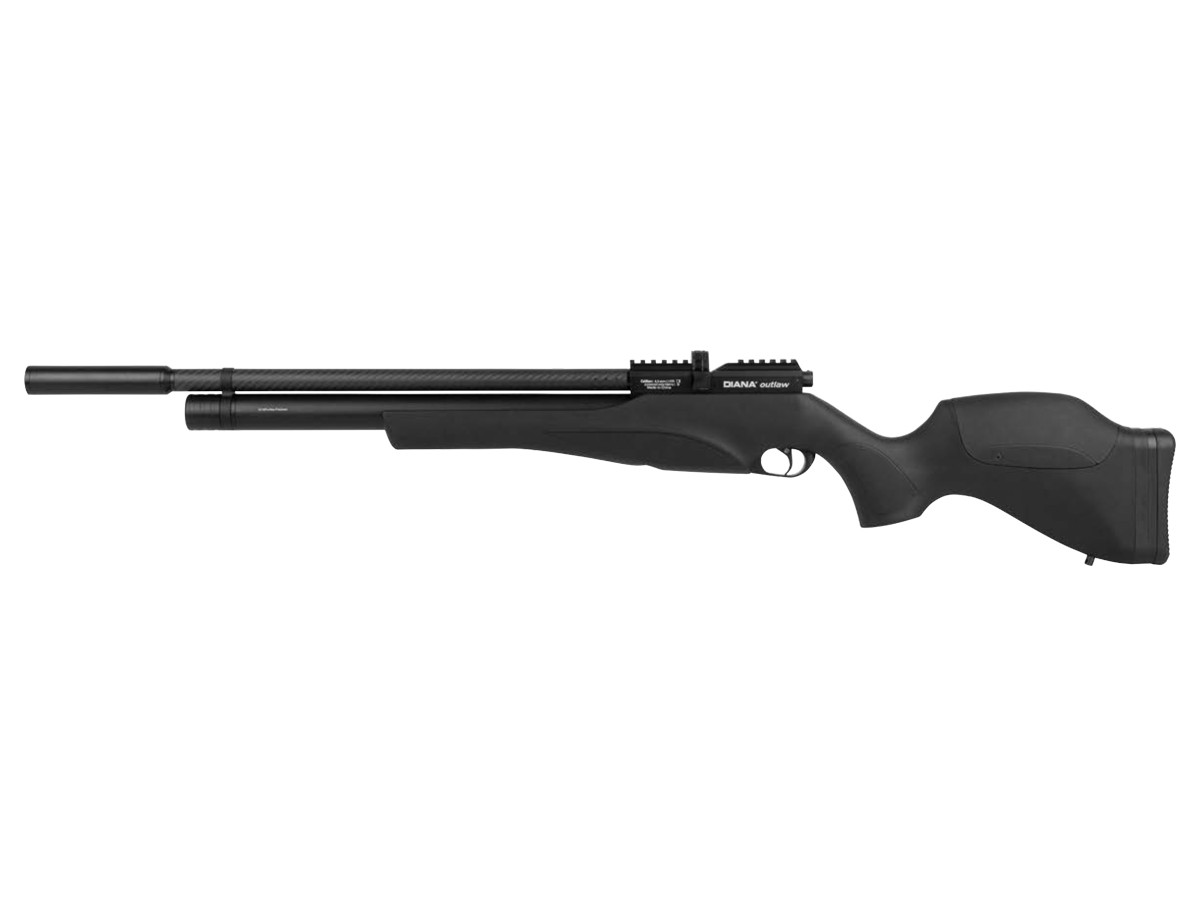
The Diana Outlaw Gen 2 Synthetic gives you a precise and reliable PCP air rifle with a durable synthetic stock and adjustable features for personalized operation. You’ll appreciate getting lead pellet speeds up to 1050 fps in .177, 985 fps in .22, and 920 fps in .25, plus power up to 22 fpe in .177, 35 fpe in .22, and 45 fpe in .25, because it gives you the performance and precision you need for small game hunting, pesting, and target shooting.

This air rifle gives you precise shots that are quieter than you’d expect for its power level, thanks to its rifled barrel that is fully shrouded and moderated. Plus, you’ll get consistent speeds and predictable performance with every shot because it has a regulator.

The Diana Outlaw Gen 2 Synthetic will stand up to rough use because it has an all weather synthetic stock for durability. You’ll also like that you can get the personalized clean and sharp trigger break you want, because it uses the two stage adjustable DIT (Diana Improved Trigger) that lets you adjust the travel and sear engagement.

In order to accommodate a scope, this air rifle has a Picatinny scope rail, and it also gives you better eye alignment with a scope because it has a cheek piece that you can adjust for height. You also get an easy and fast way to securely attach items like a bipod, because it has an M-LOK accessory rail underneath the forearm.

If you’re in the market for a capable and precise regulated PCP air rifle for effective target shooting, pest control, and small game hunting, get the Diana Outlaw Gen 2 Synthetic at Airgun Depot now.

Diana Outlaw Gen 2, Synthetic Features:

  • Repeater
  • PCP
  • Regulated
  • Synthetic stock
  • Sidelever action
  • Moderated barrel w/carbon fiber shroud
  • Magazine capacity: 12 rounds (.177), 10 rounds (.22, .25)
  • Dual integrated pressure gauges (fill pressure, regulator pressure)
  • 210cc air cylinder
  • Max. fill pressure: 3,620 psi (250 bar)
  • Max. velocity (w/lead pellets): 1050 fps (.177), 985 fps (.22), 920 fps (.25)
  • Max. energy: 22 fpe (.177), 35 fpe (.22), 45 fpe (.25)
  • DIT (Diana Improved Trigger) two-stage adjustable trigger
  • Checkering on forearm and grip
  • Height-adjustable cheek piece
  • Picatinny scope rail
  • M-LOK accessory rail under forearm
  • Manual safety
  • Sling swivel stud
  • Barrel length: 18″
  • Overall length: 42″
  • Weight: 6.9 lbs.
Specs
  • Manufacturer Diana
  • Caliber .177
  • Velocity 11050 fps
  • Condition New
  • Ammo Type Pellets
  • Action Sidelever
  • Barrel Style Rifled
  • Fire Mode Repeater
  • Gun Weight 6.70
  • Loudness 3-Medium
  • Magazine Capacity 12
  • Mechanism Pre-charged pneumatic
  • Rail Weaver/Picatinny
  • Safety Manual
  • Front Sights none
  • Rear Sights none
  • Trigger Adjustability Two-stage adjustable
  • Use Small game hunting/target practice
  • Warranty 1-year limited warranty

Diana Outlaw Gen 2 Synthetic

Performance is delivered by a regulated PCP platform that is designed for consistent field and range use. Precision is supported by a sidelever action, a shrouded and moderated barrel, and an accessory-ready synthetic stock so that weather, weight, and mounting needs can be handled by shooters of many experience levels.

Why the Diana Outlaw Gen 2 Synthetic Is Chosen

Reliability is built into the Diana Outlaw Gen 2 Synthetic through a factory regulator, a 210cc air cylinder, and a maximum fill of 3,625 PSI (250 bar). Consequently, shot-to-shot velocity is held more evenly across a fill. Meanwhile, backyard and small-game work is supported by a quieter report because an 18-inch barrel is enclosed in a carbon-fiber sleeve and finished with an integrated moderator.

Furthermore, handling is improved by a lightweight synthetic stock of about 6.7–6.9 lb and an overall length near 42 inches. Therefore, carry in the woods and setup on a bench can both be completed without excess bulk. In addition, length of pull can be refined with a removable shim and an adjustable buttpad, so a comfortable hold can be achieved by a wider range of body sizes.

Features That Support Everyday Use

Modern mounting is provided so optics and accessories can be added without extra adapters.

  • A Picatinny rail is fitted on the breech so scopes and red dots can be mounted securely.
  • M-LOK slots are cut into the forend so a bipod, sling, or light can be attached.
  • A rear sling stud is retained so the rifle can be carried in the field.
  • Two magazines are included, and a ratchet-style rotor is used so loading can be completed more easily.
  • A two-stage Diana Improved Trigger is fitted, and a manual safety is placed for controlled operation.
  • Fill and regulator gauges are provided so remaining air and set pressure can be checked at a glance.

Power, Calibers, and Regulated Consistency

Velocity and energy figures are published so the Diana Outlaw Gen 2 Synthetic can be matched to legal limits and intended use. Up to about 1,050 fps is listed in .177, while about 985 fps is listed in .22. Correspondingly, muzzle energy of roughly 22 ft-lbs is quoted in .177, about 32–35 ft-lbs in .22, and up to about 45 ft-lbs where a .25 option is offered. Magazine capacity is typically listed around 12 rounds in .177 and 10–11 rounds in .22.

Moreover, a regulated valve is used so air is metered more evenly until the regulator setpoint is left behind. As a result, useful strings of consistent shots are produced from a single fill when suitable pellets are selected. Subsequently, heavier match pellets are often preferred because grouping and energy transfer can be improved at typical small-game distances.

Practical Use on the Range and in the Field

Target practice is supported because a sidelever is cycled with modest effort and follow-up shots can be sent without a full bolt stroke. Likewise, pest control and small-game hunting are supported when legal power levels and appropriate pellets are used. Meanwhile, neighbor-friendly sessions are made more practical because the shrouded, moderated barrel reduces report compared with an unshrouded tube.

Additionally, weather resistance is improved by the synthetic stock, so rain, dust, and rough transport can be tolerated better than with unprotected wood. Therefore, the rifle can be taken from vehicle to stand or from case to bench with fewer concerns about finish damage. Inclusive design is also considered: a lighter all-weather stock, an adjustable pad, and a moderate overall length allow the same platform to be shared by new shooters and experienced hunters.

Build Details That Improve Confidence

An 18-inch rifled barrel is stabilized by a barrel band and protected by the carbon-fiber sleeve. Consequently, point of impact is helped to stay more stable when accessories are added or when the rifle is carried over uneven ground. In the same way, the split Picatinny rail allows optics to be aligned over the action without relying on older 11 mm dovetails alone.

Internally, hammer-spring and regulator adjustments exist on the platform, although access typically requires stock removal and, for regulator work, a depressurized cylinder. For most owners, factory settings are intended to be used as delivered, with pellet testing used to confirm groups. Two magazines are packed so a spare can be kept loaded while the first is being used.

What Is Included and How It Is Set Up

A complete starting kit is supplied so first fill and first zero can be completed sooner.

  • The Diana Outlaw Gen 2 Synthetic rifle is supplied with two rotary magazines.
  • A probe-style fill adapter is used with the 3,625 PSI cylinder.
  • A soft case is often included so a scoped rifle can be transported more safely.
  • Checkered or textured grip areas are molded so a secure hold can be maintained in wet conditions.

Responsible ownership is required. Local airgun laws, FAC or power limits, and safe backstops must be observed. Eye protection should be worn, and the rifle should be treated as loaded until it is confirmed otherwise.

Who Benefits From This Platform

Beginners are helped by a manageable weight, a sidelever that is easier to cycle than many spring pistons, and a regulator that reduces the steep velocity drop of an unregulated tube. Intermediate shooters are given M-LOK and Picatinny real estate so a hunting or HFT-style setup can be built. Experienced users can still extract value because consistency, a usable shot count from 210 cc, and a quiet shroud remain useful even when more expensive rifles are already owned.

Conversion is supported because the Diana Outlaw Gen 2 Synthetic combines regulated PCP consistency, modern rails, and an all-weather stock at a mid-tier price. Accuracy potential is realized when pellets are tested, the barrel is kept clean, and fill pressure is kept within the published range. After that, the same rifle can be used for plinking, formal practice, and legal small-game work without a platform change.

A final check of caliber, local energy limits, and preferred optic height should be completed before checkout. Once those choices are set, the Diana Outlaw Gen 2 Synthetic can be brought into service as a quiet, regulated, accessory-ready PCP that is ready for both bench and field.

Diana, Bintac, AEA and Hatsan Airguns: Rifles, Pistols, PCPs and Accessories

For shooters comparing trusted platforms, the Diana range remains a major point of interest. Searches such as diana air rifle, diana air rifles, air rifle diana, rws diana air rifle, rws diana, diana rws, and diana r reflect the continued popularity of classic airgun designs. Well-known spring-powered choices include the diana 34, diana model 34, diana rws 34, rws diana 34, diana r34, and diana 34 air rifle. Shooters interested in the updated modular platform may also search for diana 34 ems or diana 34 ems fiber optic sights.

Other established models continue to attract enthusiasts, including the diana 35, diana 48, diana mod 48, rws diana model 48, diana 54, diana 350 magnum, diana 350 magnum air rifle, 350 magnum diana, and diana rws 460 magnum. These rifles appeal to buyers comparing traditional spring-piston construction, power, accuracy, build quality, and different configurations for recreational or sporting use.

Diana PCP Air Rifles, Pistols and Accessories

The Diana catalog also includes PCP, CO2, and pistol-format options suited to different shooting preferences. Popular searches include diana r22, diana 2, diana 250, diana two fifty, diana 250 air rifle, diana stormrider, diana outlaw gen 2, diana airbug, diana bandit black, diana lp8, lp8 diana, diana air pistol, and diana pellet gun.

Owners looking to maintain, repair, or customize certain platforms may also search for diana chaser accessories and diana chaser parts. For target shooting and recreational plinking, a 4.5mm air gun remains a common caliber choice. Meanwhile, hunting diana searches often focus on Diana rifles suited to lawful pest-control or hunting applications where airgun use is permitted.

The term nerf diana can occasionally appear alongside Diana-related search traffic, although it represents a different product category and should not be confused with traditional pellet rifles or air pistols.

Bintac and AEA PCP Airguns

Big-bore and tactical PCP enthusiasts frequently compare Diana products with Bintac and AEA platforms. Popular searches include bintac aea harpoon, aea harpoon air gun, bintac t9 full auto, bintac t9 price, bintac mcar 457, aea terminator, and aea megalodon for sale.

Other related searches include airgun shotgun, automatic air gun, air powered 50 cal rifle, and zeus 72 cal air rifle price. Shooters setting up high-pressure PCP equipment may also research an air tank for pcp airguns or anti air tanks while comparing suitable filling equipment and accessories.

The broader phrase bee bee gun rifle may also be used by new shooters searching for BB rifles, pellet rifles, and other recreational air-powered platforms.

Hatsan Air Rifles and PCP Platforms

Hatsan remains another widely searched manufacturer across spring-piston, PCP, semi-automatic, and big-bore categories. General searches such as hatsan air rifle, hatsan air guns, hatsan pcp, hatsanusa, hatsan usa, air rifle, air rifles, and airguns cover a broad selection of products.

Break-barrel shoppers frequently compare the hatsan model 95, hatsan mod 95, mod 95, hatsan 125, hatsan 135, hatsan 135 vortex air rifle, hatsan 135 carnivore, hatsan zada, and hatsan airtact air rifle. The related search hatsan airtact is also common among buyers researching lightweight and affordable break-barrel rifles.

Customers searching for discounted or previously owned products may also use the phrase hatsan refurbished while comparing factory-refurbished or pre-owned Hatsan models.

Hatsan PCP and Big-Bore Airguns

For PCP enthusiasts, popular searches include hatsan flash, hatsan flashpup qe, hatsan bullboss, hatsan hercules, hatsan hercules bully, hatsan invader, hatsan factor rc, hatsan neutron star, hatsan harpoon, hatsan piledriver, and hatsan big bore carnivore rifle.

These searches cover everything from compact PCP rifles to powerful large-caliber platforms. Buyers can compare factors such as air capacity, operating pressure, caliber, barrel configuration, magazine capacity, stock design, overall weight, and intended use before selecting a suitable platform.

Hatsan Blitz, Sortie and Semi-Automatic Models

Shooters interested in rapid-fire PCP platforms frequently search for hatsan sortie, hatsan sortie tact, hatsan sortie tact semi-auto pcp, and hatsan sortie accessories. The Hatsan Blitz family also generates searches including hatsan blitz, hatsun blitz, hatsan blitz full automatic, and hatsan blitz 30 cal.

Compact PCP pistol and carbine shoppers may also research the hatsan velox and hatsan jet 2, providing additional choices for shooters who prefer smaller platforms.

Airgun Optics, Pellets and Accessories

Accessories, optics, ammunition, and filling equipment are important parts of a complete airgun setup. A basic 4×20 optic may suit certain entry-level rifles, while ammunition such as h&n field target trophy bleifrei can appeal to shooters specifically searching for lead-free pellets.

The search phrase econ ii may also appear alongside airgun-related product research depending on the equipment, accessory, or platform being compared.

Whether the goal involves target shooting, recreational plinking, collecting, pest control, or lawful hunting, the wide selection of Diana, AEA, Bintac, and Hatsan platforms gives shooters numerous choices. Comparing the correct caliber, rifle type, filling system, optics, pellets, accessories, and replacement parts can help buyers identify equipment that best matches their intended application.

Frequently Asked Questions

Answers are provided below so buying, filling, shooting, and caring for this regulated sidelever PCP can be completed with fewer surprises. Inclusive language is used throughout, because the same platform can be shared by new shooters, experienced hunters, and range regulars when local laws and safe practices are followed.

What type of air rifle is this, and how is it powered?

A pre-charged pneumatic (PCP) action is used, so compressed air is stored in an onboard cylinder and released in metered amounts by a regulator. Consequently, a spring or gas ram does not have to be cocked for each shot. Instead, a sidelever is cycled so a pellet can be chambered from a rotary magazine and the hammer can be set. Meanwhile, high-pressure air is held in a 210 cc reservoir that is filled to a published maximum of 3,625 PSI (250 bar). Therefore, multiple consistent shots can be taken from one fill when the regulator remains in its working range.

Which calibers are offered, and how should a caliber be chosen?

.177 and .22 are the most commonly listed options, while .25 is referenced on some regional listings. Accordingly, flatter trajectory and higher pellet counts are often associated with .177, whereas more energy on small game is typically associated with .22. Where .25 is available, still more muzzle energy is quoted, although magazine capacity is reduced and legal limits must be checked first. Ultimately, local power caps, intended distance, and preferred pellet weight should be compared before a caliber is selected.

How much velocity and energy can be expected?

Published figures of about 1,050 fps in .177 and about 985 fps in .22 are commonly listed. Correspondingly, muzzle energy near 22 ft-lbs is quoted in .177, roughly 32–35 ft-lbs in .22, and up to about 45 ft-lbs where .25 is offered. However, actual results depend on pellet weight, fill pressure, regulator setpoint, and local FAC or unlicensed limits. Therefore, a chronograph session with the chosen pellet is recommended after the barrel has been cleaned.

How many shots are produced from one fill?

A useful regulated string is produced while cylinder pressure stays above the regulator setpoint. In independent tests of closely related Gen 2 examples, more than thirty consistent shots have been recorded before velocity begins to fall. After that point, energy declines shot by shot as remaining air is used. For planning, a conservative working string plus a reserve should be assumed, and a refill should be scheduled before the gauge enters the lower band.
Diana Outlaw Gen 2 Synthetic

How is the rifle filled, and what equipment is required?

A probe-style fill adapter is used at the cylinder. A hand pump, a carbon-fiber tank, or a compressor rated for at least 250 bar can be connected after the probe is seated and the bleed valve is confirmed closed. Subsequently, pressure is raised slowly to the published maximum and never beyond it. Afterward, the hose is bled before the probe is removed so O-rings are not damaged. Inclusive practice is advised: filling should be learned with a mentor or written guide so new owners are not left guessing at fittings.

Where are the gauges located, and what do they show?

A fill-pressure gauge is placed at the cylinder so remaining air can be read after a session. In addition, a regulator-pressure gauge is fitted in the stock or forend area so the set working pressure can be monitored. Together, these two readings allow a refill to be planned before consistency is lost. If a gauge appears stuck or fogged, shooting should be paused until the reading can be confirmed.

Is the action regulated, and can the regulator be adjusted?

A factory regulator is installed so each shot uses a more even charge of air. Consequently, groups and velocity stay tighter across the useful part of a fill. Fine adjustment of regulator and hammer spring is possible on the platform, yet access typically requires stock removal and, for regulator work, a fully depressurized cylinder. For most owners, factory settings should be left unchanged until pellet testing shows a clear need and the correct tools are available.

What magazines are supplied, and how is loading completed?

Two rotary magazines are included. Capacity is commonly listed around twelve rounds in .177 and ten or eleven rounds in .22. A ratchet-style rotor is used on the Gen 2 magazine so the spring does not have to be held by hand while pellets are seated. After pellets are loaded flush, the magazine is inserted until it locks. A spare magazine can then be kept ready so a string is not interrupted by a refill of pellets.

How does the sidelever work, and is it suitable for new shooters?

The lever is drawn rearward to cock the hammer and index the magazine, then returned forward to close the breech. Compared with a long spring-piston stroke, less physical effort is required. Therefore, smaller-framed shooters and those returning after a break can often run the action more comfortably. A deliberate, complete stroke should still be used so short-stroking and misfeeds are avoided.

What kind of trigger and safety are fitted?

A two-stage Diana Improved Trigger is used, and pull weight out of the box is often reported near two pounds. Adjustment is possible within the two-stage design so creep and break can be refined. A manual safety is located near the trigger so the action can be blocked when the rifle is carried or staged. The safety should be treated as a backup only; muzzle direction and finger discipline remain the primary controls.

What optics rail and accessory slots are provided?

A Picatinny rail is machined or fitted on the breech so modern rings and red-dot mounts can be used without an 11 mm adapter. Under the forend, M-LOK slots are cut so a bipod, sling plate, or light can be attached. A rear sling stud is retained as well. As a result, a hunting carry setup or a bench-rest bipod setup can be built on the same rifle.

Why is a synthetic stock used, and who benefits from it?

Weather, transport, and field moisture are tolerated more readily by a synthetic stock than by unfinished wood. Weight stays in the mid-six-pound range, so all-day carry is more practical. Textured grip areas are molded so a secure hold can be kept in rain or gloves. Inclusive fit is further supported by an adjustable buttpad and a removable length-of-pull shim, allowing one rifle to be shared among shooters of different stature when safe handling rules are observed.

How loud is the report, and can it be used in a backyard?

A shrouded 18-inch barrel with a carbon-fiber sleeve and an integrated moderator is used, so report is reduced compared with an open muzzle. Loudness is often described in the medium band rather than as fully silent. Neighbor-friendly practice is therefore more realistic when legal, but local noise rules and safe backstops must still be respected. Extra aftermarket silencers should be added only where thread pitch and local law allow.

What pellets are recommended for accuracy?

Heavier match pellets are frequently preferred once the barrel is seasoned. In related testing, mid-to-heavy .22 pellets in the 18–21 grain class have produced stable energy and tight groups. In .177, quality diabolo match pellets should be compared side by side at 25 yards. Alloy pellets may raise velocity on paper, yet lead match pellets often group better. A simple ladder test—same rest, same fill band, three pellet types—will show which lot is favored by that individual barrel.

How should the barrel be cleaned and maintained?

A dirty barrel is commonly reported on new examples because preservative grease may be present from storage. A few dry patches followed by a lightly oiled pass, then more dry patches, are usually enough to start. After that, cleaning should be kept modest so the choke and rifling are not worn. External metal can be wiped after wet use. O-rings at the fill port should be inspected and lightly lubricated with airgun-safe grease. High-pressure service beyond basic seals is best left to a qualified technician.

Can hammer spring or power be tuned by the owner?

Internal adjustments exist, yet they are not intended as daily external knobs. Stock removal is required, and regulator work additionally requires a depressurized tube. Over-springing can raise energy at the cost of shot count and consistency. Therefore, pellet choice and fill discipline should be optimized first. Any tuning should be verified with a chronograph so legal limits are not exceeded.

Is this rifle suitable for hunting and pest control?

Small-game and pest use is a stated purpose when local law, minimum energy, and ethical shot placement are observed. A regulated string, a quiet shroud, M-LOK for a bipod, and a sling stud support field work. Head or heart-lung shots at known distances should be practiced before live use. Inclusive ethics apply: only legal species and seasons should be pursued, and a clear backstop must always be confirmed.

What about plinking, HFT-style practice, and shared family use?

Plinking is well supported by magazine capacity and modest recoil. Formal practice benefits from the Picatinny rail and consistent regulator. Shared use is realistic because weight, sidelever effort, and an adjustable pad reduce barriers for new participants. Supervision, eye protection, and a written range brief should still be used whenever mixed experience levels share the same rifle.

What is included in the box?

Two magazines, a fill probe, and often a soft case sized for a scoped rifle are supplied. An owner’s manual and basic seal kit may also be packed. A scope is not included, so rings and an optic matched to the Picatinny rail should be chosen separately. A pump or tank is likewise purchased separately unless a bundle is selected at checkout.

How should legal limits and shipping rules be checked?

Power, magazine capacity, and age limits vary by country, state, and sometimes municipality. FAC or equivalent paperwork may be required above a published energy threshold. Import, carrier, and customs rules for PCP cylinders must be read before an order is placed. Inclusive compliance means every adult in a household should know the local limit that applies to that caliber.

What warranty and first-use steps are recommended?

A limited manufacturer warranty is typically offered through authorized dealers. First use should include a visual inspection, a barrel clean, a correct fill, and a function check with the muzzle in a safe direction. Loose barrel bands have been noted on some examples and should be confirmed snug before zeroing. After the first range session, screws and the fill-port seal should be rechecked.

How can grouping problems be diagnosed?

If groups open, pellet brand, fill band, rest quality, and scope mount torque should be isolated one variable at a time. A dirty barrel, a loose band, or shooting off the regulator curve are common causes. After those are ruled out, magazine condition and lever stroke should be inspected. Only then should internal tuning be considered.

Who is this rifle intended for?

New PCP owners are given a regulated, sidelever platform that is easier to shoot well than many spring rifles. Intermediate hunters are given rails, M-LOK, and a weather-ready stock. Experienced shooters can still use the consistent string and quiet barrel as a spare or travel rifle. Conversion is supported when caliber, legal energy, and optic choice are confirmed before purchase, so the first fill can be followed quickly by a confident zero.

Diana Outlaw Gen 2 Synthetic

Calibers, FAC Limits, Power Output, and Accessories

Caliber choice, legal power class, and supporting accessories are considered together so the rifle can be matched to local rules and intended use. Inclusive planning is encouraged, because the same platform can be set up for supervised practice, pest work, or licensed hunting when energy limits and safe backstops are observed.

Available Calibers and How Each Is Typically Used

.177 and .22 are the most widely listed chamberings. On some regional catalogs, .25 is also referenced. Consequently, trajectory, pellet count, and on-target energy can be balanced rather than treated as a single number.

In .177, a flatter path and higher magazine capacity are usually obtained. Published velocity near 1,050 fps and energy near 22 ft-lbs are commonly quoted. Therefore, paper, spinners, and close-range pest work are often assigned to this chambering when local unlicensed limits allow that output. Magazine capacity is typically listed around twelve rounds, so follow-up shots can be kept ready without frequent reloads.

In .22, a heavier pellet is launched at a listed speed near 985 fps, with published energy in the 32–35 ft-lb band. As a result, small-game use is more often associated with this caliber when ethical range and shot placement are practiced. Capacity is commonly listed at ten or eleven rounds. Mid-weight to heavy match pellets in the 18–21 grain class are frequently favored after the barrel has been cleaned.

Where .25 is offered, published energy can approach about 45 ft-lbs, while velocity and magazine capacity are reduced. Accordingly, that option is treated as a power-oriented choice and must be checked against FAC or equivalent paperwork before purchase. Inclusive advice applies: the largest legal caliber is not automatically the best choice for every shooter or every property.

FAC, Unlicensed Limits, and Responsible Power Planning

Power is not fixed in isolation from the law. Unlicensed ceilings differ by country and sometimes by region. In the United Kingdom, a typical unlicensed air-rifle threshold of 12 ft-lbs is widely cited; output above that band is treated as FAC. In other markets, different joule or foot-pound caps apply, and age or storage rules may be added. Therefore, published factory figures should be read as maximum claims, not as a guarantee that a given rifle will remain legal in every postcode.

A factory regulator is used so velocity stays more even while cylinder pressure remains above the setpoint. Chronograph results still vary with pellet weight, fill pressure, and hammer-spring setting. For that reason, a new rifle should be tested with the intended pellet before it is assumed to sit under a local cap. If FAC paperwork is held, higher output can be used within the license conditions. If paperwork is not held, a sub-limit setup, a restricted market version, or a different caliber should be selected instead.

Inclusive compliance means every adult who will shoot the rifle should know the limit that applies. Export, import, and carrier rules for pre-charged cylinders should also be read, because a legal rifle at the destination can still be delayed in transit if documentation is incomplete.

Power Delivery in Practical Terms

A 210 cc cylinder filled to 3,625 PSI (250 bar) supplies the working air. While the regulator remains in control, a useful string of consistent shots is produced. After pressure falls through the setpoint, energy declines shot by shot. Consequently, hunting or match strings should be planned inside the regulated window rather than to the last gasp of the gauge.

Energy on target still depends on pellet choice. Light alloy pellets may raise advertised speed, yet heavier lead match pellets often transfer energy more usefully and group more tightly. A simple comparison at 25 yards—same rest, same fill band—will show which lot is favored by that barrel. Afterward, a working zero and a maximum ethical distance can be written down so guesswork is reduced in the field.

Diana Outlaw Gen 2 Synthetic

Accessories That Complete a Working Setup

Modern mounting points are already built in, so a usable kit can be assembled without custom machining.

  • Picatinny rings and a scope or red dot can be fitted on the breech rail so aiming can be refined for eyesight and distance.
  • An M-LOK bipod or sling plate can be attached under the forend so supported shots and carry can both be arranged.
  • A rear sling stud is provided so a two-point sling can be added for walks between stands.
  • Extra rotary magazines can be kept loaded so a string is not stopped by a pellet refill.
  • A hand pump, carbon tank, or compressor rated for 250 bar is required, together with the supplied fill probe.
  • Quality pellets in the chosen caliber, a soft or hard case, and eye protection complete the first-range kit.
  • A chronograph is strongly recommended whenever FAC status or a local cap must be proven.

Optic height should be chosen so cheek weld on the synthetic comb remains comfortable. Excessively high mounts can force a strained head position, while very low mounts may crowd a large ocular bell. Inclusive fitting matters here: a shared rifle should be zeroed and combed so more than one shooter can obtain a repeatable sight picture.

Moderator and barrel-sleeve design already reduce report compared with an open muzzle. Extra silencers should be added only where thread pitch and local law allow. Lights or lasers on M-LOK can assist pest routes at dusk, provided batteries, zero, and safe direction are checked every outing.

Fill adapters, spare O-rings, and airgun-safe grease should be stored with the pump so a field leak does not end a session. Aftermarket hammers or regulators exist for advanced owners, yet those parts change power and may move a rifle across a legal line. Any such work should be verified on a chronograph and recorded against the license or unlicensed cap that applies.

When caliber, FAC class, and accessories are chosen together, the rifle can be turned from a boxed PCP into a complete, legal, and comfortable system. A final check of local energy rules, preferred pellet, and optic mount should be completed before the first fill so the first range trip can be spent shooting rather than sorting fittings.

Select Caliber

.177, .22, .25

Reviews

There are no reviews yet.

Be the first to review “Diana Outlaw Gen 2 Synthetic”

Related Products

FAQ

  • Spring-Piston (Break-Barrel or Underlever): Cock by compressing a spring. Reliable, no external air source needed, but can have more recoil (“spring twang”) and require technique to shoot accurately.
  • Pre-Charged Pneumatic (PCP): Filled from a scuba tank, compressor, or pump. High power, low recoil, multiple shots per fill. Popular for precision and hunting.
  • CO₂: Powered by disposable cartridges. Good for pistols and semi-auto/repeaters, but performance drops in cold weather.
  • Multi-Pump Pneumatic: Hand-pumped to build pressure. Versatile but requires effort.
  • Gas Ram (Nitro Piston): Uses compressed gas instead of a metal spring. Smoother than traditional springers.

Calibers: Most common are .177 (4.5mm) for speed/flat trajectory and general use, and .22 (5.5mm) for better hunting knockdown power. Larger “big bore” (.25, .30, .357+) exist for hunting bigger game where legal.

Yes, many modern PCP and springers deliver enough energy for small game (rabbits, squirrels, birds) and even larger game in some areas. Muzzle energy (in ft-lbs or joules) matters more than velocity alone. Always match caliber, pellet weight, and energy to the game and check local hunting regs.

Treat every airgun as if it is loaded.

  • Always point the muzzle in a safe direction.
  • Keep your finger off the trigger until ready to shoot.
  • Know your target and what is beyond it (pellets can ricochet or travel far).
  • Wear eye protection.
  • Store unloaded, out of reach of children/untrained users, and ideally locked.
  • Never shoot at hard surfaces or in areas where pellets could escape your property.

Follow these rules strictly—airguns cause real injuries.

Laws differ dramatically by country, state/province, and even city. Always verify current local laws before buying, owning, transporting, or using an airgun. Age restrictions (often 18+) are common.

Examples (summaries only; check official sources):

  • UK: Air rifles ≤12 ft-lbs (16.3 joules) and pistols ≤6 ft-lbs generally do not require a license (FAC needed above that).
  • USA: Varies by state. Some treat powerful airguns as firearms; others do not. Many states now allow big-game hunting with air rifles.
  • Canada: Some airguns classified as firearms if they exceed velocity/energy thresholds.
  • Australia: Often treated as firearms; licensing/registration required in most states.
  • EU/France/Belgium/etc.: Varies; many allow low-power (<20J) guns freely to adults, with higher power needing permits. Germany has strict ~7.5J limits in some contexts.
  • Other countries: Some have no restrictions below certain energies; others ban or heavily regulate them.

Resources: Wikipedia “Air gun laws”, airgun forums, or official government sites. For travel, research transit laws carefully.

Consider:

  • Purpose: Plinking/backyard → lower power springer or CO₂. Hunting/precision → PCP.
  • Budget: Entry-level springers are affordable; PCPs need a fill system (extra cost).
  • .177 vs .22: .177 easier for beginners/targets; .22 better for hunting.
  • Power source: Convenience vs performance.
  • Test pellets in your gun—accuracy varies.

Buy from reputable dealers and consider warranties.

  • Clean barrel periodically (especially if accuracy drops) with patches and appropriate tools/solvents. Avoid over-oiling.
  • Lubricate moving parts and seals with airgun-specific oil (not general gun oil). Springers need piston seal oil occasionally.
  • Check screws, seals for leaks (PCP), and safety mechanisms regularly.
  • Store in a cool, dry place, ideally in a case. Avoid leaving cocked for long periods.

Follow your model’s manual. Basic care extends life significantly.

International shipping may be available for select products. Customers are responsible for understanding and complying with their local import laws and regulations before ordering.

Yes. Customers are required to confirm their order number through WhatsApp or Live Chat before orders are processed and shipped.

If local laws prevent shipment to your area, your order may be canceled and refunded according to our store policy.

Processing typically takes 1–3 business days after payment confirmation. Delivery times vary depending on destination, carrier, and product availability.


  • Wrong pellets for your barrel/caliber.
  • “Death grip” or poor shooting form (especially with springers—let the gun recoil naturally).
  • Loose scopes or mounts.
  • Ignoring safety or local laws.
  • Over-oiling or shooting with obstructions.


Pellets are the most common projectile (lead or lead-free). Match them to your gun, caliber, and purpose—test several brands as accuracy varies by barrel.

  • Domed (Round-Head): Best all-rounder. Excellent accuracy, ballistic coefficient, and energy retention. Ideal for target shooting, field target, and general hunting (e.g., JSB Exact, Air Arms Diabolo Field, H&N Field Target Trophy).
  • Wadcutter (Flat-Head): Clean holes in paper. Best for close-range target/plinking (under 20-25 yards).
  • Hollow Point: Expands on impact for better energy dump. Good for small game hunting (e.g., Predator Polymag, H&N Terminator).
  • Pointed: More penetration, but often less accurate than domed.
  • Slugs: Heavier, more aerodynamic for high-power PCPs at longer ranges (better for big game where legal).

Tips: Heavier pellets in .22/.25 for hunting (better momentum). Lighter in .177 for speed/flat trajectory. Always check head size fit (e.g., 4.51-4.53mm variants).

Muzzle energy (ft-lbs or joules) matters more than velocity. Ethical shots require precise placement (head/heart-lung) within effective range.

Rough Guidelines (adjust for distance, pellet, and local laws):

  • Small game (squirrels, rabbits, birds): 9-20+ FPE, .177/.22.
  • Medium (raccoons, etc.): 25+ FPE, .22/.25 recommended.
  • Larger game: 40-100+ FPE in .30+ calibers (up to big bore for deer/hogs where permitted).

PCPs dominate serious hunting due to power and shot count. Springers/gas rams work well for small game but require skill. Always prioritize clean kills and check seasons/species rules.

  • Barrel Cleaning: Use a pull-through kit or rod with patches. Avoid brushes that could damage rifling. Clean when accuracy drops or after 500-1000 shots.
  • Lubrication: Airgun-specific silicone oil for seals/O-rings (sparingly—excess causes dieseling in springers). Springers may need piston lube periodically.
  • PCP Specific: Check for leaks (soapy water test), monitor regulator/hammer settings, and keep fill systems clean. Don’t exceed rated pressure.
  • General: Tighten stock screws, inspect for wear, store properly. Chronograph shots to track consistency.

Common Issues:

  • Inconsistent velocity → dirty barrel, bad pellets, or seal problems.
  • Spring “twang” → tuning or proper hold.
  • Low power → worn seals or under/over-pumping.

Toggle Content

  • Scopes: Airgun-rated (hold zero under recoil). 3-9x or 4-12x common.
  • Fill Systems: Hand pumps, compressors, or tanks for PCPs.
  • Safety Gear: Eye/ear protection, targets with backstops.
  • Noise: Airguns quieter than firearms, but moderators help further.

Budget Tip: Start with a quality springer (~$150-400) before investing in PCP setup.

Airgunning offers endless depth—from backyard plinking to precision competition and ethical hunting. Prioritize safety, legality, and practice. If you want specifics (e.g., recommendations for a country, budget, hunting small game, or a particular type like PCP vs springer), let me know for more targeted info! Shoot responsibly.

Tuning improves accuracy, reduces noise/recoil, or increases power (within legal limits).

  • Springers: Lighter springs, guides, seals, or custom tuning kits for smoother shot cycle. “V-Mach” or similar professional tunes popular.
  • PCPs: Regulator tuning, hammer spring adjustments, valve work for efficiency and shot count. Some add electronic systems.
  • Accessories: Suppressors (often unregulated on airguns), better triggers, stocks, and scopes.

Caution: Check laws—power increases may reclassify your gun. DIY only if experienced; professional tuners recommended.

You must be at least 18 years old to purchase any airgun or related accessories from our store. By placing an order, you confirm that you meet the legal age requirements in your state or country.

Yes. Orders may require age verification before processing and shipping. In some cases, we may request a valid government-issued ID to confirm eligibility.