Calibers, FAC Status, Power Output, and Accessories for the Diana 54 Airking Pro Laminated
A clear understanding of caliber choice, legal power classification, and supporting accessories is required before the Diana 54 Airking Pro Laminated is selected. Consequently, both factory chamberings, typical energy figures, FAC implications, and the fittings that are supplied or commonly added are reviewed below. Moreover, inclusive guidance is offered so that left-handed and right-handed shooters, as well as users in different legal jurisdictions, can be served.
Available Calibers and How Each Is Best Applied
Two pellet calibers are officially offered for the Diana 54 Airking Pro Laminated: 4.5 mm (.177) and 5.5 mm (.22). Therefore, a choice can be made according to trajectory preference, intended quarry, and local power limits.
In .177, a flatter flight path is generally produced. As a result, holdover at typical airgun distances can be reduced, and paper-target or pest work at moderate range is often favored. Official manufacturer velocity with lead pellets is stated at up to 295 m/s (975 fps), with energy listed at 24 J (17.8 ft·lbs). However, higher speeds with lightweight alloy pellets are sometimes published by retailers, commonly approaching about 1,100 fps. Accordingly, grouping tests with several pellet weights should still be completed, because accuracy—not catalogue speed—determines field results.
In .22, greater pellet mass is carried to the target. Consequently, more energy on impact is typically delivered, and small-game or heavier pest use is frequently preferred where the law allows. Official figures with lead pellets are given as up to 225 m/s (740 fps) and 26 J (19.2 ft·lbs). Retail listings sometimes quote around 900 fps with lighter ammunition. Meanwhile, drop at longer distance is usually more pronounced than in .177, so range estimation and pellet selection become more important.
A single-shot loading port is used in both calibers. Therefore, each pellet is seated individually, and a deliberate shooting rhythm is encouraged. Likewise, a precision-rifled 440 mm (17.3 in) barrel is fitted so that consistent spin can be imparted once a preferred pellet brand has been identified.
Power Levels, Legal Limits, and FAC Considerations
Power output is not identical in every market. Furthermore, advertised maxima refer to unrestricted factory specification with lead pellets and can be reduced to satisfy national law. For that reason, the exact energy of the rifle that will be shipped should always be confirmed before purchase.
Where a full-power export specification is lawful, approximately 17.8 ft·lbs in .177 and 19.2 ft·lbs in .22 can be expected from the official data sheet. In contrast, a sub-12 ft·lbs configuration is commonly supplied in the United Kingdom so that an FAC is not required for ownership and use as an air rifle. In other European markets, a 7.5 J version may be provided so that licensing thresholds can be observed. Consequently, “FAC” status is not a single worldwide label; it is determined by the energy of the specific example and by the rules of the country in which the rifle will be used.
Because energy can vary with pellet weight, temperature, and break-in condition, a chronograph check after delivery is recommended. Additionally, local hunting, transport, and storage rules should be reviewed. Inclusive, responsible use is expected: a safe backstop must be used, and the rifle should be handled only by those who are legally entitled to possess it.
Cocking effort is often reported near 40 lb. Therefore, a stable stance is advised, especially during a first range session. The recoilless sliding action reduces felt kick, yet residual movement inside the stock still occurs; a spring-rated optic should be chosen if a scope is added.
Factory-Fitted Equipment and Recommended Accessories
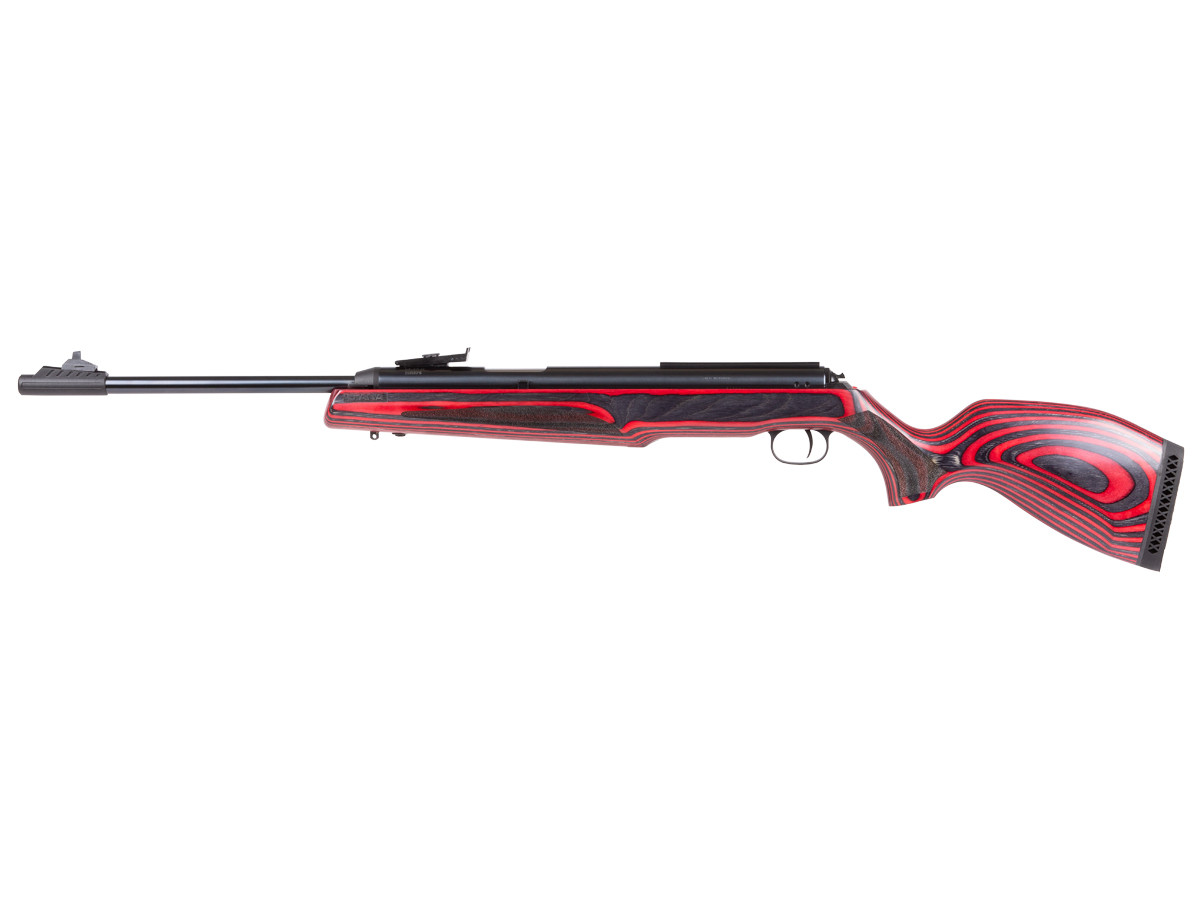
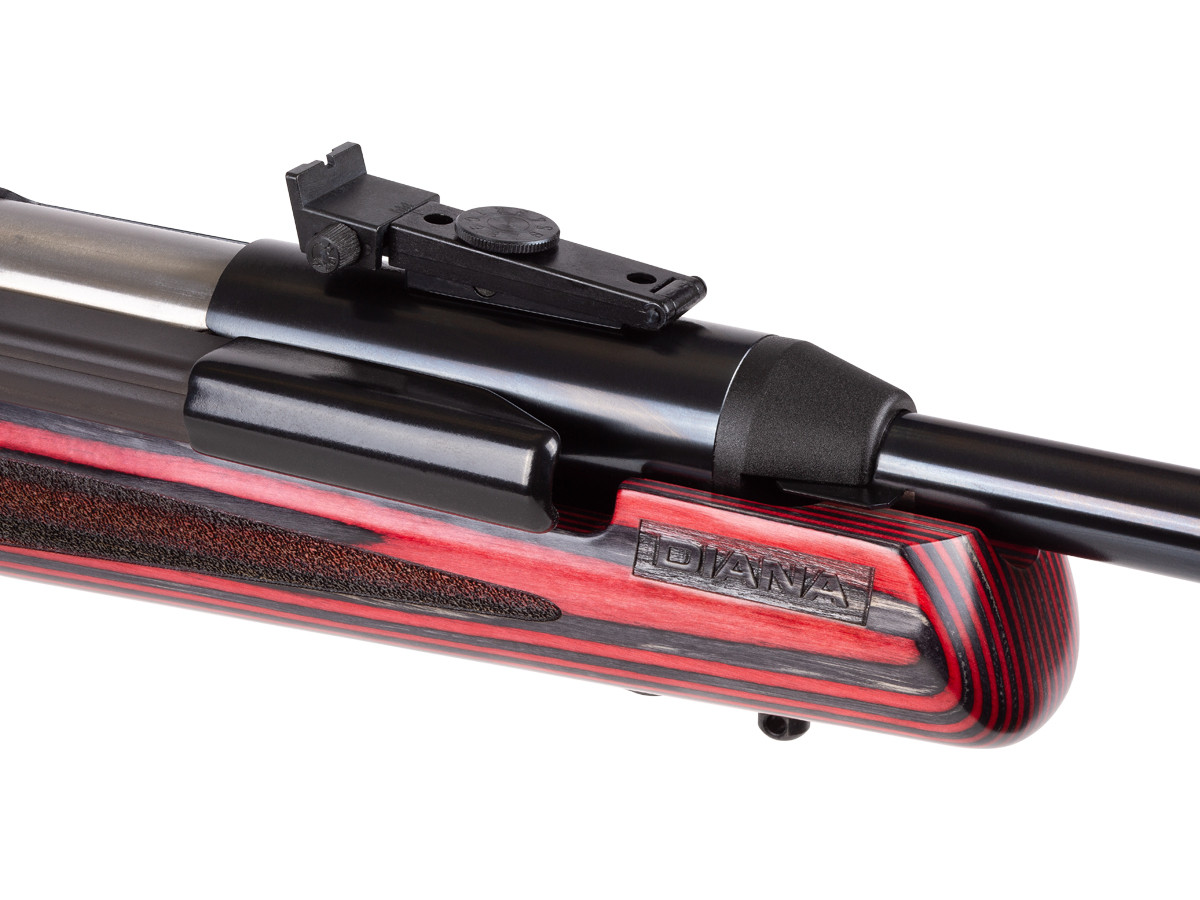
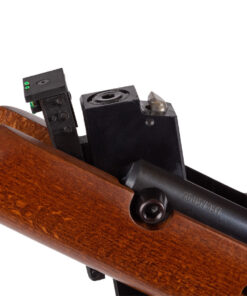
A useful set of fittings is already included with the Diana 54 Airking Pro Laminated. Open sights are supplied, with a rear sight that can be adjusted for windage and elevation and a front sight that can be removed when the adjustable barrel weight is preferred. An 11 mm dovetail rail with stop-pin holes is milled on the action so that a scope can be mounted. A forearm stud is fitted so that a bipod can be attached. An adjustable muzzle weight is provided so that balance can be refined. A two-stage T06 trigger can be adjusted to suit different finger lengths and preferences. An automatic safety is engaged on cocking. A rubber buttpad and checkered laminate grip and forearm are present so that a secure, comfortable hold can be maintained by a wide range of users.
The following accessories are commonly added after purchase:
- Spring-piston-rated riflescope and two-piece mounts matched to the 11 mm rail
- Bipod compatible with the forearm stud
- Quality lead pellets in several weights for grouping tests (.177 and .22 as appropriate)
- Sling only if a rear attachment point is added; a front stud alone is supplied from the factory
- Soft case or hard case sized for a 44 in / 1,120 mm rifle
- Barrel-cleaning kit and spring-piston-safe lubricants
- Chronograph for verifying local legal power
- Adjustable shooting rest for zeroing and accuracy work
Because the action moves within the stock, cheap non-spring-rated scopes should be avoided. Likewise, mounts with a recoil pin or stop should be preferred so that optic shift can be limited. When a bipod is fitted, a supported position can be used for pest control or precision practice. When open sights are retained, a compact, ready-to-shoot package is kept for close-range work.
Pellet choice remains the most important “accessory.” Mid-weight match or hunting pellets are usually more consistent than the lightest alloys once the rifle has been broken in. Inclusive practice means several brands should be tried so that the combination that groups best in this barrel is found, rather than a single advertised speed being chased.
Matching Caliber, Power, and Kit to the Intended Role
For formal or informal target shooting, .177 with a quality scope and a known pellet is often selected because a flatter trajectory can be used. For pest control at modest distance, either caliber can be effective when legal energy and a safe backstop are confirmed; a bipod and the factory stud then become especially useful. For small-game hunting where permitted, .22 and a full-power specification are more commonly specified, provided FAC or equivalent authority has been obtained if local limits are exceeded.
In every role, the same core platform is retained: a German-made, recoilless sidelever spring-piston rifle with an ambidextrous red-and-black laminate stock. Accessories should be chosen to support that platform rather than to fight it. When caliber, legal power, and supporting equipment are aligned, the Diana 54 Airking Pro Laminated can be employed with confidence, consistency, and respect for the rules that apply to every shooter.
Epic Airguns, Hatsan, Bintac and High-Performance PCP Air Rifles
Modern epic airguns continue to attract shooters who want advanced PCP technology, adaptable configurations, precision, and high-capacity air systems. Whether someone searches for epic air, epic 1, epic one, epic1, or the epic one air rifle, the interest generally centers on premium compressed-air platforms built for accurate shooting. The growing Epic lineup also includes searches for epic 2, the epic 2, epic 2.0, epic two lite, and epic two walnut, giving enthusiasts several terms to explore when comparing configurations, materials, and performance.
Shooters researching an air rifle com resource or a specialized pcp air gun shop may also encounter terms such as epicair, airgun one incorporated, 30 epic, epic optics, epic eagle, epic vision, airpne, and pist2 while comparing manufacturers, accessories, optics, and PCP platforms. Other searches, including pellet gun yeeps, kalibrgun snipe 2, air gun makers, and compressed air rifles, reflect how broad the modern airgun market has become.
For larger-caliber and tactical PCP enthusiasts, products associated with bintac aea harpoon, bintac t9 full auto, bintac mcar 457, and aea terminator have generated interest among buyers looking beyond conventional sporting rifles. Shooters researching anti air tanks may instead be looking for filling equipment and high-pressure storage solutions, while searches for bintac t9 price often come from buyers comparing premium PCP platforms before making a purchase.
Interest in a bee bee gun rifle can range from recreational plinking to entry-level target shooting, whereas searches such as zeus 72 cal air rifle price focus on extremely large-bore PCP technology. A suitable air tank for pcp airguns is particularly important for shooters who want convenient refilling away from a compressor or dive shop.
Large-caliber PCP platforms are also reflected in searches such as aea harpoon air gun, airgun shotgun, automatic air gun, air powered 50 cal rifle, and aea megalodon for sale. These terms demonstrate how air-powered technology has expanded far beyond the traditional pellet rifle and into increasingly specialized shooting platforms.
Hatsan Air Rifles, PCP Models and Popular Configurations
Among established manufacturers, hatsan blitz remains one of the most recognizable search terms for shooters interested in rapid-fire PCP designs. The wider hatsan air rifle lineup covers numerous shooting applications, while models such as the hatsan sortie, hatsan model 95, hatsan harpoon, hatsan hercules, and hatsan piledriver appeal to different sections of the airgun market.
Buyers searching hatsanusa or hatsan usa are often looking for Hatsan products, specifications, service information, accessories, or replacement components available within the American market. Meanwhile, the hatsan sortie tact semi-auto pcp offers a semiautomatic-style platform, and interest in hatsan sortie accessories gives owners options for refining their setup.
Traditional spring-powered enthusiasts frequently research the hatsan 135, hatsan 125, hatsan mod 95, and the shorter mod 95 search phrase. PCP shooters may instead consider the hatsan bullboss, hatsan hercules bully, hatsan flash, hatsan invader, or hatsan flashpup qe.
Value-conscious customers can also explore hatsan refurbished products and other refurbished air rifles when available. Models such as the hatsan airtact air rifle, hatsan neutron star, hatsan zada, and hatsan 135 carnivore broaden the selection even further.
Because terminology varies among shoppers, searches may include air rifle, air rifles, airguns, hatsun blitz, hatzan blitz, or the broader phrase hatsan air guns. Likewise, shooters researching PCP-specific options frequently use hatsan pcp when comparing regulated systems, air cylinders, magazines, power levels, and available calibers.
Hatsan Blitz, Big-Bore PCP and Semi-Automatic Options
The hatsan blitz full automatic platform is especially notable among buyers interested in fast cycling and high-capacity PCP technology. Searches such as hatsan blitz 30 cal and hatsan blitz .30 cal commonly focus on the larger-caliber Blitz configuration, while terms such as blitz guns and blitz 777 may appear during broader product research.
For shooters interested in other compact pneumatic platforms, the hatsan velox and hatsan jet 2 offer additional choices. Searches for jet ii may refer to the same general family, while hatsan jet 2 accessories can help owners locate compatible components and upgrades.
Additional Hatsan searches include hatsan sortie tact, hatsan airtact, hatsan factor rc, and hatsan 135 vortex air rifle. Buyers seeking larger projectiles and increased energy may also investigate the hatsan big bore carnivore rifle or related big-bore configurations.
The bullmaster provides another PCP platform for shooters comparing bullpup-style layouts, while invader auto attracts interest from users researching semiautomatic air rifle designs.
Calibers, Pellets, Optics and Shooting Accessories
Choosing the correct caliber remains an important part of selecting an airgun. A 30 cal air rifle can offer considerably more projectile mass than a traditional .177 caliber rifle, although the best choice depends on intended use, legal requirements, shooting distance, and available ammunition.
A quality air pellet gun should be paired with ammunition suited to its barrel and power output. Some users may type pallet gun when searching for pellet-powered equipment, while competitive shooters might research premium ammunition such as h&n field target trophy bleifrei.
Optics are equally important for accurate shooting. A basic 4×20 optic may be sufficient for recreational use at modest distances, whereas more advanced scopes can provide adjustable magnification, parallax correction, and improved reticles for longer-range shooting.
Searches involving econ ii may relate to specific airgun equipment or components, while crow magnum remains another term encountered by enthusiasts researching established airgun products.
PCP Air Supply, Range and Specialized Shooting Equipment
Unlike spring-powered rifles, PCP systems rely on compressed air stored at high pressure. Therefore, shooters comparing compressed air rifles should consider cylinder capacity, regulator performance, fill pressure, shot count, and refill equipment alongside muzzle performance.
A dependable air tank for pcp airguns can simplify field refilling, while suitable fill adapters and rated high-pressure equipment should always be used according to manufacturer specifications.
The practical range of air rifle performance varies considerably according to caliber, projectile design, muzzle energy, weather conditions, optics, and shooter ability. Consequently, there is no single universal air rifle range that applies to every platform.
Some shooters also explore an arrow launcher configuration, which uses air pressure to propel compatible arrows or bolts rather than conventional pellets. This specialized equipment demonstrates the versatility available across today’s airgun market.
From epic one and epic two walnut configurations to hatsan blitz, aea terminator, and large-bore PCP platforms, today’s market includes recreational rifles, precision systems, semiautomatic designs, tactical configurations, and specialized high-powered airguns. Comparing construction quality, caliber, air capacity, ammunition compatibility, intended shooting application, and available accessories can help buyers identify the platform that best matches their needs.
Frequently Asked Questions
A wide range of practical questions is raised by new and experienced owners before a recoilless German sidelever spring-piston rifle of this type is purchased. Consequently, the answers below are written so that caliber choice, legal power, handling, optics, and care can be understood without guesswork. Inclusive language is used throughout, because left-handed and right-handed shooters, as well as users in different legal jurisdictions, are equally considered.
General Design and Shooting Character
What type of air rifle is this model?
A single-shot, spring-piston sidelever is employed. A fixed, precision-rifled barrel is retained, while cocking is completed from the side rather than by breaking the barrel. In addition, a patented sliding action is mounted inside the stock so that recoil and vibration can be absorbed before they are fully transmitted to the shoulder. Therefore, a smoother shooting impression than that of many conventional springers is often reported.
How is recoilless shooting achieved?
The action is allowed to move on a guided system within the stock when the shot is released. As a result, much of the spring-piston pulse is taken up internally. Felt kick is reduced, and follow-through through a scope can be observed more easily. Residual movement still occurs, however, so spring-rated optics and secure mounts should still be specified.
Is the stock suitable for both left-handed and right-handed users?
An ambidextrous laminated hardwood stock is fitted, with cheek support present on both sides. Checkering is cut into the pistol grip and forearm, and a rubber buttpad is included. Consequently, a usable hold can be obtained by shooters on either side without a dedicated left-hand stock being required.
How heavy is the rifle, and how is that weight felt in use?
A mass of approximately 4,700 g (about 10.25–10.7 lb) is carried. That weight can feel substantial during a long walk, yet it is frequently found helpful on the firing point because muzzle movement can be damped. Balance can be refined because an adjustable barrel weight is supplied at the muzzle.
How difficult is cocking?
Sidelever cocking effort is commonly reported near 40 lb. A stable stance and correct lever technique are therefore recommended. A cocking safety is incorporated so that uncontrolled return of the lever can be prevented. Inclusive practice means the rifle should be cocked only when a safe muzzle direction has already been established.
Calibers, Pellets, and Accuracy
Which calibers are available?
Two factory chamberings are offered: 4.5 mm (.177) and 5.5 mm (.22). A flatter trajectory is generally associated with .177, while greater on-target energy is typically associated with .22. The same sidelever action, recoilless mounting, and laminate stock are used in both versions.
What velocities and energy figures are published?
Official manufacturer data with lead pellets list up to 295 m/s (975 fps) and 24 J (17.8 ft·lbs) in .177, and up to 225 m/s (740 fps) and 26 J (19.2 ft·lbs) in .22. Higher speeds with lightweight alloy pellets are sometimes quoted by retailers. Actual results vary with pellet mass, temperature, break-in, and the legal power setting of the individual rifle.
Which pellet types should be tested first?
Mid-weight lead domed or hunting pellets are usually the most consistent starting point. Lightweight alloys can produce higher chronograph readings but may group less tightly once the barrel has been fouled and settled. Several brands and weights should be grouped at a known distance so that the combination preferred by this barrel can be identified.
Is a magazine fitted?
No magazine is used. Each pellet is loaded singly through the loading port. A slower, more deliberate rhythm is therefore encouraged, which many precision-oriented shooters regard as an advantage.
Power, FAC, and Legal Status
Is a firearms certificate required?
That question cannot be answered with a single worldwide statement. Legal classification depends on the energy of the specific rifle and on the laws of the country or region of use. In some markets a full-power specification is lawful without a certificate; in others a reduced-power version is supplied so that licensing thresholds are not crossed. In the United Kingdom, a sub-12 ft·lbs specification is commonly supplied so that an FAC is not required for ordinary air-rifle use. Elsewhere, a 7.5 J version may be provided. The exact energy of the rifle that will be shipped should always be confirmed before an order is placed.
Can power be assumed from a catalogue page alone?
No. Catalogue maxima refer to unrestricted factory figures and to particular pellet types. Local law may require a lower setting. A chronograph check after delivery is the only reliable way to verify the example in hand.
May the rifle be used for hunting or pest control?
Use for hunting or pest control is permitted only where local wildlife, firearms, and airgun laws allow it, and only when a safe backstop and appropriate energy are present. Inclusive, responsible conduct requires that quarry, distance, and land permission be lawful. Where energy exceeds a local limit, the correct certificate or licence must be held before the rifle is used in the field.
Sights, Optics, and Trigger
Are open sights included?
Adjustable open sights are supplied. Windage and elevation can be set at the rear sight. The front sight can be removed when the adjustable barrel weight is preferred instead. A ready-to-shoot iron-sight package is therefore available from the first session.
Can a scope be mounted?
An 11 mm dovetail rail with stop-pin holes is milled on the action. A compact or mid-length scope can be fitted, provided enough clearance remains for the loading port and sidelever. Spring-piston-rated optics and mounts with a recoil pin or stop should be chosen, because the action still moves inside the stock even though felt recoil is reduced.
What should be known about the trigger?
A two-stage adjustable T06 unit is fitted. Adjustment can be completed without full disassembly. A cleaner, more predictable break can be obtained after a short setup period. Inclusive use means the trigger should be set to a weight that remains safe for the individual shooter and for the environment in which the rifle will be used.
How does the safety operate?
An automatic safety is engaged when the rifle is cocked. The shot cannot be released until the safety is deliberately taken off. That arrangement reduces the chance of an unintentional discharge during loading, yet it does not replace muzzle discipline.
Stock, Accessories, and Support Gear
What fittings are supplied from the factory?
A red-and-black laminated stock, checkering, rubber buttpad, open sights, adjustable barrel weight, 11 mm rail, T06 trigger, automatic safety, and a forearm stud for a bipod are included. A complete “bare rifle plus irons” package is therefore delivered.
Which accessories are most often added?
A spring-rated scope and matching mounts, a bipod for the forearm stud, a selection of quality pellets, a chronograph, a case long enough for a 44 in / 1,120 mm rifle, and a cleaning kit are the most common additions. A rear sling swivel is not always present from the factory; a sling should be fitted only after a secure rear attachment point has been added.
Can a bipod be attached?
Yes. A stud is provided on the forearm so that a compatible bipod can be mounted. A supported position can then be used for zeroing, pest control, or longer precision strings.
Is the barrel weight useful?
The muzzle weight can be adjusted so that balance is shifted slightly. Some shooters prefer extra mass at the muzzle for a steadier hold; others reduce it when a lighter carry is wanted. The front sight can be exchanged or removed depending on how the muzzle is configured.
Handling, Maintenance, and Ownership
Is dry-firing permitted?
Dry-firing of a spring-piston rifle should be avoided. Damage to the piston seal and other internal parts can be caused if the action is released without a pellet. A safe pellet and a safe backstop should be used whenever the trigger is pressed.
How should the rifle be cleaned and stored?
The bore should be kept free of excessive lead and debris with appropriate felt pellets or a pull-through. Harsh solvents that attack seals should be avoided. The laminate stock should be protected from prolonged moisture. Storage should be secure, unloaded, and out of reach of unauthorized persons, in accordance with local law.
Is a break-in period expected?
Yes. Velocity and grouping often settle after a number of shots. Pellet tests should be repeated after that period rather than judged from the first tin alone.
Why is the rifle described as “made in Germany”?
Design, machining, and assembly standards associated with German sporting-airgun production are applied. Fit of the action, quality of the laminate, and the T06 trigger unit reflect that manufacturing background. Routine care is still required if that quality is to be preserved.
What limitations should be accepted honestly?
The rifle is heavy. Cocking effort is significant. Only one shot is available before a reload. Power may be legally reduced in some countries. A rear sling point may need to be added. Those points are trade-offs against recoilless shooting, a fixed barrel, an ambidextrous laminate stock, and a refined sidelever action.
Choosing and Using the Rifle Responsibly
Who is this platform best suited for?
Shooters who want spring-piston independence from tanks and compressors, yet prefer less felt recoil than a typical break-barrel, are the primary audience. Target practice, lawful pest control, and small-game hunting (where permitted) can all be supported when caliber, energy, and accessories are matched to the task.
How should a first range session be organized?
A known-distance backstop should be prepared. Open sights or a securely mounted spring-rated scope should be used. Several pellet types should be grouped. Cocking technique should be practiced slowly. The automatic safety should be understood before live fire begins. Inclusive coaching is recommended if a new shooter is being introduced to a heavy sidelever.
What is the most important safety reminder?
Legal status, muzzle direction, and a safe backstop remain more important than velocity figures. The recoilless system makes the rifle more comfortable; it does not make it less powerful or less subject to the law. Every shot should be treated as if a pellet will leave the barrel, because that is exactly what will occur when the trigger is pressed with a loaded chamber.
When those points are understood, the laminated sidelever can be enjoyed as a precise, distinctive, and inclusive spring-piston rifle—provided caliber, power specification, and accessories have been chosen to match both the shooter and the rules that apply in the place of use.









Reviews
There are no reviews yet.