We Deliver Airguns Directly To Your Door
SKU N/A Category

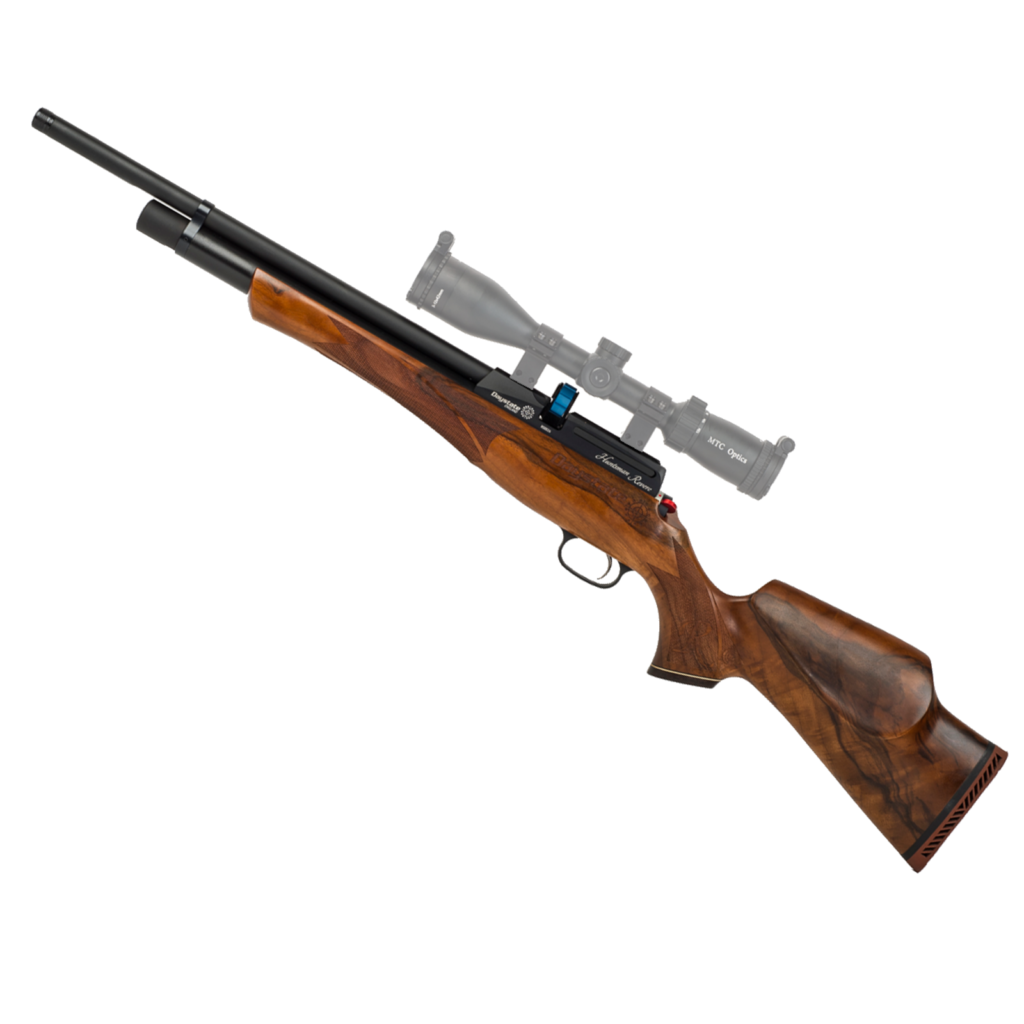
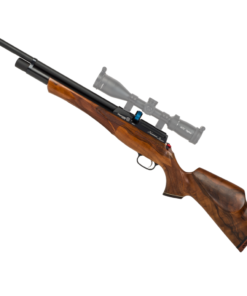
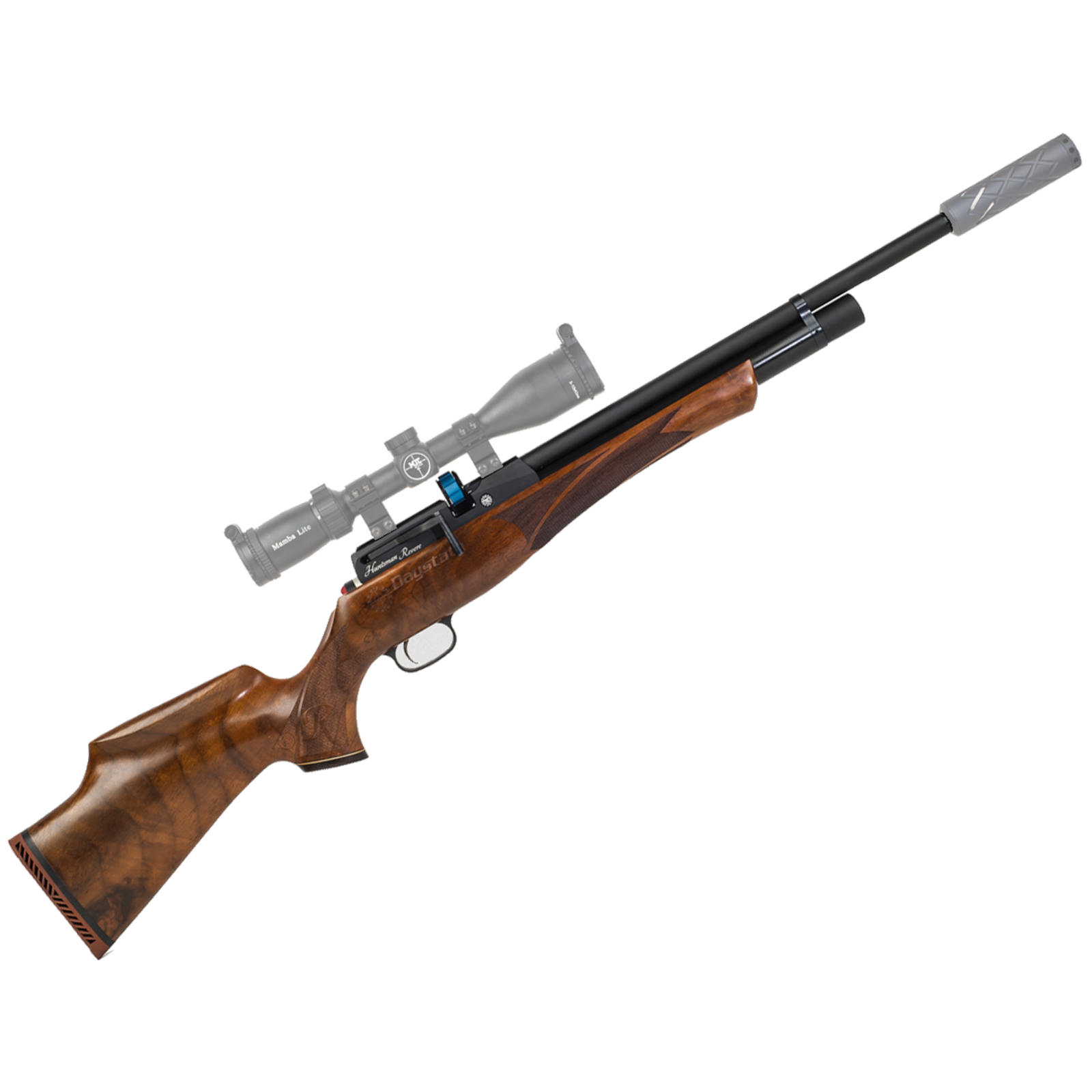
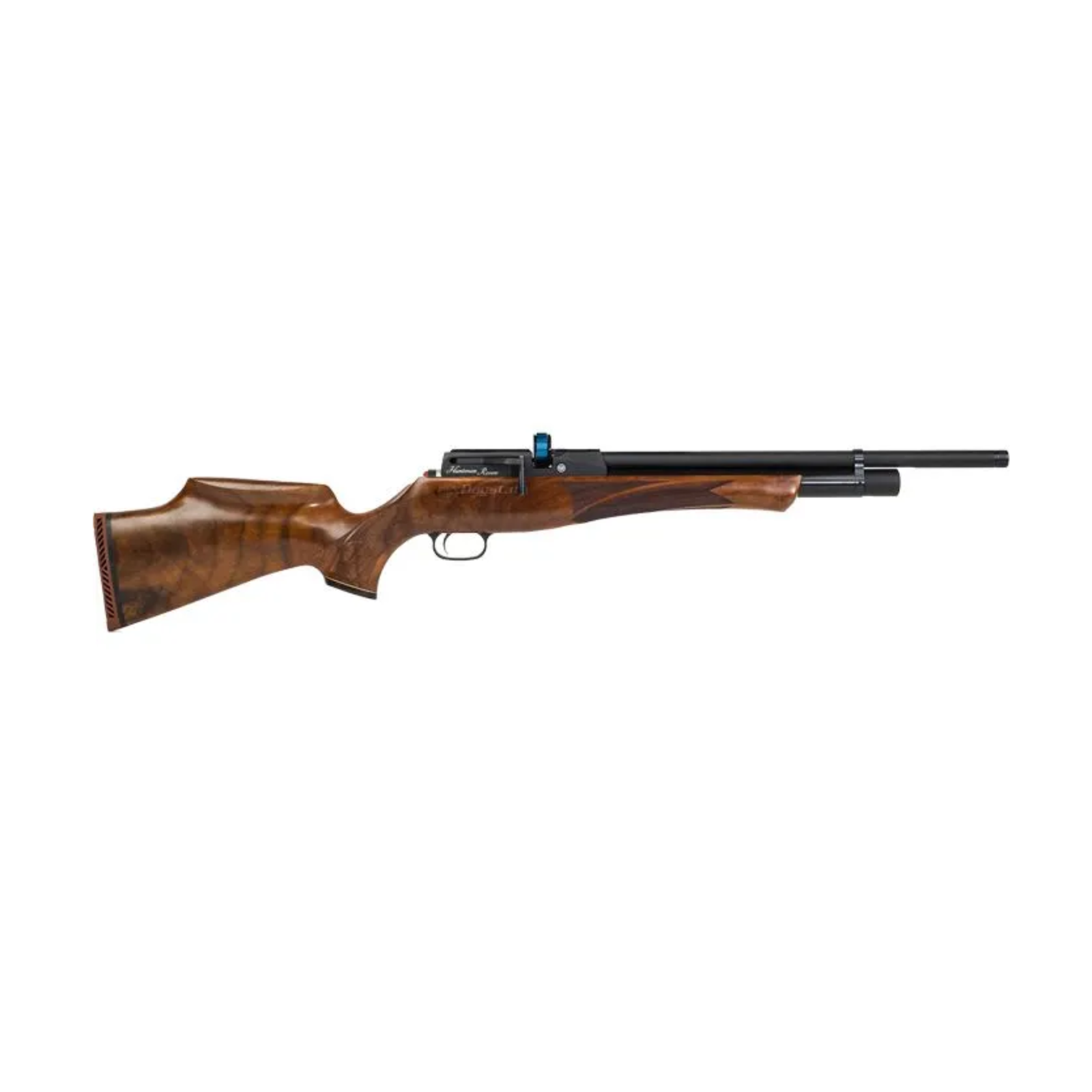
Daystate Huntsman Revere

$1,510.00

Power source: Pre compressed pneumatic (PCP)
Caliber: 5.5mm (.22) | 6.35mm (.25)
Muzzle energy: 55 joule
Fill pressure: 250 bar
Air capacity: 162cc
Regulator: Huma regulated
Operating system: Sidelever
Magazine: 10 shots
Max. projectile length:
Optic mounting: 11mm dovetail
Weight: 2900 grams
Length: 928mm
Barrel length: 430mm
Muzzle: 1/2unf
Accessories: Magazine, fill probe

Daystate Huntsman Revere

precision is presented as a refined evolution of an iconic British PCP sporter. Classic hunting lines are preserved while modern regulation, sidelever operation, and match-grade barrel work are introduced. Consequently, field handling and target-grade consistency are combined in one compact package.

Why the Daystate Huntsman Revere Stands Apart

An established Huntsman silhouette is retained. Meanwhile, a sidelever action is fitted so that cocking effort is reduced, especially on higher-power FAC configurations. Furthermore, a HUMA-Air regulator is integrated with an updated hammer and valve system. As a result, shot-to-shot consistency is elevated to levels more commonly associated with dedicated target rifles.

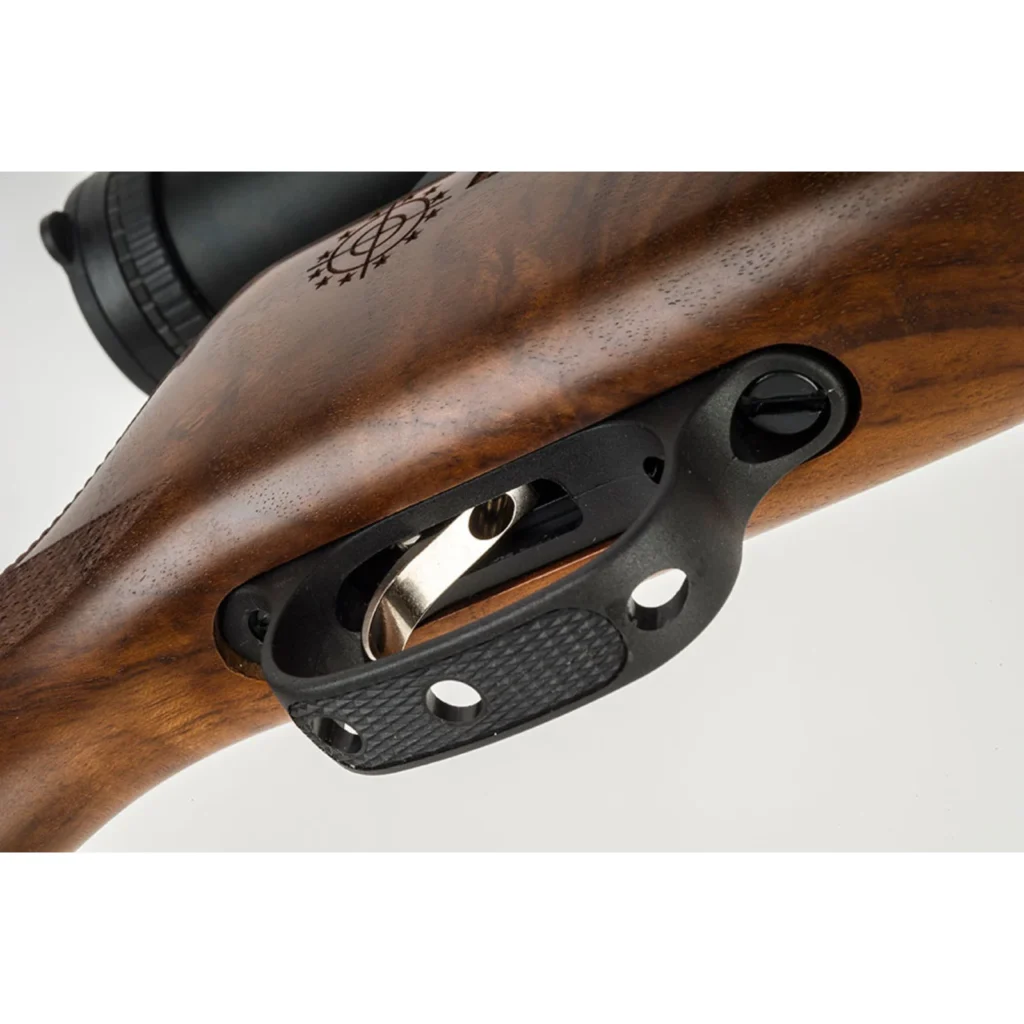
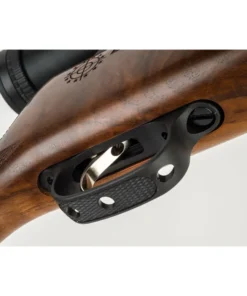
A Lothar Walther match-grade barrel is shrouded and free-floated. In addition, a 1/2″ UNF muzzle thread is provided so that a moderator can be fitted when stealth is required. Moreover, a two-stage adjustable trigger is offered, allowing first-stage travel and release weight to be tailored. Therefore, control is improved whether the rifle is used from a rest or from unsupported field positions.

Walnut stocks produced by Minelli are supplied in dedicated right-hand and left-hand layouts. Additionally, a Safari edition with raised-grain finish and an adjustable cheekpiece is available on selected variants. Hence, a secure, natural hold is encouraged for a wide range of shooters.

Core Engineering Highlights

The following attributes are built into the Daystate Huntsman Revere:

  • Regulated PCP action — A HUMA regulator is paired with Daystate’s developed hammer and valve arrangement so that velocity variation is kept exceptionally tight across a fill.
  • Sidelever cocking — Smooth, low-effort cycling is delivered; a mechanical slingshot hammer system is employed.
  • Match-grade barrel — A 430 mm Lothar Walther tube is shrouded; ART-spec tuning is applied on many examples.
  • Gate-loading magazine — A self-indexing rotary magazine is included (13-shot in .177, 11-shot in .22, 10-shot in .25) together with a magnetic single-shot tray.
  • Compact sporting dimensions — Overall length of approximately 928 mm and an unscoped weight near 2.8–2.9 kg are maintained for all-day carry.
  • 250 bar fill — A 132 cc cylinder is used on standard 12 ft-lb models; a 162 cc cylinder is fitted on many export/FAC versions.
  • Two-stage trigger & manual safety — Adjustable pull and stage length are provided; a rotary trigger-block safety is fitted.
  • Moderator-ready muzzle — A removable shroud cap exposes the 1/2″ UNF thread.

Sub-12 ft-lb UK-legal rifles typically return around 140 shots in .177 and 160 shots in .22 from a full 250 bar fill. Meanwhile, FAC/export versions can be specified up to approximately 18 ft-lbs in .177, 30 ft-lbs in .22, and 40 ft-lbs in .25, with correspondingly lower shot counts at the highest power settings. Accordingly, legal and application-specific power levels can be selected.

Handling, Accuracy, and Field Use

A lower-seated action is cradled by the classic sporter stock so that balance remains forward of the trigger yet still pointable. Subsequently, instinctive shouldering is encouraged during woodland stalking or hide work. Likewise, the relatively modest weight reduces fatigue during long sessions.

Exceptional grouping is routinely reported when quality waisted round-head pellets are used. Tight clusters at 30–40 yards are commonly achieved once the barrel is leaded in. In addition, chronograph spreads of only a few feet per second over strings of tens of shots are frequently recorded thanks to the regulator. Therefore, holdover remains predictable and ethical shot placement is supported.

Hunting, pest control, HFT-style target work, and precision plinking are all accommodated. Moreover, left-handed configurations (including left-side lever and magazine access on dedicated models) are offered so that the platform remains inclusive. A fill probe with a twist-collar port is used rather than a Foster fitting on many examples; twin gauges for cylinder and regulator pressure are fitted on certain production runs.

Calibres, Power, and Accessories

Calibre choice is made according to intended use and local regulations:

  • .177 — High shot count and flat trajectory for targets and smaller quarry at 12 ft-lbs; FAC options around 18 ft-lbs.
  • .22 — A popular all-round hunting balance; generous shot strings at 12 ft-lbs and FAC outputs near 30 ft-lbs.
  • .25 — Greater energy for larger quarry where FAC or export power is permitted (up to ~40 ft-lbs).

Recommended pellets such as Rangemaster Sovereign, Kaiser, King, or equivalent premium round-heads are advised so that magazine indexing remains reliable and accuracy is maximised. An 11 mm dovetail rail is provided for optics. Consequently, a compact hunting scope or a higher-magnification target optic can be mounted according to preference.

A three-year manufacturer warranty is typically supplied. Furthermore, the platform remains serviceable through established Daystate support networks.

Who the Daystate Huntsman Revere Is Built For

Traditional sporting aesthetics are demanded by many enthusiasts, yet modern consistency and easier cycling are also required. That combination is delivered here. Compact length and modest mass are appreciated by hunters who cover ground. Simultaneously, match-level grouping is valued by shooters who spend time on the range.

Legal power limits vary by territory; factory settings are applied with a safety margin for the recommended ammunition. Responsible ownership, local licensing, and safe handling practices remain essential.

Precision, heritage styling, and regulated performance are united in the Daystate Huntsman Revere. Classic Huntsman character is therefore carried forward while contemporary engineering is applied where it most improves the shot.

Calibre, FAC rating, power output, and accessory choice are matched to the intended use of the Daystate Huntsman Revere. Legal limits, quarry size, shooting distance, and personal preference are therefore considered together so that the rifle is specified correctly from the outset.

Calibres Offered on the Daystate Huntsman Revere

Three principal calibres are supplied. In addition, a .20 option appears on selected official specification tables. Consequently, a suitable chambering can be selected for target work, pest control, or hunting.

.177 (4.5 mm)

A flatter trajectory is produced in .177. Moreover, a high shot count is returned from a 250 bar fill on the standard 12 ft-lb cylinder. Approximately 140 regulated shots are typically delivered at UK-legal power. Meanwhile, FAC/export versions can be set around 18 ft-lbs, with roughly 46 usable shots commonly quoted from the larger 162 cc reservoir. Magazine capacity of 13 pellets is provided. Therefore, this calibre is frequently chosen for HFT-style targets, longer-range precision practice, and smaller quarry where legal energy is sufficient.

.22 (5.5 mm)

A widely favoured hunting balance is offered in .22. Furthermore, generous shot strings are achieved at 12 ft-lbs—around 160 shots from the 132 cc cylinder on many reviews. FAC configurations of approximately 30 ft-lbs are available, with about 39 shots often listed; higher 40 ft-lb settings reduce the count further. An 11-shot magazine is fitted. As a result, this chambering remains popular among field users who require a blend of energy, pellet availability, and consistency.

.25 (6.35 mm)

Greater striking energy is delivered in .25 where FAC or export power is permitted. Up to around 40 ft-lbs can be specified. Subsequently, roughly 20 shots at 40 ft-lbs or about 45 shots at 30 ft-lbs are quoted from the 162 cc cylinder. A 10-shot magazine is supplied. Hence, this option is selected when larger quarry or greater down-range authority is required and local law allows the higher output.

A compact overall length of 928 mm and an unscoped weight near 2.8–2.9 kg are retained across calibres. Likewise, the same 430 mm Lothar Walther match-grade shrouded barrel architecture is used, so handling character remains familiar after a calibre change.

FAC, Legal Power, and Shot Performance

Power is factory-set according to the destination market. UK sub-12 ft-lb rifles are typically chrono’d in the 11.3–11.5 ft-lb region with very tight velocity spreads thanks to the HUMA regulator. Export and FAC models are offered at higher outputs: approximately 18 ft-lbs in .177, 30 ft-lbs in .22, and up to 40 ft-lbs in .25. Power ceilings also vary by country (examples include lower joule limits in some European markets). Accordingly, the exact energy delivered on any individual rifle should be confirmed against the certificate and local regulations before use.

A 132 cc air cylinder is fitted to many standard 12 ft-lb guns. Meanwhile, a 162 cc cylinder is commonly used on FAC/export rifles so that usable shot counts remain practical at elevated energy. Fill pressure remains 250 bar in both cases. Consequently, a consistent regulated plateau is maintained rather than a steep unregulated curve.

Shot counts are always pellet- and power-dependent. Premium waisted round-head pellets are required for reliable magazine indexing and best accuracy. Inferior or oddly shaped ammunition can cause misfeeds and should therefore be avoided.

Practical Power Summary

Highlighted listings for quick comparison:

  • UK-legal 12 ft-lb class — Circa 140 shots (.177) and 160 shots (.22); energy typically ~11.3–11.5 ft-lbs with low fps variation.
  • FAC / export .177 — Up to ~18 ft-lbs; around 46 shots from the larger cylinder on published figures.
  • FAC / export .22 — Up to ~30 ft-lbs (approx. 39 shots); higher 40 ft-lb settings available with fewer shots.
  • FAC / export .25 — Up to ~40 ft-lbs (approx. 20 shots) or ~30 ft-lbs (approx. 45 shots).
  • Regulator benefit — Tight velocity spreads (often single-digit to low-teens fps over long strings) are recorded when quality pellets are used.

Licensed holders and destination-market buyers are advised to verify the exact factory setting, because energy may be set slightly below the published maximum to protect accuracy with recommended ammunition.

Accessories, Optics, and Supporting Equipment

A comprehensive accessory path is supported so that the Daystate Huntsman Revere can be configured for stealth hunting or precision target work.

The shrouded barrel terminates in a removable cap that exposes a 1/2″ UNF thread. Therefore, a compact 0dB-style moderator or aftermarket silencer (Huggett and similar patterns are commonly fitted in reviews) can be added when report reduction is needed. An 11 mm dovetail rail is provided for scopes. Compact hunting optics or higher-magnification target scopes can thus be mounted; saddle clearance should be checked because the gate-loading magazine sits slightly taller than older Daystate magazines.

Included with the rifle on most packages:

  • Self-indexing rotary magazine (calibre-specific capacity)
  • Magnetic single-shot loading tray
  • Fill probe with twist-collar port protection

Optional and commonly paired items include dedicated left-hand stocks (lever and magazine access reversed), the raised-grain Safari stock with adjustable cheekpiece, spare magazines, and quality fill gear rated to 250 bar. Rangemaster Sovereign and Kaiser pellets are recommended for 12 ft-lb rifles; Sovereign Hunter, King, and Emperor grades are suggested as energy rises. Likewise, a stable rest, bipod, or sling can be added according to discipline.

A three-year manufacturer warranty is typically supplied. Service support and genuine parts remain available through Daystate’s network. Inclusive left- and right-hand configurations ensure the platform can be specified for a wide range of shooters without compromise to cocking or loading ergonomics.

Correct calibre, legal power, and accessory selection allow the regulated sidelever action and match-grade barrel to perform as intended. Ethical, accurate shooting is therefore supported whether the Daystate Huntsman Revere is used in the field or on the range.

Daystate, FX Airguns, PCP Rifles, Accessories and Precision Airgun Equipment

For enthusiasts researching premium PCP platforms, accessories, replacement components, and precision shooting equipment, the modern airgun market offers an extensive range of options from brands such as Daystate and FX. Searches for daystate blackwolf, daystate redwolf, delta wolf, huntsman daystate, daystate alpha wolf, wolf delta, day state, and daystate delta wolf frequently come from shooters comparing electronic PCP technology, ergonomic designs, premium construction, and sophisticated firing systems. Traditional styling also remains important, which is why terms such as stock walnut, safari stock, dima stock, rimfire stocks, and stock replacement continue to attract buyers who value both appearance and practical fit.

Among electronically controlled PCP rifles, the daystate alpha wolf, daystate blackwolf, daystate redwolf, and daystate delta wolf are commonly associated with advanced regulation, refined shot management, and a highly consistent firing cycle. Searches such as what is a delta wolf, what is a delta wolf, delta wolf meaning, deltaw, blackwolf, red alpha wolf, alpha red wolf, model alpha gun, model alpha gun, and electronic wolves often reflect buyers trying to understand how Daystate’s electronically managed rifles differ from conventional mechanical PCP systems. Other searches, including daysta, wolf gun, wolverine gun, wolveriner, daystate wolverine sapphire, daystate wolverine sapphire, and wolfpack armory wolverine, demonstrate the broad interest surrounding Wolf-branded and Wolverine-related sporting platforms.

Small ergonomic components can make a substantial difference to comfort and handling. A rifle butt pad, rubber butt, rubber butt pad, and butt pad rifle accessory can improve shoulder contact, while a bradley cheek riser can help support a more consistent head position. Likewise, enthusiasts may research gecko grips, a cocking ball, short cocking, an index pin, pin magazine, lock timing, and lock time when learning about rifle ergonomics, cycling characteristics, and replacement components. Searches for buddy bottle cover and buddy bottle cover also remain relevant for shooters who want to protect external air cylinders from cosmetic wear during transport or field use.

Magazine compatibility is another frequent consideration. Users may search for a 177 magazine, mag 177, 25 magazine, 5.0 mm pellets, 177 pellets types, slug pellet, or a general pellet rifle when comparing ammunition formats and magazine configurations. Pellet selection should always match the manufacturer’s recommended caliber and specifications for the rifle being used. A well-matched magazine and suitable ammunition can support reliable feeding and consistent performance without unnecessary mechanical stress.

PCP equipment relies on compressed air, so searches such as air rifle compressed air, air gun pc, air gun, and air guns are commonly connected with understanding pre-charged pneumatic systems. Owners also frequently search for a pcp o ring kit because seals form an important part of maintaining an air-tight pneumatic system. Maintenance should follow manufacturer-approved procedures, especially for high-pressure components, regulators, cylinders, and valves.

Sound-moderation accessories form another major category. Common search terms include air gun suppressor, air gun suppressors, airgun moderator, air rifle moderator, 0db, 0db moderator, 0 db moderator, 0 db moderator, 0 db moderator, 0 db moderator, and hogan decimeater silencer. Thread-related searches include silencer thread adapter, thread protector rifle, and muzzle thread protector. Compatibility depends on barrel threading, caliber, applicable law, and manufacturer specifications, so owners should verify all requirements before purchasing or fitting any muzzle accessory.

Mounting systems have also become increasingly important as modular fore-ends and accessory rails become more common. Searches for an mlok to picatinny rail adapter, best m-lok to picatinny rail adapter, m-lok to picatinny adapter, picatinny m lok adapter, and picatinny bag rider usually come from shooters wanting greater flexibility when mounting supported accessories. The best adapter is generally one that matches the rifle’s rail specification, uses quality hardware, fits securely, and avoids unnecessary bulk.

Sling-related searches are equally common. Buyers frequently look up how to put a gun sling on a rifle, how to put a rifle sling on, how to install a rifle sling, riffle sling, rigle sling, how to put sling on rifle, installing a rifle sling, and attaching a sling to a rifle. A compatible sling can improve carrying comfort and transportation, but attachment points should always be checked against the rifle manufacturer’s recommendations to avoid damage to the stock or mounting hardware.

The alpha wolf barrel and accessories such as an ats tuner may also interest precision-focused users researching how different rifle configurations are designed. Similarly, terms such as weatherby vanguard trigger adjustment appear in broader shooting-related searches, although trigger systems differ significantly between platforms and should be serviced or adjusted only according to the applicable manufacturer’s safety instructions. Another unusual search phrase, how to put extinguisher call back together, is unrelated to PCP rifle servicing and should be treated according to the specific extinguisher manufacturer’s maintenance guidance rather than general airgun information.

For buyers comparing premium European PCP equipment, daystate redwolf price and daystate redwolf price are common commercial-intent searches. Pricing can vary depending on caliber, stock type, configuration, region, dealer, and included accessories. People may also search fx airgun dealer near me when looking for authorized retailers, parts support, servicing, or warranty assistance.

FX Airguns remains another major name in the PCP market. Popular searches include fx impact m3 .22cal air rifle. 600mm barrel, fx impact m3, fx impact mk3, fx m3 airgun, fx m3, impact m3, and fx impact m3 air rifle. Price-focused searches such as fx impact m3 precio, fx impact m3 precio en usa, and fx impact m3 price indicate strong buyer interest in comparing regional pricing and available configurations. The modular design philosophy associated with the FX Impact family makes it especially attractive to experienced PCP users who prioritize adjustability, ergonomics, accessory compatibility, and high-quality construction.

Potential buyers also encounter less common search phrases such as griffin gun, unfend, black snood, red bodywarmer, and can wolverine go on planes. Airline transport rules for sporting equipment and compressed-air components can differ substantially between carriers and countries, so travelers should always check current airline, airport, customs, and destination regulations before making travel arrangements. Likewise, terms such as 3.55kg in lbs may appear when buyers compare rifle weight specifications across metric and imperial listings.

Whether someone is researching the daystate alpha wolf, daystate blackwolf, daystate redwolf, huntsman daystate, wolf delta, an fx impact m3, or another premium pellet rifle, the most important purchasing factors remain intended use, caliber compatibility, overall weight, stock ergonomics, magazine design, air-cylinder capacity, manufacturer support, and accessory compatibility. Premium PCP ownership is best supported by appropriate maintenance, manufacturer-approved components, secure storage, responsible handling, and compliance with all local laws and transport requirements.

Field Carry and First Contact

A modest unscoped mass near three kilograms is appreciated once a compact hunting scope and a short moderator are fitted. As a result, the outfit remains light enough for several hours of walking without the fatigue associated with bullpups or bottle-heavy tactical rifles. Balance is kept slightly forward of the trigger, so the muzzle stays steady when a pause is made at a gate or hedge line. Meanwhile, overall length under a metre allows the rifle to be slipped through cover and across ditches without constant snagging.

A sidelever is cycled with the rifle still in the shoulder. Therefore, a follow-up shot can be prepared with less movement than a long bolt throw would require. The magazine is loaded in advance with waisted round-head pellets so that indexing remains reliable. A single-shot tray is reserved for bench confirmation or for the last careful shot of a session when magazine spring tension is no longer wanted.

Highlighted points for opening a session:

  • A full 250 bar fill is completed at home or in the vehicle so that the regulator plateau is available from the first shot.
  • Zero is confirmed at the expected hunting distance before departure.
  • A moderator is fitted when local rules and courtesy require a reduced report.
  • Spare magazines or a tin of matched pellets are carried in a pocket rather than left in the bag.
  • A sling is attached only when long walks between permission boundaries are expected.

Woodland Stalking and Close Cover

Quiet approach work is favoured in mixed woodland. Leaves, bramble, and uneven ground demand a rifle that can be held ready for long minutes without strain. The slim sporter stock is therefore tucked along the body while the supporting hand remains under the forend. Subsequently, the rifle can be raised in one motion when a grey squirrel or rabbit is spotted along a ride.

Shots inside thirty metres are common in this setting. A flat .177 trajectory is often selected for such distances at legal 12 ft-lb energy, while .22 is chosen when a little more authority is preferred on slightly larger quarry. Because velocity variation is kept tight by the regulator, holdover remains predictable after the first confirmation group. Moreover, the shrouded barrel and an added moderator keep the report from rolling through the trees and alerting every animal on the beat.

A two-stage trigger is set a little heavier for gloved winter use so that an accidental discharge is avoided when fingers are cold. Likewise, the manual safety is applied while moving and taken off only when the stance is settled. Follow-up shots, if ethically required, are cycled with the sidelever without the rifle being lowered from the shoulder. Consequently, disturbance is minimised and a second opportunity can be taken if the first pellet was deflected by a twig.

Wet weather does not change the fundamental handling. An oiled walnut stock is wiped after the outing; metalwork is dried before the rifle is cased. Rain covers for the optic are kept in a pocket because a sudden shower is typical under a closed canopy.

Farm Pest Control and Boundary Work

Permission shooting around barns, straw stacks, and field margins is a frequent application. Distances vary from fifteen metres at a feeder to forty metres across a paddock. Therefore, a reliable zero and a consistent pellet are more valuable than maximum theoretical energy. Sub-12 ft-lb rifles are used where the law requires it; FAC settings are reserved for licensed holders and for quarry that justifies the extra power.

A .22 chambering is commonly selected for this work because pellet choice is wide and energy at 12 ft-lbs remains adequate for rabbits and similar pests when shot placement is correct. Meanwhile, .25 FAC outputs are employed only where the certificate and the landowner’s brief allow higher energy. Shot counts of well over a hundred at legal power mean a morning’s circuit can be completed from a single fill. As a result, a pump or bottle is left in the vehicle rather than carried across wet fields.

Highlighted field habits for pest circuits:

  • Approach lanes are walked with the safety applied and the muzzle controlled.
  • Shots are taken from a kneeling or seated position against a gate post when possible so that the group size already proven on the range is reproduced.
  • Magazine capacity (thirteen, eleven, or ten according to calibre) is used for a short sequence, then the rifle is made safe before the next building is approached.
  • Spent magazines are swapped rather than reloaded in the open when multiple pests are expected at one location.
  • Carcass recovery and landowner courtesy are completed before the next drive is started.

Low muzzle blast with a moderator fitted is valued near livestock and dwellings. Neighbours are less likely to be disturbed, and quarry just out of sight is less likely to be educated by a sharp crack. Additionally, the compact length helps when the rifle is carried along a feed passage or lifted into a utility vehicle between farms.

Hide, High Seat, and Static Ambush

Static positions change the demands placed on the rifle. Weight matters less than a stable hold and a trigger that can be released without a flinch after a long wait. The two-stage unit is therefore adjusted for a clean second-stage break. A raised-grain or adjustable-cheek Safari-style stock, where fitted, helps the eye return to the same scope alignment after each scan of the ground.

Pigeons at decoys, rabbits on a dusk lawn, and corvids on a fence line are typical targets. Distances are often known in advance, so a single aiming mark can be used. Because the regulated action produces a tight velocity band, the same hold is trusted from the first shot of the fill to the last usable shot on the plateau. A single-shot tray is sometimes preferred in a hide so that each pellet is chambered deliberately and the magazine face cannot catch on clothing.

Cold sits in winter high seats reward a rifle that is not muzzle-heavy. Gloves can still work the sidelever. A moderator remains useful so that one bird does not empty the entire flight. Subsequently, a second and third opportunity can be taken before the pattern is abandoned.

Range Practice, HFT-Style Lanes, and Zero Confirmation

Practical field accuracy is built on the range. Fifty-metre and thirty-metre cards are shot from the same positions later used on permission: sitting, kneeling, and a modified prone. Groups already reported in independent tests—often well under twenty millimetres at thirty to forty metres with matched pellets—are reproduced only when the same pellet lot and the same fill pressure are used.

HFT-style targets at unknown distances reward a flat-shooting .177 at 12 ft-lbs and a scope with a fine reticle. Wind calls still matter; the rifle’s consistency simply removes one variable. FAC rifles at higher energy are practised at longer distances so that drop charts remain honest. Moreover, magazine feeding is tested with the exact pellet that will be hunted, because odd shapes can fail to index.

A fill is monitored on the cylinder gauge. Practice strings are stopped while the regulator is still on the plateau rather than run into the fall-off. Therefore, hunting sessions begin with the same velocity the last range group was shot at. The single-shot tray is used for grouping tests so that magazine spring effects are isolated from barrel and regulator performance.

Travel Between Permissions and All-Day Outings

Several permissions in one day require a rifle that is easily cased and uncased. The modest length fits most lockable automotive cases without the barrel being removed. A fill probe and a small 250 bar source travel with the outfit. Left-hand configurations, where specified, keep loading and cocking on the correct side so that the same routine is used on every outing.

Fatigue is reduced because the action sits low in the stock and the forend can be held close to the body on long walks. A sling is added only for the transfer between woods; it is removed or loosened before a stalk so that it cannot catch. Inclusive stock options mean the same practical routine is available to left- and right-handed shooters without improvised holds.

Weather changes are expected. Rain, frost, and dust are wiped from the action and the probe port before the rifle is stored. An oiled walnut finish is maintained so that the stock does not become slick when wet. Consequently, the next dawn start is not delayed by avoidable maintenance.

Matching Power Class to the Task

Legal 12 ft-lb rifles are used for the majority of UK field work and for any territory where that ceiling applies. Shot counts in the region of 140 in .177 and 160 in .22 allow a full day without a refill. FAC and export settings—around 18 ft-lbs in .177, 30 ft-lbs in .22, and up to 40 ft-lbs in .25—are reserved for licensed use and for quarry or distances that justify the extra energy. Shot counts fall as energy rises, so a larger cylinder and a realistic plan for top-ups are required.

Pellet choice is treated as part of the scenario, not an afterthought. Premium round-heads that match the magazine are selected. Heavier pellets are used as energy increases so that stability and terminal performance remain acceptable. Chronograph checks after a barrel clean or a long storage period confirm that the regulated output has not drifted.

Highlighted decision points before leaving home:

  • Calibre and legal energy are confirmed against the day’s permission and the quarry list.
  • Moderator, scope height, and magazine clearance are checked together.
  • Fill pressure and regulator gauge (where fitted) are read before the first shot.
  • A spare magazine and a known-good tin of pellets travel with the rifle.
  • Safety, muzzle control, and local rules remain in force from the vehicle to the last retrieve.

Closing the Session

After the last retrieve, the rifle is made safe, the magazine is removed, and residual pressure practice is followed according to the owner’s handbook. The barrel is not left leaded with a cheap pellet that will be abandoned next week. Instead, the same premium ammunition used in the field is reserved for the next zero check. Storage is dry, cased, and separate from ammunition as required by local law.
General Setup and Handling

Which stock layouts are supplied?

Dedicated right-hand and left-hand walnut sporters are produced so that cocking and magazine access can be placed on the correct side. Additionally, a raised-grain Safari-style stock with an adjustable cheekpiece is offered on selected editions. Consequently, a consistent cheek weld can be obtained by a wide range of shooters without improvised holds. An oiled finish is typically applied so that grain remains visible and grip is retained in damp weather. Inclusive specification is therefore available rather than a single ambidextrous compromise on every example.

How is the rifle carried for long sessions?

An unscoped mass near 2.8–2.9 kg and an overall length of approximately 928 mm are maintained. As a result, all-day walking is supported once a compact optic and a short moderator are added. Balance is kept slightly forward of the trigger, so the muzzle remains steady when a pause is made at cover. A sling may be fitted for transfers between permissions and removed before a stalk so that straps cannot catch. Fatigue is reduced compared with heavier bottle-fed or bullpup layouts.

Is the action suitable for gloved winter use?

A sidelever is employed so that cocking effort remains low even when FAC energy is specified. Furthermore, the lever can be cycled with the rifle still in the shoulder. A two-stage trigger is adjustable for pull weight and first-stage travel; a slightly heavier setting is often chosen when gloves are worn. Meanwhile, a manual rotary safety is applied while moving and taken off only when the stance is settled. Cold-weather control is therefore practical without a change of platform.

Calibres, Magazines, and Pellets

Which calibres can be specified?

Principal chamberings of .177, .22, and .25 are offered. In addition, a .20 option appears on some official tables. A 13-shot magazine is supplied in .177, an 11-shot unit in .22, and a 10-shot unit in .25. A magnetic single-shot tray is included for bench work or for a final deliberate shot. Calibre is therefore matched to trajectory, quarry, and legal energy rather than treated as a cosmetic choice.

Why must waisted round-head pellets be used?

The magazine is engineered around waisted round-head designs. Odd shapes or poor-quality ammunition can fail to index and may cause a jam. Moreover, accuracy and regulator consistency depend on uniform pellets. Premium grades equivalent to Rangemaster Sovereign or Kaiser are commonly recommended at 12 ft-lbs; heavier Hunter, King, or Emperor types are suggested as energy rises. Inferior tins should be avoided if reliable feeding and tight groups are required.

Can the magazine be loaded in the field?

A hinged gate is opened so that pellets can be dropped nose-first into the rotor. The drum is then tensioned. Spare magazines are often carried so that a second unit can be swapped rather than reloaded in the open when several pests are expected at one location. Subsequently, the empty magazine is refilled in cover. Single-shot use remains available when magazine spring tension is not wanted.

Power, FAC Ratings, and Shot Counts

What energy is delivered on standard rifles?

UK-legal examples are typically set in the 11.3–11.5 ft-lb region. Independent strings often show only a few feet per second of variation across dozens of shots because a HUMA regulator is fitted. Approximately 140 shots in .177 and 160 shots in .22 are commonly quoted from a 132 cc cylinder filled to 250 bar. Exact figures remain pellet- and temperature-dependent. Factory settings include a safety margin for recommended ammunition.

What FAC and export outputs are available?

Higher-power versions can be specified at around 18 ft-lbs in .177, 30 ft-lbs in .22, and up to 40 ft-lbs in .25 where law and licensing allow. A 162 cc cylinder is frequently used on these rifles so that usable shot counts remain practical. Published examples include roughly 46 shots at 18 ft-lbs in .177, about 39 shots at 30 ft-lbs in .22, and around 20 shots at 40 ft-lbs or 45 shots at 30 ft-lbs in .25. Power ceilings also differ by country. Accordingly, the certificate and the individual rifle must be checked before use.

How is fill pressure managed?

A working pressure of 250 bar is specified. A fill probe with a twist-collar port is used on many examples rather than a Foster fitting. Cylinder and, on some production runs, regulator gauges are provided so that the plateau can be monitored. Practice and hunting strings are stopped while the regulator remains on the useful portion of the curve. A top-up is completed before the fall-off begins if a second session is planned the same day.

Highlighted power reminders:

  • Legal 12 ft-lb rifles are used where that ceiling applies.
  • FAC outputs are reserved for licensed holders and appropriate quarry.
  • Shot count falls as muzzle energy rises.
  • Pellet weight is increased with power so that stability is retained.
  • Chronograph checks are repeated after cleaning or long storage.

Barrel, Moderator, and Optics

Can a silencer be fitted?

A full-length shroud protects a 430 mm Lothar Walther match-grade barrel. The end cap is removed to expose a 1/2″ UNF thread. Compact 0dB-style or aftermarket moderators are therefore supported when local rules and courtesy require a reduced report. Field use near livestock and dwellings benefits from the quieter muzzle. Thread protection is replaced when a moderator is not fitted.

What scope rail is provided?

An 11 mm dovetail is machined for optics. Compact hunting scopes and higher-magnification target optics can both be mounted. Saddle clearance should be verified because the gate-loading magazine sits slightly taller than older designs. A one-piece mount is often preferred so that zero is retained after travel. Parallax and reticle choice are matched to typical distances of 20–40 metres in woodland and somewhat further on the range.

How accurate is the barrel in practical use?

Match-grade tubes with ART-spec tuning are widely reported. Groups well inside 20 mm at 30–40 metres are frequently recorded once the barrel is leaded with a consistent pellet. Five-shot clusters around 11 mm at shorter distances appear in several tests. Wind and shooter error remain the larger variables once the regulator and barrel are settled. Zero is confirmed from the same positions later used on permission.

Caliber

.177, .22, .25

Reviews

There are no reviews yet.

Be the first to review “Daystate Huntsman Revere”

Related Products

FAQ

  • Spring-Piston (Break-Barrel or Underlever): Cock by compressing a spring. Reliable, no external air source needed, but can have more recoil (“spring twang”) and require technique to shoot accurately.
  • Pre-Charged Pneumatic (PCP): Filled from a scuba tank, compressor, or pump. High power, low recoil, multiple shots per fill. Popular for precision and hunting.
  • CO₂: Powered by disposable cartridges. Good for pistols and semi-auto/repeaters, but performance drops in cold weather.
  • Multi-Pump Pneumatic: Hand-pumped to build pressure. Versatile but requires effort.
  • Gas Ram (Nitro Piston): Uses compressed gas instead of a metal spring. Smoother than traditional springers.

Calibers: Most common are .177 (4.5mm) for speed/flat trajectory and general use, and .22 (5.5mm) for better hunting knockdown power. Larger “big bore” (.25, .30, .357+) exist for hunting bigger game where legal.

Yes, many modern PCP and springers deliver enough energy for small game (rabbits, squirrels, birds) and even larger game in some areas. Muzzle energy (in ft-lbs or joules) matters more than velocity alone. Always match caliber, pellet weight, and energy to the game and check local hunting regs.

Treat every airgun as if it is loaded.

  • Always point the muzzle in a safe direction.
  • Keep your finger off the trigger until ready to shoot.
  • Know your target and what is beyond it (pellets can ricochet or travel far).
  • Wear eye protection.
  • Store unloaded, out of reach of children/untrained users, and ideally locked.
  • Never shoot at hard surfaces or in areas where pellets could escape your property.

Follow these rules strictly—airguns cause real injuries.

Laws differ dramatically by country, state/province, and even city. Always verify current local laws before buying, owning, transporting, or using an airgun. Age restrictions (often 18+) are common.

Examples (summaries only; check official sources):

  • UK: Air rifles ≤12 ft-lbs (16.3 joules) and pistols ≤6 ft-lbs generally do not require a license (FAC needed above that).
  • USA: Varies by state. Some treat powerful airguns as firearms; others do not. Many states now allow big-game hunting with air rifles.
  • Canada: Some airguns classified as firearms if they exceed velocity/energy thresholds.
  • Australia: Often treated as firearms; licensing/registration required in most states.
  • EU/France/Belgium/etc.: Varies; many allow low-power (<20J) guns freely to adults, with higher power needing permits. Germany has strict ~7.5J limits in some contexts.
  • Other countries: Some have no restrictions below certain energies; others ban or heavily regulate them.

Resources: Wikipedia “Air gun laws”, airgun forums, or official government sites. For travel, research transit laws carefully.

Consider:

  • Purpose: Plinking/backyard → lower power springer or CO₂. Hunting/precision → PCP.
  • Budget: Entry-level springers are affordable; PCPs need a fill system (extra cost).
  • .177 vs .22: .177 easier for beginners/targets; .22 better for hunting.
  • Power source: Convenience vs performance.
  • Test pellets in your gun—accuracy varies.

Buy from reputable dealers and consider warranties.

  • Clean barrel periodically (especially if accuracy drops) with patches and appropriate tools/solvents. Avoid over-oiling.
  • Lubricate moving parts and seals with airgun-specific oil (not general gun oil). Springers need piston seal oil occasionally.
  • Check screws, seals for leaks (PCP), and safety mechanisms regularly.
  • Store in a cool, dry place, ideally in a case. Avoid leaving cocked for long periods.

Follow your model’s manual. Basic care extends life significantly.

International shipping may be available for select products. Customers are responsible for understanding and complying with their local import laws and regulations before ordering.

Yes. Customers are required to confirm their order number through WhatsApp or Live Chat before orders are processed and shipped.

If local laws prevent shipment to your area, your order may be canceled and refunded according to our store policy.

Processing typically takes 1–3 business days after payment confirmation. Delivery times vary depending on destination, carrier, and product availability.


  • Wrong pellets for your barrel/caliber.
  • “Death grip” or poor shooting form (especially with springers—let the gun recoil naturally).
  • Loose scopes or mounts.
  • Ignoring safety or local laws.
  • Over-oiling or shooting with obstructions.


Pellets are the most common projectile (lead or lead-free). Match them to your gun, caliber, and purpose—test several brands as accuracy varies by barrel.

  • Domed (Round-Head): Best all-rounder. Excellent accuracy, ballistic coefficient, and energy retention. Ideal for target shooting, field target, and general hunting (e.g., JSB Exact, Air Arms Diabolo Field, H&N Field Target Trophy).
  • Wadcutter (Flat-Head): Clean holes in paper. Best for close-range target/plinking (under 20-25 yards).
  • Hollow Point: Expands on impact for better energy dump. Good for small game hunting (e.g., Predator Polymag, H&N Terminator).
  • Pointed: More penetration, but often less accurate than domed.
  • Slugs: Heavier, more aerodynamic for high-power PCPs at longer ranges (better for big game where legal).

Tips: Heavier pellets in .22/.25 for hunting (better momentum). Lighter in .177 for speed/flat trajectory. Always check head size fit (e.g., 4.51-4.53mm variants).

Muzzle energy (ft-lbs or joules) matters more than velocity. Ethical shots require precise placement (head/heart-lung) within effective range.

Rough Guidelines (adjust for distance, pellet, and local laws):

  • Small game (squirrels, rabbits, birds): 9-20+ FPE, .177/.22.
  • Medium (raccoons, etc.): 25+ FPE, .22/.25 recommended.
  • Larger game: 40-100+ FPE in .30+ calibers (up to big bore for deer/hogs where permitted).

PCPs dominate serious hunting due to power and shot count. Springers/gas rams work well for small game but require skill. Always prioritize clean kills and check seasons/species rules.

  • Barrel Cleaning: Use a pull-through kit or rod with patches. Avoid brushes that could damage rifling. Clean when accuracy drops or after 500-1000 shots.
  • Lubrication: Airgun-specific silicone oil for seals/O-rings (sparingly—excess causes dieseling in springers). Springers may need piston lube periodically.
  • PCP Specific: Check for leaks (soapy water test), monitor regulator/hammer settings, and keep fill systems clean. Don’t exceed rated pressure.
  • General: Tighten stock screws, inspect for wear, store properly. Chronograph shots to track consistency.

Common Issues:

  • Inconsistent velocity → dirty barrel, bad pellets, or seal problems.
  • Spring “twang” → tuning or proper hold.
  • Low power → worn seals or under/over-pumping.

Toggle Content

  • Scopes: Airgun-rated (hold zero under recoil). 3-9x or 4-12x common.
  • Fill Systems: Hand pumps, compressors, or tanks for PCPs.
  • Safety Gear: Eye/ear protection, targets with backstops.
  • Noise: Airguns quieter than firearms, but moderators help further.

Budget Tip: Start with a quality springer (~$150-400) before investing in PCP setup.

Airgunning offers endless depth—from backyard plinking to precision competition and ethical hunting. Prioritize safety, legality, and practice. If you want specifics (e.g., recommendations for a country, budget, hunting small game, or a particular type like PCP vs springer), let me know for more targeted info! Shoot responsibly.

Tuning improves accuracy, reduces noise/recoil, or increases power (within legal limits).

  • Springers: Lighter springs, guides, seals, or custom tuning kits for smoother shot cycle. “V-Mach” or similar professional tunes popular.
  • PCPs: Regulator tuning, hammer spring adjustments, valve work for efficiency and shot count. Some add electronic systems.
  • Accessories: Suppressors (often unregulated on airguns), better triggers, stocks, and scopes.

Caution: Check laws—power increases may reclassify your gun. DIY only if experienced; professional tuners recommended.

You must be at least 18 years old to purchase any airgun or related accessories from our store. By placing an order, you confirm that you meet the legal age requirements in your state or country.

Yes. Orders may require age verification before processing and shipping. In some cases, we may request a valid government-issued ID to confirm eligibility.