We Deliver Airguns Directly To Your Door
SKU N/A Category

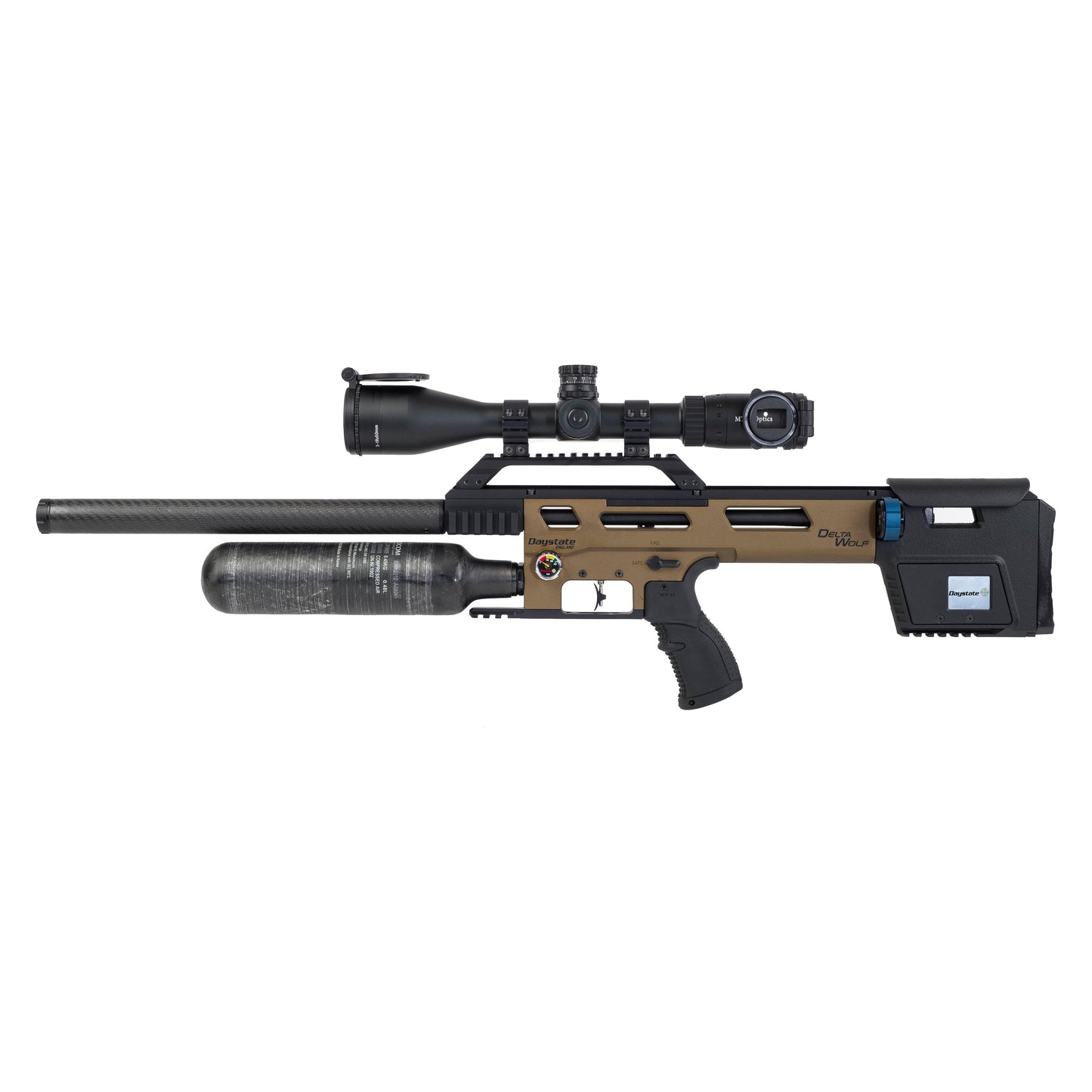
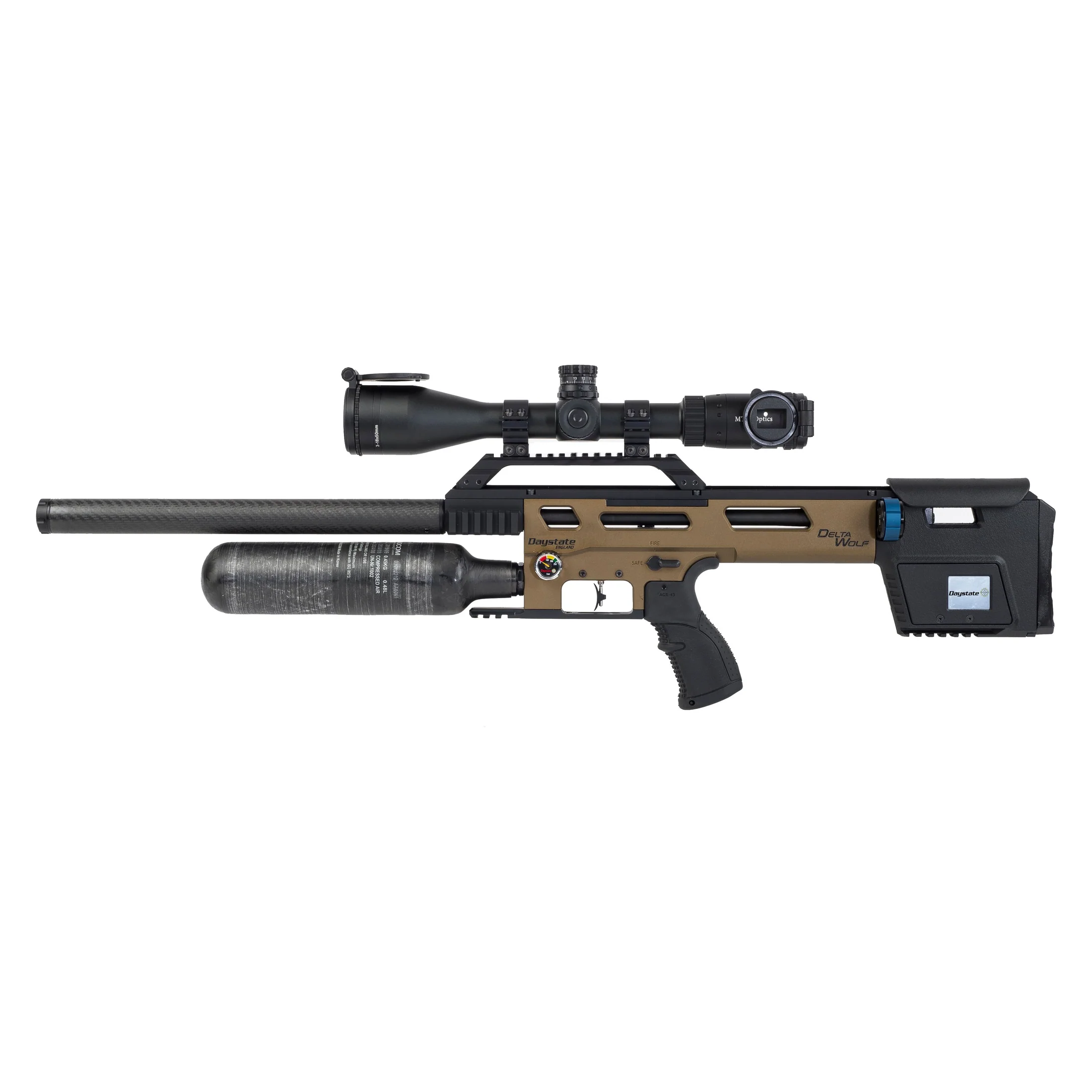
Daystate Delta Wolf Bronze

$2,611.00

THE DELTA WOLF

INTRODUCING…THE MOST ADVANCED AIRGUN OF ALL TIME

The Delta Wolf heralds the birth of a new family of electronic precharged pneumatic airguns for the decade ahead. The advent of this technology truly reinforces Daystate’s reputation as a maker of the world’s most advanced airguns. Nothing like Delta Wolf has been attempted in either the airgun  – or firearm  – worlds before.

FEATURES AND SPECIFICATIONS OF THE DELTA WOLF AIR RIFLE

Delta Wolf is the first Daystate to adopt an advanced tactical form factor that has proven popular with shooters across multiple disciplines – but make no mistake; Delta Wolf the world’s most advanced airgun and represents years of development and investments that, courtesy of newly-filed patents, will make it a very hard act to follow, let alone actually beat!

Building on years of expertise that has already resulted in market-leading electronic rifles such as the Red Wolf and Pulsar, Daystate has taken the concept to the next level. At its electronic heart, the Delta Wolf has next-generation touch screen Advanced Velocity Technology (AVT) which enables the selection of pre-set calibre-specific power levels. AVT is also Bluetooth enabled to connect to other devices and is designed to accept future upgrades and technological innovations, helping to make the Delta Wolf future-proof.


The incorporation of an onboard chronograph further enables users to customise the Delta Wolf according to their specific needs and different pellets. Users can also adjust the pressure in the Huma-Air regulator and exploit the benefits of the huge 34cc plenum chamber, to achieve specific velocities. In addition, a newly designed fast flow valve system improves efficiency and shot count from the 480cc carbon bottle, which takes a 240-bar fill and is removable, allowing a spare to be fitted in seconds.

A new design, higher-capacity Self-Indexing magazine system taking between eight and 13 shots is cycled with a smooth side-lever cocking action, the lever for which can be swapped by the shooter to the left in a minute.  Inserted from either side, the Delta Wolf is configured to allow two magazines to be installed and used in concert to effectively double the shot count.


In addition to technological advances, the Delta Wolf has a fully modular tactical stock design. Weighing 3.1kg (6.8lbs) for the full-length 600mm barrel version and measuring 840mm (34”)the rifle is available in black or bronze and features an ambidextrous AR-style safety catch and pistol grip.

There are under and side-mounted Picatinny accessory rails and a 20mm Picatinny scope rail that can be moved by as much as 150mm to accommodate zero eye relief scopes, like the MTC Optics SWAT Prismatic, as well as a large objective lens, high magnification optics. Additional adjustments to the cheek piece and butt pad, which is compatible with a range of exclusive optional accessories developed by PGS Precision Rifle Services for perfect eye alignment.


The Delta Wolf is available with 430 and 600mm ART developed barrels. A 30mm diameter carbon shroud reduces muzzle blast considerably and the addition of a 0db silencer makes the rifle almost silent.

Although users of high-powered air rifles, in particular, will value the ability to fine-tune it, a UK legal version of the Delta Wolf has also been designed to take into account the legal power restriction. For example, on the UK version, the power settings allow adjustment down from 12-foot pound in % increments and the onboard chronograph displays muzzle velocity allowing the shooter to ensure that he remains compliant. On all versions, every component has been painstakingly designed to optimise accuracy and efficiency. The Delta Wolf sets a new standard for others to follow.

Delta Wolf Video Review

Delta Wolf Video Review 2

* Scope & mount are for illustration purposes and not included.

SPECIFICATION

DELTA WOLF
Overall Length 722. mm (28.4 ins)
Barrel Length 430 mm (17 ins)
Cylinder Capacity 480 cc
Weight (Unscoped) from 3.1 kg (6.8lbs)
Available Calibres .177 inch (4.5 mm), .22 inch (5.5 mm)
Loading Magazine
Cocking Side Lever action – reversible
Magazine 13 Shot (.177), 11 Shot (.22)
Fill Pressure Up to 240 BAR (3,480 psi)
Power / Shots Per Charge 0.303 N/A
Power / Shots Per Charge 0.25 N/A
Power / Shots Per Charge 0.22 TBC
Power / Shots Per Charge 0.177 TBC
Trigger Electronic release. Adjustable for weight and length of stage.
Safety Manual, Electronic isolation. AR15 type lever
Stock Alloy, black anodised or Bronze Cerakote
Options PRS accessories 0dB Silencer, Bipod


Daystate Delta Wolf Bronze

Precision is delivered through an electronically managed PCP platform that has been engineered for consistent velocity, modular setup, and field-ready control. Advanced Velocity Technology is combined with an integral chronograph so that shot-to-shot output can be monitored and refined. Consequently, a premium hunting, target, and pest-control rifle is offered to shooters who value repeatable accuracy and adaptable power.

Electronic Control and AVT Performance

Touchscreen programming is housed in the butt so that calibre-specific power levels can be selected without tools. Moreover, an onboard chronograph is linked to the firing system, and velocity variation is therefore corrected in real time. In addition, factory profiles and advanced modes are made available so that pellet weight and desired speed can be matched to the intended use. Furthermore, night-display and sleep-timer options are included so that field conditions can be accommodated. As a result, consistent groups are produced even when ammunition or range changes.

Power, Calibres, and Shot Count

A removable 480 cc carbon cylinder is filled to 240 bar, and a fast-flow valve plus large plenum are employed so that efficiency is maximised. Meanwhile, Huma-Air regulation is fitted on high-power configurations so that exact velocities can be dialled in. Accordingly, legal-limit and FAC outputs are supported depending on barrel and market specification.

Highlighted specifications that are commonly listed:

  • Calibres that are offered: .177, .22, and on HP versions .25 and .30
  • Magazine capacities that are provided: 13 (.177), 11 (.22), 10 (.25), 8 (.30)
  • Dual-magazine capability that is enabled so that shot count can be doubled
  • Typical sub-12 shot counts that are reported: 400+ in .177 and 450+ in .22
  • High-power energies that are available: up to approximately 61 ft-lb in .22 and higher in larger FAC calibres
  • Barrel lengths that can be specified: 430 mm (17 in) tactical or 600 mm (23 in) HP
  • Overall lengths that are measured: about 722 mm or 842 mm depending on configuration
  • Unscoped weights that are quoted: roughly 3.35–3.55 kg (7.4–7.8 lb)

Therefore, a single platform can be configured for backyard practice, HFT-style precision, or larger-calibre hunting where local law permits.

Modular Tactical Stock and Ambidextrous Design

A bronze Cerakote alloy chassis is finished so that a distinctive tactical appearance is presented while corrosion resistance is retained. Likewise, an AR-style pistol grip and electronic isolation safety are fitted so that familiar handling is achieved. In the same way, the side lever is made reversible in minutes so that left- or right-hand operation can be chosen. Additionally, cheek piece and butt pad are adjustable, and optional PRS accessories can be fitted so that eye alignment and length of pull are refined.

Picatinny rails are mounted on the forend, sides, and underside, while a sliding 20–22 mm scope rail is provided so that short-eye-relief or high-magnification optics can be positioned. Consequently, bipods, lamps, and other accessories are easily attached. A 30 mm carbon shroud is used so that muzzle report is reduced, and a 0 dB silencer option can be added when extra quietness is required.

Trigger, Safety, and User Interface

An electronic two-stage trigger is adjustable for pull weight, stage length, and blade position, and a crisp release is therefore obtained. Meanwhile, an AR15-type lever isolates the electronics so that a positive manual safety is retained. Battery power is supplied by a high-capacity Li-Po pack that is charged via USB-C, and hundreds of shots are typically supported between charges. Hence, the rifle remains ready after a short connection to a standard charger.

Practical Use and Conversion-Focused Benefits

Field barrel and probe swaps are completed in a few minutes, after which the matching AVT profile is selected on the screen. Thus, calibre changes are performed without a workshop visit. Moreover, two magazines can be inserted from opposite sides so that follow-up shots are kept flowing during pest control or competition strings. Inclusive design is emphasised: ambidextrous controls, adjustable furniture, and clear on-screen menus are provided so that a wide range of shooters can set the rifle comfortably.

Accuracy that has been documented in independent tests includes tight groups at typical airgun distances when quality pellets are used and the platform is supported. Consistency is further supported by digital regulation and chrono feedback. Responsible ownership remains essential: local FAC or energy limits must be observed, safe backstops must be used, and regular maintenance of seals and electronics should be followed.

Why the Daystate Delta Wolf Bronze Is Chosen

Premium materials, CNC assembly, and firmware that can be updated via optional data transfer keep the rifle current. Therefore, long-term value is delivered beyond a single season. Conversion is encouraged because the same chassis can be adapted from compact tactical length to longer high-power barrels, from plinking loads to hunting slugs where legal, and from factory presets to fine-tuned advanced mode.

Shooters who want a future-ready electronic PCP with distinctive bronze finish, high shot counts, and genuine modularity will find the Daystate Delta Wolf Bronze configured to dominate every shot when it is set up correctly and used within the law. Explore available barrel kits, magazines, and accessories so that the rifle can be matched exactly to the intended discipline.

Calibres, FAC Ratings, Power Levels and Accessories for the Daystate Delta Wolf Bronze

A versatile platform is presented by the Daystate Delta Wolf Bronze so that multiple calibres, legal energy bands and supporting accessories can be combined according to local law and intended use. Consequently, a single chassis is adapted from licence-free practice to FAC hunting or long-range work where regulations allow. Inclusive setup is supported because left- and right-hand operation, adjustable furniture and clear electronic menus are provided for a wide range of shooters.

Available Calibres and Magazine Options

Four principal calibres are offered across the range so that pellet or slug choice can be matched to the task. Standard tactical configurations are commonly supplied in .177 (4.5 mm) and .22 (5.5 mm). High-power HP versions additionally accept .25 (6.35 mm) and .30 (7.62 mm) when FAC conditions are met. Barrel and probe kits are therefore exchanged in minutes, after which the matching AVT profile is selected on the touchscreen.

Self-indexing magazines are inserted from either side of the breech. Dual-magazine use is enabled so that capacity is effectively doubled without a reload pause.

Highlighted calibre and magazine details that are listed:

  • .177 capacity that is provided: 13 shots per magazine
  • .22 capacity that is provided: 11 shots per magazine
  • .25 capacity that is provided on HP models: 10 shots per magazine
  • .30 capacity that is provided on HP models: 8 shots per magazine
  • Dual-magazine pairing that is supported so that follow-up strings are extended
  • Calibre-change kits that are available so that barrels and probes can be swapped in the field
  • German-made ART barrels that are specified with twist rates suited to each calibre and velocity band

Thus, a compact .177 setup can be used for high-volume target work while a larger FAC calibre is reserved for heavier projectiles when law and land permission permit.

FAC, Legal-Limit Power and Energy Bands

Power output is managed electronically so that legal-limit and FAC configurations are clearly separated. UK-style sub-12 ft-lb models are programmed with restricted maximum energy, typically around 11.3–12 ft-lb, and incremental percentage steps (often 5 percent) are offered so that output can be reduced for close-range or indoor use. High-power HP rifles are instead supplied with pre-set calibre-specific energy bands that reach far higher figures where a Firearms Certificate is held.

Approximate published energies that are associated with HP configurations include up to about 20–31 ft-lb in .177, 45–61 ft-lb (and higher on Performance valves) in .22, around 67–81 ft-lb in .25, and 95–115 ft-lb in .30 depending on barrel length and valve specification. A 480 cc carbon bottle filled to 240 bar, a large plenum and a fast-flow valve are employed so that usable shot counts remain practical even at elevated power. Sub-12 shot counts of 400-plus in .177 and 450-plus in .22 are commonly reported; FAC counts are lower but still generous for hunting strings.

Local licensing, energy limits and hunting laws must always be observed. Therefore, the correct factory programme and barrel combination should be selected before the rifle is used, and a chronograph check is recommended after any change of pellet, slug or regulator setting.

Power Adjustment, Regulation and Consistency

Advanced Velocity Technology is linked to an integral chronograph so that requested velocity is maintained shot after shot. Factory mode allows rapid selection of calibre, barrel length and pellet weight. Advanced mode then permits finer tuning. On HP rifles, Huma-Air regulator pressure can also be adjusted so that the large secondary chamber is exploited for exact speed control. Night-mode dimming and auto-sleep timers are included so that battery life and concealment are protected during evening pest control.

Consistency figures that have been published in independent tests frequently show single-figure or low-double-figure fps spreads when quality ammunition is used. Hence, group size at typical airgun distances is limited more by the shooter and conditions than by the platform when the rifle is correctly programmed.

Accessories That Complete the System

A modular tactical stock is designed so that optics, supports and quieting devices can be added without gunsmithing. Sliding Picatinny scope rails, side and under-rail sections, and an adjustable cheek piece and butt pad are fitted as standard. Optional PRS furniture, AimGrip-style bipods, 0 dB silencers and extra carbon shrouds are commonly paired with the bronze chassis.

Highlighted accessory categories that are frequently specified:

  • Extra magazines and dual-magazine use that are recommended for extended sessions
  • Calibre and barrel kits that are stocked so that the same rifle can serve several roles
  • 0 dB silencers and larger shrouds that are fitted when report must be minimised
  • Bipods, bag riders and forend rails that are attached for supported precision
  • High-magnification or short-eye-relief scopes that are mounted on the sliding rail
  • USB-C chargers and spare Li-Po packs that keep the electronics ready
  • Fill probes, spare O-rings and carbon bottles that support rapid field topping-up
  • Optional data-transfer devices that allow firmware updates and deeper programming

Inclusive language is used throughout because accessories and furniture adjustments are intended for shooters of different statures and dominant hands. Responsible pairing of power, calibre and accessory is essential: a quiet shroud and legal-limit programme suit close pest work, while a longer HP barrel, larger calibre and certified FAC setup are reserved for appropriate ranges and quarry.

The Daystate Delta Wolf Bronze is therefore positioned as a configurable system rather than a fixed rifle. Calibre, energy band and accessory package can be chosen together so that accuracy, shot count and legal compliance are balanced. Explore official kits and compatible optics so that the platform is completed for the intended discipline and remains future-ready as firmware and barrel options continue to be developed.

Daystate, Delta Wolf, Alpha Wolf and Premium PCP Air Rifle Accessories

For shooters researching premium PCP platforms, daystate blackwolf, daystate redwolf, delta wolf, huntsman daystate, and daystate alpha wolf frequently appear among the most searched Daystate-related terms. Whether someone searches for wolf delta, day state, daystate delta wolf, blackwolf, deltaw, daysta, or wants to understand the delta wolf meaning, these rifles are commonly associated with modern PCP engineering, electronic control systems, adjustable configurations, and high-end airgun performance.

People asking what is a delta wolf are generally researching the electronic Daystate platform and how it differs from conventional PCP rifles. Related searches often include electronic wolves, firing cycle, lock time, lock timing, short cocking, cocking ball, index pin, and pin magazine. Searches may also focus on configuration-specific components such as an alpha wolf barrel, stock walnut, safari stock, dima stock, stock replacement, rimfire stocks, or a rifle butt pad.

Daystate Red Wolf, Alpha Wolf and Wolverine Searches

The daystate redwolf family remains closely connected with searches for daystate redwolf price, red alpha wolf, alpha red wolf, and the newer daystate blackwolf platform. Some shoppers may also compare these rifles with the daystate wolverine sapphire, wolverine gun, wolveriner, wolf gun, wolfpack armory wolverine, or even search unusual phrases such as can wolverine go on planes while researching transport rules.

Accessories frequently searched alongside these platforms include a rubber butt, rubber butt pad, butt pad rifle, bradley cheek riser, gecko grips, picatinny bag rider, and buddy bottle cover. Cosmetic or clothing-related search phrases such as red bodywarmer and black snood may also appear alongside broader brand searches.

Magazine-related searches include 177 magazine, mag 177, and 25 magazine, while ammunition research can include 177 pellets types, 5.0 mm pellets, and slug pellet. Because pellet suitability depends on the rifle, barrel, legal power level, and intended range use, compatible ammunition should always be selected according to the manufacturer’s specifications.

PCP Air Systems, Moderators and Thread Accessories

Many enthusiasts researching Daystate rifles also search for air rifle compressed air, compressed air rifle, what are pcp air rifles, and what is a pre charged pneumatic air rifle. These searches relate to the fundamental operating principle of PCP systems, in which stored compressed air is used to power each shot.

Common accessory searches include air gun pc, air gun suppressor, air gun suppressors, airgun moderator, air rifle moderator, 0db, 0db moderator, and 0 db moderator. Buyers may also encounter searches for a hogan decimeater silencer, silencer thread adapter, thread protector rifle, and muzzle thread protector when comparing muzzle accessories and compatible threaded components. Local regulations should always be checked before purchasing or fitting sound-moderating equipment.

Maintenance-related searches often include pcp o ring kit, while tuning-oriented users may look for an ats tuner. Search terms such as unfend can also appear in broad airgun keyword datasets, even when the intended product or meaning is unclear.

M-LOK, Picatinny and Rifle Sling Accessories

Accessory compatibility is another major area of interest. Common searches include mlok to picatinny rail adapter, best m-lok to picatinny rail adapter, m-lok to picatinny adapter, and picatinny m lok adapter. These adapters are often researched by users who want to mount compatible optics, rests, bipods, bags, or other permitted accessories on an appropriate rail system.

Sling-related searches include riffle sling, rigle sling, how to put a gun sling on a rifle, how to put a rifle sling on, how to install a rifle sling, how to put sling on rifle, installing a rifle sling, and attaching a sling to a rifle. Because attachment arrangements differ between stocks, rails, swivels, and chassis systems, the correct mounting points should always be confirmed from the manufacturer’s documentation.

Other general mechanical or unrelated search phrases found within broader keyword datasets include how to put extinguisher call back together, weatherby vanguard trigger adjustment, and 3.55kg in lbs. While these terms may appear in search data, they are not necessarily specific to Daystate PCP rifles.

BRK, Brocock and XR Air Rifle Searches

Alongside Daystate products, many buyers compare models produced under the Brocock and BRK families. Popular searches include brocock ltd, brocock sniper xr, brocock commander xr, pathfinder xr, brk ghost, brocock airguns, brocock commander, brk ghost air rifle, and brk sniper xr.

The brocock sniper xr is often researched by shooters comparing compact PCP platforms, while the brocock commander xr and brocock commander searches generally relate to larger tactical-style PCP configurations. Meanwhile, brk ghost and brk ghost air rifle searches reflect growing interest in BRK-branded PCP systems.

Those comparing local purchasing options may also search fx airgun dealer near me, even when their primary interest is Daystate or Brocock. This reflects the way many airgun shoppers compare several premium manufacturers before deciding which PCP platform, stock configuration, calibre, regulator setup, magazine system, and accessory package best matches their intended sporting use.

Additional Daystate and Airgun Search Terms

Broader searches surrounding these rifles may include model alpha gun, griffin gun, and general comparisons involving a wolf gun or other premium PCP platform. Buyers may also investigate different stock materials, rail systems, moderators, magazines, barrel options, butt pads, cheek risers, thread protectors, and compressed-air accessories before completing a build.

Whether someone begins with daystate redwolf, explores the daystate alpha wolf, compares a daystate delta wolf, investigates the daystate blackwolf, or considers a daystate wolverine sapphire, the most useful approach is to verify model compatibility, calibre, pressure specifications, local regulations, and manufacturer-supported accessories before purchasing replacement components or upgrades.

Practical Use Scenarios and Field Applications

A compact tactical chassis is carried into varied environments so that precision work, pest management and structured practice can be completed with one configurable platform. Consequently, session planning is simplified because power profiles, magazines and support accessories are prepared in advance. Inclusive handling is retained throughout because reversible controls, adjustable furniture and on-screen menus are provided for shooters of different statures and dominant hands. Responsible use remains essential: legal energy limits, land permission and safe backstops are observed before any shot is taken.

Supported Precision on the Range

A bench or bag rest is employed so that human movement is reduced and the electronic trigger can be evaluated fairly. Moreover, a sliding rail is positioned so that eye relief matches the chosen optic. In addition, factory or advanced velocity modes are selected so that pellet weight and requested speed are aligned. As a result, tight groups are produced at typical club distances when quality ammunition is used and conditions are stable.

Cheek height and length of pull are adjusted first so that a repeatable head position is obtained. Meanwhile, a two-stage electronic release is set for a light, consistent break. Furthermore, magazine pairing is used so that long strings can be fired without frequent reloading. Therefore, concentration is kept on hold and follow-through rather than on mechanical cycling.

Night-display dimming is activated during evening range sessions so that the screen does not flare through the optic. Likewise, auto-sleep timing is lengthened when the rifle is left ready between relays. Hence, battery drain is limited while the system stays available.

Highlighted range practices that are commonly followed:

  • A stable rest that is used so that platform potential is isolated from shooter error
  • Chronograph confirmation that is performed after any pellet or profile change
  • Incremental power reduction that is applied for indoor or short-lane work
  • Dual magazines that are loaded so that strings remain uninterrupted
  • Notes that are kept on velocity, group size and wind so that future sessions are improved

Thus, the rifle is treated as a measurement tool as well as a shooting instrument, and progress is tracked over time.

Pest Control Around Buildings and Holdings

A legal-limit programme is selected so that energy stays within licence-free bands where that restriction applies. Consequently, close work around outbuildings, feed stores and boundary hedges can be conducted without unnecessary report or over-penetration when a suitable backstop is present. A carbon shroud and optional moderator are fitted so that disturbance to livestock and neighbours is reduced.

Ambidextrous magazine insertion is used so that the rifle can be kept on the shoulder while a fresh magazine is introduced from the support side. In the same way, a short tactical barrel configuration is preferred when movement through doorways and around machinery is required. Additionally, a compact bipod or bag is attached only when a supported shot is available; otherwise, offhand or kneeling positions are adopted with the adjustable butt pad set for a firm mount.

Dusk and dawn windows are exploited because many pest species are active then. Night mode is therefore enabled so that the display remains readable without destroying night vision. Sleep timers are shortened between stalks so that accidental illumination is avoided. Inclusive safety briefings are given whenever more than one person is present, and a clear arc of fire is agreed before the first magazine is inserted.

Weather and wind are read continuously. Light projectiles in smaller calibres are favoured for shorter distances, while a slightly heavier pellet is chosen when a modest breeze is present. Regulator and valve consistency are relied upon so that the first shot after a wait remains close to the last recorded velocity.

Field Hunting Where Law and Permission Allow

FAC-rated profiles and longer barrels are reserved exclusively for jurisdictions and certificates that permit elevated energy. Accordingly, larger calibres and slugs are considered only after legal status has been confirmed. A longer shrouded barrel is then selected so that velocity and downrange energy are increased while report is still managed.

Terrain dictates support. Open ground favours a bipod and rear bag; woodland edges favour a quicker kneeling or sitting position with the cheek piece already set. Picatinny side rails accept a lamp or thermal clip-on where local rules allow, and the sliding scope rail is moved so that a large-objective optic still clears the shroud.

Two magazines are carried pre-loaded so that a follow-up can be taken without breaking position. Spare carbon bottles are packed when a long day is planned, because a 240-bar fill and efficient valve still have finite capacity at high power. Fill-port covers are kept closed between top-ups so that debris is excluded.

Ethical shot placement is prioritised over maximum energy. Therefore, ranges are limited to those at which a clean vital-zone hit is realistic in the prevailing wind. After any calibre or barrel swap, the matching electronic profile is loaded and a few confirmation shots are fired into a safe bank before the hunt continues.

Competition-Style and HFT-Inspired Practice

Course-style targets at mixed distances are used so that holdover, wind reading and time pressure can be rehearsed. A moderate power setting is chosen so that trajectory remains predictable and pellet flight is not overly violent in a breeze. Side-lever throw is kept short and smooth so that the rifle stays on aim between shots.

The electronic isolation lever is practised as a deliberate safety habit between lanes. Inclusive coaching language is used when newcomers share the line: explanations focus on process rather than on equipment prestige. Adjustable furniture is demonstrated so that each participant can obtain a comfortable mount rather than fighting a fixed stock.

Data from the onboard chronograph is reviewed between cards so that a sudden shift in velocity is noticed before a match score is affected. Firmware and saved profiles are treated as part of match preparation, just as pellet batch and scope tracking are checked.

Travel, Storage and Multi-Role Days

A compact overall length is valued when the rifle is moved between vehicles, hides and club lockers. The carbon bottle is removed for separate storage when regulations or airline-style rules require it. USB-C charging is completed from a power bank so that the electronics remain ready after a long journey.

A single outing may combine zero confirmation, a short pest circuit and evening paper punching. Profiles are therefore saved under clear names so that the correct energy band is recalled without guesswork. Inclusive packing lists include hearing and eye protection for every participant, not only for the person holding the rifle.

Maintenance intervals are observed in the field: a quick visual check of the fill probe, magazine lips and rail screws is performed before the first shot of the day. O-rings and a small tool kit travel with the rifle so that a minor leak does not end the session.

Calibre and Configuration Changes During a Session

Barrel and probe exchange is completed in a few minutes when a different projectile is required. Afterwards, the corresponding electronic programme is selected so that valve timing and requested velocity match the new tube. A short confirmation string is fired and recorded. Dual-calibre days are therefore practical for clubs that allow mixed targets, provided legal limits for each configuration are respected.

Magazine bodies for each calibre are colour-coded or labelled so that a mismatch is avoided under time pressure. Inclusive procedure is written down for shared rifles: the last user records which profile and barrel were fitted.

Evening, Weather and Low-Light Considerations

Rain covers and a towel are packed because electronics and touchscreens prefer dryness. Condensation on the optic is managed with a lens cloth rather than by wiping the display with a wet glove. Wind flags or natural indicators are watched continuously; power is not increased as a substitute for waiting out a gust.

Cold weather shortens battery life, so a spare charged pack is carried. Heat soak after a long string is allowed to settle before the next precision group is shot. Night mode and reduced screen brightness protect vision when a lamp is used only for identification.

Conversion-Focused Outcomes for Everyday Owners

Time behind the rifle is used to build a personal data book: pellet, profile, temperature, group size and notes on trigger feel. Consequently, confidence grows because results are repeatable rather than accidental. Accessories are added only when they solve a documented need—extra magazines for volume work, a moderator for close holdings, a bipod for open-ground precision.

Inclusive clubs benefit when the platform is shared under supervision: ambidextrous controls reduce the number of left-hand conversions required, and on-screen menus reduce the mystery of electronic rifles for newcomers. Safety culture is reinforced by treating the isolation lever and muzzle discipline as non-negotiable regardless of how advanced the firing system appears.

Long-term ownership is supported by firmware updates, spare magazines and official barrel kits. The rifle is therefore viewed as a system that can be refined season by season rather than replaced. Practical success is measured in consistent first-shot hits, quiet lawful pest work, enjoyable range evenings and a clear conscience that every configuration stayed inside the rules that apply to that place and that day.

Frequently Asked Questions

Clear answers are collected below so that ownership decisions, legal checks and first-session setup can be completed with fewer surprises. Inclusive wording is used throughout because shooters of different experience levels and dominant hands are expected to share the same platform. Local energy limits, licensing and land permission must still be confirmed before any configuration is used.

How are calibres chosen and changed?

Four principal projectile diameters are supported across the family so that target work, pest control and FAC hunting can be matched to the task. Smaller tubes are commonly preferred for high shot count and flat trajectory at club distances. Larger tubes are reserved for heavier pellets or slugs where a certificate and suitable quarry exist. Barrel and probe kits are exchanged in a few minutes, after which the matching electronic profile is selected on the screen. A short confirmation string is then fired into a safe backstop so that velocity and point of impact are verified. Dual-calibre days are therefore practical when magazines and programmes are labelled clearly.

What energy bands are available, and how does FAC differ from a legal-limit setup?

Restricted programmes are supplied for markets in which a low muzzle-energy ceiling applies without a certificate. Incremental percentage steps are often provided so that output can be reduced for indoor lanes or close buildings. High-power profiles are instead issued only where a Firearms Certificate or equivalent permission is held. Published energies rise substantially in the larger diameters and longer barrels, while usable shot count falls as power is increased. A 480 cc bottle filled to 240 bar remains the air source in both cases. Consequently, the same chassis can serve two legal worlds, but the correct factory programme must be loaded and a chronograph check is recommended after every change of pellet, slug or regulator setting.

Daystate Delta Wolf Bronze

How does the electronic firing system and onboard chronograph work?

Requested velocity is managed by an onboard computer that communicates with a barrel-mounted chronograph. Factory mode allows rapid selection of calibre, barrel length and projectile weight. Advanced mode then permits finer tuning. Variation is corrected shot by shot so that consistency is maintained when temperature or fill pressure drifts. Night-display dimming and sleep timers are included so that field use after dark remains practical. Firmware updates can be applied with an optional data device so that the system stays current. Inclusive practice is to treat the screen as a tool rather than a toy: profiles are named clearly and the last setting is recorded when the rifle is shared.

How long does the battery last and how is it charged?

A high-capacity lithium-polymer pack is housed in the butt and is charged in place with a USB-C cable from a 5-volt supply rated at two amps or more. Hundreds of shots are typically supported between charges under normal use. Cold weather and constant screen-on time reduce endurance, so a spare charged pack is carried on long days. The rifle will not fire if air and electronics are not both ready. Therefore, a short charge the evening before a session is treated as part of standard preparation.

Can magazines be used from either side, and can two be fitted at once?

Self-indexing magazines are inserted from left or right so that ambidextrous operation is available from the box. Two magazines can be fitted back-to-back so that capacity is effectively doubled. Capacities vary by diameter: higher counts are provided in the smaller calibres and lower counts in the largest FAC options. Smooth indexing is relied upon so that the short side-lever throw stays consistent. Spare bodies are labelled by calibre so that a mismatch under time pressure is avoided.

Is the rifle fully ambidextrous?

The side lever is reversed in minutes, magazines feed from either side, and an AR-style safety and grip are fitted so that left- and right-hand use is supported without a gunsmith visit. Cheek piece and butt pad are adjustable, and aftermarket grips that share the same interface can be fitted. Inclusive clubs therefore spend less time converting furniture and more time on safe technique.

What accessories are most useful for everyday shooting?

A sliding Picatinny rail accepts both conventional and short-eye-relief optics. Side and under rails accept bipods, lamps and bag riders. A carbon shroud reduces report; a 0 dB moderator is added when extra quietness is required around holdings. Extra magazines, a spare bottle, fill probe, O-rings and a USB charger complete a practical field kit. PRS-style furniture is chosen when a more specialised prone or bench position is used regularly. Accessories are added only when they solve a documented need rather than for appearance alone.

How quiet is the rifle in the field?

A 30 mm carbon shroud is fitted as standard on many configurations so that muzzle blast is already reduced. An additional moderator can be attached when livestock, neighbours or quarry education demand still lower report. High-power FAC shots remain louder than legal-limit strings. Terrain, wind and a solid backstop still matter more than hardware when disturbance must be minimised.

What shot counts can be expected from a full fill?

Legal-limit strings of four hundred-plus shots in the smallest common calibre and four hundred and fifty-plus in the next size are frequently reported. FAC counts are lower because more air is used per shot. Dual magazines extend the number of shots that can be fired before a pause, but they do not increase the air stored in the bottle. Fill pressure, regulator setting, temperature and projectile weight all influence the final figure. A gauge and the chronograph are therefore checked rather than assumed.

How is consistency maintained from first shot to last?

Digital regulation, a large plenum and closed-loop chronograph feedback are combined so that velocity stay close to the requested value. Independent tests have shown tight spreads when quality ammunition is used. The first shot after a long wait is still confirmed on paper or a safe bank after any profile change. Pellet batch variation remains the shooter’s responsibility; the electronics cannot correct a mixed tin.

Can barrels be swapped in the field?

Yes. The design allows a tube and probe change in minutes. The corresponding electronic programme is then selected so that valve timing matches the new barrel. A few confirmation shots are fired before the session continues. Kits should be kept clean and the correct magazine used for each diameter.

Caliber

.177, .22, .25, .30

Reviews

There are no reviews yet.

Be the first to review “Daystate Delta Wolf Bronze”

Related Products

FAQ

  • Spring-Piston (Break-Barrel or Underlever): Cock by compressing a spring. Reliable, no external air source needed, but can have more recoil (“spring twang”) and require technique to shoot accurately.
  • Pre-Charged Pneumatic (PCP): Filled from a scuba tank, compressor, or pump. High power, low recoil, multiple shots per fill. Popular for precision and hunting.
  • CO₂: Powered by disposable cartridges. Good for pistols and semi-auto/repeaters, but performance drops in cold weather.
  • Multi-Pump Pneumatic: Hand-pumped to build pressure. Versatile but requires effort.
  • Gas Ram (Nitro Piston): Uses compressed gas instead of a metal spring. Smoother than traditional springers.

Calibers: Most common are .177 (4.5mm) for speed/flat trajectory and general use, and .22 (5.5mm) for better hunting knockdown power. Larger “big bore” (.25, .30, .357+) exist for hunting bigger game where legal.

Yes, many modern PCP and springers deliver enough energy for small game (rabbits, squirrels, birds) and even larger game in some areas. Muzzle energy (in ft-lbs or joules) matters more than velocity alone. Always match caliber, pellet weight, and energy to the game and check local hunting regs.

Treat every airgun as if it is loaded.

  • Always point the muzzle in a safe direction.
  • Keep your finger off the trigger until ready to shoot.
  • Know your target and what is beyond it (pellets can ricochet or travel far).
  • Wear eye protection.
  • Store unloaded, out of reach of children/untrained users, and ideally locked.
  • Never shoot at hard surfaces or in areas where pellets could escape your property.

Follow these rules strictly—airguns cause real injuries.

Laws differ dramatically by country, state/province, and even city. Always verify current local laws before buying, owning, transporting, or using an airgun. Age restrictions (often 18+) are common.

Examples (summaries only; check official sources):

  • UK: Air rifles ≤12 ft-lbs (16.3 joules) and pistols ≤6 ft-lbs generally do not require a license (FAC needed above that).
  • USA: Varies by state. Some treat powerful airguns as firearms; others do not. Many states now allow big-game hunting with air rifles.
  • Canada: Some airguns classified as firearms if they exceed velocity/energy thresholds.
  • Australia: Often treated as firearms; licensing/registration required in most states.
  • EU/France/Belgium/etc.: Varies; many allow low-power (<20J) guns freely to adults, with higher power needing permits. Germany has strict ~7.5J limits in some contexts.
  • Other countries: Some have no restrictions below certain energies; others ban or heavily regulate them.

Resources: Wikipedia “Air gun laws”, airgun forums, or official government sites. For travel, research transit laws carefully.

Consider:

  • Purpose: Plinking/backyard → lower power springer or CO₂. Hunting/precision → PCP.
  • Budget: Entry-level springers are affordable; PCPs need a fill system (extra cost).
  • .177 vs .22: .177 easier for beginners/targets; .22 better for hunting.
  • Power source: Convenience vs performance.
  • Test pellets in your gun—accuracy varies.

Buy from reputable dealers and consider warranties.

  • Clean barrel periodically (especially if accuracy drops) with patches and appropriate tools/solvents. Avoid over-oiling.
  • Lubricate moving parts and seals with airgun-specific oil (not general gun oil). Springers need piston seal oil occasionally.
  • Check screws, seals for leaks (PCP), and safety mechanisms regularly.
  • Store in a cool, dry place, ideally in a case. Avoid leaving cocked for long periods.

Follow your model’s manual. Basic care extends life significantly.

International shipping may be available for select products. Customers are responsible for understanding and complying with their local import laws and regulations before ordering.

Yes. Customers are required to confirm their order number through WhatsApp or Live Chat before orders are processed and shipped.

If local laws prevent shipment to your area, your order may be canceled and refunded according to our store policy.

Processing typically takes 1–3 business days after payment confirmation. Delivery times vary depending on destination, carrier, and product availability.


  • Wrong pellets for your barrel/caliber.
  • “Death grip” or poor shooting form (especially with springers—let the gun recoil naturally).
  • Loose scopes or mounts.
  • Ignoring safety or local laws.
  • Over-oiling or shooting with obstructions.


Pellets are the most common projectile (lead or lead-free). Match them to your gun, caliber, and purpose—test several brands as accuracy varies by barrel.

  • Domed (Round-Head): Best all-rounder. Excellent accuracy, ballistic coefficient, and energy retention. Ideal for target shooting, field target, and general hunting (e.g., JSB Exact, Air Arms Diabolo Field, H&N Field Target Trophy).
  • Wadcutter (Flat-Head): Clean holes in paper. Best for close-range target/plinking (under 20-25 yards).
  • Hollow Point: Expands on impact for better energy dump. Good for small game hunting (e.g., Predator Polymag, H&N Terminator).
  • Pointed: More penetration, but often less accurate than domed.
  • Slugs: Heavier, more aerodynamic for high-power PCPs at longer ranges (better for big game where legal).

Tips: Heavier pellets in .22/.25 for hunting (better momentum). Lighter in .177 for speed/flat trajectory. Always check head size fit (e.g., 4.51-4.53mm variants).

Muzzle energy (ft-lbs or joules) matters more than velocity. Ethical shots require precise placement (head/heart-lung) within effective range.

Rough Guidelines (adjust for distance, pellet, and local laws):

  • Small game (squirrels, rabbits, birds): 9-20+ FPE, .177/.22.
  • Medium (raccoons, etc.): 25+ FPE, .22/.25 recommended.
  • Larger game: 40-100+ FPE in .30+ calibers (up to big bore for deer/hogs where permitted).

PCPs dominate serious hunting due to power and shot count. Springers/gas rams work well for small game but require skill. Always prioritize clean kills and check seasons/species rules.

  • Barrel Cleaning: Use a pull-through kit or rod with patches. Avoid brushes that could damage rifling. Clean when accuracy drops or after 500-1000 shots.
  • Lubrication: Airgun-specific silicone oil for seals/O-rings (sparingly—excess causes dieseling in springers). Springers may need piston lube periodically.
  • PCP Specific: Check for leaks (soapy water test), monitor regulator/hammer settings, and keep fill systems clean. Don’t exceed rated pressure.
  • General: Tighten stock screws, inspect for wear, store properly. Chronograph shots to track consistency.

Common Issues:

  • Inconsistent velocity → dirty barrel, bad pellets, or seal problems.
  • Spring “twang” → tuning or proper hold.
  • Low power → worn seals or under/over-pumping.

Toggle Content

  • Scopes: Airgun-rated (hold zero under recoil). 3-9x or 4-12x common.
  • Fill Systems: Hand pumps, compressors, or tanks for PCPs.
  • Safety Gear: Eye/ear protection, targets with backstops.
  • Noise: Airguns quieter than firearms, but moderators help further.

Budget Tip: Start with a quality springer (~$150-400) before investing in PCP setup.

Airgunning offers endless depth—from backyard plinking to precision competition and ethical hunting. Prioritize safety, legality, and practice. If you want specifics (e.g., recommendations for a country, budget, hunting small game, or a particular type like PCP vs springer), let me know for more targeted info! Shoot responsibly.

Tuning improves accuracy, reduces noise/recoil, or increases power (within legal limits).

  • Springers: Lighter springs, guides, seals, or custom tuning kits for smoother shot cycle. “V-Mach” or similar professional tunes popular.
  • PCPs: Regulator tuning, hammer spring adjustments, valve work for efficiency and shot count. Some add electronic systems.
  • Accessories: Suppressors (often unregulated on airguns), better triggers, stocks, and scopes.

Caution: Check laws—power increases may reclassify your gun. DIY only if experienced; professional tuners recommended.

You must be at least 18 years old to purchase any airgun or related accessories from our store. By placing an order, you confirm that you meet the legal age requirements in your state or country.

Yes. Orders may require age verification before processing and shipping. In some cases, we may request a valid government-issued ID to confirm eligibility.