Frequently Asked Questions
How is digital regulation applied to each shot?
Mapped compensation is applied so that valve opening is calculated from live cylinder pressure. Consequently, energy delivery remains stable as the bottle is emptied. Furthermore, shot-to-shot variation is kept extremely small across long strings. In addition, three factory-mapped power levels are stored so that output can be changed in seconds without tools. Therefore, the same platform can be used for legal-limit target work or higher-energy field use where regulations allow. Meanwhile, remaining air, battery status and shot count are shown on the onboard display so that conditions are monitored without guesswork.
Which calibres and energy levels are typically supplied?
.177, .22 and .25 are commonly offered, while a larger .303 option is reserved for selected high-power configurations. Sub-12 ft-lbs settings are mapped for markets that require them. Additionally, higher FAC outputs are programmed for licensed users. As a result, pest control, hunting and precision target disciplines can all be addressed by choosing the appropriate map. Shot count naturally falls as energy rises; hundreds of consistent shots are obtained at legal-limit power, while fewer, harder-hitting shots are delivered in high-power mode. Local laws must always be checked before a high-energy map is selected.
How many shots can be expected from a full fill?
A large carbon-fibre bottle is fitted on the lightweight configuration, and fill pressures of up to 250 bar are accepted on those models. Consequently, several hundred shots at modest energy are routinely recorded in published figures. Moreover, digital regulation stretches usable air further than a simple unregulated valve would allow. Variation of only a few feet per second over long strings has been documented in independent tests. Therefore, a full day’s club session or an extended hunting outing can often be completed from a single fill when the lower maps are used. Higher maps reduce capacity, yet consistency is still maintained by the same electronic control.
Is the stock suitable for both left- and right-handed shooters?
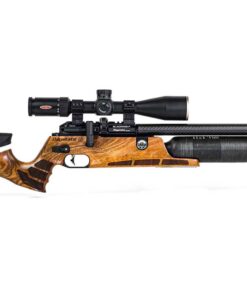
An ambidextrous laminate stock is supplied as standard. Furthermore, the side-lever can be reversed so that cocking remains comfortable from either side. In addition, a raised cheekpiece and an adjustable butt pad are fitted, allowing comb height and length of pull to be tailored. As a result, a repeatable mount is achieved for a wide range of body sizes and shooting styles. Inclusive design is therefore built in rather than added later. Soft red tones sandwiched between darker laminate layers give the furniture a distinctive appearance while remaining practical in the field.
How is the trigger configured?
An electronic two-stage trigger is used. Pull weight and length of stage can both be adjusted so that a crisp, predictable break is obtained. Consequently, hold-off error is reduced and group size benefits. Moreover, the electronic release is independent of the mechanical effort required to index the magazine, so cocking remains light even when the trigger is set very fine. A manual cross-bar safety with lever-open deactivation is provided so that the action cannot be fired while the lever is open. Safety and precision are therefore combined.
Calibres, FAC Considerations, Power Maps and Accessories
A wide choice of calibres is offered so that target, pest-control and hunting roles can all be addressed. .177, .22 and .25 are supplied on standard and HiLite configurations, while .303 is reserved for selected high-power HiLite HP models. Magazine capacity is matched to pellet diameter: thirteen shots are typically provided in .177, eleven in .22, ten in .25 and eight in .30. A single-shot tray is included with every rifle so that deliberate hand-loading remains possible when magazine fire is not required. Consequently, both rapid follow-up sequences and slow, precise single loading are supported by the same action.
How Calibre Choice Affects Use
.177 is favoured when a flat trajectory and high shot count at modest energy are wanted. Tight groups on paper and small-pest work at legal-limit power are therefore commonly assigned to this calibre. .22 is treated as the all-rounder: a useful balance of energy, pellet weight and remaining shots is obtained, so club use and general hunting can share one rifle. .25 is selected when extra impact is required at FAC levels; fewer shots are delivered, yet knockdown on larger quarry is improved. .303 is mapped only on the longer-barrel HP variant and is intended for licensed big-bore work where local rules allow. Inclusive advice is given: the “best” calibre is the one that matches the owner’s permission, typical ranges and quarry rather than a single universal answer.
Power Settings, Legal Limits and FAC
Three factory-programmed energy maps are stored in the electronic control unit. Switching among those maps is completed in seconds, so a morning of legal-limit target practice can be followed by an afternoon of higher-output field use without tools. Sub-12 ft-lbs settings are supplied for jurisdictions in which that ceiling applies and no certificate is needed. Higher maps raise muzzle energy substantially. Published figures for HiLite configurations include approximately 18 ft-lbs in .177, around 45 ft-lbs in .22 and .25, and, on HP models, roughly 65 ft-lbs in .25 and up to about 80 ft-lbs in .303, subject to exact factory mapping and local limits. Shot count falls as energy rises: several hundred consistent shots are recorded at legal-limit power from the 480 cc carbon bottle, while high-power strings are shorter yet still tightly regulated by MCT.
Fill pressure of up to 250 bar is accepted on HiLite bottles; B-Type cylinders are commonly rated to 230 bar. Because valve opening is calculated from live pressure, velocity remains stable as the bottle empties. Independent tests have shown only a few feet per second of variation over long strings at modest power. Therefore, chronograph results stay predictable whether a low or high map is selected. FAC or equivalent authority is required wherever the chosen map exceeds the unlicensed limit. Maps do not override the law; owners remain responsible for confirming the exact energy of the rifle in hand and for holding the correct certificate before a high-power setting is used.
Highlighted Power and Calibre Notes
- .177: high shot count, flat trajectory, legal-limit and moderate FAC maps
- .22: balanced energy and capacity for club and general hunting
- .25: increased impact on FAC maps, fewer shots per fill
- .303: HP-only big-bore option for licensed users
- Three selectable maps stored in the electronic unit
- Legal-limit settings provided where required by national rules
- Higher FAC outputs available on HiLite and HiLite HP versions
- Shot count reduced as energy is increased, consistency retained by digital regulation
Accessories That Complete the Package
A charging set and fill adaptor are listed as common options so that the bottle can be replenished from a stirrup pump or compressor. A threaded muzzle allows a silencer to be fitted; the existing carbon shroud already reduces report, and a second-stage moderator can be added when extra quietness is wanted. A protective gun box or hard case is frequently offered so that the laminate stock and electronics are shielded in transit. Extra rotary magazines and the supplied single-shot tray expand loading flexibility. An optional programmer exists for finer adjustment of maps within safe factory limits, although everyday changes among the three stored levels require no extra device.
Sling swivels are mentioned on some specifications so that a sling can be fitted for long walks. Scope mounting uses a standard 11 mm dovetail; no iron sights are fitted, so an optic is assumed. Genuine batteries and charging leads keep the electronic valve, trigger and display within warranty. Inclusive practice is recommended: accessories should be chosen to match the shooter’s role—quiet hunting, benchrest groups or all-day club sessions—rather than collected for their own sake. Official parts and servicing preserve the mapping accuracy on which consistency depends.
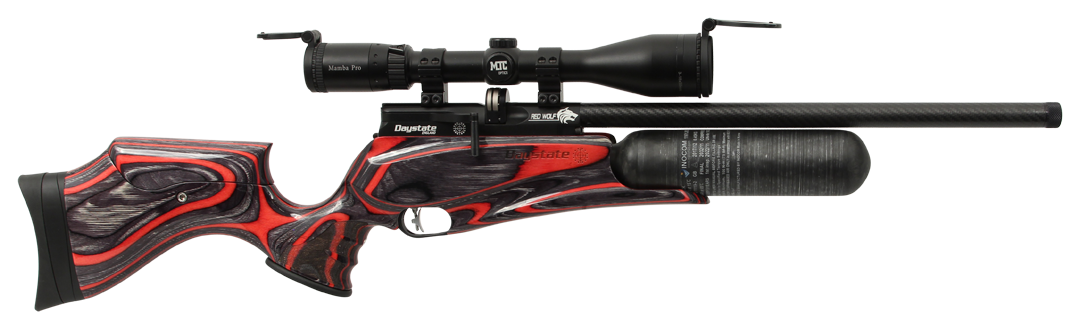
When calibre, map and accessories are chosen together, the rifle can be configured as a high-capacity legal-limit target tool or as a licensed hunting platform. Local regulations, safe storage and responsible use remain the first requirements; the hardware simply provides the range of options needed to stay within those rules while still delivering regulated, match-like performance.
Daystate, FX Airguns, PCP Rifles, Accessories and Precision Airgun Equipment
For enthusiasts researching premium PCP platforms, accessories, replacement components, and precision shooting equipment, the modern airgun market offers an extensive range of options from brands such as Daystate and FX. Searches for daystate blackwolf, daystate redwolf, delta wolf, huntsman daystate, daystate alpha wolf, wolf delta, day state, and daystate delta wolf frequently come from shooters comparing electronic PCP technology, ergonomic designs, premium construction, and sophisticated firing systems. Traditional styling also remains important, which is why terms such as stock walnut, safari stock, dima stock, rimfire stocks, and stock replacement continue to attract buyers who value both appearance and practical fit.
Among electronically controlled PCP rifles, the daystate alpha wolf, daystate blackwolf, daystate redwolf, and daystate delta wolf are commonly associated with advanced regulation, refined shot management, and a highly consistent firing cycle. Searches such as what is a delta wolf, what is a delta wolf, delta wolf meaning, deltaw, blackwolf, red alpha wolf, alpha red wolf, model alpha gun, model alpha gun, and electronic wolves often reflect buyers trying to understand how Daystate’s electronically managed rifles differ from conventional mechanical PCP systems. Other searches, including daysta, wolf gun, wolverine gun, wolveriner, daystate wolverine sapphire, daystate wolverine sapphire, and wolfpack armory wolverine, demonstrate the broad interest surrounding Wolf-branded and Wolverine-related sporting platforms.
Small ergonomic components can make a substantial difference to comfort and handling. A rifle butt pad, rubber butt, rubber butt pad, and butt pad rifle accessory can improve shoulder contact, while a bradley cheek riser can help support a more consistent head position. Likewise, enthusiasts may research gecko grips, a cocking ball, short cocking, an index pin, pin magazine, lock timing, and lock time when learning about rifle ergonomics, cycling characteristics, and replacement components. Searches for buddy bottle cover and buddy bottle cover also remain relevant for shooters who want to protect external air cylinders from cosmetic wear during transport or field use.
Magazine compatibility is another frequent consideration. Users may search for a 177 magazine, mag 177, 25 magazine, 5.0 mm pellets, 177 pellets types, slug pellet, or a general pellet rifle when comparing ammunition formats and magazine configurations. Pellet selection should always match the manufacturer’s recommended caliber and specifications for the rifle being used. A well-matched magazine and suitable ammunition can support reliable feeding and consistent performance without unnecessary mechanical stress.
PCP equipment relies on compressed air, so searches such as air rifle compressed air, air gun pc, air gun, and air guns are commonly connected with understanding pre-charged pneumatic systems. Owners also frequently search for a pcp o ring kit because seals form an important part of maintaining an air-tight pneumatic system. Maintenance should follow manufacturer-approved procedures, especially for high-pressure components, regulators, cylinders, and valves.
Sound-moderation accessories form another major category. Common search terms include air gun suppressor, air gun suppressors, airgun moderator, air rifle moderator, 0db, 0db moderator, 0 db moderator, 0 db moderator, 0 db moderator, 0 db moderator, and hogan decimeater silencer. Thread-related searches include silencer thread adapter, thread protector rifle, and muzzle thread protector. Compatibility depends on barrel threading, caliber, applicable law, and manufacturer specifications, so owners should verify all requirements before purchasing or fitting any muzzle accessory.
Mounting systems have also become increasingly important as modular fore-ends and accessory rails become more common. Searches for an mlok to picatinny rail adapter, best m-lok to picatinny rail adapter, m-lok to picatinny adapter, picatinny m lok adapter, and picatinny bag rider usually come from shooters wanting greater flexibility when mounting supported accessories. The best adapter is generally one that matches the rifle’s rail specification, uses quality hardware, fits securely, and avoids unnecessary bulk.
Sling-related searches are equally common. Buyers frequently look up how to put a gun sling on a rifle, how to put a rifle sling on, how to install a rifle sling, riffle sling, rigle sling, how to put sling on rifle, installing a rifle sling, and attaching a sling to a rifle. A compatible sling can improve carrying comfort and transportation, but attachment points should always be checked against the rifle manufacturer’s recommendations to avoid damage to the stock or mounting hardware.
The alpha wolf barrel and accessories such as an ats tuner may also interest precision-focused users researching how different rifle configurations are designed. Similarly, terms such as weatherby vanguard trigger adjustment appear in broader shooting-related searches, although trigger systems differ significantly between platforms and should be serviced or adjusted only according to the applicable manufacturer’s safety instructions. Another unusual search phrase, how to put extinguisher call back together, is unrelated to PCP rifle servicing and should be treated according to the specific extinguisher manufacturer’s maintenance guidance rather than general airgun information.
For buyers comparing premium European PCP equipment, daystate redwolf price and daystate redwolf price are common commercial-intent searches. Pricing can vary depending on caliber, stock type, configuration, region, dealer, and included accessories. People may also search fx airgun dealer near me when looking for authorized retailers, parts support, servicing, or warranty assistance.
FX Airguns remains another major name in the PCP market. Popular searches include fx impact m3 .22cal air rifle. 600mm barrel, fx impact m3, fx impact mk3, fx m3 airgun, fx m3, impact m3, and fx impact m3 air rifle. Price-focused searches such as fx impact m3 precio, fx impact m3 precio en usa, and fx impact m3 price indicate strong buyer interest in comparing regional pricing and available configurations. The modular design philosophy associated with the FX Impact family makes it especially attractive to experienced PCP users who prioritize adjustability, ergonomics, accessory compatibility, and high-quality construction.
Potential buyers also encounter less common search phrases such as griffin gun, unfend, black snood, red bodywarmer, and can wolverine go on planes. Airline transport rules for sporting equipment and compressed-air components can differ substantially between carriers and countries, so travelers should always check current airline, airport, customs, and destination regulations before making travel arrangements. Likewise, terms such as 3.55kg in lbs may appear when buyers compare rifle weight specifications across metric and imperial listings.
Whether someone is researching the daystate alpha wolf, daystate blackwolf, daystate redwolf, huntsman daystate, wolf delta, an fx impact m3, or another premium pellet rifle, the most important purchasing factors remain intended use, caliber compatibility, overall weight, stock ergonomics, magazine design, air-cylinder capacity, manufacturer support, and accessory compatibility. Premium PCP ownership is best supported by appropriate maintenance, manufacturer-approved components, secure storage, responsible handling, and compliance with all local laws and transport requirements.
What barrel and silencing features are included?
A match-grade Lothar Walther barrel is selected and then wrapped and fully shrouded. As a result, muzzle report is already reduced before any extra moderator is fitted. The muzzle is threaded so that a silencer can be added when extra quietness is required. Additionally, the shroud contributes to a clean, modern profile. Accuracy at longer airgun distances is supported by the quality of the tube and by the consistency of the electronic valve. Groups remain tight when quality pellets matched to the chosen calibre are used.
How is the magazine system operated?
A self-indexing rotary magazine is supplied, with capacity varying by calibre (typically thirteen shots in .177, eleven in .22 and ten in .25). A single-shot tray is also included so that deliberate hand-loading remains possible. The side-lever only has to index the magazine and probe the pellet; no heavy spring is compressed. Consequently, follow-up shots are fast and fatigue is kept low during long sessions. Double-loading is designed out of the system. Both rapid hunting sequences and slow, precise target work are therefore supported.
What weight and overall length should be expected?
Unscoped weight is listed at approximately 3.5 kg for the compact laminate version. Overall length is about 39 inches on the standard barrel configuration and longer on the high-power barrel. A carbon-fibre bottle is used on the lightweight model so that mass is kept down without sacrificing air volume. Balance in the shoulder is therefore described as pointable rather than muzzle-heavy. Extended standing or kneeling sessions remain comfortable for most shooters once the adjustable furniture has been set.
How is the onboard electronics package powered and monitored?
A rechargeable battery supplies the electronic valve, trigger and display. Battery state is shown on the screen together with cylinder pressure in fine increments, shot count and magazine status. Consequently, unexpected power loss is avoided if the display is checked before a session. The cell is designed for a very large number of shots between charges. Removal for charging is possible so that the rifle can remain locked away while the battery is topped up—an advantage for FAC users. Waterproofing of the control unit is specified so that field use in damp conditions remains practical.
Can power be changed in the field?
Three mapped settings are stored and can be selected in seconds. No tools or extra programmers are required for everyday changes between those factory maps. An optional programmer exists for finer tuning within safe limits, yet most owners simply switch among the three pre-set levels. Therefore, a morning of paper punching at modest energy can be followed by an afternoon of hunting at higher output without returning home. Legal limits must still be respected; the maps do not override local regulations.
Is the platform intended for hunting, target work, or both?
Both roles are supported. Legal-limit maps and high shot counts suit club and HFT-style use. Higher-energy maps and larger calibres suit pest control and hunting where FAC or equivalent permission is held. The adjustable stock, light cocking and quiet shroud make the rifle equally at home on the range or in woodland. Inclusive ergonomics mean that a wide range of enthusiasts can be accommodated rather than only one body type or handedness. Responsible, legal use is always required.
What maintenance is normally required?
Clean, dry air must be used for filling. The fill adaptor is of the familiar bayonet type. Periodic inspection of seals, the battery charge and the shroud is recommended. Because the valve is electronically controlled, mechanical wear on the hammer and valve stem is reduced compared with a purely spring-driven system. Consequently, service intervals can be longer when the rifle is treated correctly. Official servicing and genuine parts are advised so that the electronic mapping remains accurate. A multi-year warranty is commonly offered, reflecting confidence in the build.
How quiet is the rifle in the field?
The integral carbon shroud already attenuates the report. A threaded muzzle allows a second-stage silencer to be added. Combined with the consistent, regulated shot, the result is a discreet report suitable for close-range pest work when local rules permit. High-power maps naturally produce more noise, yet the shroud still helps. Neighbours and wildlife are therefore less disturbed than with an unshrouded, unregulated action of similar energy.
What safety features are built in?
A manual cross-bar safety is fitted. The action is deactivated while the side-lever is open, reducing the chance of an accidental discharge during loading. The electronic trigger cannot fire unless the system is armed and the safety is off. Inclusive design does not remove the need for safe handling; the rifle must still be treated as a firearm, pointed in a safe direction, and stored securely. Local licensing, age and power-limit rules must be observed at all times.
How does consistency compare with mechanical regulators?
Electronic mapping continuously adjusts valve dwell to the falling pressure curve. A mechanical regulator holds a set intermediate pressure; this system instead calculates the exact opening required for each shot. As a result, very flat velocity strings are obtained over hundreds of shots. Independent chronograph tests have recorded single-digit feet-per-second variation across long strings at legal-limit power. Groups therefore remain predictable even as the bottle empties, which is especially useful on the range and for longer hunting shots.
Who is this rifle designed for?
Enthusiasts who value electronic precision, an adjustable laminate stock and high shot counts are the intended audience. Left- and right-handed shooters are equally accommodated. Club shooters, hunters with the correct permissions, and collectors of premium British PCPs all find a role for the platform. Beginners can use the lower maps and the light cocking; experienced owners can exploit the higher maps and the fine trigger. Inclusive language and design are therefore matched by inclusive practical use—provided every owner stays within the law and practises safe handling.
Are accessories and further customisation available?
Silencers, charging kits, extra magazines, hard cases and an optional programmer are commonly listed. Scope mounting uses a standard 11 mm dovetail. The adjustable furniture already covers most fit requirements, so extra aftermarket stocks are rarely needed. Genuine accessories keep the electronic system and warranty intact. Retailers can confirm current packages and legal power settings for each market.
How should legal and FAC considerations be handled?
Power maps must never exceed the limit allowed in the owner’s country or on their certificate. Sub-12 ft-lbs settings exist precisely so that unlicensed use remains possible where that is the law. Higher maps are intended only for holders of the appropriate authority. Fill pressure, calibre and energy figures published by the factory should be treated as guidance; the exact rifle in hand should be chronographed if there is any doubt. Responsible ownership includes knowing the rules before the first shot is fired.
What should be checked before a first range session?
Battery charge, cylinder pressure, correct magazine orientation and trigger safety should all be verified. The chosen power map should match the intended use and local limit. Length of pull and cheekpiece height should be set so that a natural mount is obtained. Quality pellets of the correct calibre should be used. A few sighters will confirm zero after any transport. Once those steps are completed, the combination of digital consistency, light cocking and an adjustable stock allows attention to stay on the target rather than on the rifle.
Practical Use Scenarios in the Field and on the Range
A digitally regulated, laminate-stocked side-lever PCP is most useful when its maps, calibre and furniture are matched to a real task. Consequently, several typical days are described below so that owners can see how the same action is adapted without hardware changes. Inclusive language is used throughout: left- and right-handed shooters, different statures and both licensed and legal-limit users are accommodated by the adjustable stock and reversible lever. Local laws, safe backstops and responsible quarry selection remain the first conditions of every scenario.
Club Morning on the Zeroing Range
A low-energy map is selected before the first shot. The carbon bottle is filled to the recommended pressure and the display is checked so that battery state and remaining air are known. Length of pull and cheekpiece height are set until a natural mount is obtained; the same adjustments serve both shorter and taller shooters. An 11 mm-mounted optic is already zeroed at a familiar distance. Pellets of the chosen calibre are loaded into the rotary magazine, or the single-shot tray is inserted when each round is to be placed by hand.
Light cocking effort is appreciated during a long string. Because the electronic valve compensates for falling pressure, velocity stays flat and groups remain predictable from the first shot to the last. A few sighters confirm that transport has not shifted zero. Paper targets at 25, 40 and 55 yards are then engaged. Transition between distances is made simply by holding or dialling; the consistent muzzle velocity reduces the need for constant re-zeroing. After several magazines the bottle still holds ample air at legal-limit power, so a second detail can be shot without a refill. Inclusive practice is observed: inexperienced club members can use the same rifle once the furniture has been reset, because the lever and trigger do not demand unusual strength.
Highlighted Range-Day Checks
- Low map confirmed before live fire
- Display read for pressure and battery
- Comb and butt pad adjusted for the current shooter
- Magazine or tray selected according to the drill
- Backstop and range rules verified
Afternoon Hunter Field Target or Simulated Field Course
A mid-level map is sometimes preferred when knock-down targets or slightly longer field distances are used, provided the energy still complies with club and national limits. The ambidextrous laminate stock is left at the settings established in the morning, or a second shooter quickly re-adjusts the pad and cheekpiece. Kneeling and sitting positions are adopted; the relatively compact overall length of the standard barrel version helps when the rifle must be held across the body between targets.
The shrouded barrel already quiets the report; a screw-on moderator can be added if the course sits near housing. Follow-up shots on a miss are taken with little extra effort because the side-lever only indexes the magazine. Digital consistency means that a hold-over learned on the first lane remains valid on the last. Inclusive teams can share one rifle: the lever is swapped if a left-handed partner takes over, and the electronic trigger can be lightened or weighted to suit different preferences. After the course the display still shows a comfortable reserve, illustrating how mapped regulation stretches a fill across mixed standing and supported shots.
Legal-Limit Pest Control at Dusk
Permission, insurance and a safe backstop are confirmed before the rifle is carried onto private land. A legal-limit map is locked in so that the energy stays within the unlicensed ceiling. .177 or .22 is commonly chosen for small pests at modest ranges. The quiet shroud and optional silencer keep disturbance low. The adjustable comb allows a solid cheek weld even when a thick jacket is worn.
Stalking is conducted with the rifle slung or carried at the trail. When a shot is presented, the light cocking cycle and crisp electronic trigger reduce movement. A second pellet is already in the magazine if a follow-up is ethically required. Shot-to-shot velocity remains tight, so the hold used at 25 yards is still valid at 35 yards. After the outing the bottle is bled or left at residual pressure according to the owner’s habit, and the battery is checked so that the next dawn start is not interrupted. Inclusive safety culture is emphasised: every participant on the permission is briefed, and the rifle is never left unattended.
Licensed High-Power Hunting Session
Where a certificate or equivalent authority is held, a higher map and, if appropriate, a larger calibre are selected. The longer-barrel HP configuration is sometimes preferred for extra velocity and sight radius. Energy rises and shot count falls, yet MCT still flattens the curve so that the first and last shots of a shorter string stay close in speed. Ethical ranges are kept inside the capability of the chosen pellet and the shooter’s practised skill; extra power is not treated as a substitute for placement.
The same adjustable furniture is used, perhaps with a slightly different comb height if a larger optic or night-vision unit is mounted. Fill pressure is taken to the HiLite maximum so that the reduced shot count is still adequate for a morning’s work. A moderator remains useful even at higher energy. After the session the map is returned to a legal-limit setting if the rifle will next be used on an unlicensed range, preventing an accidental over-limit shot. Inclusive responsibility applies equally to FAC holders: the certificate, land permission and quarry list must all be in order before the high map is used.
Shared Family or Club Rifle Across Different Shooters
Because the stock is ambidextrous and both the lever and the trigger are adjustable, the same platform can be passed among several people in one afternoon. A taller shooter lengthens the pull; a shorter shooter shortens it. A left-handed user reverses the lever in a few minutes. Inclusive design therefore reduces the need for a second rifle. Each person still verifies the map, the safety and the magazine before firing. A simple range card noting “low map / 40-yard zero / current comb setting” keeps transitions safe. High shot count at modest energy means that a fill can serve an entire family detail without a mid-session trip to the pump.


Reviews
There are no reviews yet.