Precision Performance Is Unlocked by the Beeman Under Lever
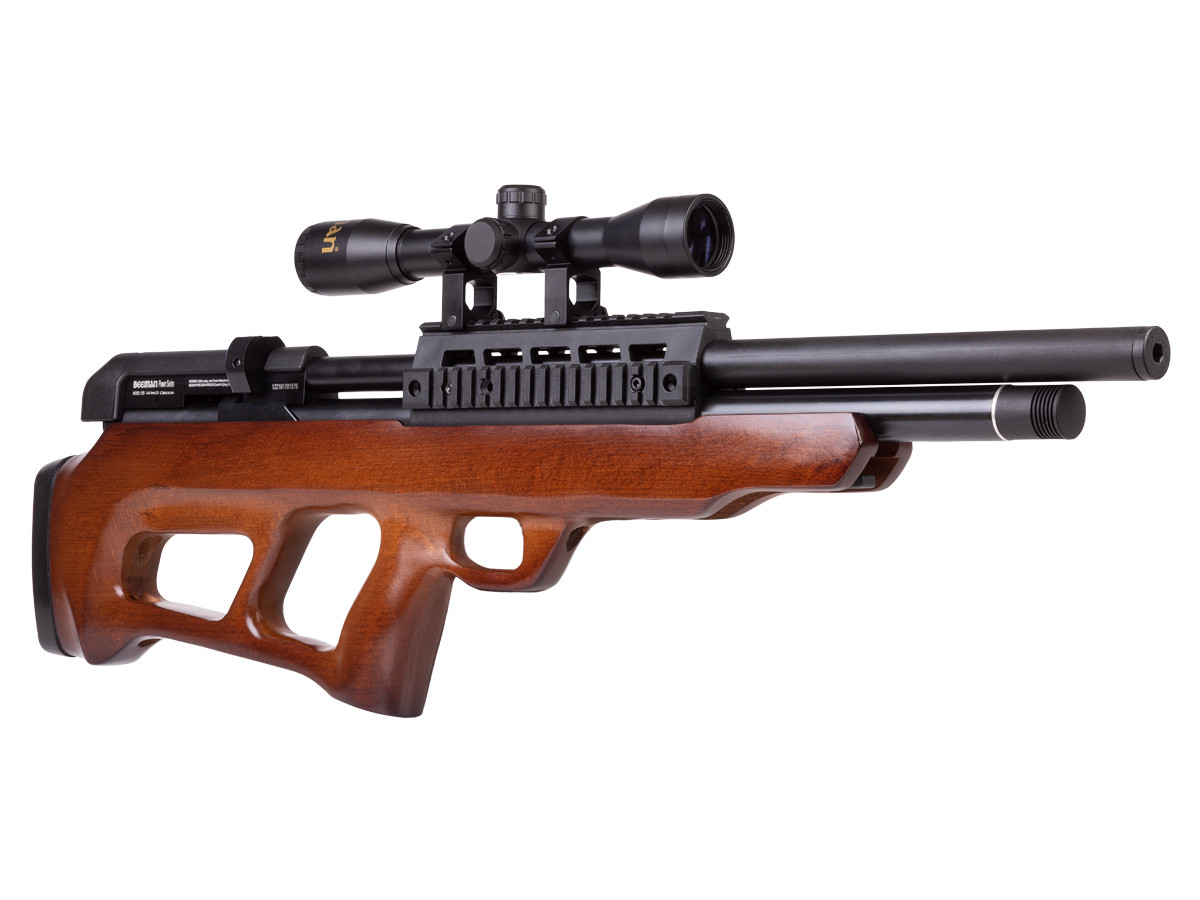
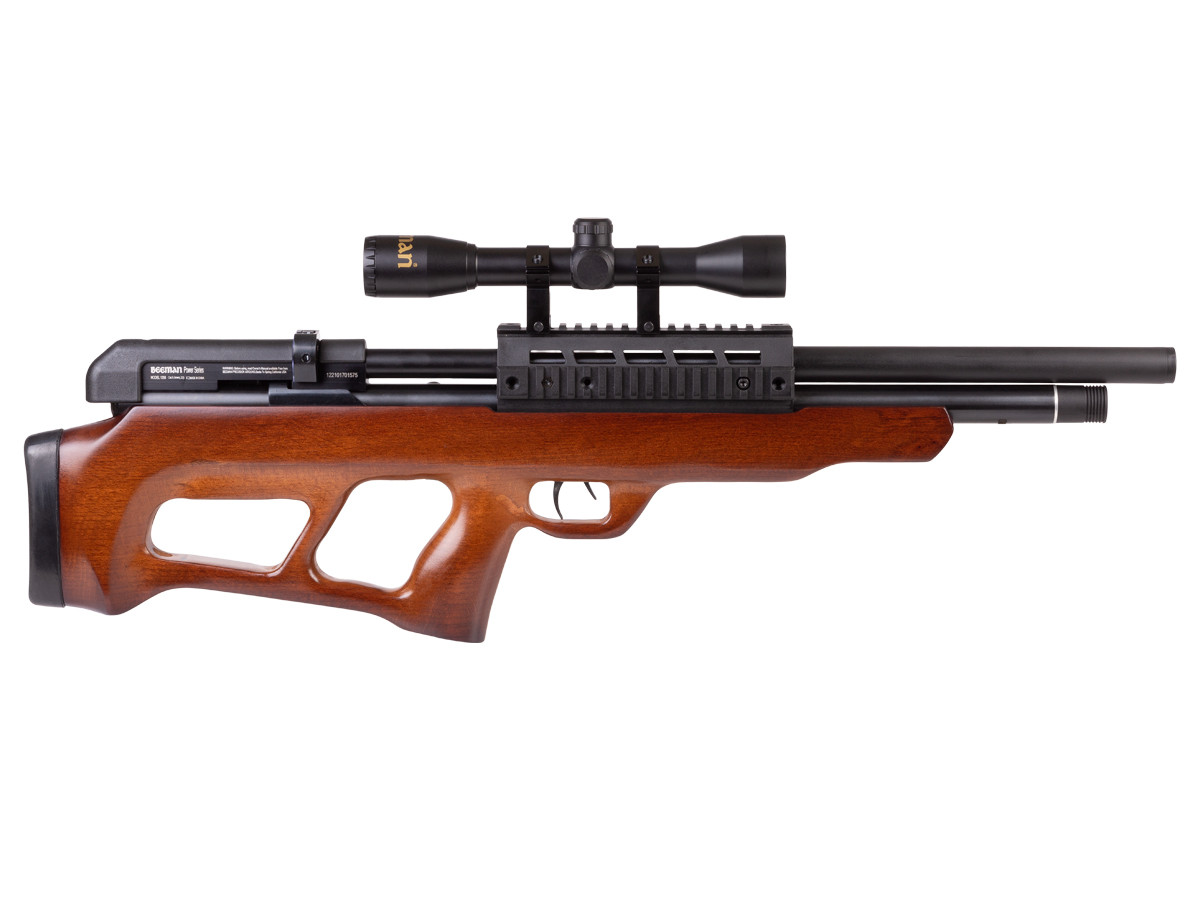
Exceptional value is delivered through the compact bullpup design of the Beeman Under Lever, where pre-charged pneumatic power is combined with an innovative underlever cocking system. Affordable access to features typically reserved for higher-priced platforms is provided, and consistent velocities of up to 1050 fps in .177, 880 fps in .22, and 780 fps in .25 are achieved. Consequently, small-game hunting, pest control, and recreational plinking are supported with reliability. Furthermore, an ambidextrous European wood thumbhole stock is incorporated so that shooters of every background can enjoy comfortable handling. Meanwhile, a shrouded barrel and included 4×32 optic ensure the package is ready for immediate use.
Distinctive Underlever Action and Ergonomic Design
Smooth cycling is enabled by the unique front underlever located in the forearm. The lever is simply drawn downward and rearward to cock the action, after which it is returned forward to chamber a pellet and close the bolt. As a result, effort is minimized and the shooting position can be maintained. In addition, equal ease is offered to both left- and right-handed users because no protruding side bolt or lever is present.
Ambidextrous Wood Stock and Compact Handling
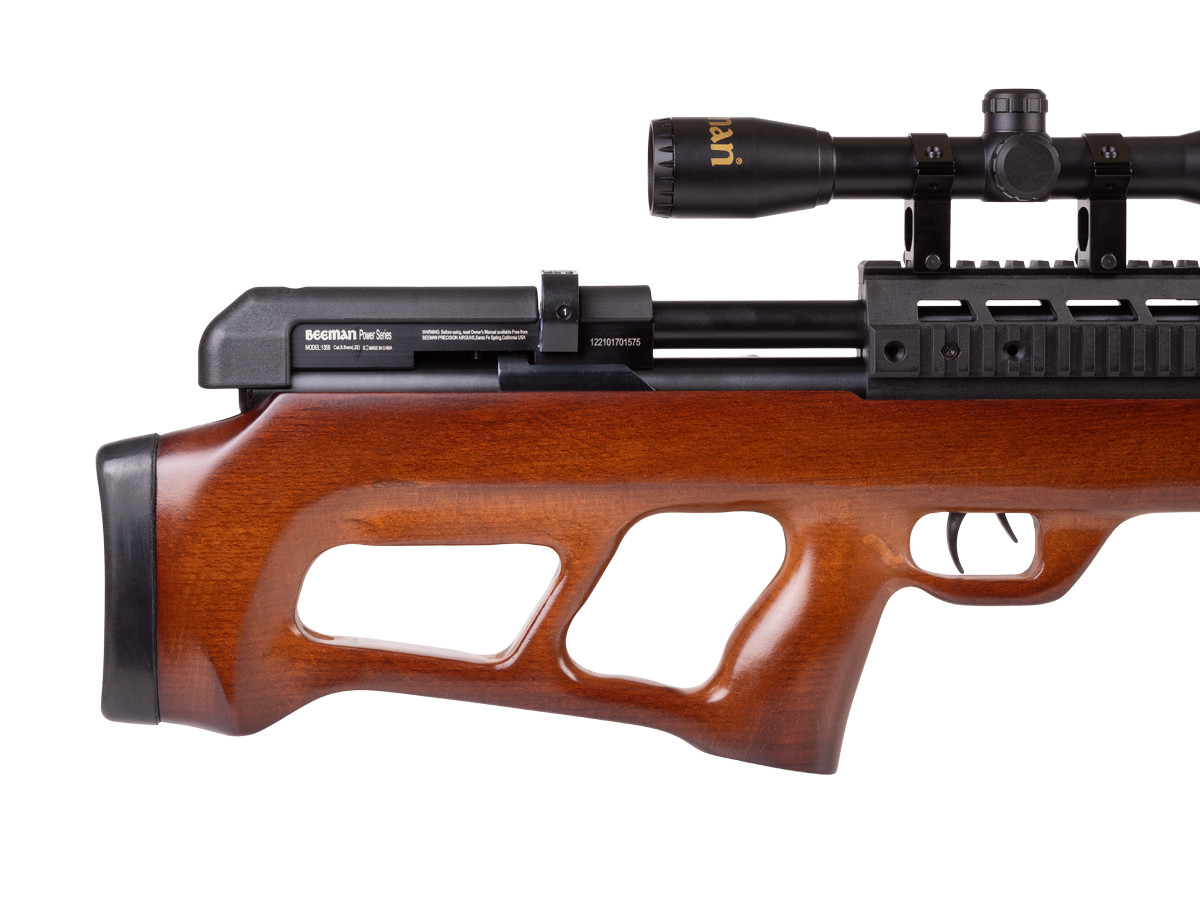
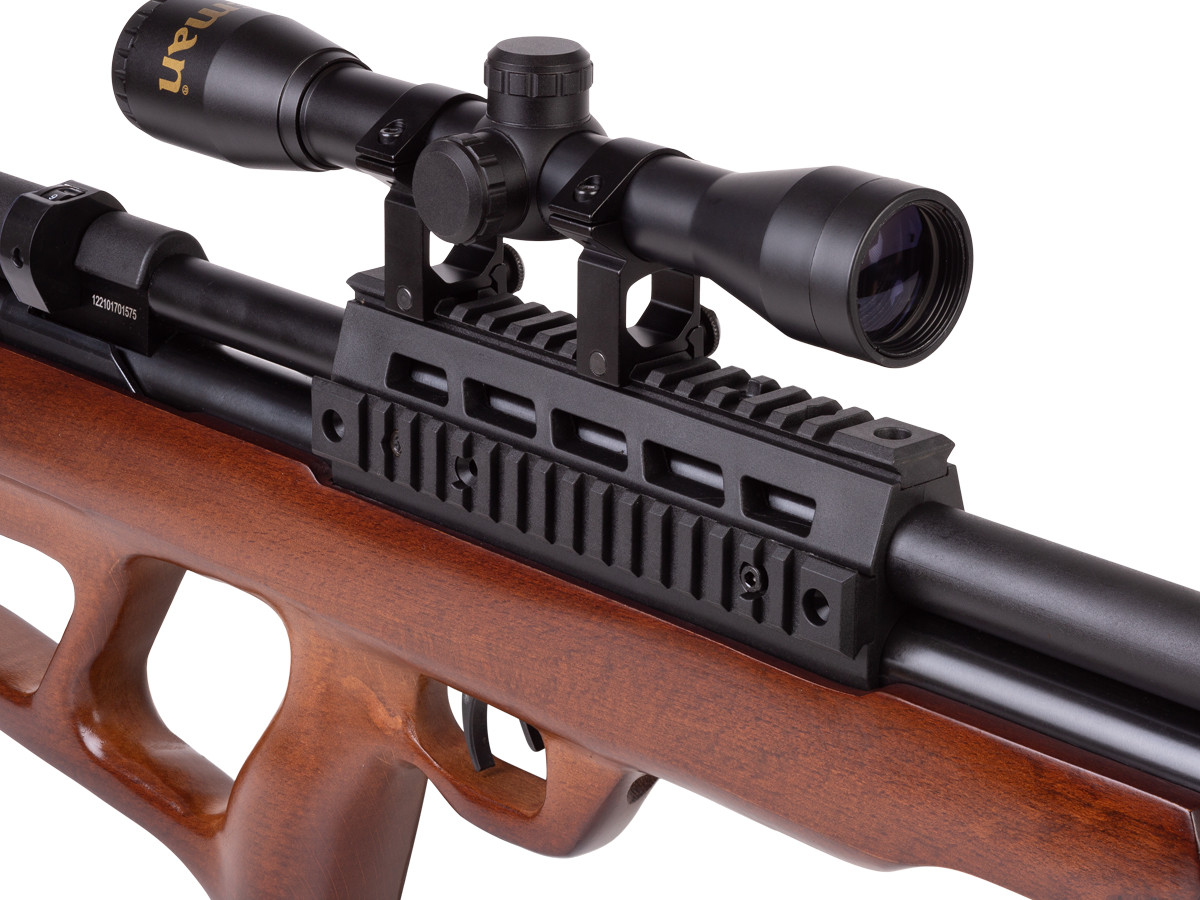
Strength and classic aesthetics are supplied by the European hardwood thumbhole stock. A rubber buttpad is fitted so that recoil absorption and a stable shoulder weld are improved. Overall length is kept to just 29.25 inches and weight is held near 7.4 pounds; therefore, maneuverability in tight spaces or during extended field sessions is enhanced. Three Picatinny rails are also provided so that optics, bipods, or lights can be mounted according to individual preference.
Power Delivery, Consistency, and Included Accessories
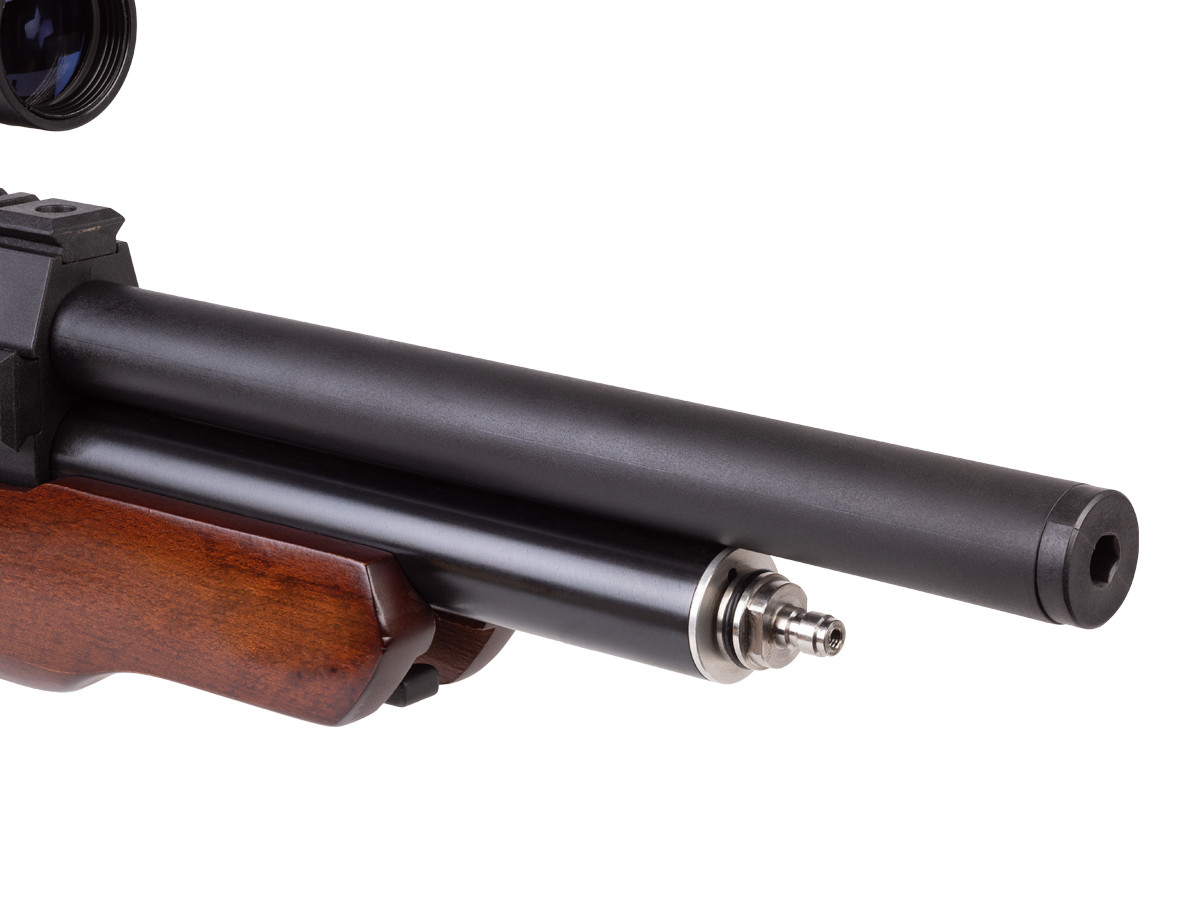
Compressed air at a maximum of 3000 PSI is stored in the reservoir, and a male quick-disconnect fill fitting allows rapid topping-up from a pump or compressor. An integrated manometer is mounted on the side so that remaining pressure can be monitored at a glance. Hammer-spring adjustment at the rear of the action permits fine-tuning of power output. Moreover, a two-stage adjustable trigger is installed so that break characteristics can be tailored.
Highlighted product features of the Beeman Under Lever include:
- Pre-charged pneumatic (PCP) power plant with 3000 PSI maximum fill
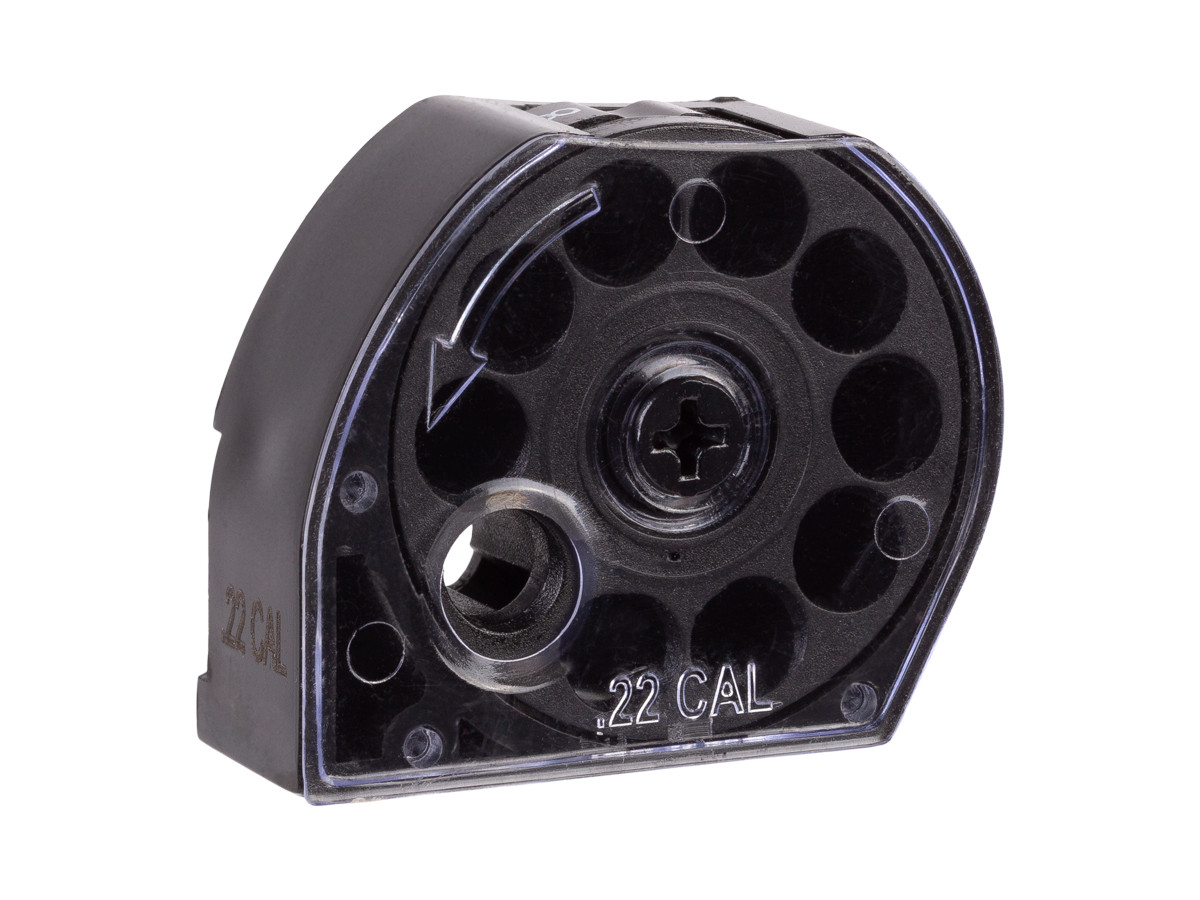
- Repeater operation via rotary magazines (12-round .177, 10-round .22, 9-round .25)
- Unique underlever cocking system for ambidextrous use
- Shrouded rifled barrel for reduced report
- European wood ambidextrous thumbhole stock with rubber buttpad
- Three Picatinny rails for optics and accessories
- Included 4×32 Beeman scope and rings
- Integrated pressure gauge and hammer-spring adjustment
- Male quick-disconnect fill port plus degassing screw
- Compact 29.25-inch overall length and approximately 7.4 lb weight
Consequently, a complete ready-to-shoot package is supplied, including two magazines, a single-shot tray, and necessary tools.
Velocity, Accuracy, and Shot Count
High muzzle velocities are generated across calibers, giving sufficient energy for humane small-game harvests or precise target work. Because the system is spring-free, recoil is virtually eliminated and follow-up shots can be placed more quickly. Shot strings of 40 or more usable pellets per fill are commonly reported when appropriate pellet weights are selected. Accuracy is further supported by the rifled barrel and the stable bullpup layout; therefore, tight groups at typical hunting and backyard ranges are routinely produced.
Practical Applications for Every Shooter
Versatility is demonstrated across multiple disciplines. Pest control around barns or gardens is accomplished with the compact profile that allows easy carry through brush. Plinking and informal target practice are enjoyed thanks to the low perceived recoil and smooth cycling. Small-game hunting of squirrels, rabbits, or similar species is supported by the available power levels when local regulations are observed. Additionally, the included scope and rails make the platform suitable for new shooters who wish to start with a complete setup as well as experienced enthusiasts seeking an economical second rifle.
Transitioning from fill to firing is straightforward: the reservoir is charged, the magazine is inserted, the underlever is cycled, and the two-stage trigger is pressed. Safety is addressed by a manual safety and the side-mounted pressure gauge that remains visible during handling. Inclusive design choices—ambidextrous stock, effortless cocking, and modest weight—ensure that shooters of varying stature and experience levels can participate comfortably.
Why the Beeman Under Lever Stands Out
Value is maximized because features such as a wood thumbhole stock, shrouded barrel, adjustable hammer spring, and factory optic are bundled at an accessible price point. Reliability is reinforced by the simple, robust underlever mechanism that avoids the complexity of some side-lever or bolt systems. Maintenance remains modest: regular inspection of seals, occasional lubrication of the cocking linkage, and proper fill-pressure discipline keep the rifle performing. Consequently, long-term ownership costs stay low.
Responsible use is always encouraged. Local airgun regulations, safe backstops, and appropriate pellet selection must be observed. When these practices are followed, years of accurate, enjoyable shooting can be expected from this distinctive bullpup.
The Beeman Under Lever therefore represents an intelligent entry into regulated PCP shooting. Compact dimensions, unique cocking convenience, and proven power are combined in one attractive package that welcomes every enthusiast to the range or field.
Barra Air Rifles, BB Guns, PCP Systems, Electric Airguns, and Advanced Shooting Platforms
The modern airgun market offers a wide range of shooting platforms designed for beginners, enthusiasts, and experienced shooters. From traditional BB gun designs to advanced pneumatic systems, today’s technology provides improved accuracy, power, reliability, and versatility. The Barra product range has gained attention among airgun users because of its combination of innovative engineering and practical shooting performance.
Popular models include the Barra 300Z, Barra 350Z, Barra 250Z, Barra 400, Barra 400E Gen 2, Barra 400 E, 400E, 400 e, Bara 400E, Barra 1100Z, Barra 1100Z Gen 2, Barra 1200G, Barra 100, BA-400, Barra 1866, Barra 1866 Rosie Bundle, Barra 270Z, Barra Sportsman 900, and Sportsman 900. These platforms are designed for different shooting preferences, including recreational shooting, target practice, and precision applications.
A BB gun rifle provides a classic shooting experience, while a BB rifle offers a compact and accessible option for users interested in recreational shooting. Many shooters also search for a BB gun rifle with scope because an optic can improve aiming consistency and overall shooting control. Traditional accessories and variations include BB rifle pump, BB gun pump, and BB gun rifle pump systems.
PCP Air Rifle and Compressed Air Technology
Advanced airgun technology has been transformed through precharged pneumatic systems. A PCP rifle uses stored air pressure to deliver consistent performance, making it a popular choice among users who want accuracy and power. A PCP air rifle operates through compressed air stored inside a reservoir, allowing multiple shots before refilling.
Many shooters research air rifle compressed air technology because it provides smooth operation, reduced vibration, and improved shot consistency. A compressed air pellet guns platform uses high-pressure air to propel pellets efficiently, while a high pressure air rifle is designed for users who require increased performance.
Other related systems include air gun compressed, compressed air guns, and compressed air rifle designs. These platforms are commonly paired with equipment such as a PCP pump for air rifle and other filling accessories.
For new users asking PCP air rifle meaning, what is a PCP air rifle, what is PCP air rifle, or whats a PCP gun, the answer refers to a precharged pneumatic system that stores compressed air before shooting. A pre charged pneumatic air rifles setup provides an alternative to spring-powered designs and is widely used for precision shooting.
Barra PCP Models and Caliber Options
The Barra 250Z PCP air rifle is designed for shooters looking for a powerful and compact pneumatic platform. The Barra 250Z for sale market includes different configurations, including the Barra 250Z .25 cal version.
Large-caliber airguns are becoming increasingly popular, with options such as a 25 cal air rifle 1000 fps, 25 caliber pellet rifle, .25 PCP air rifle, PCP 25 caliber air rifle, 25 caliber air rifle, and 25 Z configurations.
These larger-caliber platforms are designed for users who want increased energy and performance compared with smaller calibers. Other popular caliber choices include the 22 cal air rifle, 22 caliber air rifle, 22 caliber pellet gun, and 22 pellet rifle 1200 fps options.
Electric BB Guns and Automatic Airgun Platforms
Electric-powered shooting systems have created another category within recreational shooting. An electric BB gun uses battery-powered technology to provide a unique shooting experience. Related designs include electric pellet gun, electric air gun, air gun electric, electric rifle, battery powered air gun, electric BB guns, electric guns, and airsoft air guns electric.
Users searching for high-speed systems may look for terms such as most powerful fully automatic BB gun, full auto BB gun electric, best full auto BB gun, best full auto BB guns, full auto BB gun 1000 fps, full auto BB gun, and fully automatic BB gun.
These platforms are designed for users who want rapid operation and modern features. Performance-focused searches may also include strong BB guns when comparing powerful recreational shooting options.
Pellet Guns, Break Barrel, and Traditional Air Rifles
Traditional airgun designs remain popular because of their simplicity and reliability. A pellet gun provides a practical option for target shooting, while a pellet rifle offers improved stability and accuracy.
A pellet sniper platform is designed for users interested in precision shooting. Classic spring-powered systems include the break barrel pellet gun 1200 fps, break barrel, and single shot 22 break barrel rifle.
For beginners researching what is a break barrel air rifle, this system works through a hinged barrel mechanism that compresses a spring or gas piston before each shot. These designs remain popular because they require minimal additional equipment.
Additional traditional options include air gun pump action, air rifle pump action, pump pellet gun, and pump BB pistol platforms.
Barra Sportsman and Additional Airgun Platforms
The Sportsman 900 air rifle and Sportsman 900 BB gun provide versatile options for recreational users. These models are part of the wider selection of Barra shooting products designed for different experience levels.
Other available platforms include 250Z, Barra 300Z, and various modern Barra configurations. Accessories such as pellet trap for 1200 fps, camouflage pellet guns, and Mossy Oak 308 products allow shooters to customize their equipment.
Users interested in alternative power systems may also explore a CO2 rifle, lever action air rifle, and lever action PCP air rifle. These designs combine traditional handling with modern airgun technology.
Choosing the Right Airgun System
Selecting the right platform depends on shooting purpose, preferred caliber, power requirements, and experience level. A PCP review can help users compare different pneumatic systems, while PCP shooting provides insight into the performance advantages of regulated air platforms.ar bb gun
Whether choosing a Barra model, a compressed air system, an electric shooting platform, or a traditional spring-powered design, understanding features and applications helps buyers select the correct equipment.bb gunning.what gen is black 2.barra 250z 25 cal
From the Barra 400E price to advanced PCP technology and modern electric systems, today’s airgun market provides a wide range of choices for recreational shooters, target enthusiasts, and experienced users seeking reliable performance.b a r r a.bara 250z.full auto electric bb gun.barra 400e aeg.
Calibres, FAC Considerations, Power Output and Accessories for the Beeman Under Lever
Multiple calibre options are offered by the Beeman Under Lever so that a wide range of shooting needs can be met. Consequently, .177, .22 and .25 versions are produced, each being supplied with a matching rotary magazine. Transition from one discipline to another is therefore made simpler because the same compact bullpup platform and underlever action are retained across the line.
Available Calibres and Typical Applications
The smallest bore is represented by the .177 model (commonly listed as 1357). High velocities approaching 1050 fps are generated, and a 12-shot magazine is fitted. As a result, flat trajectories and economical pellet use are favoured for plinking, formal target practice and lighter pest work. Meanwhile, the popular .22 chambering (model 1358) is provided with a 10-round magazine and advertised speeds near 880 fps. Greater down-range energy is delivered, and ethical small-game harvests at moderate distances are supported. Finally, the .25 variant (model 1359) utilises a 9-shot magazine and reaches approximately 780–830 fps. Heavier projectiles are launched, and additional knockdown power for larger pests or shorter-range hunting is obtained.
Pellet Selection Across Calibres
Accuracy is maximised when pellets of appropriate weight and shape are chosen. Lighter match or wadcutter designs are often preferred in .177 for indoor or close-range work. Mid-weight domed or hollow-point pellets in the 14–18 grain class are frequently selected for .22 hunting and general shooting. Heavier slugs or hunting pellets in the 20–26 grain range are commonly used in .25 so that energy transfer is improved. Inclusive testing of several brands is recommended because individual rifles can show a preference; therefore, groups should be recorded at intended distances before a final load is adopted.
FAC Status and Legal Power Limits
Muzzle energy well above the United Kingdom’s unlicensed 12 ft-lb threshold is produced by factory-specification Beeman Under Lever rifles. Independent testing of the .22 version has recorded energies in the 20–25 ft-lb range with heavier pellets. Consequently, a Firearms Certificate (FAC) is required for ownership and use in England, Wales and Northern Ireland, and equivalent licensing applies in other jurisdictions that impose similar energy limits. Scotland’s Air Weapon Certificate rules must also be observed. Because advertised velocities generate substantial energy, shipment of full-power examples to the UK is commonly restricted by retailers.
Hammer-spring adjustment is provided at the rear of the action. Power can therefore be reduced by turning the adjuster counter-clockwise, and shot count is simultaneously increased. Nevertheless, once a rifle has been manufactured and sold as an FAC-capable firearm, the “once FAC, always FAC” principle generally applies in the UK. Local police guidance and current legislation must always be verified before purchase or modification. Responsible compliance is expected of every shooter regardless of experience level.
Power Tuning and Consistency
Fill pressure is limited to 3000 PSI on most examples. An unregulated valve produces a characteristic power curve: higher velocities appear at the beginning of a fill and a gradual decline follows. Approximately 40 usable shots per fill are typically obtained when moderate pellet weights are used. Shot-to-shot consistency can be improved by staying within a narrower pressure window or by fitting aftermarket regulators where available. Later regulated UK-market versions (sometimes numbered 13575 / 13585 / 13595) have been introduced so that sub-12 ft-lb performance can be maintained more easily; buyers should confirm the exact specification with the seller.
Recommended Accessories and Upgrades
A complete starter package is already included: two magazines, a single-shot tray, a 4×32 scope with rings, a degassing screw and Allen keys. Additional items can nevertheless enhance versatility.
Highlighted accessories commonly paired with the Beeman Under Lever:
- Extra rotary magazines in matching calibre for faster reloads
- Higher-quality compact scopes (3–12× or similar) with side focus for hunting distances
- Aftermarket barrel-shroud extensions or ½-UNF moderator adapters to reduce report
- Picatinny-mounted bipods or slings for field stability
- Hand pumps or portable electric compressors rated for 3000 PSI
- Quality lead pellets and slugs matched to each calibre
- Protective hard case or padded bag suited to the 29.25-inch overall length
- Chronograph for verifying velocity and remaining within legal limits
Three Picatinny rails already present on the rifle allow lights, lasers or extra optics to be added without extra machining. Because the underlever remains unobstructed, accessories can be mounted on either side, supporting both left- and right-handed users equally.
Filling equipment must be compatible with the male Foster-style quick-disconnect fitting. Regular inspection of O-rings and the use of a water-trap filter on pumps help preserve valve life. Inclusive maintenance practices—keeping the action clean, storing the rifle uncharged when possible, and wearing eye protection—are encouraged for all owners.
When calibre, legal power setting and supporting accessories are chosen thoughtfully, the Beeman Under Lever becomes a flexible tool for backyard practice, pest management and licensed hunting. Local regulations remain the first consideration; once those requirements are satisfied, the platform rewards careful setup with compact handling and usable power across three popular bore sizes.
Frequently Asked Questions
Comprehensive answers are provided below so that every aspect of ownership, legal compliance and practical use can be understood. Inclusive language is employed throughout, and information is presented for shooters of all experience levels.
General Design and Operation
How is the cocking cycle completed?
The action is cycled by an under-forearm lever that is drawn downward and rearward until a positive stop is reached. The lever is then returned forward so that a pellet is seated and the bolt is closed. Smooth, low-effort movement is produced because the linkage is engineered for both left- and right-handed users. Consequently, the shooting position can be maintained and follow-up shots can be taken without shifting grip. A distinct tactile stop at each end of travel is felt, reducing the chance of incomplete cocking.
Why was a bullpup layout selected?
Overall length is kept to approximately 29.25 inches while a full-length rifled barrel is retained. Compact handling in vehicles, blinds or dense cover is therefore achieved without sacrificing velocity potential. Balance is shifted rearward, and a stable hold is encouraged by the thumbhole stock. As a result, the platform remains manoeuvrable for shooters of varying stature.
Is the stock suitable for every shooter?
An ambidextrous European hardwood thumbhole stock is fitted, and a rubber buttpad is installed so that recoil absorption and cheek weld are improved. No protruding side lever or bolt handle is present; therefore equal access is granted to left- and right-handed users. Modest overall weight near 7.4 pounds further supports comfortable carry during extended sessions.
Calibres, Power and Legal Considerations
Which calibres are offered?
Three popular bore sizes are manufactured. A 12-shot magazine is supplied with the smallest calibre, a 10-shot magazine accompanies the mid-size option, and a 9-shot magazine is paired with the largest. High advertised velocities are generated in each chambering so that plinking, pest control and small-game work can be addressed. Pellet preference should be confirmed by grouping tests because individual barrels can favour particular weights and shapes.
Does factory power exceed unlicensed limits in some countries?
Muzzle energies well above 12 foot-pounds are commonly recorded when standard hunting pellets are used. Independent chronograph tests of the mid-calibre version have shown figures in the 20–25 foot-pound range. Consequently a Firearms Certificate is required in England, Wales and Northern Ireland, and equivalent licensing applies in other jurisdictions with similar energy ceilings. Scotland’s separate air-weapon rules must also be observed. Local legislation should always be verified before purchase.
Can output be reduced?
A hammer-spring adjuster is located at the rear of the action. Clockwise rotation increases power while counter-clockwise rotation lowers velocity and simultaneously raises shot count. Nevertheless, once a rifle has been produced and sold as a high-power firearm, the “once FAC, always FAC” principle generally remains in force in the United Kingdom. Professional advice from the local licensing authority is recommended before any permanent alteration is undertaken.
How many shots are obtained from a full fill?
Approximately forty usable shots per 3000 PSI fill are typically reported when mid-weight pellets are selected. An unregulated valve produces a gradual velocity decline; therefore the most consistent portion of the curve is often used for hunting or competition. Staying within a narrower pressure window or fitting an aftermarket regulator can further flatten the string.
Filling, Maintenance and Reliability
What fill pressure is specified?
A maximum of 3000 PSI (approximately 206 bar) is stated by the manufacturer. Earlier packaging that listed 3500 PSI should be disregarded. Over-filling can damage seals or lock the valve. A male Foster-style quick-disconnect fitting is provided so that pumps or compressors can be attached rapidly. An integral side-mounted manometer allows remaining pressure to be read at a glance.
How should the reservoir be charged safely?
The rifle must be unloaded and pointed in a safe direction. A water-trap filter is advised when a hand pump is used so that moisture is excluded. Filling should be performed slowly, and the gauge should be monitored continuously. After charging, the rifle may be left to rest so that any temperature-related pressure change can settle. Regular inspection of O-rings and the degassing screw is recommended.
What routine care is required?
The cocking linkage benefits from occasional light lubrication. The barrel should be cleaned with a proper airgun rod and felt pellets when accuracy declines. Seals are best left undisturbed unless leakage is observed. Storage in an uncharged or partially charged state reduces long-term stress on the valve. Inclusive maintenance habits—eye protection, safe muzzle direction and separate storage of pellets—are expected of every owner.
Optics, Accessories and Customisation
What is supplied in the box?
Two rotary magazines, a single-shot tray, a 4×32 optic with rings, a degassing tool and the necessary Allen keys are included. Three Picatinny rails are already present so that additional lights, bipods or secondary optics can be mounted immediately. The factory scope is adequate for initial zeroing and short-range work; higher-magnification compact scopes are frequently added later for hunting distances.
Highlighted items commonly added after purchase include:
- Extra magazines in the matching calibre
- Compact variable-power scopes with side parallax
- Aftermarket shroud extensions or ½-UNF moderator adapters
- Rail-mounted bipods and slings
- 3000 PSI-rated hand pumps or portable compressors
- Calibre-specific hunting and match pellets
- A padded case sized for the short overall length
- A chronograph for legal-power verification
Can a moderator be fitted?
The factory shroud already reduces report to a medium level. Aftermarket extensions that slide over the existing shroud are available and do not require an adapter on many examples. Threaded adapters can also be installed so that conventional ½-UNF silencers may be used. Neighbour-friendly backyard shooting is thereby improved while the compact profile is largely retained.
Are extra magazines easy to obtain?
Spare magazines share the same design as those used on certain companion pistols from the same family. Additional units can therefore be sourced from major airgun retailers. A spare-magazine holder is present on some stock variants, allowing a second magazine to be carried on the rifle itself.
Accuracy, Trigger and Shooting Performance
What level of accuracy can be expected?
Sub-inch groups at typical hunting and plinking distances are regularly reported when suitable pellets are chosen. The recoilless PCP power plant and stable bullpup layout contribute to repeatable shot placement. Best results are obtained after a short break-in period and after the most accurate pellet for that particular barrel has been identified.
How is the trigger described?
A two-stage adjustable unit is fitted. First-stage travel can feel firm, yet the second-stage break is generally crisp once the wall is reached. Adjustment screws allow pull weight and travel to be tailored. Many owners find the trigger perfectly serviceable after a brief familiarisation period; others elect to polish or lighten the mechanism within safe limits.
Is the rifle quiet enough for backyard use?
The integrated shroud produces a medium report. Additional moderation is frequently added when neighbours are close. Because the action itself is recoilless, perceived noise is limited to the muzzle blast and the mechanical click of the underlever. Hearing protection remains advisable during extended sessions.
Practical Use and Safety
Is the platform suitable for hunting?
Sufficient energy for ethical dispatch of small game and pests is generated when appropriate pellets and ranges are observed. The short length aids movement through cover, and the ambidextrous stock accommodates varied shooting positions. Local hunting regulations and minimum energy requirements must always be respected.
What safety features are present?
A manual safety is provided, and the side-mounted pressure gauge remains visible during handling. The underlever cannot be cycled accidentally while the rifle is shouldered in a conventional manner. Standard airgun safety rules—muzzle awareness, positive target identification and secure storage—apply at all times.
Can both left- and right-handed shooters use the rifle equally?
Yes. The absence of a side-mounted cocking handle or bolt, combined with the ambidextrous thumbhole stock, allows the same technique to be used from either shoulder. Rails on both sides further support accessory placement for every user.250 z
What should be considered before first use?
The owner’s manual must be read in full. Fill pressure limits should be confirmed, and the hammer spring should be left at a conservative setting until velocity is verified with a chronograph. A safe backstop and appropriate eye protection are mandatory. Inclusive instruction for new shooters is encouraged so that safe habits are established from the outset.
When these points are observed, reliable service and enjoyable shooting can be expected from the compact PCP bullpup for many seasons. Local laws remain the first and most important consideration for every owner.
Practical Use Scenarios in the Field and at Home
Everyday shooting situations are examined below so that the compact underlever PCP bullpup can be visualised in real-world conditions. Inclusive language is used throughout, and each scenario is written for shooters of every background and experience level. Transition from one setting to the next is made smoothly so that versatility is clearly illustrated.
Backyard Pest Management at Dusk
Quiet movement around outbuildings is required when rodents or similar pests appear at last light. The short overall length allows the rifle to be carried through doorways and along narrow paths without catching on frames or foliage. Because the under-forearm lever is drawn downward while the rifle remains shouldered, the sight picture can be held and a follow-up shot prepared almost immediately.
A mid-weight hollow-point pellet in the mid-size calibre is typically selected so that energy transfer remains adequate at fifteen to twenty-five yards. The reservoir is filled to the recommended maximum before the session begins, and the side-mounted gauge is checked at a glance. Consequently a string of consistent shots remains available without an immediate return to the pump.
The factory shroud already reduces report to a medium level; an aftermarket extension can be added when neighbours live close by. A stable rest against a fence post or vehicle wing is adopted, the two-stage trigger is pressed through its wall, and the pest is dispatched humanely. Afterward the rifle is made safe, the magazine is removed, and the area is inspected so that no pellet or casualty is left unattended.
Field notes commonly observed during dusk pest work include:
- Compact length that clears doorways and garden gates easily
- Ability to cycle the action without breaking cheek weld
- Medium report that is further lowered by a simple shroud extension
- Sufficient remaining shots for several opportunities in one fill
- Ambidextrous stock that accommodates either shoulder in tight corners
Inclusive practice demands that local by-laws, safe backstops and neighbour consideration are always respected.
Small-Game Hunting Along Hedgerows
A morning walk along field edges is undertaken when rabbits or squirrels are expected. The modest weight near seven and a half pounds allows the rifle to be carried slung or in the hand for extended periods. Three Picatinny rails already present permit a compact variable-power scope and a light bipod to be fitted, improving first-shot confidence at thirty to forty yards.
Heavier domed or hunting pellets in the larger two calibres are preferred so that remaining energy at impact stays ethical. The hammer-spring adjuster can be set to a moderate position that balances velocity with shot count. An unregulated curve is accepted; therefore the most consistent portion of the fill is used for hunting shots and the later, declining shots are reserved for closer opportunities or practice.
The underlever is cycled while the shooter remains crouched or kneeling. Because no side handle protrudes, clothing and vegetation are less likely to snag. A shot is taken from a natural rest—a gate post, a kneeling roll or the bipod—and the animal is recovered promptly. After the session the rifle is degassed or left at a safe residual pressure, magazines are emptied, and the bore is given a quick wipe if moisture or debris has been encountered.
Transition from hedgerow to woodland edge is accomplished without changing platforms. The same compact dimensions that aid vehicle transport also help when a sudden change of position is required.
Informal Range Sessions and Skill Building
A club or private range visit is arranged so that groups can be recorded and pellet preference confirmed. Multiple magazines are pre-loaded at the bench, and a single-shot tray is kept ready for the most accurate loads. The included 4×32 optic is used for initial zero; a higher-magnification compact scope is often substituted once distances stretch beyond thirty yards.
Recoil is virtually absent, so follow-up shots can be observed through the glass. The two-stage trigger is dry-fired a few times (where permitted) so that the break point becomes familiar. Groups are shot from a bench, then from sitting and kneeling positions so that field reality is simulated. Chronograph readings are taken at the beginning, middle and end of a fill so that the power curve is understood and legal limits are verified where required.
Left- and right-handed shooters share the same rifle without adjustment of the stock. Rails on both sides allow a spotting scope or timer to be mounted according to individual preference. Inclusive coaching is straightforward because the cocking motion is identical for every participant.
Travel, Vehicle and Blind Use
The 29-inch class length permits the rifle to be placed across a vehicle seat or in a modest case without disassembly. A padded bag or compact hard case is chosen so that the wood stock and scope remain protected. Upon arrival at a permission or hide, the rifle is filled from a portable pump or a small compressor that has been carried in the same vehicle.
Inside a tight hide the underlever can still be operated because the motion occurs beneath the forend rather than to the side. A bipod or shooting sticks are deployed on the existing rails, and waiting shots are taken without the need to stand or shift the entire platform. After darkness falls a compact light can be attached to a side rail if local rules allow.
When the outing ends the rifle is made safe, residual pressure is noted on the gauge, and the package is returned to the vehicle in minutes. Consequently spontaneous opportunities can be accepted without the bulk associated with full-length sporters.
Licensed High-Power Hunting Where Permitted
In jurisdictions that require a certificate for energies above the unlicensed threshold, the same rifle is employed for longer-range small-game work. Heavier pellets or slugs in the largest calibre are selected, and the hammer spring is left at a higher setting so that remaining energy at fifty yards stays adequate. A quality side-focus scope with a suitable reticle is mounted, and ballistic data gathered earlier at the range is applied.
Fill discipline becomes more important because the unregulated curve is steeper at higher power. Shooters often work within a narrower pressure band and carry a spare charged bottle or a compact compressor. Ethical shot placement and positive identification remain non-negotiable. After the hunt the rifle is logged according to certificate conditions and stored securely.
Inclusive access is maintained: the ambidextrous layout means a licensed left-handed hunter uses exactly the same technique as a right-handed companion.
Family Introduction and Shared Practice
New shooters of legal age are introduced on a supervised range. The recoilless discharge and modest cocking effort reduce intimidation. The underlever’s positive stops give clear feedback, so incomplete cycles are rare. A lighter pellet and a reduced hammer-spring setting are chosen at first so that report and recoil sensation stay comfortable.
The thumbhole stock fits a range of hand sizes, and the rubber buttpad helps smaller frames obtain a consistent weld. Magazines can be loaded by a more experienced companion while the new shooter concentrates on sight picture and trigger control. Inclusive language and unhurried coaching turn the session into a shared activity rather than a test.
Safety rules are repeated at the start of every outing: muzzle direction, loaded-chamber awareness, and eye protection for everyone on the line. When these habits are established, confidence grows quickly.
Seasonal and Weather Considerations
Damp autumn mornings require extra attention to the wood stock and metal surfaces. A light wipe-down after use prevents moisture from sitting in the thumbhole or around the gauge. Extreme cold can affect regulator-less valves; therefore a slightly higher starting pressure or a shorter session may be planned. Summer heat increases fill-pressure readings, so the gauge is watched closely and over-filling is avoided.
Pellets are kept dry and separate from the rifle. A small kit containing spare O-rings, an Allen key and a few extra magazines travels with the rifle so that a field issue can be addressed without ending the day.
Practical habits that support reliable use across seasons include:
- Verification of fill pressure before every outing
- Selection of pellets previously grouped in that specific barrel
- Periodic cleaning of the bore after dusty or wet conditions
- Secure, separate storage of the rifle and ammunition
- Chronograph checks whenever the hammer spring is adjusted
- Respect for local seasons, permissions and energy limits
When these scenarios are combined, the compact underlever PCP bullpup is shown to serve backyard, hedgerow, range, vehicle and licensed-hunting roles with equal competence. Careful preparation, legal awareness and inclusive safety practices remain the foundation of every successful outing.







Reviews
There are no reviews yet.