Reximex META Bullpup PCP Air Rifle
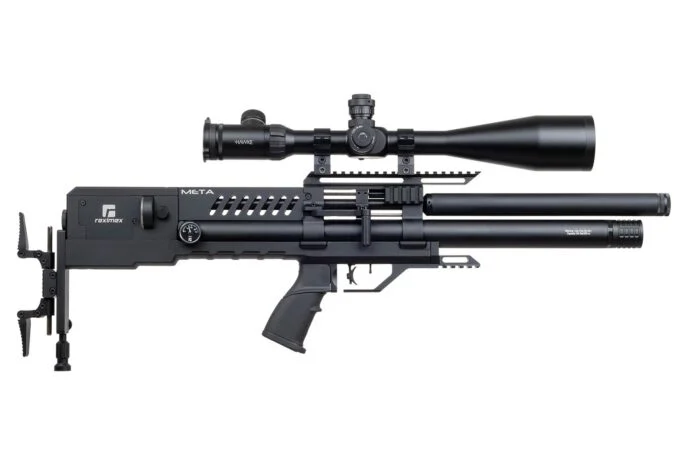
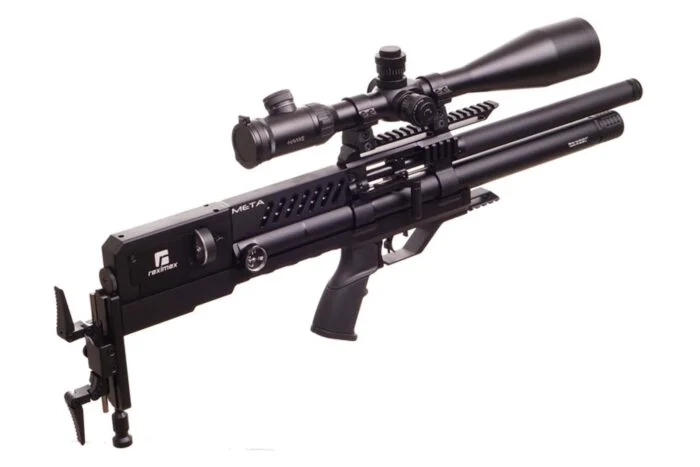
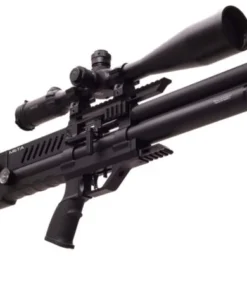
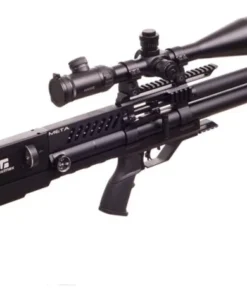
Precision, compact handling, and regulated consistency are delivered by the Reximex META Bullpup PCP Air Rifle for target work, pest control, and field use. A tactical aluminum chassis is combined with a side-lever action so that barrel length is preserved while overall size is reduced. Consequently, maneuverability in tight cover and on the range is improved without a sacrifice in accuracy.
Compact Bullpup Architecture and Adjustable Fit
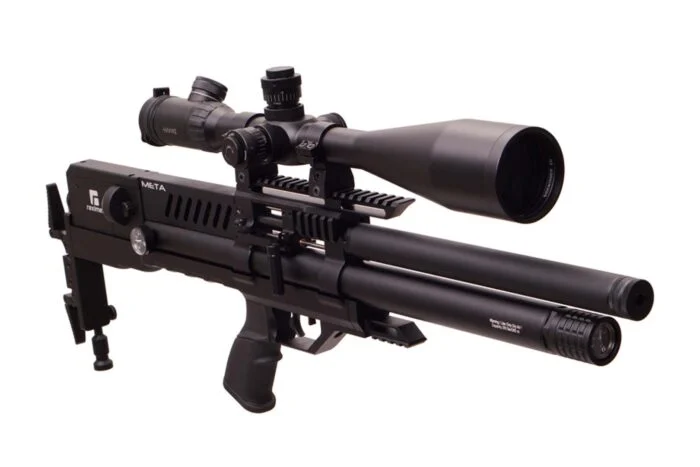
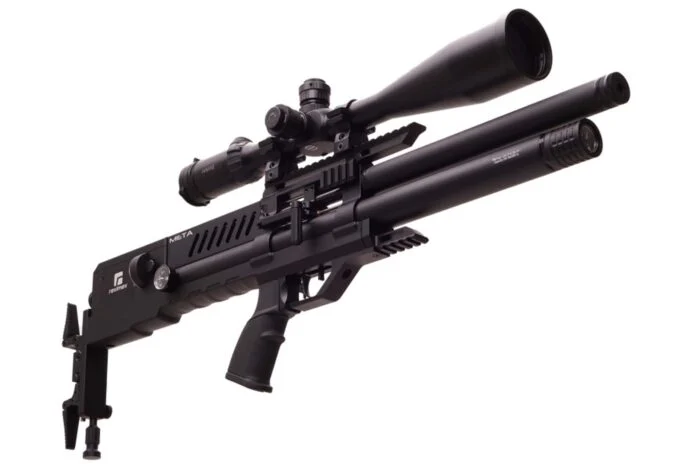
A high-quality anodized aluminum bullpup stock is employed so that mass is kept close to the shooter. As a result, balance is maintained during standing, kneeling, and supported positions. Furthermore, a 3-axis adjustable butt pad is fitted so that length of pull, height, and cant can be tailored. In addition, an integrated monopod is provided so that extra rear support can be applied when a stable hold is required.
An AR-style pistol grip with textured surfaces is used so that control is retained in wet or gloved conditions. Meanwhile, an overall length of approximately 750 mm (29.5 in) is achieved with a 480 mm (18.8 in) precision-rifled barrel. Therefore, a full-length tube is retained inside a compact envelope. Weight is held near 3.6 kg (7.9 lb) unscoped, so fatigue during longer sessions is reduced.
Ambidextrous Side-Lever Operation
A reversible cocking handle is included so that left- and right-handed users are equally served. Moreover, the side lever is positioned for a short, repeatable stroke. Subsequently, follow-up shots can be cycled with minimal disturbance to the sight picture. An index-style rotary magazine is seated in the receiver so that loading remains positive and the profile stays clean.
Regulated Power, Calibers, and Shot Economy
A factory regulator is installed so that downstream pressure remains consistent across the usable fill. Consequently, velocity variation is minimized and groups stay tighter as the cylinder is depleted. A 250-bar fill is accepted by an aluminum air tube of approximately 260–280 cc. In addition, an onboard pressure gauge is provided so that remaining air can be monitored at a glance. A quick-fill probe is supplied so that topping off is completed without tools.
Power can be tuned in two complementary ways. First, a transfer-port adjustment knob is offered so that muzzle energy can be raised or lowered for local limits, pellet choice, or distance. Second, an externally accessible hammer-spring screw is provided so that valve dwell can be refined. Therefore, both legal-limit and higher-output setups can be configured where regulations allow.
Caliber options are offered as follows:
- .177 (4.5 mm) — 14-shot magazine; FAC figures near 332 m/s (1000 fps) and about 25.4 J / 18.7 ft-lbs; roughly 125 efficient shots from 250–130 bar under stated test conditions
- .22 (5.5 mm) — 12-shot magazine; FAC figures near 269 m/s (880 fps) and about 42.2 J / 31.2 ft-lbs; roughly 85 efficient shots
- .25 (6.35 mm) — 10-shot magazine; FAC figures near 244 m/s (800 fps) and about 48.9 J / 36.1 ft-lbs; roughly 80 efficient shots
Velocity and energy figures are published from specified JSB pellet weights and will vary with projectile, temperature, altitude, and tune. Likewise, UK and other restricted markets are typically supplied at sub-12 ft-lbs, where shot count is increased by the lower energy setting. A single-shot tray is commonly included so that slugs or match pellets can be loaded individually when magazines are not preferred.
Quiet Barrel, Rails, and Trigger Control
An integrated SilentForce moderator is built into the shroud so that report is reduced at the muzzle. Furthermore, a 1/2″ UNF thread is retained under a cap so that an extra moderator or brake can be fitted where permitted. Precision rifling is used throughout the 480 mm barrel so that pellet stability and grouping potential are supported.
Mounting flexibility is addressed with an 11/22 mm Picatinny top rail for optics. Additionally, side rails and a lower Picatinny section are machined so that lights, lasers, bipods, or slings can be attached. As a result, the platform can be adapted for daylight target work or low-light pest sessions.
A 4-way adjustable metal trigger shoe is fitted so that reach, angle, and feel can be matched to the user. Moreover, a two-stage mechanism is employed so that a clean break can be obtained after setup. An ergonomic manual safety is placed for positive engagement. Therefore, the rifle can be made ready or made safe without breaking the firing grip.
Practical Use, Care, and Responsible Ownership
Field handling is favored by the short overall length, so movement through woodland, farm buildings, and range benches is simplified. Meanwhile, the regulated action supports consistent holds at typical airgun distances when quality pellets are selected and the zero is confirmed. Extended sessions are supported by dual magazines and efficient air use; a spare cylinder or compressor fill can be planned when high-volume practice is intended.
Maintenance remains straightforward. After each session, the exterior is wiped and the fill port is kept clean. Periodically, O-rings and the probe seal are inspected. Hammer-spring and transfer-port settings should be recorded so that a known tune can be restored. Legal power limits, local licensing (including FAC where required), safe storage, and backstop discipline must be observed by every owner. Inclusive, responsible use is expected from new and experienced shooters alike.
Highlighted Product Features
- Regulated PCP platform with side-lever cocking and reversible handle
- Calibers: .177 / .22 / .25 with 14 / 12 / 10-shot rotary magazines
- Power adjustment via transfer port plus external hammer-spring screw
- 250 bar fill, ~260–280 cc aluminum tube, onboard gauge, quick-fill probe
- 480 mm rifled barrel, integrated SilentForce moderator, 1/2″ UNF thread
- Aluminum bullpup stock, 3-axis butt pad, monopod, textured AR-style grip
- 11/22 mm top rail plus side and lower Picatinny sections
- 4-way adjustable trigger and manual safety
- Typical package: two magazines, single-shot tray, fill probe; hard case often included
- Approx. dimensions: 750 mm overall, 3.6 kg unscoped
Why the Reximex META Bullpup PCP Air Rifle Is Chosen
A compact tactical layout is paired with genuine adjustability so that one rifle can serve range days and field work. In addition, regulation and dual power controls are provided so that consistency and legal compliance can both be managed. Optics and accessories are readily mounted. Quiet operation is supported by the integrated moderator. Consequently, the Reximex META Bullpup PCP Air Rifle is positioned as a versatile, conversion-ready choice for shooters who want a short, tunable, multi-caliber PCP without giving up barrel length or shot-to-shot stability.
Calibres, FAC, Power and Accessories for the Reximex META Bullpup PCP Air Rifle
Three pellet calibres are offered on the Reximex META Bullpup PCP Air Rifle so that different ranges, quarry sizes, and legal limits can be matched. Moreover, factory power figures, FAC and non-FAC setups, and a wide accessory ecosystem are provided so that the same compact bullpup can be configured for club use, pest work, or higher-output field shooting where regulations permit.
Calibre Choices and Magazine Capacity
Availability is given in .177 (4.5 mm), .22 (5.5 mm), and .25 (6.35 mm). Consequently, a light, high-velocity option, a versatile mid-calibre, and a heavier-hitting platform can all be selected from one design family.
A 14-shot rotary magazine is supplied for .177. Likewise, a 12-shot magazine is supplied for .22, while a 10-shot magazine is supplied for .25. In addition, a single-shot tray is commonly included so that match pellets or slugs can be loaded individually when magazine feeding is not preferred. An index-style magazine well is machined into the receiver so that insertion remains positive and the bullpup profile stays compact.
Typical published FAC test data (JSB pellets of stated weights) are summarised as follows:
- .177 (4.5 mm): about 332 m/s (1000 fps); energy near 25.4 J / 18.7 ft-lbs; magazine 14; roughly 125 efficient shots from 250–130 bar
- .22 (5.5 mm): about 269 m/s (880 fps); energy near 42.2 J / 31.2 ft-lbs; magazine 12; roughly 85 efficient shots
- .25 (6.35 mm): about 244 m/s (800 fps); energy near 48.9 J / 36.1 ft-lbs; magazine 10; roughly 80 efficient shots
Velocity and energy are influenced by pellet weight and shape, temperature, altitude, fill pressure, and hammer-spring setting. Therefore, chrono confirmation after any tune is recommended. Meanwhile, lower power settings increase shot count and flatten legal-limit trajectories.
.177 is often favoured for paper, spinners, and HFT-style work because of its flatter path and high magazine capacity. Furthermore, .22 is widely chosen for general pest control and mid-range hunting because of a useful balance of energy and pellet mass. .25 is selected when extra momentum on larger quarry is required and local law allows the extra energy.
FAC, Legal Limits and Power Adjustment
Two complementary power controls are fitted. First, a transfer-port adjustment knob is provided so that air delivered to the pellet can be raised or lowered. Second, an external hammer-spring screw is offered so that valve opening can be refined. As a result, both legal-limit and FAC-level outputs can be approached on the same action, subject to local rules.
In the United Kingdom and similar restricted markets, sub-12 ft-lbs (approximately 16.3 J) configurations are typically supplied so that no FAC is required. Consequently, shot count rises and report is reduced. Elsewhere, FAC or equivalent licensing may be needed once muzzle energy exceeds the local unlicensed threshold. Owners must verify national and regional airgun law, age limits, storage rules, and transport requirements before any high-power setup is used.
A factory regulator is installed so that downstream pressure remains stable across the usable portion of the fill. Therefore, groups stay more consistent as the 250-bar, approximately 260–280 cc aluminium tube is depleted. An onboard gauge is provided so that remaining pressure can be read at a glance. A quick-fill probe is included so that topping off can be completed without extra tools.
Power should be set with a chronograph and a safe backstop. Thereafter, settings can be recorded so that a known tune can be restored after maintenance. Inclusive, responsible use is expected: new and experienced shooters alike are advised to stay inside legal energy limits and to treat every pellet as if it can cause injury.
Accessories, Rails and Practical Add-Ons
An 11/22 mm Picatinny top rail is milled so that scopes, red dots, and night-vision units can be mounted. Additionally, side Picatinny sections and a lower rail are provided so that lights, IR illuminators, lasers, bipods, or sling hardware can be attached without crowding the optic.
An integrated SilentForce moderator is built into the shroud so that muzzle report is reduced. Furthermore, a 1/2″ UNF thread is retained under a removable cap so that an extra moderator, brake, or thread protector can be fitted where permitted. A 3-axis adjustable butt pad and monopod are already on the stock so that length of pull, height, cant, and rear support can be tailored before extra furniture is added.
Common complementary items that are readily used with the Reximex META Bullpup PCP Air Rifle include:
- Quality match or hunting pellets matched to calibre and choke
- A second pair of rotary magazines for faster range sessions
- A compact PCP compressor or dive-bottle fill station rated for 250 bar
- A two-piece or one-piece Picatinny scope mount of appropriate height
- A lightweight bipod on the lower rail for prone or bench work
- A single-point or two-point sling using rail or stud adapters
- Spare fill-probe O-rings and a small seal kit
- A hard case (often supplied) plus extra foam for optic-fitted transport
- Eye and ear protection, a chrono, and a pellet trap or approved backstop
Optics should be chosen for the intended distance: a compact 3–12× or 4–16× airgun-rated scope suits most .22 and .25 pest work, while higher magnification can be used for .177 paper. Parallax that focuses down to typical airgun ranges is preferred. Night-vision or thermal add-ons can be mounted on the top or side rails when legal for the intended use.
Aftermarket grips in AR pattern can replace the factory pistol grip if a different angle is desired. Likewise, extra cheek-riser or pad kits can be considered if the 3-axis pad does not reach a preferred head position with a large optic.
Matching Calibre, Power and Accessories to the Task
Club and plinking sessions are well served by .177 at legal limit, two magazines, and a mid-range scope. Pest control around buildings is often better served by .22, a moderator, a compact optic, and a lower-rail light. Longer-range or larger-quarry work, where FAC is held, may be paired with .25, a confirmed high-power tune, a robust mount, and a stable bipod.
Air supply should be planned around the published shot counts: .177 at FAC settings may deliver around 125 efficient shots from 250–130 bar, while .22 and .25 deliver fewer. Lower power settings stretch that figure. A spare cylinder or a portable compressor keeps sessions from being cut short.
Every accessory addition changes balance and legal status. Therefore, overall length, weight, and energy should be rechecked after the rifle is fully dressed. Safe handling, inclusive range etiquette, and compliance with local airgun law remain the foundation of every setup built around the Reximex META Bullpup PCP Air Rifle.
Weihrauch Air Rifles, PCP Platforms, Spring-Piston Systems, and Related Airgun Terminology
Enthusiasts researching premium German airgun engineering frequently encounter models and search terms such as Weihrauch HW100X Karbine, Thumbhole PCP Air Rifle, hw35, h 45, german air rifle, accurate air rifles, hw97k, hw 70, hw35e for sale, hw40, weihrauch hw30, weihrauch hw80, weihrauch hw 95, hw100, hw 97k, hw35 air rifle, hw50 s, weihrauch hw45, weihrauch english, weihrauch hw98, weihrauch englisch, hw77 air rifle, weihrauch hw50s, compressed air rifles, air rifle makes, spring piston, what are air rifles, weihrauch hw44, air shot gun, sk x rifles, weihrauch hw50, hw30s, hw 30, what are air pistols, hw50, and rifles de aire.
Within the Weihrauch lineup, the Weihrauch HW77 air rifle is widely recognized as a traditional fixed-barrel underlever platform. Related terminology includes HW77 Green Laminate rifle, Weihrauch underlever air rifle, HW77 spring piston air rifle, Weihrauch HW77 for sale, and German precision air rifle. Researchers comparing versions may also encounter phrases such as buy Weihrauch HW77 Green Laminate online, Weihrauch HW77 Green Laminate price and specs, Weihrauch HW77 accuracy review, HW77 Green Laminate vs HW97 comparison, is Weihrauch HW77 good for beginners, precision shooting airgun, high quality German airguns, best price Weihrauch HW77, where to buy Weihrauch HW77, Weihrauch HW77 in stock, affordable premium air rifle, and top rated underlever air rifle.
Technical comparison searches commonly include Weihrauch HW77 vs HW97, HW77 vs break barrel air rifle, best Weihrauch air rifles, most accurate air rifle for target shooting, air rifle with low recoil, durable air rifle for outdoor use, and reliable air rifle for long term use. These phrases generally reflect interest in operating systems, mechanical durability, handling characteristics, consistency, and the differences between fixed-barrel underlever designs, break-barrel rifles, and PCP platforms.
Other Weihrauch-related terminology includes air pistols, hw100 airgun, weihrauch hw95, weihrauch hw 30, weihrauch hw90, hw 44, hw 40, hw 98, and weihrauch hw100. The HW100 family represents the PCP side of Weihrauch’s catalog, while models such as the HW30, HW50, HW80, HW90, HW95, HW97, and HW98 are associated with spring-powered or gas-ram-style sporting airgun platforms depending on the specific model and configuration. By contrast, the HW44 is commonly discussed as a PCP air pistol.
The broader airgun market also includes search terminology connected with alternative PCP manufacturers and modern platforms. Examples include 25 karma, pcp bb gun, karma eq air rifle, karma red panda, panda guns, full auto pcp, karma sls compact, air karma, red panda hat, eq air, karma sls, eq magazine, air pcp, and karma airguns. These terms may refer to specific products, product families, accessories, community terminology, or unrelated search phrases that appear alongside airgun research.
Reximex is another name frequently encountered in PCP discussions. Related search phrases include reximex airguns, reximex rp, reximex throne gen 2, reximex mito, reximex rpa, sbs12, reximex mitos, reximex lieva, reximex accura pcp air rifle, and reximex throne gen2. Model naming can vary slightly between retailers, regions, and search listings, which explains variations such as “Throne Gen 2” and “Throne Gen2” or “Mito” and “Mitos.”
Airgun research also involves understanding velocity and energy. Searches such as fps to joules calculator, fps to ft lbs, and airgun calculator relate to converting projectile velocity and mass into kinetic-energy measurements. These calculations are commonly used for technical comparison, range evaluation, regulatory research, and understanding how different compressed-air or spring-powered platforms perform within their intended specifications.
More general discovery terms can include gunseek and yivli av tüfeği, alongside broader international phrases such as rifles de aire. Because airgun terminology varies considerably between English, German, Spanish, and Turkish-speaking markets, researchers may encounter several different naming conventions for comparable sporting, target, and recreational airgun platforms.
Taken together, terms ranging from Weihrauch HW100X Karbine and Thumbhole PCP Air Rifle to HW77 Green Laminate rifle, spring piston, compressed air rifles, karma airguns, and reximex airguns illustrate the diversity of modern airgun technology. Weihrauch remains particularly associated with German engineering, fixed-barrel underlever rifles, traditional spring-powered designs, precision PCP systems, and air pistols, while Karma and Reximex represent additional names encountered when comparing contemporary PCP platforms and associated airgun technology.
Practical Use in Everyday Shooting
Compact regulated bullpup layout is employed so that a full-length barrel can be carried in tight cover, on farm tracks, and on crowded club benches. Consequently, movement between firing points is simplified while pellet stability at typical airgun distances is retained. Inclusive use is intended: new shooters and experienced field users can apply the same platform once legal limits, safe backstops, and local rules have been confirmed.
A short overall length is favoured when gates, hedges, and vehicle interiors must be negotiated. Meanwhile, mass concentrated near the grip reduces muzzle swing during standing shots. Therefore, first-round hits on small reactive targets become more repeatable after a careful zero is established.
Establishing Zero and Confirming Tune
A chronograph and a known pellet are used before any field session. Thereafter, velocity is recorded at the chosen transfer-port and hammer-spring settings so that a legal-limit or higher-output tune can be repeated. Groups are then fired at 20, 30, and 40 metres from a rested position so that the optic’s elevation and windage can be locked.
Parallax is adjusted to the most common working distance. Moreover, a second confirmation group is fired after the rifle has been carried, slung, and placed on a vehicle seat, because mounts can shift during transport. A notebook or phone log is kept so that pellet batch, fill pressure, and click values are not forgotten.
Supported confirmation is completed with the rear monopod deployed on a bag or firm ground. As a result, vertical stringing from inconsistent shoulder pressure is reduced. Standing confirmation is added last so that field holds are not based only on bench data.
Club Range and Skill Building
Lane work is organised around short strings rather than endless magazines. Two rotary magazines are loaded in advance so that the firing point is not left to refill. A single-shot tray is reserved for slug or match-pellet tests when magazine feed is not required.
Reactive targets and paper are mixed. Consequently, hold-over practice and group measurement are both completed in one visit. Wind flags or natural indicators at 25–40 metres are observed so that .177 and .22 trajectories can be learned in real air rather than only on a chart.
Fatigue is managed by alternating standing, kneeling, and seated positions. Furthermore, the adjustable butt pad is reset between positions so that head alignment on the optic remains consistent. Inclusive range etiquette is observed: muzzles stay pointed at the backstop, and the manual safety is applied whenever the rifle is grounded or passed.
Pest Control Around Buildings and Yards
Short overall length is exploited in barns, polytunnels, and yard corners where a conventional rifle would snag. Quiet report from the integrated moderator is relied upon so that remaining quarry is less likely to bolt after the first shot. Legal energy and local permissions are verified before any shot is taken near livestock, neighbours, or public paths.
.22 is frequently selected for rats, feral pigeon, and similar mid-sized pests because pellet mass and energy remain useful inside typical farm distances. A compact optic with close-focus parallax is preferred so that a 15–30 metre hold can be taken quickly. A lower-rail light is fitted only where illumination is legal and does not silhouette the shooter against buildings.
Movement is planned so that a solid rest—gate post, feed bin, or deployed monopod—is available before the shot. Therefore, rushed unsupported shots are avoided. Two magazines and a modest pellet tin are carried in a small pouch so that a complete circuit of outbuildings can be finished without a return to the vehicle.
After the session, the fill port is wiped and the rifle is cased before it is placed in a locked store. Spent pellets and empty magazines are accounted for so that nothing is left in livestock areas.
Field Edges, Woodland Edges and Longer Holds
Hedgerow and woodland-edge work is conducted from kneeling or sitting whenever possible. The bullpup balance is used so that the muzzle stays on the lane while the shooter settles. A two-point or single-point sling is attached to a rail adapter so that the rifle can be carried muzzle-down or across the chest during walks between likely spots.
.25 is considered when larger quarry and greater pellet momentum are required and licensing allows the extra energy. Hold-over is confirmed on a safe bank or approved target at the expected distance before live quarry is addressed. Wind at the target, not only at the shooter, is read because heavier pellets still drift at 35–50 metres.
A bipod on the lower rail is deployed on firm ground for longer waits. Meanwhile, the monopod is used when only a rear rest is available. Vegetation is cleared from the barrel and moderator so that a first-shot flyer is not caused by a blade of grass in the crown.
Heat shimmer and rain are treated as reasons to shorten the maximum engagement distance. Consequently, ethical hits are favoured over optimistic range stretching. Inclusive field conduct includes informing landowners of the session times and recovering every pellet wad or discarded target where practical.
Supported Positions and the Monopod
Prone use is supported by the lower rail and a compact bipod. Recoil is modest, yet a consistent cheek weld is still required because the bullpup’s high bore line can magnify small head movement. The 3-axis pad is raised or lowered so that the optic sits without neck strain.
Kneeling is stabilised by dropping the monopod onto the rear heel or a small bag. As a result, the rear of the action is locked without a full sitting position. Standing shots remain the last choice and are limited to closer, larger targets unless a tree or post can be used as a hasty rest.
Trigger reach is checked in each position because glove thickness and coat bulk change finger placement. The four-way shoe is left at a known setting once a clean break has been found. Safety is applied between strings even when the magazine is still indexed.
Low Light and Restricted Visibility
Side rails accept a lamp or IR unit when night work is lawful. Beam direction is set so that the shooter is not illuminated from the front. A simple red-dot or a low-power variable optic is often clearer than high magnification when ambient light is poor.
Fill pressure is checked before last light because a gauge is harder to read later. Magazines are loaded in advance with a headlamp pointed at the ground, not at the skyline. Movement between stands is slow so that footing and muzzle control are maintained.
After dark, every shot is taken only when the target is positively identified and the backstop is known. Inclusive practice means a second person can act as spotter when local rules and landowner permission allow.
Weather, Transport and Session Logistics
Rain is managed by wiping the action and keeping the fill probe capped. Textured grip surfaces remain usable with light gloves. Optics are fitted with flip covers so that a sudden shower does not end the session.
Vehicle transport is completed with the rifle unloaded, safety on, and cased. A hard case with cut foam protects the optic and the aluminium chassis on rough tracks. At the destination, a quick visual check of rail screws and butt-pad clamps is performed before the first magazine is inserted.
Air planning is based on the chosen calibre and power setting. A legal-limit tune yields more shots per fill than a high-output tune. A spare cylinder or a scheduled compressor stop is arranged when a long day is expected. Two magazines plus a tin of a single proven pellet batch prevent mixed-ammo errors.
Calibre-Led Session Examples
A morning of paper and spinners is built around .177, a mid-range variable scope, and frequent chrono checks. Distances are kept inside the distance at which groups remain ethically small. Wind doping is practised in short strings so that learning is retained.
An afternoon of yard pest work is built around .22, a moderator, a compact optic, and a lamp reserved for legal hours. Routes are walked first without the rifle so that angles and backstops are known. Only then is the magazine inserted.
A licensed high-power outing is built around .25, a confirmed tune, a robust mount, and a bipod. Distances are limited to those at which pellet placement on vital areas can be guaranteed. Recovery and reporting follow landowner agreements.
Safety, Law and After-Action Care
Local energy limits, age restrictions, and storage laws are treated as part of the shot process, not as an afterthought. FAC or equivalent documents are carried when the tune exceeds the unlicensed threshold. Public paths, roads, and neighbouring dwellings are treated as no-shot zones unless a safe backstop is beyond doubt.
After every outing the exterior is dried, the probe seal is inspected, and the rifle is stored unloaded in a locked cabinet. Settings for transfer port and hammer spring are written down. Inclusive sharing of the rifle with other authorised users includes a briefing on the current zero, the current power setting, and the magazine capacity of the calibre in use.
Practical success is measured by consistent, legal, recoverable shots rather than by maximum distance. When the compact bullpup, the regulator, and a disciplined rest are used together, the same platform can serve the club lane at mid-morning and the farm edge at dusk—provided the pellet, the tune, and the backstop have all been chosen with care.



Reviews
There are no reviews yet.