Reximex Meta Plus
Regulated tactical bullpup PCP air rifle is presented as a compact, customizable platform for target work, pest control, and field use. Consistent velocity, high air capacity, and extensive adjustability are combined in a short overall package so that precision can be pursued by left- and right-handed shooters alike.
Compact Bullpup Architecture for Controlled Handling
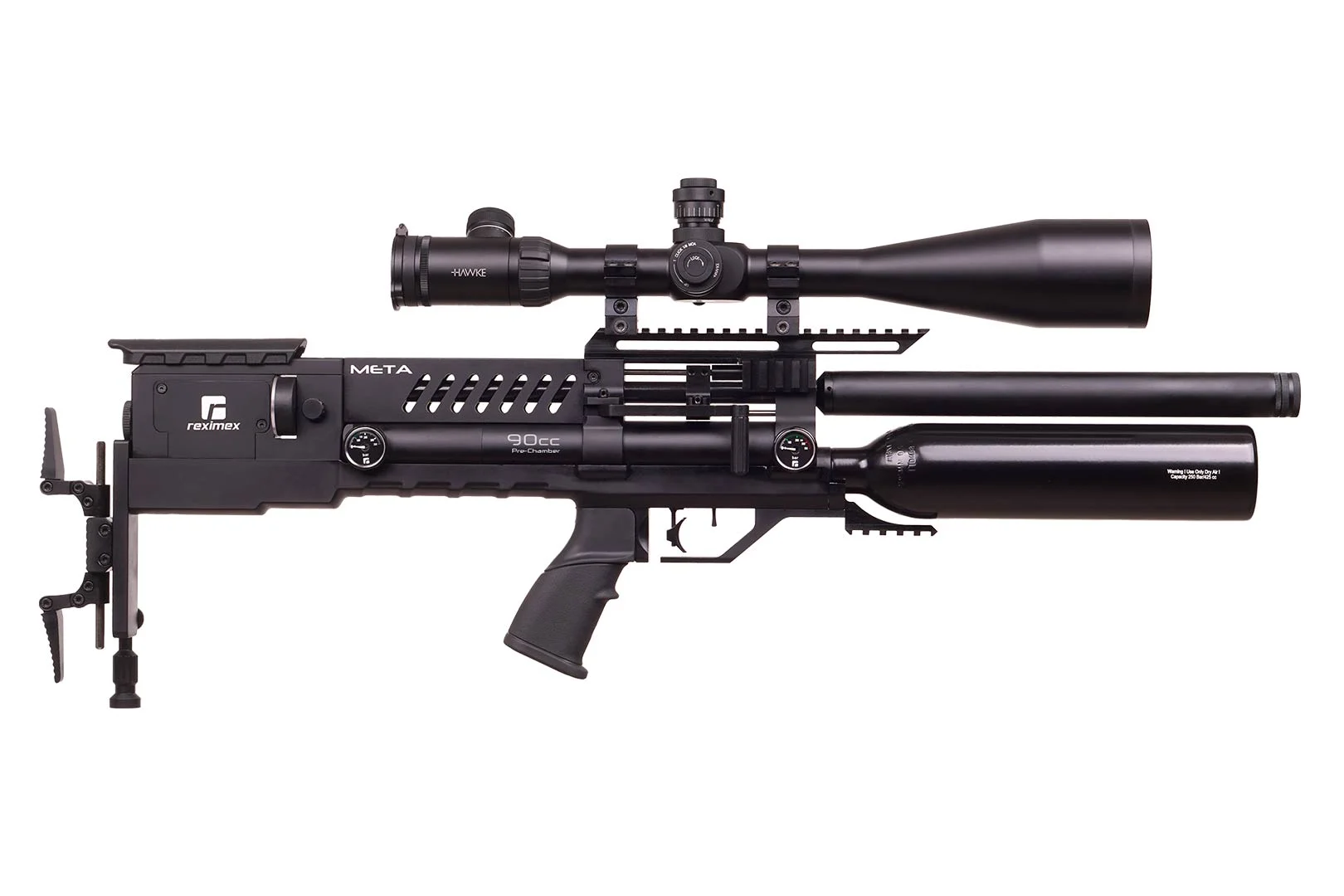
A tactical bullpup layout is employed so that a 480 mm precision-rifled barrel can be retained inside an overall length of only 780 mm. Balance is improved by this arrangement, and fatigue during longer sessions is reduced because weight is kept close to the shooter. An aluminum-and-synthetic chassis is used, and an AR-15-style grip is fitted so that a familiar hold can be adopted by a wide range of users.
Ambidextrous operation is supported throughout. A reversible side-lever cocking handle is provided, and the magazine is inserted from the left side after the cover is secured. Consequently, the same rifle can be configured without tools for either-handed use.
Fit That Can Be Tailored on the Spot
Shoulder contact is refined by a 3-axis adjustable butt pad. Height, cant, and micro-position of the pad arms can be set with Allen screws so that a repeatable cheek weld and sight picture are obtained. An integrated monopod is included at the rear; additional stability can therefore be gained when the rifle is rested on a bag, bench, or irregular ground.
Air System, Regulator, and Power Control
A 425 cc buddy bottle is paired with a 90 cc pre-chamber, giving a combined 515 cc air volume. Fill pressure of 250 bar is specified. Because a factory regulator is fitted, shot-to-shot consistency is maintained across a long usable pressure band. Reservoir and regulator pressures can be monitored on dedicated gauges.
External hammer-spring adjustment is offered via a large rear dial. In addition, a power-adjuster knob located ahead of the magazine port allows muzzle energy to be reduced for garden or club use or raised (where local law permits) for hunting and FAC applications. Shot counts of approximately 225 (.177), 155 (.22), and 160 (.25) at optimal velocity are typically recorded between 250 and 110 bar, depending on pellet and setting.
Quiet Barrel and Accessory Threads
The barrel is fully shrouded and an integrated sound moderator is built in, so report is already modest. A ½” UNF thread is concealed under a removable muzzle cap; an extra moderator or compensator can therefore be added when still greater quietness is required.
Features Highlighted for Everyday Use
- Regulated PCP action is supplied so that velocity remains even from the first shot to the last usable fill.
- 515 cc total air capacity (425 cc bottle + 90 cc pre-chamber) is provided for extended sessions between fills.
- Reversible side-lever is fitted for fully ambidextrous cocking.
- 3-axis adjustable butt pad with monopod is included so that fit and rest stability can be refined.
- 4-way adjustable trigger and manual safety are installed for a personalized break and positive safe/fire control.
- 22 mm Picatinny rail on top, plus side and lower rails, is present so that optics, IR illuminators, lasers, and bipods can be mounted.
- Index magazine is recessed into the receiver; capacities of 14 (.177), 12 (.22), and 10 (.25) rounds are offered, and a single-shot tray is commonly supplied.
- Externally adjustable hammer spring and power knob allow fine-tuning of energy and shot count.
- AR-15 grip and tactical synthetic/aluminum stock deliver a familiar, weather-resistant hold.
- Hard case, fill probe, spare magazine, and tools are typically packed so that the rifle can be transported and maintained immediately.
Calibers, Legal Power, and Practical Roles
The Reximex Meta Plus is offered in .177, .22, and .25. Sub-12 ft·lbs UK-legal versions are available where no FAC is held; higher-output FAC configurations deliver published energies in the region of 18.7 / 31.2 / 36.1 ft·lbs respectively when suitable pellets are used. Velocity figures of up to 1000 fps (.177), 880 fps (.22), and 800 fps (.25) are quoted under test conditions; actual results vary with pellet weight, temperature, and elevation.
Because power can be dialed down, the same platform can be used for quiet backyard practice and then restored for field work. Compact length makes movement through cover easier, while the monopod and rails support both supported-target and hunting positions. Groups in the 6 mm class at 30 m have been reported with well-matched .177 pellets once the rifle is zeroed and the regulator is on song.
Optics and Accessory Freedom
A full-length 22 mm Picatinny (MIL-STD-1913) rail accepts conventional scopes, compact red dots, or night-vision units. Side rails are ideally placed for an IR torch or laser; the lower rail accepts a bipod or sling stud. Consequently, the rifle can be built into a daylight target rig or a low-light pest-control setup without aftermarket chassis work.
Why the Reximex Meta Plus Is Chosen
Value is delivered by combining a large regulated air supply, genuine adjustability, and a quiet shrouded barrel in a price band well below many European flagship bullpups. Inclusive design—reversible lever, multi-axis pad, AR grip, and four-way trigger—means the rifle can be shared or handed on without compromise. Responsible ownership is supported by a positive manual safety and by the ability to drop power when surroundings demand it.
A complete package is usually received: rifle, magazines, single-shot tray, fill probe, Allen keys, and a protective hard case. After local laws and fill-equipment compatibility have been checked, the Reximex Meta Plus can be brought into service quickly. Precision, shot count, and comfort are therefore placed within reach of target shooters, pest controllers, and hunters who prefer a short, highly adjustable regulated bullpup.
Weihrauch Air Rifles, PCP Platforms, Spring-Piston Systems, and Related Airgun Terminology
Enthusiasts researching premium German airgun engineering frequently encounter models and search terms such as Weihrauch HW100X Karbine, Thumbhole PCP Air Rifle, hw35, h 45, german air rifle, accurate air rifles, hw97k, hw 70, hw35e for sale, hw40, weihrauch hw30, weihrauch hw80, weihrauch hw 95, hw100, hw 97k, hw35 air rifle, hw50 s, weihrauch hw45, weihrauch english, weihrauch hw98, weihrauch englisch, hw77 air rifle, weihrauch hw50s, compressed air rifles, air rifle makes, spring piston, what are air rifles, weihrauch hw44, air shot gun, sk x rifles, weihrauch hw50, hw30s, hw 30, what are air pistols, hw50, and rifles de aire.
Within the Weihrauch lineup, the Weihrauch HW77 air rifle is widely recognized as a traditional fixed-barrel underlever platform. Related terminology includes HW77 Green Laminate rifle, Weihrauch underlever air rifle, HW77 spring piston air rifle, Weihrauch HW77 for sale, and German precision air rifle. Researchers comparing versions may also encounter phrases such as buy Weihrauch HW77 Green Laminate online, Weihrauch HW77 Green Laminate price and specs, Weihrauch HW77 accuracy review, HW77 Green Laminate vs HW97 comparison, is Weihrauch HW77 good for beginners, precision shooting airgun, high quality German airguns, best price Weihrauch HW77, where to buy Weihrauch HW77, Weihrauch HW77 in stock, affordable premium air rifle, and top rated underlever air rifle.
Technical comparison searches commonly include Weihrauch HW77 vs HW97, HW77 vs break barrel air rifle, best Weihrauch air rifles, most accurate air rifle for target shooting, air rifle with low recoil, durable air rifle for outdoor use, and reliable air rifle for long term use. These phrases generally reflect interest in operating systems, mechanical durability, handling characteristics, consistency, and the differences between fixed-barrel underlever designs, break-barrel rifles, and PCP platforms.
Other Weihrauch-related terminology includes air pistols, hw100 airgun, weihrauch hw95, weihrauch hw 30, weihrauch hw90, hw 44, hw 40, hw 98, and weihrauch hw100. The HW100 family represents the PCP side of Weihrauch’s catalog, while models such as the HW30, HW50, HW80, HW90, HW95, HW97, and HW98 are associated with spring-powered or gas-ram-style sporting airgun platforms depending on the specific model and configuration. By contrast, the HW44 is commonly discussed as a PCP air pistol.
The broader airgun market also includes search terminology connected with alternative PCP manufacturers and modern platforms. Examples include 25 karma, pcp bb gun, karma eq air rifle, karma red panda, panda guns, full auto pcp, karma sls compact, air karma, red panda hat, eq air, karma sls, eq magazine, air pcp, and karma airguns. These terms may refer to specific products, product families, accessories, community terminology, or unrelated search phrases that appear alongside airgun research.
Reximex is another name frequently encountered in PCP discussions. Related search phrases include reximex airguns, reximex rp, reximex throne gen 2, reximex mito, reximex rpa, sbs12, reximex mitos, reximex lieva, reximex accura pcp air rifle, and reximex throne gen2. Model naming can vary slightly between retailers, regions, and search listings, which explains variations such as “Throne Gen 2” and “Throne Gen2” or “Mito” and “Mitos.”
Airgun research also involves understanding velocity and energy. Searches such as fps to joules calculator, fps to ft lbs, and airgun calculator relate to converting projectile velocity and mass into kinetic-energy measurements. These calculations are commonly used for technical comparison, range evaluation, regulatory research, and understanding how different compressed-air or spring-powered platforms perform within their intended specifications.
More general discovery terms can include gunseek and yivli av tüfeği, alongside broader international phrases such as rifles de aire. Because airgun terminology varies considerably between English, German, Spanish, and Turkish-speaking markets, researchers may encounter several different naming conventions for comparable sporting, target, and recreational airgun platforms.
Taken together, terms ranging from Weihrauch HW100X Karbine and Thumbhole PCP Air Rifle to HW77 Green Laminate rifle, spring piston, compressed air rifles, karma airguns, and reximex airguns illustrate the diversity of modern airgun technology. Weihrauch remains particularly associated with German engineering, fixed-barrel underlever rifles, traditional spring-powered designs, precision PCP systems, and air pistols, while Karma and Reximex represent additional names encountered when comparing contemporary PCP platforms and associated airgun technology.
Calibres, FAC Status, Power Options, and Accessories for the Reximex Meta Plus
A complete understanding of the Reximex Meta Plus is obtained when calibre choice, legal power classification, energy adjustment, and accessory mounting are examined together. Performance, legality, and long-term usefulness are all shaped by these four areas, and each is addressed so that a suitable configuration can be selected by every shooter.
Available Calibres and Typical Applications
Three factory calibres are offered so that different roles can be served by the same platform. A .177 (4.5 mm) barrel is supplied when maximum velocity, flat trajectory, and high magazine capacity are required. Target work, HFT-style practice, and longer-range pest control on small quarry are therefore supported. A 14-shot rotary magazine is used in this calibre, and approximately 225 consistent shots can be obtained from a 250-bar fill when the regulator remains on song.
A .22 (5.5 mm) barrel is fitted when a balance of energy, pellet mass, and shot count is preferred. Hunting and general field use are commonly assigned to this calibre. A 12-shot magazine is provided, and roughly 155 usable shots are recorded under similar fill conditions. Greater downrange energy is delivered than in .177, while trajectory remains practical for most outdoor distances.
A .25 (6.35 mm) barrel is chosen when heavier pellets and higher impact energy are needed. Larger pests and closer-range hunting are typically addressed. A 10-shot magazine is employed, and about 160 shots at optimal velocity are quoted. Because pellet drop increases, ranging discipline is required; in return, terminal performance is improved.
Pellet selection remains critical in every calibre. Match-grade domed or hollow-point pellets of appropriate weight are recommended so that the rifled 480 mm barrel can produce tight groups. After a short barrel-cleaning period, consistency is usually established and the regulator can be relied upon.
FAC Requirements and Legal Power Bands
Legal classification depends on the country and the energy setting that leaves the factory. In the United Kingdom a sub-12 ft·lbs version is available so that no Firearms Certificate is required. Power is limited by the transfer-port and hammer-spring settings; a typical UK-legal output of 10.8–11.8 ft·lbs is recorded. Consequently the rifle can be owned and used on private land without FAC paperwork, provided local by-laws and safe-use rules are observed.
Where higher energy is permitted, FAC or equivalent licensing is required. Published FAC figures reach approximately 18.7 ft·lbs in .177, 31.2 ft·lbs in .22, and 36.1 ft·lbs in .25 when suitable pellets are used. Velocity claims of up to 1000 fps, 880 fps, and 800 fps respectively are listed under test conditions; actual results vary with pellet weight, temperature, and elevation. Import and retail versions in some markets are further restricted (for example to 3 J) so that licence-free sale can occur; those units can later be returned to higher output only where law allows and a qualified technician is used.
Because an external power-adjuster knob and a rear hammer-spring dial are fitted, energy can be reduced even on an FAC rifle. Garden or club sessions can therefore be conducted at lower power, air consumption can be stretched, and report can be quietened without a permanent mechanical change. After the session the original setting can be restored. Inclusive use is supported: the same rifle can be shared among family members or club colleagues whose legal status or preferred power level differs.
Power Adjustment, Regulator, and Shot Economy
A factory regulator is installed so that muzzle velocity remains even from the first shot until reservoir pressure falls near the regulator set-point. Two gauges are provided: one for bottle pressure and one for regulator pressure. Fill pressure of 250 bar is specified; most users refill when the bottle gauge approaches 110–130 bar so that the regulator does not drop off.
The power knob, located ahead of the magazine port, and the large rear hammer-spring wheel allow fine control. Lower settings increase shot count and reduce report; higher settings (where legal) raise energy for hunting. Combined air volume of 515 cc (425 cc bottle plus 90 cc pre-chamber) supplies the long shot strings already noted. Air efficiency is therefore high for a compact bullpup, and fewer fills are needed during a day’s shooting.
Accessory Rails, Optics, and Supporting Equipment
Mounting flexibility is built in so that the rifle can be adapted without chassis replacement. A 22 mm Picatinny rail runs along the top of the receiver and accepts conventional scopes, compact red-dots, or night-vision units. Side Picatinny rails are present on both sides of the forend; an IR illuminator, laser, or compact torch can therefore be aligned with a night-vision optic. A lower Picatinny rail accepts a bipod, sling swivel, or monopod accessory. Because the factory rear monopod is already integrated into the butt pad, additional rest options are obtained without extra bulk.
The muzzle is ½” UNF threaded beneath a removable cap. An aftermarket moderator or muzzle brake can be added when still greater sound reduction or recoil management is desired. The integrated shroud and moderator already keep report modest; the thread simply extends that capability.
Standard supply typically includes two rotary magazines, a single-shot tray, a fill probe, Allen keys, spare O-rings, and a hard transport case. A sling, bipod, and quality optic are the most common first additions. Because the grip is AR-15 pattern, aftermarket grips can be swapped if a different angle or texture is preferred. All adjustments—butt pad, trigger, hammer spring, and power—are performed with the supplied tools, so workshop visits are rarely required for setup.
Practical Use Across Everyday Distances and Roles
Supported practice, field work, and shared sessions are all accommodated by a short regulated bullpup whose air supply, adjustability, and rail layout have been arranged for real-world conditions. Because overall length remains modest, movement through doorways, vehicles, and undergrowth is simplified. At the same time a long barrel and large combined reservoir are retained, so consistency and shot count are not sacrificed. Inclusive handling is maintained throughout: left- and right-handed users can be served after the cocking lever is reversed and the butt pad is set.
Quiet Back-Garden and Club Practice
A reduced power setting is selected first so that report stays neighbour-friendly and pellet energy remains appropriate for short ranges. After the reservoir is filled to the recommended pressure, the regulator gauge is checked and the hammer-spring wheel is turned until a comfortable, repeatable break is obtained. Magazines are loaded on the bench; thereafter they are inserted from the left and seated against the moulded guide. A compact optic or red-dot is already zeroed at 20–30 metres, and a simple rest or the integrated rear monopod is used so that group size can be observed without fatigue.
Sessions of several dozen shots can be completed before a refill is required. When groups open, the barrel is given a light clean and a different pellet weight is tried until a preferred combination is confirmed. Because power can be lowered further, tin-can or spinner practice can continue even when space is limited. After the session the safety is applied, residual pressure is noted, and the rifle is returned to its hard case so that dust and moisture are kept away from the gauges and rails.
Club evenings follow a similar rhythm. A bench or bag rest is used, distances are stepped out to 40–50 metres, and knock-down targets are engaged once zero is verified. The four-way trigger is refined so that a light second stage can be felt by every member who will fire the rifle that evening. Consequently, newcomers and experienced shooters can share the same platform without a lengthy re-zero each time the stock is adjusted.
Pest Control in Gardens, Allotments, and Farm Edges
When small pests must be managed, a mid-range power setting is chosen and a heavier, accurate pellet is selected. Approaches are made from cover; the compact length allows the rifle to be carried muzzle-down or across the chest without snagging. Once a safe backstop is confirmed, the monopod or a fence rail is used to steady the shot. Side rails already carry a compact illuminator if dusk work is anticipated, so the same optic can be used from late afternoon into early evening.
Follow-up shots are available from the rotary magazine without a change of position. After a successful engagement the area is checked, the safety is reapplied, and the rifle is slung or cased for the walk back. Because shot count remains high, several locations can be visited on one fill. When legal limits require sub-threshold energy, the power knob is simply turned down before the outing; no parts are exchanged and the same zero can often be retained at typical pest distances.
Mixed terrain is handled by the adjustable pad. Height and cant are set so that a standing or kneeling position still produces a consistent cheek weld. Rain or damp grass is less of a concern because the synthetic and anodised surfaces shed water; after the outing the fill port and gauges are wiped and the case is left slightly ajar until condensation has gone.
Ethical Hunting at Moderate Ranges
Where licensing and local rules permit higher energy, the hammer spring and transfer setting are raised and a calibre matched to the quarry is used. Stalking is aided by the short overall package; hides and vehicle windows can be used without the muzzle protruding excessively. A quality scope on the top rail is zeroed at the expected engagement distance, and a bipod on the lower rail is deployed when a prone or seated shot is taken.
Ranging is practised beforehand because pellet drop increases with heavier projectiles. Once the shot is taken, the magazine supplies immediate follow-ups if a second pellet is required. After the retrieve, the rifle is made safe and pressure is logged so that the next outing starts with a known fill. Because the regulator holds velocity until the bottle approaches the set-point, the last shots of a long sit remain predictable.
Transport between permissions is simplified by the supplied hard case. Foam inserts keep the optic aligned and the bottle protected. Upon arrival the pad is re-checked, the lever direction is confirmed for the day’s shooter, and a couple of fouling shots are fired into a safe bank before live quarry is sought.
Low-Light and Accessory-Supported Sessions
Night or dusk work is prepared in daylight. An illuminator or laser is aligned on a side rail so that the beam coincides with the point of impact at the chosen range. A night-vision or thermal unit can be mounted on the main Picatinny rail when regulations allow. The integrated moderator already reduces muzzle flash and report; an additional threaded moderator can be fitted if still greater discretion is needed.
Because the rifle remains compact, it can be carried in a vehicle or on a short walk without drawing attention. Batteries and extra magazines are kept in the case lid. After dark the monopod or a fence post again supplies a stable rest. Shots are taken only when a clear backstop and positive identification are certain. At the end of the session lights are switched off, the safety is applied, and the rifle is cased before the return journey.
Shared Use Among Different Shooters
Inclusive design is put into practice when more than one person will fire the same rifle. The cocking lever is swapped to the opposite side in minutes. Pad height and angle are reset with the supplied keys so that a shorter or taller shooter obtains a full sight picture. Trigger weight and travel are altered through the four-way adjustment until a comfortable break is felt by each user. An aftermarket grip can be fitted if a different angle is preferred; the original AR-pattern grip is retained for those who already know that shape.
A log of settings—pad marks, hammer-wheel position, power-knob index, and preferred pellet—is kept in the case. Consequently the rifle can be returned to a known state after each change. Club members, family, and visiting friends can therefore be accommodated without a permanent compromise to any one person’s fit.
Travel, Storage, and Between-Session Care
Before a journey the bottle pressure is noted and, if a long period of storage is expected, a partial fill is often preferred to a full 250-bar charge. The hard case is closed on dry foam; silica gel can be added in humid climates. Upon arrival the gauges are inspected, the fill probe is connected only with clean, dry air, and a few shots are fired to confirm regulator behaviour before serious use.
Routine care is light. The barrel is cleaned when groups open or after a dusty day. O-rings at the fill port are checked and lightly greased if dryness is seen. Rails are kept free of grit so that optics and bipods remain secure. Because most adjustments are external, workshop time is rarely needed for ordinary shooting.
Weather changes are met by the same habits. In cold conditions a slightly higher fill may be used so that the regulator stays above its drop-off point for the whole session. In heat, extra care is taken not to leave a full bottle in direct sun. After rain the case is opened and the rifle is allowed to air before being put away.
A Typical Day Combined
A single outing can move from garden zero-check to a permission and back again. Morning practice is conducted at reduced power; the same rifle is then turned up, magazines are swapped for the field calibre if required, and the optic is confirmed at the hunting zero. After the afternoon sit the power is lowered once more for a short evening pest round near buildings. One fill, one case, and one set of tools cover the entire day. Fatigue is limited by the balanced bullpup layout and the rear rest. Safety remains a constant: the manual catch is used whenever the rifle is carried or set down, and a backstop is verified before every shot.
In this way supported precision, ethical field use, low-light work, and shared enjoyment are all obtained from the same compact regulated platform. Settings are recorded, accessories stay on the rails that were designed for them, and the next session begins from a known, repeatable starting point.
Frequently Asked Questions
Clear answers are gathered below so that ownership, legal use, setup, and day-to-day handling can be understood before the first fill. Inclusive language is used throughout because the same platform is expected to be shared by left- and right-handed shooters, club members, and family.
Which calibre is normally chosen first?
A decision is usually based on intended distance and quarry rather than on a single “best” option. Flat trajectory and high magazine capacity are obtained with the smallest bore, so backed-garden practice and small-pest work at moderate range are commonly assigned to it. A middle bore is selected when a balance of energy and shot count is wanted for general field use. The largest factory bore is reserved for heavier pellets and closer ethical hunting where local law allows the extra energy. After a short fouling period, group size is compared with two or three pellet weights in the chosen bore until a preferred combination is confirmed.
Is a certificate required, and how is power kept legal?
Classification depends on the energy that leaves the muzzle and on the country of use. A factory-limited version is supplied in many markets so that ownership can proceed without a certificate, provided private-land and by-law rules are followed. Where higher output is permitted, the appropriate licence must be held before the hammer spring and transfer setting are raised. Because an external power knob and a rear hammer wheel are fitted, energy can be reduced again for club or garden sessions even on a licensed rifle. Consequently one platform can be shared among users whose legal status differs, provided each person stays within the limit that applies to them.
How many shots are typically obtained from one fill?
Shot count is governed by calibre, pellet weight, regulator set-point, and the power setting in use. Under optimal velocity, figures in the region of two hundred-plus, one hundred fifty-five, and one hundred sixty shots are commonly recorded from a 250-bar fill down to the point at which the regulator begins to drop off. Lower power stretches the string further; higher power shortens it. A written log of starting pressure and shots fired is kept by many owners so that the next outing begins with a known reserve.
What fill pressure is specified and how is the bottle charged?
A maximum of 250 bar is marked on the reservoir. A standard probe is supplied and is connected only to clean, dry air from a hand pump, compressor, or dive bottle fitted with a suitable whip and gauge. The bottle gauge and the regulator gauge are both watched during the fill. Over-filling is avoided. After disconnection the port is capped and the rifle is made safe before it is moved.
Can the cocking lever and stock be set for either hand?
Ambidextrous use is supported. The side lever is reversed with the supplied tools, and the magazine continues to be inserted from the left against a moulded guide. Pad height, cant, and wing position are then reset so that a full sight picture is obtained by the new shooter. Trigger travel and weight are altered through the four-way adjustment until a comfortable break is felt. An aftermarket grip of AR pattern can be fitted if a different angle is preferred. Settings are noted in the case lid so that the original user can restore them later.
Which accessories are most often added first?
A quality optic is mounted on the full-length 22 mm rail. A bipod or sling stud is attached to the lower rail, and an illuminator or laser is aligned on a side rail when dusk or night work is planned. The muzzle already carries an integrated moderator; a second ½” UNF moderator can be added if still greater quietness is required. Extra magazines and a single-shot tray are normally included in the box, so immediate follow-up shots and precision single loading are both available from the first session.



Reviews
There are no reviews yet.