Reximex Pretensis Regulated PCP Air Rifle: Consistent Precision for Every Shot
Exceptional shot-to-shot consistency is delivered by the Reximex Pretensis Regulated, a full-length PCP sporter that is engineered for hunters, pest controllers, and target shooters of every experience level. A factory-fitted regulator is combined with a 260cc air cylinder so that stable velocity is maintained throughout the charge. Consequently, reliable performance is offered without the pronounced power curve that is often associated with unregulated platforms. Furthermore, an ambidextrous stock, side-lever action, and dual mounting rail are provided so that comfort and customisation are accessible to a wide range of users.
Moreover, UK-legal power in the region of 10.8–11.8 ft/lbs is produced while generous shot counts are supported. Therefore, extended sessions on the range or in the field can be enjoyed before a refill is required. In addition, two multi-shot magazines and a single-shot tray are supplied as standard, so that both rapid follow-up shots and precise single-loading practice are enabled.
Key Features of the Reximex Pretensis Regulated
A comprehensive specification is packed into a balanced, full-length layout. Notably, the following attributes are highlighted for product listings:
- Regulated 260cc air cylinder – consistent pressure and high shot efficiency are achieved
- Side-lever cocking action – smooth, repeatable cycling is enabled
- Adjustable two-stage trigger with shiftable shoe – a personalised pull is allowed
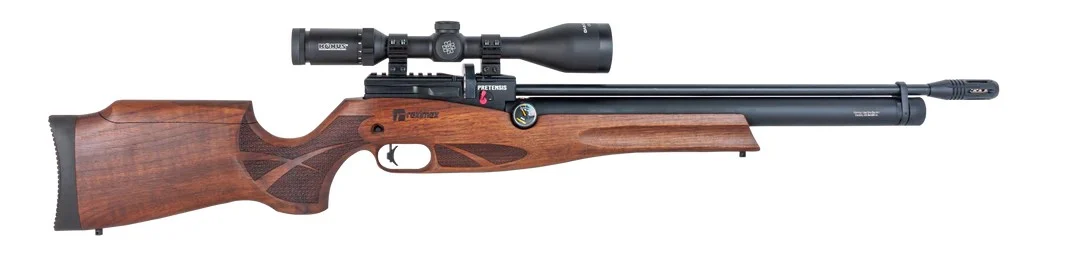
- Ambidextrous Turkish walnut or synthetic stock – an adjustable cheek piece and butt pad are included
- Dual Picatinny/dovetail hybrid rail plus lower accessory rail – optics and extras are readily mounted
- ½” UNF threaded muzzle with air stripper – a moderator or brake can be fitted
- Foster quick-fill port and side-mounted pressure gauge – charging and monitoring are simplified
- Manual safety – secure handling is supported
- Two rotary magazines (14-shot .177 / 12-shot .22) plus single-shot tray
- Pre-fitted sling swivel studs – field carry is facilitated
As a result, a ready-to-customise platform is presented that can be tailored to hunting, HFT-style practice, or backyard precision work.
Regulator, Cylinder and Shot Capacity
Stable muzzle velocity is maintained by the integrated regulator of the Reximex Pretensis Regulated. Consequently, tighter groups and more predictable holdover are produced from shot to shot. Meanwhile, a 260cc reservoir is utilised so that approximately 150 shots in .177 and up to 180 shots in .22 can be obtained from a 200-bar fill, depending on pellet choice and power setting. Additionally, a recommended fill pressure of around 200 bar is advised by many retailers, although a maximum of 250 bar is marked on some examples. Therefore, component stress can be reduced while useful capacity is still retained.
Furthermore, a clearly visible side-mounted gauge is fitted so that remaining pressure can be checked at a glance. In the same way, a Foster-style quick-fill inlet is protected by a snap-fit cap at the front of the cylinder, and the necessary probe is included. Thus, topping up from a pump or bottle is made straightforward.
Action, Trigger and Handling
Smooth magazine cycling is provided by the right-side lever of the Reximex Pretensis Regulated. Subsequently, follow-up shots can be taken with minimal disturbance to the sight picture. Likewise, a fully adjustable two-stage trigger is incorporated; after the stock is removed, the mechanism can be tuned and the blade shoe can be shifted for height and angle. As a result, a crisp, repeatable release is available to shooters who prefer a light first stage or a more defined second stage.
In addition, a manual safety is positioned for quick access above the grip or at the rear of the action, so that the rifle can be placed on safe or brought to fire without a change of hold. Moreover, an overall length of approximately 1020–1050 mm and a weight in the region of 2.8–3.3 kg (unscoped) are combined, so that a full-length barrel of about 570–580 mm is retained without excessive bulk. Consequently, balance in the shoulder is preserved during standing, kneeling, or supported positions.
Stock Options, Fit and Field Use
Comfort across a wide range of physiques is supported by the adjustable stock of the Reximex Pretensis Regulated. Specifically, both Turkish walnut and durable synthetic versions are offered; an adjustable cheek piece and rubber butt pad are fitted so that eye alignment and length of pull can be refined. Likewise, pre-fitted swivel screws are provided, and an ambidextrous layout is used so that left- and right-handed shooters are equally accommodated.
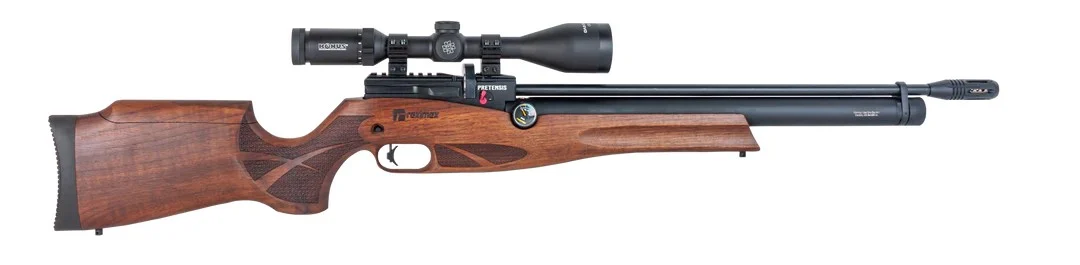
Meanwhile, a lower Picatinny rail is present for a bipod, lamp, or other accessory. In contrast to purely target-oriented designs, the sporter profile remains practical for woodland stalking and pest control. Therefore, the rifle can be carried slung for long periods and still be brought to aim quickly when a shot is presented.
Optics, Moderators and Customisation
Flexible mounting is enabled by the hybrid Picatinny/dovetail rail that straddles the magazine well. Consequently, a wide choice of scopes, red dots, and mounts can be attached without proprietary hardware. Additionally, the ½” UNF thread at the muzzle accepts a silencer or allows the supplied air stripper to be retained. As a result, muzzle report can be reduced for discreet hunting, while barrel harmonics and consistency can still be managed.
Furthermore, power adjustment is available on many examples via a multi-stop lever. Thus, energy can be lowered for close-range work, quieter shooting, or extended shot count when conditions or local limits require it. Ultimately, a platform that can be refined over time is offered rather than a fixed, one-setting rifle.
Practical Performance and Responsible Ownership
Accuracy potential is unlocked when quality pellets are matched to the barrel of the Reximex Pretensis Regulated. For instance, consistent sub-12 ft/lbs output in the 11 ft/lbs region is typically recorded, making the rifle suitable for legal-limit use in jurisdictions where an FAC is not required. Nevertheless, local laws, safe backstops, and landowner permission must always be observed. In the same way, hearing protection, eye protection, and a clear understanding of the trajectory are recommended for every session.
Moreover, the combination of regulator, generous cylinder, and multi-shot magazines means that a full afternoon of practice or a productive pest-control outing can be completed with fewer interruptions. Subsequently, more time can be spent on marksmanship rather than on refilling. Therefore, both newcomers who are building fundamentals and experienced shooters who demand repeatable results can benefit from the same core design.
In addition, two magazines and a single-shot tray are included so that magazine-fed speed and single-pellet precision can both be practised. Likewise, the side-lever remains easy to operate even when gloves are worn, and the safety can be engaged or disengaged without breaking the shooting position. As a result, confidence in the field is increased.
Why the Reximex Pretensis Regulated Belongs in the Collection
Value, consistency, and adaptability are brought together by the Reximex Pretensis Regulated. A regulated action that was once reserved for higher price brackets is now paired with an adjustable stock, dual rail, threaded barrel, and high shot count. Consequently, a complete hunting or target package can be assembled without unnecessary complexity. Furthermore, walnut and synthetic options allow the rifle to be chosen for classic appearance or all-weather practicality.
Ultimately, precision is placed within reach of every enthusiast who values a well-balanced, full-length PCP that remains legal-limit friendly, easy to fill, and straightforward to maintain. When responsible use, quality ammunition, and a suitable optic are combined with this platform, consistent groups and ethical field performance can be expected. The Reximex Pretensis Regulated is therefore presented as a versatile, conversion-ready choice for shooters who want regulated reliability without sacrificing handling or capacity.
Calibres, FAC, Power and Accessories of the Reximex Pretensis Regulated
Flexible calibre choice, legal-limit power, and a practical accessory package are combined in the Reximex Pretensis Regulated so that hunters, pest controllers, and target shooters of every experience level can be served. Consequently, a single platform can be matched to local regulations, preferred pellet size, and the optics or moderators that are already owned. Furthermore, regulated consistency is retained across the available options, so that shot-to-shot reliability is not sacrificed when a different calibre or power setting is selected.
Calibre Options for the Reximex Pretensis Regulated
Two primary pellet calibres are offered on the full-length Reximex Pretensis Regulated. Specifically, .177 (4.5 mm) is provided for flatter trajectory and higher magazine capacity, while .22 (5.5 mm) is supplied for greater downrange energy and a slightly higher typical shot count from the same 260cc cylinder. Additionally, a 14-shot rotary magazine is used in .177, whereas a 12-shot magazine is employed in .22. Therefore, rapid follow-up shots remain available in both sizes, and two magazines plus a single-shot tray are included so that mixed practice can be carried out.
Meanwhile, .25 (6.35 mm) availability is sometimes listed on related Pretensis variants, yet the regulated full-length model is most commonly stocked in .177 and .22. As a result, pellet supply, magazine interchange, and published shot-count figures can be planned around those two mainstream options. In the same way, pellet selection remains critical: lighter, high-quality .177 slugs or diabolo pellets are often favoured for precision work, while heavier .22 pellets are frequently chosen for pest control where impact energy is valued.
Moreover, barrel length of approximately 570–580 mm is shared across calibres, so that the same overall handling and rail layout are preserved. Likewise, the ½” UNF muzzle thread and air stripper remain compatible regardless of the pellet diameter that is chosen. Thus, a moderator, brake, or the factory stripper can be fitted without a change of rifle architecture.
Calibre snapshot for listings:
- .177 (4.5 mm) – 14-shot magazines; flatter trajectory; typically around 150 regulated shots from a 200-bar fill
- .22 (5.5 mm) – 12-shot magazines; stronger impact energy; typically around 180 regulated shots from a 200-bar fill
- Magazine set – two rotary magazines and one single-shot tray are supplied
- Shared platform – same regulated 260cc cylinder, side-lever action, and dual rail are used
FAC Status and Legal Power Output
UK-legal, non-FAC power is delivered by the standard Reximex Pretensis Regulated. Consequently, muzzle energy in the region of 10.8–11.8 ft/lbs is produced, remaining below the 12 ft/lbs threshold that would otherwise require a Firearms Certificate in Great Britain. Therefore, the rifle can be purchased and used by appropriately licensed shooters without FAC paperwork in jurisdictions where that limit applies, provided all other local laws, age restrictions, and safe-storage rules are observed.
Nevertheless, legal limits vary by country and region. In contrast to the UK sub-12 specification, higher-power or FAC-rated versions may be offered in some export markets or on related Reximex models. As a result, confirmation of the exact power stamp and local classification should always be obtained before purchase or import. Furthermore, responsible ownership requires that a safe backstop, landowner permission, and appropriate hearing and eye protection are used on every outing.
Additionally, a recommended fill of around 200 bar is commonly advised even when a 250-bar maximum is marked on the cylinder. Thus, component life can be protected while regulated consistency and useful shot count are still obtained. Meanwhile, remaining pressure is displayed on the side-mounted gauge so that the charge can be monitored without guesswork.
Power Adjustment and On-Range Performance
Adjustable output is featured on many examples of the Reximex Pretensis Regulated. Specifically, a multi-stop lever or similar control is used so that muzzle energy can be reduced from full legal-limit power down toward the mid or low single-digit ft/lbs range. Consequently, quieter shooting, closer-range work, or a higher shot count can be selected when conditions or pellet choice benefit from a milder setting.
Moreover, the factory regulator continues to stabilise velocity at each chosen setting. Therefore, the wide power curve that is typical of unregulated knock-open valves is avoided, and tighter groups can be produced once a preferred pellet and power stop are matched. In addition, the two-stage adjustable trigger and shiftable shoe allow the release to be refined so that the selected power level is not wasted by a heavy or inconsistent pull.
Likewise, chronograph testing with the intended pellet is recommended after any change of power stop or after a new fill routine is adopted. As a result, holdover and windage can be confirmed rather than assumed. Ultimately, legal-limit hunting energy and reduced-power practice can both be obtained from the same regulated action.
Accessories, Thread and Mounting Options
A practical starter set is included with the Reximex Pretensis Regulated, while a wide aftermarket path is left open. Notably, the following items are supplied or readily added:
- Fill probe / Foster adaptor – charging from a pump or bottle is enabled
- Two multi-shot magazines and single-shot tray – magazine-fed and single-pellet use are both supported
- Factory air stripper – muzzle blast can be managed until a moderator is fitted
- ½” UNF threaded muzzle – a silencer or alternative brake can be attached where permitted
- Hybrid Picatinny/dovetail top rail – scopes and red dots are mounted without proprietary rings
- Lower Picatinny rail – a bipod, lamp, or laser can be added
- Pre-fitted sling swivel studs – a sling can be attached for field carry
- Adjustable cheek piece and butt pad – optic height and length of pull can be matched
Furthermore, a scope and mounts are not included as standard, so that existing optics can be transferred or a new combination can be chosen to suit budget and discipline. In the same way, a compact moderator is frequently fitted by hunters because the unmoderated report is described as relatively sharp. Therefore, discreet pest control and more comfortable range sessions are both encouraged.
Additionally, the ambidextrous stock and dual-rail layout mean that left- and right-handed shooters, as well as users of night-vision or thermal add-ons, can be accommodated without a change of rifle. Consequently, the Reximex Pretensis Regulated can be grown into a complete field system: regulator and calibre for consistency, legal-limit power for compliance, and open accessory interfaces for the optic, moderator, bipod, and sling that each shooter prefers. Responsible use of those accessories, together with quality pellets matched to the chosen calibre, remains the foundation of accurate, ethical performance.
Weihrauch Air Rifles, PCP Platforms, Spring-Piston Systems, and Related Airgun Terminology
Enthusiasts researching premium German airgun engineering frequently encounter models and search terms such as Weihrauch HW100X Karbine, Thumbhole PCP Air Rifle, hw35, h 45, german air rifle, accurate air rifles, hw97k, hw 70, hw35e for sale, hw40, weihrauch hw30, weihrauch hw80, weihrauch hw 95, hw100, hw 97k, hw35 air rifle, hw50 s, weihrauch hw45, weihrauch english, weihrauch hw98, weihrauch englisch, hw77 air rifle, weihrauch hw50s, compressed air rifles, air rifle makes, spring piston, what are air rifles, weihrauch hw44, air shot gun, sk x rifles, weihrauch hw50, hw30s, hw 30, what are air pistols, hw50, and rifles de aire.
Within the Weihrauch lineup, the Weihrauch HW77 air rifle is widely recognized as a traditional fixed-barrel underlever platform. Related terminology includes HW77 Green Laminate rifle, Weihrauch underlever air rifle, HW77 spring piston air rifle, Weihrauch HW77 for sale, and German precision air rifle. Researchers comparing versions may also encounter phrases such as buy Weihrauch HW77 Green Laminate online, Weihrauch HW77 Green Laminate price and specs, Weihrauch HW77 accuracy review, HW77 Green Laminate vs HW97 comparison, is Weihrauch HW77 good for beginners, precision shooting airgun, high quality German airguns, best price Weihrauch HW77, where to buy Weihrauch HW77, Weihrauch HW77 in stock, affordable premium air rifle, and top rated underlever air rifle.
Technical comparison searches commonly include Weihrauch HW77 vs HW97, HW77 vs break barrel air rifle, best Weihrauch air rifles, most accurate air rifle for target shooting, air rifle with low recoil, durable air rifle for outdoor use, and reliable air rifle for long term use. These phrases generally reflect interest in operating systems, mechanical durability, handling characteristics, consistency, and the differences between fixed-barrel underlever designs, break-barrel rifles, and PCP platforms.
Other Weihrauch-related terminology includes air pistols, hw100 airgun, weihrauch hw95, weihrauch hw 30, weihrauch hw90, hw 44, hw 40, hw 98, and weihrauch hw100. The HW100 family represents the PCP side of Weihrauch’s catalog, while models such as the HW30, HW50, HW80, HW90, HW95, HW97, and HW98 are associated with spring-powered or gas-ram-style sporting airgun platforms depending on the specific model and configuration. By contrast, the HW44 is commonly discussed as a PCP air pistol.
The broader airgun market also includes search terminology connected with alternative PCP manufacturers and modern platforms. Examples include 25 karma, pcp bb gun, karma eq air rifle, karma red panda, panda guns, full auto pcp, karma sls compact, air karma, red panda hat, eq air, karma sls, eq magazine, air pcp, and karma airguns. These terms may refer to specific products, product families, accessories, community terminology, or unrelated search phrases that appear alongside airgun research.
Reximex is another name frequently encountered in PCP discussions. Related search phrases include reximex airguns, reximex rp, reximex throne gen 2, reximex mito, reximex rpa, sbs12, reximex mitos, reximex lieva, reximex accura pcp air rifle, and reximex throne gen2. Model naming can vary slightly between retailers, regions, and search listings, which explains variations such as “Throne Gen 2” and “Throne Gen2” or “Mito” and “Mitos.”
Airgun research also involves understanding velocity and energy. Searches such as fps to joules calculator, fps to ft lbs, and airgun calculator relate to converting projectile velocity and mass into kinetic-energy measurements. These calculations are commonly used for technical comparison, range evaluation, regulatory research, and understanding how different compressed-air or spring-powered platforms perform within their intended specifications.
More general discovery terms can include gunseek and yivli av tüfeği, alongside broader international phrases such as rifles de aire. Because airgun terminology varies considerably between English, German, Spanish, and Turkish-speaking markets, researchers may encounter several different naming conventions for comparable sporting, target, and recreational airgun platforms.
Taken together, terms ranging from Weihrauch HW100X Karbine and Thumbhole PCP Air Rifle to HW77 Green Laminate rifle, spring piston, compressed air rifles, karma airguns, and reximex airguns illustrate the diversity of modern airgun technology. Weihrauch remains particularly associated with German engineering, fixed-barrel underlever rifles, traditional spring-powered designs, precision PCP systems, and air pistols, while Karma and Reximex represent additional names encountered when comparing contemporary PCP platforms and associated airgun technology.
Practical Use Scenarios in the Field and on the Range
Everyday shooting tasks are handled with composure when a regulated full-length PCP sporter, a 260cc cylinder, and an adjustable stock are brought together. Consequently, sessions that once felt rushed—zeroing a new optic, walking a hedgerow at dusk, or working through an HFT-style course—can be completed with fewer interruptions. Furthermore, inclusive use is supported: newcomers, experienced hunters, left- and right-handed shooters, and those who prefer a lighter pull or a higher cheek weld can all be accommodated without a change of platform.
First Range Session and Establishing a Reliable Zero
A calm first outing is begun by confirming fill pressure on the side-mounted gauge and by seating a quality magazine or the single-shot tray. Subsequently, a sturdy rest or bipod on the lower rail is employed so that the barrel and regulator can reveal their true grouping potential. Meanwhile, a mid-range zero—commonly 25 to 35 yards depending on calibre and pellet—is established before longer holdovers are mapped.
Moreover, ten-shot strings are fired after the regulator has settled, so that velocity scatter is observed rather than assumed. As a result, a pellet that groups tightly at the chosen power stop can be locked in for the rest of the season. In addition, the two-stage trigger is refined only after the stock screws have been checked, because an unstable action can mask an otherwise excellent barrel. Therefore, the first afternoon is spent on process: fill, rest, group, adjust cheek piece, and record the zero, rather than on ambitious field shots.
Likewise, hearing and eye protection are worn throughout, and a safe backstop is verified before every string. Thus, good habits are formed from the opening session and are carried into later hunting use.
Woodland Stalking and Hedgerow Pest Control
Quiet movement along a field margin is made easier when overall weight stays in the mid-three-kilogram class and a sling is attached to the pre-fitted studs. Consequently, the rifle can be carried for long periods and still be mounted quickly when a rabbit or squirrel is presented. Furthermore, an adjustable butt pad and cheek piece allow a consistent sight picture whether the shot is taken standing beside a gate or kneeling behind a bank.
Meanwhile, a moderator on the ½” UNF thread is strongly favoured for this work, because muzzle report is reduced and livestock or neighbouring properties are less likely to be disturbed. In the same way, the side-lever can be cycled with gloves on, so that winter evenings and damp mornings do not force a change of technique. Additionally, two magazines are carried so that a follow-up is available if the first pellet is deflected by a twig.
Ethical ranges are kept short. Therefore, shots are taken only when a clear view of the vitals is obtained and a safe backstop exists beyond the target. Moreover, .22 is often selected for this role because impact energy at typical hedgerow distances is appreciated, while .177 remains a valid choice where a flatter trajectory and extra magazine capacity are preferred. As a result, the same regulated action can serve both calibres without a change of filling routine.
Field checklist that is commonly packed:
- Full 200-bar charge confirmed on the gauge
- Two loaded magazines plus a spare tin of the zeroed pellet
- Compact moderator already fitted
- Sling attached and length set for carry-to-aim
- Soft gloves that still allow the safety and lever to be worked
- Notebook or phone note of zero and holdovers
Farm Buildings, Barns and Close-Range Pest Work
Confined spaces demand a different tempo. Subsequently, the power adjuster—where fitted—is stepped down so that over-penetration through thin cladding is reduced and ricochet risk is lowered. Consequently, quieter, more controlled shots can be taken at rats or feral pigeons when a safe internal backstop has been arranged.
Furthermore, the single-shot tray is useful in dusty barns because a single pellet can be loaded without exposing a full magazine to grit. Meanwhile, the hybrid rail accepts a compact red-dot or a low-magnification scope so that rapid acquisition in dim light is possible. In contrast to long woodland shots, holdover is minimal; therefore, time is spent on footing, muzzle awareness, and confirming that no person or animal stands beyond the intended point of impact.
Additionally, a lower rail bipod is often left off in these tight aisles, and the rifle is instead supported on a bag or a solid beam. Thus, stability is gained without extra width that would snag on hoppers or door frames. Likewise, after the session the action is wiped and the fill cap is checked, because agricultural dust is unkind to gauges and probes.
Positional Practice and Hunter Field Target Style Courses
Positional discipline is built when the same rifle is used standing, kneeling, sitting, and prone. Moreover, the ambidextrous stock and adjustable comb allow a repeatable cheek weld even when the body is twisted around a peg or a tree. Consequently, holdover cards developed on the bench can be tested under realistic strain.
Meanwhile, the regulator’s consistency becomes most obvious on a course where every target sits at a different distance. As a result, the shooter can trust that a miss is more likely to be wind or ranging error than a sudden drop in muzzle energy. Furthermore, magazine capacity of 14 in .177 or 12 in .22 is sufficient for a typical lane, yet a second magazine is kept ready so that a mid-course refill of the action is avoided.
In addition, the side-lever’s short, smooth stroke helps when the rifle must be recocked without leaving the kneeling position. Therefore, rhythm is maintained and the sight picture is disturbed less than with a long, stiff bolt. Likewise, a modest power setting can be chosen on tight indoor or short outdoor courses so that pellet splash and target damage are reduced while the same zero is largely retained.
Supported Hunting from a Stick, Bipod or Vehicle Rest
Longer waits at a high seat or along a ride are made more comfortable when the lower Picatinny rail accepts a bipod or when a shooting stick is used under the forend. Subsequently, muscle fatigue is delayed and the regulator’s tight velocity band can be fully exploited. Moreover, the full-length barrel still provides a stable sight radius, so that a 40-yard rabbit or a wary squirrel at the edge of a wood remains a realistic, ethical opportunity.
Furthermore, vehicle-based work—where legal and safe—is supported by the same rail and by a weight that can be lifted in and out of a cab without strain. Consequently, a farmer checking paddocks at last light can keep the rifle ready without a cumbersome case for every short stop. Nevertheless, the muzzle is always controlled, the safety remains engaged until the shot is imminent, and local transport laws are followed.
Additionally, a night-vision or thermal add-on can be mounted on the hybrid rail when permitted, because the stock’s comb can be raised to match the taller optic. Thus, after-dark pest control does not require a second, dedicated rifle.
Filling, Magazines and Session Flow Away from the Workshop
A day in the field is paced by the 260cc cylinder. Therefore, a morning fill to the recommended pressure often covers a full pest-control circuit or an afternoon of positional practice before another charge is needed. Meanwhile, the Foster probe and protective cap keep grit out of the inlet when the rifle is laid on a tailgate or a coat.
Moreover, magazines are loaded at home or at the truck so that cold fingers are not asked to seat pellets in a hurry. As a result, the first shot of a stalk is not delayed by a fumbled rotor. In the same way, the single-shot tray is kept in a pocket for the rare moment when a damaged magazine lip is discovered or when a particular pellet must be tested on the spot.
Likewise, the pressure gauge is glanced at after every magazine, not only at the start of the day. Consequently, a declining charge is noticed before groups open up, and a top-up can be planned rather than improvised in failing light.
Weather, Clothing and Inclusive Handling
Rain, frost, and wind are met with the same core technique. Subsequently, a synthetic stock option—where chosen—sheds moisture more readily, while walnut is dried and lightly oiled after the outing. Furthermore, gloves with tactile palms still allow the manual safety and the side-lever to be operated, so that shooters with larger or smaller hands are not excluded.
Meanwhile, the adjustable butt pad compensates for heavy winter coats that would otherwise shorten the length of pull. Therefore, the same zero and comb height can be retained from summer shirtsleeves to mid-winter layers. In addition, left-handed users are not forced onto an opposite-side lever; the ambidextrous furniture and a safety that can be reached from either side keep the platform usable across the community of shooters.
As a result, a family or club setting can share one rifle among several people after only a few minutes of comb and pad adjustment. Inclusive language and practice matter here: every participant is given a clear briefing on the safety, the muzzle, and the backstop before live pellets are loaded.
Matching Power, Pellet and Purpose Without Guesswork
Different tasks ask for different energy. Consequently, full legal-limit output is reserved for longer, ethical hunting shots, while a reduced stop on the power lever is selected for close barn work or for introducing a new shooter to recoil-free practice. Moreover, the regulator continues to flatten the velocity curve at each stop, so that a change of power does not instantly destroy group shape.
Furthermore, pellet mass and head size are matched to the barrel rather than to marketing claims. Therefore, a tin is chrono-tested and grouped before it is trusted on live quarry. In the same way, a moderator can slightly shift point of impact; a confirmation group is always fired after the can is fitted or removed.
Additionally, holdover notes are kept in one place—phone, card, or stock tape—so that a rushed dusk shot is not taken on memory alone. Thus, practical use stays tied to data gathered on the range, not to hope.
After the Shot: Observation, Safety and Care
The sequence does not end at the trigger. Subsequently, the target area is watched for a clean result, and a second shot is taken only when it is justified and safe. Meanwhile, the safety is re-applied before the rifle is slung or placed in a vehicle. Furthermore, magazines are emptied or bagged so that a loaded rotor is not left in a case.
Moreover, a brief wipe of the action, a check of the fill cap, and a note of remaining pressure prepare the rifle for the next outing. Consequently, the same regulated consistency that was enjoyed at dawn is still available the following weekend. In addition, local laws on storage, transport, and age are treated as part of the shooting routine, not as an afterthought.
Ultimately, practical use is defined by repeatable process: a known fill, a known pellet, a fitted optic, a safe backstop, and a stock that can be adjusted to the person behind it. When those elements are combined with a side-lever action, a regulator, and open accessory rails, woodland circuits, barn work, positional courses, and quiet range evenings can all be completed with confidence. Every shooter—new or seasoned—is invited to treat each scenario as a chance to refine ethics and marksmanship rather than to rush the shot.



Reviews
There are no reviews yet.