Weihrauch HW97KT Synthetic Blackline – Precision, Performance and German Engineering
The Weihrauch HW97KT Synthetic Blackline combines traditional German engineering, precision-focused design, and contemporary styling in a dependable spring-powered air rifle. Developed for enthusiasts who appreciate consistency, durability, and refined handling, this remarkable model offers an impressive combination of mechanical quality and practical functionality.
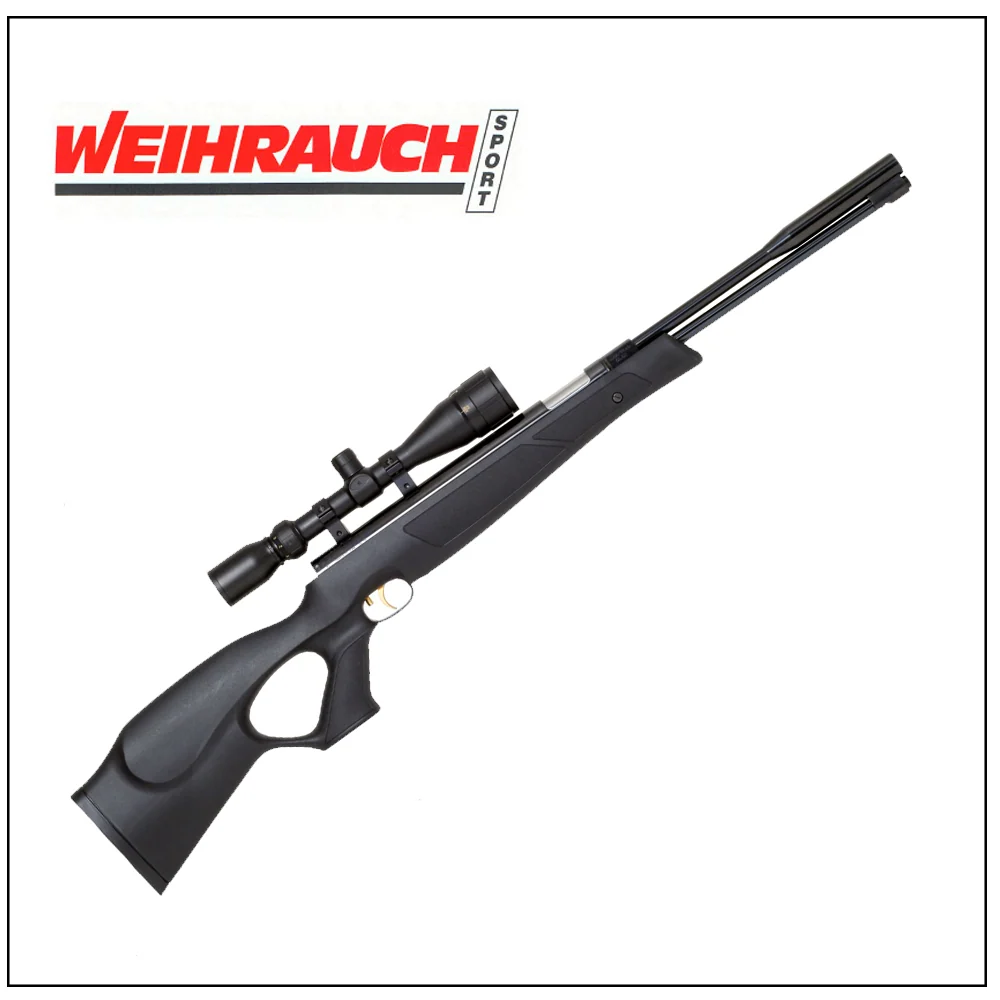
Built around Weihrauch’s celebrated HW97 platform, the Blackline edition features an elegant black synthetic thumbhole stock, a fixed-barrel configuration, and the renowned two-stage Rekord match trigger. Consequently, shooters are provided with a sophisticated platform that supports controlled, repeatable shooting during target practice and organised sporting activities.
Furthermore, its underlever cocking mechanism eliminates the need for compressed-air cylinders, external charging equipment, or disposable CO₂ cartridges. Instead, a self-contained spring-piston system delivers traditional mechanical operation.
Whether an established enthusiast is upgrading an existing collection or a developing shooter is exploring quality spring-powered equipment, the Weihrauch HW97KT Synthetic Blackline represents a distinctive example of German craftsmanship.
Weihrauch HW97KT Synthetic Blackline – Premium Features and Specifications
Key Features and Product Highlights
The HW97 Blackline has been designed around dependable mechanical components and a practical stock configuration. Each major feature contributes to the rifle’s distinctive appearance and established sporting heritage.
Highlighted Product Features:
- Manufacturer: Weihrauch Sport, Germany
- Model: HW97 Blackline Synthetic Thumbhole
- Power System: Spring-piston mechanism
- Cocking Mechanism: Underlever operation
- Barrel Configuration: Fixed barrel
- Stock Material: Durable black synthetic construction
- Stock Design: Ambidextrous thumbhole profile
- Trigger System: Two-stage Weihrauch Rekord match trigger
- Safety Mechanism: Automatic safety
- Available Calibres: .177, .20, .22 and .25, subject to market availability
- Barrel Length: Approximately 300 mm
- Overall Length: Approximately 1,015 mm
- Unscoped Weight: Approximately 4.2 kg
- Sighting System: Designed primarily for telescopic sights
- Loading System: Single-shot pellet loading
- Metal Finish: Traditional blued action
- Buttplate: Rubber buttplate
- Primary Applications: Target practice, field-target competitions, silhouette shooting and recreational marksmanship
Together, these specifications establish the rifle as a traditional yet sophisticated sporting platform.
Precision-Focused Fixed Barrel Construction
A defining characteristic of the Weihrauch HW97KT Synthetic Blackline is its fixed-barrel construction.
Unlike traditional break-barrel configurations, the HW97 platform incorporates an underlever cocking arrangement. As a result, the barrel remains securely positioned within the action rather than being repeatedly pivoted during the cocking cycle.
This arrangement is valued by shooters who prioritise consistent equipment alignment and predictable mechanical behaviour.
Additionally, the rifle features a muzzle-weight assembly designed to complement the overall balance of the system. The combination of a substantial action, fixed barrel and carefully considered stock profile provides a stable sporting platform.
The 300 mm barrel is housed within a compact overall design that balances traditional engineering with modern presentation.
Ultimately, the fixed-barrel construction remains one of the most recognisable elements of the Weihrauch HW97 series.
Advanced Synthetic Thumbhole Stock and Ergonomic Comfort
Durable Black Synthetic Construction
Unlike traditional hardwood alternatives, the Blackline edition incorporates a synthetic thumbhole stock finished in an understated black colour.
This modern material provides practical advantages for shooters seeking equipment with straightforward maintenance requirements. For example, synthetic construction does not require the same surface-care routine as a traditional varnished wooden stock.
Moreover, the dark finish creates an attractive contrast with the blued metal action, producing a refined appearance without excessive decorative elements.
The exterior is designed to complement the sporting character of the rifle while maintaining a clean, functional profile.
Consequently, the stock serves as both a practical structural component and an important part of the HW97 Blackline’s visual identity.
Ambidextrous Thumbhole Design
Comfort and accessibility are important considerations in any sporting air rifle.
Accordingly, the Weihrauch HW97 Blackline features an ambidextrous synthetic thumbhole stock intended to accommodate both right-handed and left-handed shooters.
The thumbhole configuration provides a distinctive grip profile, while the raised cheekpiece supports a head position suited to optical sights.
Furthermore, textured gripping areas contribute to comfortable handling during recreational and supervised sporting sessions.
A rubber buttplate completes the stock arrangement and provides a practical contact surface.
Although individual fit will vary according to body dimensions and personal preferences, the overall design demonstrates Weihrauch’s attention to ergonomic functionality.
Balanced Construction for Sporting Applications
With an approximate unscoped weight of 4.2 kg, the rifle possesses a substantial feel associated with established spring-powered target platforms.
Its balanced construction has been developed with controlled sporting use in mind.
Additionally, the relationship between the action, stock and underlever assembly contributes to the model’s familiar HW97 handling characteristics.
For experienced enthusiasts, this traditional configuration provides a recognisable alternative to lightweight pre-charged pneumatic designs.
Weihrauch Rekord Match Trigger – Refined Mechanical Engineering
Renowned Two-Stage Trigger System
One of the most respected components of the Weihrauch HW97 family is the manufacturer’s Rekord two-stage match trigger.
Recognised throughout the sporting airgun community, this established mechanism is associated with carefully engineered operation and a refined trigger feel.
Its two-stage configuration provides a distinct mechanical arrangement appreciated by target-shooting enthusiasts.
Moreover, the trigger system has contributed significantly to the longstanding reputation of Weihrauch spring-piston air rifles.
Rather than relying on complex electronic components, the Rekord mechanism reflects the manufacturer’s traditional emphasis on mechanical engineering.
An automatic safety mechanism is also incorporated into the rifle’s design. Nevertheless, safe handling practices, proper supervision where necessary, and awareness of the target environment remain essential.
Spring-Piston Performance and Independent Operation
Traditional Underlever Power System
The Weihrauch HW97 Blackline operates using a conventional spring-piston power system.
Unlike PCP air rifles, which require compressed-air charging equipment, this configuration uses a self-contained mechanical power source.
Consequently, additional equipment such as charging cylinders, compressors and refill pumps is not necessary for normal operation.
This straightforward arrangement appeals to enthusiasts who prefer traditional airgun engineering and fewer external power-system requirements.
Furthermore, the single-shot loading configuration reflects the rifle’s target-oriented design and encourages a deliberate approach to recreational marksmanship.
Available Calibres and Regional Power Variations
Several calibre configurations are associated with the HW97 Blackline platform.
The .177 and .22 versions are commonly recognised, while .20 and .25 options may be available through selected markets or special-order arrangements.
Importantly, muzzle energy and velocity depend on calibre, pellet characteristics, regional specifications and the particular factory configuration.
For example, reduced-power versions may be supplied in jurisdictions where specific energy limits apply.
Therefore, customers should confirm the exact calibre, manufacturer-rated power and local regulatory requirements before selecting a configuration.
Designed for Optical Sights and Sporting Versatility
Scope-Oriented Stock Geometry
The Weihrauch HW97 Blackline has been developed primarily around the use of telescopic sights.
Rather than incorporating traditional open sights, the platform features a raised stock comb intended to complement optical sighting equipment.
This design reflects its heritage in field-target and silhouette-shooting disciplines.
Furthermore, the absence of conventional open sights helps maintain the rifle’s streamlined exterior.
Compatible optics and mounting equipment should always be confirmed against the manufacturer’s specifications.
Applications for Recreational and Competitive Shooting
The Weihrauch HW97KT Synthetic Blackline has established relevance across several recognised sporting environments.
In supervised target-shooting facilities, its traditional mechanical design can be appreciated by enthusiasts interested in spring-powered equipment.
Similarly, field-target and silhouette-shooting participants may value the platform’s established competition heritage.
For collectors, meanwhile, the Blackline edition introduces a contemporary synthetic-stock interpretation of the classic Weihrauch HW97 design.
Its combination of heritage, mechanical simplicity and distinctive styling makes it a noteworthy addition to an airgun collection.
German Craftsmanship and Long-Term Ownership
Established Weihrauch Manufacturing Heritage
Weihrauch Sport is widely associated with German airgun manufacturing and traditional sporting equipment.
Over successive generations, the company has developed a reputation for precision-engineered mechanisms, recognisable product designs and attention to manufacturing quality.
The HW97 Blackline reflects this heritage through its combination of proven mechanical components and contemporary synthetic materials.
In addition, the established HW97 platform benefits from widespread familiarity among experienced airgun enthusiasts.
This longstanding recognition contributes to the rifle’s appeal among those who appreciate traditional spring-powered engineering.
Maintenance and Responsible Ownership
Proper care remains important for preserving the condition of any mechanical sporting rifle.
Accordingly, owners should follow the manufacturer’s instructions for inspection, cleaning, storage and periodic professional servicing.
The rifle should always be treated as potentially loaded, kept securely stored and used only in suitable, lawful environments.
Additionally, local age restrictions, licensing requirements and applicable airgun regulations should be reviewed before possession or use.
Calibres, FAC Power, Recommended Scopes and Essential Accessories
The Weihrauch HW97 Blackline is a precision-engineered, spring-piston air rifle designed for traditional target shooting and recreational sporting activities. With multiple calibre options, regional power configurations, and a scope-oriented design, the rifle offers flexibility for enthusiasts who appreciate dependable German engineering.
Furthermore, its fixed-barrel construction, underlever operating system, and celebrated Rekord match trigger establish it as a distinctive choice among premium spring-powered air rifles.
Understanding the available calibres, legal power classifications, and compatible equipment is essential when comparing different factory configurations.
Available Calibres and Their Characteristics
.177 Calibre (4.5 mm)
The .177 calibre is widely recognised in recreational target shooting and organised airgun competitions.
Its relatively small pellet diameter makes it a familiar option within many target-shooting disciplines. Additionally, compatible ammunition is commonly available through specialist sporting retailers.
The manufacturer lists a nominal maximum velocity of approximately 280 metres per second for the standard specification, although actual performance depends on the particular factory version and ammunition used.
Key characteristics include:
- Widely recognised target-shooting calibre
- Extensive availability of compatible sporting pellets
- Commonly used in organised airgun disciplines
- Performance dependent on factory power configuration
.20 Calibre (5.0 mm)
The .20 calibre represents a less common alternative within the spring-powered air rifle market.
Although this calibre is available in selected configurations, regional distribution may be limited.
According to the manufacturer’s published specifications, its listed velocity is approximately 215 metres per second.
Furthermore, pellet availability can differ considerably between countries, making local ammunition supply an important ownership consideration.
For enthusiasts interested in this configuration, confirmation of factory availability and suitable ammunition is recommended before purchase.
.22 Calibre (5.5 mm)
The .22 calibre is another established option in the wider sporting airgun market.
Its larger pellet diameter distinguishes it from the .177 configuration, while the same traditional spring-piston operating principle is retained.
The manufacturer’s current published velocity figure is approximately 205 metres per second, depending on the specification.
Additionally, .22 pellets are widely represented among sporting ammunition manufacturers.
Nevertheless, individual pellet characteristics, applicable legislation, and factory power ratings should be checked independently rather than assuming identical performance across different versions.
.25 Calibre (6.35 mm)
The .25 calibre is the largest option listed within the manufacturer’s current specifications for this model.
Its larger diameter offers a distinct configuration for enthusiasts interested in comparing the engineering characteristics of different airgun calibres.
Published factory information lists a nominal velocity of approximately 165 metres per second.
However, this calibre may be subject to restricted distribution or special-order availability in certain markets.
Consequently, customers should confirm the exact factory model, ammunition compatibility, and local possession requirements before purchasing.
FAC and Non-FAC Power Configurations
What Does FAC Mean?
FAC stands for Firearm Certificate, a term commonly associated with firearm licensing requirements in the United Kingdom.
Within the British airgun market, the designation is frequently used to distinguish rifles that exceed the standard unlicensed air-rifle energy limit.
For England and Wales, air rifles exceeding 12 foot-pounds of muzzle energy generally require the relevant firearm certificate. Different rules apply in Scotland and Northern Ireland.
Therefore, FAC terminology should not be interpreted as a universal international classification.
Standard and Higher-Power Factory Versions
Different regional versions may be supplied to comply with local legislation.
For example, certain German-market configurations are manufactured below 7.5 joules. Meanwhile, UK-market versions are commonly supplied within the applicable 12 ft-lb threshold, approximately 16.3 joules.
Higher-energy factory configurations may also be distributed where legally permitted.
Importantly, the manufacturer does not publish one universal muzzle-energy figure covering every calibre and regional variation.
As a result, advertised energy figures should always be verified against the precise factory model.
Unauthorised power modifications should be avoided, and all servicing should comply with applicable laws and manufacturer guidance.
Recommended Scope Considerations
Choosing a Suitable Telescopic Sight
The rifle features a stock specifically designed for optical sighting equipment and is supplied without conventional open sights.
Consequently, a compatible telescopic sight is an important consideration for owners intending to use the rifle at an authorised sporting range.
Because spring-piston air rifles generate distinctive recoil forces, compatibility should be confirmed before purchasing optical equipment.
A suitable scope should be explicitly approved by its manufacturer for spring-piston airgun applications.
Furthermore, optical clarity, warranty coverage, environmental protection, and general ease of use are valuable qualities when comparing products.
Scope Brands Worth Researching
Several established optical manufacturers offer product ranges that include equipment intended for airgun applications.
Examples include:
- Hawke Optics: Offers dedicated airgun-oriented optical products.
- MTC Optics: Known for sporting optics used across various airgun disciplines.
- UTG / Leapers: Manufactures optical accessories, including selected airgun-compatible products.
- Vortex Optics: Offers sporting scopes, although suitability for spring-piston recoil must be confirmed for each model.
Brand recognition alone does not establish compatibility. Instead, buyers should consult official documentation for their chosen scope and seek appropriate professional advice.
Essential Accessories and Ownership Equipment
Recommended Supporting Accessories
A properly selected equipment package contributes to responsible storage, convenient transportation, and routine maintenance.
Useful accessories include:
- Lockable rifle case: Supports secure transportation and storage.
- Protective scope covers: Help protect exposed optical surfaces.
- Manufacturer-approved cleaning supplies: Support appropriate exterior care.
- Microfibre cleaning cloth: Suitable for gentle surface maintenance.
- Approved rifle storage cabinet: Provides an additional security measure.
- Protective shooting glasses: Help provide eye protection at sporting facilities.
- Hearing protection: May be required under individual range regulations.
- Calibre-matched sporting pellets: Must correspond exactly to the rifle’s marked calibre.
- Manufacturer’s instruction manual: Provides essential operating and maintenance information.
- Qualified servicing support: Helps preserve the condition of internal mechanical components.
Maintenance and Storage Accessories
Unlike compressed-air systems, the traditional spring-piston mechanism does not require an external charging compressor or refill cylinder.
Nevertheless, responsible maintenance remains necessary.
Appropriate protective materials should be selected according to the manufacturer’s recommendations. In particular, unsuitable lubricants should never be introduced into internal spring-piston components.
Furthermore, secure storage protects the equipment from unauthorised access and unnecessary environmental exposure.
Choosing the Correct Factory Configuration
Selecting an appropriate version requires consideration of calibre availability, regional power restrictions, intended lawful sporting activities, and individual handling preferences.
Additionally, customers should confirm whether a rifle is supplied independently or as part of a retailer’s accessory package.
The synthetic thumbhole stock, fixed-barrel construction, and two-stage Rekord trigger remain defining features across the Blackline design.
Ultimately, careful attention to published specifications and legal requirements helps customers make informed decisions while appreciating the craftsmanship and established sporting heritage of this German-engineered spring-powered platform.
Weihrauch HW97KT Synthetic Blackline – A Distinctive Sporting Air Rifle
The Weihrauch HW97KT Synthetic Blackline brings together classic spring-piston technology, a modern black synthetic thumbhole stock, a fixed-barrel action and Weihrauch’s respected Rekord match trigger.
Its substantial construction, ambidextrous stock design and scope-oriented configuration reflect the needs of enthusiasts who appreciate traditional sporting air rifles.
Furthermore, the self-contained underlever mechanism distinguishes the model from modern compressed-air alternatives, while its understated Blackline styling gives it a contemporary identity.
For anyone researching the Weihrauch HW97 family, this synthetic-stock edition offers a compelling example of established German mechanical craftsmanship combined with practical sporting design.
Gamo Air Rifles, PCP Airguns, Pellet Pistols and Modern Airgun Systems
Choosing the right gamo air rifle depends on how the rifle will be used, the preferred caliber, the powerplant, and the shooter’s experience level. Gamo produces a broad range of recreational, target, and sporting airguns, so buyers searching for a gamo pellet gun, gamo air rifles, or a traditional gamo pellet rifle can compare several operating systems before deciding which configuration best fits their needs.
One of the most familiar designs is the break barrel air rifle. This platform remains popular because it combines straightforward operation with a self-contained powerplant. Shooters comparing high powered air rifles or a high power air rifle should consider much more than headline velocity. Pellet weight, caliber, barrel length, trigger quality, consistency, and shooting conditions all affect practical performance.
Models chambered as a gamo 177 configuration are frequently selected for target shooting and recreational use because .177 pellets generally offer a flatter trajectory than heavier calibers. Likewise, a gamo break barrel rifle provides the simplicity many shooters want without the need for a separate compressed-air charging system.
Break-Barrel Rifles and Pistols
People researching the best air rifles frequently encounter spring-powered and gas-piston break-barrel platforms. Search terms such as brake barrel bb gun are also common, although pellet rifles and BB guns are technically different categories and may use different ammunition and barrel designs.
Compact airguns include the break barrel pellet pistol, break barrel air pistol, and break barrel pistol. Larger-caliber searches may include a 22 caliber break barrel air pistol, while buyers may also look for a break action pellet pistol, the best break barrel pellet pistol, or a 22 pellet pistol for recreational shooting.
Power-oriented shoppers sometimes search for the most powerful break barrel pellet gun. However, raw velocity should never be the only specification considered. Accuracy, appropriate ammunition, safe handling, and local laws are equally important. A phrase such as bee bee gun pistol may be used informally by shoppers, but users should confirm whether a particular handgun actually fires steel BBs, lead pellets, or another compatible projectile.
Gamo Swarm Multi-Shot Air Rifles
Gamo’s magazine-fed break-barrel systems have helped popularize multi-shot operation in a category that historically required a pellet to be loaded manually after every shot.
The gamo swarm magnum 10x gen3i is closely associated with this concept, while searches for the gamo swarm magnum, gamo swarm maxxim gen 3, and swarm magnum gen3i reflect interest in different Swarm generations and configurations. Another commonly researched model is the gamo swarm magnum pro 10x gen3i.
The broader gamo magnum gen3i category appeals to shooters who want high-energy break-barrel performance together with magazine-fed convenience. Gamo’s multi-shot technology is also frequently found through searches for gamo 10x, multi shot pellet gun, gamo swarm, gamo swarm 10x, and pellet gun with magazine.
A magazine system can make repeated target sessions more convenient because pellets can be prepared before shooting begins. Nevertheless, users should always verify magazine compatibility, pellet length, pellet diameter, and model generation before ordering replacements.
Gamo Arrow PCP Air Rifles
Shooters interested in pre-charged pneumatic technology may encounter the gamo arrow range. The gamo arrow pcp combines a PCP powerplant with a lightweight sporting format, while the full term gamo arrow pcp air rifle is commonly used when comparing it with conventional spring or gas-piston rifles.
Related searches include pcp arrow guns, arrow rifle, pcp arrow gun, arrow rifles, and arrow air rifle. These phrases generally reflect interest in compact PCP-style sporting rifles rather than traditional break-barrel platforms.
Caliber-specific buyers may search for a gamo arrow .22, while the gamo arrow classic may appeal to shooters looking for another Arrow-series configuration.
PCP technology uses stored compressed air rather than relying on a spring or piston being compressed for each shot. This can produce a smooth firing cycle, reduced mechanical movement, and consistent shot-to-shot performance when the rifle is properly filled and maintained.
Understanding PCP Airguns
A pcp air rifle uses a reservoir filled with high-pressure air. PCP stands for precharged pneumatic, and the technology is widely used in modern sporting and precision airguns.
Searches for pcp air rifles, pcp rifle, pcp guns, pcp rifles, and pcp air gun generally refer to this same basic operating principle. Some buyers describe the platform as an air rifle compressed air system, while others search for a pcp pellet rifle or use the reversed phrase rifle pcp.
PCP rifles usually require additional filling equipment such as a suitable hand pump, compressor, or certified high-pressure cylinder. Users should follow the manufacturer’s recommended fill pressure because overfilling a reservoir can be unsafe and may also reduce performance.
Gas-Piston and Lever-Operated Airguns
A common beginner question is what is a gas piston air rifle. Instead of using a traditional coiled steel spring, a gas-piston system compresses gas inside a sealed cylinder. When the trigger is released, the piston moves rapidly and compresses air behind the pellet.
Other mechanical airgun designs include under lever air rifles, the singular underlever air rifle, and the alternative spelling under lever air rifle. In these designs, a separate lever positioned beneath the barrel is used to cock the mechanism.
Shooters may also research a side lever air gun or side lever air rifle, where the cocking lever operates from the side of the receiver. These fixed-barrel layouts can provide a different shooting experience compared with conventional break-barrel systems.
Search terms such as lever action pellet gun, air gun thumb lever, and lever action air rifle can refer to several different mechanisms, so buyers should check the specific manufacturer’s action type rather than assuming every lever-operated airgun works identically.
Gamo Shadow and High-Velocity Searches
Long-running Gamo product lines continue to generate searches including gamo shadow 1000, shadow 1000 gamo, and gamo 1000 shadow. Another associated search phrase is 1000/4.5, which is often used by shoppers researching 4.5 mm or .177-class air rifles.
Velocity-focused buyers may also search for a gamo 1800 fps air rifle. Advertised velocity can vary according to pellet composition and weight, so actual shooting performance may differ when standard lead pellets are used.
Likewise, shoppers researching gamo 1800 fps air rifle price should compare the exact model number, caliber, powerplant, bundled optic, warranty, and regional specification rather than relying solely on a velocity figure.
Other unusual search terms such as shotgun pellet gun may describe an airgun with styling inspired by a shotgun rather than a conventional pellet rifle. Searches for pellet guns that can kill should be approached from a safety perspective: airguns are not toys, and even relatively modest-powered models can cause severe or fatal injuries. Every airgun should therefore be handled with the same disciplined muzzle and trigger control expected of potentially dangerous sporting equipment.
Air Pistols, Pellet Pistols and CO2 Systems
The air pistol category includes many different operating systems, and modern air pistols may use springs, gas pistons, CO2 cartridges, or pre-charged pneumatic reservoirs.
For pellet-firing handguns, common searches include pellet pistols, pellet pistol, pistol pellet gun, pellet handgun, pellet gun pistol, pellet gun pistols, pistol air, and air pellet pistol.
CO2-powered handguns form another major category. A co2 pistol typically uses a disposable carbon-dioxide cartridge to propel BBs or pellets. Buyers may also search for pistol co2, co2 pistols, or the commonly mistyped c02 pistol.
Related searches include co2 air pistols, co2 gun, c02 guns, guns co2, and co 2 gen. Regardless of spelling, the key consideration is ammunition compatibility and the correct cartridge type specified by the manufacturer.
CO2 performance can be affected by ambient temperature because pressure changes as the cartridge becomes warmer or colder. For that reason, shooters should expect some variation in velocity during different environmental conditions.
Target Shooting and 10-Meter Airgun Use
Precision shooting requires appropriate targets and a safe backstop. A 10m rifle is generally associated with structured 10-meter air-rifle shooting, where accuracy, repeatability, shooting position, and trigger control are emphasized.
Recreational shooters may use pellet gun targets, while rifle users commonly search for air rifle targets, targets for air rifle, and airgun targets. The term air gun targets is another broad variation covering both rifle and pistol applications.
Dedicated practice setups can include air rifle shooting targets and airgun shooting targets designed to provide clear aiming points and easy scoring. Depending on the shooting discipline, an air rifle target may use small scoring rings intended for precision practice.
Handgun shooters may choose air pistol targets, whereas a pellet rifle target should be paired with a backstop capable of safely containing the pellets used by the particular rifle.
Airgun Cleaning and Maintenance
Regular airgun maintenance helps preserve reliability, accuracy, and safe function. Although airguns generally require less bore cleaning than many powder-burning firearms, seals, external metalwork, fasteners, magazines, and moving components still need periodic inspection.
A pellet rifle cleaning kit can contain cleaning rods, pull-through systems, suitable patches, and other airgun-safe tools. Likewise, a pellet gun cleaning kit can help remove accumulated debris when cleaning is genuinely required.
Proper air gun maintenance also involves checking stock screws, inspecting seals, keeping optics securely mounted, and following the manufacturer’s lubrication guidance. Excessive oil should be avoided because unsuitable lubricants can damage seals or cause unwanted combustion inside some spring-piston airguns.
For PCP equipment, reservoir condition, fill fittings, O-rings, and pressure gauges should also be inspected periodically. Magazine-fed models should be kept clean so pellets feed smoothly without deformation.
Ultimately, the best choice depends on the intended use. A traditional break-barrel rifle offers simplicity, a Gamo Swarm platform adds multi-shot convenience, and a PCP system provides a smoother firing cycle with an external filling requirement. Comparing caliber, powerplant, ergonomics, ammunition, maintenance demands, and safe target equipment makes it much easier to select an airgun that delivers dependable performance for responsible recreational or target shooting.
Frequently Asked Questions (FAQs)
1. What makes this spring-powered air rifle different from other models?
A combination of traditional German engineering, fixed-barrel construction, and contemporary synthetic materials distinguishes this sporting air rifle from many conventional alternatives.
Unlike typical break-barrel models, its barrel remains stationary because the cocking mechanism operates through an underlever system. Consequently, the design provides a consistent mechanical arrangement appreciated by experienced target-shooting enthusiasts.
Furthermore, the rifle incorporates a renowned two-stage match trigger, an ergonomic thumbhole stock, and a self-contained spring-piston power system.
Another important distinction involves its classic mechanical operation. External compressed-air cylinders and CO₂ cartridges are unnecessary, making ownership appealing to enthusiasts who prefer established engineering over complex charging arrangements.
Overall, its combination of durability, traditional construction, and modern styling creates a distinctive sporting platform.
2. Is this air rifle suitable for beginners?
Beginners with appropriate training and supervision may appreciate its reliable mechanical construction and established manufacturing heritage. However, several characteristics should be considered before choosing it as a first air rifle.
For instance, the substantial weight and spring-powered cocking mechanism may require greater physical effort than some lightweight recreational alternatives.
Additionally, its single-shot configuration and optical sighting arrangement differ from simpler entry-level models.
Therefore, newer shooters should receive appropriate instruction from a qualified professional and become familiar with all safety procedures before using the equipment.
A supervised sporting environment provides a suitable setting for developing responsible handling habits. Ultimately, individual strength, experience, local regulations, and personal comfort should guide purchasing decisions.
3. Does the rifle require an external air compressor or charging cylinder?
No. Its spring-piston operating system functions independently of compressed-air charging equipment.
Instead of relying on an external air supply, the rifle uses an internal spring and piston assembly to generate the compressed air required for each shot.
Consequently, owners do not need a PCP charging compressor, refill cylinder, or hand pump.
This traditional system remains appealing to enthusiasts who appreciate straightforward mechanical equipment with fewer external power-system requirements.
Nevertheless, normal maintenance and periodic professional inspection remain important for preserving dependable operation.
Unlike pre-charged pneumatic alternatives, the spring-powered configuration does not depend on maintaining a separate pressurised storage reservoir.
4. What calibres are available?
Several calibre options are associated with the wider product family, although availability varies by country and individual factory configuration.
Common options include .177 (4.5 mm) and .22 (5.5 mm). Certain markets may also offer .20 (5.0 mm) and .25 (6.35 mm) versions.
Each calibre has different pellet characteristics, and factory performance specifications may vary accordingly.
Furthermore, national legislation can determine which configurations are available through authorised retailers.
Before purchasing, customers should confirm the exact calibre listed on the individual product and review the manufacturer’s corresponding specifications.
Importantly, ammunition should always match the calibre stamped on the rifle. Incorrect ammunition must never be used.
5. Is the synthetic stock durable enough for regular sporting use?
Yes. The synthetic stock is designed to provide practical durability for normal recreational and sporting applications.
Compared with conventional wooden stocks, synthetic materials generally require less cosmetic maintenance and are less susceptible to certain environmental changes.
Moreover, the black exterior provides a contemporary appearance that complements the traditional blued metal action.
Although synthetic materials offer practical advantages, proper handling and storage remain essential.
Exposure to excessive heat, aggressive cleaning chemicals, or unsuitable storage conditions should be avoided.
For long-term ownership, the manufacturer’s maintenance recommendations should be followed. Regular visual inspections are also advisable to identify damage or wear before continued use.
6. Can both right-handed and left-handed shooters use the rifle?
Yes. The synthetic thumbhole stock is designed with an ambidextrous profile, making it suitable for consideration by both right-handed and left-handed enthusiasts.
This configuration provides greater flexibility than stocks specifically shaped for only one dominant hand.
Additionally, the raised cheekpiece and distinctive grip design contribute to its sporting appearance.
Nevertheless, comfort remains subjective because hand dimensions, arm length, and body proportions differ between individuals.
A suitable fit should be assessed before purchase whenever possible.
For clubs or supervised sporting facilities accommodating different participants, an ambidextrous configuration can provide useful versatility.
7. Does this model include a telescopic sight?
A telescopic sight should not be assumed to be included with the standard rifle.
The platform is designed primarily for optical sights, but individual retail packages may differ depending on the distributor and product listing.
For this reason, buyers should review the supplied-accessories section before ordering.
Some retailers may offer separate packages containing compatible optics, mounts, or protective accessories.
However, these additions are not necessarily part of the manufacturer’s standard configuration.
Customers should also confirm compatibility with the rifle’s mounting system and the recoil characteristics of spring-piston equipment.
Professional guidance can help ensure that any chosen optical equipment meets the manufacturer’s requirements.



Reviews
There are no reviews yet.