Weihrauch HW97KT Blackline Synthetic Stainless Steel – Technical Features, Design and Specifications
Weihrauch HW97KT Blackline Synthetic Stainless Steel – Product Overview
The Weihrauch HW97KT Blackline Synthetic Stainless Steel belongs to Weihrauch’s established HW97 family of spring-piston air rifles. Designed around a fixed-barrel system and an underlever cocking mechanism, this model combines traditional German airgun engineering with contemporary synthetic-stock styling.
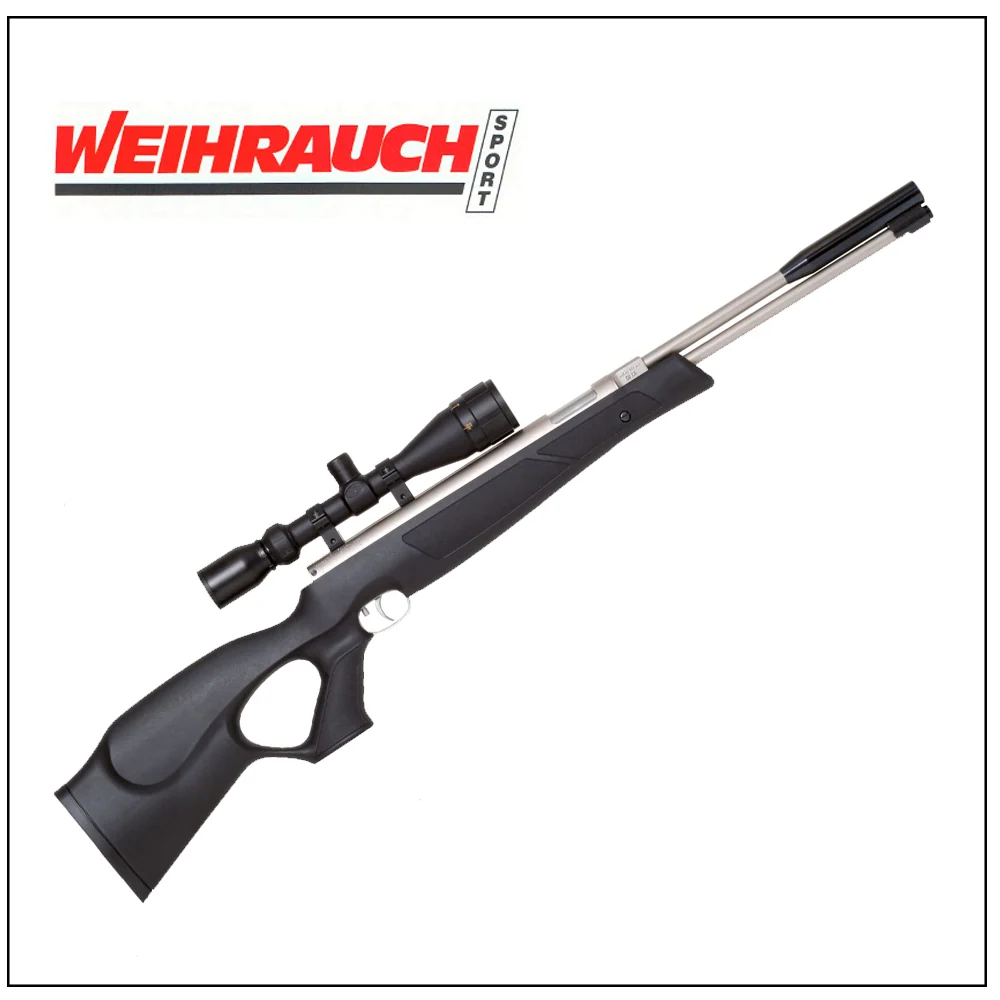
A distinctive black thumbhole stock complements the metallic stainless-look action, creating a recognizable appearance within the HW97 product range. Furthermore, its mechanical configuration reflects Weihrauch’s longstanding emphasis on target-shooting equipment.
Unlike pre-charged pneumatic air rifles, this model uses an internal spring-piston mechanism. Consequently, its operation does not require a separate compressed-air cylinder, electric compressor or charging bottle.
The rifle also incorporates the manufacturer’s well-known two-stage Rekord trigger system, an automatic safety mechanism and a stock configuration intended for both right-handed and left-handed users.
Key Product Features
- Brand: Weihrauch Sport
- Product family: HW97
- Model designation: HW97 Black Line STL / HW97KT Blackline Stainless
- Country of manufacture: Germany
- Operating system: Spring-piston
- Cocking mechanism: Underlever
- Barrel configuration: Fixed barrel
- Stock material: Black synthetic
- Stock design: Ambidextrous thumbhole
- Metal finish: Stainless-look surface treatment
- Trigger: Two-stage Rekord match trigger
- Safety: Automatic safety mechanism
- Loading capacity: Single pellet
- Barrel length: 300 mm
- Overall length: Approximately 1,015 mm
- Weight: Approximately 4.2 kg without an optical sight
- Sighting arrangement: Designed for optical sights; conventional open sights are not supplied
These specifications describe the manufacturer’s HW97 Black Line STL configuration. Market-specific versions may differ.
German Engineering and Mechanical Construction
Spring-Piston Operating System
The Weihrauch HW97KT Blackline Synthetic Stainless Steel uses a mechanical spring-piston system rather than compressed-air storage.
Its internal mechanism consists of a mainspring, piston and compression chamber. Together, these components form the power system characteristic of conventional spring-operated air rifles.
Because the system operates mechanically, its maintenance requirements differ from those of PCP equipment. For example, there is no high-pressure onboard air reservoir requiring periodic refilling.
Nevertheless, proper inspection and manufacturer-approved servicing remain important.
Fixed-Barrel Design
A fixed-barrel arrangement defines the HW97 platform.
The barrel remains in a stationary position relative to the main action during the normal cocking cycle. This design distinguishes the rifle from break-barrel models, which incorporate a hinged barrel assembly.
Additionally, Weihrauch fits the HW97 series with a muzzle-weight assembly.
The combination of its steel action, barrel and underlever mechanism contributes to the model’s substantial overall weight.
Underlever Construction
Beneath the barrel sits the underlever mechanism.
This arrangement is a defining characteristic of the HW97 family and gives the rifle its recognizable external profile.
Unlike a break-barrel system, the underlever configuration separates the cocking mechanism from the fixed barrel.
However, the rifle remains a single-shot design, with each loading cycle accommodating one pellet.
Blackline Synthetic Stock and Stainless-Look Finish
Black Synthetic Thumbhole Stock
The black synthetic thumbhole stock is among the most recognizable characteristics of this configuration.
Its molded construction offers a visually different alternative to the beechwood and laminated wooden stocks available elsewhere in the HW97 range.
Furthermore, the thumbhole profile incorporates a raised cheekpiece and shaped grip area.
A textured grip and fore-end contribute to the stock’s distinctive surface design.
Synthetic materials also differ from traditional wood in their response to environmental moisture. Even so, the metal components still require appropriate protection against corrosion.
Ambidextrous Design
The manufacturer’s stock configuration accommodates both left-handed and right-handed users.
This ambidextrous layout is especially relevant to clubs and supervised sporting environments where different participants may use similar equipment.
However, users should not confuse the synthetic version with the wooden HW97 KT model, which may include different buttplate adjustment features.
Stainless-Look Metallic Finish
The Weihrauch HW97KT Blackline Synthetic Stainless Steel features a silver-colored action that contrasts with its black synthetic stock.
Importantly, Weihrauch describes this finish as stainless-look, rather than identifying the entire action as solid stainless steel.
Therefore, the product’s finish should not be interpreted as proof that every metallic component is manufactured from stainless steel.
The finish gives this variation its distinctive appearance while preserving the familiar external design of the HW97 platform.
Trigger System and Safety Features
Two-Stage Rekord Match Trigger
The HW97 Black Line STL incorporates Weihrauch’s two-stage Rekord trigger.
This established mechanical trigger design appears across several rifles in the manufacturer’s range.
Its two-stage construction differentiates it from simpler single-stage trigger arrangements.
Any trigger inspection, maintenance or adjustment should follow the manufacturer’s published instructions or be performed by a qualified airgun technician.
Automatic Safety Mechanism
An automatic safety mechanism is included as part of the rifle’s standard configuration.
Although the mechanism serves an important safety function, it does not replace responsible handling practices.
Every air rifle should be treated as loaded until its condition has been independently verified.
Furthermore, secure storage, suitable eye protection and appropriate supervised shooting facilities remain essential considerations.
Calibre Availability and Model Variations
The Weihrauch HW97 product family is manufactured in several calibre configurations.
Manufacturer-Listed Calibres
- .177 / 4.5 mm
- .20 / 5.0 mm
- .22 / 5.5 mm
- .25 / 6.35 mm
Availability depends on the market, distributor and exact product variation.
In the UK, .177 and .22 are commonly listed, while .20 and .25 may require special ordering.
Different jurisdictions may also impose restrictions based on muzzle energy, licensing requirements or permitted ownership.
For this reason, specifications and legal requirements should be checked against the exact model and intended country of use.
Dimensions, Weight and Equipment Compatibility
Physical Specifications
The HW97 Black Line STL has an overall length of approximately 101.5 cm and a barrel length of 30 cm.
Its listed weight of about 4.2 kg excludes an optical sight.
These dimensions place it among relatively substantial spring-piston sporting air rifles rather than compact, lightweight models.
Optical Sights and Accessories
The rifle is designed primarily for use with an optical sight.
Unlike some traditional sporting air rifles, this configuration does not include conventional open sights.
Its raised cheekpiece reflects this scope-oriented design.
However, buyers and owners should verify optical mounting compatibility, accessory specifications and manufacturer recommendations before selecting equipment.
Additionally, the retail package may vary between distributors. Scopes, mounts, protective cases and other accessories should not be assumed to be included.
Maintenance, Storage and Long-Term Care
Routine Exterior Inspection
Regular exterior inspection helps owners identify signs of corrosion, stock damage or component deterioration.
Metal surfaces should be maintained according to Weihrauch’s recommendations, particularly after exposure to damp environments.
Similarly, the synthetic stock can be cleaned using materials compatible with its surface finish.
Aggressive chemicals and inappropriate lubricants should be avoided.
Professional Mechanical Servicing
Spring-piston systems contain components under mechanical tension.
Consequently, internal servicing and repairs should be undertaken only by appropriately qualified personnel.
The manufacturer’s original documentation should remain the primary reference for maintenance intervals, approved materials and replacement components.
Responsible Storage
Secure storage is an essential part of airgun ownership.
When not in use, the rifle should be unloaded and protected from unauthorized access.
Local laws may also establish specific requirements for transportation, possession and storage.
Weihrauch HW97KT Blackline Synthetic Stainless Steel – Final Overview
The Weihrauch HW97KT Blackline Synthetic Stainless Steel represents a distinctive configuration within Weihrauch’s HW97 spring-piston family.
Its defining characteristics include a fixed-barrel mechanism, underlever construction, black synthetic thumbhole stock and stainless-look metallic finish.
Meanwhile, the Rekord two-stage trigger, automatic safety mechanism and ambidextrous stock reflect established features of the manufacturer’s sporting air rifle designs.
For anyone researching the HW97 series, the Blackline Stainless configuration provides a useful comparison with the conventional wooden-stock HW97 KT, the standard HW97 K and other Black Line variations.
Understanding the exact model designation, available calibres, dimensions, finish and regional requirements is essential when comparing manufacturer specifications or documenting this air rifle for a product catalogue.
Weihrauch HW97KT Blackline Synthetic Stainless Steel – Calibres, FAC, Power, Recommended Scopes and Accessories
Calibre Options for the Weihrauch HW97KT Blackline Synthetic Stainless Steel
The Weihrauch HW97KT Blackline Synthetic Stainless Steel belongs to a respected family of German-manufactured spring-piston air rifles. Its fixed-barrel construction, underlever mechanism and synthetic thumbhole stock distinguish it from conventional break-barrel designs.
Before comparing specifications, an important distinction should be made: HW97 KT and HW97 Black Line STL are separate manufacturer configurations. The stainless-look synthetic model is officially identified as the HW97 Black Line STL.
Available Calibres
The manufacturer’s catalogue lists four calibre options for the Black Line STL, although availability differs between markets.
-
.177 calibre (4.5 mm): A commonly offered calibre in the HW97 series.
-
.20 calibre (5.0 mm): A less frequently stocked option, depending on the distributor.
-
.22 calibre (5.5 mm): Another widely recognized calibre within the HW97 product family.
-
.25 calibre (6.35 mm): A larger-diameter option listed in manufacturer and distributor documentation.
All four refer to pellet diameters rather than separate operating mechanisms. Furthermore, the selected calibre does not independently establish the rifle’s muzzle energy, licensing classification or suitability for a particular jurisdiction.
Official specifications should therefore be checked against the exact product code and regional version.
FAC and Non-FAC Versions Explained
What Does FAC Mean?
FAC stands for Firearm Certificate, a term used in British firearms licensing.
In England and Wales, air rifles capable of exceeding 12 foot-pounds of muzzle energy require a firearm certificate. This threshold is approximately 16.3 joules.
By comparison, an air rifle that does not exceed the threshold is generally exempt from firearm certification in England and Wales, although other restrictions still apply.
Scotland operates a different air-weapon licensing system, so the England and Wales rules should not be applied throughout the United Kingdom.
The current official guidance explains these distinctions in detail.
FAC and Reduced-Power Configurations
Different versions of the Weihrauch HW97 Black Line STL are offered for different regulatory markets.
For example, German distributors identify reduced-power models rated below 7.5 joules alongside FAC-designated versions.
However, the designation FAC does not establish one universal power output. Likewise, manufacturer velocity figures should not be treated as guaranteed measurements for every rifle.
Important purchasing information: Licensing requirements must be verified in the destination country before ordering, possessing or importing an air rifle.
Weihrauch HW97KT Blackline Power Specifications
Spring-Piston Power System
The Weihrauch HW97 Black Line STL uses a self-contained spring-piston power system.
Unlike pre-charged pneumatic air rifles, this mechanism does not require a high-pressure air reservoir or external compressor.
Its fixed-barrel configuration also eliminates the hinged barrel joint found on break-barrel models.
Several mechanical features define the rifle:
-
Spring-piston operating mechanism
-
-
Underlever cocking system
-
Single-shot loading arrangement
-
Two-stage Weihrauch Rekord trigger
-
Automatic safety mechanism
-
Stainless-look metallic finish
Manufacturer Velocity Information
Historical manufacturer documentation lists nominal velocities of approximately 290 m/s for the .177 configuration and 230 m/s for the .22 configuration.
Nevertheless, those figures describe published configurations rather than guaranteed velocities for every market or individual rifle.
Actual muzzle energy depends on the factory version and applicable legal restrictions.
A licensed dealer or qualified technician should verify the exact specification where regulatory classification is important.
Scope Compatibility and Optical Sight Considerations
Understanding the Rifle’s Optical Sight Configuration
The Weihrauch HW97 Black Line STL is supplied without conventional open sights. Its raised cheekpiece and stock profile were designed with optical sight use in mind.
However, a scope should not automatically be assumed to be included with the rifle.
When documenting a compatible optical sight in a product catalogue, several specifications deserve attention.
General scope compatibility information:
-
Manufacturer-confirmed compatibility with spring-piston air rifles
-
Correct attachment interface for the specific rifle
-
Adequate clearance around the action and loading area
-
Appropriate scope weight for the intended configuration
-
Warranty coverage for spring-piston recoil
-
Professional installation and inspection requirements
Spring-piston rifles produce a distinctive recoil impulse, and not every optical sight is approved for this type of mechanism.
For that reason, it is important to distinguish manufacturer-confirmed compatibility from general marketing claims.
Specific scope models, magnification settings and aiming-system upgrades should be assessed through a qualified dealer or sporting-club armourer rather than selected solely from generic recommendations.
Accessories for the Weihrauch HW97 Black Line STL
Protective Storage and Transport Accessories
Suitable protective equipment can contribute to long-term preservation of the rifle’s stock, metal finish and mechanical components.
The following accessory categories are relevant to general ownership and maintenance:
-
Lockable rifle case: Supports secure storage and legally compliant transportation.
-
Protective storage sleeve: Helps prevent superficial scratches during storage.
-
Moisture-control products: May reduce condensation within suitable storage environments.
-
Approved exterior cleaning cloth: Helps maintain the synthetic stock and metal surfaces.
-
Manufacturer-approved maintenance materials: Support routine exterior care.
-
Eye protection: Essential for supervised sporting environments.
-
Printed instruction manual: Provides model-specific safety and maintenance guidance.
Importantly, a protective sleeve should not be regarded as a replacement for secure, lockable storage.
Maintenance Accessories
Proper maintenance helps preserve the rifle’s condition.
The synthetic stock can generally be cleaned without the specialized wood-care products sometimes used for traditional timber stocks.
Meanwhile, metallic components require maintenance consistent with Weihrauch’s recommendations.
Internal repairs should be assigned to qualified technicians because spring-piston mechanisms contain components under tension.
Technical Specifications at a Glance
| Specification |
HW97 Black Line STL |
| Manufacturer |
Weihrauch Sport |
| Origin |
Germany |
| Operating system |
Spring-piston |
| Barrel |
Fixed, 300 mm |
| Cocking system |
Underlever |
| Calibres |
.177, .20, .22, .25 |
| Overall length |
1,015 mm |
| Weight without scope |
Approximately 4.2 kg |
| Stock |
Black synthetic thumbhole |
| Stock orientation |
Ambidextrous |
| Trigger |
Two-stage Rekord |
| Safety |
Automatic |
| Metal finish |
Stainless-look |
| Open sights |
None supplied |
| FAC availability |
Market-dependent |
Final Overview
The Weihrauch HW97KT Blackline Synthetic Stainless Steel, more precisely identified as the HW97 Black Line STL, combines established German spring-piston engineering with a synthetic thumbhole stock and distinctive stainless-look finish.
Its four catalogue-listed calibres, fixed-barrel design, Rekord trigger and scope-oriented stock arrangement make its technical specification straightforward to compare with other HW97 variants.
Meanwhile, FAC and reduced-power configurations demonstrate why regional product specifications matter.
For an accurate product listing, the exact calibre, factory power classification, optical sight inclusion and accessory package should always be confirmed before publication.
Falcon Scope, Falcon Optics, Element Titan 3-18×50 and Precision Rifle Optics: Complete Buying Guide
Discover Falcon Scope Technology and Modern Precision Optics
Choosing the right falcon scope can transform the viewing experience for target shooters, outdoor enthusiasts, and precision optics users. Modern optical technology combines high-quality glass, adjustable magnification, durable construction, and advanced reticle systems to support clear observation across different distances.
Whether researching falcon optics, falcon optical, falcon vision, or falcon tactical equipment, understanding individual product specifications remains essential. Different optic companies manufacture equipment for competitive target shooting, hunting, observation, thermal imaging, and specialist applications.
The Falcon Optical Systems product range includes competition-oriented riflescopes, while other manufacturers offer digital and thermal solutions. Consequently, buyers should distinguish traditional optical scopes from electronic observation equipment before comparing features.
Falcon Optics and Popular Optical Configurations
Falcon Optical Systems produces riflescopes designed for demanding precision applications. Its competition-oriented products include high-magnification options featuring specialized turret adjustments and optical systems.
Popular search terms include:
- falcon 10×50 and 10 x50 configurations for fixed-magnification optical research.
- falcon xl and falcon sp for model identification and compatibility searches.
- falcon 40 and 30 falcon when researching unidentified Falcon-related equipment.
- falcon claw and falconclaw for accessories or products requiring brand verification.
- tactical falcon and falcon arm when comparing tactical accessories and related equipment.
- falcon receiver when identifying device-specific components.
- falcon scanner and falcon thermal for electronic observation equipment.
Because similarly named products may belong to unrelated manufacturers, confirming the exact model is always recommended.
Understanding Rifle Scope Magnification and Objective Lens Sizes
Comparing 3-18×50, 4.5-18 and High-Magnification Scopes
Optical magnification determines how large a distant subject appears through a scope. For example, 3-18 magnification provides an adjustable viewing range suitable for diverse observation and sporting applications.
Searches for 3×18, 3×18 scope, 3-18 scopes, and 3:18 often relate to variable-magnification optics. Meanwhile, 4.5 x 18, 4.5 18, 4x-18, and 18 scope reflect interest in alternative magnification ranges.
Consumers comparing nightforce 3-18 equipment with the best 3-18 scopes should examine optical clarity, adjustment consistency, weight, eye relief, and warranty coverage.
Similarly, numerical searches such as 18x-4, 60x 3 50x 5, 3/5/25, and 3 5 25 should be checked against manufacturer specifications rather than interpreted automatically as verified optical configurations.
Understanding 50mm and 60mm Objective Lenses
An objective lens collects incoming light and contributes to image brightness and resolution. Common measurements include 50mm and 60mm, although overall image quality depends on glass composition, coatings, magnification, and environmental conditions.
Buyers sometimes search for how big is 50 x 60 or what size is 50 x 60. These measurements require context because 50 x 60 could describe physical dimensions rather than magnification.
Other numerical search variations include 25 x .50, 500 x 50, 500×60, 510 50, 50×0, 36x 50, 1/4×40, .25×50, 800 x 50, 60 x50, .50 x 10, 50x.05, 7.5 x 50, 50x 05, .25 x 50, 50 600, and 1050 x 5.
Furthermore, searches such as 10:50, scope50, and xoi50.com may represent alternative notation, incomplete model references, or unrelated websites. Therefore, these strings should never substitute for documented optical specifications.
Element Titan 3-18×50: Premium Optical Performance
Why the Element Titan 3-18×50 Deserves Attention
The element titan 3-18×50 is a versatile first-focal-plane riflescope designed around a broad magnification range and precision adjustment system.
Also searched as element titan 3 18×50, this model combines a 34mm main tube, 50mm objective lens, illuminated reticle, and adjustable parallax.
Its notable features include:
- 3-18x magnification: Supports flexible viewing across different distances.
- 50mm objective: Provides substantial light-gathering area.
- 34mm main tube: Accommodates a wide internal adjustment range.
- First-focal-plane reticle: Maintains consistent angular subtensions throughout magnification changes.
- Precision turrets: Support repeatable elevation and windage adjustments.
- HD glass: Helps minimize optical distortion and improve image definition.
- Weather-resistant construction: Supports operation in challenging outdoor conditions.
The manufacturer’s published specifications include 150 MOA of elevation adjustment, a mechanical zero-stop, and parallax adjustment beginning at 10 yards.
Consequently, this optic is worth considering when comparing premium variable-magnification scopes. Element Optics official specifications.
Chromatic Aberration and Optical Image Quality
Understanding chromatic aberration scope performance helps buyers evaluate image sharpness. Chromatic aberration appears as unwanted colored fringes around contrasting objects.
High-quality glass and effective lens coatings can reduce these imperfections, improving visual definition.
Likewise, users researching element ll should verify whether the search refers to a specific product generation, model designation, or accessory.
Falcon Thermal Imaging, Red Dot Optics and Electronic Sensors
Advanced Falcon Vision and Thermal Observation
Modern thermal equipment detects infrared radiation rather than depending entirely on visible light.
For users exploring falcon thermal, this distinction is important because thermal imaging and conventional optical magnification serve different purposes.
Some searches also mention elbit falcon and elbit falcon red dot. However, the precise manufacturer and model must be established before making compatibility or performance claims.
Additionally, falcon sensor manual searches generally indicate a need for operating instructions, sensor calibration information, maintenance guidance, or technical support.
Related search terms such as falke optics and optical camp may point toward alternative optic brands or specialist optical applications.
Even accessories marketed under unrelated product categories, including the falconeye patriot convertible bluetooth headset, require independent compatibility checks.
How Far Can a Falcon See?
The question how far can a falcon see can refer either to the bird’s remarkable natural eyesight or the observation distance of an optical device.
For riflescopes, useful viewing distance depends on magnification, atmospheric clarity, objective lens performance, and the size of the observed subject. No universal distance rating applies to every Falcon-branded device.
Rifle Rangefinders and Advanced Distance-Measuring Technology
Choosing a Rifle Rangefinder and Integrated Optics
A rifle rangefinder measures distance using optical or electronic technology. Modern laser devices can provide fast measurements and improve distance awareness in sporting and observation environments.
Common product searches include rifle range finder, laser range finder for rifle, rangefinder scope for rifle, and rangefinding rifle scope.
Additionally, scopes with rangefinders built in combine observation and distance measurement within a single optical platform.
A picatinny mounted rangefinder, sometimes described as a picatinny range finder, uses a compatible rail interface for attachment.
Other configurations include a weapon mounted range finder, while the abbreviation wmlrf commonly refers to a weapon-mounted laser rangefinder.
Electronic Ballistic Calculators and Distance Systems
A weapon mounted ballistic calculator can combine measured distance with programmed ballistic information, depending on its design.
Products associated with arken wmlrf searches include Arken’s weapon-mounted ranging equipment. Its TargetLock TL3000 incorporates laser-ranging and ballistic calculation capabilities. Arken Optics official product information.
Meanwhile, element rf searches may relate to Element Optics rangefinding products. Buyers should confirm the exact model, intended purpose, and accessories before purchasing.
Rifle Scope Mounts, Rings and Precision Accessories
Understanding Picatinny and Dovetail Scope Mounts
Choosing the correct mounting system is essential for secure installation and optical alignment.
A dovetail scope mount connects compatible optics to a dovetail-style rail, while dovetail rings provide alternative mounting arrangements.
Similarly, dovetail scope mounts and 30mm dovetail scope rings must match both the optic tube diameter and rail dimensions.
For Picatinny systems, popular options include picatinny scope mounts, picatinny scope rings, 30mm scope mount picatinny, and 30mm picatinny scope rings.
Buyers should confirm tube size, ring height, rail compatibility, and appropriate installation specifications.
Diving Board Mounts and Scope Accessories
Specialist mounting configurations include a 34mm diving board mount, 34mm scope mount with diving board, diving board scope mount, and 30mm diving board mount.
A scope diving board generally describes an elevated accessory mounting platform integrated with or attached to a compatible optical mounting system.
An element mount may provide a manufacturer-specific mounting solution, while a turret wheel can assist with handling or adjustment on compatible scopes.
Protective Covers for Optical Equipment
Protecting lenses helps preserve optical performance during transportation and storage.
Popular protective accessories include:
- tenebraex scope caps for compatible objective and ocular lenses.
- tenebraex scope covers for additional lens protection.
- allen neoprene scope cover for cushioning and shielding an optic during storage or transport.
Choosing the Right Falcon Scope and Optical Accessories
Selecting an effective optical system requires more than comparing magnification numbers. Glass quality, mechanical reliability, reticle design, mounting compatibility, environmental resistance, and manufacturer support all influence long-term satisfaction.
Whether researching Falcon optics, Element Titan models, advanced rangefinding technology, or protective accessories, prioritize verified product specifications over ambiguous search terminology.
For the best purchasing experience, compare authentic manufacturer documentation, confirm compatibility, and choose equipment suited to your intended sporting or observation application.
Frequently Asked Questions (FAQs)
General Information and Product Features
1. What makes this air rifle different from other spring-powered models?
This model combines a fixed-barrel system, underlever mechanism, synthetic thumbhole stock, and German manufacturing. Unlike conventional break-barrel designs, its barrel remains stationary during the cocking process.
Additionally, the rifle incorporates a two-stage trigger system and an automatic safety mechanism. Its metallic stainless-look finish contrasts with the black synthetic stock, creating a distinctive appearance.
The overall construction reflects a traditional mechanical approach rather than the compressed-air technology found in PCP models.
2. Is this air rifle suitable for beginners?
The suitability of any air rifle depends on the individual’s experience, physical ability, local legal requirements, and access to qualified supervision.
This particular model weighs approximately 4.2 kilograms without an optical sight, making it relatively substantial.
For newcomers, understanding safe handling, secure storage, and the manufacturer’s operating instructions is essential. Furthermore, supervised instruction at an authorized sporting facility can help establish responsible practices.
A qualified instructor can assess whether the rifle’s weight and operating characteristics are appropriate for an individual.
3. Where is this model manufactured?
The rifle is manufactured by Weihrauch Sport in Germany.
The company has a longstanding history of producing sporting airguns, including spring-piston and pre-charged pneumatic models.
German manufacturing is an important part of the brand’s identity. Nevertheless, buyers should evaluate individual products using verified specifications, manufacturer documentation, warranty information, and condition rather than relying exclusively on country of origin.
4. Does it require an external air compressor?
No. The rifle incorporates a self-contained spring-piston mechanism.
Unlike PCP equipment, it does not use an onboard high-pressure air cylinder that must be refilled through an external compressor or charging pump.
Its mechanical system includes an internal spring and piston assembly.
However, the absence of compressed-air charging equipment does not eliminate maintenance requirements. Routine exterior inspection and appropriate professional servicing remain important for long-term mechanical condition.
5. Is the metallic action made entirely from stainless steel?
The manufacturer identifies the exterior treatment as a stainless-look finish.
Consequently, the appearance should not be interpreted as confirmation that the complete action is manufactured from solid stainless steel.
This distinction matters because surface treatments and base materials have different characteristics.
Although the metallic finish offers a distinctive appearance, regular maintenance remains necessary, particularly when equipment is stored in humid conditions.
Calibres, Power and Performance
6. Which calibres are available?
Manufacturer documentation for the relevant product family includes .177, .20, .22, and .25 calibre configurations.
These correspond to nominal pellet diameters of 4.5 mm, 5.0 mm, 5.5 mm, and 6.35 mm.
Availability varies according to the regional distributor and specific model configuration.
Additionally, local legislation may restrict ownership or importation regardless of calibre.
Prospective owners should therefore confirm the exact factory designation and applicable regulatory classification.
7. Are all calibre versions equally powerful?
Not necessarily.
Calibre identifies projectile diameter, while muzzle energy describes the energy associated with a projectile as it leaves the barrel.
Different factory configurations can have different energy ratings.
Furthermore, regulations may limit the maximum permissible output in certain jurisdictions.
For accurate technical documentation, the relevant manufacturer’s specification should be consulted rather than assuming that all variants provide identical performance.
8. What does FAC mean?
FAC means Firearm Certificate.
In England and Wales, air rifles capable of exceeding 12 foot-pounds of muzzle energy generally require firearm certification.
This threshold is approximately 16.3 joules.
However, licensing arrangements differ between jurisdictions, including Scotland and Northern Ireland.
The designation should therefore be interpreted according to the applicable national legislation.
Possession, transportation, and import requirements should be confirmed with the relevant authorities before ownership.
9. Can the power rating differ between countries?
Yes. Factory versions may be supplied with different energy specifications to reflect national regulations.
For example, reduced-power configurations exist in markets where lower muzzle-energy limits apply.
As a result, an identical-looking product may have a different regulatory classification depending on its original factory configuration.
The authoritative reference is the specification associated with the exact model and serial-numbered product.
10. Is this a single-shot or repeating air rifle?
This is a single-shot spring-piston air rifle.
It does not incorporate a conventional multi-pellet magazine system.
The single-shot arrangement is a characteristic of the manufacturer’s traditional fixed-barrel underlever design.
Consequently, it should not be confused with magazine-fed PCP products or other repeating airgun platforms.
Construction and Mechanical Design
11. What is the advantage of a fixed-barrel design?
A fixed barrel remains attached to the action without the hinged movement associated with break-barrel systems.
This construction eliminates the barrel pivot found on those designs.
It also creates a distinct mechanical layout, with the cocking mechanism positioned beneath the barrel.
However, the presence of a fixed barrel alone does not guarantee a particular level of accuracy. Manufacturing tolerances, condition, maintenance, and other variables remain important.
12. What is an underlever mechanism?
An underlever mechanism is a cocking arrangement in which the lever is positioned beneath the barrel.
It differs visibly and mechanically from a break-barrel configuration.
This arrangement is commonly associated with several traditional European spring-piston air rifle designs.
The internal spring mechanism remains under mechanical tension as part of its normal operating cycle.
For safety, all inspection and maintenance should follow official manufacturer documentation.
13. What is a two-stage trigger?
A two-stage trigger divides trigger movement into two distinct phases.
The first stage involves initial movement, while the second stage represents the final portion of the mechanism’s operation.
The manufacturer’s Rekord system is a well-established example of this design.
Any servicing or adjustment should be undertaken only in accordance with approved instructions or by a qualified technician.
Unauthorized modifications may create safety concerns and affect warranty coverage.
14. Does the rifle include an automatic safety?
Yes. The standard configuration includes an automatic safety mechanism.
Nevertheless, mechanical safety devices should never replace responsible handling procedures.
All air rifles must be treated as potentially loaded until their condition has been verified.
Furthermore, the muzzle must remain directed toward a safe area, and the rifle should be stored securely when not in use.
15. Is the synthetic stock resistant to moisture?
Synthetic stock materials generally respond differently to moisture than traditional wooden stocks.
They do not have the same natural grain structure and are not subject to identical swelling and shrinkage characteristics.
However, this does not make the complete rifle waterproof.
Metal components, mechanical assemblies, and external finishes still require protection against moisture and environmental contamination.
Careful drying and appropriate storage are essential after exposure to damp conditions.
Scopes and Accessories
16. Does the rifle come with a scope?
The standard manufacturer’s configuration does not necessarily include an optical sight.
Retail packages may differ between distributors, so buyers should check the exact contents of the advertised package.
The rifle is designed with optical sight use in mind and does not feature conventional open sights.
Nevertheless, no particular scope should be assumed to be included unless the seller explicitly identifies it as part of the supplied equipment.
17. Are all rifle scopes compatible?
No. Compatibility depends on several factors, including the manufacturer’s approval for spring-piston recoil, mounting interface, physical clearance, and installation requirements.
Spring-operated air rifles generate a recoil impulse that differs from those of some other sporting platforms.
Consequently, an optical sight intended for one type of equipment may not necessarily be approved for another.
Compatibility should be confirmed through the scope manufacturer and an appropriately qualified specialist.
18. What protective accessories are useful?
General ownership accessories include lockable storage cases, protective sleeves, suitable cleaning cloths, moisture-control materials, and approved eye protection.
A properly fitted case can help protect the exterior against accidental scratches during lawful transport.
Meanwhile, moisture-control products can contribute to suitable storage conditions.
Such accessories should complement, rather than replace, proper maintenance and secure storage practices.
19. Can the rifle accommodate left-handed users?
The synthetic thumbhole stock is described by the manufacturer as ambidextrous.
This means its configuration is intended to accommodate both left-handed and right-handed individuals.
Nevertheless, physical comfort depends on individual body dimensions and preferences.
The raised cheekpiece, overall stock proportions, and equipment weight should be evaluated under qualified supervision.
Maintenance and Long-Term Ownership
20. How should the exterior be cleaned?
Exterior care should follow the manufacturer’s published maintenance guidance.
Generally, a clean, soft cloth can be used to remove superficial dust from suitable surfaces.
For metallic components, only manufacturer-approved maintenance materials should be considered.
Harsh solvents or incompatible cleaning agents may damage surface treatments or synthetic materials.
Additionally, the product should be checked for moisture before storage.
21. How often should professional servicing take place?
There is no single universal servicing interval suitable for every spring-piston air rifle.
The appropriate schedule depends on the manufacturer’s guidance, operating history, environmental exposure, and observed mechanical condition.
Signs of damage, unusual mechanical behavior, or deteriorating external components should be assessed by a qualified technician.
Internal disassembly is not an appropriate substitute for professional inspection.
22. Can the internal spring be replaced?
The internal spring is a serviceable mechanical component, but replacement involves working with a mechanism that may retain substantial stored energy.
Consequently, spring replacement and internal repairs should be handled by qualified personnel.
Any replacement component must be approved for the exact model and compatible with the applicable legal power classification.
Unauthorized alterations may affect safe operation, warranty eligibility, and regulatory compliance.
23. How should the rifle be stored?
The rifle should be stored unloaded, securely locked, and protected against unauthorized access.
A suitable storage location should also minimize excessive humidity and exposure to damaging environmental conditions.
Where required, storage arrangements must comply with national or regional firearms legislation.
A soft transport sleeve alone should not be regarded as secure long-term storage.
24. Is the synthetic stock easy to maintain?
Synthetic stocks generally require less specialized surface treatment than traditional unfinished wood.
Their molded exterior does not need conventional wood oils or wax treatments.
However, suitable cleaning materials should still be selected according to the manufacturer’s recommendations.
Avoid exposing the stock to excessive heat, aggressive chemicals, or unnecessary mechanical stress.
Purchasing, Warranty and Regulatory Questions
25. Is a licence required to own this air rifle?
Licensing requirements depend on the country, region, and exact power classification.
For example, England and Wales distinguish between certain lower-powered air rifles and those requiring firearm certification.
Scotland has separate licensing requirements, while other countries use different classification systems.
Importation, possession, transportation, and use may also be regulated independently.
Always consult the relevant authorities rather than relying on general product descriptions.
26. Does the rifle include a manufacturer’s warranty?
Warranty eligibility depends on the manufacturer’s terms, local distributor arrangements, purchase location, and proof of purchase.
Coverage may also differ between new, pre-owned, and independently imported products.
Buyers should request written warranty documentation and retain their original purchase records.
Additionally, unauthorized repairs or modifications may affect coverage.500x 50
27. What should be inspected when considering a pre-owned example?
A pre-owned rifle should be evaluated for its general condition, documentation, correct model identification, and signs of improper modification.
Visible corrosion, damaged stock components, missing safety equipment, or unexplained alterations deserve particular attention.
A qualified technician can provide a professional mechanical assessment.
The ownership history and applicable transfer requirements should also be established before any transaction.
28. Is the rifle suitable for long-term ownership?
Long-term ownership depends on appropriate maintenance, responsible storage, availability of authorized servicing, and compliance with applicable legislation.
Its established spring-piston architecture provides a recognizable mechanical foundation, while the synthetic stock offers an alternative to traditional timber construction.
Nevertheless, durability cannot be guaranteed independently of how equipment is handled, maintained, and stored.
29. What is included in a standard retail package?
The exact package contents should be confirmed with the supplying distributor.
Depending on the market, standard documentation may include the manufacturer’s operating instructions and applicable warranty information.
Optional optical sights, mounts, protective cases, and other accessories should not be presumed to be included.
Product listings should identify included items clearly to prevent confusion.
30. What information should be confirmed before purchase?
Several details are important when verifying a particular configuration.
These include the exact manufacturer designation, calibre, factory energy classification, regional legal requirements, warranty terms, and supplied accessories.
Furthermore, the distinction between a stainless-look finish and actual stainless-steel construction should be clearly understood.
Finally, accurate documentation and access to qualified servicing contribute to informed, responsible ownership.
Final Frequently Asked Questions Summary
This German-manufactured spring-piston air rifle combines traditional mechanical construction with a contemporary synthetic thumbhole stock. Its fixed barrel, underlever mechanism, two-stage trigger, and stainless-look finish are among its defining characteristics.
Understanding calibre availability, regional energy classifications, optical sight compatibility, maintenance requirements, and legal obligations is essential when evaluating its specifications.
For the most reliable information, consult official manufacturer documentation, authorized distributors, and the relevant national authorities.



Reviews
There are no reviews yet.