Weihrauch HW100KT – German Engineering, Precision Performance and Compact PCP Air Rifle Design
Weihrauch HW100KT – A Detailed Overview of German Airgun Engineering
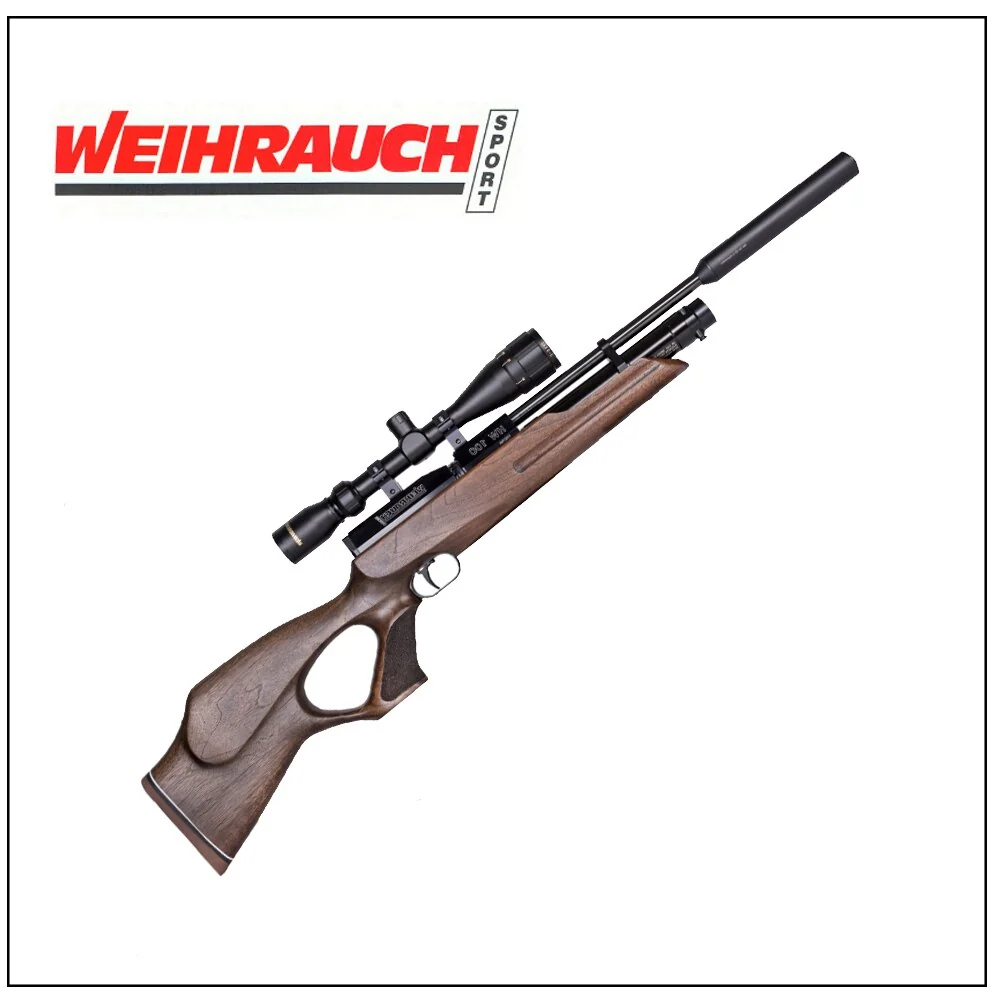
The Weihrauch HW100KT is a pre-charged pneumatic (PCP) air rifle recognized for its German engineering, compact carbine configuration, and ergonomic thumbhole stock. Developed as part of Weihrauch’s established HW100 series, this model combines a regulated air system, side-lever action, multi-shot magazine, and adjustable match-style trigger.
Furthermore, the KT designation refers to the Karbine Thumbhole configuration. Its shortened barrel and distinctive stock distinguish it from longer HW100 variants. Consequently, the rifle offers a different handling profile while retaining many of the mechanical characteristics associated with the wider product family.
Built around a conventional PCP operating system, the platform uses compressed air rather than a spring-powered mechanism. As a result, spring-related recoil and vibration are avoided, while a regulated air supply supports consistent performance throughout the usable filling range.
Key Features and Product Highlights
-
Manufacturer: Weihrauch Sport, Germany
-
-
Airgun Type: Pre-charged pneumatic (PCP)
-
Configuration: Compact carbine with thumbhole stock
-
Available Calibres: .177 and .22, with .20 available by special order in some markets
-
Magazine Capacity: 14-shot rotary magazine
-
Loading Mechanism: Side-lever repeating action
-
Trigger System: Adjustable two-stage match trigger
-
Air Regulation: Integrated regulator for controlled air delivery
-
Stock Options: Walnut and selected synthetic configurations
-
Barrel Length: Approximately 310 mm on the current UK-listed KT configuration
-
Overall Length: Approximately 955 mm
-
Weight: Approximately 2.9 kg for the current UK-listed configuration
-
Safety: Manual safety mechanism
-
Optics: Designed for compatible scope-mounting systems
-
Air Filling: Quick-fill system
-
Design Heritage: German engineering and established HW100-series construction
Specifications can differ between the earlier HW100KT, the newer HW100 X KT, and individual stock or market configurations.
Compact Carbine Construction and Ergonomic Thumbhole Stock
A Distinctive Stock Designed Around Shooter Comfort
One of the most recognizable characteristics of the Weihrauch HW100KT is its thumbhole stock.
Unlike a conventional sporter stock, the thumbhole configuration incorporates an opening behind the pistol grip. This arrangement provides a defined hand position and creates a distinctive visual profile.
Additionally, the stock’s sculpted shape incorporates finger grooves along the fore-end. These details contribute to its ergonomic character and provide tactile reference points during handling.
Traditional walnut configurations emphasize natural wood grain, while synthetic alternatives offer a different surface finish and appearance. Therefore, the specific stock material should always be identified when comparing individual versions.
The cheekpiece also forms an important part of the overall stock design. Its purpose is to support a repeatable head position when using an appropriate optical sight.
Compact Dimensions and Balanced Construction
The KT designation identifies the carbine-length version of the thumbhole model.
Compared with longer HW100 variants, the reduced barrel length produces a shorter overall profile. Nevertheless, the platform retains its regulated PCP mechanism and familiar side-lever system.
The compact barrel, air cylinder, and stock work together to establish the rifle’s balance. Moreover, differences in cylinder construction and stock materials can influence the weight of particular generations.
The current UK-listed HW100 X KT measures approximately 95.5 cm overall and features a 31 cm barrel. Its listed weight is approximately 2.9 kg, although other configurations can differ.
Regulated PCP Technology and Mechanical Consistency
Understanding the Pre-Charged Pneumatic System
At the center of the Weihrauch HW100KT is a compressed-air power system.
Air is stored inside a dedicated pressure cylinder and released through the rifle’s valve mechanism during operation. Unlike spring-powered designs, the system does not rely on a moving mainspring to generate propulsion.
Furthermore, an integrated regulator controls the pressure supplied to the firing mechanism. This arrangement is intended to reduce variations in air delivery as cylinder pressure gradually decreases.
Consequently, the regulator represents an important part of the platform’s performance architecture.
Weihrauch has continued developing this technology across successive HW100 generations. The newer HW100 X family introduces a redesigned regulator and a lighter aluminum cylinder rated for a 250-bar filling pressure. Earlier configurations may use different cylinders and filling specifications.
Side-Lever Repeating Mechanism
Another distinguishing feature is the mechanical side-lever action.
The system is paired with a removable rotary magazine, allowing the mechanism to index successive pellets without requiring an individual pellet to be placed directly into the breech each time.
Each standard magazine accommodates 14 pellets.
Importantly, the repeating mechanism is separate from the regulated air-delivery system. The former manages the loading sequence, while the latter controls the supply of compressed air used during firing.
Together, these mechanisms form two central elements of the HW100KT design.
Two-Stage Match Trigger and Manual Safety
Adjustable Trigger Architecture
The Weihrauch HW100KT incorporates a two-stage match-style trigger system.
A two-stage design separates initial trigger movement from the final release stage. As a result, the mechanism offers a defined operating sequence rather than a single continuous stage.
Weihrauch includes trigger adjustment as part of the rifle’s factory design. However, adjustments should follow the manufacturer’s documentation and should be performed by a qualified technician when appropriate.
Furthermore, the trigger assembly forms part of the rifle’s broader mechanical construction, alongside its action, regulator, and magazine system.
Integrated Manual Safety
A manual safety mechanism is provided on the HW100KT.
Its operation depends on the rifle’s action and the particular model generation. Therefore, owners should consult the correct manual for their exact version.
A mechanical safety should never replace fundamental airgun handling precautions. Appropriate supervision, secure storage, and compliance with local laws remain essential.
German Manufacturing and Product Heritage
The Weihrauch Engineering Tradition
Weihrauch Sport has an established history in the manufacture of sporting airguns.
Its HW100 product family reflects the company’s long-running focus on precision-machined components, established mechanical designs, and continued model refinement.
Rather than replacing the entire platform with every generation, Weihrauch has introduced updates to selected systems, including pressure regulation, filling arrangements, and cylinder construction.
Additionally, the availability of different stocks, barrel configurations, and materials demonstrates the versatility of the underlying HW100 design.
The HW100KT represents the compact thumbhole member of that family, while the HW100 X KT represents the newer generation of the same general configuration.
Materials, Finish and Construction Quality
The rifle incorporates metal mechanical components, a dedicated air cylinder, and a manufactured stock assembly.
Depending on the version, stock finishes may include oiled walnut or synthetic materials. Exterior metal finishes and component treatments also vary according to the production generation.
Because these materials serve different purposes, their maintenance requirements should be considered individually.
Wooden stocks, for instance, require suitable care to preserve their finish. Meanwhile, metal components benefit from appropriate protection against moisture and corrosion.
Correct maintenance supports the condition of the rifle without requiring unauthorized modification of its pressure-bearing components.
Weihrauch HW100KT Calibre Options and Model Variations
Available Calibre Configurations
The Weihrauch HW100KT has been offered in .177 and .22 calibre configurations, with .20 available by special order in certain markets.
Each configuration uses the same general PCP architecture, although ammunition dimensions and performance characteristics differ.
Moreover, market-specific legislation can affect which variants are supplied and how they are classified.
For this reason, advertised muzzle energy, filling pressure, and other numerical specifications should always correspond to the exact model and intended sales market.
Earlier HW100KT Compared With HW100 X KT
An important distinction exists between earlier production models and the newer X-generation platform.
Earlier versions have been documented with 200-bar air systems. By comparison, the updated HW100 X family uses a 250-bar aluminum air cylinder and redesigned pressure regulation.
The newer generation also incorporates weight-saving changes and improvements intended to increase the number of usable shots per fill.
Nevertheless, these features should not automatically be attributed to every rifle carrying the HW100KT name. Production year and exact model designation remain important when identifying specifications.
Overall Product Characteristics
The Weihrauch HW100KT combines several established airgun design features within a compact, thumbhole-stock configuration.
Its principal characteristics include regulated PCP operation, a 14-shot rotary magazine, a side-lever action, and an adjustable two-stage trigger.
Equally important, its place within the wider HW100 family provides a useful basis for understanding the mechanical developments introduced across successive generations.
Ultimately, the Weihrauch HW100KT is best understood as a compact German-engineered PCP platform whose exact specifications depend on its production generation, calibre, stock configuration, and regional version.
Weihrauch HW100KT Calibres, FAC Power, Scope Compatibility and Recommended Accessories
Weihrauch HW100KT Available Calibres and Performance Characteristics
The Weihrauch HW100KT is offered in several calibre configurations, allowing the manufacturer to accommodate different sporting markets and regulatory requirements. Its compact design, regulated PCP mechanism, and 14-shot rotary magazine remain defining characteristics across the range.
Furthermore, calibre availability can depend on the rifle’s production generation, country of sale, and specific distributor arrangements. Consequently, individual product specifications should be confirmed before purchase.
.177 Calibre (4.5 mm)
The .177 calibre is one of the most widely available configurations within the HW100KT family.
This version uses 4.5 mm pellets and is commonly associated with sporting target disciplines. Moreover, .177 is a familiar calibre throughout the international airgun market, making it an established option for clubs and recreational facilities.
Its characteristics include:
-
Widely recognized 4.5 mm pellet specification
-
Availability in standard-power configurations
-
Compatibility with calibre-specific 14-shot magazines
-
Established use in regulated sporting environments
-
Availability across numerous HW100 model generations
.20 Calibre (5.0 mm)
Alternatively, the .20 calibre occupies a less common position within the HW100 product range.
Weihrauch lists this calibre for selected models, although availability may be limited to special orders in certain regions.
Additionally, compatible magazines and ammunition are less universally stocked than their .177 and .22 counterparts. Therefore, checking availability through an authorized distributor is particularly important.
.22 Calibre (5.5 mm)
Another established configuration is the .22 calibre, which uses 5.5 mm pellets.
This version has been offered across numerous HW100 variants, including traditional thumbhole and newer X-series configurations.
As with other calibre choices, compatible magazines must match the specific rifle version. Additionally, local restrictions can affect the availability of particular power classifications.
Weihrauch HW100KT FAC Models and Power Classifications
Understanding FAC and Standard-Power Versions
FAC stands for Firearm Certificate, a term particularly relevant to firearms licensing in Great Britain.
In England and Wales, an air rifle capable of producing muzzle energy above 12 ft-lb generally requires the appropriate firearm certificate. Scotland has a different air-weapon licensing framework, while Northern Ireland operates under separate firearms legislation.
For that reason, FAC classification should not be treated as a universal international specification.
Different HW100 models may be supplied in standard-power and higher-energy configurations, depending on the market. However, these variants should not automatically be assumed to have identical internal components or performance ratings.
Power Ratings and Factory Specifications
The standard UK-market HW100KT has historically been supplied in configurations below the 12 ft-lb threshold, equivalent to approximately 16.3 joules.
For example, an independent review of an HW100KT Adjustable Laminate reported an output of 11.34 ft-lb for the particular example tested.
Nevertheless, actual published ratings depend on the version and manufacturer designation. A higher-output model should therefore be identified using its factory documentation rather than an assumed figure.
Important product details include:
-
Standard UK classification: Generally below 12 ft-lb
-
FAC classification: Subject to the relevant firearm certification requirements
-
Power source: Pre-charged compressed air
-
Pressure regulation: Integrated regulator system
-
Factory configuration: Dependent on market and generation
-
Legal compliance: Governed by the destination country’s applicable laws
Weihrauch HW100KT Air Cylinder and Pressure Regulation
Earlier 200-Bar PCP Configurations
Earlier HW100KT models feature a compressed-air cylinder with a manufacturer-specified maximum filling pressure of 200 bar.
The regulator manages pressure delivery within the action, supporting consistency during the usable operating range.
Additionally, an integrated pressure gauge provides a means of checking cylinder pressure.
Updated HW100 X Pressure System
By comparison, Weihrauch’s newer HW100 X family incorporates a 250-bar aluminum air cylinder and redesigned regulator.
The manufacturer reports that the new cylinder reduces weight in the carbine configuration by approximately 240 grams compared with its predecessor.
For the current UK-listed HW100 X KT, published shot-count figures are approximately 100 shots in .177 and 135 in .22 per fill, although these are model-specific manufacturer figures.
Importantly, the 250-bar specification must not be applied to older 200-bar cylinders.
Weihrauch HW100KT Scope Compatibility and Optical Sight Information
Factory Scope-Mounting Interfaces
The HW100KT product family incorporates scope-mounting provisions rather than conventional open sights on many configurations.
Earlier models commonly feature an 11 mm dovetail mounting interface. Meanwhile, Weihrauch identifies both 11 mm prism and Picatinny mounting alternatives within its updated HW100 X range.
Consequently, compatibility depends on the exact rifle generation and installed interface.
Important Scope Compatibility Considerations
Before selecting optical equipment, the following product information should be established:
-
Rail format: 11 mm dovetail or Picatinny, where applicable
-
Model generation: Earlier HW100KT or updated HW100 X KT
-
Manufacturer compatibility: Suitability for the supplied mounting interface
-
Mount dimensions: Verified against the manufacturer’s documentation
-
Factory equipment: Whether mounts or optical equipment are included
Because optical systems differ in mechanical construction, buyers should consult an authorized retailer or qualified gunsmith for model-specific compatibility rather than assume universal fitment.
Weihrauch HW100KT Recommended Accessories and Maintenance Equipment
Protective Storage and Transport Accessories
Several non-performance accessories can help preserve the condition of the HW100KT during ownership.
A lockable hard case provides physical protection during lawful transportation and storage. Additionally, a padded interior helps prevent unnecessary contact between the rifle and surrounding equipment.
Recommended ownership accessories include:
-
Lockable hard rifle case: For secure storage and lawful transportation
-
Protective rifle sleeve: For protection from dust and superficial marks
-
Trigger or cable lock: An additional layer of storage security
-
Microfiber cleaning cloth: For exterior surface maintenance
-
Manufacturer-approved cleaning products: For appropriate routine care
-
Moisture-control packs: For dry storage environments
-
Original instruction manual: For operating and maintenance guidance
-
Calibre-labelled storage containers: For identifying ammunition separately
PCP Air System Maintenance
The compressed-air system requires particular attention because the cylinder contains highly pressurized air.
Accordingly, owners should follow the manufacturer’s prescribed service intervals and pressure limits. Any cylinder damage, suspected leakage, or regulator malfunction should be assessed by qualified personnel.
Furthermore, pressure-bearing components should never be modified outside approved service procedures.
Final Overview
The Weihrauch HW100KT combines established calibre options, regulated PCP technology, a compact thumbhole-stock layout, and model-specific optical mounting provisions.
Its standard-power and FAC classifications vary by market, while the newer HW100 X generation introduces important differences in air-cylinder construction and regulator design.
Ultimately, accurate model identification, compatible maintenance equipment, secure storage, and compliance with local firearms legislation are essential considerations for responsible ownership of this German-engineered air rifle.
Air Rifles, PCP Systems, Calibers, Target Shooting and Popular Models
The world of air arms, air guns, and precision shooting equipment covers everything from recreational target shooting to sporting applications. For newcomers asking what is an air gun, what is an air rifle, what is air rifle, what is a air rifle, what is a airgun, what is an airgun, or what are airguns, the basic principle is straightforward. An air gun uses compressed gas or air to propel a projectile rather than relying on the combustion system associated with conventional firearms.
Understanding how does an air gun work, how does air gun work, how do air guns work, how does an air rifle work, how does air rifle work, and how do air rifle work can help buyers distinguish between the different operating systems available. Depending on the design, power can be supplied by a spring piston, compressed air cylinder, CO2 cartridge, or another pneumatic mechanism.
PCP Air Rifles and Compressed-Air Systems
One of the most popular categories is the pre-charged pneumatic platform. Searches such as what is a pcp air rifle, what is a pcp airgun, what is pcp air rifle, what is a pcp air gun, what is a pcp rifle, what is pcp rifle, what are pcp air rifles, and what is a pre charged pneumatic air rifle all relate to the same fundamental technology. A PCP rifle stores compressed air inside a reservoir and releases a controlled quantity each time the rifle is fired.
For shoppers researching pcp gun meaning, pcp rifle meaning, or pcp air rifle meaning, PCP simply refers to a pre-charged pneumatic system. Air is normally added using a pcp hand pump, dive cylinder, or pcp air compressor. Consequently, an air compressed gun or air compressor rifle can deliver consistent performance without requiring the shooter to manually compress a spring before every shot.
Some searches also include pcp bb gun, although many PCP platforms are primarily designed around pellets rather than traditional BB ammunition. Understanding the intended ammunition is therefore important before selecting accessories, magazines, or loading equipment.
.177 Caliber, .22 Caliber and Pellet Selection
Caliber choice is one of the most frequently researched subjects among airgun buyers. The .177 caliber remains extremely popular for recreational shooting and precision target applications. Products described as a 177 air rifle, 177 bullet, or even 177 cal darts may appear during searches, although ammunition compatibility always needs to be checked against the manufacturer’s specifications.
Questions including 177 or 22, 177 cal vs 22, 177 caliber vs 22, .177 caliber vs .22, .177 pellet vs .22 pellet, and .22 vs .177 pellet generally focus on differences in projectile size, trajectory, energy, and intended use. A smaller .177 pellet is commonly chosen for paper targets and precision shooting, whereas larger calibers may be selected for applications where additional projectile mass is desired.
Understanding bb gun pellet sizes is equally important because BBs and pellets are not automatically interchangeable. Before purchasing ammunition, shooters should confirm the caliber and projectile type specified for their particular pellet rifle, pellet pistol, or bb gun.
Air Arms Rifles and Popular Models
Among established manufacturers, air arms products remain widely searched by enthusiasts interested in precision PCP and spring-powered platforms. Well-known searches include air arms s510, s510, air arms s410, aa s400, pro sport air arms, prosport air arms, tx 200, and tx200.
Variations such as air arm and airarm are also commonly entered by shoppers searching for the brand. Buyers looking specifically for regulated sporting configurations may encounter the air arms s510 ultimate sporter .177 sub 12, a phrase frequently associated with UK-oriented searches for the S510 platform.
Each Air Arms model has its own action, stock design, power configuration, caliber options, and intended shooting environment. Therefore, specifications should always be checked against the exact version being considered rather than assumed from another model in the same family.
FX Impact M3, FX Maverick and Modern PCP Platforms
Premium PCP research frequently includes the fx maverick and the fx impact m3. Buyers may also search for fx impact mk3, fx m3 airgun, fx m3, impact m3, or fx impact m3 air rifle while comparing generations and configurations.
More specific searches such as fx impact m3 .22cal air rifle. 600mm barrel focus on caliber and barrel-length combinations. Meanwhile, international shoppers may search fx impact m3 precio, fx impact m3 precio en usa, or fx impact m3 price when researching current market pricing.
Because FX platforms can be produced in multiple barrel lengths, calibers, power settings, and regional configurations, buyers should verify the exact specification offered in their country before ordering.
Break-Barrel Air Rifles
Another major category is the break barrel air rifle. Anyone asking what is a break barrel air rifle or what is a break barrel pellet gun is usually referring to a rifle in which the barrel is hinged downward to cock the internal powerplant and expose the breech for loading.
Break-barrel designs remain popular because they can provide a self-contained shooting system without an external compressor or air bottle. Models such as a gamo pellet gun are frequently encountered by buyers exploring this category.
Learning how to load pellet gun equipment properly is particularly important. Pellets should match the manufacturer’s recommended caliber and should be loaded in accordance with the owner’s manual while the rifle is pointed in a safe direction and handled under normal shooting-range safety procedures.
CO2, Pellet Pistols and Other Airgun Types
Not every airgun uses PCP or spring power. A co2 powered pellet rifle, for example, uses replaceable CO2 cartridges as its propellant source. CO2 systems can be found in rifles and handguns intended for recreational shooting, training, and target use.
People researching air pistol uses or general pellet gun uses will encounter equipment intended for target practice, recreational plinking, skills training, competition, and other lawful sporting activities. A pellet pistol can offer a compact platform, while rifles generally provide a longer sight radius and additional stability.
Search terms such as pelet guns are also common misspellings of pellet guns and can still represent useful search intent when website content is designed to answer frequently asked buyer questions naturally.
Target Shooting and Airgun Practice
One of the most established uses of airguns is target shooting with air rifles. Dedicated air guns for target shooting may emphasize accuracy, adjustable stocks, match triggers, regulated air delivery, and compatibility with precision optics.
Likewise, airgun target practice and airgun for target practice are common search topics among people looking for an accessible way to develop shooting fundamentals. Proper backstops, eye protection, safe handling practices, and suitable ranges should always be used.
The practical range of air rifle equipment varies considerably according to caliber, muzzle energy, projectile selection, environmental conditions, and the rifle itself. As a result, buyers should use manufacturer specifications and local range rules rather than assuming that every air rifle performs identically.
Hunting Air Rifles and Appropriate Use
Some shooters research air rifles for hunting, hunting air rifles, best air rifle for hunting, pellet gun for rabbits, or even the informal phrase rats gun when looking for equipment designed for lawful pest-control or hunting applications.
Suitability depends heavily on local law, caliber, projectile energy, quarry species, shot placement requirements, and humane hunting standards. Questions such as can a bb gun kill a fox should therefore not be treated simply as equipment-selection questions. Legal restrictions and animal-welfare requirements should be checked first, and low-powered BB guns are not appropriate substitutes for equipment legally and ethically suitable for a particular species.
Similarly, searches for air rifles for deer hunting and big game hunting with air rifle involve specialized legal and ballistic requirements. Large-bore systems such as a 72 caliber air rifle or products associated with bluegrass big bore illustrate how different big-bore pneumatic platforms can be from conventional small-caliber pellet rifles. Local hunting regulations must determine whether such equipment may legally be used.
Licensing and UK Airgun Regulations
Legal requirements differ considerably by jurisdiction. UK-oriented searches frequently include do you need a licence for air rifle, air rifle certificate uk, and 22 rifle uk license. However, the rules governing air rifles, conventional .22 firearms, certificates, age restrictions, possession, transportation, and power limits are not identical.
Consequently, buyers should confirm current legislation with the relevant licensing authority before purchasing or using any regulated equipment. Particular attention should also be paid to whether a rifle is configured below or above applicable power thresholds.
Sportsman, Gamo and Other Popular Searches
Beyond specialist PCP manufacturers, buyers may encounter products such as the sportsman 900 while comparing recreational air rifles. Searches for a gamo pellet gun are also common because Gamo offers numerous spring-powered and pneumatic models across different price points and configurations.
The broader search for best air guns can include everything from affordable recreational platforms to sophisticated regulated PCP rifles. Rather than treating one design as universally superior, buyers should compare caliber, intended application, weight, stock ergonomics, power source, shot capacity, charging equipment, availability of spare parts, and local legal requirements.
Airgun Safety, Home Use and Responsible Ownership
Searches for air guns for home defense do appear online, but an airgun should not automatically be assumed to be suitable for defensive use. Laws vary significantly, and airguns can cause serious injury. Secure storage, lawful ownership, training, safe handling, and avoidance of unnecessary confrontation remain essential.
Whether someone owns an air rifle, pellet rifle, bb gun, or PCP platform, the equipment should always be treated as capable of causing injury. A secure backstop should be used for recreational shooting, the muzzle should remain pointed in a safe direction, and manufacturer instructions should be followed carefully.
Ultimately, understanding the differences between PCP rifles, break-barrel systems, CO2 equipment, caliber choices, and individual models makes it easier to compare the extensive range of modern airguns. From Air Arms platforms to FX rifles and recreational pellet guns, careful specification checking, responsible handling, lawful use, and suitable ammunition selection remain central to getting the right equipment for the intended purpose.
Frequently Asked Questions (FAQs)
General Information and Product Features
1. What makes this air rifle different from other PCP models?
This model stands out because of its compact carbine construction, ergonomic thumbhole stock, and established German engineering. Furthermore, its regulated pre-charged pneumatic system helps maintain controlled air delivery throughout the usable pressure range.
Unlike traditional spring-powered designs, the internal mechanism uses compressed air rather than a mainspring. Consequently, spring-generated vibration is eliminated, creating a different operating experience.
Another distinguishing characteristic is the side-lever action, which works with a removable rotary magazine. Additionally, an adjustable two-stage trigger and thoughtfully shaped stock contribute to the product’s mechanical refinement.
Overall, the combination of construction quality, practical dimensions, and established manufacturing heritage makes this configuration a recognizable member of the premium sporting airgun category.
2. Is this model suitable for beginners?
Yes, it can be suitable for adult beginners who receive appropriate instruction and understand the responsibilities associated with compressed-air equipment.
However, its multi-shot action, adjustable trigger, and high-pressure air system require familiarity with manufacturer instructions. Therefore, supervised education is particularly important for individuals who have never handled a PCP platform.
A qualified instructor can explain safe storage, mechanical controls, pressure-cylinder precautions, and applicable laws.
Additionally, new owners should become familiar with the supplied documentation before attempting any operation or maintenance.
Although the design incorporates a manual safety mechanism, safe handling practices remain essential regardless of experience.
3. Where is this model manufactured?
Production is associated with Weihrauch Sport, an established German manufacturer recognized for sporting airguns and precision-engineered mechanical products.
The company has developed numerous air rifle families over several decades. As a result, its product range includes traditional spring-powered platforms alongside modern compressed-air systems.
German manufacturing heritage is a prominent characteristic of the brand. Furthermore, engineering development and product refinements continue across different generations.
Manufacturing origin should nevertheless be checked against the original product markings and authorized distributor information, particularly when comparing older equipment with current models.
4. What is the advantage of the compact carbine design?
A compact carbine configuration offers a shorter overall profile than many full-length alternatives within the same product family.
Additionally, its reduced barrel length contributes to the distinctive proportions of the rifle. The overall balance, however, also depends on the stock material, air-cylinder construction, and attached equipment.
The thumbhole stock further distinguishes this configuration visually and ergonomically.
Different generations may have slightly different dimensions and weights. Therefore, the complete factory specification should be consulted when physical size is an important purchasing consideration.
5. What materials are used in its construction?
Construction combines machined metal components, a compressed-air cylinder, a manufactured stock, and a dedicated mechanical action.
Traditional versions feature wooden stocks, including walnut configurations. Alternatively, selected variants are supplied with synthetic or other specialized stock materials.
Furthermore, the newer generation incorporates an aluminum pressure cylinder designed to reduce overall weight compared with previous configurations.
Material specifications can vary between production generations. Consequently, a product listing should identify the actual stock finish and cylinder type rather than assume that every version is identical.

Calibres, Power and Air Regulation
6. Which calibres are available?
Common factory configurations include .177 (4.5 mm) and .22 (5.5 mm). Additionally, .20 (5.0 mm) has been offered for selected markets or through special ordering arrangements.
Availability depends on the specific model generation and regional distributor.
Each calibre requires appropriately matched ammunition and magazine components. Therefore, compatibility should always be confirmed through original manufacturer specifications.
Importantly, calibre designation alone does not establish the rifle’s muzzle energy or legal classification. These characteristics depend on the particular factory configuration and applicable national regulations.
7. What does FAC mean?
FAC commonly means Firearm Certificate, particularly in the context of firearms legislation in Great Britain.
In England and Wales, air rifles capable of exceeding 12 foot-pounds of muzzle energy generally fall within firearm certification requirements.
However, regulations differ in Scotland, Northern Ireland, and other countries.
Consequently, a model described as FAC-rated in one market may be classified differently elsewhere.
Prospective owners should confirm their legal obligations with the appropriate authority before purchasing, importing, transporting, or possessing regulated equipment.
8. How powerful is the standard version?
Standard UK-market configurations are generally designed to remain below the 12 ft-lb legal threshold applicable to air rifles in England and Wales.
Nevertheless, advertised power ratings can differ between regional versions, production generations, and factory specifications.
A manufacturer’s numerical rating should always be distinguished from an individual test result.
Furthermore, the permitted maximum output can vary considerably between jurisdictions.
The most dependable reference is the original documentation supplied for the exact model, together with any applicable certification or official distributor information.
9. What is a regulated PCP system?
A regulated PCP system uses a pressure-regulating mechanism between the main compressed-air reservoir and the rifle’s operating valve.
Its principal function is to manage the pressure supplied from the reservoir as the stored air gradually decreases.
Consequently, the system is designed to support more consistent operation throughout its designated working range.
Unlike an unregulated arrangement, pressure delivery is managed by an additional internal component.
However, the regulator does not eliminate the need for maintenance, inspection, or compliance with the manufacturer’s prescribed pressure limits.
10. What is the maximum filling pressure?
The maximum filling pressure depends on the exact generation.
Earlier configurations commonly used 200-bar air cylinders, whereas updated X-generation models incorporate cylinders rated for 250 bar.
These ratings are not interchangeable.
Furthermore, the introduction of an aluminum cylinder in newer models represents a significant construction change.
Owners should identify the installed cylinder and follow the maximum pressure specified in its documentation.
Under no circumstances should an older cylinder be filled according to a newer model’s rating simply because the rifles belong to the same product family.
11. Does the regulator require regular servicing?
Regulators are precision mechanical components that should receive inspection or servicing according to manufacturer recommendations.
Over time, seals and other internal components can experience wear or deterioration.
Nevertheless, servicing intervals vary with equipment age, storage conditions, and operating history.
Any suspected regulator fault should be assessed by an authorized technician.
Furthermore, the regulator and pressure-bearing assembly should not be opened or modified without the appropriate qualifications and approved procedures.
Professional servicing helps preserve mechanical integrity and supports responsible ownership.
Magazine, Trigger and Mechanical Features
12. How many pellets does the magazine hold?
The standard rotary magazine accommodates 14 pellets.
This capacity is an established characteristic of the product family and provides a multi-shot mechanical configuration.
However, magazine compatibility must be established by calibre and model generation.
A magazine designed for a different calibre should not be assumed compatible merely because its external appearance is similar.
Additionally, original manufacturer components and verified replacements are preferable when maintaining the equipment’s intended configuration.
13. Does the rifle use a side-lever mechanism?
Yes. A side-lever repeating system forms part of the established mechanical design.
Its purpose is to operate the loading mechanism in conjunction with the removable rotary magazine.
Unlike a single-shot platform, the repeating configuration incorporates a mechanism that indexes the magazine.
Nevertheless, owners should follow the exact instructions provided with their individual version.
Mechanical controls should never be forced, particularly when resistance or an abnormal operating condition is encountered.
Any suspected defect warrants inspection by a qualified service provider.
14. Is the trigger adjustable?
An adjustable two-stage match-style trigger is included as a factory feature.
The two-stage arrangement separates the initial trigger movement from the final release stage.
Furthermore, the manufacturer provides an adjustment system as part of the assembly.
However, trigger adjustments can affect the operation of a safety-critical mechanism.
Therefore, changes should follow the manufacturer’s documentation and, where necessary, be undertaken by a qualified gunsmith.
The trigger should also be inspected whenever unusual movement, damage, or inconsistent operation is observed.
15. Does it include a manual safety?
Yes, a manual safety mechanism is incorporated into the design.
The exact arrangement may differ between generations, so the relevant instruction manual should be consulted.
Importantly, a manual safety is a mechanical device and should never be considered a substitute for correct handling or secure storage.
Additionally, users should keep equipment inaccessible to unauthorized individuals.
A damaged or malfunctioning safety mechanism requires professional attention before further use.
Optics, Stock and Accessories
16. Can an optical sight be fitted?
The product family includes factory provisions for optical sight mounting.
Earlier versions commonly use an 11 mm dovetail interface, while newer configurations may offer different rail arrangements, including Picatinny alternatives.
Consequently, the correct mounting interface must be identified before purchasing additional equipment.
Optical accessories also vary in dimensions and compatibility.
An authorized retailer or qualified gunsmith can confirm whether a particular sight and mounting assembly are appropriate for the exact model.
17. What is special about the thumbhole stock?
The thumbhole stock features a dedicated opening behind the pistol grip, creating a distinctive ergonomic profile.
Additionally, its sculpted contours and fore-end detailing distinguish it from conventional straight-stock configurations.
Walnut versions display natural wood grain, while alternative materials offer different finishes and maintenance characteristics.
The cheekpiece contributes to the stock’s overall geometry.
Furthermore, stock dimensions can vary between model versions, making the official specification useful when comparing different configurations.
18. What accessories are useful for responsible ownership?
Several protective and maintenance accessories can support long-term ownership.
A lockable hard case offers protection during lawful transportation and secure storage. Meanwhile, a microfiber cloth can help preserve external finishes.
Other useful items include moisture-control products, manufacturer-approved cleaning materials, and the original instruction manual.
Additionally, appropriate storage arrangements are particularly important in households where unauthorized access may be possible.
Any maintenance equipment should be compatible with the supplied materials and manufacturer recommendations.
Maintenance, Durability and Ownership
19. How should the exterior be maintained?
Routine exterior care should follow the manufacturer’s instructions.
Wooden stock surfaces may require different cleaning materials from synthetic stocks or finished metal components.
Generally, a clean microfiber cloth helps remove ordinary dust, fingerprints, and superficial contamination.
Furthermore, moisture should not be allowed to remain on vulnerable metal surfaces for extended periods.
Harsh solvents and unapproved cleaning agents should be avoided because they may damage finishes, seals, or other materials.
Professional advice is recommended whenever corrosion or significant deterioration is discovered.
20. How long can the rifle last?
Service life depends on manufacturing condition, maintenance history, storage environment, and the condition of individual components.
A well-maintained mechanical platform can remain serviceable for many years. However, high-pressure seals, regulators, cylinders, and moving parts may require inspection or replacement.
Consequently, no fixed service-life guarantee should be assumed without reference to manufacturer documentation.
Regular professional inspection and appropriate storage can help preserve the equipment’s condition.
21. Are spare parts available?
Replacement-part availability depends on the model’s production date, individual component, and regional distribution network.
Common service items may be available through authorized dealers or qualified repair centers.
Nevertheless, older generations sometimes use components that differ from current production models.
Therefore, the original model designation and serial information should be checked before replacement parts are ordered.
Pressure-related components and other safety-critical assemblies should be serviced only through approved procedures.
22. Is this product suitable for long-term ownership?
The platform’s established engineering heritage, replaceable service components, and range of configurations are relevant considerations for long-term ownership.
Furthermore, its traditional design and continuing model development have helped maintain its recognition within the sporting airgun market.
However, long-term suitability depends on proper maintenance, legal compliance, and the availability of professional servicing.
Owners should retain original documentation, follow storage requirements, and arrange appropriate inspection of pressure-bearing components.
Ultimately, the combination of German manufacturing heritage, regulated PCP architecture, compact construction, and recognizable mechanical features gives this model an established place within the modern sporting airgun category.


Reviews
There are no reviews yet.