Walther Rotex RM8 – Premium German-Engineered PCP Air Rifle with Classic Wooden Stock
Product Description – Walther Rotex RM8
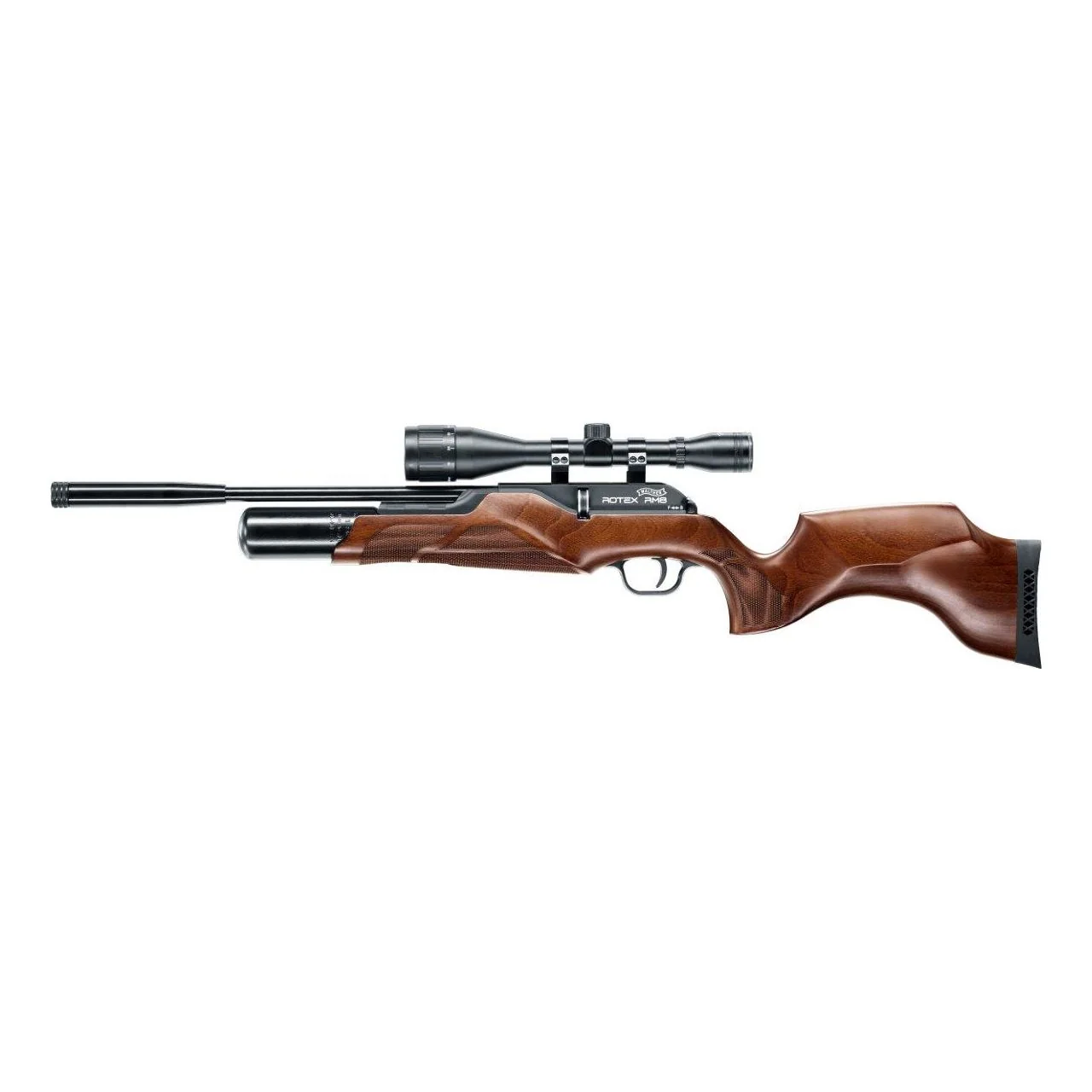
The Walther Rotex RM8 is a German-engineered pre-charged pneumatic (PCP) air rifle distinguished by its traditional wooden stock, precision-manufactured components, and eight-shot rotary magazine. Through its combination of European craftsmanship and established pneumatic technology, a distinctive balance of heritage styling and modern engineering is achieved.
Designed and manufactured in Germany, the rifle is complemented by an Italian-made Minelli wooden stock. Furthermore, its refined construction is supported by a Walther barrel, integrated compressed-air cylinder, and carefully arranged operating components.
Alongside its traditional appearance, several practical characteristics are incorporated into the overall design. Consequently, the Walther Rotex RM8 is recognized as a notable model within the sporting and recreational air rifle category.
Key Features and Product Highlights
The following characteristics are associated with the classic Walther Rotex RM8 configuration:
-
-
-
Manufacturer: Umarex / Walther, Germany
-
Power system: Pre-charged pneumatic (PCP)
-
Available calibres: .177 (4.5 mm) and .22 (5.5 mm)
-
Magazine capacity: Eight-shot rotary magazine
-
Action: Manual bolt-action mechanism
-
Stock: Italian-made Minelli wooden stock
-
Barrel: 500 mm Walther precision barrel
-
Overall length: Approximately 1,040 mm for the original specification
-
Weight: Approximately 3.61 kg without accessories
-
Air system: Integrated high-pressure compressed-air cylinder
-
Pressure monitoring: Built-in pressure gauge
-
Safety: Manual trigger safety
-
Optics: Designed for telescopic sights; scope not ordinarily included
-
Energy options: Different factory configurations depending on calibre and market
Specifications refer to the original model documented in the manufacturer’s earlier catalogue and operating manual. Later versions and regional configurations may differ.
German Engineering and Traditional European Craftsmanship
A Distinguished Manufacturing Heritage
The Walther Rotex RM8 has been developed around the established engineering traditions associated with German airgun manufacturing. Throughout its construction, careful attention is given to material selection, mechanical arrangement, and component integration.
In addition, a traditional British-inspired sporting profile is complemented by German mechanical design. As a result, a familiar exterior appearance is combined with the technical characteristics of a contemporary PCP platform.
Rather than being defined exclusively by appearance, the rifle is distinguished by its internal construction. Its operating components are housed within a conventional sporting-rifle arrangement, while the compressed-air system is incorporated beneath the barrel.
Equally important, the model’s manufacturing background is supported by the involvement of specialist European component producers. Through this combination, the Rotex RM8 occupies a recognizable position among traditionally styled pneumatic sporting rifles.
Premium Minelli Wooden Stock
An Italian-manufactured Minelli stock is fitted to the traditional wooden-stock version. Its natural wood grain is displayed across the body, while textured gripping surfaces are incorporated into designated areas.
Furthermore, the stock’s ergonomic profile is complemented by a defined pistol grip, shaped fore-end, and rubber buttplate.
Through this arrangement, traditional woodwork is combined with a recognizable sporting-rifle silhouette. Meanwhile, the natural variations in timber grain ensure that individual wooden stocks may differ slightly in color and appearance.
The classic styling is particularly notable because it is retained despite the integration of a compressed-air power system.
Pre-Charged Pneumatic Technology
Integrated Compressed-Air System
A pre-charged pneumatic mechanism is incorporated into the Walther Rotex RM8. Unlike a spring-powered air rifle, compressed air is stored within an integrated cylinder and is used as the system’s energy source.
For monitoring purposes, a pressure gauge is built into the rifle. Additionally, a dedicated filling connection is provided as part of the original design.
The operating system is supported by a conventional bolt-action arrangement and an eight-shot rotary magazine.
Importantly, the manufacturer’s original manual identifies a compressed-air system with a specified pressure rating of 232 bar. However, applicable pressure limits and approved filling procedures must always be confirmed against the manual for the exact variant.
Eight-Shot Rotary Magazine
An eight-round rotary magazine is supplied as a defining feature of the classic model. Its compact design is integrated into the rifle’s receiver arrangement.
Rather than relying on a single-shot loading configuration, a removable rotary magazine is incorporated into the original engineering concept.
The magazine system is complemented by the rifle’s manual bolt-action mechanism. Consequently, the Walther Rotex RM8 can be distinguished from single-shot PCP models through its factory-designed multi-shot construction.
Proper magazine condition, compatible ammunition, and manufacturer-approved maintenance remain important considerations throughout ownership.
Precision-Manufactured Walther Barrel
Barrel Construction and Technical Design
A 500 mm barrel is specified for the original Walther Rotex RM8 in the manufacturer’s operating documentation.
Manufacturing quality is emphasized through the model’s use of established barrel-production techniques. In addition, the original design incorporates a threaded muzzle arrangement identified in manufacturer literature.
For the standard rifle, open sights are not normally supplied. Instead, the product is designed around an optics-compatible configuration.
However, accuracy-related outcomes are influenced by ammunition characteristics, maintenance condition, individual equipment differences, and environmental conditions. Therefore, particular performance results should not be assumed without appropriate testing.
Consistent Engineering Standards
Throughout the rifle’s design, the interaction between the barrel, action, and compressed-air system is governed by the manufacturer’s technical specifications.
Moreover, the mechanical assembly is supported by components intended for the model’s designated factory operating range.
When the rifle is maintained according to official instructions, its technical condition can be assessed against the manufacturer’s documented standards.
For further clarity, technical inspection and servicing should be undertaken by suitably qualified professionals.
Ergonomic Design and Exterior Finish
Balanced Traditional Styling
The classic Rotex RM8 is recognized by its combination of a wooden stock, dark metal components, and an under-barrel compressed-air cylinder.
Its overall proportions are influenced by conventional sporting-rifle design. Meanwhile, the fore-end is shaped around the pneumatic cylinder, creating a visually integrated profile.
A textured pistol-grip area and fore-end are incorporated into the wooden stock. In addition, the buttplate is finished with a rubberized surface.
These exterior elements contribute to the rifle’s recognizable appearance without abandoning the traditional design language associated with European sporting airguns.
Durable Materials and Finishing Details
Metallic operating components are combined with natural timber to create the model’s characteristic appearance.
Furthermore, corrosion prevention and careful storage are important for preserving the original finish. The wooden stock should be protected from prolonged exposure to excessive moisture, while metal surfaces should be maintained according to the manufacturer’s guidance.
Through routine condition checks, visible wear, surface deterioration, and potential servicing requirements can be identified.
Available Calibres and Factory Configurations
The Walther Rotex RM8 has been produced in two commonly documented calibres: .177 (4.5 mm) and .22 (5.5 mm).
Different factory energy configurations have also been identified in the manufacturer’s historical catalogue. These include variants listed at 7.5, 16, 24, and 30 joules, depending on model and calibre.
However, regional legal requirements vary considerably. Certain configurations may be subject to licensing, registration, or other restrictions.
Accordingly, the exact model number, calibre, factory energy rating, and local legal status should be verified before acquisition or transfer.
Maintenance, Storage, and Long-Term Care
Responsible Equipment Maintenance
The Walther Rotex RM8 is designed around a high-pressure pneumatic system, making appropriate inspection and maintenance particularly important.
The condition of the air cylinder, seals, pressure gauge, and other pneumatic components should be evaluated in accordance with the manufacturer’s instructions.
Additionally, only compatible, manufacturer-approved servicing materials should be considered. Unauthorized pressure-system modifications should be avoided because serious equipment failure or injury could result.
Where specialized repair is required, inspection should be entrusted to a qualified airgun technician.
Safe Storage and Ownership
Secure storage is an essential consideration for every air rifle.
The equipment should be stored unloaded, protected from unauthorized access, and kept in accordance with applicable local laws.
Furthermore, the owner’s manual should be retained for reference. Manufacturer warnings, inspection intervals, and transport requirements should be followed throughout the equipment’s service life.
What Makes the Walther Rotex RM8 Distinctive?
Several characteristics distinguish the Rotex RM8 within the classic PCP air rifle category.
First, traditional wooden-stock styling is combined with German pneumatic engineering. Second, a dedicated eight-shot rotary magazine is incorporated into the original configuration.
Additionally, a Walther barrel, integrated pressure gauge, and compressed-air cylinder are included in the model’s core design.
The Italian-made Minelli stock provides another distinguishing characteristic, particularly for those interested in traditional European sporting-rifle craftsmanship.
Finally, the availability of different factory configurations demonstrates how the model has been adapted for different regulatory markets.
Together, these characteristics establish the Walther Rotex RM8 as a technically interesting example of a traditionally styled, German-manufactured PCP air rifle.
Conclusion
The Walther Rotex RM8 represents a combination of traditional European stock design and modern pre-charged pneumatic engineering. Its eight-shot magazine, precision-manufactured barrel, integrated compressed-air system, and Italian Minelli wooden stock contribute to its distinctive identity.
For collectors, sporting-equipment researchers, and responsible airgun owners, the model offers an opportunity to examine how established craftsmanship has been integrated into a contemporary pneumatic platform.
Its exact specifications, condition, and regulatory classification should always be checked against the particular factory version and applicable local requirements.
Walther Rotex RM8 – Calibres, FAC Classification, Power Specifications, Scope Compatibility and Accessories
1. Available Calibres and Factory Specifications
The Walther Rotex RM8 is available in two established airgun calibres: .177 (4.5 mm) and .22 (5.5 mm). Both configurations are documented in the manufacturer’s technical literature and form part of the rifle’s original pre-charged pneumatic product range.
Different production versions have been manufactured to meet regional regulatory requirements. Consequently, calibre alone should not be used to determine a rifle’s muzzle energy, licensing classification, or factory operating specifications.
.177 Calibre (4.5 mm)
The .177 configuration is recognized as one of the manufacturer’s original calibre options. It is identified in historical operating manuals and product catalogues, including versions produced with different factory energy ratings.
Furthermore, the rifle incorporates an eight-shot rotary magazine designed for the specified calibre. The corresponding components must match the model’s original factory configuration.
.22 Calibre (5.5 mm)
The .22 configuration is another established version within the product family. Like the smaller-calibre model, it uses a compressed-air cylinder, manually operated bolt-action mechanism, and designated rotary magazine.
However, calibre-specific components are not necessarily interchangeable. Therefore, replacement parts should be identified through the correct manufacturer part number.
2. FAC and Non-FAC Classifications
What Does FAC Mean?
FAC stands for Firearm Certificate, a term commonly used in Great Britain when discussing firearms licensing.
In England and Wales, an air rifle with muzzle energy exceeding 12 foot-pounds (approximately 16.3 joules) is generally subject to firearm certification requirements. Scotland and Northern Ireland have different air-weapon licensing frameworks.
Accordingly, the expression FAC is primarily a legal classification rather than a particular mechanical feature.
Non-FAC Factory Versions
Lower-energy factory configurations have been manufactured for jurisdictions with specific regulatory thresholds.
For example, historical manufacturer catalogues identify 7.5-joule and 16-joule variants.
These factory ratings should not automatically be interpreted as exemptions from licensing. Instead, applicable legislation and the rifle’s actual certified specification must be considered.
FAC-Rated Factory Versions
Higher-energy versions have also been documented, including 24-joule and 30-joule configurations.
Such models may be subject to additional licensing, registration, storage, and transfer requirements, depending on the jurisdiction.
Importantly, unauthorized alteration of the pressure system or energy output can affect legal classification and equipment safety. The manufacturer specifically warns against modifications that change the rifle’s classification.
3. Power and Energy Specifications
The manufacturer’s historical documentation identifies several factory-rated configurations.
| Calibre |
Documented factory energy |
| .177 (4.5 mm) |
7.5 J, 16 J, 24 J |
| .22 (5.5 mm) |
7.5 J, 16 J, 30 J |
Source: Historical Umarex catalogue. Availability varies by model, production year, and market.
Understanding Muzzle Energy
Muzzle energy describes the kinetic energy of a projectile as it exits the barrel. It is commonly expressed in joules or foot-pounds.
Unlike compressed-air cylinder pressure, muzzle energy describes a different physical characteristic.
Consequently, reservoir pressure should never be treated as an interchangeable measure of projectile energy.
Factory energy ratings also help determine the legal classification of an air rifle in certain countries.
Compressed-Air Cylinder
The original operating manual specifies a compressed-air cylinder with a maximum pressure rating of 232 bar.
A pressure gauge is integrated into the rifle, allowing the reservoir’s pressure to be monitored.
Furthermore, the manufacturer requires clean, dry, oil-free compressed air and prohibits alterations to the cylinder and valve assembly.
For safety, pressure vessels must be inspected and serviced according to manufacturer instructions. The original manual also identifies age-related cylinder inspection requirements.
4. Scope Compatibility and Optical Accessories
Factory Optical Mounting Arrangement
The traditional model is documented with an 11 mm scope mounting rail.
This is an important compatibility characteristic because mounting standards vary among sporting air rifles.
Although many retailers display the rifle with an optical sight installed, scopes are not necessarily included with the standard product.
Therefore, the manufacturer’s package specification should be reviewed to establish exactly what is supplied.
Considerations When Selecting a Scope
Optical compatibility should be assessed using the manufacturer’s documented mounting specifications and the optical manufacturer’s published requirements.
Relevant considerations include the following:
-
Mounting standard: Compatibility with the rifle’s factory rail
-
Manufacturer approval: Confirmation that the optic and mounting hardware are appropriate for the model
-
Mechanical clearance: Verification that the accessory does not obstruct safety-critical components
-
Warranty conditions: Compliance with installation restrictions
-
Professional installation: Inspection by a qualified technician where appropriate
Rather than recommending an optic intended to increase weapon effectiveness, the most appropriate approach is to confirm the physical and mechanical compatibility of an existing or proposed accessory with an authorized specialist.
5. Recommended Maintenance, Storage and Protective Accessories
Several non-performance accessories can support responsible ownership, equipment preservation, and regulatory compliance.
Protective Carrying Case
A suitably sized protective case helps shield the equipment from scratches, accidental impacts, and environmental exposure during lawful transportation.
Ideally, the case should provide sufficient internal space to prevent pressure against delicate exterior components.
Additionally, a lockable design may help satisfy applicable transportation and storage requirements.
Secure Storage Cabinet
A lockable, legally compliant storage cabinet is an important ownership accessory.
Depending on the jurisdiction, specific requirements may apply to cabinet construction, installation, and access control.
Furthermore, ammunition should be stored according to local legislation and manufacturer safety guidance.
Safety Glasses
Suitable protective eyewear is an essential safety consideration at approved sporting facilities.
Eyewear should comply with appropriate impact-resistance standards and be maintained in good condition.
For supervised recreational activities, relevant facility-specific safety rules should also be followed.
Manufacturer-Approved Maintenance Supplies
External maintenance products can help preserve the rifle’s factory finish.
Useful categories include soft cleaning cloths, approved exterior protective products, and suitable storage materials.
However, cleaning chemicals and lubricants must be compatible with the manufacturer’s recommendations.
Unauthorized internal servicing or pressure-system disassembly should be avoided.
Pressure-System Inspection Services
Professional inspection is particularly important for equipment containing high-pressure compressed air.
A qualified technician can assess the condition of the cylinder, seals, pressure gauge, and other safety-critical components.
Moreover, any equipment showing signs of leakage, damage, or deterioration should be withdrawn from use pending inspection.
6. Original Accessories and Replacement-Part Compatibility
Replacement components should be selected using the correct model designation and production variant.
The original rifle incorporates several calibre-specific parts, including its rotary magazine.
Therefore, components supplied for another calibre or a different product-family version should not automatically be considered interchangeable.
Original documentation, identifiable part numbers, and authorized service support can help establish compatibility.
Furthermore, accessories shown in promotional images may not form part of a standard factory package.
7. Final Considerations
The Walther Rotex RM8 is distinguished by its two documented calibres, multiple factory energy configurations, eight-shot rotary magazine, and traditional European engineering.
Its original compressed-air system, manufacturer-defined specifications, and established product history are important characteristics for collectors and responsible owners.
Before selecting accessories or replacement components, the exact model variant should be verified.
Falcon Scope, Falcon Optics, Element Titan 3-18×50 and Precision Rifle Optics: Complete Buying Guide
Discover Falcon Scope Technology and Modern Precision Optics
Choosing the right falcon scope can transform the viewing experience for target shooters, outdoor enthusiasts, and precision optics users. Modern optical technology combines high-quality glass, adjustable magnification, durable construction, and advanced reticle systems to support clear observation across different distances.
Whether researching falcon optics, falcon optical, falcon vision, or falcon tactical equipment, understanding individual product specifications remains essential. Different optic companies manufacture equipment for competitive target shooting, hunting, observation, thermal imaging, and specialist applications.
The Falcon Optical Systems product range includes competition-oriented riflescopes, while other manufacturers offer digital and thermal solutions. Consequently, buyers should distinguish traditional optical scopes from electronic observation equipment before comparing features.
Falcon Optics and Popular Optical Configurations
Falcon Optical Systems produces riflescopes designed for demanding precision applications. Its competition-oriented products include high-magnification options featuring specialized turret adjustments and optical systems.
Popular search terms include:
- falcon 10×50 and 10 x50 configurations for fixed-magnification optical research.
- falcon xl and falcon sp for model identification and compatibility searches.
- falcon 40 and 30 falcon when researching unidentified Falcon-related equipment.
- falcon claw and falconclaw for accessories or products requiring brand verification.
- tactical falcon and falcon arm when comparing tactical accessories and related equipment.
- falcon receiver when identifying device-specific components.
- falcon scanner and falcon thermal for electronic observation equipment.
Because similarly named products may belong to unrelated manufacturers, confirming the exact model is always recommended.
Understanding Rifle Scope Magnification and Objective Lens Sizes
Comparing 3-18×50, 4.5-18 and High-Magnification Scopes
Optical magnification determines how large a distant subject appears through a scope. For example, 3-18 magnification provides an adjustable viewing range suitable for diverse observation and sporting applications.
Searches for 3×18, 3×18 scope, 3-18 scopes, and 3:18 often relate to variable-magnification optics. Meanwhile, 4.5 x 18, 4.5 18, 4x-18, and 18 scope reflect interest in alternative magnification ranges.
Consumers comparing nightforce 3-18 equipment with the best 3-18 scopes should examine optical clarity, adjustment consistency, weight, eye relief, and warranty coverage.
Similarly, numerical searches such as 18x-4, 60x 3 50x 5, 3/5/25, and 3 5 25 should be checked against manufacturer specifications rather than interpreted automatically as verified optical configurations.
Understanding 50mm and 60mm Objective Lenses
An objective lens collects incoming light and contributes to image brightness and resolution. Common measurements include 50mm and 60mm, although overall image quality depends on glass composition, coatings, magnification, and environmental conditions.
Buyers sometimes search for how big is 50 x 60 or what size is 50 x 60. These measurements require context because 50 x 60 could describe physical dimensions rather than magnification.
Other numerical search variations include 25 x .50, 500 x 50, 500×60, 510 50, 50×0, 36x 50, 1/4×40, .25×50, 800 x 50, 60 x50, .50 x 10, 50x.05, 7.5 x 50, 50x 05, .25 x 50, 50 600, and 1050 x 5.
Furthermore, searches such as 10:50, scope50, and xoi50.com may represent alternative notation, incomplete model references, or unrelated websites. Therefore, these strings should never substitute for documented optical specifications.
Element Titan 3-18×50: Premium Optical Performance
Why the Element Titan 3-18×50 Deserves Attention
The element titan 3-18×50 is a versatile first-focal-plane riflescope designed around a broad magnification range and precision adjustment system.
Also searched as element titan 3 18×50, this model combines a 34mm main tube, 50mm objective lens, illuminated reticle, and adjustable parallax.
Its notable features include:
- 3-18x magnification: Supports flexible viewing across different distances.
- 50mm objective: Provides substantial light-gathering area.
- 34mm main tube: Accommodates a wide internal adjustment range.
- First-focal-plane reticle: Maintains consistent angular subtensions throughout magnification changes.
- Precision turrets: Support repeatable elevation and windage adjustments.
- HD glass: Helps minimize optical distortion and improve image definition.
- Weather-resistant construction: Supports operation in challenging outdoor conditions.
The manufacturer’s published specifications include 150 MOA of elevation adjustment, a mechanical zero-stop, and parallax adjustment beginning at 10 yards.
Consequently, this optic is worth considering when comparing premium variable-magnification scopes. Element Optics official specifications.
Chromatic Aberration and Optical Image Quality
Understanding chromatic aberration scope performance helps buyers evaluate image sharpness. Chromatic aberration appears as unwanted colored fringes around contrasting objects.
High-quality glass and effective lens coatings can reduce these imperfections, improving visual definition.
Likewise, users researching element ll should verify whether the search refers to a specific product generation, model designation, or accessory.
Falcon Thermal Imaging, Red Dot Optics and Electronic Sensors
Advanced Falcon Vision and Thermal Observation
Modern thermal equipment detects infrared radiation rather than depending entirely on visible light.
For users exploring falcon thermal, this distinction is important because thermal imaging and conventional optical magnification serve different purposes.
Some searches also mention elbit falcon and elbit falcon red dot. However, the precise manufacturer and model must be established before making compatibility or performance claims.
Additionally, falcon sensor manual searches generally indicate a need for operating instructions, sensor calibration information, maintenance guidance, or technical support.
Related search terms such as falke optics and optical camp may point toward alternative optic brands or specialist optical applications.
Even accessories marketed under unrelated product categories, including the falconeye patriot convertible bluetooth headset, require independent compatibility checks.
How Far Can a Falcon See?
The question how far can a falcon see can refer either to the bird’s remarkable natural eyesight or the observation distance of an optical device.
For riflescopes, useful viewing distance depends on magnification, atmospheric clarity, objective lens performance, and the size of the observed subject. No universal distance rating applies to every Falcon-branded device.
Rifle Rangefinders and Advanced Distance-Measuring Technology
Choosing a Rifle Rangefinder and Integrated Optics
A rifle rangefinder measures distance using optical or electronic technology. Modern laser devices can provide fast measurements and improve distance awareness in sporting and observation environments.
Common product searches include rifle range finder, laser range finder for rifle, rangefinder scope for rifle, and rangefinding rifle scope.
Additionally, scopes with rangefinders built in combine observation and distance measurement within a single optical platform.
A picatinny mounted rangefinder, sometimes described as a picatinny range finder, uses a compatible rail interface for attachment.
Other configurations include a weapon mounted range finder, while the abbreviation wmlrf commonly refers to a weapon-mounted laser rangefinder.
Electronic Ballistic Calculators and Distance Systems
A weapon mounted ballistic calculator can combine measured distance with programmed ballistic information, depending on its design.
Products associated with arken wmlrf searches include Arken’s weapon-mounted ranging equipment. Its TargetLock TL3000 incorporates laser-ranging and ballistic calculation capabilities. Arken Optics official product information.
Meanwhile, element rf searches may relate to Element Optics rangefinding products. Buyers should confirm the exact model, intended purpose, and accessories before purchasing.
Rifle Scope Mounts, Rings and Precision Accessories
Understanding Picatinny and Dovetail Scope Mounts
Choosing the correct mounting system is essential for secure installation and optical alignment.
A dovetail scope mount connects compatible optics to a dovetail-style rail, while dovetail rings provide alternative mounting arrangements.
Similarly, dovetail scope mounts and 30mm dovetail scope rings must match both the optic tube diameter and rail dimensions.
For Picatinny systems, popular options include picatinny scope mounts, picatinny scope rings, 30mm scope mount picatinny, and 30mm picatinny scope rings.
Buyers should confirm tube size, ring height, rail compatibility, and appropriate installation specifications.
Diving Board Mounts and Scope Accessories
Specialist mounting configurations include a 34mm diving board mount, 34mm scope mount with diving board, diving board scope mount, and 30mm diving board mount.
A scope diving board generally describes an elevated accessory mounting platform integrated with or attached to a compatible optical mounting system.
An element mount may provide a manufacturer-specific mounting solution, while a turret wheel can assist with handling or adjustment on compatible scopes.
Protective Covers for Optical Equipment
Protecting lenses helps preserve optical performance during transportation and storage.
Popular protective accessories include:
- tenebraex scope caps for compatible objective and ocular lenses.
- tenebraex scope covers for additional lens protection.
- allen neoprene scope cover for cushioning and shielding an optic during storage or transport.
Choosing the Right Falcon Scope and Optical Accessories
Selecting an effective optical system requires more than comparing magnification numbers. Glass quality, mechanical reliability, reticle design, mounting compatibility, environmental resistance, and manufacturer support all influence long-term satisfaction.
Whether researching Falcon optics, Element Titan models, advanced rangefinding technology, or protective accessories, prioritize verified product specifications over ambiguous search terminology.
For the best purchasing experience, compare authentic manufacturer documentation, confirm compatibility, and choose equipment suited to your intended sporting or observation application.
Frequently Asked Questions (FAQs)
1. What is a pre-charged pneumatic air rifle?
A pre-charged pneumatic (PCP) air rifle is a sporting airgun that uses compressed air stored inside a high-pressure cylinder. Instead of depending on a spring-powered mechanism or a disposable CO₂ cartridge, energy is supplied through a rechargeable compressed-air reservoir.
This technology is widely recognized for its distinctive mechanical design and established presence in recreational target shooting. Furthermore, PCP systems are available in numerous configurations, ranging from compact sporting models to traditional wooden-stock designs.
Unlike conventional spring-powered systems, the compressed-air supply must be replenished using suitable filling equipment. Therefore, owners should understand the manufacturer’s pressure specifications, maintenance requirements, and safety instructions.
2. Is this air rifle manufactured in Germany?
Yes. The traditional model is associated with German manufacturing and engineering through Walther and Umarex.
Its construction reflects the combination of European manufacturing expertise and established sporting-airgun design principles. Additionally, selected components are sourced from specialist manufacturers, including the Italian stock producer Minelli.
German manufacture does not automatically establish that every component originates in Germany. Instead, the complete product represents a combination of specialist engineering and European craftsmanship.
For complete confirmation, the markings, serial number, manufacturer’s documentation, and exact production variant should be examined.
3. What materials are used in the wooden stock?
The traditional stock is manufactured from natural hardwood, commonly specified as walnut in product literature. It is produced by Minelli, an Italian manufacturer recognized for wooden sporting-gun stocks.
Natural timber provides the distinctive grain patterns associated with classic sporting equipment. Furthermore, the stock incorporates textured gripping areas, a shaped fore-end, and a defined pistol grip.
Because natural wood varies, differences in grain distribution and color may be observed between individual examples.
Appropriate maintenance is also essential. The stock should be protected from prolonged moisture exposure, excessive temperatures, and harsh cleaning chemicals.
Consequently, its original appearance can be better preserved through careful handling and proper storage.
4. How many pellets can the magazine hold?
The standard rotary magazine accommodates eight pellets.
This eight-shot configuration is an established characteristic of the original design. Moreover, the magazine is incorporated into a manually operated bolt-action system.
Magazine compatibility should always be confirmed against the rifle’s calibre and specific production version. Although magazines may appear similar externally, differences in dimensions and specifications can affect compatibility.
Only manufacturer-approved components should be used.
Additionally, a magazine should be inspected periodically for visible damage, excessive wear, or contamination. If its condition is uncertain, professional assessment is recommended.
5. Which calibres are available?
Two commonly documented calibres are available: .177 (4.5 mm) and .22 (5.5 mm).
Both are established airgun calibres, although the exact factory configuration can differ according to the market in which the equipment was originally supplied.
Importantly, calibre must not be confused with muzzle energy. Different versions may have different factory energy ratings even when the same calibre designation is used.
Before purchasing replacement components or compatible ammunition, the calibre marking should be checked against the manufacturer’s documentation.
Local laws may also impose restrictions based on calibre, muzzle energy, or other technical classifications.
6. Does the air rifle include a telescopic scope?
A telescopic scope is not necessarily included with the standard rifle.
Depending on the original package and retailer configuration, equipment may be supplied with or without additional optical accessories.
Therefore, product photographs should not automatically be interpreted as proof that a particular scope is included.
The contents of a package should be confirmed through its official specification sheet or a clearly documented inventory.
For second-hand examples, the condition and originality of any included accessories should also be examined.
Furthermore, any optical equipment should be installed and checked by someone familiar with the manufacturer’s approved mounting system.
7. What is the overall length of the rifle?
The original traditional configuration is approximately 1,040 mm in overall length.
However, different production versions, stock configurations, or factory modifications may have different dimensions.
The listed measurement should therefore be treated as a model-specific reference rather than a universal specification for every version.
Overall length is relevant to transportation, storage, protective-case selection, and equipment identification.
When dimensions are important, the exact manufacturer’s technical sheet should be consulted.
In addition, any protective storage case should provide sufficient internal clearance without placing unnecessary pressure on the rifle’s components.
8. How much does the rifle weigh?
The original wooden-stock configuration is commonly documented at approximately 3.61 kg without additional accessories.
Actual total weight may differ depending on the production version and any components fitted to the equipment.
For example, protective cases and separately supplied accessories contribute to transport weight but are not included in the rifle’s basic specification.
Consequently, product listings should distinguish between the manufacturer’s stated weight and the total weight of a complete package.
Where precise measurements are required, the actual equipment should be weighed using a suitable scale.
9. What is the maximum filling pressure?
The original manufacturer’s documentation specifies a compressed-air cylinder rated for 232 bar.
This pressure rating is an important technical characteristic and should never be exceeded.
Furthermore, owners should verify that the cylinder, filling equipment, and associated components meet the manufacturer’s requirements.
High-pressure compressed air must be handled carefully because damaged or incorrectly maintained equipment can present serious hazards.
For this reason, filling and servicing should be performed only according to official instructions.
If the pressure rating cannot be confirmed, a qualified technician should inspect the equipment before it is used.
10. Does the rifle include a built-in pressure gauge?
Yes. A pressure gauge is incorporated into the original design.
This component provides a visual indication of the compressed-air pressure within the reservoir.
Furthermore, its placement forms part of the equipment’s integrated pneumatic arrangement.
The gauge should be examined periodically for visible damage, unusual readings, or other signs of deterioration.
However, a pressure gauge should not be considered a substitute for proper professional inspection.
If inconsistent readings or suspected faults are identified, the equipment should be assessed by a qualified technician before further use.
11. What type of barrel is installed?
A precision-manufactured Walther barrel is incorporated into the original model.
The barrel measures approximately 500 mm and is associated with the manufacturer’s established sporting-airgun engineering.
Additionally, the original product documentation identifies a threaded muzzle arrangement.
The barrel’s condition is an important part of the rifle’s overall mechanical integrity. Therefore, visible corrosion, internal damage, and unauthorized modifications should be treated seriously.
Although precision manufacturing is an important characteristic, actual performance cannot be guaranteed solely from barrel specifications.
Individual equipment condition and maintenance history should also be considered.
12. Is the trigger adjustable?
Certain original configurations feature a manufacturer-designed adjustable trigger assembly.
However, the precise adjustment provisions should be confirmed through the appropriate owner’s manual.
Because the trigger forms part of the equipment’s safety-critical operating mechanism, unauthorized adjustments or modifications are not recommended.
Furthermore, a trigger that appears damaged, inconsistent, or mechanically defective should be examined by a qualified professional.
The original safety arrangement must remain functional at all times.
13. How many shots are available from one air fill?
The number of shots available from one fill depends on the factory configuration and operating conditions.
Some retailer specifications reference approximately 180 shots for particular versions. However, this figure should not be treated as a guaranteed result across every calibre or energy configuration.
Differences in factory specifications, equipment condition, and environmental conditions can affect the number of shots obtained.
Consequently, manufacturer documentation should take priority over generalized performance claims.
It is also important to distinguish between the total number of shots and the number delivered within a particular performance range.
South London Airgun Centre
14. Is a firearms certificate required?
Licensing requirements depend on the country, region, calibre, and factory energy classification.
Some jurisdictions allow certain low-powered air rifles without a firearms certificate, while more powerful versions may be regulated as firearms.
Furthermore, minimum-age requirements, registration obligations, transport restrictions, and approved storage conditions may apply.
For example, different rules can exist within the same country depending on the local jurisdiction.
Therefore, no universal licensing exemption should be assumed.
Before ownership or transfer, the relevant legal requirements should be confirmed with the appropriate authorities.
15. Can the rifle be transported internationally?
International transportation may be possible where permitted by law, but it can involve substantial regulatory restrictions.
Import permits, export authorization, customs declarations, carrier policies, and local firearms classifications may all be relevant.
Additionally, compressed-air cylinders can be subject to specific transportation restrictions, particularly during air travel.
Importantly, permission to own an air rifle in one country does not automatically establish permission to import it into another.
Any proposed international transfer should therefore be reviewed with the relevant customs authority, licensing body, and authorized carrier.
16. How should the equipment be stored?
Secure, dry, and legally compliant storage is recommended.
The rifle should be kept unloaded and protected against unauthorized access, particularly by children and other individuals who are not permitted to handle it.
Furthermore, its storage environment should be protected from excessive humidity, extreme temperatures, and corrosive substances.
A suitable locked cabinet or other legally approved storage arrangement may be required.
For the compressed-air system, the manufacturer’s specific storage instructions should also be followed.
Regular visual inspection can help identify moisture exposure, exterior deterioration, or potential servicing requirements.
17. How often should maintenance be performed?
Maintenance requirements depend on the equipment’s age, condition, usage history, and manufacturer recommendations.
Routine visual inspection is important, particularly for the exterior finish, stock, pressure gauge, and pneumatic components.
Additionally, professional servicing may be necessary when seals deteriorate or mechanical irregularities are identified.
Because the compressed-air reservoir operates under high pressure, internal repairs should not be attempted without the appropriate qualifications and equipment.
The official owner’s manual remains the primary reference for maintenance requirements.
18. Is this model suitable for collectors?
Yes. The traditional wooden-stock design, German manufacturing background, and Italian craftsmanship make the model an interesting subject for sporting-airgun collectors.
Its established product history also contributes to its appeal among enthusiasts of European pneumatic engineering.
However, collectible value depends on several factors, including originality, physical condition, documentation, and market demand.
Examples retaining their original components and manufacturer documentation may be of particular interest.
Ultimately, historical significance and collectible value should be evaluated separately from any claims about performance.



Reviews
There are no reviews yet.