Daystate, FX Airguns, PCP Rifles, Accessories and Precision Airgun Equipment
For enthusiasts researching premium PCP platforms, accessories, replacement components, and precision shooting equipment, the modern airgun market offers an extensive range of options from brands such as Daystate and FX. Searches for daystate blackwolf, daystate redwolf, delta wolf, huntsman daystate, daystate alpha wolf, wolf delta, day state, and daystate delta wolf frequently come from shooters comparing electronic PCP technology, ergonomic designs, premium construction, and sophisticated firing systems. Traditional styling also remains important, which is why terms such as stock walnut, safari stock, dima stock, rimfire stocks, and stock replacement continue to attract buyers who value both appearance and practical fit.
Among electronically controlled PCP rifles, the daystate alpha wolf, daystate blackwolf, daystate redwolf, and daystate delta wolf are commonly associated with advanced regulation, refined shot management, and a highly consistent firing cycle. Searches such as what is a delta wolf, what is a delta wolf, delta wolf meaning, deltaw, blackwolf, red alpha wolf, alpha red wolf, model alpha gun, model alpha gun, and electronic wolves often reflect buyers trying to understand how Daystate’s electronically managed rifles differ from conventional mechanical PCP systems. Other searches, including daysta, wolf gun, wolverine gun, wolveriner, daystate wolverine sapphire, daystate wolverine sapphire, and wolfpack armory wolverine, demonstrate the broad interest surrounding Wolf-branded and Wolverine-related sporting platforms.
Small ergonomic components can make a substantial difference to comfort and handling. A rifle butt pad, rubber butt, rubber butt pad, and butt pad rifle accessory can improve shoulder contact, while a bradley cheek riser can help support a more consistent head position. Likewise, enthusiasts may research gecko grips, a cocking ball, short cocking, an index pin, pin magazine, lock timing, and lock time when learning about rifle ergonomics, cycling characteristics, and replacement components. Searches for buddy bottle cover and buddy bottle cover also remain relevant for shooters who want to protect external air cylinders from cosmetic wear during transport or field use.
Magazine compatibility is another frequent consideration. Users may search for a 177 magazine, mag 177, 25 magazine, 5.0 mm pellets, 177 pellets types, slug pellet, or a general pellet rifle when comparing ammunition formats and magazine configurations. Pellet selection should always match the manufacturer’s recommended caliber and specifications for the rifle being used. A well-matched magazine and suitable ammunition can support reliable feeding and consistent performance without unnecessary mechanical stress.
PCP equipment relies on compressed air, so searches such as air rifle compressed air, air gun pc, air gun, and air guns are commonly connected with understanding pre-charged pneumatic systems. Owners also frequently search for a pcp o ring kit because seals form an important part of maintaining an air-tight pneumatic system. Maintenance should follow manufacturer-approved procedures, especially for high-pressure components, regulators, cylinders, and valves.
Sound-moderation accessories form another major category. Common search terms include air gun suppressor, air gun suppressors, airgun moderator, air rifle moderator, 0db, 0db moderator, 0 db moderator, 0 db moderator, 0 db moderator, 0 db moderator, and hogan decimeater silencer. Thread-related searches include silencer thread adapter, thread protector rifle, and muzzle thread protector. Compatibility depends on barrel threading, caliber, applicable law, and manufacturer specifications, so owners should verify all requirements before purchasing or fitting any muzzle accessory.
Mounting systems have also become increasingly important as modular fore-ends and accessory rails become more common. Searches for an mlok to picatinny rail adapter, best m-lok to picatinny rail adapter, m-lok to picatinny adapter, picatinny m lok adapter, and picatinny bag rider usually come from shooters wanting greater flexibility when mounting supported accessories. The best adapter is generally one that matches the rifle’s rail specification, uses quality hardware, fits securely, and avoids unnecessary bulk.
Sling-related searches are equally common. Buyers frequently look up how to put a gun sling on a rifle, how to put a rifle sling on, how to install a rifle sling, riffle sling, rigle sling, how to put sling on rifle, installing a rifle sling, and attaching a sling to a rifle. A compatible sling can improve carrying comfort and transportation, but attachment points should always be checked against the rifle manufacturer’s recommendations to avoid damage to the stock or mounting hardware.
The alpha wolf barrel and accessories such as an ats tuner may also interest precision-focused users researching how different rifle configurations are designed. Similarly, terms such as weatherby vanguard trigger adjustment appear in broader shooting-related searches, although trigger systems differ significantly between platforms and should be serviced or adjusted only according to the applicable manufacturer’s safety instructions. Another unusual search phrase, how to put extinguisher call back together, is unrelated to PCP rifle servicing and should be treated according to the specific extinguisher manufacturer’s maintenance guidance rather than general airgun information.
For buyers comparing premium European PCP equipment, daystate redwolf price and daystate redwolf price are common commercial-intent searches. Pricing can vary depending on caliber, stock type, configuration, region, dealer, and included accessories. People may also search fx airgun dealer near me when looking for authorized retailers, parts support, servicing, or warranty assistance.
FX Airguns remains another major name in the PCP market. Popular searches include fx impact m3 .22cal air rifle. 600mm barrel, fx impact m3, fx impact mk3, fx m3 airgun, fx m3, impact m3, and fx impact m3 air rifle. Price-focused searches such as fx impact m3 precio, fx impact m3 precio en usa, and fx impact m3 price indicate strong buyer interest in comparing regional pricing and available configurations. The modular design philosophy associated with the FX Impact family makes it especially attractive to experienced PCP users who prioritize adjustability, ergonomics, accessory compatibility, and high-quality construction.
Potential buyers also encounter less common search phrases such as griffin gun, unfend, black snood, red bodywarmer, and can wolverine go on planes. Airline transport rules for sporting equipment and compressed-air components can differ substantially between carriers and countries, so travelers should always check current airline, airport, customs, and destination regulations before making travel arrangements. Likewise, terms such as 3.55kg in lbs may appear when buyers compare rifle weight specifications across metric and imperial listings.
Whether someone is researching the daystate alpha wolf, daystate blackwolf, daystate redwolf, huntsman daystate, wolf delta, an fx impact m3, or another premium pellet rifle, the most important purchasing factors remain intended use, caliber compatibility, overall weight, stock ergonomics, magazine design, air-cylinder capacity, manufacturer support, and accessory compatibility. Premium PCP ownership is best supported by appropriate maintenance, manufacturer-approved components, secure storage, responsible handling, and compliance with all local laws and transport requirements.
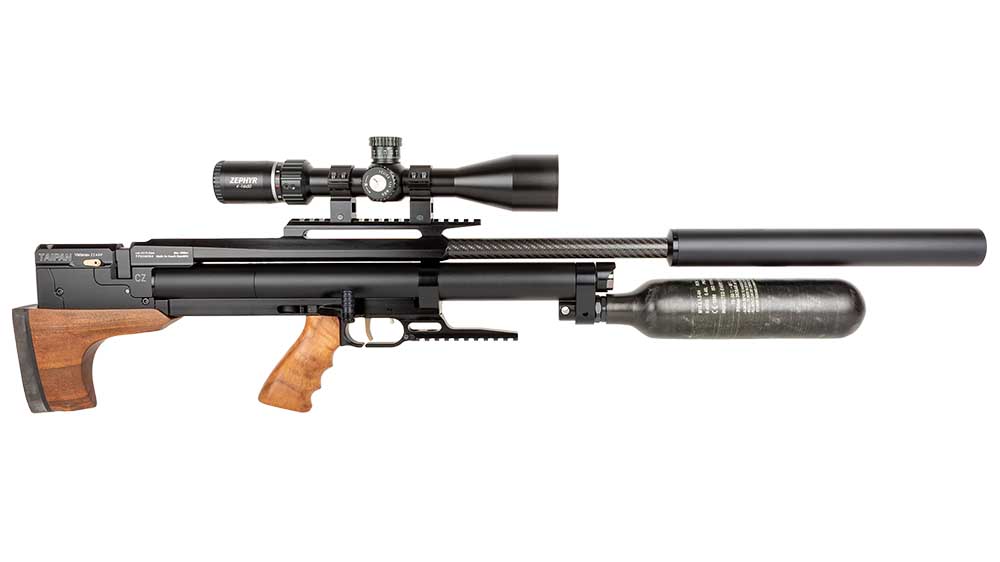
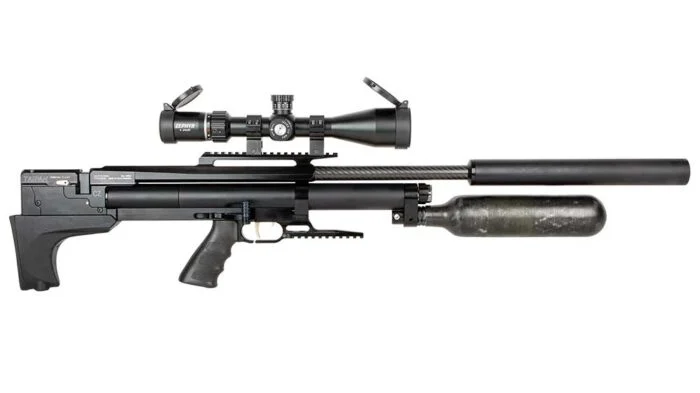
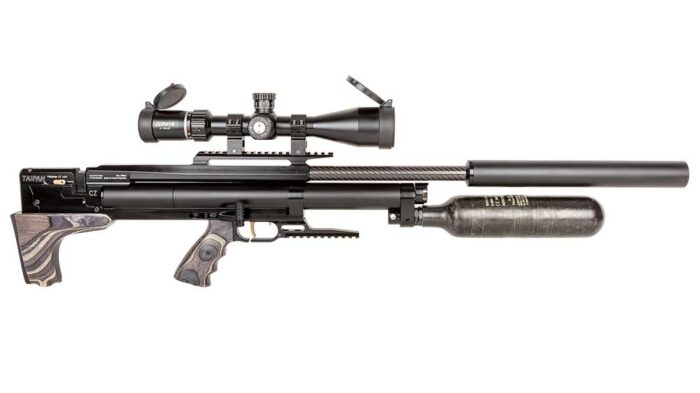
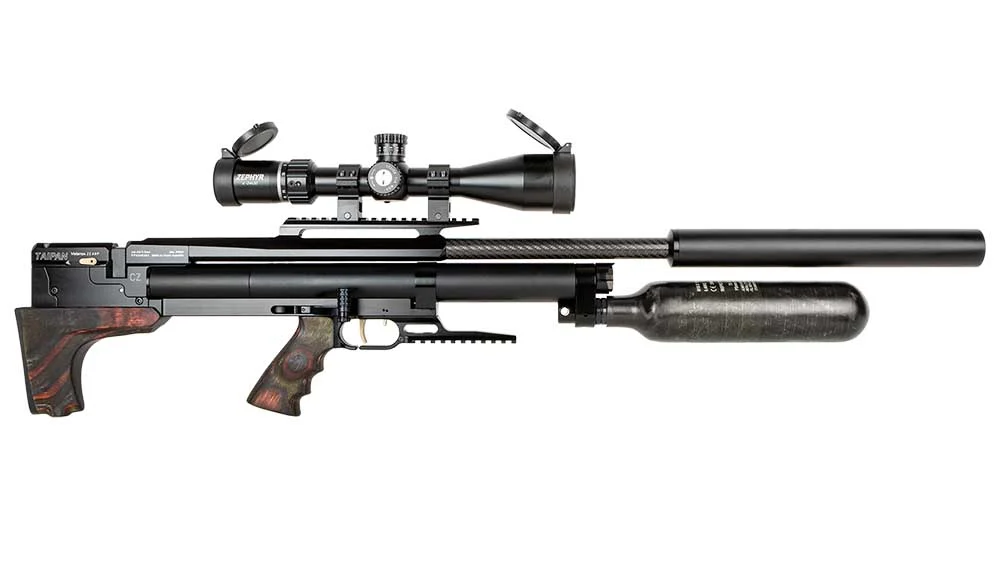
Calibres, FAC Status, Power Output, and Accessories for the Taipan Veteran II Tactical AR 700mm
Calibre choice is treated as a performance decision rather than a cosmetic option on the Taipan Veteran II Tactical AR 700mm. Consequently, each chambering is matched to a regulated power band, a 700 mm CZ/Lothar Walther polygon barrel, and a projectile family that rewards either precision pellets or high-BC slugs. Furthermore, legal classification must be confirmed before purchase, because muzzle energy in FAC markets sits well above typical unlicensed limits.
Calibre Options and Typical Applications
A .22 / 5.5 mm chambering is most often specified at approximately 65 J. Therefore, a versatile balance of trajectory, pellet availability, and terminal performance is delivered for mid-range hunting, pest control, and slug work. Moreover, a .25 / 6.35 mm chambering is typically listed at approximately 85 J. As a result, heavier slugs can be driven with greater remaining energy at distance, which is preferred when wind drift and animal size must be managed. Additionally, a .177 / 4.5 mm option is listed by some distributors for markets where flatter trajectory and lower legal energy are required; however, factory energy figures for that calibre are not always published at the same FAC level as the two larger bores.
Inclusive use is supported because the same chassis, rail, trigger, and air system are shared across chamberings. Hence, a club, family, or mixed-discipline shooter can select the calibre that matches local law and intended quarry without learning a new platform. Likewise, magazine geometry and the ADF (Anti Double Feed) system remain consistent, so loading habits transfer from one calibre to another.
Barrel geometry is optimized for slugs as well as conventional diabolo pellets. Consequently, boat-tail slugs in .22 and .25 are frequently chosen when sub-MOA groups at 50 m and beyond are the goal. Meanwhile, quality domed pellets remain an economical choice for practice, zero confirmation, and closer pest work.
FAC, Legal Power, and Responsible Classification
In the United Kingdom, energy above 12 ft-lb (approximately 16.3 J) for a rifle requires a Firearm Certificate. Therefore, the advertised 65 J (.22) and 85 J (.25) outputs of the Taipan Veteran II Tactical AR 700mm place those FAC-specification rifles firmly in licensed territory. Converted approximately, 65 J equals about 48 ft-lb and 85 J equals about 63 ft-lb. Accordingly, possession, transport, storage, and use must follow FAC conditions, approved land, and local hunting or pest-control rules.
A sub-12 ft-lb tune is offered or achievable in some markets and on some examples. In those cases, a lower regulator or hammer setting is employed so that the rifle can be held without FAC where the law allows. Nevertheless, every buyer is expected to verify the exact energy of the unit being purchased, because factory FAC rifles are not interchangeable with unlicensed airguns. Furthermore, export, import, and transit rules differ by country; EU, US, and other jurisdictions apply their own power, calibre, and licensing thresholds.
Safety language remains inclusive and non-negotiable. Eye protection is required. A verified backstop is required. Fill equipment rated for 300 bar is required. Subsequently, the manual safety and ADF system are used as designed so that a second projectile cannot be chambered while one already occupies the breech.
Power Delivery, Regulator, and Shot Consistency
A 300 bar maximum fill is specified. Moreover, a 480 cc Kevlar bottle is combined with a power plenum, so total air volume is increased and long regulated strings can be supported. As a result, velocity spread is kept tight when the regulator is operating in its designed window. Additionally, the bottle can be detached under pressure, therefore a spare charged cylinder can be carried and exchanged in the field without dumping the remaining air.
Power is not presented as a single number for every pellet. Instead, energy is influenced by projectile weight, skirt fit, and tune. Consequently, chronograph confirmation after a change of ammunition is recommended. Likewise, slug tunes that reach 60-plus ft-lb in .25 on long barrels have been reported by independent testers, while pellet tunes at the same fill remain more moderate. Hence, the 700 mm tube is used to extract both efficiency and accuracy rather than raw speed alone.
A two-stage trigger adjustable from approximately 0.5 to 1.5 kgf is provided so that the break can be matched to benchrest or field use. Meanwhile, the forward ambidextrous lever keeps cycling short, so follow-up shots stay on the regulated curve instead of being rushed.
Highlighted Accessories and Supporting Equipment
- Magazines and loading: Two 10-round rotary magazines are typically supplied; a single-shot tray is included for precision loading.
- Moderators: An extended factory silencer is fitted; a shorter standard-variant moderator can be substituted when a compact profile is preferred.
- Optics interface: A 20 MOA Picatinny rail aligned with the barrel accepts long-range scopes; a forward rail accepts bipods, lights, or lasers.
- Grip and stock parts: Any commercial AR-15 pistol grip can be fitted; the adjustable rubber butt pad is used to set length of pull.
- Air management: A 300 bar probe fill, spare Kevlar bottle, and a quality compressor or dive bottle are recommended for FAC-level shooting.
- Ammunition: Matched .22 or .25 pellets plus high-BC slugs suited to the polygon twist.
- Support gear: Bipod, rear bag, spirit level, and a chronograph for tune verification.
- Safety kit: Rated eye protection, gun slip, and secure FAC-compliant storage.
Conversion is completed when calibre, legal power, and accessories are chosen together. Therefore, the Taipan Veteran II Tactical AR 700mm should be ordered with a confirmed FAC or sub-12 specification, a matching optic on the 20 MOA rail, spare magazines, and a 300 bar fill source. Subsequently, zero can be established, a slug or pellet load can be selected, and consistent regulated performance can be enjoyed within the law by every responsible shooter who takes the platform afield.
Practical Use in the Field and on the Range
A complete shooting day is built around preparation, confirmation of zero, and disciplined follow-through. Therefore, a verified 300 bar fill is completed before departure, after which bottle pressure is read on the gauge and recorded mentally for the session ahead. Furthermore, magazines are loaded with a single, consistent projectile type so that skirt fit and weight are not mixed mid-string. Meanwhile, eye protection is fitted, a safe backstop is identified, and local licensing conditions are reviewed so that every shot remains lawful.
Inclusive participation is supported from the first handling drill. Consequently, length of pull is set on the adjustable pad, an AR-pattern grip that matches hand size is fitted, and the ambidextrous lever is confirmed on the preferred side. As a result, left-handed and right-handed shooters can share the same chassis without a second rifle being required.
Zero Confirmation and Short-Range Familiarization
A bench or solid bag rest is adopted at a known distance, typically 25 to 30 metres for initial confirmation. Thereafter, a cold-barrel group is fired so that point of impact can be compared with the previous session. Moreover, the two-stage trigger is used with a paused second stage, so that the break is felt rather than snatched. Additionally, the free-floating 700 mm barrel is allowed to settle between shots; as a result, heat and vibration are not allowed to masquerade as a zero shift.
A 20 MOA rail already supplies extra elevation. Hence, a long-range optic can be left near the centre of its travel while closer zeros are still obtained. Likewise, a spirit level on the scope or a careful check of cant is used, because a bullpup’s compact length of pull can invite a rolled shoulder if the pad is set too short.
When groups tighten, the same ammunition is retained for the rest of the day. Conversely, a change of pellet or slug is treated as a new zero event. Subsequently, the single-shot tray may be employed for the most careful confirmation loads, after which rotary magazines are returned to service for practical strings.
Long-Range Slug and Precision Practice
Extended distance is where the longer tube and polygon rifling are used most deliberately. Therefore, a 50 metre and then a 75 or 100 metre target array is engaged only after a solid 30 metre zero has been proven. Furthermore, high-BC slugs are seated fully and inspected so that a high skirt or damaged boat-tail is not sent down the bore. Meanwhile, wind flags or natural indicators are read before each string, because remaining energy at FAC-level output still does not cancel drift.
A regulated shot curve is respected. Consequently, the first shots after a fill are not treated as “warm-up waste”; instead, they are recorded, and the string is stopped before the regulator falls off. In addition, a chronograph is used on the first outing with a new slug weight so that velocity and extreme spread are known rather than assumed. Thereafter, holdover or turret clicks are applied from data, not from hope.
Follow-up shots remain quiet because the extended moderator is left in place. As a result, a second aiming picture can be recovered without a flinch developing in the shooter or in nearby wildlife. Similarly, the Anti Double Feed system is trusted to prevent a stacked chamber if a magazine is indexed twice under stress.
Woodland Pest Control and Hide Work
Movement through cover is planned around the bullpup layout. Although overall length with the 700 mm barrel is greater than a short-tube variant, the action still sits rearward, so a vehicle door, hide window, or fence line can be used without an excessive muzzle swing. Therefore, a padded rest on a window ledge or bipod on the forward rail is preferred over unsupported offhand work when a humane first shot is required.
A calibre and projectile are chosen to match quarry and law. Moreover, a .22 pellet or slug may be selected for smaller pests at moderate range, while a .25 slug may be reserved for larger permitted species where energy and sectional density are needed. Additionally, shot placement is treated as the only ethical standard; consequently, a rushed shot through brush is declined, and a better angle is waited for.
Sound signature is managed by the shroud and extended moderator. Hence, a follow-up opportunity is more likely to remain available if the first shot is a miss or a wounded animal must be finished. Nevertheless, no moderator replaces a safe backstop or a clear view of what lies beyond the target.
Temperature and moisture are considered. A free-floating barrel is less likely to print a new group when the stock swells or the day warms, yet lubricant condition and seal behaviour still change in cold weather. Therefore, a brief confirmation group is fired after a long sit in a hide. Likewise, the Kevlar bottle is protected from knocks, and the fill port is kept clean of debris when the rifle is laid across a bag in wet grass.
Vehicle, Travel, and Shared Club Use
Transport is completed with the rifle unloaded, magazines removed, and a locked case or slip used according to local rules. Furthermore, FAC documentation is carried where required. Meanwhile, the detachable bottle can be stored charged or empty as the journey and regulations demand; spare cylinders are secured so that valves are not stressed.
At a club range, the same platform can be passed between shooters after a safety check. Consequently, grip angle and pad height are reset for each person, and the lever side is confirmed. Inclusive coaching is delivered by describing the trigger stages and the short cocking stroke rather than by assuming prior bullpup experience. As a result, a new shooter is not forced into an awkward reach behind the cheek weld, which is a common complaint on older rear-lever designs.
A training string is kept on one magazine. Thereafter, the ADF feature is demonstrated empty so that the reason for a blocked feed is understood before live ammunition is used. Additionally, the manual safety is operated before every bench change and before the rifle is grounded.
Field Maintenance Between Strings
A practical session is interrupted only for essentials. Therefore, the crown and moderator threads are checked if a change in report or a sudden flyer appears. Moreover, the probe fill is wiped before reconnection so that grit is not driven into the valve. Subsequently, magazines are emptied if a stoppage is suspected, and the chamber is inspected rather than forced.
The interchangeable AR grip is left at the setting that produced the best groups that day. Likewise, the tactical grooved lever is retained if gloves are worn, while the smoother spare lever may be fitted for bare-hand bench work. In addition, the forward accessory rail is used for a bipod only when the terrain justifies it; otherwise, a rear bag and a light hold on the forend keep the free-float barrel from being loaded.
End-of-day air is either topped to a known pressure or left in a recorded window for the next outing. Consequently, the regulator is not asked to work from an unknown remaining charge. Finally, the rifle is stored legally, dry, and with the safety applied.
Highlighted Field Checklist
- Fill confirmed and gauge read before leaving home
- Single projectile type loaded; slugs inspected for damage
- Eye protection worn; backstop and legal conditions confirmed
- Pad, grip, and lever side set for the person shooting
- Cold-barrel group fired before long-range or hunting shots
- Regulator window respected; string stopped before fall-off
- Moderator left fitted unless a shorter unit is required for space
- Bipod or bag used; cant checked on the 20 MOA optic
- Magazines and single-shot tray swapped only after a safe clear
- Spare bottle and probe kept clean and rated for 300 bar
- Transport unloaded, documented, and secured
- Brief confirmation group after weather or long waits
A full day is judged successful when every shot is accounted for, every legal condition is met, and the same point of impact is recovered after movement, temperature change, and shared use. Therefore, preparation, regulated consistency, and unhurried trigger work are treated as the practical method—not speed for its own sake. Subsequently, the platform rewards shooters who plan the fill, choose one load, and let the free-floating barrel and quiet moderator do the mechanical work while discipline does the rest.
Frequently Asked Questions
Clear answers are provided below so that calibre choice, legal power, air management, and field setup can be understood before a purchase is completed. Furthermore, every reply is written for shooters of all experience levels, including those who share a rifle among family members or club partners. Moreover, local law always takes priority over any general description.
Which calibres are normally offered, and how is each one used?
A .22 / 5.5 mm chambering is most often listed near 65 J on FAC-specification examples. Consequently, a balance of pellet supply, trajectory, and terminal performance is obtained for pest control and mid-range slug work. Additionally, a .25 / 6.35 mm chambering is typically listed near 85 J. As a result, heavier slugs can be driven with greater remaining energy when wind and animal size must be managed. Meanwhile, a .177 option is listed by some distributors where a flatter path or a lower legal energy band is required; however, published FAC energy for that bore is not always equal to the two larger chamberings.
Inclusive selection is supported because the same chassis, rail, trigger, and air system are shared. Therefore, a household or club can standardise on handling drills while each person still chooses the calibre that matches quarry and licence conditions. Likewise, magazine format and the anti-double-feed mechanism remain familiar when a second barrelled action in another bore is added later.
Is a Firearm Certificate required, and how is power classified?
In the United Kingdom, rifle energy above 12 ft-lb (approximately 16.3 J) is treated as a firearm. Hence, advertised outputs near 65 J and 85 J place those examples in FAC territory—about 48 ft-lb and 63 ft-lb respectively. Accordingly, storage, transport, and use must follow certificate conditions and approved land rules.
A sub-12 ft-lb tune is supplied or achievable in some markets. Nevertheless, the exact energy of the individual rifle must be confirmed, because a factory FAC unit is not interchangeable with an unlicensed airgun. Furthermore, import, export, and transit limits differ by country. Subsequently, a dealer or licensing authority is consulted before funds are committed.
Responsible ownership is expected at every power level. Eye protection is required. A verified backstop is required. Fill kit rated for the stated working pressure is required.
Why is a 700 mm barrel chosen instead of a shorter tube?
Longer dwell and a free-floating polygon profile are used to stabilise both pellets and slugs at distance. Consequently, groups at 50 m and beyond are more repeatable when ammunition is matched to the twist. Moreover, the tube is fully shrouded and finished with an extended moderator, so report is reduced without a barrel band that could shift zero.
Overall length increases compared with a 550 mm variant. Therefore, vehicle doors, hide windows, and woodland lanes are planned in advance. In addition, a compact bullpup action still keeps the balance rearward, so the extra tube is not felt as a traditional full-length sporter.
How is the air system filled, and how many shots are typically obtained?
A 300 bar maximum fill is specified on high-power examples. Furthermore, a 480 cc Kevlar bottle is paired with a plenum, so total volume is increased and long regulated strings can be supported. Additionally, the bottle can be detached under pressure; as a result, a spare charged cylinder may be carried and exchanged without dumping the remaining air.
Shot count is not a single published figure for every load. Energy, projectile weight, and regulator window all influence the string. Consequently, a chronograph is used after a change of slug or pellet, and the string is stopped before the regulator falls off. Meanwhile, a pressure gauge is read before every outing so that an unknown remaining charge is not trusted.
What does the anti-double-feed system prevent?
A second projectile cannot be chambered while one already occupies the breech. Therefore, a stacked load—common when a magazine is indexed twice under stress—is avoided. Moreover, the feature is especially useful when spare magazines are carried in a pouch and swapped quickly in the field.
A stoppage is still cleared with the rifle pointed in a safe direction. Subsequently, the chamber is inspected rather than forced. Likewise, the single-shot tray is used when the most careful loading is required.
How many magazines are supplied, and can a single pellet be loaded?
Two 10-round rotary magazines are typically included. In addition, a single-shot tray is provided for confirmation groups and slug seating. As a result, practice can move from precision loading to practical strings without extra parts being ordered on day one.
Magazines are kept dedicated to one calibre and, where possible, one projectile type. Hence, skirt damage and mixed weights are reduced.
Can the grip and length of pull be adjusted for different shooters?
An AR-15 pattern pistol grip is fitted and can be exchanged for any commercial AR grip. Therefore, hand size, angle, and texture can be matched without a new stock. Similarly, a synthetic buttstock with an adjustable rubber pad is used so that length of pull and shoulder contact can be set for each person.



Reviews
There are no reviews yet.