Precision and Rapid Capability Are Combined in the TAIPAN Slash Tactical 420 Self-Indexing PCP Air Rifle
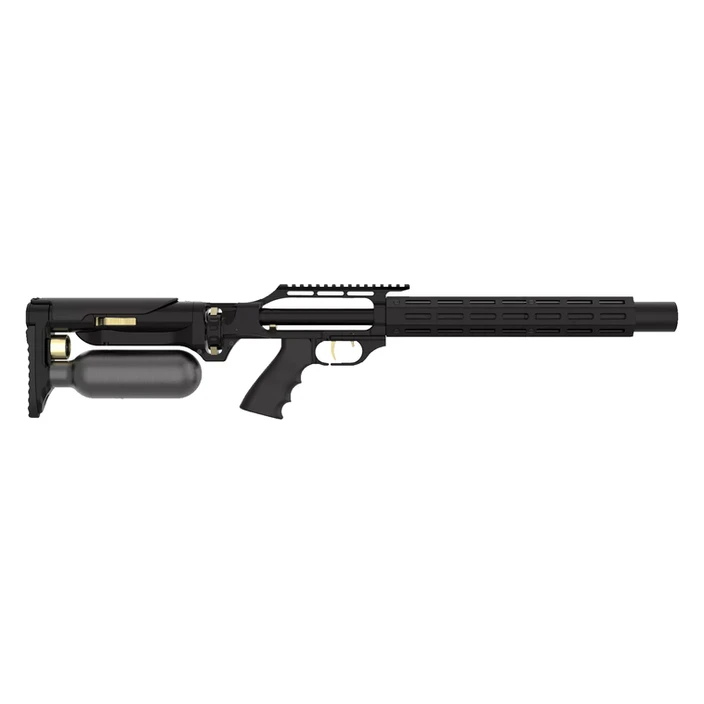
Exceptional compact performance is delivered by the TAIPAN Slash Tactical 420 Self-Indexing PCP Air Rifle through a purpose-built bullpup platform. Consequently, rapid follow-up shots are enabled without manual cycling between rounds. Moreover, a patented ultra-fast valve is employed so that consistent energy is maintained while air consumption is kept remarkably low. Furthermore, a 420 mm shrouded barrel is integrated, and as a result a well-balanced overall length of approximately 809 mm is achieved. In addition, a weight of roughly 2.8 kg is realized, therefore handling in confined or dynamic environments is facilitated for a wide range of enthusiasts.
A 300 cc carbon-fiber bottle is housed in the buttstock and is rated to 300 bar. Subsequently, an impressive number of regulated shots per fill is supported. Likewise, a 46 cc power plenum is utilized so that shot-to-shot consistency is preserved. Meanwhile, an externally adjustable regulator is provided, and therefore power can be tailored to local legal limits or specific disciplines. Notably, both pellets and slugs are accepted by the factory-tuned system without additional modification.
Revolutionary Self-Indexing Action and Efficiency
True semi-automatic operation is realized by the TAIPAN Slash Tactical 420 Self-Indexing PCP Air Rifle via a self-indexing rotary magazine. Consequently, up to twelve rounds can be discharged in quick succession. In addition, a unique decocking system is incorporated, and as a result the action can be safely returned to an uncocked state. Furthermore, an automatic magazine-removal safety is combined with a manual safety, therefore unintended discharge is further reduced.
Air usage of approximately 7–9 cm³ per joule is reported, and consequently high shot counts are obtained even in rapid-fire sequences. Moreover, a spring-free magazine design is employed so that projectile deformation is minimized. Likewise, slugs up to 13 mm in length are supported. As a result, versatility across target, pest-control, and recreational applications is expanded.
Key Performance Highlights
- Self-indexing 12-round magazine is fitted so that rapid consecutive shots are enabled without manual indexing.
- Patented high-speed valve is utilized, and therefore muzzle energy remains consistent with minimal air waste.
- 300 cc carbon-fiber bottle is integrated at 300 bar, consequently extended shooting sessions are supported.
- Externally adjustable regulator is provided, and as a result output can be matched to legal or practical requirements.
- Shrouded barrel with integrated moderator is employed so that report is reduced and barrel rigidity is increased.
- 20 MOA Picatinny rail is mounted, therefore long-range optic alignment is facilitated.
- Octagonal tactical handguard with M-LOK slots is featured, and consequently accessories can be attached on multiple faces.
- AR-15 compatible polymer grip is supplied and is interchangeable, therefore individual ergonomics can be accommodated.
- Match-grade CZUB rifled barrel is installed, and as a result repeatable accuracy is promoted.
- Unique decocking lever is included so that safe handling after a session is simplified.
Compact Tactical Chassis and Modular Design
A low-profile full-metal aluminum chassis is used by the TAIPAN Slash Tactical 420 Self-Indexing PCP Air Rifle. Consequently, flex and vibration are minimized. In addition, an octagonal fore-end is wrapped tightly around the shroud on the Tactical variant, and therefore multiple M-LOK attachment points are created. Furthermore, a height-adjustable buttpad is offered on many configurations, so that cheek weld and length of pull can be refined. Meanwhile, the compact 420 mm barrel configuration is selected specifically so that maneuverability is prioritized without sacrificing usable velocity at typical airgun distances.
Optics mounting is simplified by the canted 20 MOA rail. Subsequently, hold-over at extended ranges is reduced. Likewise, the absence of iron sights reflects the intended use with quality glass. As a result, the platform is readily adapted for field-target practice, discreet pest management, or structured training where local regulations permit.
Calibers, Power, and Practical Considerations
Availability in .177 (4.5 mm), .22 (5.5 mm), and .25 (6.35 mm) is confirmed for the 420 mm Tactical model in most markets. Consequently, energy figures that vary by jurisdiction and regulator setting are produced. Moreover, high-power FAC versions are offered in certain regions, while sub-12 ft-lb configurations are supplied where required by law. Therefore, local licensing and energy limits must always be verified before purchase or use.
Two magazines are typically included. In calibers above .177, one magazine is optimized for pellets and one for slugs. In addition, a fill probe is supplied. Responsible ownership is emphasized: eye protection is required, safe backstops must be used, and all applicable airgun laws must be observed. Inclusive participation is supported when every shooter—regardless of experience level—follows manufacturer guidance and local rules.
Accuracy, Quiet Operation, and Field Use
Match-grade barrel quality is combined with regulator consistency, and consequently tight groups at 30–50 m are routinely reported under controlled conditions. Furthermore, the full-length shroud plus integrated moderator reduces muzzle report, therefore neighbor-friendly or discreet sessions are more practical. Meanwhile, the self-indexing action allows multiple targets to be engaged without breaking position to cycle a bolt or lever. As a result, rhythm and follow-through are preserved.
The compact dimensions and modest weight make the TAIPAN Slash Tactical 420 Self-Indexing PCP Air Rifle suitable for vehicle transport, hide use, or club ranges where space is limited. In addition, the modular rail and M-LOK system allow bipods, lights, or slings to be added as needed. Nevertheless, the rifle remains a precision instrument; therefore regular maintenance, correct fill pressure, and quality ammunition are essential for sustained performance.
Conversion-focused value is realized because a single platform serves target work, pest control, and recreational rapid-fire practice. Moreover, the ability to run both pellets and slugs without mechanical changes increases ammunition flexibility. Consequently, the TAIPAN Slash Tactical 420 Self-Indexing PCP Air Rifle is positioned as a modern, efficient choice for shooters who value compact handling, consistent power, and genuine multi-shot speed within a regulated PCP design.
Legal compliance, safe handling, and respect for surroundings remain the foundation of enjoyable shooting. When those principles are observed, the engineering of this compact tactical PCP can be fully appreciated.
Calibres, FAC Ratings, Power Output and Accessories Are Explained for the TAIPAN Slash Tactical 420 Self-Indexing PCP Air Rifle
A clear understanding of available calibres, legal power bands and compatible accessories is required before the TAIPAN Slash Tactical 420 Self-Indexing PCP Air Rifle is selected. Consequently, informed decisions can be made by shooters of every experience level. Moreover, local regulations must always be consulted, because energy limits and licensing requirements differ by country and region. Furthermore, factory specifications are presented as approximate figures that are influenced by pellet or slug weight, regulator setting and ambient conditions.
Available Calibres and Intended Applications
Three primary calibres are commonly offered on the compact 420 mm Tactical platform. Therefore, a practical balance between trajectory, energy and shot count is provided.
.177 (4.5 mm) is frequently chosen when flat trajectory and high pellet velocity are preferred. As a result, paper-target work and longer-range plinking are supported. In addition, ammunition cost is generally lower, and consequently high-volume practice remains economical.
.22 (5.5 mm) is widely regarded as the most versatile option. Consequently, both precision target shooting and humane pest control can be undertaken with the same rifle. Moreover, a dedicated pellet magazine and a dedicated slug magazine are typically supplied in this calibre, so that projectile type can be changed without mechanical alteration.
.25 (6.35 mm) is selected when greater down-range energy and slug compatibility are desired. Therefore, larger pests or more demanding field applications can be addressed where local law permits. Likewise, heavier projectiles are stabilised by the match-grade CZUB barrel, and as a result grouping remains repeatable when the regulator is correctly set.
A .30 (7.62 mm) option is more commonly associated with the longer 550 mm barrel in many catalogues. Nevertheless, availability on the 420 mm Tactical variant should be confirmed with the retailer, because market listings vary.
Inclusive language is used throughout: every calibre can be enjoyed by newcomers and experienced marksmen alike when safety rules and legal limits are observed.
Highlighted Calibre Considerations
- .177 is favoured when maximum velocity and a flatter path are required for target work.
- .22 is recommended when a single rifle must serve both club shooting and discreet pest management.
- .25 is preferred when additional energy and slug performance are needed within legal constraints.
- Dedicated pellet and slug magazines are supplied in most .22 and .25 packages, therefore feeding reliability is preserved.
- Spring-free magazine design is employed so that deformation of longer slugs (up to approximately 13 mm) is avoided.
FAC, Legal Limits and Adjustable Power
Power output of the TAIPAN Slash Tactical 420 Self-Indexing PCP Air Rifle is not a single fixed figure. Instead, it is determined by the externally adjustable regulator, barrel length, calibre and the legal framework of the destination country.
In jurisdictions where a 12 ft-lb (approximately 16 J) limit applies, sub-12 ft-lb examples are commonly supplied. Consequently, values in the region of 10.8–11.8 ft-lb are frequently quoted for UK-legal rifles. Moreover, consistency within a few feet per second over a string is reported when the regulator is not over-driven.
Where a Firearm Certificate (FAC) or equivalent high-power licence is held, substantially higher energies become available. Therefore, published ranges for the 420 mm barrel typically fall around:
- .177: approximately 18–42 J in factory configuration, with higher figures possible on longer barrels or with specific ammunition.
- .22: approximately 42–70 J.
- .25: approximately 60–100 J.
Higher catalogue maxima (for example 80 J, 140 J or 180 J) are more often associated with the 550 mm barrel under ideal conditions. As a result, the compact 420 mm model is positioned as a manoeuvrable rather than maximum-energy platform. In addition, an optional higher-pressure regulator kit is mentioned by some distributors, and consequently further tuning may be possible for licensed users.
Air consumption remains efficient (approximately 7–9 cm³ per joule) even when power is increased, because the patented high-speed valve is used. Nevertheless, shot count per 300 bar fill of the 300 cc carbon-fibre bottle decreases as energy rises. Therefore, the regulator should be set to the lowest power that still meets the intended task.
Legal compliance is non-negotiable. Consequently, the rifle must never be used above the limit permitted by the owner’s licence or national law. Inclusive participation is only possible when every shooter verifies current regulations before purchase and use.
Accessories, Optics and Modular Expansion
A comprehensive accessory ecosystem is supported by the tactical chassis of the TAIPAN Slash Tactical 420 Self-Indexing PCP Air Rifle. Consequently, the rifle can be adapted to range, field or training roles.
A 20 MOA canted Picatinny rail is fitted as standard. Therefore, long-range optics can be zeroed with reduced hold-over. Moreover, approximately 160 mm of clamping length is typically available, so that a wide variety of scopes and mounts can be accommodated. In addition, quality first-focal-plane or second-focal-plane optics in the 4–16× or similar range are commonly paired with the platform.
An octagonal tactical handguard carrying multiple M-LOK slots on several faces is provided. As a result, bipods, lights, lasers, sling mounts or weights can be attached without additional adapters in most cases. Furthermore, an AR-15-pattern polymer pistol grip is supplied and is fully interchangeable, therefore aftermarket grips that suit individual hand size or shooting style can be fitted.
A unique decocking lever, manual safety and magazine-removal safety are already integrated. Nevertheless, additional safety practices—eye protection, safe backstops and correct storage—remain essential.
Standard package contents usually include a fill probe, two magazines (pellet and slug where applicable) and, in some listings, a seating tool. Optional extras frequently requested by owners include:
- extra rotary magazines for faster reloads,
- an adapter for a secondary sound moderator,
- Arca or Picatinny bipod rails,
- carbon-fibre or adjustable cheek risers where the stock allows,
- high-pressure fill hoses and gauges,
- hard cases sized for the 809 mm overall length.
Because the action is self-indexing, follow-up shots can be taken rapidly once an optic and bipod are fitted. Consequently, the same rifle can serve structured competition practice one day and controlled pest work the next, provided all legal and safety conditions are met.
Responsible customisation is encouraged. Therefore, only accessories that do not interfere with the safety mechanisms or exceed local power limits should be added. When these principles are followed, the modular nature of the TAIPAN Slash Tactical 420 Self-Indexing PCP Air Rifle can be fully utilised by the entire shooting community.
Daystate, FX Airguns, PCP Rifles, Accessories and Precision Airgun Equipment
For enthusiasts researching premium PCP platforms, accessories, replacement components, and precision shooting equipment, the modern airgun market offers an extensive range of options from brands such as Daystate and FX. Searches for daystate blackwolf, daystate redwolf, delta wolf, huntsman daystate, daystate alpha wolf, wolf delta, day state, and daystate delta wolf frequently come from shooters comparing electronic PCP technology, ergonomic designs, premium construction, and sophisticated firing systems. Traditional styling also remains important, which is why terms such as stock walnut, safari stock, dima stock, rimfire stocks, and stock replacement continue to attract buyers who value both appearance and practical fit.
Among electronically controlled PCP rifles, the daystate alpha wolf, daystate blackwolf, daystate redwolf, and daystate delta wolf are commonly associated with advanced regulation, refined shot management, and a highly consistent firing cycle. Searches such as what is a delta wolf, what is a delta wolf, delta wolf meaning, deltaw, blackwolf, red alpha wolf, alpha red wolf, model alpha gun, model alpha gun, and electronic wolves often reflect buyers trying to understand how Daystate’s electronically managed rifles differ from conventional mechanical PCP systems. Other searches, including daysta, wolf gun, wolverine gun, wolveriner, daystate wolverine sapphire, daystate wolverine sapphire, and wolfpack armory wolverine, demonstrate the broad interest surrounding Wolf-branded and Wolverine-related sporting platforms.
Small ergonomic components can make a substantial difference to comfort and handling. A rifle butt pad, rubber butt, rubber butt pad, and butt pad rifle accessory can improve shoulder contact, while a bradley cheek riser can help support a more consistent head position. Likewise, enthusiasts may research gecko grips, a cocking ball, short cocking, an index pin, pin magazine, lock timing, and lock time when learning about rifle ergonomics, cycling characteristics, and replacement components. Searches for buddy bottle cover and buddy bottle cover also remain relevant for shooters who want to protect external air cylinders from cosmetic wear during transport or field use.
Magazine compatibility is another frequent consideration. Users may search for a 177 magazine, mag 177, 25 magazine, 5.0 mm pellets, 177 pellets types, slug pellet, or a general pellet rifle when comparing ammunition formats and magazine configurations. Pellet selection should always match the manufacturer’s recommended caliber and specifications for the rifle being used. A well-matched magazine and suitable ammunition can support reliable feeding and consistent performance without unnecessary mechanical stress.
PCP equipment relies on compressed air, so searches such as air rifle compressed air, air gun pc, air gun, and air guns are commonly connected with understanding pre-charged pneumatic systems. Owners also frequently search for a pcp o ring kit because seals form an important part of maintaining an air-tight pneumatic system. Maintenance should follow manufacturer-approved procedures, especially for high-pressure components, regulators, cylinders, and valves.
Sound-moderation accessories form another major category. Common search terms include air gun suppressor, air gun suppressors, airgun moderator, air rifle moderator, 0db, 0db moderator, 0 db moderator, 0 db moderator, 0 db moderator, 0 db moderator, and hogan decimeater silencer. Thread-related searches include silencer thread adapter, thread protector rifle, and muzzle thread protector. Compatibility depends on barrel threading, caliber, applicable law, and manufacturer specifications, so owners should verify all requirements before purchasing or fitting any muzzle accessory.
Mounting systems have also become increasingly important as modular fore-ends and accessory rails become more common. Searches for an mlok to picatinny rail adapter, best m-lok to picatinny rail adapter, m-lok to picatinny adapter, picatinny m lok adapter, and picatinny bag rider usually come from shooters wanting greater flexibility when mounting supported accessories. The best adapter is generally one that matches the rifle’s rail specification, uses quality hardware, fits securely, and avoids unnecessary bulk.
Sling-related searches are equally common. Buyers frequently look up how to put a gun sling on a rifle, how to put a rifle sling on, how to install a rifle sling, riffle sling, rigle sling, how to put sling on rifle, installing a rifle sling, and attaching a sling to a rifle. A compatible sling can improve carrying comfort and transportation, but attachment points should always be checked against the rifle manufacturer’s recommendations to avoid damage to the stock or mounting hardware.
The alpha wolf barrel and accessories such as an ats tuner may also interest precision-focused users researching how different rifle configurations are designed. Similarly, terms such as weatherby vanguard trigger adjustment appear in broader shooting-related searches, although trigger systems differ significantly between platforms and should be serviced or adjusted only according to the applicable manufacturer’s safety instructions. Another unusual search phrase, how to put extinguisher call back together, is unrelated to PCP rifle servicing and should be treated according to the specific extinguisher manufacturer’s maintenance guidance rather than general airgun information.
For buyers comparing premium European PCP equipment, daystate redwolf price and daystate redwolf price are common commercial-intent searches. Pricing can vary depending on caliber, stock type, configuration, region, dealer, and included accessories. People may also search fx airgun dealer near me when looking for authorized retailers, parts support, servicing, or warranty assistance.
FX Airguns remains another major name in the PCP market. Popular searches include fx impact m3 .22cal air rifle. 600mm barrel, fx impact m3, fx impact mk3, fx m3 airgun, fx m3, impact m3, and fx impact m3 air rifle. Price-focused searches such as fx impact m3 precio, fx impact m3 precio en usa, and fx impact m3 price indicate strong buyer interest in comparing regional pricing and available configurations. The modular design philosophy associated with the FX Impact family makes it especially attractive to experienced PCP users who prioritize adjustability, ergonomics, accessory compatibility, and high-quality construction.
Potential buyers also encounter less common search phrases such as griffin gun, unfend, black snood, red bodywarmer, and can wolverine go on planes. Airline transport rules for sporting equipment and compressed-air components can differ substantially between carriers and countries, so travelers should always check current airline, airport, customs, and destination regulations before making travel arrangements. Likewise, terms such as 3.55kg in lbs may appear when buyers compare rifle weight specifications across metric and imperial listings.
Whether someone is researching the daystate alpha wolf, daystate blackwolf, daystate redwolf, huntsman daystate, wolf delta, an fx impact m3, or another premium pellet rifle, the most important purchasing factors remain intended use, caliber compatibility, overall weight, stock ergonomics, magazine design, air-cylinder capacity, manufacturer support, and accessory compatibility. Premium PCP ownership is best supported by appropriate maintenance, manufacturer-approved components, secure storage, responsible handling, and compliance with all local laws and transport requirements.
Frequently Asked Questions
Clear answers are provided below so that common questions about this compact tactical PCP bullpup can be resolved before a purchase is made. Consequently, shooters of every experience level can compare features, legal limits and practical use with confidence. Moreover, local regulations must always be verified, because power limits, licensing and permitted uses differ by country.
How is the self-indexing action operated?
Manual cycling of a bolt or side lever between shots is not required during a string. Instead, a patented high-speed valve and rotary magazine are employed so that each trigger press indexes the next chamber. As a result, up to twelve rounds can be discharged in rapid succession when the magazine is loaded and the safety is disengaged. Furthermore, a unique decocking lever is fitted. Therefore the action can be returned to a safe, uncocked condition after a session without a shot being fired. In addition, an automatic safety linked to magazine removal is combined with a manual safety, and consequently unintended discharge is further reduced when established handling rules are followed.
Which calibres are offered on the 420 mm tactical model?
Three calibres are most commonly listed for the compact barrel: .177 (4.5 mm), .22 (5.5 mm) and .25 (6.35 mm). A .30 option is more often associated with the longer barrel in manufacturer catalogues, so availability on the shorter tactical variant should be confirmed with the seller. Consequently, trajectory, energy and ammunition cost can be matched to the intended discipline. Moreover, .177 is frequently selected when a flatter path and high pellet velocity are desired for target work. Likewise, .22 is widely regarded as the most versatile choice for mixed club and field use. In addition, .25 is preferred when greater down-range energy and slug performance are needed within legal limits.
Can both pellets and slugs be used?
Yes. Factory tuning is applied so that both conventional pellets and slugs can be fired without mechanical modification. Furthermore, two magazines are typically supplied. In calibres above .177, one magazine is generally intended for pellets and one for slugs; a small marking is often used so that the two can be distinguished. A spring-free magazine design is employed, and therefore projectile deformation is minimised. Slugs up to approximately 13 mm in length are supported by that design. As a result, ammunition flexibility is increased for target practice and, where lawful, field applications.
What power levels can be expected, and how does FAC apply?
A single fixed energy figure is not published for every market. Instead, output is governed by an externally adjustable regulator, calibre, projectile weight and national law. In jurisdictions where a 12 ft-lb (approximately 16 J) limit applies, sub-12 ft-lb examples are commonly supplied, with quoted values often falling around 10.8–11.8 ft-lb. Where a Firearm Certificate or equivalent high-power licence is held, higher energies become available. Approximate factory ranges quoted for the 420 mm barrel include roughly 18–42 J in .177, 42–70 J in .22 and 60–100 J in .25, depending on regulator setting and ammunition. Higher catalogue maxima are more frequently associated with the 550 mm barrel. Consequently, the compact model is positioned as a manoeuvrable platform rather than a maximum-energy rifle. Legal limits must never be exceeded. Inclusive participation depends on every owner confirming current licensing rules before the rifle is purchased or used.
How many shots are obtained from one fill?
A 300 cc carbon-fibre bottle rated to 300 bar is housed in the buttstock. A 46 cc power plenum is also used. Efficient air consumption of approximately 7–9 cm³ per joule is reported because of the fast valve. Therefore a useful number of regulated shots can be obtained even in self-indexing mode. Shot count falls as energy is increased and as heavier slugs are chosen. Published examples for lower-power settings often cite well over a hundred shots in smaller calibres, while high-power FAC use may yield only a few magazines per fill. Consistency is preserved when the regulator is not over-driven. A pressure gauge is provided so that remaining air can be monitored.
How is the rifle filled, and what pressure is used?
Filling is performed with the supplied probe (or a compatible quick-connect kit where fitted). Maximum working pressure is 300 bar. Overfilling must be avoided. Dry, clean air from a suitable compressor or scuba setup should be used, and moisture must be kept out of the system. After filling, the probe is removed and the rifle is treated as loaded until it has been confirmed otherwise. Regular inspection of O-rings and the fill port is recommended.
What is the difference between the 420 mm and 550 mm barrels?
Overall length of the 420 mm version is approximately 809 mm and weight is about 2.8 kg. The 550 mm version is longer (around 940 mm) and slightly heavier (about 3.1 kg). Greater velocity and energy potential are typically associated with the longer barrel, especially in larger calibres. Manoeuvrability, vehicle transport and use in confined hides are favoured by the shorter barrel. Accuracy remains high on both lengths when a match-grade CZUB barrel and a stable rest are used. Choice should be based on typical shooting distance and handling preference rather than on a single specification.
How does the tactical stock differ from the standard stock?
An octagonal fore-end that wraps the shroud and carries M-LOK slots on multiple faces is used on the tactical variant. Consequently, lights, bipods, slings and other accessories can be attached without extra adapters in most cases. A more conventional fore-end, sometimes with an Arca rail, is found on the standard model. Both versions share the same self-indexing action, carbon-fibre bottle, 20 MOA Picatinny rail and AR-15-pattern interchangeable grip. Therefore the difference is primarily ergonomic and accessory-related rather than ballistic.
Which optics and accessories can be fitted?
A 20 MOA canted Picatinny rail is fitted as standard, with a useful length of clamping space. Long-range zeroing is thereby simplified. Quality scopes in common airgun magnifications are readily mounted. M-LOK slots on the tactical handguard accept bipods, lights and other attachments. The polymer pistol grip can be exchanged for other AR-15-pattern grips so that hand size and shooting style can be accommodated. Optional extras frequently added by owners include extra magazines, a secondary moderator adapter, fill hoses, hard cases and bag riders. Accessories must not interfere with the safety mechanisms or push the rifle beyond legal energy limits.
How quiet is the rifle in use?
A full-length shroud with an integrated sound moderator is fitted. Report is therefore reduced compared with an unshrouded barrel. Additional moderation may be possible with a suitable adapter, subject to local law. Complete silence is not claimed; neighbours and livestock can still be disturbed if shots are taken carelessly. Responsible use in appropriate locations remains essential.
What level of accuracy can be expected?
Match-grade rifling, a rigid aluminium chassis and a regulated valve are combined so that tight groups at 30–50 m are routinely reported from a rest under still conditions. Single-hole groups at 30–40 m have been described in independent tests of well-tuned examples. Results depend on ammunition quality, scope setup, shooter technique and weather. The self-indexing action does not replace fundamentals: a stable position, consistent trigger press and correct zero are still required.
How is the magazine loaded and changed?
The rotary magazine can be removed quickly by disengaging the retainer, unlike some other semi-automatic PCP designs. Loading is performed off the rifle, after which the magazine is reinserted and locked. The rifle cannot be fired if the retainer is not correctly in place. Two magazines are usually supplied so that one can be loaded while the other is in use. Care must be taken that pellets or slugs are seated fully to prevent jams.
Is the trigger adjustable?
An adjustable two-stage trigger is fitted. Weight and travel can therefore be refined within the limits set by the manufacturer. After any adjustment, function and safety should be checked with the rifle pointed in a safe direction and the magazine removed. A crisp, predictable break contributes to the accuracy potential of the platform.
What maintenance is required?
External metalwork should be kept clean and lightly protected from moisture. The fill port, probe and O-rings should be inspected regularly. The barrel should be cleaned according to the ammunition type being used; excessive oil in a PCP barrel can affect accuracy and regulator behaviour. The carbon-fibre bottle must not be damaged or over-pressurised. Professional service is recommended if leaks, inconsistent velocity or unusual noises appear. Storage should be in a secure, dry place, unloaded, with air pressure reduced if the rifle will not be used for an extended period, following the manufacturer’s guidance.
Who is this rifle intended for?
The compact tactical layout is suited to shooters who value rapid follow-up shots, modular accessory mounting and a short overall length. Club target work, structured training and, where lawful, discreet pest control can all be undertaken. Newcomers can use the rifle successfully when instruction and supervision are provided; experienced marksmen can exploit the regulator, slug capability and rail system. Inclusive participation is supported when safety equipment is worn and every participant follows range or field rules.
What is included in a typical package?
Contents vary by retailer, but a fill probe, two magazines and basic documentation are commonly supplied. Some packages add a seating tool. Optics, bipods and cases are usually optional. Warranty terms (often one year from the distributor) should be read at the point of sale. Proof of age and compliance with local airgun law are required for purchase and delivery in most markets.
Are there any special safety points unique to this design?
Yes. The self-indexing action means that a loaded magazine and a disengaged safety can produce a shot with only a trigger press. The decocking procedure must be learned and practised with an empty magazine first. The rifle must not be left cocked. Eye protection is required at all times. A safe backstop capable of stopping the chosen pellet or slug at the selected power level must be used. Children and unauthorised persons must never have access. These practices apply to every air rifle; they are simply more important when rapid multi-shot capability is present.
When the questions above have been considered together with current local law, a well-informed decision can be made. Precision, efficiency and modularity are offered by the platform; responsible ownership remains the condition on which those qualities can be enjoyed.
Practical Use Scenarios
A wide range of lawful shooting activities can be supported by this compact self-indexing PCP bullpup when local regulations, safe backstops and responsible ownership are observed. Consequently, participants of every experience level can match the platform to club practice, field positions, discreet pest work or structured training. Moreover, the short overall length, regulated power and twelve-round rotary magazine are employed so that rhythm is preserved once a stable position has been established. Furthermore, inclusive participation is possible only when eye protection is worn, firearms-style muzzle discipline is applied to an air rifle, and energy limits are never exceeded.
Controlled Range and Club Target Sessions
Formal range time is often the first setting in which the platform is evaluated. A bench or sandbag rest is used so that the match-grade barrel and regulator can be assessed without positional error. Subsequently, groups at 25–50 m are recorded with both pellets and, where magazines allow, slugs. Consistent velocity is produced when the externally adjustable regulator is set within its intended band; therefore string-to-string variation can be kept small if the valve is not over-driven.
Rapid strings are then introduced. Because indexing is performed automatically, follow-up shots can be released without a break in cheek weld. As a result, trigger timing and recoil management can be practised in a way that bolt-action PCPs do not permit. Meanwhile, two magazines are kept loaded so that a change can be completed quickly between strings. In addition, a 20 MOA rail is already present, and consequently a club optic can be zeroed with reduced hold-over at the longer end of typical airgun distances.
Noise is moderated by the full-length shroud. Nevertheless, range officers and neighbouring bays must still be considered. Therefore high-volume semi-automatic practice is best scheduled when the facility rules allow it. Inclusive coaching is encouraged: newcomers can begin with single, deliberate shots before magazine dumps are attempted, while experienced marksmen can use the same session to confirm slug point of impact.
Highlighted range practices
- A stable rest is employed first so that mechanical accuracy can be separated from shooter error.
- Regulator pressure is noted at the start and end of each string, and therefore consistency can be logged.
- Magazines are swapped only after the muzzle has been kept pointed at the backstop.
- Decocking is performed at the close of every detail so that the rifle is not left cocked in the rack.
- Shot data is recorded for both pellet and slug magazines when both are supplied.





Reviews
There are no reviews yet.