Snowpeak PP700W Air Pistol
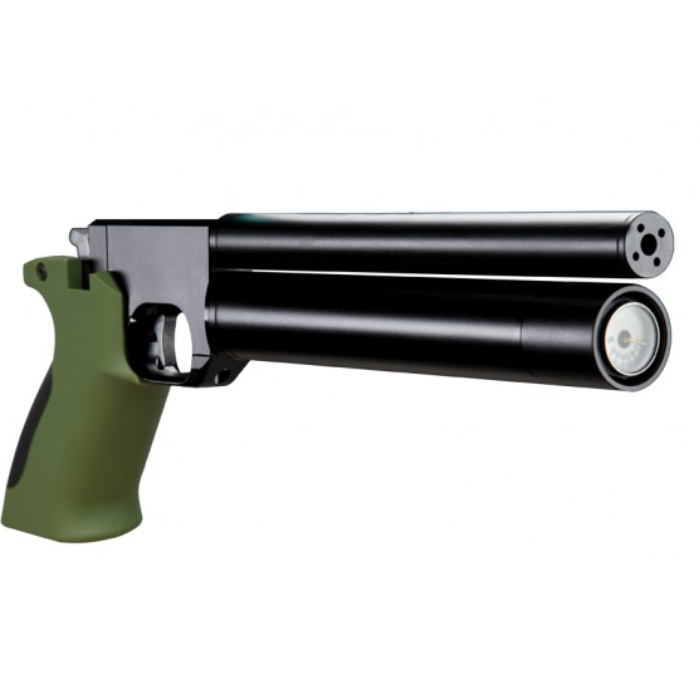
The Snowpeak PP700W – Air Pistol is a compact pre-charged pneumatic platform designed around straightforward operation, a relatively simple mechanical layout, and a traditional pistol-sized configuration. Rather than relying on disposable CO₂ cartridges or a spring-powered action, the PP700W uses compressed air stored within its onboard reservoir. Consequently, it belongs to the PCP category of air pistols and offers the operating characteristics commonly associated with that system.
With its compact dimensions, manually operated action, and distinctive external hammer arrangement, the Snowpeak PP700W has developed a recognizable place within the Snowpeak airgun range. Depending on the market, the model may also appear under SPA or Artemis branding. Therefore, specifications and supplied components should always be checked against the exact regional version before use.
Snowpeak PP700W – Air Pistol Design and Construction
A relatively minimalist layout defines the Snowpeak PP700W – Air Pistol. Its barrel, receiver, air reservoir, grip, and operating components are arranged within a compact platform rather than a rifle-sized chassis.
Published PP700W specifications generally place overall length at approximately 366–370 mm, while several current listings state a weight of around 1.1 kg. Because dimensions can vary slightly between production runs and distributors, these figures should be treated as configuration-specific rather than universal.
Furthermore, the pistol incorporates a rifled barrel intended for conventional airgun pellets. A barrel shroud is also fitted on commonly listed versions. Together, these elements form part of the PP700W’s relatively uncluttered mechanical design.
Traditional Grip Configuration
A shaped pistol grip forms the main contact point between the user and the platform. Current product listings describe the grip as ambidextrous or suitable for either hand, although individual fit will naturally depend on hand size and personal preference.
Because the PP700W remains compact, its controls can be reached without the extended dimensions associated with a PCP rifle. Nevertheless, proper handling procedures remain essential whenever the pistol is being transported, inspected, filled, stored, or used.
PCP Operating System
Unlike spring-powered air pistols, the Snowpeak PP700W – Air Pistol stores compressed air inside an integrated cylinder. Therefore, there is no spring-piston movement during the firing cycle.
A pressure gauge is included on commonly documented configurations so that reservoir pressure can be monitored. In addition, published PP700W listings describe the pistol as regulated. The regulator helps manage the air supplied from the reservoir during operation.
This type of system can produce a different handling characteristic from either CO₂ or spring-powered platforms. However, actual performance depends on caliber, pellet choice, fill condition, regional specification, mechanical condition, temperature, and manufacturer configuration.
Single-Shot Layout
The PP700W is generally configured as a single-shot PCP air pistol.
As a result, it does not use the high-capacity magazine system seen on some larger modern PCP platforms. Its simpler single-shot arrangement is instead one of the defining characteristics of this particular model.
The operating mechanism should always be handled according to the manufacturer’s instructions. Likewise, compressed-air components should never be disassembled while pressurized.
Adjustable Trigger System
Another notable component of the Snowpeak PP700W – Air Pistol is its adjustable trigger arrangement.
Snowpeak’s PCP manual specifically identifies the PP700W alongside the PP700S-A and states that a trigger adjustment screw is used for adjusting the first-stage length.
This provides some ability to tailor trigger characteristics within the manufacturer’s intended adjustment range. Nevertheless, trigger components are safety-critical parts. Consequently, adjustments should remain within documented specifications, and proper function should always be verified after servicing or adjustment.
Available Calibers
The Snowpeak PP700W – Air Pistol is commonly encountered in the following pellet calibers:
- 4.5 mm / .177
- 5.5 mm / .22
- Single-shot pellet configuration
- PCP compressed-air operating system
- Rifled barrel
- Integrated air reservoir
- Pressure monitoring gauge on commonly listed versions
- Regulated system on commonly documented versions
- Adjustable trigger mechanism
- Manual operating action
- Compact pistol-format construction
Both .177 and .22 PP700W versions continue to appear in current product documentation and retailer listings.
Performance figures should not automatically be transferred from one caliber or regional model to another. In particular, airgun power limits differ between jurisdictions, and distributors may supply versions configured specifically for local legislation.
Compact Dimensions and Handling
One of the clearest characteristics of the Snowpeak PP700W – Air Pistol is its size.
At roughly 37 cm in overall length according to several published specifications, the PP700W occupies substantially less space than a full-size PCP rifle. Consequently, storage and transportation requirements differ from those associated with longer airguns, although secure storage and local legal requirements still apply.
Its compact dimensions do not remove the need for responsible muzzle control. An air pistol should always be treated as capable of causing serious injury.
Sight and Accessory Provision
PP700W versions are commonly supplied with a mounting rail intended to accommodate compatible sighting equipment. Some published configurations do not include conventional open sights.
Therefore, anyone evaluating a particular example should verify exactly what sighting arrangement, mounting standard, filling equipment, seals, and other accessories are supplied with that version rather than assuming that every PP700W package is identical.
Compatibility should also be checked carefully before mounting accessories. Rail dimensions and regional configurations may differ between versions.
Maintenance and PCP Care
Routine inspection is especially important with PCP equipment because the system contains compressed air at high pressure.
Before use, the reservoir, seals, filling components, pressure gauge, barrel, trigger assembly, and other visible components should be inspected for obvious damage or deterioration. Any unexplained pressure loss, damaged seal, abnormal mechanical resistance, or malfunction should be addressed before further operation.
Only equipment rated for the relevant working pressure should be connected to a PCP reservoir. Furthermore, manufacturer-approved procedures should be followed whenever filling or depressurizing the pistol.
Snowpeak’s PCP documentation includes model-specific guidance for its compressed-air platforms, including the PP700W family, which reinforces the importance of consulting the correct manual instead of relying solely on general PCP instructions.
Responsible Ownership and Legal Considerations
Airgun legislation differs considerably between countries and, in some jurisdictions, between states, provinces, or regions.
Consequently, the Snowpeak PP700W – Air Pistol may be subject to restrictions concerning age, possession, licensing, power level, transportation, storage, discharge, modification, or transfer. A model that is legal under one regulatory framework may require authorization elsewhere.
Users should therefore confirm current local requirements before possessing, transporting, modifying, or using any air pistol.
Safe handling remains equally important regardless of legal classification. The muzzle should remain pointed in a safe direction, fingers should remain away from the trigger until appropriate, and a suitable backstop should be used wherever lawful shooting takes place.
Understanding the Snowpeak PP700W Platform
Overall, the Snowpeak PP700W – Air Pistol represents a compact, single-shot PCP design built around compressed-air operation, a rifled barrel, an adjustable trigger system, and a straightforward pistol-format layout.
Its relatively simple architecture distinguishes it from larger magazine-fed PCP rifles and more complex semi-automatic airgun platforms. At the same time, caliber, velocity, power output, supplied equipment, and regulatory classification can vary according to the exact market configuration.
For that reason, the most reliable approach is to identify the specific PP700W version being considered and compare its markings, manual, caliber, pressure specifications, and supplied components with current manufacturer or distributor documentation.
When used and maintained in accordance with those instructions, the PP700W can be understood as a compact example of Snowpeak’s PCP air-pistol engineering rather than simply as a scaled-down air rifle.
Snowpeak PP700W – Air Pistol Calibres, FAC, Power and Accessories
Understanding the calibre, legal power category, and supporting equipment of the Snowpeak PP700W – Air Pistol is important because specifications can differ between countries and distributors. Although the basic platform remains compact and PCP-operated, individual versions may be configured differently to comply with local regulations.
Available Calibres for the Snowpeak PP700W – Air Pistol
The Snowpeak PP700W – Air Pistol is most commonly encountered in two calibres:
- .177 / 4.5 mm
- .22 / 5.5 mm
These two pellet sizes are widely used across sporting airguns. However, they should not automatically be regarded as having identical performance characteristics.
The .177 calibre uses a smaller-diameter pellet. Consequently, pellets of equivalent design are generally lighter than their .22 counterparts. The calibre is commonly associated with recreational target shooting and other lawful sporting applications where its smaller projectile format is appropriate.
By comparison, the .22 calibre uses a larger and normally heavier pellet. Consequently, its velocity will usually differ from the .177 version even when both pistols operate within a similar regulated energy category.
Actual performance should therefore be determined from the specific model rather than simply inferred from calibre.
Calibre Selection and Pellet Compatibility
Correct pellet diameter is essential.
A .177 barrel should only be used with correctly specified 4.5 mm airgun ammunition, while a .22 model requires properly specified 5.5 mm pellets. Incorrect ammunition can cause poor performance, mechanical problems, or unsafe operation.
Pellet weight, shape, consistency, and manufacturing tolerance can also affect how a particular air pistol performs. For that reason, manufacturer-approved ammunition specifications should always take priority over generic recommendations.
Because barrels and individual production examples can behave differently, no single pellet type should be assumed to provide identical results across every PP700W.
Snowpeak PP700W Power Output
The Snowpeak PP700W – Air Pistol uses compressed air stored in its onboard reservoir. As a PCP design, power is generated when controlled compressed air propels the pellet through the barrel.
Published velocity and energy figures for PP700W examples vary considerably by country. This is partly because airguns are often configured specifically to satisfy local legal limits.
Therefore, advertised maximum velocity alone should not be treated as a universal specification.
Pellet weight also matters. Two pellets travelling at the same velocity can produce different muzzle-energy values if their masses differ. Likewise, a lighter pellet may produce a higher velocity while still remaining within the same general energy class.
For that reason, muzzle energy expressed in joules or foot-pounds provides more useful regulatory information than velocity by itself.
Regulated PCP Operation
PP700-series designs are commonly associated with a regulated or consistent-valve PCP system.
A regulator or controlled valve system helps manage the pressure supplied from the reservoir during operation. Consequently, the air pressure delivered to the firing system can remain more consistent as reservoir pressure gradually declines.
However, regulation should not be interpreted as a guarantee of identical velocity for every shot. Pellet variation, temperature, reservoir pressure, seal condition, mechanical condition, and other factors can still influence measured results.
FAC and Legal Power Classification
The term FAC is primarily associated with firearm licensing terminology in the United Kingdom.
For airguns, legal treatment depends on whether a particular airgun exceeds statutory power thresholds and also on whether the platform is legally classified as a pistol or rifle.
Therefore, the term should not be applied casually to every higher-powered airgun.
Air pistols and air rifles can be treated differently under UK legislation. Furthermore, Scotland operates a separate air-weapon licensing framework. Other countries use entirely different legal classifications.
Consequently, someone considering a Snowpeak PP700W – Air Pistol should verify the legal classification of the exact model in their jurisdiction rather than relying on a generic description such as “FAC version.”
Power limits can also affect ownership, transfer, transportation, storage, and lawful places of use.
Why Regional Specifications Matter
A Snowpeak PP700W supplied in one country may not necessarily have the same output as an apparently identical model supplied elsewhere.
Importers and manufacturers may configure airguns to comply with national regulations. Consequently, differences may exist in valve settings, regulator configuration, or other factory parameters.
For that reason, product pages should clearly distinguish between manufacturer specifications and the specifications of the actual version being supplied.
Users should never assume that a configuration shown on an overseas website is legally or mechanically identical to their local version.
Air Reservoir and Charging Equipment
As a PCP platform, the Snowpeak PP700W – Air Pistol requires an appropriate compressed-air source.
Compatible charging categories may include:
- PCP hand pumps
- Suitable high-pressure compressors
- Rated compressed-air cylinders
- Manufacturer-compatible fill probes or adapters
- Correctly rated hoses and connectors
- Pressure-monitoring equipment
Snowpeak itself lists pumps, compressors, air tanks, cleaning equipment, scopes, pellets, bags, and target equipment among its airgun accessory categories.
Only equipment designed for PCP operating pressures should be connected to the air reservoir.
Ordinary workshop compressors are generally unsuitable because PCP systems operate at much higher pressures.
Furthermore, all filling equipment should remain within the maximum working pressure specified for the particular pistol.
Optics and Sight Accessories
Some PP700-family versions incorporate a dovetail mounting arrangement.
Where a compatible rail is present, appropriately sized optical sights may potentially be fitted. Snowpeak’s current related PP700S-A specification, for example, identifies a 12 mm dovetail rail.
However, the exact rail dimensions of a PP700W should be physically confirmed before buying mounts or optics.
Possible sighting accessories may include:
- Compact airgun scopes
- Compatible reflex sights
- Appropriate dovetail mounts
- Protective scope covers
Accessories should remain proportionate to the pistol’s compact dimensions and should not interfere with its controls or safe operation.
Cleaning and Maintenance Accessories
Routine care contributes to reliable PCP operation.
Useful general maintenance items can include:
- Airgun-compatible cleaning materials
- Soft cleaning cloths
- Suitable barrel-cleaning equipment
- Manufacturer-approved lubricants
- Replacement sealing components specified for the model
- Protective storage cases or bags
Snowpeak also lists cleaning kits and gun bags within its official accessory range.
Petroleum-based oils or unsuitable lubricants should not automatically be applied to high-pressure PCP components because material compatibility is important.
Instead, servicing instructions supplied by the manufacturer should be followed.
Protective Storage Equipment
Secure storage remains important regardless of an air pistol’s power level.
A fitted case or padded bag can protect the Snowpeak PP700W from impact, moisture, dust, and accidental damage while it is being stored or lawfully transported.
Nevertheless, a transport case should not automatically be considered secure storage. Local legislation may impose additional requirements regarding locked containers, ammunition separation, access by minors, or transportation.
Choosing Accessories for the PP700W
Accessories should be selected according to compatibility rather than appearance alone.
Mounting dimensions, thread specifications, operating pressure, calibre, and intended function should all be confirmed before equipment is fitted.
Moreover, modifications affecting pressure regulation, valve operation, barrel configuration, or power output can alter both mechanical reliability and legal classification.
For that reason, accessories that simply support normal operation—such as compatible charging equipment, cases, cleaning supplies, appropriate sights, and manufacturer-approved replacement components—should be distinguished from internal performance modifications.
Overall, the Snowpeak PP700W – Air Pistol is most commonly found in .177 and .22 calibres, while its exact muzzle output depends heavily on the regional specification. Its PCP format supports a range of practical accessories, particularly approved filling equipment, compatible sights, storage solutions, and maintenance products. Most importantly, the exact power level and legal category should always be verified for the individual pistol and the jurisdiction in which it will be possessed or used.
Frequently Asked Questions About the Snowpeak PP700W – Air Pistol
What type of air pistol is the Snowpeak PP700W?
The Snowpeak PP700W is a pre-charged pneumatic, or PCP, air pistol. Instead of using a spring mechanism or disposable CO₂ cartridge, compressed air is stored inside an onboard reservoir and released through the firing system when the pistol is operated. This gives the platform the operating characteristics normally associated with compact PCP airguns.
Because the PP700W uses compressed air, appropriate filling equipment is required. Depending on the setup, this may include a PCP hand pump, high-pressure compressor, or suitable compressed-air cylinder with compatible filling hardware.
Which calibres are available for the PP700W?
The Snowpeak PP700W is most commonly found in .177 / 4.5 mm and .22 / 5.5 mm configurations. Snowpeak’s closely related current PP700S-A platform is officially documented in these same two calibres.
A .177 version uses smaller-diameter pellets, while the .22 version uses a larger and typically heavier projectile. Actual velocity and muzzle energy should be verified for the particular regional model rather than assumed solely from calibre.
Is the PP700W a PCP pistol?
Yes. The PP700W belongs to the PCP category.
Compressed air is held inside the pistol’s reservoir. During normal operation, part of that stored air is released to propel the pellet. PCP systems differ mechanically from spring-piston and CO₂-powered platforms because the energy source has already been stored as compressed air before each firing cycle.
This also means that the condition of the reservoir, seals, filling equipment, and pressure-monitoring components should be checked regularly.
Is the PP700W single-shot or magazine-fed?
The traditional PP700W is commonly identified as a manually operated, single-shot design. However, buyers and owners should verify the exact version because Snowpeak has produced closely related PP700-series configurations with different loading arrangements.
For example, Snowpeak’s currently documented PP700S-A includes a magazine according to the manufacturer’s present specification.
Consequently, components from one PP700-series variant should not automatically be assumed to fit another.
Does the PP700W have a regulated air system?
The PP700 platform is associated with a controlled PCP valve arrangement designed to manage the air supplied from the reservoir.
Snowpeak describes the closely related PP700S-A as having a consistent valve. Such systems are intended to reduce major pressure variation across a useful part of the reservoir’s operating range.
Nevertheless, actual shot-to-shot performance can still be affected by pellet weight, pellet consistency, temperature, seal condition, reservoir pressure, and the condition of the pistol.
What is the power of the Snowpeak PP700W?
There is no single universal power figure that can safely be applied to every PP700W.
Different markets can receive different factory configurations because airgun regulations vary by jurisdiction. Furthermore, muzzle energy depends on both projectile mass and velocity.
For this reason, advertised velocity should not automatically be interpreted as an energy rating. The exact output should be determined from the specifications of the individual pistol and, where legally appropriate, verified using suitable measuring equipment.
Is the Snowpeak PP700W considered FAC?
That depends on the jurisdiction and exact configuration.
The term FAC is primarily associated with UK firearm licensing terminology. Air pistols and air rifles can be treated differently under UK legislation, and different rules also apply in Scotland.
Therefore, describing every higher-output PP700W as an “FAC model” would be misleading.
Anyone considering ownership should check the current regulations covering air pistols in their location, particularly rules concerning muzzle energy, possession, licensing, storage, transportation, transfer, and lawful use.
What is the difference between .177 and .22 versions?
The main difference is pellet diameter.
A .177 pellet measures approximately 4.5 mm, whereas a .22 pellet measures approximately 5.5 mm. Pellets in .22 are generally heavier than comparable .177 pellets.
As a result, velocity characteristics can differ considerably between the two calibres. A smaller and lighter pellet can often travel faster, while a heavier projectile can produce different energy and trajectory characteristics.
Neither calibre should be judged solely by its advertised velocity. Instead, the intended lawful use, pellet compatibility, regional regulations, and actual factory configuration should be considered.
How is the Snowpeak PP700W filled?
The pistol requires compressed air from suitable PCP charging equipment.
Common charging solutions include a properly rated hand pump, dedicated PCP compressor, or certified compressed-air cylinder fitted with compatible connectors.
Only equipment rated for the working pressure of the airgun should be used. An ordinary household or workshop compressor should not be substituted because it may not be designed for PCP pressures.
The manufacturer’s filling procedure and maximum pressure should always be followed.
What pressure does the PP700 platform use?
Exact specifications should be confirmed for the PP700W model being used.
For comparison, Snowpeak currently lists a maximum fill pressure of 25 MPa for the closely related PP700S-A.
However, that figure should not be automatically transferred to an older or differently configured PP700W without checking its documentation or markings.
Exceeding the specified maximum pressure can damage high-pressure components and create a serious safety hazard.
Does the PP700W have an adjustable trigger?
PP700-series pistols are commonly equipped with adjustable trigger systems.
The current Snowpeak PP700S-A, for example, is officially specified with a two-stage adjustable trigger.
Any adjustment should remain within manufacturer specifications. Because the trigger is a safety-critical component, excessive alteration can affect proper operation.
After any permitted adjustment, safe function should be checked in accordance with the manufacturer’s instructions before further use.
Can an optic be fitted to the PP700W?
Some versions include a dovetail mounting provision that can accept compatible sighting equipment.
Snowpeak currently lists a 12 mm dovetail rail on the PP700S-A. PP700W owners should nevertheless confirm the dimensions on their own pistol before purchasing mounts.
Possible compatible categories can include compact airgun scopes or appropriately mounted reflex sights. However, the mount should fit the actual rail correctly and should not obstruct controls or interfere with safe operation.
Does the PP700W come with open sights?
Equipment packages differ.
Some PP700-series models incorporate conventional front and rear sights. Snowpeak’s current PP700S-A specification lists both a front sight and rear sight.
Older PP700W versions and distributor packages may vary. Therefore, anyone evaluating a particular pistol should rely on photographs, markings, and current product documentation for that exact example.
What accessories are commonly used with the PP700W?
Typical supporting equipment can include appropriately rated PCP charging equipment, compatible fill adapters, protective cases, pellet storage, suitable sighting equipment, cleaning supplies, and replacement seals specified for the pistol.
Snowpeak’s broader accessory range includes air pumps, compressors, air tanks, cleaning equipment, optics, pellets, bags, and target equipment.
Accessories should always be chosen according to compatibility rather than appearance alone.
Can any PCP hand pump be used?
Not automatically.
A pump must be rated for the pressure required by the pistol and must use compatible fittings. Hose threads, fill probes, adapters, and connector standards can differ between manufacturers and models.
Before connecting any charging equipment, the pressure rating and fitting type should be confirmed.
Improvised adapters or components that are not pressure-rated should not be used.
What pellets should be used?
Only pellets matching the barrel’s stated calibre should be used.
A .177 pistol requires appropriately sized .177 / 4.5 mm pellets, while a .22 version requires .22 / 5.5 mm pellets.
Within those calibres, pellet shape and weight can vary considerably.
The manufacturer’s recommendations should be followed, particularly where pellet weight may affect legal muzzle-energy limits.
How often should the PP700W be cleaned?
Cleaning frequency depends on storage conditions, frequency of use, and the condition of the barrel and external components.
The pistol should be inspected periodically for moisture, corrosion, damaged seals, loose fittings, unusual pressure loss, or mechanical wear.
Over-cleaning the bore is not necessarily beneficial, so manufacturer-approved maintenance practices should be followed.
Only cleaning products suitable for airguns should be used.
What type of lubricant should be used?
Only lubricants recommended for PCP equipment should be used.
High-pressure air systems can be sensitive to inappropriate oils and greases. Petroleum products should not automatically be applied to pressure-side components because some materials are unsuitable for high-pressure pneumatic applications.
Manufacturer-approved lubricants are preferable, especially around seals and filling components.
Can the PP700W be stored with air in the reservoir?
Storage procedures should follow the manufacturer’s documentation.
PCP airguns are often stored with some pressure remaining in the reservoir because seals may rely on pressure to remain correctly seated. However, the recommended storage pressure can vary.
The pistol should never be stored where unauthorized people can access it, and local legal requirements concerning secure airgun storage should always be followed.
Is the PP700W suitable for beginners?
Its mechanical layout is relatively straightforward, but PCP ownership introduces additional responsibilities that do not exist with simpler spring-powered platforms.
A new user must understand safe muzzle control, trigger discipline, appropriate backstops, compressed-air filling procedures, pressure limits, secure storage, and local law.
Therefore, familiarity with basic airgun safety and PCP charging procedures is important before the pistol is used.
Is the PP700W the same as the PP700S-A?
No. They belong to the same general product family, but the names should not be treated as interchangeable.
Snowpeak currently lists the PP700S-A with a 72 cc air capacity, .177 and .22 calibre options, a 12 mm dovetail rail, a consistent valve, adjustable trigger, magazine, and 25 MPa maximum fill pressure.
The PP700W may differ in loading system, grip construction, supplied equipment, production year, and market specification.
Can parts from a PP700S-A be fitted to a PP700W?
Compatibility should not be assumed.
Even closely related models can differ in dimensions, valve components, breech arrangements, seals, grips, rails, and other parts.
Replacement components should be matched to the exact model and production version whenever possible.
Safety-critical parts should be installed and inspected by a competent technician when necessary.
How should the air reservoir be inspected?
The reservoir should be checked for visible corrosion, impact damage, leaking seals, unusual pressure loss, or other abnormalities.
A damaged high-pressure cylinder should not continue to be filled.
The pressure gauge should also be monitored during normal filling so that the maximum specified pressure is not exceeded.
If the reservoir, valve, gauge, or filling system behaves abnormally, use should stop until the fault has been identified.
Can the power be increased?
Internal changes affecting valve timing, regulator pressure, airflow, or other operating parameters can affect safety, reliability, and legal classification.
For that reason, this type of modification should not be treated as routine maintenance.
Owners should keep the pistol within its manufacturer specification and comply with the legal power limits applicable in their jurisdiction.
Does temperature affect PCP performance?
It can.
Temperature changes may influence pressure, seals, lubricants, and pellet performance. Although compressed-air systems are generally less temperature-sensitive than CO₂ platforms, environmental conditions can still contribute to variations.
Very high or very low temperatures may also affect storage and seal life.
The pistol should therefore be kept within the temperature conditions recommended by the manufacturer.
How should the PP700W be transported?
Transportation rules differ by jurisdiction.
As a general safety practice, the pistol should be unloaded, secured inside a suitable protective case, and handled in a way that prevents unauthorized access.
Applicable laws may impose additional requirements concerning locked cases, public transportation, vehicles, ammunition, or documentation.
Local regulations should therefore be checked before travelling with any air pistol.
Is a special backstop required?
A suitable backstop should always be used wherever lawful target shooting takes place.
The backstop must be capable of safely containing the projectile being used and should be positioned so that a missed target cannot endanger people, animals, property, roads, or neighbouring areas.
Hard surfaces that may cause ricochets should be avoided.
Why can specifications differ between websites?
Differences can result from production updates, regional versions, distributor configurations, calibre, legal power limits, or confusion between related PP700 models.
Snowpeak currently lists the PP700S-A in .177 and .22 with a 365 mm overall length, 0.9 kg weight, 72 cc reservoir, 12 mm dovetail rail, adjustable trigger, and 25 MPa maximum fill pressure.
Those figures provide useful family-level context, but they should not automatically be presented as PP700W specifications unless the exact model documentation confirms them.
What should be checked before using a PP700W?
Before use, the user should confirm that the correct calibre pellet is being used, the reservoir is within its permitted pressure range, the barrel is unobstructed, the sights or optic are secure, the trigger and operating mechanism function normally, and no visible damage or leakage is present.
The surrounding area and backstop should also be checked.
Most importantly, the pistol should always be handled as though it is capable of causing serious injury. Safe muzzle direction, trigger discipline, secure storage, and compliance with local legislation remain essential throughout ownership.
Snowpeak Airguns, PCP Rifles, Air Pistols and Umarex Airguns
For shooters researching Snowpeak airguns, Snowpeak Sports, and the wider Snowpeaks product range, there are many PCP rifles, air pistols, and shooting accessories to consider. Popular searches include the Snowpeak AP900, Snowpeak AP900B PCP air rifle, Snowpeak MAX 1, Snowpeak MAX 1 price, Snowpeak PP750, PP750, Snow Peak PP750, and PP750 air pistol. Buyers also regularly compare models such as the Snowpeak P35, P35, P 35, PCP P 35, Snowpeak P35X, P35X, P35X PCP, and Snowpeak P35 vs P35X.
Other Snowpeak models attracting attention include the Snow Peak PP20, Snowpeak PP20, Snowpeak M25, M25 rifle, M-25, M25 weapon, Snowpeak M60, Snowpeak M60B, M 60B, rifle M60, rifle M50, and M50 rifle. Searches such as Snow Peak brand origin are also common among buyers who want to understand the manufacturer before choosing a rifle or pistol.
Snowpeak PCP Models and Related Airgun Searches
The PCP category covers everything from compact pistols to full-size hunting and target rifles. Searches frequently include PR900 Gen 3, CR650, SR 1000X, T Rex 6000, and pistolet PCP Arcea-Snowpeak Onix Sport. People comparing pneumatic platforms may also search what is a PCP airgun, air gun, air rifle, pellet pistol, air gun accessories, 9mm pellet, and pellet 9mm.
Some search phrases overlap with firearm terminology even when shoppers are researching airgun products. These include rifle M60, how much did the M60 weigh, rifle M50, M50 rifle, M25 weapon, and snowfall gun. Therefore, model specifications should always be checked carefully so that a historical firearm search is not confused with a modern sporting airgun product.
Umarex Airguns, Air Rifles, Pistols and PCP Platforms
Alongside Snowpeak products, Umarex USA, UmarexUSA, Umarex airguns, and Umarex air rifles are widely searched by recreational shooters, target shooters, and PCP enthusiasts. The Umarex range includes PCP rifles, CO₂-powered platforms, break-barrel pistols, BB guns, airsoft replicas, and large-caliber airgun systems.
Popular PCP searches include Umarex Notos, Umarex Notos Carbine, Umarex Gauntlet, Umarex Gauntlet 2, Umarex Gauntlet 30, Umarex Zelos, Umarex Origin, Umarex Komplete, and Umarex Komplete NCR .22. Hunters researching larger airgun platforms may also encounter the Umarex Hammer, Umarex Hammer .50 caliber, Umarex Hammer Carbine, Umarex Primal 20, and Umarex AirSaber.
Umarex Pistols, BB Guns and T4E Models
For handgun-style platforms, popular searches include Umarex BB gun, BBgun, BB gun pistol, metal BB gun, Umarex TR50, Umarex HDR 50, Umarex T4E, Umarex T4E Smith, Umarex Smith, and Umarex P2P DR50 how many joules.
Glock-style replicas remain another major category. Search terms include Glock BB gun, Glock 19 BB gun, Umarex Glock 19, Umarex Glock 19X, Umarex Glock 19 Gen3 .177 caliber BB gun air pistol, Umarex Glock 17, Umarex Glock 17 Gen 5, Umarex Glock, airsoft Glock, airsoft Glock 19, Glock 17 airsoft, and Glock airsoft gun.
Other replica and recreational searches include Umarex MP40, Umarex MP5, Umarex Legends, Umarex HK Heckler, Umarex shotgun, and airsoft pistol.Umarex DX17.
Break-Barrel and Sporting Umarex Airguns
Shooters looking for spring or gas-piston platforms frequently research the Umarex Trevox, loading Umarex Trevox break barrel .177, Umarex pistol break barrel, Umarex Fusion 2, Umarex Synergis Elite, and Amazon Umarex Browning 800 Express. These platforms provide alternatives for people who want an airgun without relying on a high-pressure PCP charging system.
Additional searches across the Umarex catalog include Umarex H, while broader terms such as air rifle, pellet pistol, air gun, and air gun accessories help buyers compare platforms, ammunition, optics, filling equipment, targets, cases, and other shooting equipment.
Whether the focus is a Snowpeak M60, Snowpeak M25, Snowpeak P35X, Snowpeak PP750, Snowpeak MAX 1, Umarex Notos, Umarex Gauntlet 2, Umarex Origin, or Umarex Hammer Carbine, buyers should compare caliber, operating system, power level, dimensions, intended use, and local regulations before selecting an airgun.
Why Consider the Snowpeak PP700W – Air Pistol?
The Snowpeak PP700W – Air Pistol can appeal to people looking for a compact PCP platform with straightforward mechanical operation, manageable dimensions, and relatively simple supporting equipment. Rather than being universally better than every alternative, its strengths are most relevant to users who value portability, single-shot operation, compressed-air consistency, and a traditional pistol-format design.
Different airguns are suited to different purposes. Therefore, the PP700W should be evaluated according to its intended lawful use, calibre, regional power specification, ergonomics, maintenance requirements, and compatibility with available PCP equipment.
Compact Design Can Be an Important Advantage
One of the clearest reasons to consider the PP700W is its compact construction.
Compared with a full-length PCP air rifle, a pistol-format platform requires considerably less storage space. This can make secure transport and organization easier where local laws permit possession and transportation.
Its shorter dimensions can also make the platform easier to handle on a controlled target range where space is limited.
However, compact size should never be confused with reduced responsibility. The pistol still requires safe muzzle control, an appropriate backstop, secure storage, and careful handling.
PCP Operation Provides a Distinct Shooting Characteristic
The PP700W uses pre-charged pneumatic technology.
Instead of relying on a spring that moves during the firing cycle, energy is stored as compressed air inside the reservoir. When the firing system is operated, controlled air pressure propels the pellet through the barrel.
This arrangement can produce a relatively smooth firing cycle compared with spring-piston designs because there is no large spring and piston moving forward inside the action.
For controlled target shooting, this mechanical characteristic may be useful because less internal movement occurs during the shot cycle.
Nevertheless, actual consistency depends on reservoir pressure, valve condition, seals, pellet quality, temperature, and the individual pistol.
Straightforward Single-Shot Operation
The traditional PP700W is commonly configured as a single-shot platform.
This relatively simple loading arrangement can be attractive to users who prefer a basic mechanical system without the additional components associated with magazine-fed designs.
A single-shot configuration can also make each loading cycle deliberate during recreational target sessions.
At the same time, anyone who prefers rapid follow-up capability or a larger magazine system may find another PCP platform more suitable.
Therefore, the PP700W’s single-shot arrangement should be viewed as a design characteristic rather than an automatic advantage.
Fewer Feeding Components
A single-shot system eliminates several components normally required by a rotary or removable magazine.
As a result, there are fewer magazine-related parts that can become misaligned, damaged, or incompatible with certain pellet shapes.
This simplicity can also make basic inspection more straightforward.
However, the breech, seals, loading mechanism, and barrel still require proper care.
Choice of Common Airgun Calibres
Another reason the PP700W remains relevant is its availability in commonly used airgun calibres.
The platform is frequently encountered in:
- .177 / 4.5 mm
- .22 / 5.5 mm
Because both calibres are widely established, compatible pellets are generally produced by many airgun ammunition manufacturers.
The .177 configuration uses a smaller and normally lighter projectile, while the .22 configuration uses a wider and typically heavier pellet.
Neither calibre is inherently the best choice for every situation.
Instead, the appropriate configuration depends on local regulations, manufacturer specifications, intended lawful use, and personal preference.
Adjustable Trigger Characteristics
The PP700-series design incorporates an adjustable trigger arrangement.
For users who spend time on controlled target shooting, some ability to tailor trigger characteristics within the manufacturer’s permitted range can be valuable.
A predictable trigger can help a shooter operate the pistol consistently without applying unnecessary disturbance during the firing cycle.
However, trigger adjustment is a safety-sensitive procedure.
Adjustments should remain within documented manufacturer limits, and a trigger should never be altered in a way that compromises reliable engagement or safe operation.
Consistency Matters More Than Extreme Adjustment
For most recreational target use, a consistent and correctly functioning trigger is more important than reducing trigger weight to an extreme level.
The purpose of adjustment should therefore be to achieve predictable operation within safe specifications.
If the trigger behaves unexpectedly after servicing or adjustment, the pistol should not be used until it has been inspected.
Integrated Compressed-Air Reservoir
The onboard reservoir is another defining reason someone might choose a compact PCP pistol.
Once filled with suitable high-pressure air equipment, the reservoir supplies the energy needed for multiple firing cycles.
This removes the need for disposable CO₂ capsules and avoids the large mechanical spring used in spring-powered pistols.
Appropriate PCP charging equipment is still required, however.
Depending on the owner’s setup, that might include a properly rated hand pump, PCP compressor, or compressed-air cylinder.
Therefore, the PP700W is particularly practical for someone who already owns compatible PCP charging equipment.
For someone without such equipment, a simpler non-PCP platform might involve fewer supporting requirements.
Pressure Monitoring Adds Useful Information
Common PP700W configurations incorporate a pressure gauge.
A pressure gauge allows the user to monitor the condition of the compressed-air supply rather than estimating remaining pressure.
This information is important because a PCP should only be filled and operated within the pressure range specified by the manufacturer.
Pressure monitoring can therefore support routine inspection and maintenance.
Nevertheless, a gauge is not a substitute for proper filling procedures.
All hoses, adapters, pumps, compressors, and cylinders used with the system must also be correctly pressure-rated.
Simple Mechanical Architecture
The PP700W is not built around extensive electronics or highly complex user interfaces.
Its relatively conventional mechanical structure can appeal to users who prefer straightforward operation.
There are fewer electronic systems to configure, and routine ownership is largely focused on maintaining seals, pressure integrity, barrel condition, trigger function, and the external finish.
This simplicity can make the pistol easier to understand mechanically.
However, PCP systems still contain high-pressure components and should not be casually disassembled.
Internal servicing should be performed according to manufacturer procedures or by an appropriately competent technician.
Useful Platform for Controlled Target Practice
Where legally permitted, the PP700W can be suitable for recreational target shooting within an appropriately controlled environment.
Its compact format, PCP operation, and single-shot loading system create a relatively deliberate shooting process.
This can make it useful for practising basic principles such as:
- Safe muzzle direction
- Consistent grip
- Sight alignment
- Trigger control
- Stable shooting position
- Follow-through
- Safe loading and unloading procedures
A suitable pellet trap or backstop remains essential.
Shooting should never take place where a missed or deflected pellet could reach people, animals, roads, neighbouring property, or other unsafe areas.
Accessory Compatibility Can Improve Practicality
Depending on the exact version, the PP700W may provide mounting provisions for compatible sighting equipment.
This can allow the platform to be configured with appropriately sized optics where the mounting system supports them.
Protective cases, cleaning equipment, compatible fill adapters, and correctly rated charging equipment can also improve everyday ownership.
Accessory compatibility should always be verified before purchase because rail dimensions, threads, fittings, and production specifications may differ.
Potentially Lower Mechanical Complexity Than Larger PCP Systems
Larger PCP rifles can include multi-shot magazines, adjustable regulators, electronic firing controls, multiple power settings, complex stocks, or extensive accessory rails.
The PP700W generally takes a simpler approach.
For someone who wants a compact PCP primarily for controlled recreational target use, the absence of unnecessary systems may be an advantage.
Conversely, someone who wants extensive adjustability, a rifle stock, high-capacity magazine, or specialized competition features may prefer another platform.
Why It Is Not Automatically Better Than Every Alternative
A useful comparison should consider the disadvantages as well as the strengths.
The PP700W requires access to high-pressure charging equipment. Its compact grip and dimensions may not suit every user. Single-shot loading can be slower than using a magazine, and regional power restrictions can significantly affect specifications.
Additionally, air pistols may be regulated differently from air rifles.
For those reasons, it should not be described as universally superior.
Its strongest case is instead based on matching the product to the user’s requirements.
Who May Find the PP700W Suitable?
The platform may be worth considering for someone who values:
- Compact PCP construction
- Common .177 or .22 calibre availability
- Straightforward single-shot operation
- A relatively simple mechanical platform
- Adjustable trigger characteristics
- Integrated pressure monitoring
- Compatibility with standard PCP support equipment
- Easy-to-store dimensions
- Recreational target-shooting use where legally permitted
These qualities explain why the model continues to attract interest despite the availability of more complex PCP designs.
Final Perspective
The main reason to consider the Snowpeak PP700W – Air Pistol is not that it is automatically more powerful, advanced, or capable than every competing airgun.
Its appeal comes from a different combination of qualities: compact size, PCP operation, common calibre choices, relatively simple mechanics, single-shot functionality, and manageable supporting equipment.
For someone who already understands PCP systems and wants a compact platform for lawful recreational target use, those characteristics can make the PP700W a practical option to evaluate.
The final decision should still be based on the exact regional specification, comfortable ergonomics, local legal requirements, access to suitable filling equipment, and the intended use of the pistol.
Matching those factors to the individual user is more meaningful than simply describing one airgun as universally “better” than another.


Reviews
There are no reviews yet.