REXIMEX PRETENSIS AMBUSH CERAKOTE
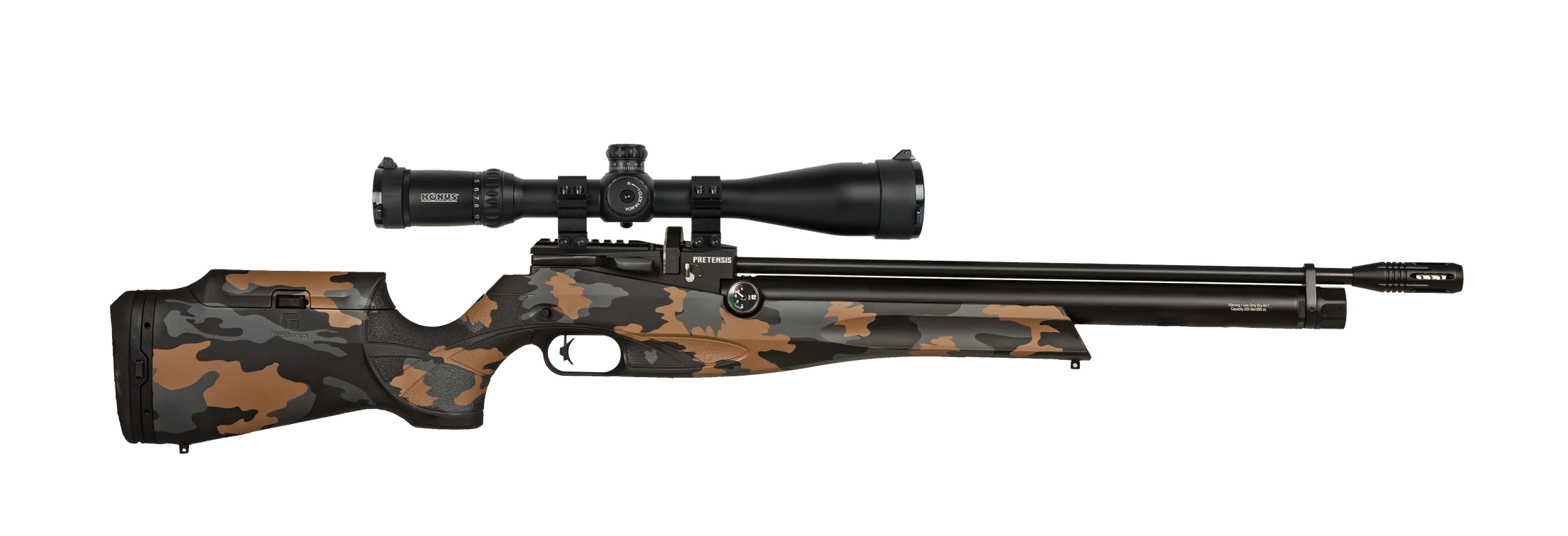
The REXIMEX PRETENSIS AMBUSH CERAKOTE is a PCP air rifle model from REXIMEX, presented in an Ambush Cerakote finish. Its distinctive exterior appearance provides a recognizable alternative to conventional finishes, while the Pretensis platform offers a dedicated design for enthusiasts interested in the engineering and construction of modern pre-charged pneumatic air rifles.
Furthermore, the Cerakote exterior gives the model a distinctive visual identity. Its finish is an important part of the product’s overall presentation, making it particularly recognizable within the Pretensis range.
Distinctive Cerakote Finish
The Ambush Cerakote finish is one of the defining visual characteristics of this model.
Cerakote is a specialist coating commonly used on equipment and components where surface protection and appearance are important considerations. However, its exact properties depend on the coating formulation and application process.
The finish should be maintained according to the manufacturer’s care instructions. Regular visual inspection is also recommended to identify any scratches, wear or surface deterioration.
Product Design and Construction
The Pretensis platform should be assessed according to its manufacturer documentation and the specifications of the particular production version.
Important product information should include:
- Manufacturer and model identification.
- Original Cerakote finish and colour.
- Overall product condition.
- Manufacturer’s serial identification.
- Supplied factory components.
- Original packaging, where available.
- Manufacturer documentation and safety instructions.
Additionally, differences between production versions should be checked before any specifications are published.
Product Identification and Compatibility
Before purchasing replacement components or arranging servicing, the exact model and production version should be confirmed.
Likewise, compatibility should not be assumed simply because another component belongs to the same manufacturer’s product range.
Manufacturer-approved documentation and qualified servicing should be used whenever maintenance or replacement components are required.
Condition and Maintenance
The exterior should be inspected for visible damage, corrosion, coating deterioration and signs of unauthorized modification.
Moreover, manufacturer-approved maintenance procedures should be followed. Any suspected mechanical defect should be assessed by a qualified airgun technician before the equipment is returned to service.
Responsible Ownership and Storage
Safe ownership practices should always be maintained.
- The product should be handled as a potentially dangerous airgun.
- The manufacturer’s safety instructions should be followed.
- Secure storage should be provided, away from unauthorized access.
- Local ownership, transport and storage regulations should be observed.
- Appropriate professional inspection should be arranged when necessary.
Frequently Considered Product Information
Before documenting or evaluating this model, the following information should be verified against the manufacturer’s official documentation:
- Exact model designation and production year.
- Available factory configurations.
- Manufacturer-confirmed dimensions and weight.
- Original finish specification.
- Included factory components.
- Applicable regulatory classification.
- Warranty and servicing arrangements.

Final Product Information
The REXIMEX PRETENSIS AMBUSH CERAKOTE is identifiable by its distinctive exterior finish and its position within the REXIMEX Pretensis product family.
For accurate product documentation, the manufacturer’s specifications, original configuration and applicable safety requirements should be confirmed before publication. This ensures that prospective readers receive reliable information without unsupported technical claims.
Frequently Asked Questions (FAQs)
1. What is the Pretensis Ambush Cerakote model?
It is a PCP air rifle model manufactured by REXIMEX. It is distinguished by its Ambush Cerakote exterior finish and its position within the manufacturer’s Pretensis range. Its exact specifications and factory configuration should be confirmed using the relevant manufacturer documentation.
2. What does Cerakote mean?
Cerakote is a specialist protective coating used on various types of equipment and components. It is recognized for its distinctive appearance and surface-finishing properties. However, different formulations may offer different characteristics, and the precise coating specification should be verified with the manufacturer.
3. What makes the Ambush finish distinctive?
The Ambush finish provides a recognizable exterior appearance. It distinguishes the model visually from conventional black or standard-finish alternatives. The final appearance will depend on the particular coating formulation and production batch.
4. Is Cerakote a type of paint?
No. Cerakote is a specialist coating system rather than ordinary decorative paint. Its formulation and application process are different from conventional household or general-purpose paints. Consequently, manufacturer-approved care instructions should always be followed.
5. Is the exterior coating resistant to scratches?
The level of scratch resistance depends on the coating formulation, preparation and application quality. Although specialist coatings are designed for particular surface-performance requirements, they should not be considered completely scratch-proof. Abrasive contact and inappropriate cleaning products should be avoided.
6. Does the finish require special maintenance?
Yes. Appropriate surface care is recommended. A clean, soft cloth should be used for routine external cleaning when permitted by the manufacturer’s instructions. Strong solvents, abrasive materials and unapproved chemicals should not be applied.
7. Is this model part of the REXIMEX Pretensis family?
Yes. It belongs to the Pretensis product family. Nevertheless, individual versions may differ in their original specifications, finish, factory components and production details. Therefore, the exact model identification should be checked before components or accessories are selected.
8. Is it a PCP air rifle?
Yes. It belongs to the pre-charged pneumatic category. This classification refers to an air-powered system that uses stored compressed air. The manufacturer’s operating instructions must be consulted for the correct requirements and limitations of the particular version.
9. What does PCP mean?
PCP stands for Pre-Charged Pneumatic. It describes an air-powered system in which compressed air is stored in a dedicated reservoir. The system is designed around stored pneumatic energy rather than the conventional spring-piston arrangement found in other airgun categories.
10. Does the product require specialist servicing?
Professional servicing is recommended whenever mechanical faults, leaks or other unusual conditions are identified. A qualified airgun technician should be consulted rather than attempting unauthorized internal repairs. Manufacturer-approved service procedures should always be observed.
11. How can the exact production version be identified?
The manufacturer’s product documentation, model markings and serial identification should be consulted. Where uncertainty exists, the manufacturer or an authorized service representative should be contacted. Similar product names should not be treated as proof of identical specifications.
12. Are all versions supplied with the same components?
Not necessarily. Factory packages and regional configurations may differ. Consequently, the supplied components should be checked against the original order documentation and the manufacturer’s published specification sheet.
13. Is the finish available in other colours?
The availability of alternative finishes depends on the manufacturer’s production range and regional distribution. Different versions may be offered at different times. Current availability should therefore be confirmed through an authorized manufacturer or distributor.
14. Can the exterior finish become worn?
Yes. Any exterior coating can show signs of wear after prolonged handling or exposure to unsuitable conditions. Scratches, surface marks and coating deterioration should be inspected periodically. Professional assessment is recommended if substantial damage is observed.
15. How should the product be stored?
Secure storage should be provided in a dry, controlled environment. Access should be restricted to authorized adults, and applicable local storage regulations should be followed. The manufacturer’s safety and storage instructions should take priority.
16. Can it be transported internationally?
International transportation is subject to the regulations of the exporting country, importing country and transit countries. Airgun classifications and import requirements may differ considerably. Written confirmation of applicable requirements should be obtained before transportation is arranged.
17. Does ownership require a licence?
Licensing requirements depend on the country, regional jurisdiction, product classification and applicable power limits. Some jurisdictions impose registration or licensing requirements, while others apply different restrictions. Local authorities should be consulted before ownership or transportation.
18. Can replacement components be purchased separately?
Replacement components may be available through authorized distributors or qualified service providers. However, availability and compatibility must be confirmed using the exact model identification and production version.
19. Are universal accessories compatible?
Compatibility should never be assumed. Accessories differ in their dimensions, attachment standards and manufacturer specifications. The official documentation should be checked before any accessory is purchased or fitted.
20. Can the Cerakote finish be repainted?
Any refinishing work should be evaluated by a qualified coating specialist. Applying ordinary paint or an incompatible coating may affect the original surface and appearance. Manufacturer-approved refinishing procedures are recommended.
21. How should scratches on the exterior be assessed?
Minor surface marks should be distinguished from deeper coating damage. A visual inspection should be performed under suitable lighting. Where the underlying material is exposed or corrosion is suspected, professional assessment should be arranged.
22. Does the coating protect against corrosion?
Certain specialist coating formulations are designed to provide corrosion protection. Nevertheless, the actual protection level depends on the specific product and application process. The finish should not be treated as a substitute for proper storage and maintenance.
23. Can the product be cleaned with household chemicals?
Unapproved household chemicals should be avoided. Some cleaning agents may affect the appearance or integrity of specialist coatings. Only cleaning materials permitted by the manufacturer should be used.
24. Is professional inspection necessary after prolonged storage?
An inspection is advisable before the equipment is returned to service after prolonged storage. Any visible deterioration, unusual condition or suspected mechanical fault should be evaluated by a qualified technician.
25. How can buyers verify that a product is genuine?
Authenticity should be established through the manufacturer’s identification markings, serial information, original documentation and authorized distribution records. If doubts remain, the manufacturer should be contacted for verification.
26. Does the product come with a manufacturer’s warranty?
Warranty coverage depends on the country of purchase, seller, production version and applicable warranty conditions. Buyers should request written warranty information and retain their original purchase documentation.
27. What should be checked when receiving an order?
The product identification, exterior condition, supplied documentation and listed factory components should be compared with the original order. Any discrepancy or visible damage should be documented and reported to the seller promptly.
28. Can the product be used in all weather conditions?
Environmental suitability should be determined from the manufacturer’s instructions. Exposure to excessive moisture, extreme temperatures or unsuitable storage conditions may affect the equipment. The recommended environmental limitations should be observed.
29. How should a damaged coating be handled?
Damaged areas should be inspected rather than covered with unapproved paint or chemicals. If the underlying material is exposed, professional advice should be obtained. A qualified coating specialist can determine whether refinishing is appropriate.
30. Is this model suitable for first-time owners?
Suitability should be evaluated according to the individual’s knowledge, applicable legal requirements and ability to follow all safety procedures. Appropriate instruction and supervision should be obtained where required. Secure storage and responsible handling must always be prioritized.
31. What documentation should accompany the product?
Relevant documentation may include the manufacturer’s operating manual, product identification information, warranty details and applicable safety instructions. The exact documents supplied will depend on the seller and regional configuration.
32. Can the product be modified?
Unauthorized modifications should be avoided. Alterations may affect safety, reliability, warranty coverage and legal classification. Any servicing or adjustment should be carried out only by appropriately qualified professionals in accordance with manufacturer requirements.
33. How can the original finish be preserved?
The exterior should be protected from abrasive contact, unsuitable chemicals and unnecessary exposure to damaging environmental conditions. Routine inspections and manufacturer-approved cleaning procedures will help maintain its appearance.
34. Where can technical specifications be verified?
The manufacturer’s official product documentation is the preferred reference. Authorized distributors may also provide product identification information and regional specification sheets. Third-party descriptions should be cross-checked before being relied upon.
35. What is the most important consideration before purchasing?
Accurate identification and verification should be prioritized. The exact production version, original condition, supplied components, warranty coverage and local legal classification should all be established before a purchase decision is made.
36. How should long-term ownership be approached?
Responsible ownership should be based on proper storage, regular condition inspections, manufacturer-approved maintenance and compliance with applicable laws. Professional servicing should be arranged whenever a fault or abnormal condition is identified.
37. Are regional specifications always identical?
No. Regional product configurations and legal classifications may differ. Buyers should therefore avoid relying on specifications published for another market without confirming that they apply to the version being considered.
38. Why is accurate model identification important?
Accurate identification helps prevent confusion between different production versions. It also supports correct documentation, warranty enquiries, professional servicing and replacement-component compatibility checks.
39. What should be done if a mechanical problem is noticed?
The equipment should not be returned to service until the problem has been professionally assessed. A qualified technician should be contacted, and the manufacturer’s safety instructions should be followed.
40. What is the best way to maintain product value?
Original documentation, purchase records and factory components should be retained where possible. The exterior should be protected from avoidable damage, and all maintenance should be documented. Additionally, unauthorized modifications should be avoided.
Final FAQ Summary
The REXIMEX Pretensis range is distinguished by its PCP engineering and available exterior configurations. For the Ambush Cerakote version, particular attention should be given to finish identification, original specifications, condition, documentation and responsible ownership.
For reliable product information, the manufacturer’s documentation should always be used as the primary reference. This approach helps ensure that specifications remain accurate and that maintenance, storage and ownership requirements are properly understood.
FX Airguns, PCP Air Rifles, Hatsan Models and Modern Airgun Platforms
Modern airguns cover a wide range of platforms, from a basic pellet gun or BB gun to sophisticated regulated PCP airguns designed for target shooting, sporting applications, and long-range precision. Buyers researching an air rifle and air pistol collection will often encounter manufacturers such as FX and Hatsan because both companies offer extensive selections of air rifles, accessories, configurations, and caliber choices.
FX Airguns Sweden and the FX PCP Rifle Range
FX Airguns has become strongly associated with Swedish airgun engineering. Searches for fx airguns sweden, fx airguns sverige, fxairguns, and fx usa commonly lead enthusiasts toward the manufacturer’s extensive PCP lineup. In the American market, fx airguns usa is another widely searched phrase when people are researching available models, specifications, support, and accessories.
Among fx air rifles, the Impact family remains particularly recognizable. Searches frequently include fx impact, f x impact, fx impact m4, fx m4, impact m4 air rifle, and impact m4 500mm when comparing current configurations. The modular design philosophy associated with the Impact platform has helped make the fx air rifle range popular among shooters who appreciate adjustability and configurable PCP systems.
Earlier generations remain widely researched as well. The fx impact m3, impact m3, fx impact mk3, fx m3, and fx m3 airgun continue to attract attention from owners comparing generations or researching replacement components.
Caliber-specific searches include fx impact m3 .22cal air rifle, fx impact m3 .22cal air rifle. 600mm barrel, and the more general fx impact m3 air rifle. People comparing international pricing may also search fx impact m3 precio, fx impact m3 precio en usa, or fx impact m3 price before checking local regulations, specifications, and availability.
Beyond the Impact series, the FX catalog includes several distinctive designs. The fx leopard and fx leopard airgun are frequently researched alongside fx leopard .22 pcp specs by users interested in specifications and configuration details.
Other notable searches include fx drs, fx drs tactical, fx drs classic, and fx drs pro. These terms reflect interest in the different DRS configurations and their intended shooting styles.
The wider FX family also includes models such as the fx king, fx wildcat, fx panthera, and fx dreamline. Collectively, these platforms demonstrate the variety available to anyone researching a premium pcp air rifle, pellet rifle, or configurable precision air gun.
Some enthusiasts also search fx outdoors when researching outdoor shooting equipment and related products, while marketplaces and information sources such as guns.com may appear during broader online research.
Understanding Pellet Guns and PCP Air Rifles
A traditional pellet gun uses shaped pellets rather than conventional firearm ammunition. The broader term pellet guns can describe spring-powered, CO₂-powered, pneumatic, and PCP platforms.
A PCP air rifle stores compressed air inside a reservoir. This system can provide consistent pressure across multiple shots depending on the rifle’s regulator, reservoir capacity, caliber, and power configuration.
For shooters comparing ammunition sizes, .177 caliber remains one of the most common options. Larger configurations are also available, including the increasingly searched 30 cal air rifle category.
Some users accidentally search pallet gun when looking for pellet-powered equipment. Regardless of terminology, specifications such as energy output, caliber, barrel length, intended range, and local legal requirements should always be reviewed before use.
The practical range of air rifle platforms varies significantly. Pellet weight, velocity, environmental conditions, barrel design, optics, and shooter technique can all affect useful range and accuracy.
Hatsan Air Rifle and PCP Platforms
The hatsan air rifle lineup covers traditional spring-powered designs as well as modern PCP systems. Searches such as hatsanusa, hatsan usa, hatsan air guns, and hatsan pcp are commonly used by enthusiasts researching the company’s models.
One of the most recognizable platforms is the hatsan blitz. Search variations include hatsun blitz, hatzan blitz, hatsan blitz full automatic, hatsan blitz 30 cal, and hatsan blitz .30 cal. Specifications and legal classifications can vary by market, so owners should verify the rules applicable in their jurisdiction.
Another frequently researched model is the hatsan model 95, also searched as hatsan mod 95 and mod 95. This traditional air rifle platform remains familiar to shooters interested in conventional stock designs.
The hatsan 125 is another established model, while the hatsan 135 family attracts shooters researching powerful spring-piston platforms. Related searches include hatsan 135 vortex air rifle, hatsan 135 carnivore, and hatsan big bore carnivore rifle.
Hatsan Sortie, BullBoss and Bullpup Designs
Compact and semi-automatic PCP designs form another part of Hatsan’s catalog. The hatsan sortie is commonly researched alongside hatsan sortie tact, hatsan sortie tact semi-auto pcp, and hatsan sortie accessories.
Bullpup enthusiasts may encounter the hatsan bullboss, bullmaster, and hatsan hercules bully. Their compact layouts are designed to reduce overall length while maintaining useful barrel dimensions.
Other PCP models include the hatsan flash, hatsan flashpup qe, and hatsan invader. These rifles provide additional choices for people comparing conventional and bullpup PCP configurations.
Hatsan Hercules, Piledriver and Large-Caliber Platforms
For people researching larger airgun platforms, hatsan hercules and hatsan piledriver often appear in search results. Large-bore air rifles differ considerably from standard .177 and .22 pellet rifles in projectile size, power output, air consumption, and intended application.
The hatsan harpoon is associated with specialized projectile launching, while an arrow launcher represents another distinct air-powered category. Such equipment can be subject to different legal rules depending on location, so local regulations should be checked before ownership or use.
Additional Hatsan Models
The Hatsan catalog extends well beyond its best-known rifles. The hatsan airtact and hatsan airtact air rifle provide another entry point into the brand’s conventional rifle selection.
Other searches include hatsan zada, hatsan neutron star, hatsan factor rc, hatsan velox, and hatsan jet 2. Each platform serves a somewhat different role, making specifications such as caliber, reservoir capacity, operating system, barrel configuration, and overall dimensions important comparison points.
Shoppers researching discounted equipment may also encounter hatsan refurbished listings or broader searches for refurbished air rifles. Condition, warranty coverage, seals, regulators, reservoirs, and service history should be checked carefully when evaluating previously used or factory-refurbished equipment.
Airgun Optics, Pellets and Accessories
Accessories can significantly affect how an air rifle is configured. A compact 4×20 optic may suit basic shooting applications, while more advanced PCP rifles are frequently paired with adjustable optics.
Pellet choice also matters. Products such as h&n field target trophy bleifrei provide an option for shooters specifically researching lead-free projectile designs. Pellet diameter, weight, head size, and barrel compatibility should all be considered when evaluating accuracy.
Terms such as econ ii may also appear when researching airgun-related equipment and accessories. Compatibility should always be verified against the exact manufacturer, model, and specification rather than relying solely on a product name.
Comparing FX and Hatsan Air Guns
FX and Hatsan approach the modern air rifle market from different directions. FX is particularly well known for highly configurable PCP platforms such as the Impact, Panthera, Wildcat, Dreamline, Leopard, DRS, and King. Hatsan, meanwhile, maintains an exceptionally broad range spanning spring-powered rifles, PCP systems, bullpups, semi-automatic platforms, and larger-caliber airguns.
Whether researching an FX Impact M3, FX Impact M4, FX DRS, Hatsan Blitz, Hatsan Sortie, Hatsan Hercules, or another platform, specifications should be compared carefully. Caliber, operating pressure, reservoir capacity, barrel length, projectile compatibility, optics mounting, overall dimensions, energy output, and regional legal requirements can all influence which configuration is appropriate for a particular lawful sporting or target-shooting application.
Calibres, FAC Classification, Power Specifications and Accessories
Available Calibres
The REXIMEX Pretensis platform has been listed in three principal calibre options, although availability may vary according to the particular production version and regional distributor.
The published calibre options include:
- .177 (4.5 mm): A commonly encountered airgun calibre.
- .22 (5.5 mm): Another established calibre within the PCP airgun category.
- .25 (6.35 mm): A larger calibre option listed by several retailers.
These options should be verified against the exact Ambush Cerakote version before a product specification is published. Furthermore, the availability of a particular calibre should not be assumed across every market.
The manufacturer’s documentation should be consulted to establish the original configuration and applicable technical specifications.
FAC Classification
What Does FAC Mean?
FAC stands for Firearms Certificate in the United Kingdom. It refers to a licensing framework applicable to certain firearms and airguns that fall outside the relevant unlicensed airgun limits.
The classification of an air rifle is determined by its actual configuration, power output and applicable legislation. Therefore, the model name or exterior finish alone cannot establish its legal classification.
Is an FAC Required?
In England and Wales, the general unlicensed air rifle limit is 12 ft-lb of muzzle energy. Air rifles exceeding that limit generally require the appropriate firearms certificate.
In Scotland, separate air weapon licensing requirements apply. Northern Ireland also operates under its own firearms legislation.
Consequently, the legal status of a particular unit should be confirmed with the relevant licensing authority before ownership, transportation or transfer.
Power Specifications
Understanding Manufacturer Power Ratings
Power output is normally expressed in foot-pounds (ft-lb) or joules (J). These measurements describe the energy associated with the projectile and are important when establishing the applicable legal classification.
Retailer specifications for the Pretensis Cerakote range have reported different power figures. One retailer lists approximately 11.3 ft-lb, while another publishes a range of 10.8–11.8 ft-lb.
These figures should be treated as retailer-reported specifications rather than guaranteed measurements for every individual unit.
Why Can Published Figures Differ?
Several factors may account for differences between published specifications:
- Different production configurations.
- Regional market requirements.
- Manufacturing variations.
- Differences in testing methods.
- Changes between product versions.
For accurate product information, the manufacturer’s documentation and the verified test certificate for the particular unit should be used.
Scope and Optical Equipment Information
Factory Scope Inclusion
A telescopic sight should not automatically be assumed to be included with the rifle. Some retailer listings explicitly identify optical equipment and mounting accessories as separate purchases.
Therefore, the original package contents should be confirmed before an order is placed.
Optical Compatibility
Any optical equipment should be assessed for compatibility by a qualified retailer or professional. Mounting standards, manufacturer specifications and product documentation should be checked before accessories are purchased.
No particular magnification or optical configuration should be assumed to be suitable for every production version.
Accessories and Supplied Components
Understanding the Original Package
Retailer listings may identify different supplied components depending on the market and package configuration.
The following items may appear in product documentation:
- Original manufacturer instruction manual.
- Factory identification documentation.
- Manufacturer-supplied accessories.
- Original packaging.
- Warranty information.
- Product inspection documentation.
However, the precise contents should always be verified against the seller’s written inventory.
Storage and Protection Accessories
Appropriate storage equipment is an important consideration for responsible ownership.
A suitable secure storage case should be selected according to the manufacturer’s recommendations and applicable local regulations. Additionally, access should be restricted to authorized individuals.
Protective storage should also be provided to reduce unnecessary exposure to moisture, dust and accidental external damage.
Maintenance Documentation
Manufacturer-approved maintenance information should be retained with the original product records.
Where inspection or servicing is required, a qualified technician should be consulted. Unauthorized modifications and unapproved replacement components should be avoided.
Important Technical Verification Before Purchase
Before the product specifications are finalized for a website listing, the following information should be confirmed:
- Exact calibre supplied.
- Original factory configuration.
- Manufacturer-confirmed power classification.
- Applicable regional licensing requirements.
- Original package contents.
- Warranty conditions.
- Product identification and serial documentation.
- Authorized servicing arrangements.
Final Specifications Note
The REXIMEX Pretensis Ambush Cerakote has been listed by retailers in .177, .22 and .25 calibre configurations. However, actual availability and power classification must be verified for the individual production version.
For reliable product documentation, manufacturer specifications should take precedence over generalized retailer descriptions. This will ensure that customers receive accurate information about the product’s configuration, legal classification, included components and ownership requirements.
Practical Use Scenarios and Everyday Ownership Considerations
1. Understanding the Product in Everyday Ownership
A modern pre-charged pneumatic air rifle should be understood through its construction, maintenance requirements and intended manufacturer-approved applications. Its overall design, exterior finish and factory configuration contribute to its identity within the airgun market.
For prospective owners, particular attention should be given to the original specifications and product documentation. Furthermore, the exact production version should be identified before any maintenance or compatibility decisions are made.
The Ambush Cerakote exterior provides a distinctive appearance. Consequently, its surface condition, original finish and general presentation should be included in routine ownership inspections.
2. Product Inspection After Delivery
Checking the Exterior Condition
When a new or previously owned unit is received, an initial visual inspection should be performed.
The following areas should be documented:
- General exterior condition.
- Original Cerakote finish.
- Visible scratches or coating deterioration.
- Manufacturer identification markings.
- Serial identification.
- Original packaging and documentation.
- Presence of all advertised factory components.
Additionally, any visible damage should be photographed and reported to the seller before the product is accepted as being in satisfactory condition.
Reviewing the Documentation
Manufacturer documentation should be retained for future reference. It provides important information concerning product identification, safety requirements, maintenance and applicable warranty conditions.
Where documentation is incomplete, clarification should be requested from the seller or authorized distributor.
3. Ownership in a Dedicated Storage Environment
Secure Storage Arrangements
A suitable storage environment is an essential part of responsible ownership.
The product should be kept in a secure location where access is restricted to authorized adults. Moreover, storage arrangements should comply with local regulations and manufacturer recommendations.
A dedicated storage case or approved cabinet may be considered, provided that it offers appropriate protection and security.
Protecting the Exterior Finish
The specialist exterior coating should be protected against unnecessary abrasion, moisture and unsuitable cleaning products.
A clean storage environment can help reduce the accumulation of dust and surface contamination. Similarly, unnecessary contact with rough materials should be avoided.
4. Routine Condition Monitoring
Visual Inspections
Periodic inspections are recommended to establish whether the exterior and documented factory configuration remain in satisfactory condition.
Attention should be given to:
- Surface deterioration.
- Signs of corrosion.
- Unusual external damage.
- Missing identification information.
- Changes in the original condition.
- Evidence of unauthorized modification.
If an abnormal condition is discovered, professional advice should be obtained before the equipment is returned to service.
Maintaining Ownership Records
An organized record of the purchase date, seller information, warranty details and servicing history can be particularly useful.
Furthermore, photographs taken at the time of purchase can provide a helpful reference when the product’s condition is reviewed later.
5. Maintenance and Professional Servicing
Manufacturer-Approved Care
Maintenance requirements should be determined by the official operating manual rather than generalized instructions intended for other models.
This is particularly important because different PCP platforms may have different internal components and servicing requirements.
A qualified airgun technician should be consulted whenever a mechanical problem, suspected pressure-system fault or abnormal condition is identified.
Preserving the Cerakote Exterior
The original finish should be maintained using only manufacturer-approved cleaning materials.
Aggressive chemicals, abrasive pads and unauthorized refinishing products should be avoided. Otherwise, unnecessary surface deterioration may be introduced.
Where significant coating damage is observed, professional assessment should be arranged.
6. Environmental Considerations
Storage in Different Conditions
Environmental conditions should be considered when selecting a suitable storage location.
Excessive moisture, unsuitable temperatures and prolonged exposure to damaging environmental conditions may affect the equipment’s condition.
A dry, controlled environment is preferable. Additionally, the manufacturer’s recommendations should be followed whenever the product is stored for an extended period.
Transport Between Locations
Transportation should be approached with particular attention to applicable legislation.
The equipment should be secured appropriately, and all relevant documentation should be retained where required. International transportation should only be arranged after the regulations of the exporting, importing and transit jurisdictions have been confirmed.
7. Responsible Ownership and Safety Awareness
Responsible ownership should remain a central consideration throughout the product’s service life.
All manufacturer safety instructions and local legal requirements should be followed.
Furthermore, access should be restricted to authorized individuals, and the equipment should never be treated as a toy or handled casually.
Where instruction is required, appropriate professional guidance should be obtained.
8. Evaluating a Previously Owned Unit
A second-hand product requires additional attention because its previous ownership and maintenance history may not be fully known.
Exterior and Documentation Assessment
The original appearance should be compared with the seller’s photographs and description.
Any unexplained damage, missing documentation or inconsistencies in the product identification should be clarified before the transaction is completed.
Servicing History
Where available, previous servicing records should be reviewed.
A documented maintenance history can provide useful information about professional inspections, replacement components and general ownership records.
However, the absence of service documentation should not be interpreted as proof that the equipment has never been serviced.
9. Product Photography and Website Presentation
Accurate Visual Representation
High-quality photographs are particularly important when the product is presented through an online catalogue.
A clear background should be used so that the exterior finish can be represented accurately.
Recommended photographs for a product listing include:
- Overall exterior appearance.
- Close-up of the original finish.
- Manufacturer identification markings.
- Original packaging.
- Included factory documentation.
- Any visible cosmetic imperfections.
Photographs should represent the actual item rather than an unrelated production version.
Honest Product Descriptions
Technical specifications should be supported by reliable documentation.
Similarly, the exact calibre, power classification, condition and supplied components should be identified accurately.
This approach helps reduce misunderstandings and provides prospective customers with more reliable product information.
10. Ownership for Collectors and Enthusiasts
For collectors, the product’s original condition and documentation may be important considerations.
The distinctive exterior finish can contribute to its visual identity within a wider collection of airgun products.
Original packaging, manufacturer literature and purchase documentation should therefore be retained where possible.
Additionally, unauthorized refinishing or modification should be avoided when preservation of the original configuration is a priority.
11. Warranty and After-Sales Support
Warranty conditions should be reviewed before ownership.
Coverage may vary depending on the seller, country of purchase and manufacturer’s regional arrangements.
Important information includes:
- Warranty duration.
- Covered manufacturing defects.
- Exclusions and limitations.
- Authorized servicing locations.
- Required purchase documentation.
- Procedures for reporting faults.
Where a warranty concern arises, the seller or authorized distributor should be contacted before unauthorized repairs are attempted.
12. Long-Term Product Preservation
Long-term preservation involves more than maintaining the external appearance.
The original documentation, purchase information and servicing records should be kept together.
Periodic visual inspections should also be documented. Consequently, changes in the exterior condition can be identified more easily over time.
Where professional servicing is required, invoices and inspection reports should be retained as part of the ownership history.
13. Understanding Regional Compliance
Legal requirements should be established before ownership, transportation or transfer.
Different countries may apply different rules to airguns based on power output, product classification and other characteristics.
For example, the United Kingdom has specific licensing requirements for certain airguns, while Scotland and Northern Ireland operate under distinct regulatory arrangements.
Therefore, the classification of an individual unit should never be inferred solely from its model designation.
Written confirmation from the relevant authority is recommended whenever legal uncertainty exists.
14. What Makes a Good Ownership Experience?
A satisfactory ownership experience is supported by accurate product information, responsible storage and access to professional servicing.
The original condition should be preserved, and all applicable safety requirements should be respected.
Furthermore, clear communication with the seller can help establish whether the product is supplied with its complete documentation and original factory components.
These considerations are particularly important when products are purchased remotely or through international distributors.
15. Final Practical Ownership Overview
The REXIMEX Pretensis Ambush Cerakote represents a distinctive entry within the REXIMEX Pretensis product family.
Its specialist exterior finish, original factory configuration and manufacturer documentation should all be considered when evaluating the product.
For everyday ownership, attention should be focused on secure storage, appropriate maintenance, regular condition inspections and professional servicing whenever necessary.
Ultimately, responsible ownership is established through accurate information, proper documentation and compliance with applicable regulations. By following these principles, the original condition and product records can be better preserved throughout the equipment’s service life.


Reviews
There are no reviews yet.