Reximex Lieva Lever-action PCP: Classic Handling With Modern Regulated Precision
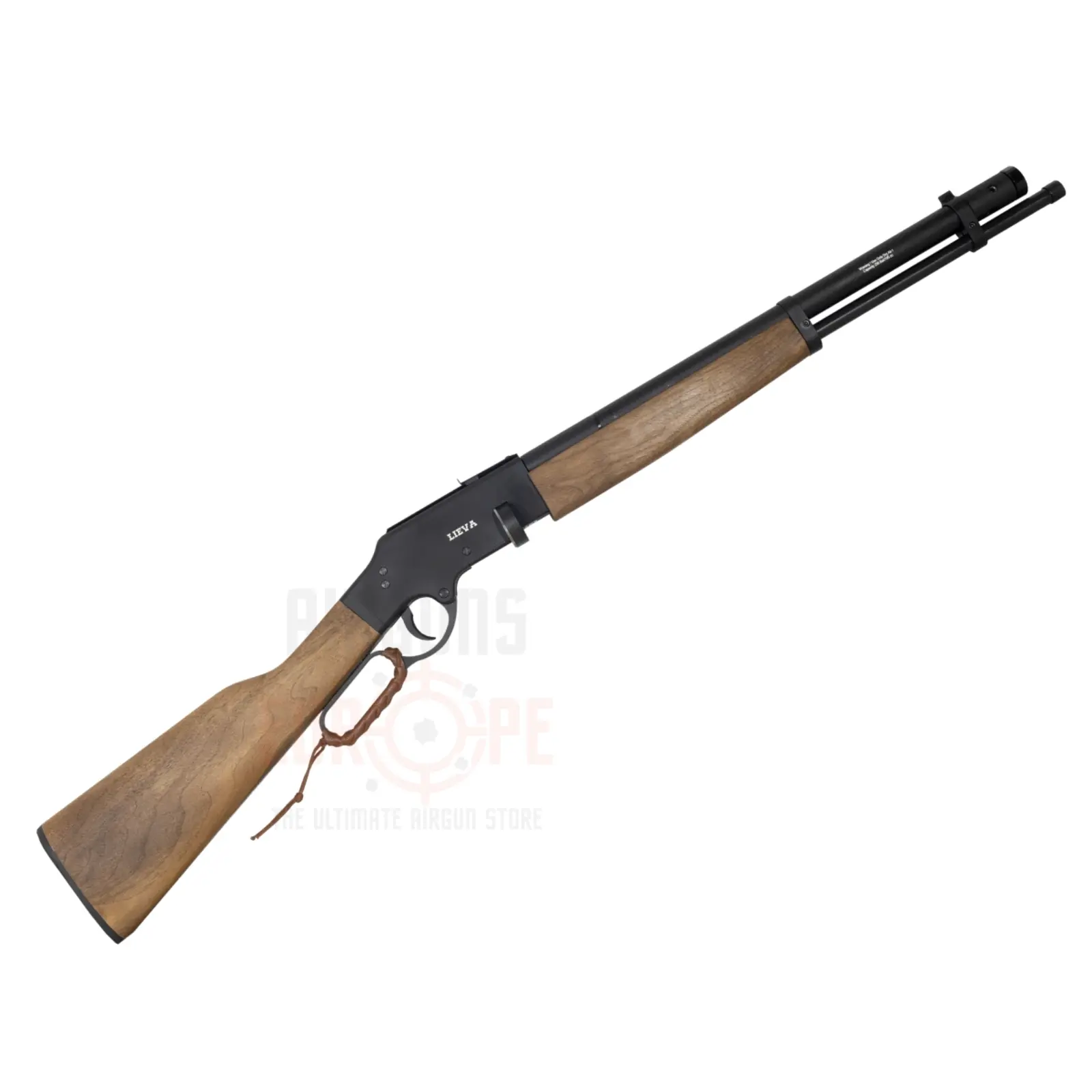
A distinctive shooting experience is delivered by the Reximex Lieva Lever-action PCP, where Western-inspired styling is combined with contemporary pre-charged performance. Consequently, a compact, pointable platform is offered to backyard plinkers, small-game hunters, and range enthusiasts alike. Moreover, an inverted layout is employed so that the air cylinder is placed above the barrel, while the rifled tube is positioned underneath. As a result, the silhouette of a traditional lever rifle is recalled without conventional PCP bulk being imposed.
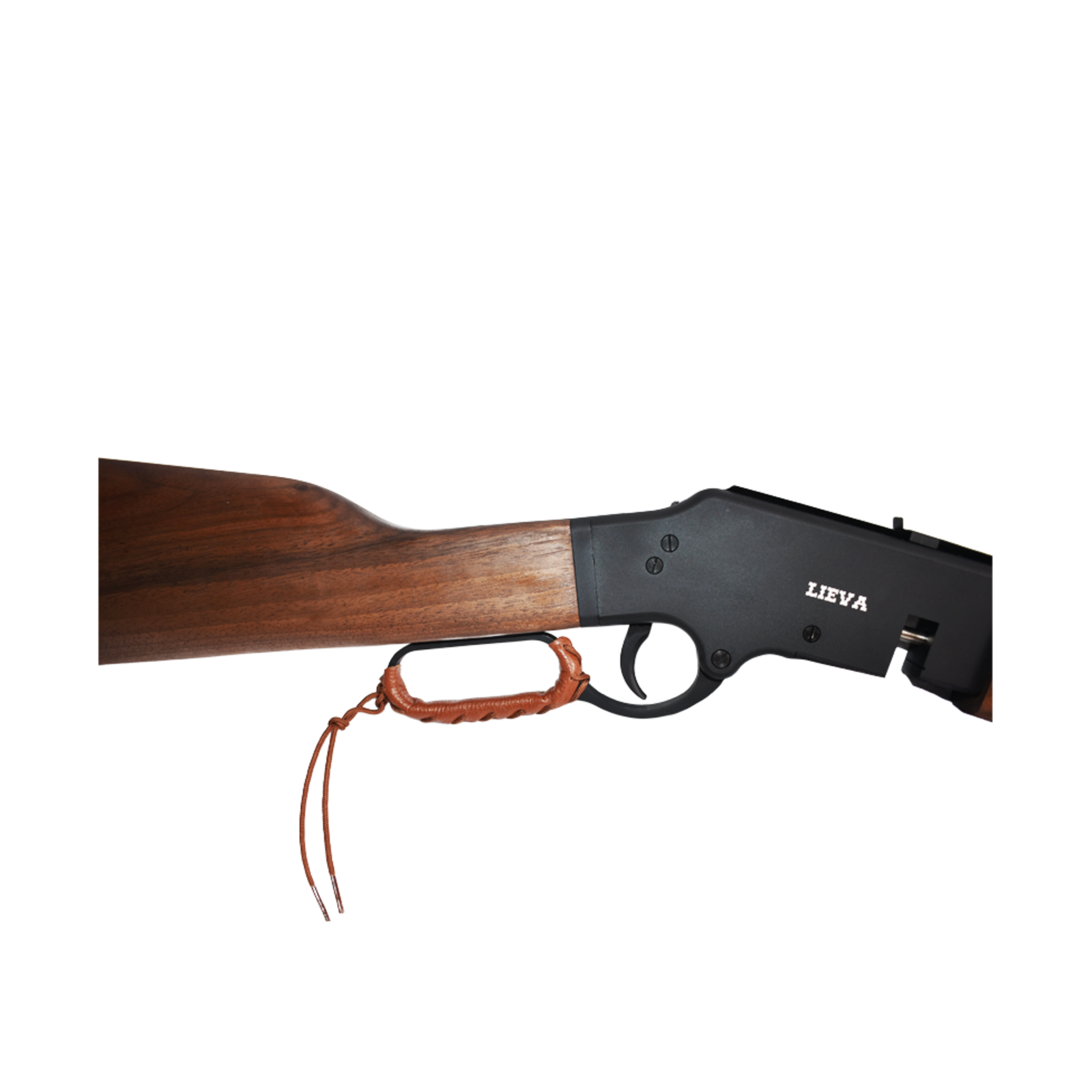
Furthermore, an ambidextrous Turkish walnut stock is fitted so that a secure hold can be enjoyed by left- and right-handed shooters. In addition, a leather-wrapped under-lever is provided, and a magnetic catch is used so that the lever is held neatly against the forend when not in cycle. Therefore, follow-up shots can be cycled quickly after a short familiarisation period. Meanwhile, two rotary magazines plus a single-shot tray are supplied, so that both rapid strings and careful single-pellet work can be supported.
Why the Reximex Lieva Lever-action PCP Stands Apart
An unconventional architecture is used on the Reximex Lieva Lever-action PCP. Specifically, the 105 cc reservoir is mounted on top, while the barrel is run beneath it. Consequently, the magazine well is kept clear of the sight line, and open sights can be used without the receiver being interrupted. Likewise, an 11 mm dovetail rail is machined so that a compact scope or red-dot can be mounted when extra precision is required.
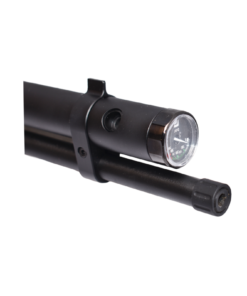
Additionally, a factory regulator is integrated so that shot-to-shot velocity is kept consistent across the usable pressure band. Subsequently, groups can be tightened and holdover can be predicted more reliably. Equally important, a front-mounted gauge is included so that remaining pressure can be read at a glance before the fill probe is inserted.
Core Highlights at a Glance
- Action: Smooth lever-action cocking is used for fast, satisfying follow-up shots.
- Powerplant: A regulated 105 cc PCP cylinder is employed for consistent output.
- Calibres: .177, .22, and .25 options are offered so that pellet choice can be matched to the task.
- Magazines: Capacities of 14 (.177), 12 (.22), and 10 (.25) are provided, with two magazines plus a single-shot tray included.
- Stock: An ambidextrous Turkish walnut stock and forend are fitted for comfort and classic appearance.
- Sights: Adjustable rear and blade front iron sights are installed as standard.
- Optics: An 11 mm dovetail rail is included for scopes or red-dots.
- Muzzle: A ½” UNF thread is provided so that a slim or collared moderator can be fitted where permitted.
- Finish: Black or silver/nickel metalwork is available so that personal style can be expressed.
- Handling: A compact overall length of approximately 38–38.6 inches and a light carry weight are achieved for all-day use.
- Safety: A manual safety is fitted, and responsible handling is expected at all times.
Design, Ergonomics, and Inclusive Handling
A compact overall length of roughly 970–980 mm is maintained so that the rifle can be shouldered easily in hides, gardens, and tight ranges. Meanwhile, a modest unscoped weight (typically in the mid-4 lb to low-6 lb class, depending on specification) is achieved so that fatigue is reduced during longer sessions. Consequently, the platform can be used comfortably by a wide range of shooters when local laws and range rules are observed.
Moreover, the walnut furniture is shaped with an ambidextrous profile so that neither left- nor right-handed users are excluded. In the same way, the lever throw is kept short and positive so that cycling can be learned quickly. Afterward, the magnetic lever lock is relied upon so that the under-lever is not left dangling in a bag or vehicle. Therefore, a tidy, classic outline is preserved between shots.
Additionally, an engraved receiver is featured on many examples so that visual character is added without function being sacrificed. Likewise, a rubber butt pad is typically fitted so that recoil sensation remains modest and shoulder contact stays consistent. As a further benefit, the inverted cylinder-over-barrel layout allows the rifle to be pointed much like a light field gun rather than a bulky bottle-fed PCP.
Regulator, Fill, and Shot Consistency
A regulated air system is built into the Reximex Lieva Lever-action PCP so that velocity variation is kept low while the cylinder remains above the regulator setpoint. Consequently, tighter groups can be produced once a favoured pellet is identified. Furthermore, fill pressures of 200–250 bar are specified by market, and a compact 105 cc tube is used so that a useful shot string can still be obtained despite the slim Western profile.
Subsequently, approximately 40–60 regulated shots per fill can be expected, depending on calibre, pellet weight, and power setting. In addition, a power-adjustment screw is provided on many versions so that output can be reduced for close-range garden use where that feature is fitted. Meanwhile, the fill port is located at the front of the cylinder, and the supplied probe is inserted after the protective cap is removed. Therefore, topping-up remains straightforward when a compatible pump or bottle is used.
Importantly, legal muzzle energy differs by country. Accordingly, UK-market examples are commonly supplied in sub-12 ft·lb form, while higher-output specifications are listed in other regions. For that reason, local airgun laws, licensing, and hunting rules must always be checked before purchase or use.
Accuracy, Calibres, and Practical Use
A rifled barrel of about 500–520 mm (approximately 20.4 inches) is employed so that pellet spin and stability are supported. Consequently, tight groups at typical airgun distances can be achieved from a rest once the correct pellet is matched. Moreover, open sights are usable for plinking and close work, while the dovetail rail allows an optic to be added when longer, more precise shots are planned.
In .177, a high-velocity, flat-trajectory option is provided for targets and small pests. Alternatively, .22 is chosen by many shooters when a balance of energy and shot count is preferred. Meanwhile, .25 is selected when extra downrange punch is wanted for permitted small-game use. In every case, humane, legal, and ethical shooting practices are required.
Additionally, the lever cycle encourages a deliberate rhythm: the action is cocked, the shot is taken, and the next pellet is indexed. As a result, a more engaging cadence is created than with a simple bolt. At the same time, the single-shot tray can be used when slugs or selected pellets are tested one at a time.
Accessories, Moderators, and Setup Tips
A ½” UNF muzzle thread is supplied so that a moderator can be fitted where legal. However, because the air cylinder sits immediately above the barrel, a slim-neck or collared silencer is generally preferred so that clearance is maintained. Likewise, compact optics are recommended because the dovetail section is relatively short.
Furthermore, two magazines are included so that one can be loaded while the other is in use. Therefore, downtime at the bench is reduced. Afterward, the yellow-accented rotors found on many Reximex magazines make pellet orientation easier in low light. Finally, a quality fill source, a burst disc-safe whip, and correct probe lubrication should be used so that the 105 cc cylinder is charged safely.
Who the Reximex Lieva Lever-action PCP Is For
A characterful alternative to conventional bolt-action PCPs is presented by this model. Consequently, it is well suited to shooters who want Western styling without CO2 weather sensitivity. Moreover, it can be enjoyed for informal target work, pest control where permitted, and range sessions in which a lively lever cycle is preferred.
At the same time, responsible ownership is essential. Therefore, eye protection should be worn, a safe backstop must be confirmed, and local regulations must be followed. In addition, FAC or equivalent licensing may be required for higher-power versions in some countries.
When classic looks, regulated consistency, multi-shot convenience, and light handling are wanted in one package, the Reximex Lieva Lever-action PCP should be considered. Subsequently, calibre, finish, and legal power level can be selected so that the rifle matches the intended use. After that, a favoured pellet can be tested, an optic or moderator can be added if needed, and a distinctive, conversion-ready platform can be put to work.
Weihrauch Air Rifles, PCP Platforms, Spring-Piston Systems, and Related Airgun Terminology
Enthusiasts researching premium German airgun engineering frequently encounter models and search terms such as Weihrauch HW100X Karbine, Thumbhole PCP Air Rifle, hw35, h 45, german air rifle, accurate air rifles, hw97k, hw 70, hw35e for sale, hw40, weihrauch hw30, weihrauch hw80, weihrauch hw 95, hw100, hw 97k, hw35 air rifle, hw50 s, weihrauch hw45, weihrauch english, weihrauch hw98, weihrauch englisch, hw77 air rifle, weihrauch hw50s, compressed air rifles, air rifle makes, spring piston, what are air rifles, weihrauch hw44, air shot gun, sk x rifles, weihrauch hw50, hw30s, hw 30, what are air pistols, hw50, and rifles de aire.
Within the Weihrauch lineup, the Weihrauch HW77 air rifle is widely recognized as a traditional fixed-barrel underlever platform. Related terminology includes HW77 Green Laminate rifle, Weihrauch underlever air rifle, HW77 spring piston air rifle, Weihrauch HW77 for sale, and German precision air rifle. Researchers comparing versions may also encounter phrases such as buy Weihrauch HW77 Green Laminate online, Weihrauch HW77 Green Laminate price and specs, Weihrauch HW77 accuracy review, HW77 Green Laminate vs HW97 comparison, is Weihrauch HW77 good for beginners, precision shooting airgun, high quality German airguns, best price Weihrauch HW77, where to buy Weihrauch HW77, Weihrauch HW77 in stock, affordable premium air rifle, and top rated underlever air rifle.
Technical comparison searches commonly include Weihrauch HW77 vs HW97, HW77 vs break barrel air rifle, best Weihrauch air rifles, most accurate air rifle for target shooting, air rifle with low recoil, durable air rifle for outdoor use, and reliable air rifle for long term use. These phrases generally reflect interest in operating systems, mechanical durability, handling characteristics, consistency, and the differences between fixed-barrel underlever designs, break-barrel rifles, and PCP platforms.
Other Weihrauch-related terminology includes air pistols, hw100 airgun, weihrauch hw95, weihrauch hw 30, weihrauch hw90, hw 44, hw 40, hw 98, and weihrauch hw100. The HW100 family represents the PCP side of Weihrauch’s catalog, while models such as the HW30, HW50, HW80, HW90, HW95, HW97, and HW98 are associated with spring-powered or gas-ram-style sporting airgun platforms depending on the specific model and configuration. By contrast, the HW44 is commonly discussed as a PCP air pistol.
The broader airgun market also includes search terminology connected with alternative PCP manufacturers and modern platforms. Examples include 25 karma, pcp bb gun, karma eq air rifle, karma red panda, panda guns, full auto pcp, karma sls compact, air karma, red panda hat, eq air, karma sls, eq magazine, air pcp, and karma airguns. These terms may refer to specific products, product families, accessories, community terminology, or unrelated search phrases that appear alongside airgun research.
Reximex is another name frequently encountered in PCP discussions. Related search phrases include reximex airguns, reximex rp, reximex throne gen 2, reximex mito, reximex rpa, sbs12, reximex mitos, reximex lieva, reximex accura pcp air rifle, and reximex throne gen2. Model naming can vary slightly between retailers, regions, and search listings, which explains variations such as “Throne Gen 2” and “Throne Gen2” or “Mito” and “Mitos.”
Airgun research also involves understanding velocity and energy. Searches such as fps to joules calculator, fps to ft lbs, and airgun calculator relate to converting projectile velocity and mass into kinetic-energy measurements. These calculations are commonly used for technical comparison, range evaluation, regulatory research, and understanding how different compressed-air or spring-powered platforms perform within their intended specifications.
More general discovery terms can include gunseek and yivli av tüfeği, alongside broader international phrases such as rifles de aire. Because airgun terminology varies considerably between English, German, Spanish, and Turkish-speaking markets, researchers may encounter several different naming conventions for comparable sporting, target, and recreational airgun platforms.
Taken together, terms ranging from Weihrauch HW100X Karbine and Thumbhole PCP Air Rifle to HW77 Green Laminate rifle, spring piston, compressed air rifles, karma airguns, and reximex airguns illustrate the diversity of modern airgun technology. Weihrauch remains particularly associated with German engineering, fixed-barrel underlever rifles, traditional spring-powered designs, precision PCP systems, and air pistols, while Karma and Reximex represent additional names encountered when comparing contemporary PCP platforms and associated airgun technology.
Calibres, FAC, Power, and Accessories for the Reximex Lieva Lever-action PCP
A practical choice among .177, .22, and .25 is offered by the Reximex Lieva Lever-action PCP, so that pellet weight, trajectory, and legal energy can be matched to the intended task. Consequently, a single platform can be specified for targets, permitted pest work, or small-game use where local rules allow. Moreover, factory-regulated output is provided so that velocity remains consistent while the cylinder stays above the regulator setpoint. Therefore, holdover can be predicted more reliably once a favoured pellet is identified.
Furthermore, power ratings are not identical in every market. Accordingly, UK-legal examples are commonly supplied in sub-12 ft·lb form, while higher-output specifications are listed for export and FAC territories. In addition, a power-adjustment screw is fitted on many versions so that muzzle energy can be reduced for close-range garden sessions. As a result, the same rifle can be tuned for short-distance plinking without a different gun being required.
How Each Calibre Is Typically Used
A flatter trajectory is generally delivered by .177, so that small targets and paper can be engaged with less holdover at typical airgun distances. Meanwhile, a useful balance of energy, pellet availability, and shot count is provided by .22, which is frequently selected for mixed range and field work. Subsequently, extra downrange punch is offered by .25 when permitted small-game use is planned and a heavier pellet is preferred.
Additionally, magazine capacity changes with calibre. Specifically, 14 shots are held in .177, 12 shots are held in .22, and 10 shots are held in .25. Likewise, two rotary magazines plus a single-shot tray are supplied so that rapid strings and careful one-pellet testing can both be supported. Therefore, slugs or selected match pellets can be tried without the magazine being emptied first.
- .177: A high-velocity, flatter-flight option is provided for targets, training, and light pest work where legal.
- .22: A versatile mid-weight choice is offered for everyday range use and many permitted field tasks.
- .25: Greater pellet mass is used when extra energy is wanted within local limits.
- Magazines: 14 / 12 / 10 capacities are supplied, with two magazines and a single-shot tray included.
- Legal note: Humane, ethical, and lawful use is required in every calibre.
FAC, Legal Limits, and Power Delivery
A regulated 105 cc cylinder is employed so that consistent shots can be produced from a full fill down toward the regulator floor, commonly cited around 100 bar. Consequently, extreme velocity swing is reduced compared with an unregulated compact tube. Moreover, fill pressure is specified at 200 bar in some catalogues and up to 250 bar / 3,625 PSI in others, so the exact figure on the rifle and manual should always be followed.
Meanwhile, UK-market Lieva rifles are typically set near 10.8–11.8 ft·lb, with review examples often chrono’d around 10.8 ft·lb and low double-digit fps variation over a short string. In contrast, higher figures are published for other regions—approximately 15 ft·lb in some .177 listings, and the low-20s ft·lb class in certain .22 and .25 export specifications. Therefore, the exact energy of any individual rifle must be confirmed with a chronograph after purchase.
Importantly, FAC or equivalent certification may be required wherever power exceeds the local unlicensed limit. For that reason, licensing, storage, transport, and hunting rules should be checked before an FAC-rated Reximex Lieva Lever-action PCP is ordered. Equally, a lower power setting can be selected on adjustable examples so that garden use remains neighbour-friendly where that feature is present. Afterward, the original setting can be restored when longer-range work is planned.
Shot count is also calibre- and power-dependent. Typically, around 60 regulated shots can be expected in lighter .177 setups, while roughly 40 shots are more common in .22 and .25 at higher energy. Subsequently, three magazines may consume a large portion of the usable band on some examples, so a pump or bottle should be kept ready. In every case, the front gauge should be read before a session is started.
Accessories That Complete the Setup
A conversion-ready accessory list is supported by the Reximex Lieva Lever-action PCP without the classic outline being lost. First, an 11 mm dovetail is machined so that a compact scope or red-dot can be mounted. Because the rail section is relatively short, a lightweight optic with modest rings is generally preferred so that the receiver is not overcrowded.
Second, a ½” UNF muzzle thread is provided after the protective cap is removed. However, the air cylinder sits immediately above the barrel, so a slim-neck or collared moderator is recommended if a silencer is legal in the user’s area. Otherwise, clearance problems can be created by bulky cans. Likewise, a thread adaptor can be sourced when a preferred moderator will not sit flush.
Third, the supplied fill probe is used at the front of the cylinder between the barrel band and the gauge. Therefore, a compatible Foster-style coupling, a safe fill whip, and correct probe lubrication should be prepared. In addition, a quality hand pump, compressor, or scuba bottle can be chosen according to how often the 105 cc tube will be recharged.
Fourth, extra magazines, a padded slip, and quality pellets should be budgeted. Bright rotor magazines make loading easier in low light, while a single-shot tray is kept for pellet testing. Furthermore, a modest bipod is not always ideal on this lever layout; a bag rest or sticks are often more practical in the field. Finally, eye protection, a safe backstop, and a chronograph are treated as essential accessories rather than optional extras.
- Optics: Compact 11 mm dovetail scopes or red-dots are recommended.
- Moderator: A slim or collared ½” UNF can is preferred where permitted.
- Fill kit: The supplied probe plus a safe pump, bottle, or compressor is required.
- Magazines: Spare rotary mags and the single-shot tray should be kept loaded and labelled by calibre.
- Support gear: A padded case, pellets matched to the barrel, and a chronograph complete a responsible kit.
When calibre, legal power, and accessories are chosen together, the Reximex Lieva Lever-action PCP can be specified as a stylish yet practical regulated repeater. Consequently, a .177 target setup, a .22 all-rounder, or a .25 field rifle can be built around the same lever-action core—provided local FAC rules, energy limits, and safe shooting practices are observed at every step.
Practical Use Scenarios
A compact lever-action PCP is best understood in the places it is actually carried. Consequently, everyday handling, legal limits, and a safe backstop are treated as part of the shooting plan rather than afterthoughts. Moreover, an inverted cylinder-over-barrel layout is used, so the rifle is pointed more like a light field gun than a bulky bottle-fed PCP. Therefore, garden sessions, club ranges, and permitted field work can all be approached with the same core habits.
Furthermore, an ambidextrous walnut stock is fitted so that left- and right-handed shooters are not excluded. In addition, a short, positive lever throw is provided, and a magnetic catch is relied upon so that the under-lever stays tidy between shots. As a result, a repeatable rhythm can be learned quickly: the action is cocked, the shot is taken, and the next pellet is indexed. Meanwhile, two rotary magazines and a single-shot tray are kept ready so that both rapid strings and careful pellet tests can be supported.
Garden and Backyard Sessions
A neighbour-conscious plan is required before the first pellet is fired at home. Accordingly, local airgun laws, permitted distances, and a solid backstop are confirmed in advance. Subsequently, a lower power setting is selected on adjustable examples so that muzzle energy can be reduced for short-range work. In that way, over-penetration risk is reduced and report is kept more modest when a slim moderator is legal and correctly fitted.
Additionally, open sights can be used for close steel and paper, while a compact optic is mounted only when the dovetail section will accept it without crowding the receiver. Likewise, high-contrast targets are placed so that holdover remains easy to read at 10–25 metres. Afterward, magazines are loaded at a bench rather than over a lawn, because dropped pellets are easily lost in grass.
A typical backyard sequence is organised as follows. First, the cylinder gauge is read so that a full regulated band is confirmed. Next, the manual safety is verified, and eye protection is worn by everyone on the firing line. Then a magazine is inserted from below, the lever is cycled, and a deliberate first shot is taken at a known-distance target. Consequently, zero can be confirmed before any faster strings are attempted.
Because the layout is light and pointable, standing and kneeling positions are often preferred over a heavy bench rest. Nevertheless, a bag or padded fence post can still be used when groups are being tested. Equally important, a cease-fire is called whenever a neighbour appears, a pet enters the area, or the backstop can no longer be guaranteed. Therefore, enjoyment is never placed above safety.
- A safe, legal backstop is confirmed before any home session is started.
- A reduced power setting is used for short garden distances where the screw is fitted.
- Magazines are loaded indoors or at a table so that pellets are not lost.
- Eye protection is worn by every person present.
- A cease-fire is observed the moment the area is no longer clear.
Club Range and Zeroing Days
A more measured routine is followed at the club. Consequently, the rifle is signed in according to range rules, and a chronograph is used so that legal energy can be verified rather than assumed. Moreover, pellet brands are tested in small batches because one lot may group better than another in the same barrel. As a result, a “working pellet” can be chosen before a hunting or pest season is planned.
Furthermore, the 11 mm rail is reserved for a lightweight scope or red-dot with modest rings. Because the rail is relatively short, a long, heavy optic is avoided so that balance is not pulled forward. Meanwhile, iron sights remain available for quick plinking lanes and for days when an optic cannot be fitted. In the same way, a single-shot tray is used when slugs or selected match pellets are compared one at a time.
A zeroing session is usually broken into stages. Initially, a 15–20 metre zero is established from a rest so that the first groups can be read clearly. Afterward, the target is moved to 25–30 metres, and elevation is confirmed. Subsequently, standing and kneeling groups are fired so that field positions are practised, not only bench technique. Finally, notes are written on holdover, pellet weight, and fill pressure so that the next visit starts faster.
Additionally, lever cadence is practised without rushing. If the action is short-stroked, a pellet may not index cleanly; therefore, a full, smooth throw is used every time. Likewise, the magnetic lever lock is allowed to seat before the rifle is laid on the bench, so that the under-lever is not left hanging. After a string, the gauge is checked again, because three magazines can consume a large share of the usable air on some setups.
Permitted Pest Control Around Buildings and Outbuildings
A legal pest task is approached only where airguns may lawfully be used and only on species that may lawfully be taken. Consequently, landowner permission, local by-laws, and humane range limits are confirmed before the rifle is carried. Moreover, a calibre is chosen to match the job: a flatter .177 trajectory may be preferred for close rats around sheds, while .22 is often selected when a little extra pellet mass is wanted. In some regions, .25 is reserved for larger permitted pests, provided energy remains legal.
Furthermore, shots are taken only when a close, certain hit can be guaranteed. Therefore, 20–30 metres is treated as a practical working window for many sub-12 setups, and longer chances are declined. In addition, a moderator is fitted where permitted so that disturbance to neighbours and livestock is reduced. Because the cylinder sits above the barrel, a slim-neck or collared can is chosen so that clearance is maintained.
A field carry plan is kept simple. The rifle is transported unloaded, with magazines stored separately until the shooting area is reached. Subsequently, the gauge is read, a magazine is inserted, and a short confirmation shot is taken at a safe target if zero may have shifted after travel. Afterward, the shooter moves slowly along building lines, using cover and a stable rest against a post or bag. Meanwhile, the lever is cycled only when a shot is intended, so that a live rifle is not carried cocked through doorways.
Weather is also considered. After rain, the walnut is wiped dry before the rifle is cased. In cold air, seals can feel stiffer, so a few confirmation shots are fired before pest work begins. In bright sun, the front gauge and open sights remain easy to read; in dusk, a compact red-dot may be preferred if legal lighting rules allow. Always, a missed shot is followed by a search, and a wounded animal is not left.
- Landowner permission and species rules are confirmed first.
- Only high-percentage, humane shots are taken.
- A slim moderator is used where the law allows.
- The rifle is carried unloaded between buildings.
- Weather, light, and zero are checked before the first live shot.
Small-Game Outings Where Hunting Is Lawful
A small-game walk is planned around ethics rather than shot count. Accordingly, local seasons, licensing, and energy limits are checked, and FAC or equivalent certification is obtained wherever it is required. Subsequently, pellet selection is matched to the quarry so that adequate penetration is achieved without reckless power being assumed. In many places, .22 or .25 is chosen for this work, while .177 is kept for targets unless the law and the quarry clearly allow it.
Moreover, the light carry weight is used to advantage on longer walks. The rifle is slung or carried at the trail, with the lever locked and the safety applied. When a chance appears, a rest is taken against a tree, fence, or kneeling pad. Because the action is a lever rather than a bolt, a second shot can be made ready quickly, yet that speed is used only if a first shot has failed humanely and a clear follow-up exists.
Additionally, magazines are kept clean. Dust, seed heads, and grit are wiped from rotors before they are inserted, because a dirty magazine can cause a misfeed at the worst moment. Likewise, a spare magazine is carried in a pouch so that a stoppage can be cleared by swapping rather than by field-stripping under time pressure. After the outing, unused pellets are returned to the tin, and the cylinder is not stored completely empty if the maker’s guidance advises otherwise.
Travel, Storage, and Shared Use
A family or club locker routine is written so that more than one authorised person can use the same rifle safely. Consequently, a labelled pellet tin, a known zero card, and a fill-pressure note are kept with the case. Inclusive language and shared habits matter here: the stock is ambidextrous, so the same setup can be used by left- and right-handed shooters after a brief familiarisation. Nevertheless, each person still confirms eye dominance, length of pull comfort, and legal competence before live fire.
Furthermore, transport laws are followed exactly. The rifle is cased, magazines are removed, and the vehicle is locked when unattended. At a destination range, the gauge is read before any assumption is made that yesterday’s fill is still sufficient. If a pump or bottle must be borrowed, the correct probe and thread are verified so that the front fill port is not damaged.
After a trip, a short maintenance pass is completed. The barrel thread cap is replaced if no moderator is fitted. The leather-wrapped lever is wiped, and the walnut is treated only with products suitable for gunstock oil. Then the magazines are emptied and inspected. Finally, the rifle is stored securely, away from unauthorised access, in accordance with local secure-storage rules.
Building a Repeatable Field Rhythm
A reliable outing is built from small, repeated steps. First, legal status and a safe area are confirmed. Second, air, pellets, and magazines are prepared. Third, a confirmation group is fired. Fourth, only ethical shots are taken. Fifth, the rifle is made safe before any move. Because those steps are written in passive, shared language, they can be followed by any authorised user without a private code being required.
In the garden, the same rhythm produces quiet, controlled practice. At the club, it produces a trustworthy zero. In the field, it produces humane, legal shots—or no shot at all. That last option remains the most important practical skill: when the backstop, the range, or the quarry is wrong, the lever is left un-cycled and the rifle is carried home unfired.
A compact regulated lever-action PCP rewards that discipline. Light handling is provided, magazines are supplied for both speed and care, and open sights or a small optic can be chosen according to the day. When those features are used inside the law, with inclusive safety habits and a clear backstop, practical shooting stays enjoyable, repeatable, and responsible from the first fill to the last pellet of the session.



Reviews
There are no reviews yet.