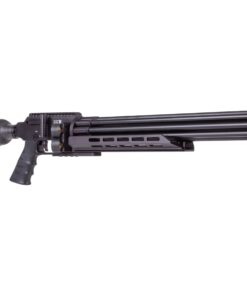
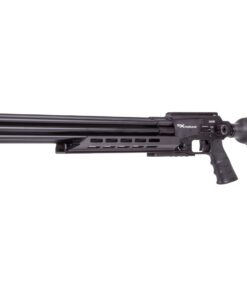
FX Royal 400 Synthetic
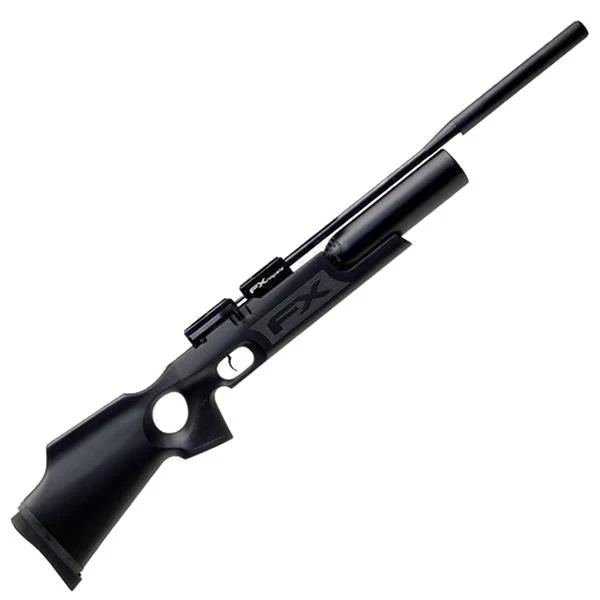
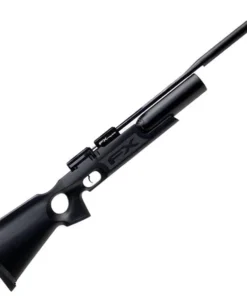
The FX Royal 400 Synthetic has been developed as a refined pre-charged pneumatic air rifle in which accuracy, handling comfort, air capacity, and dependable construction have been carefully combined. A lightweight synthetic stock has been fitted so that demanding shooting conditions can be handled without the maintenance normally associated with traditional timber stocks. At the same time, a streamlined Royal-series action has been incorporated so that smooth cycling, repeatable shot placement, and comfortable operation can be enjoyed.
For shooters who value an uncomplicated yet highly capable PCP platform, the FX Royal 400 Synthetic can be considered an attractive choice. Its design has been centred around a generous air reservoir, an ergonomic stock, a smooth loading system, and the renowned FX barrel technology associated with the Royal platform. Consequently, the rifle can be used comfortably for target shooting, recreational practice, pest-control applications where legally permitted, and general precision shooting.
Why Choose the FX Royal 400 Synthetic?
Rather than unnecessary external complexity being added, the rifle has been built around proven mechanical principles. As a result, a clean and practical shooting experience can be provided. The synthetic stock can be appreciated particularly by users who expect their equipment to be exposed to changing weather, damp grass, dust, or regular transportation.
Moreover, a substantial 400cc air cylinder has traditionally been associated with the Royal 400 configuration. Therefore, useful shot capacity can be provided between fills while the rifle’s profile remains balanced. Depending on configuration and market specification, operating characteristics can vary, so local specifications should always be confirmed before purchase.
Most importantly, the FX Royal 400 Synthetic has been designed so that precision can be supported without making the rifle unnecessarily difficult to operate.
Highlighted Product Features
- Pre-charged pneumatic system for smooth, recoilless operation
- Durable synthetic stock for practical all-weather use
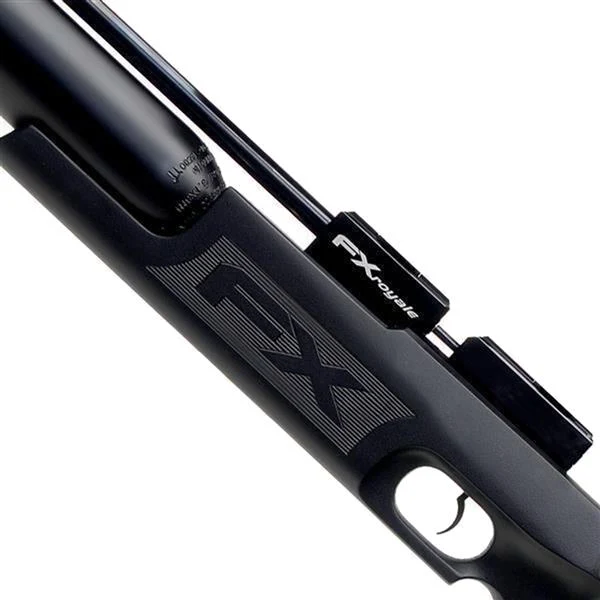
- Approximately 400cc air capacity on standard Royal 400 configurations
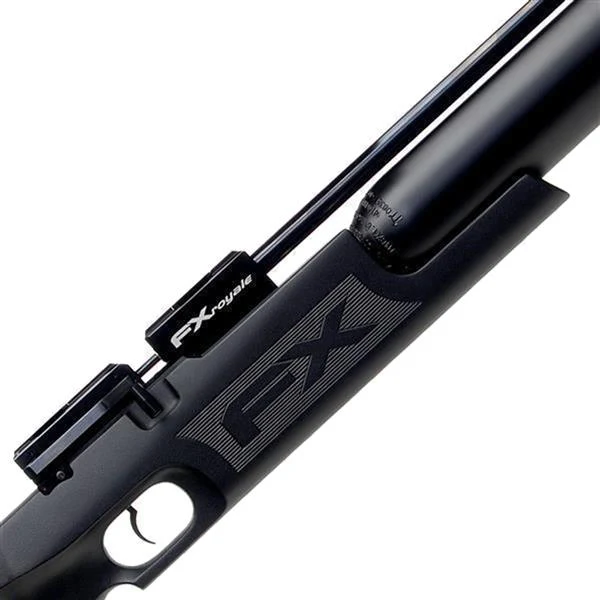
- FX Smooth Twist match-grade barrel technology on commonly listed versions
- Smooth sidelever/side-loading action for convenient cycling
- Multi-shot magazine system
- Adjustable two-stage match-style trigger
- Integrated pressure gauge
- Quick-fill charging arrangement
- Manual safety system
- 11mm scope mounting rail on commonly listed specifications
- Moderated/shrouded barrel configuration on many market versions
- Balanced full-size dimensions for steady shooting
- Lightweight construction compared with many traditional PCP rifles
Common published specifications list a 500mm FX Smooth Twist barrel, approximately 1030mm overall length, a 400cc reservoir and magazine capacities of 16 shots in .177 and 12 shots in .22, although specifications have varied by market and production version.
Synthetic Stock Designed for Practical Shooting
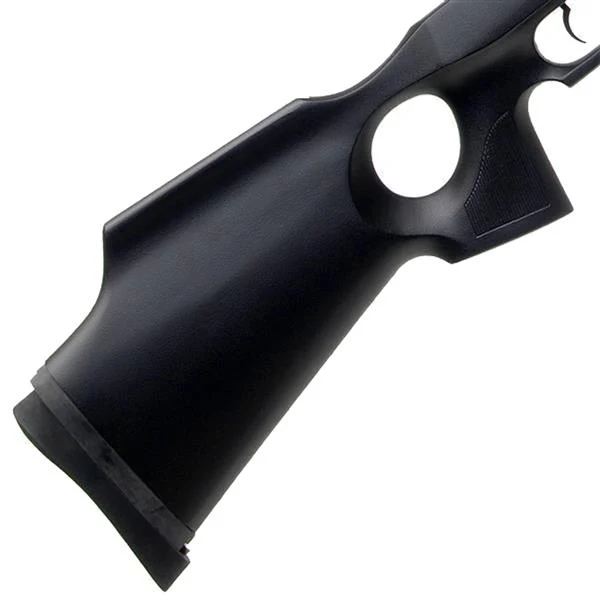
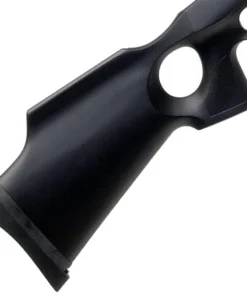
A major advantage of the FX Royal 400 Synthetic can be found in its stock. Because synthetic construction has been used, greater resistance to everyday weather exposure can be provided than would normally be expected from an untreated wooden stock. Consequently, the rifle can be carried through fields, transported to ranges, or handled during changing environmental conditions with less concern about cosmetic stock maintenance.
Furthermore, a comfortable shoulder position can be supported by the traditional sporting profile. The rifle can therefore be mounted naturally while the trigger hand is allowed to settle into a controlled position.
Because unnecessary weight can be reduced through synthetic construction, extended shooting sessions can also be made more comfortable. Published listings have placed synthetic versions around the 3.0–3.2kg range depending on configuration.
Smooth PCP Performance
Through the pre-charged pneumatic system, recoil is kept extremely low. Consequently, disturbance during the firing cycle is minimized, and consistent technique can be encouraged. This characteristic can be particularly valuable during precision target shooting, where small inconsistencies in hold or trigger control can influence group size.
Meanwhile, the large reservoir has been incorporated so that a useful quantity of compressed air can be carried on the rifle. Frequent refilling can therefore be reduced compared with smaller-cylinder PCP platforms.
An onboard pressure gauge has also commonly been fitted. As a result, remaining cylinder pressure can be checked more conveniently before shooting sessions or between groups.
Convenient Filling System
Charging can be completed through the rifle’s quick-fill arrangement. A Foster-style quick-disconnect system has been specified on some Royal 400 versions, allowing suitable charging equipment to be attached without unnecessary complication.
Nevertheless, only clean, dry compressed air and correctly rated PCP charging equipment should be used. Maximum fill pressure should always be confirmed against the specific rifle and its documentation before charging.
FX Barrel Technology and Accuracy
Exceptional practical accuracy has long been associated with the Royal series. On commonly documented versions, an FX Smooth Twist match-grade barrel of approximately 500mm has been installed.
Through this barrel arrangement, pellets can be guided consistently while unnecessary mechanical disturbance is reduced. However, optimal accuracy will still be influenced by pellet choice, calibre, velocity, atmospheric conditions, shooter technique, and individual barrel preference.
Therefore, several quality pellet types should ideally be tested. Once the preferred pellet has been identified, tighter and more repeatable groups can generally be achieved.
Stable Shooting Characteristics
Because conventional spring recoil has been eliminated, the sight picture can be disturbed less during firing. Additionally, follow-through can be maintained more naturally.
For that reason, the FX Royal 400 Synthetic can be particularly rewarding when deliberate shooting fundamentals are practised. Trigger control, breathing, body position, and consistent support can all be refined without heavy recoil masking technique.
Smooth Sidelever and Magazine Operation
A smooth repeating action has been incorporated so that follow-up shots can be prepared efficiently. The magazine is indexed as the action is cycled, allowing pellets to be presented without manual single-loading after every discharge.
In commonly listed specifications, capacity has been stated as 16 rounds in .177 and 12 rounds in .22.
Therefore, range sessions can be kept flowing while pest-control users, where such use is legal, can be provided with faster access to a follow-up shot when required.
Nevertheless, deliberate operation should always be maintained. The rifle should always be pointed in a safe direction, and the action should never be cycled until the user is ready for the next shot.
Adjustable Match-Style Trigger
Precise shooting can be strongly influenced by trigger quality. Accordingly, an adjustable match-style trigger has been incorporated into Royal 400 configurations.
A crisp release can help minimize unwanted movement at the exact moment of discharge. Consequently, the rifle can be controlled more effectively during both supported and unsupported shooting positions.
Certain published specifications describe trigger adjustment ranges of approximately 400–700 grams, while other Royal-market configurations have been supplied differently. Therefore, adjustments should be performed according to the correct manual for the individual rifle.
Controlled and Predictable Release
Rather than excessive pressure being required, a controlled trigger break can be established. Accordingly, shots can be released with reduced disturbance to the aiming point.
For experienced shooters, this adjustability can be especially useful because the trigger can be configured around preferred technique. For newer PCP users, however, conservative settings should be maintained until safe trigger handling has been fully understood.
Integrated Sound Reduction
A moderated or shrouded barrel arrangement has been incorporated into many versions of the FX Royal 400 Synthetic. Consequently, muzzle report can be reduced compared with an equivalent unmoderated PCP configuration.
Published retailer descriptions have specifically highlighted the Royal 400 as an unusually quiet high-performance PCP platform.
However, local laws concerning moderators, suppressors, airgun power levels, hunting, and ownership must always be checked before purchase or use.
Scope Mounting and Optics Compatibility
Because accurate PCP rifles are normally used with optical sights, an 11mm mounting rail has commonly been provided on Royal 400 configurations.
Accordingly, a quality airgun scope can be fitted using compatible mounts. Magnification can then be selected according to intended use. Lower-to-medium magnification can be preferred for general field use, whereas higher magnification may be selected for supported target shooting.
Correct eye relief should always be established before the mounts are fully tightened. Additionally, the scope should be levelled carefully so that elevation and windage corrections remain predictable.
Air Capacity and Shot Efficiency
A 400cc reservoir is one of the characteristics from which the Royal 400 designation has commonly been derived. Through this larger air supply, extended shooting sessions can be supported while excessive bulk is avoided.
Maximum pressure has been listed at up to approximately 220 bar on some configurations.
Nevertheless, fill pressure must never be assumed from a generic product description. The pressure marking and documentation supplied with the individual rifle should always be followed.
Furthermore, actual shot count will be influenced by calibre, power setting, regulator configuration, projectile weight, fill pressure, and the usable pressure range chosen by the shooter.
Calibres, FAC Power, Recommended Scope and Accessories
Choosing the correct calibre, power configuration, scope, and supporting accessories can make a significant difference to how this rifle performs in real-world shooting conditions. Although the underlying platform is highly capable, the best setup will depend on whether recreational target shooting, precision practice, or lawful field use is intended.
Because regional specifications have varied over the production life of the rifle, the exact configuration supplied should always be confirmed before purchase. Official parts documentation shows .177, .22 and .25-calibre components for the Royale platform, while commonly sold synthetic configurations have most often been listed in .177 and .22.
Available Calibres
.177 Calibre
The .177 calibre configuration can be particularly well suited to target shooting and general precision practice.
Because a smaller and typically lighter pellet is used, a relatively flat trajectory can be produced when suitable velocity is maintained. Consequently, holdover calculations can be simplified across common airgun distances.
This characteristic can be useful when paper targets, spinners, or small reactive targets are being engaged.
Furthermore, .177 pellets are widely available in a broad range of weights and designs. Match pellets, domed pellets, and heavier field-oriented options can therefore be tested until the most consistent combination is found.
Historical factory specifications listed a 16-shot magazine for .177 configurations.
For shooters who primarily value economical ammunition, target work, high magazine capacity, and a comparatively flat trajectory, .177 can be considered an excellent choice.
.22 Calibre
For broader field-oriented use, .22 calibre can provide a useful balance between pellet weight, retained energy, and practical trajectory.
Because heavier projectiles are generally available, greater momentum can be maintained than with many lighter .177 pellets. As a result, the calibre is commonly selected for lawful pest-control applications where suitable airgun power is permitted.
A 12-shot magazine has traditionally been supplied with .22 versions.
However, greater projectile weight normally results in a more pronounced trajectory. Therefore, accurate range estimation becomes increasingly important as target distance changes.
With a correctly zeroed scope and a suitable pellet, excellent accuracy can still be achieved.
For shooters who want one calibre for both recreational target shooting and appropriate field applications, .22 can therefore be particularly versatile.
.25 Calibre Availability
The Royale design was also produced with .25-calibre components, and official FX parts documentation identifies a 6.35mm barrel arrangement, including a higher-power version.
Availability can be much more dependent on production year and market than with .177 or .22.
Consequently, buyers considering a used .25 version should verify the rifle’s original specification, barrel, probe, magazine compatibility, and legal power classification rather than assuming that every synthetic model was supplied in this calibre.
Standard and FAC Power Configurations
Power specification represents one of the most important considerations when choosing this platform.
For jurisdictions where lower-powered air rifles can be owned under different licensing arrangements, reduced-power versions have historically been offered.
UK-market listings, for example, have shown approximately 11.5 ft-lb / 16 joule configurations.
By comparison, historical higher-power specifications listed approximately:
- .177 – around 24 joules / 18 ft-lb
- .22 – around 48 joules / 36 ft-lb
Earlier UK distributor material also described FAC variants around 35–40 ft-lb, depending on calibre and configuration.
Understanding FAC Configuration
An FAC configuration generally refers to a rifle operating above the relevant UK non-FAC air-rifle energy limit.
Therefore, ownership, purchase, transfer, storage, and use may be subject to firearms licensing requirements.
Power should never be increased simply because additional performance is desired. Legal limits must first be understood, and modifications should only be performed in accordance with applicable law and manufacturer requirements.
Furthermore, increased muzzle energy does not automatically guarantee greater accuracy.
Pellet suitability, barrel preference, regulator condition, pressure consistency, and shooter technique remain extremely important.
Power and Pellet Selection
Lower-powered configurations can be paired effectively with quality medium-weight pellets.
Meanwhile, higher-powered configurations may perform better with heavier projectiles that can use the available energy more efficiently.
Nevertheless, the most powerful pellet or heaviest pellet should not automatically be selected.
Several weights should instead be tested at a controlled range.
Accuracy should always be prioritised over theoretical velocity.
Recommended Scope
Because an 11mm dovetail rail was fitted to commonly documented Royale 400 versions, compatible dovetail scope mounts should be selected.
Best General-Purpose Choice
For most users, a quality 3-12×44, 4-12×44, or 4-16×44/50 scope can provide an excellent balance.
Lower magnification can be used for closer targets and faster target acquisition. Meanwhile, higher magnification can be selected when smaller targets or precise groups are being attempted.
Adjustable objective or side-focus capability can also be particularly useful because parallax can then be corrected at typical air-rifle distances.
Target and Precision Shooting
For predominantly supported target shooting, a 6-24×50 or similar optic may be preferred.
Greater magnification can make aiming points easier to evaluate, while side focus can help maintain a clear target image.
However, excessive magnification should not automatically be considered superior.
Higher magnification usually reduces field of view and can make natural rifle movement appear more dramatic.
Therefore, practical magnification should always be selected according to target size and distance.
Recommended Accessories
A carefully selected accessory package can improve convenience without unnecessarily increasing the rifle’s weight.
Essential Accessories
- 11mm dovetail scope mounts matched to the scope tube diameter
- Quality variable-magnification scope with adjustable parallax
- PCP charging equipment rated for the required working pressure
- Compatible filling connector
- Spare magazines in the correct calibre
- Quality domed pellets for initial accuracy testing
- Padded rifle case for transport and protection
- Pellet pouch or secure pellet tin
- Chronograph for checking consistency and legal power compliance
The original rifle specification included a quick-charge system, with later retail versions commonly describing a Foster quick-disconnect arrangement.
Shooting Support Accessories
For bench shooting, a stable front rest and rear bag can be extremely useful.
If field shooting is intended, shooting sticks may offer greater flexibility.
A bipod can also be considered where mounting arrangements permit it, although balance should be checked before permanent installation.
Maintenance Accessories
A soft external cleaning cloth should be kept available after outdoor shooting.
Suitable airgun-specific lubricants and replacement seals may also be useful for long-term maintenance, although internal servicing should only be performed when the correct procedure is understood.
Pellet barrel cleaning should not be carried out aggressively or unnecessarily.
Instead, cleaning should normally be considered when accuracy changes noticeably or contamination is suspected.
Recommended Overall Setup
For an adaptable all-round configuration, a .22 rifle paired with a 4-16×44 or 4-16×50 side-focus scope, quality dovetail mounts, spare magazine, charging system, rifle case, and several premium domed pellet types can provide an excellent starting point.
For predominantly target-oriented use, .177 combined with a higher-magnification optic may be preferred.
Ultimately, calibre and power should be selected around intended use, local legislation, and the exact factory configuration of the individual rifle. When the correct combination is chosen, excellent accuracy, comfortable shooting, and dependable performance can be obtained without unnecessary accessories or excessive complexity.
Built for Different Shooting Applications
Versatility has been built into the FX Royal 400 Synthetic. Because precision, manageable weight, large air capacity, and weather-resistant construction are combined, several shooting disciplines can be supported.
For recreational target shooting, consistent PCP operation can be appreciated. Meanwhile, for field use, the synthetic stock can provide practical durability. Where pest management or hunting with air rifles is legally permitted, suitable configurations may also be used within appropriate power and calibre limitations.
Moreover, experienced shooters who prefer a traditional sporting layout rather than a bullpup or highly tactical chassis can find the Royal platform particularly appealing.
Why the FX Royal 400 Synthetic Still Appeals to PCP Enthusiasts
Although newer FX platforms have subsequently been introduced, the Royal 400 remains attractive because a comparatively straightforward PCP architecture has been paired with proven FX engineering.
Complex external adjustment systems have not been allowed to dominate the rifle. Instead, attention has been directed toward a smooth action, effective barrel system, practical reservoir capacity, comfortable stock, and dependable trigger arrangement.
Consequently, shooters who prefer a traditional rifle profile with premium PCP characteristics can still be well served.
Furthermore, the synthetic version can be particularly suitable when durability is valued above decorative timber.
Final Overview
The FX Royal 400 Synthetic can be regarded as a capable PCP air rifle in which precision engineering and practical design have been effectively combined. A durable synthetic stock has been provided, while a generous air reservoir, multi-shot magazine, smooth action, adjustable trigger, and FX barrel system have been brought together to create a versatile shooting platform.
Whether range practice is being enjoyed, shooting skills are being developed, or lawful field applications are being undertaken, predictable performance can be delivered when the rifle is correctly maintained and appropriately configured.
Above all, the FX Royal 400 Synthetic offers a balanced combination of accuracy, comfort, durability, air capacity, and classic FX functionality. For buyers seeking a premium PCP with traditional rifle ergonomics and straightforward operation, it remains a compelling option worth considering.
Snowpeak Airguns, PCP Rifles, Air Pistols and Umarex Airguns
For shooters researching Snowpeak airguns, Snowpeak Sports, and the wider Snowpeaks product range, there are many PCP rifles, air pistols, and shooting accessories to consider. Popular searches include the Snowpeak AP900, Snowpeak AP900B PCP air rifle, Snowpeak MAX 1, Snowpeak MAX 1 price, Snowpeak PP750, PP750, Snow Peak PP750, and PP750 air pistol. Buyers also regularly compare models such as the Snowpeak P35, P35, P 35, PCP P 35, Snowpeak P35X, P35X, P35X PCP, and Snowpeak P35 vs P35X.
Other Snowpeak models attracting attention include the Snow Peak PP20, Snowpeak PP20, Snowpeak M25, M25 rifle, M-25, M25 weapon, Snowpeak M60, Snowpeak M60B, M 60B, rifle M60, rifle M50, and M50 rifle. Searches such as Snow Peak brand origin are also common among buyers who want to understand the manufacturer before choosing a rifle or pistol.
Practical Use Scenarios
A well-balanced PCP air rifle can be used across a wide range of shooting environments because accuracy, handling, air efficiency, and practical durability are brought together in one platform. Rather than being limited to a single discipline, this type of rifle can be adapted to recreational shooting, controlled target practice, farm and estate pest management where legally permitted, training sessions, and general outdoor use.
Because recoil is kept extremely low, precise shooting technique can be developed more easily. Meanwhile, a generous air reservoir allows longer shooting sessions to be completed before refilling becomes necessary. A synthetic stock also makes the rifle particularly practical when outdoor conditions are unpredictable.
For that reason, several realistic use scenarios can be considered before deciding how the rifle should be configured.
Recreational Target Shooting
One of the most suitable applications is informal target shooting. Paper targets, reactive targets, and approved metal targets can all be used when a safe backstop and suitable shooting environment have been established.
Because the firing cycle is smooth, the sight picture can remain relatively stable when the shot is released. Therefore, attention can be placed on breathing, trigger control, follow-through, and consistent body positioning.
For beginners moving into PCP shooting, this behaviour can be especially useful. Poor technique can be identified more easily because heavy recoil is not being introduced into the shooting process.
Additionally, a multi-shot magazine can make casual range sessions more convenient. Instead of a pellet being manually loaded after every shot, the action can be cycled and the next shot can be prepared quickly.
Consequently, more time can be spent practising and less time can be spent handling ammunition.
Precision Group Shooting
When accuracy is being evaluated, supported group shooting can be carried out from a bench or stable rest.
A properly zeroed scope can be used while several pellet types are tested. Each group can then be compared so that the ammunition preferred by the individual barrel can be identified.
For instance, five-shot or ten-shot groups can be fired at the same distance under similar weather conditions. Group size can then be measured and compared.
Through this process, differences between pellet designs, head sizes, weights, and manufacturing batches can be observed.
Moreover, consistency in filling pressure should be maintained during testing. If groups are compared while the reservoir is operating at significantly different pressures, the results may become less meaningful.
Once a suitable pellet and pressure range have been established, repeatable accuracy can generally be achieved more easily.
Backyard Range Practice
Where local laws and property conditions allow it, a properly designed private range can be useful for regular practice.
A secure backstop must always be provided, and the shooting lane must be arranged so that no pellet can leave the intended area. Suitable distances can then be marked for zero confirmation and general training.
Because a moderated PCP platform can produce less mechanical noise than many conventional spring-powered rifles, it may be more comfortable for controlled private-range use.
However, reduced muzzle report should never be confused with unrestricted use. Neighbours, local ordinances, boundary safety, and applicable airgun laws must still be respected.
When these requirements are satisfied, short practice sessions can be completed regularly without travelling to a formal range.
As a result, trigger control and sight alignment can be maintained more consistently over time.
Outdoor Field Practice
Field-style shooting introduces different challenges from benchrest use.
Uneven ground may be encountered, unsupported positions may be required, and wind can influence pellet movement. Therefore, practical field sessions can provide valuable training for shooters who want to improve positional skills.
Standing, kneeling, sitting, and supported shooting positions can all be practised.
For example, a tree, shooting stick, gate post, or purpose-built rest may be used as support where safe and appropriate. However, the muzzle must always remain controlled, and the shooter must remain aware of what is behind the target.
Because the stock is made from weather-resistant material, occasional exposure to damp vegetation or dusty surroundings can generally be managed more easily than with a highly finished timber stock.
Nevertheless, the rifle should still be cleaned and dried after outdoor use.
Farm Pest Management
Where local regulations allow pest control with an air rifle, a precise PCP platform may be used around agricultural land.
Small pest species can cause damage to stored feed, crops, buildings, or livestock facilities. Consequently, lawful population control may sometimes be required.
However, considerable care must be taken around barns, machinery, livestock, vehicles, and buildings.
A safe backstop must always be identified before a shot is considered.
Furthermore, appropriate pellet energy, calibre, range, and shot placement must be selected for the legal quarry species being controlled.
Shots should never be attempted when a clean and responsible outcome cannot reasonably be expected.
Therefore, fieldcraft and restraint are equally as important as mechanical accuracy.
Barn and Outbuilding Use
Some pest-control situations occur inside or around barns, sheds, feed stores, and agricultural buildings.
In these environments, the importance of pellet containment becomes even greater.
Metal walls, roofing sheets, concrete floors, machinery, and hard surfaces can create dangerous ricochet risks. Therefore, shooting angles must be chosen very carefully.
Whenever possible, soft and reliable pellet traps or suitable backstops should be positioned behind the target area.
Reduced-power configurations may also be more appropriate in certain controlled environments, depending on local law and the specific application.
Additionally, hearing protection should still be considered because sound can become amplified inside enclosed structures.
Estate and Property Management
On larger private properties, regular target practice or lawful pest management may be carried out across different areas.
A lightweight synthetic-stock rifle can be convenient when longer distances need to be walked.
Rather than carrying a heavier traditional rifle throughout the day, a more manageable platform can reduce fatigue.
At the same time, sufficient reservoir capacity can allow several shooting opportunities to be completed before a refill is required.
This combination can be especially valuable when the charging equipment is located some distance away.
However, a pressure gauge should be checked periodically so that the rifle is not allowed to fall below its useful operating range.
Shooting From a Vehicle-Supported Position
In some authorised pest-management settings, a stationary vehicle may be used as an observation point or support.
Local law must always be checked because shooting from or near a vehicle may be restricted.
Where legally permitted, the vehicle can provide shelter and a stable observation position. A padded window support or shooting bag may be used to steady the rifle without damaging the stock or scope.
The muzzle should never be allowed to contact hard surfaces because vibration can affect the shot and damage can occur.
Additionally, loaded rifles should never be transported casually inside a vehicle. Safe handling rules must remain in place at all times.
Training New Shooters
Low recoil and predictable operation can make a quality PCP platform suitable for supervised training.
A new shooter can be introduced gradually to muzzle awareness, safe loading, trigger discipline, scope use, and range commands.
Before live firing begins, the operating controls should be explained clearly.
The learner should understand how the safety operates, how the magazine is loaded, how the action is cycled, and how reservoir pressure is checked.
Once safe handling has been demonstrated, close-range target practice can begin.
Because recoil is minimal, the learner can concentrate on correct technique rather than reacting to movement from the rifle.
As confidence develops, shooting distance can gradually be increased.
Scope Zeroing Sessions
Optical sights must be correctly zeroed before accurate field or target use can be expected.
A stable bench should therefore be used when a new scope is installed.
Initial shots can be fired at a shorter distance so that large alignment errors are corrected safely. Once the point of impact is close to the aiming point, the target distance can be increased.
Small adjustments can then be made until the chosen zero is established.
Afterward, groups should be fired to confirm that the zero remains stable.
Mount screws and ring screws should also be checked periodically because movement in the optic can create apparent accuracy problems.
Pellet Testing and Ammunition Selection
Not every barrel will perform equally well with every pellet.
Therefore, testing several reputable pellet designs can be worthwhile.
During testing, environmental conditions should be kept as consistent as possible. Similar reservoir pressure, shooting position, target distance, and rest setup should be maintained.
Only one variable should ideally be changed at a time.
Once the most consistent ammunition has been identified, a larger quantity from the same production batch may be purchased.
Pellets should also be stored carefully so that skirts are not crushed or contaminated.
Damaged ammunition should not be loaded because accuracy can be affected.
Extended Range Sessions
A large air reservoir can be particularly advantageous during longer recreational sessions.
More shots can be completed before the shooting routine has to be interrupted for refilling.
Nevertheless, reservoir pressure should be monitored rather than ignored.
If pressure falls outside the most consistent operating range, point of impact may begin to change.
Therefore, experienced users often become familiar with the pressure range in which their individual rifle performs most consistently.
A shooting log can be useful for recording fill pressure, shot count, pellet type, group size, and environmental conditions.
Over time, this information can make setup decisions much easier.
Shooting From Prone Position
The prone position can provide excellent stability when sufficient ground clearance is available.
A shooting mat may be used to improve comfort, while a bipod or shooting bag may be fitted if compatible equipment is being used.
However, the air reservoir and stock geometry should be checked to ensure that the chosen rest does not interfere with handling.
When lying prone, the shooter’s body should remain aligned naturally behind the rifle.
Excessive muscular tension should be avoided because it can cause the rifle to move when the shot is released.
Shooting From Kneeling Position
Kneeling can be useful when vegetation or uneven terrain prevents prone shooting.
One knee can be placed on the ground while the opposite knee supports the forward arm.
With practice, a surprisingly stable position can be achieved.
A compact shooting cushion can also be used if permitted by the relevant shooting discipline.
Because body stability becomes more important as support is reduced, controlled breathing and trigger pressure should be emphasised.
Standing and Unsupported Practice
Standing is one of the most demanding shooting positions.
Consequently, it provides valuable training for balance and trigger control.
Rather than attempting to hold the reticle completely motionless, the shooter should allow a small natural movement pattern and release the shot smoothly when the sight picture settles.
Short sessions are generally more productive because muscle fatigue can develop quickly.
As strength and technique improve, the duration of unsupported practice can gradually be increased.
Use in Changing Weather Conditions
Outdoor shooting conditions can change rapidly.
Light rain, humidity, cold temperatures, and dusty environments can all affect equipment.
A synthetic stock provides a practical advantage because swelling and finish damage are less likely than with some untreated wooden stocks.
Even so, metal components should not be neglected.
After damp conditions, the rifle should be wiped thoroughly and stored in a dry environment.
A lightly treated cloth can be used on appropriate external metal surfaces while care is taken to keep lubricants away from the barrel interior, seals, and pressure system unless specified by the manufacturer.
Storage Between Shooting Sessions
Correct storage is part of practical ownership.
The rifle should be unloaded before it is put away, and the magazine should be removed.
A suitable level of reservoir pressure should normally be retained according to manufacturer guidance rather than deliberately emptying the system after every session.
A locked cabinet or secure storage arrangement should be used where required by law.
Pellets, filling equipment, and accessories should also be stored responsibly.
Most importantly, unauthorised users and children should never be able to access the rifle unsupervised.
Transport to the Range or Field
A padded rifle case can protect the scope, stock, barrel, and action during transportation.
Before transport, the rifle should be unloaded and the magazine should be removed.
Local laws may also require that the rifle is covered, locked, or transported separately from ammunition.
Compressed-air cylinders and charging equipment should be secured so that they cannot move freely inside a vehicle.
When the destination is reached, the rifle should only be prepared for use once a safe shooting area has been confirmed.
Diana Air Rifles and Western Airguns: Complete Guide to Precision, Performance, Models, and Airgun Technology
Discovering Diana Air Rifles and Their Reputation for Quality
The world of precision airguns continues to attract enthusiasts who value engineering quality, shooting consistency, and dependable performance. Among established manufacturers, diana air rifles have developed a recognizable identity through traditional craftsmanship, innovative mechanisms, and a diverse product collection. Whether researching a diana air rifle for recreational target shooting or comparing the different models available, understanding the brand’s history provides an excellent starting point.
Throughout the years, the rws diana air rifle category has attracted considerable attention from enthusiasts familiar with the longstanding relationship between Diana products and RWS branding. Consequently, searches for rws diana, diana rws, and air rifle diana often involve comparisons between older models, contemporary releases, and different regional product names.
Additionally, the term diana pellet gun covers several different configurations designed for sporting and recreational applications. Each model offers distinct characteristics, including variations in weight, powerplant design, handling, and sight arrangements.
For customers researching airgun ownership, evaluating mechanical reliability, manufacturer documentation, and intended use remains essential.
Diana 34 Series: Traditional Design and Modern Developments
The diana 34 remains one of the manufacturer’s most recognizable model families. Its longstanding reputation has encouraged continued interest in the diana model 34, particularly among enthusiasts who appreciate conventional spring-piston engineering.
Similarly, the diana 34 air rifle has become a familiar reference in conversations about break-barrel mechanisms and traditional sporting rifles.
Owners of older equipment may encounter the designation diana rws 34, while product listings sometimes use rws diana 34 to describe historically associated versions.
Other searches, including diana r34, frequently reflect abbreviated product naming rather than a completely separate model.
Furthermore, the diana 34 ems introduced a more modular approach to an established platform. Its Easy Modular System provides a distinctive identity within the manufacturer’s product collection.
For enthusiasts evaluating sight configurations, diana 34 ems fiber optic sights represents another important research topic. Nevertheless, specifications should always be checked against the precise model and production version.
Exploring Classic Diana Models and Magnum Air Rifles
Beyond the 34 series, several older and specialist designs maintain a place in airgun history.
The diana 35 represents a traditional model that collectors and experienced owners continue to research. Meanwhile, searches for diana 2 may refer to historic equipment requiring careful model identification.
More powerful spring-piston designs include the diana 350 magnum, widely recognized as part of the company’s performance-oriented product heritage.
The diana 350 magnum air rifle, also searched as 350 magnum diana, demonstrates the manufacturer’s longstanding interest in high-performance spring-powered technology.
Additionally, the diana rws 460 magnum is associated with a different fixed-barrel, underlever design.
The diana mod 48, diana 48, and rws diana model 48 are commonly connected with sidelever-operated air rifles. Such systems offer a different shooting experience from conventional break-barrel platforms.
Another notable model is the diana 54, which became associated with specialized recoil-management technology.
Research into hunting diana models should consider legal requirements, appropriate sporting applications, and the importance of responsible equipment selection.
Modern Diana PCP Rifles and Compact Air Pistols
Pre-charged pneumatic technology has expanded the manufacturer’s portfolio beyond conventional spring-powered equipment.
For example, the diana stormrider has become a recognizable entry in the company’s PCP rifle collection. Its design appeals to enthusiasts interested in compressed-air operation and modern airgun handling.
Similarly, the diana outlaw gen 2 is a useful search phrase for people investigating Outlaw versions and potential generational differences. However, the exact designation should be confirmed with official product documentation.
The diana r22, commonly presented as the diana r22 or R-22, offers another product family to examine when comparing current sporting rifle designs.
Other models include the diana 250, also known as the diana 250 air rifle, and the diana two fifty, providing additional options within the manufacturer’s wider catalog.
For compact shooting equipment, the diana air pistol category introduces different handling characteristics.
Examples include the diana lp8, sometimes searched as lp8 diana, alongside the diana airbug and diana bandit black.
Owners may also research diana chaser accessories and diana chaser parts when identifying compatible replacement components or manufacturer-approved additions.
Meanwhile, broad phrases such as diana r and nerf diana should be interpreted carefully because they do not necessarily identify a specific Diana airgun model.
Western Airguns and American PCP Engineering
Another important part of the sporting airgun industry involves western airguns, a manufacturer associated with American-designed and assembled PCP equipment.
Research into western air guns, western air gun, and airguns usa frequently reflects interest in domestic manufacturing, contemporary designs, and specialist sporting platforms.
Although searches for western arms, western firearm, western firearms, or western arms shotgun may appear alongside PCP terminology, these phrases can refer to different product categories or manufacturers.
Therefore, brand identification is important when comparing american made air rifles and specialist compressed-air equipment.
The company’s catalog includes several distinctive platforms, particularly the western rattler, western sidewinder, and western mordax families.
These products highlight how modern pneumatic engineering can accommodate multiple configurations, calibers, and operating systems.
Western Rattler Bullpup and Big-Bore Models
The western rattler bullpup is associated with a compact rifle layout that places much of the action behind the trigger.
Consequently, the western rattler air gun attracts attention from enthusiasts researching unconventional rifle configurations.
Common variations and search phrases include western rattler 357, 357 rattler, and western rattler 45, which relate to different caliber categories.
Similarly, searches for 357 air rifle and .35 cal air rifle often involve comparing big-bore pneumatic platforms and the practical differences between manufacturer specifications.
Interest in the western rattler bullpup for sale and western rattler bullpup amazon illustrates how customers research distribution channels, although listing availability and seller authorization require independent verification.
Another significant product is the western big bore bushbuck 45.
Research into bushbuck air rifle price often involves questions about configuration, warranty coverage, and included accessories rather than price alone.
Within the wider category, terms such as big bore pellet gun, big game air guns, and bullpup air rifle describe distinct equipment characteristics.
Because these models can produce substantial energy, responsible storage, suitable facilities, and applicable legal restrictions deserve particular attention.
Western Mordax and Mordax Venom Technology
Compact PCP engineering is represented by the western airguns mordax, a platform associated with modern controls and adaptable handling.
The western mordax pcp designation highlights its compressed-air operating system, while mordax airgun and mordax air gun remain common alternative search terms.
The western mordax venom expands this product family with additional design features and a different air-storage arrangement.
Consequently, both mordax venom and western airguns mordax attract interest from people comparing compact pneumatic platforms.
Manufacturer documentation identifies the Mordax Venom as a selectable semi-automatic and fully automatic design, subject to applicable legal restrictions.
Although the phrase desert scorpion pistol is associated with Mordax branding, buyers should distinguish marketing terminology from official model identification.
Likewise, mordax air gun price should be considered alongside configuration, legal classification, support, and warranty information.
Searches involving venom arms and serpent arms may describe unrelated businesses or terminology and should not automatically be treated as official Western product names.
Western Sidewinder and Additional Airgun Technology
The western sidewinder provides another example of contemporary PCP design.
Searches for sidewinder gun, sidewiner, and western sidewinder compact may involve different product references, spelling variations, or configuration questions.
For accurate identification, owners should consult original documentation before relying on marketplace descriptions.
In addition, sidewinder length is an important consideration when comparing dimensions, storage arrangements, and handling comfort.
People searching for a sidewinder k7a-00008 manual should verify that the document genuinely corresponds to their exact equipment, rather than assuming similarly named products share instructions.
Elsewhere, edgun west and edgunwest are additional search expressions encountered in the broader airgun marketplace, but they should not be confused with Western Airguns branding.
Selecting Suitable Airguns and Understanding Caliber Categories
Different sporting applications require different design priorities. An accurate pellet rifle may emphasize consistent grouping, comfortable handling, and repeatable operation rather than maximum advertised velocity.
Similarly, the phrase long range air rifle should encourage realistic evaluation of manufacturer specifications, environmental conditions, and properly supervised target facilities.
A 4.5mm air gun generally refers to the .177-caliber category, commonly encountered in recreational and precision-target contexts.
Meanwhile, pcp guns use stored compressed air, distinguishing them from conventional spring-powered systems.
The broader category of semi automatic pellet gun describes a particular operating arrangement, although availability and legality differ between jurisdictions.
Search terms such as lethal air guns and steel penetrating full auto airgun highlight the importance of treating powerful pneumatic equipment as potentially dangerous rather than harmless recreational devices.
Likewise, anyone investigating air pistols for hunting must understand local restrictions, humane considerations, and the limitations of the equipment involved.
Finding Reliable Airgun Information and Responsible Ownership
Enthusiasts frequently use phrases such as air guns near me, air gun dealers near me, air rifle dealers, air rifle online, and az air guns while researching local retailers, product information, and specialist services.
However, availability should never replace proper consideration of local legislation, age requirements, safe storage, and verified manufacturer support.
Searches for air gun for semi truck may relate to vehicle-carried equipment, making transportation regulations and secure storage particularly important.
Furthermore, the question where do bullets land when shot in air addresses a serious safety issue: projectiles discharged upward eventually return to earth and can cause severe injuries or death. Never fire a projectile into the air.
Ultimately, choosing sporting equipment responsibly involves understanding its design, limitations, and lawful use.
Whether comparing classic Diana engineering with modern Western pneumatic technology, informed research helps enthusiasts appreciate manufacturing quality while prioritizing safety, reliability, and responsible participation in shooting sports.

Reviews
There are no reviews yet.