FX Airguns, PCP Air Rifles, Hatsan Models and Modern Airgun Platforms
Modern airguns cover a wide range of platforms, from a basic pellet gun or BB gun to sophisticated regulated PCP airguns designed for target shooting, sporting applications, and long-range precision. Buyers researching an air rifle and air pistol collection will often encounter manufacturers such as FX and Hatsan because both companies offer extensive selections of air rifles, accessories, configurations, and caliber choices.
FX Airguns Sweden and the FX PCP Rifle Range
FX Airguns has become strongly associated with Swedish airgun engineering. Searches for fx airguns sweden, fx airguns sverige, fxairguns, and fx usa commonly lead enthusiasts toward the manufacturer’s extensive PCP lineup. In the American market, fx airguns usa is another widely searched phrase when people are researching available models, specifications, support, and accessories.
Among fx air rifles, the Impact family remains particularly recognizable. Searches frequently include fx impact, f x impact, fx impact m4, fx m4, impact m4 air rifle, and impact m4 500mm when comparing current configurations. The modular design philosophy associated with the Impact platform has helped make the fx air rifle range popular among shooters who appreciate adjustability and configurable PCP systems.
Earlier generations remain widely researched as well. The fx impact m3, impact m3, fx impact mk3, fx m3, and fx m3 airgun continue to attract attention from owners comparing generations or researching replacement components.
Caliber-specific searches include fx impact m3 .22cal air rifle, fx impact m3 .22cal air rifle. 600mm barrel, and the more general fx impact m3 air rifle. People comparing international pricing may also search fx impact m3 precio, fx impact m3 precio en usa, or fx impact m3 price before checking local regulations, specifications, and availability.
Beyond the Impact series, the FX catalog includes several distinctive designs. The fx leopard and fx leopard airgun are frequently researched alongside fx leopard .22 pcp specs by users interested in specifications and configuration details.
Other notable searches include fx drs, fx drs tactical, fx drs classic, and fx drs pro. These terms reflect interest in the different DRS configurations and their intended shooting styles.
The wider FX family also includes models such as the fx king, fx wildcat, fx panthera, and fx dreamline. Collectively, these platforms demonstrate the variety available to anyone researching a premium pcp air rifle, pellet rifle, or configurable precision air gun.
Some enthusiasts also search fx outdoors when researching outdoor shooting equipment and related products, while marketplaces and information sources such as guns.com may appear during broader online research.
Understanding Pellet Guns and PCP Air Rifles
A traditional pellet gun uses shaped pellets rather than conventional firearm ammunition. The broader term pellet guns can describe spring-powered, CO₂-powered, pneumatic, and PCP platforms.
A PCP air rifle stores compressed air inside a reservoir. This system can provide consistent pressure across multiple shots depending on the rifle’s regulator, reservoir capacity, caliber, and power configuration.
For shooters comparing ammunition sizes, .177 caliber remains one of the most common options. Larger configurations are also available, including the increasingly searched 30 cal air rifle category.
Some users accidentally search pallet gun when looking for pellet-powered equipment. Regardless of terminology, specifications such as energy output, caliber, barrel length, intended range, and local legal requirements should always be reviewed before use.
The practical range of air rifle platforms varies significantly. Pellet weight, velocity, environmental conditions, barrel design, optics, and shooter technique can all affect useful range and accuracy.
Hatsan Air Rifle and PCP Platforms
The hatsan air rifle lineup covers traditional spring-powered designs as well as modern PCP systems. Searches such as hatsanusa, hatsan usa, hatsan air guns, and hatsan pcp are commonly used by enthusiasts researching the company’s models.
One of the most recognizable platforms is the hatsan blitz. Search variations include hatsun blitz, hatzan blitz, hatsan blitz full automatic, hatsan blitz 30 cal, and hatsan blitz .30 cal. Specifications and legal classifications can vary by market, so owners should verify the rules applicable in their jurisdiction.
Another frequently researched model is the hatsan model 95, also searched as hatsan mod 95 and mod 95. This traditional air rifle platform remains familiar to shooters interested in conventional stock designs.
The hatsan 125 is another established model, while the hatsan 135 family attracts shooters researching powerful spring-piston platforms. Related searches include hatsan 135 vortex air rifle, hatsan 135 carnivore, and hatsan big bore carnivore rifle.
Hatsan Sortie, BullBoss and Bullpup Designs
Compact and semi-automatic PCP designs form another part of Hatsan’s catalog. The hatsan sortie is commonly researched alongside hatsan sortie tact, hatsan sortie tact semi-auto pcp, and hatsan sortie accessories.
Bullpup enthusiasts may encounter the hatsan bullboss, bullmaster, and hatsan hercules bully. Their compact layouts are designed to reduce overall length while maintaining useful barrel dimensions.
Other PCP models include the hatsan flash, hatsan flashpup qe, and hatsan invader. These rifles provide additional choices for people comparing conventional and bullpup PCP configurations.
Hatsan Hercules, Piledriver and Large-Caliber Platforms
For people researching larger airgun platforms, hatsan hercules and hatsan piledriver often appear in search results. Large-bore air rifles differ considerably from standard .177 and .22 pellet rifles in projectile size, power output, air consumption, and intended application.
The hatsan harpoon is associated with specialized projectile launching, while an arrow launcher represents another distinct air-powered category. Such equipment can be subject to different legal rules depending on location, so local regulations should be checked before ownership or use.
Additional Hatsan Models
The Hatsan catalog extends well beyond its best-known rifles. The hatsan airtact and hatsan airtact air rifle provide another entry point into the brand’s conventional rifle selection.
Other searches include hatsan zada, hatsan neutron star, hatsan factor rc, hatsan velox, and hatsan jet 2. Each platform serves a somewhat different role, making specifications such as caliber, reservoir capacity, operating system, barrel configuration, and overall dimensions important comparison points.
Shoppers researching discounted equipment may also encounter hatsan refurbished listings or broader searches for refurbished air rifles. Condition, warranty coverage, seals, regulators, reservoirs, and service history should be checked carefully when evaluating previously used or factory-refurbished equipment.
Airgun Optics, Pellets and Accessories
Accessories can significantly affect how an air rifle is configured. A compact 4×20 optic may suit basic shooting applications, while more advanced PCP rifles are frequently paired with adjustable optics.
Pellet choice also matters. Products such as h&n field target trophy bleifrei provide an option for shooters specifically researching lead-free projectile designs. Pellet diameter, weight, head size, and barrel compatibility should all be considered when evaluating accuracy.
Terms such as econ ii may also appear when researching airgun-related equipment and accessories. Compatibility should always be verified against the exact manufacturer, model, and specification rather than relying solely on a product name.
Comparing FX and Hatsan Air Guns
FX and Hatsan approach the modern air rifle market from different directions. FX is particularly well known for highly configurable PCP platforms such as the Impact, Panthera, Wildcat, Dreamline, Leopard, DRS, and King. Hatsan, meanwhile, maintains an exceptionally broad range spanning spring-powered rifles, PCP systems, bullpups, semi-automatic platforms, and larger-caliber airguns.
Whether researching an FX Impact M3, FX Impact M4, FX DRS, Hatsan Blitz, Hatsan Sortie, Hatsan Hercules, or another platform, specifications should be compared carefully. Caliber, operating pressure, reservoir capacity, barrel length, projectile compatibility, optics mounting, overall dimensions, energy output, and regional legal requirements can all influence which configuration is appropriate for a particular lawful sporting or target-shooting application.
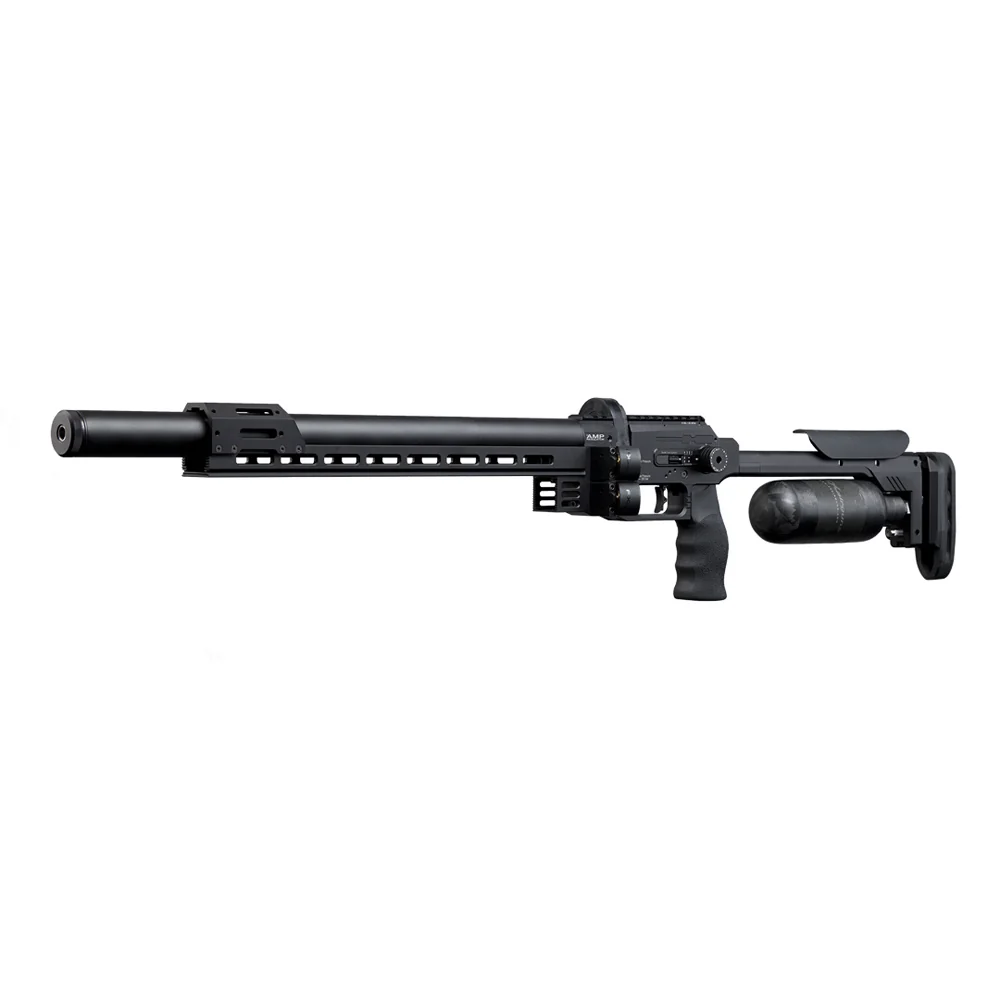
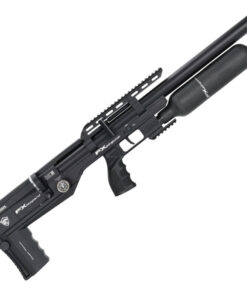
Calibres, FAC Power, and Accessories on the FX Panthera Black 700mm FAC
Calibre choice is treated as a foundational decision on the FX Panthera Black 700mm FAC. Consequently, barrel liner, twist, magazine depth, and plenum volume are aligned so that FAC energy can be used efficiently. Moreover, accessories are selected so that the same chassis can be adapted for match stages, supported hunting, and range development.
Available Calibres and Intended Roles
High-power 700 mm configurations are typically offered in .22 (5.5 mm), .25 (6.35 mm), and .30 (7.62 mm). Meanwhile, .177 is generally omitted on FAC 700 mm builds because slug mass and barrel dwell time are better served by the larger bores.
A .22 chambering is favoured when a balance of shot count, magazine capacity, and mid-weight slugs is required. Furthermore, 18-round Side-Shot magazines are supplied, and projectiles up to 13 mm in length are accepted by the deeper lid. Therefore, hybrid slugs in the low-20-grain class can be used for high shot strings, while 34–40 grain slugs can be introduced when maximum FAC energy is requested.
A .25 chambering is selected when a step-up in sectional density is needed without the full air consumption of .30. In addition, 16-round magazines are fitted. As a result, 26-grain class hybrids can be run for efficiency, while 43–55 grain slugs can be reserved for longer-range FAC work.
A .30 chambering is reserved for maximum momentum and high-BC slugs. Likewise, 13-round magazines are provided. Subsequently, 44–70 grain projectiles can be launched when the legal environment and filling capacity support true FAC output.
Inclusive use is supported because liner and calibre changes are handled through authorised FX dealers rather than improvised field swaps. Hence, left- and right-handed users can keep the same stock and lever setup while a different bore is professionally installed.
FAC Energy, Velocity, and Shot Capacity
FAC power on the FX Panthera Black 700mm FAC is produced by the combination of a 700 mm Superior Heavy STX liner, a Magnum XL over-barrel plenum of approximately 156 cc, a High-Power / Short-Impulse valve, and an externally adjustable AMP MKII regulator. Moreover, published maxima assume a tungsten hammer and appropriate slug weight.
Typical manufacturer figures for the FX Panthera Black 700mm FAC are presented as follows:
- .22 FAC: up to about 130 J / 96 ft-lbs with a 40 gr slug near 1040 fps; roughly 90 regulated shots at 900 fps with 22 gr hybrid slugs
- .25 FAC: up to about 145 J / 107 ft-lbs with a 55.5 gr slug near 930 fps; roughly 70 regulated shots at 900 fps with 26 gr hybrid slugs
- .30 FAC: up to about 203 J / 150 ft-lbs with a 70 gr slug near 982 fps; roughly 40 regulated shots at 900 fps with 44.5 gr hybrid slugs
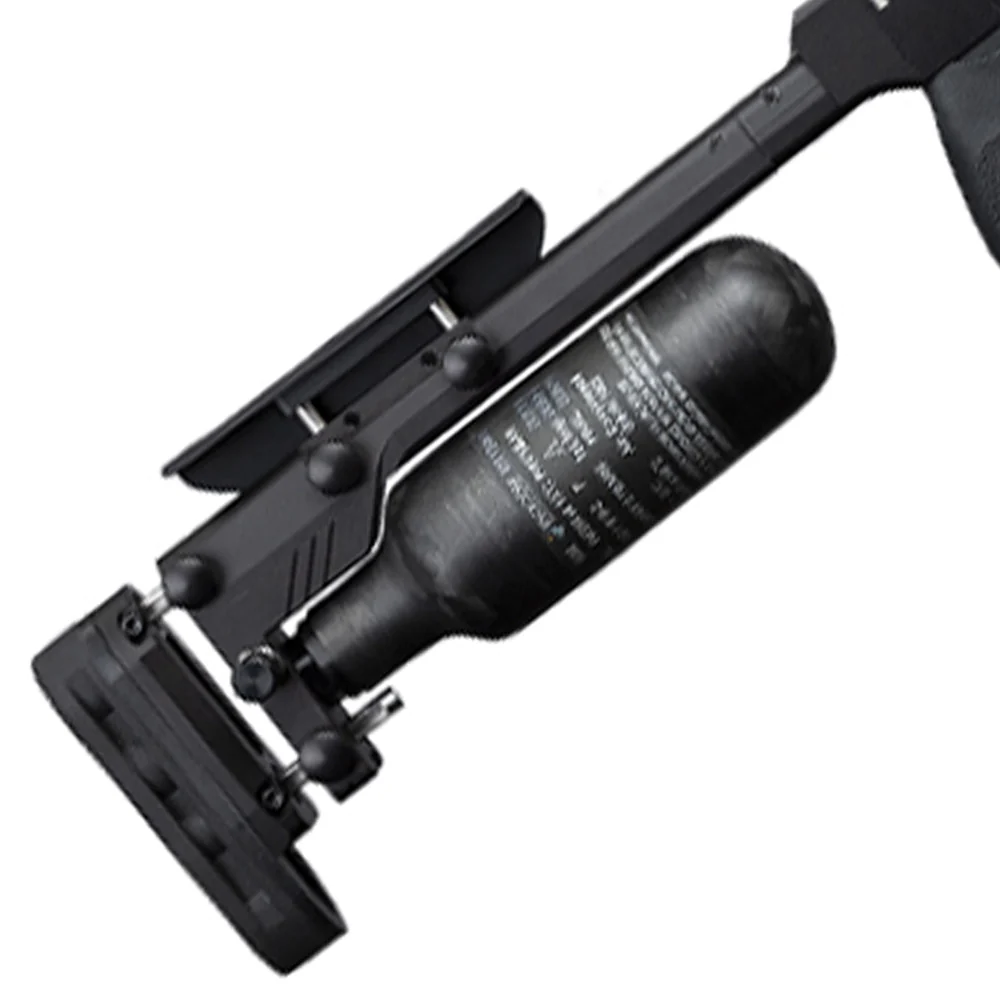
Fill pressure is specified at 250 bar (approximately 3,625 psi) into a removable 300 cc carbon-fibre cylinder. Therefore, total usable air includes both bottle volume and plenum volume. Consequently, shot counts fall when regulator pressure and hammer spring are raised for heavier slugs.
Consistency is emphasised over raw peak energy. Indeed, 10-shot strings with standard deviations in the 1–2 fps range and extreme spreads of 3–4 fps have been reported when premium slugs and a correct tune are used. Meanwhile, legal FAC status, licensing, transport, and storage rules remain the responsibility of the owner in every jurisdiction.
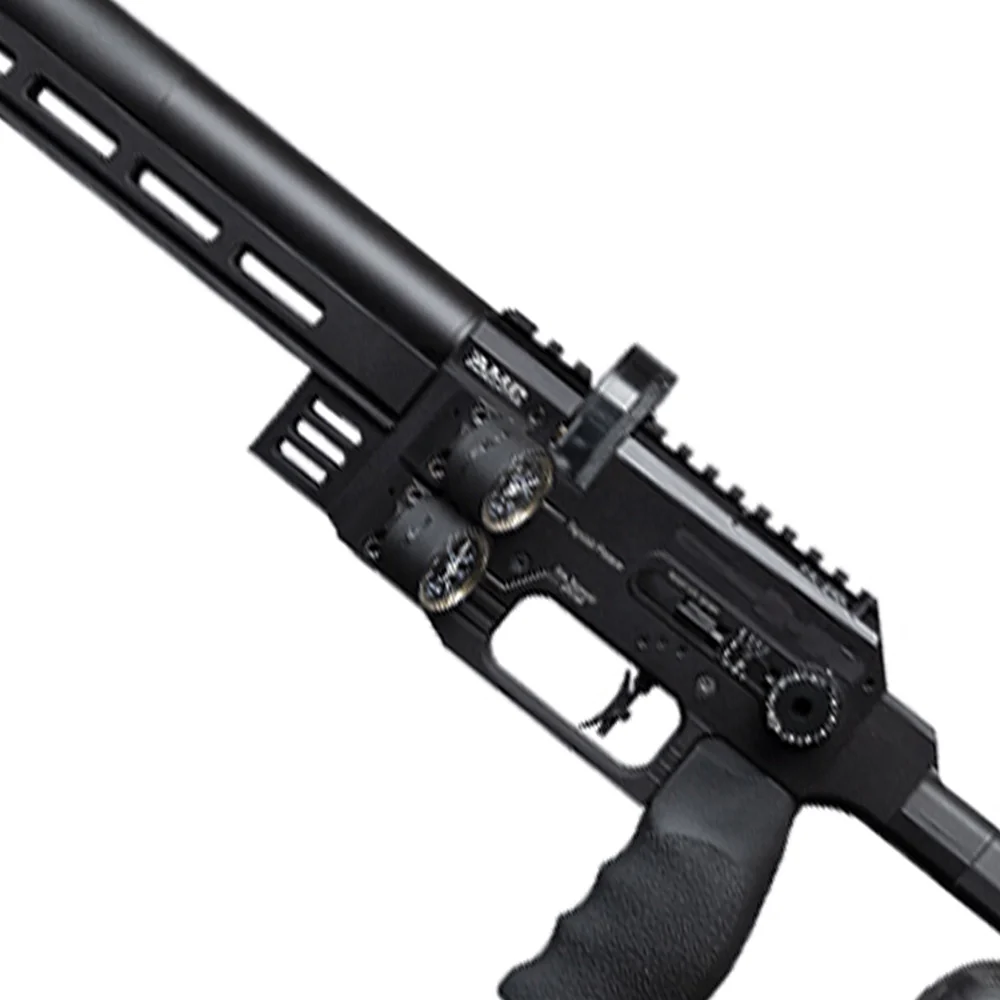
A two-stage match trigger, Quick Tune micro/macro hammer wheels, and dual angled gauges are provided so that power can be reduced for pellet practice or raised for slug work without a second rifle. As a result, a single FX Panthera Black 700mm FAC can cover training days and full-power sessions when local law allows.
Accessories That Complete a FAC Build
A conversion-focused accessory list is built around rails, fill hardware, optics, and balance rather than novelty parts.
Highlighted supporting items for the FX Panthera Black 700mm FAC include:
- Optics: 20 MOA Picatinny rail (some later MkII notes cite a steeper integrated rail) for long-range elevation; first- and second-focal-plane scopes with sufficient adjustment and a compatible reticle
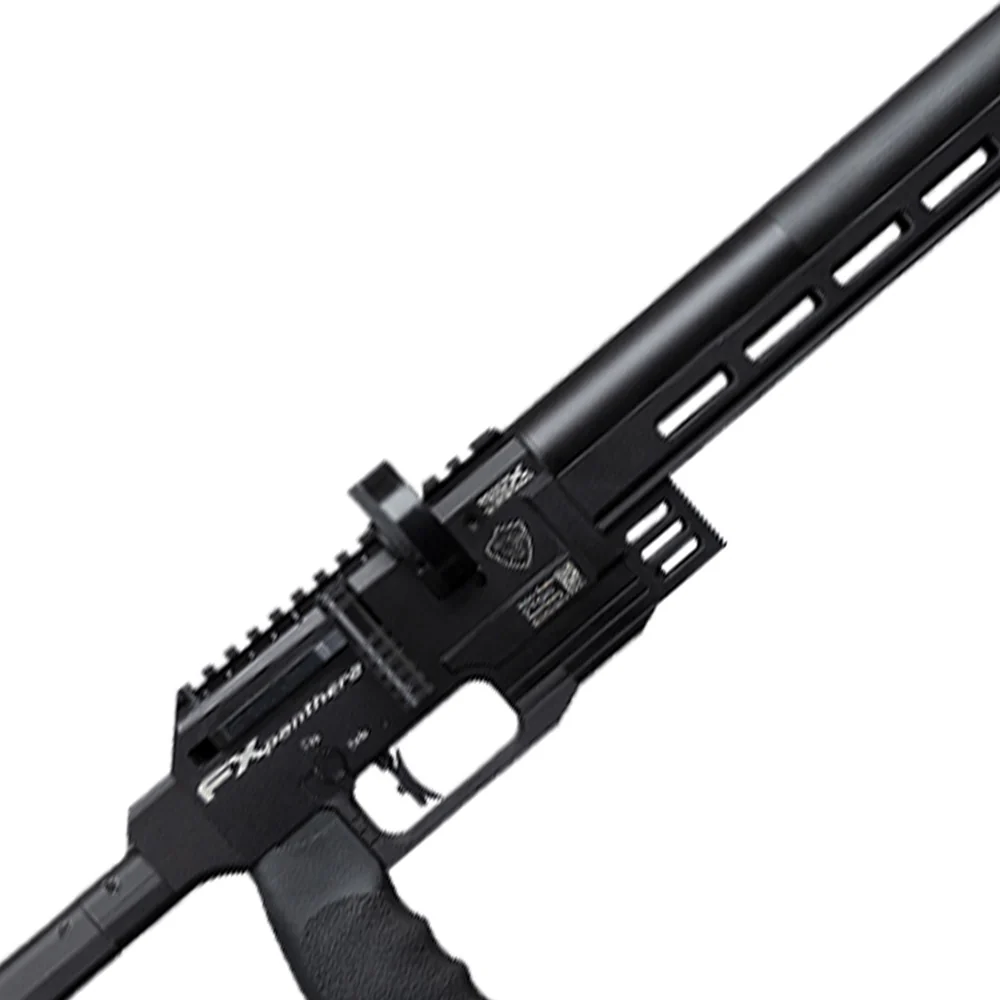
- Support: full-length ARCA rail, M-LOK sections, barricade block, optional bag rider, and internal FX barrel weights under the shroud
- Air system: rear Foster QD with dust cap, high-pressure hose, 250-bar-capable compressor or bottle, and a spare 300 cc carbon cylinder if extra shots are required
- Feeding: extra Side-Shot magazines with the deeper 13 mm lid, plus single-shot trays for load development
- Stock and controls: height-adjustable ambidextrous cheek piece, adjustable recoil pad (height, angle, length of pull), reversible sidelever, and zero-angle AR grip
- Protection and transport: factory cut-out hard case, muzzle thread protection or moderator where legally permitted, and sling or tripod hardware on ARCA/M-LOK
- Tuning aids: chronograph, extra hammer-spring settings, authorised liner or plenum service, and documented FAC-legal power certificates where required
Furthermore, M-LOK weights or a second bottle interface can be added when a stage or a long hide session demands extra air or a shifted centre of gravity. Likewise, a carbon tripod on the ARCA rail is often preferred for positional work because the 1245 mm overall length and 3.9 kg unscoped mass already favour supported shooting over all-day walk-and-stalk.
In addition, slug-specific cleaning rods, appropriate patches, and a torque-aware mounting kit for optics are recommended so that the Heavy STX liner and 20 MOA rail remain aligned. Subsequently, group size is protected after transport.
Inclusive language applies to accessory choice as well. Therefore, reversible controls, adjustable length of pull, and ambidextrous cheek geometry are retained so that more than one authorised user can share the same FX Panthera Black 700mm FAC without a second chassis.
Matching Calibre, Power, and Kit in Practice
A .22 FAC tune with mid-weight hybrids is typically paired with a moderate regulator setting, a high-capacity magazine load-out, and a mid-weight optic when shot count is the priority. Moreover, a .25 or .30 FAC tune with heavy slugs is paired with higher regulator pressure, a tungsten hammer where fitted, a stiffer bipod or tripod, and a scope with generous elevation.
Nevertheless, power must remain within the licence and local FAC limit. Consequently, a chronograph session after any hammer, regulator, or slug change is treated as mandatory. Ultimately, the FX Panthera Black 700mm FAC is most effective when calibre, projectile, plenum volume, and accessories are specified together rather than assembled at random.
Frequently Asked Questions
Common questions about a 700 mm FAC-class slug rifle are answered below. Consequently, purchasing, licensing, and first-range decisions can be made with fewer surprises. Moreover, inclusive language is used so that left- and right-handed users, shared household licences, and mixed experience levels are all considered.
Power, Licensing, and What “FAC” Actually Changes
Is a firearms certificate required before this class of rifle is used?
A certificate or equivalent high-power authorisation is required wherever muzzle energy exceeds the local airgun limit. Furthermore, transport, storage, and land-permission rules are attached to that authority. Therefore, a purchase should not be completed until the paperwork that matches the intended energy is already in hand.
Can factory energy figures be treated as a guaranteed everyday setting?
Published maxima are produced with a specific hammer, slug weight, and regulator pressure. Meanwhile, a stock hammer and a lighter projectile will usually deliver less. As a result, a chronograph session after any change of slug, spring, or regulator is treated as mandatory rather than optional.
Is the highest listed joule figure needed for every outing?
Peak energy is reserved for appropriate quarry, distance, and legal conditions. In addition, a milder regulated tune is often preferred for practice, closer pest work, or high shot-count training. Subsequently, barrel life, air consumption, and neighbour-friendly report are all improved when power is matched to the job.
How is consistency verified after a fill?
Bottle pressure and plenum pressure are read on the dual angled gauges before a string is started. Likewise, a 10-shot group over a chronograph is preferred to a three-shot cluster. Consequently, a pretty clover at 30 metres is not mistaken for a stable long-range tune.
Calibres, Magazines, and Projectiles
Which bore is usually chosen first?
A .22 chambering is frequently selected when magazine capacity and shot count are the priority. Moreover, a .25 chambering is chosen when sectional density is wanted without the full air use of .30. Therefore, a .30 chambering is reserved for heavy slugs and maximum momentum where the licence and filling logistics support it.
Are pellets still usable on a slug-oriented 700 mm liner?
Pellets can be used after power is reduced and a suitable lot is tested. Furthermore, groups may not match the best slug results because the Heavy STX liner and twist are specified around longer, heavier projectiles. As a result, pellets are treated as a training or close-range option rather than the primary FAC load.
How long a slug can be fed from the magazine?
Projectiles up to about 13 mm in length are accepted by the deeper lid. Meanwhile, a standard lid may clip longer slugs and cause a feed failure mid-stage. Subsequently, magazines are labelled by weight and length so that mixed tins are not loaded in the dark.
What magazine capacities are typically supplied?
Approximate capacities of 18 rounds in .22, 16 in .25, and 13 in .30 are commonly listed. In addition, a single-shot tray is useful during load development. Hence, a match bag usually contains at least two magazines of the same specification rather than one hero magazine and a handful of loose slugs.
Highlighted feeding habits that prevent stoppages include:
- Magazines kept free of grit after barricade stages
- Lids inspected for cracks before a hunt or match
- One slug weight per magazine body
- A rehearsal of the last-round feel so an empty gun is not “clicked” at a target
Air System, Regulator, and Shot Count
What fill pressure is specified?
A maximum fill of 250 bar into a removable 300 cc carbon-fibre cylinder is the usual figure. Furthermore, usable air also includes the large over-barrel plenum. Therefore, a compressor or bottle that honestly reaches that pressure is required; a tired pump that stops at 200 bar will silently cut both power and shot count.
How many shots can be expected from one fill?
Rough published strings at 900 fps are often near 90 in .22 with mid-weight hybrids, 70 in .25, and 40 in .30. Meanwhile, heavier slugs and higher regulator settings reduce that number quickly. Consequently, a hide session or a long PRS day is planned with a spare cylinder or a mid-day top-up rather than optimism.
Can regulator pressure be changed without stripping the action?
External adjustment is provided on the AMP-style regulator. Likewise, the upper gauge is used to confirm plenum pressure after a change. As a result, a practice tune and a FAC slug tune can be documented and recalled without a full rebuild.
Why are two gauges fitted?
Bottle pressure and regulated plenum pressure are displayed separately and at an angle that can be read from the shooting position. In addition, a falling bottle reading with a stable plenum reading is the expected picture during a good string. Subsequently, a sudden drop on the plenum gauge is treated as a reason to stop and inspect rather than to “send one more.”
Stock, Controls, and Inclusive Fit
Can the rifle be set up for a left-handed shooter?
The sidelever can be reversed and the cheek piece can be swapped. Moreover, length of pull, pad angle, and comb height are adjustable. Therefore, a shared household or club rifle can be reconfigured without a second chassis being purchased.
Is the trigger suitable for both match and field use?
A two-stage match trigger with blade reach, height, and rotation adjustment is fitted. Furthermore, a heavier first stage can be set for gloved winter use while a lighter break is reserved for bench confirmation. Consequently, one trigger shoe can cover more than one season if the settings are written down.
Does the long forend help or hinder hunting?
A full ARCA and M-LOK forend helps on a tripod, vehicle rest, or barricade. Meanwhile, the same length hinders tight woodland stalking. Hence, this configuration is treated as a supported-field or competition tool, not as a compact walker.
Highlighted fit checks before a first live string include:
- Comb height that allows a full sight picture without neck strain
- Pad contact that does not shift when the lever is cycled
- Lever throw that clears a bulky jacket
- Grip angle that keeps the trigger finger independent of the support hand
Optics, Rails, and Accessories
What kind of scope rail is provided?
A canted Picatinny rail—commonly 20 MOA on the original specification—is used so that long-range elevation remains in the scope’s travel. In addition, later revisions on some batches mention a steeper integrated rail. Therefore, ring height and objective clearance over the shroud and plenum should be confirmed before rings are purchased.
Which supports are most useful in the field?
An ARCA-compatible tripod or bipod, a rear bag or bag rider, and optional under-shroud weights are the usual kit. Likewise, M-LOK plates can carry a small pouch or a modest counterweight. As a result, balance can be shifted without drilling the chassis.
Is a second air cylinder worth carrying?
A spare 300 cc bottle is worthwhile for a match day or a long authorised sit. Furthermore, the rear Foster connection makes a swap faster than a probe-style fill in the rain. Subsequently, dust caps are refitted immediately so grit does not enter the nipple.
Can a moderator be fitted?
A muzzle thread is present on many examples, but legal status varies by country and by energy. Meanwhile, a thread protector is used when a moderator is not permitted. Consequently, local law is checked before any muzzle device is ordered.
Accuracy, Distance, and Realistic Expectations
Is 100-metre performance automatic out of the box?
Mechanical consistency is high when slugs, regulator, and hammer spring are matched. Moreover, wind, mirage, and shooter position still decide whether that consistency becomes a group on target. Therefore, a first session is used to map two distances rather than to chase a social-media claim.
Why do some strings look excellent and the next ten open up?
A different slug lot, a cold first shot from a stored fill, a shifted bipod foot, or a cheek weld that changed after the lever was cycled can all open a group. In addition, a liner that has not been cleaned after a dusty stage will show the same symptom. Subsequently, one variable is changed at a time.
Are heavy slugs always more accurate in a 700 mm tube?
Heavier slugs often prefer the longer dwell and the Heavy STX twist, but only inside a velocity window that the valve and plenum can support cleanly. Likewise, an overweight projectile at too low a speed can keyhole or drift. As a result, the chronograph and a paper target at the intended distance remain the judge.
Maintenance, Transport, and Sharing the Rifle
How should the bore be cleaned?
Tools and patches suited to a Smooth Twist X liner are used; improvised rods that scratch the bore are avoided. Furthermore, cleaning is scheduled after dusty matches and wet hides, not after every five-shot group. Consequently, the crown and liner are protected while fouling is still removed.
Can the rifle be stored at a full 250 bar for months?
Manufacturer guidance on stored pressure should be followed. Meanwhile, seals and gauges live a quieter life when a residual working pressure is used between events. Therefore, a pre-season fill and a leak check are completed before the first hunt, not in the car park.
How is a shared rifle handed between authorised users?
Settings are written down: regulator pressure, hammer micro/macro marks, comb height, and the slug lot that matches zero. In addition, lever side and pad position are photographed. Hence, the next licensed user is not forced to invent a new tune on a cold morning.
What belongs in the case besides the rifle?
A fill whip, dust cap, spare magazines, a labelled slug tin, a torque wrench for optic screws, and the licence documents are the usual minimum. Likewise, a small notebook or phone log of the last good tune saves an entire range session. Subsequently, the case is treated as part of the shooting system, not as leftover packaging.
Buying Decisions and Honest Limitations
Who is this configuration actually for?
Licensed shooters who need supported long-range consistency, slug capability, and modular rails are the intended users. Moreover, competitors who already own a high-pressure fill solution and a capable optic will extract the most value. Therefore, a first-time plinker seeking a lightweight woodland rifle is steered toward a shorter, lower-power platform.
What is the main compromise that should be accepted before money is spent?
Overall length and mass favour a tripod, hide, or barricade and penalise all-day walking. In addition, FAC energy brings legal duty, filling logistics, and higher ammunition cost. Ultimately, the rifle is at its best when those constraints are accepted in advance and the day’s work is planned around a stable rest, a documented tune, and a clear legal purpose.




Reviews
There are no reviews yet.