FX Impact M4 Sniper Black
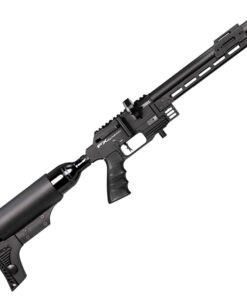
Precision at extended range is delivered by the FX Impact M4 Sniper Black, a fourth-generation modular PCP platform that has been refined for consistency, power, and adaptability. Long-range work, pest control, hunting, and competition are supported through a 700 mm Superior STX barrel, a 580 cc carbon-fiber cylinder, and an externally adjustable brass-piston AMP regulator. Consequently, a balanced, tunable rifle is offered to shooters who value repeatable velocity and a chassis that can be configured as needs change.
Why the FX Impact M4 Sniper Black Is Chosen
A longer sight radius and improved slug/pellet stability are provided by the Sniper configuration. Therefore, groups at distance can be tightened when the rifle is correctly tuned and ammunition is matched. Moreover, the black finish is paired with a reinforced top plate so that rigidity is increased and optic alignment remains stable after the rail is removed and remounted.
Furthermore, a reversible sidelever is fitted so that left- and right-handed users can be accommodated without a separate action. In addition, an FX UG1 AR-15-style grip and a vertically adjustable recoil pad are included so that length of pull and hand position can be tailored. As a result, a comfortable, inclusive shooting position can be established for a wide range of body types and disciplines.
Core Platform Highlights
- 700 mm Superior STX barrel is installed for long-range consistency, with liners that can be exchanged for slug-optimized twist rates.
- 580 cc carbon-fiber bottle is filled to 250 bar, while regulated working pressure is set externally up to 170 bar.
- Power Plenum 750 (approximately 75 cc) is placed behind the valve so that high-energy shots can be supported with stable air volume.
- Brass-piston AMP regulator is used so that faster refresh and tighter shot-to-shot consistency can be maintained.
- Quick Set Trigger is provided so that hunter, standard, or match characteristics can be selected with a single primary adjustment, while first stage, second stage, blade height, and reach remain tunable.
- 30 MOA Picatinny rail is clamped to an 11 mm dovetail backbone so that eye relief can be slid and locked without losing alignment.
- High-capacity POM magazines are redesigned with a stronger drum so that heavy slugs can be rotated smoothly.
- 1/2×20 UNF muzzle thread is cut so that a moderator or additional muzzle device can be fitted.
- Foster quick-disconnect charging is used for fast, repeatable fills.
- Switch-style safety and a modular chassis are retained so that accessories and barrel kits can be added later.
Calibres, FAC Power, and Accessories
Multiple calibres are offered on the FX Impact M4 Sniper Black, so that the same chassis can be adapted from high-volume target work to larger hunting projectiles. Typical magazine capacities are listed as approximately 34 rounds in .177, 28 in .22, 25 in .25, 23 in .30, and 18 in .35. Meanwhile, approximate shot counts from a full 250 bar fill (highly dependent on tune, projectile, and regulator setting) are published around 375 in .177, 330 in .22, 160 in .25, 105 in .30, and 45 in .35.
Peak factory energy figures are commonly quoted as up to about 47 J / 35 ft-lbs in .177, 117 J / 87 ft-lbs in .22, 135 J / 100 ft-lbs in .25, 169 J / 125 ft-lbs in .30, and 211 J / 156 ft-lbs in .35. Importantly, those maxima are associated with slug ammunition, a slug power kit, and—in several published notes—the longer 800 mm Extended barrel. Therefore, realistic output on the 700 mm Sniper barrel should be confirmed against local FAC or regional limits and the exact ammunition that will be used.
Additionally, a hard case, magazine, fill probe/Foster fitting, and often a suppressor are supplied with many retail packages. Barrel kits, liner changes, and pellet-probe swaps are supported so that calibre changes can be completed without a new rifle. Consequently, one platform can be maintained across several roles.
Practical Tuning Notes
Regulator pressure, hammer-spring preload (macro and micro Quick Tune), transfer-port setting, and plenum volume must be coordinated. Otherwise, velocity scatter or wasted air can appear. Likewise, projectile length should stay within the magazine’s design window (often cited near 12 mm for standard drums). Afterward, a chronograph session should be completed so that a safe, legal, and consistent tune can be documented.
Handling, Optics, and Field Use
An overall length of about 1000 mm (39 in) and an unscoped weight of approximately 3.25 kg (7.15 lb) are specified for the Sniper Black. Hence, a stable prone or bench position can be held without the extra length of the Extended model. At the same time, the 700 mm shrouded STX tube still provides the extra dwell that slugs and heavier pellets often need.
Side rails and an under-barrel Picatinny section are present so that bipods, lights, or weights can be attached. Meanwhile, the sliding 30 MOA rail allows high-magnification optics to be positioned for proper eye relief. Because the rail sits on a machined 11 mm dovetail, reinstallation after travel is simplified and cant errors are reduced.
For hunting and pest control, a quiet, regulated shot string can be produced when the moderator is fitted and the regulator is set below bottle pressure. For competition, the Quick Set Trigger can be lightened and the sidelever can be swapped so that follow-up shots remain smooth. Inclusive use is supported because the lever, grip, and pad can be arranged for either shoulder.
Responsible ownership remains essential. Local licensing, FAC or energy limits, safe backstops, and appropriate ammunition must always be observed. Storage, transport, and filling should follow manufacturer guidance so that the carbon cylinder and regulator stay within rated pressures.
Who the FX Impact M4 Sniper Black Serves
Shooters who want one modular rifle for distance work are served by this configuration. Moreover, users who later add a Compact or Extended barrel kit are not locked into a single length. In the same way, clubs and households with mixed-handed shooters benefit from the reversible lever and AR-style grip.
Conversion is encouraged when a platform that can be tuned, re-barrelled, and optically tailored is preferred over a fixed, non-adjustable rifle. After the first range session, regulator and trigger settings are usually refined; thereafter, shot-to-shot consistency is what keeps the FX Impact M4 Sniper Black on target when conditions change.
A premium, FAC-capable PCP in a discrete black chassis is presented here. When legal power, quality pellets or slugs, and a verified zero are combined, long-range precision can be extracted from the 700 mm STX system without abandoning the modularity that made the Impact series a standard in the first place.
Calibres, FAC Power and Accessories on the FX Impact M4 Sniper Black
A wide calibre range is supported on the FX Impact M4 Sniper Black, so that one modular chassis can be adapted from high-volume target work to heavier hunting projectiles. Consequently, barrels, probes and magazines can be exchanged instead of a second rifle being purchased. Moreover, FAC-capable energy, regulated air delivery and a deep accessory ecosystem are combined so that legal power in one region and higher output in another can both be addressed with the same platform.
Calibres That Can Be Fitted
Five factory calibres are commonly listed for the Impact M4 family: 4.5 mm (.177), 5.5 mm (.22), 6.35 mm (.25), 7.62 mm (.30) and 9 mm (.35). On the Sniper Black specifically, retail packages are most often offered in .22, .25 and .30, while .177 and .35 remain available through barrel kits or special order depending on the dealer. Therefore, a starter calibre can be chosen for local pellet supply, after which a liner or complete barrel assembly can be fitted when slugs or larger game are required.
High-capacity magazines are matched to each bore. Approximate drum counts are published as 34 shots in .177, 28 in .22, 25 in .25, 23 in .30 and 18 in .35. In addition, a stronger POM body and revised internal mechanism are used so that heavy slugs can still be rotated without binding. Meanwhile, maximum projectile length is typically kept near 12 mm on the standard magazine, so that feeding reliability is preserved. After a calibre change, the pellet probe is replaced as well, because probe diameter and travel must match the new liner.
FAC Output, Regulation and Realistic Power
Regulated PCP performance is delivered by a brass-piston AMP regulator that can be set from outside the action up to a working pressure of about 170 bar, while the carbon bottle itself is filled to 250 bar. Behind the valve, a Power Plenum 750 of roughly 75 cc is provided so that a large, stable volume of air is ready for each shot. As a result, velocity scatter can be reduced when regulator pressure, hammer-spring preload and transfer-port setting are coordinated.
Published peak energy figures for the M4 platform are often quoted as up to approximately 47 J / 35 ft-lbs in .177, 117 J / 87 ft-lbs in .22, 135 J / 100 ft-lbs in .25, 169 J / 125 ft-lbs in .30 and 211 J / 156 ft-lbs in .35. Importantly, those maxima are associated with slug ammunition, a slug power kit and—in several factory notes—the longer 800 mm Extended barrel. Therefore, output on the 700 mm Sniper tube should be treated as substantial but not automatically identical to Extended-barrel test numbers. Likewise, medium factory default settings (often cited around 60 J, 85 J and 130 J depending on calibre) are commonly shipped so that a usable tune is present before fine adjustment is made.
Approximate shot counts from a full 250 bar fill are listed near 375 in .177, 330 in .22, 160 in .25, 105 in .30 and 45 in .35. However, those figures change with regulator setpoint, projectile weight, FAC spring kits and ambient temperature. Consequently, a chronograph session after every major change is recommended so that legal limits are not exceeded and consistency can be verified.
Where sub-12 ft-lbs rules apply, Compact or Standard barrels and dual-regulator low-power setups are frequently specified instead of the Sniper FAC layout. Conversely, where FAC certificates are held, the 700 mm STX Sniper barrel, 580 cc bottle and 75 cc plenum are used so that long-range slugs can be driven with a flatter trajectory. Inclusive use is supported because power can be turned down for club ranges and raised again for field work without a different rifle being required.
Accessories, Kits and What Travels With the Rifle
A hard case is typically supplied so that the rifle can be transported with the bottle, magazines and fill probe protected. Foster quick-disconnect charging is fitted as standard, so that compressors and bottles from other FX rifles can often be shared. Additionally, a 1/2×20 UNF muzzle thread is cut so that the factory moderator or a third-party can can be attached.
Optics mounting is handled by a 30 MOA Picatinny rail that clamps to an 11 mm dovetail machined into the thicker M4 top plate. Eye relief can therefore be slid and locked without the rail losing alignment after removal. Side and under-barrel Picatinny sections are present so that bipods, lights, weights or slings can be added. The FX UG1 AR-15-style grip accepts aftermarket AR furniture, while the recoil pad can be raised or lowered so that shooters of different stature can be accommodated.
Barrel and liner kits remain the most important performance accessories. A Superior STX liner can be swapped for an STX Heavy or slug-specific twist, and a complete 500 mm, 600 mm or 800 mm assembly can replace the 700 mm Sniper tube when a compact or extra-long setup is preferred. Slug power kits, extra magazines, spare probes, M-LOK weights and cheek-piece options are catalogued so that the chassis can be specialised for benchrest, hunting or NRL-style stages.
Legal compliance must still govern every accessory choice. Fill pressure must stay at or below 250 bar, regulator settings must remain inside the AMP’s working range, and energy must match the certificate or national limit that applies to the owner. When those constraints are observed, the FX Impact M4 Sniper Black can be expanded from a single-calibre hunting rifle into a fully modular FAC platform without the core action being discarded.
FX Airguns, PCP Air Rifles, Hatsan Models and Modern Airgun Platforms
Modern airguns cover a wide range of platforms, from a basic pellet gun or BB gun to sophisticated regulated PCP airguns designed for target shooting, sporting applications, and long-range precision. Buyers researching an air rifle and air pistol collection will often encounter manufacturers such as FX and Hatsan because both companies offer extensive selections of air rifles, accessories, configurations, and caliber choices.
FX Airguns Sweden and the FX PCP Rifle Range
FX Airguns has become strongly associated with Swedish airgun engineering. Searches for fx airguns sweden, fx airguns sverige, fxairguns, and fx usa commonly lead enthusiasts toward the manufacturer’s extensive PCP lineup. In the American market, fx airguns usa is another widely searched phrase when people are researching available models, specifications, support, and accessories.
Among fx air rifles, the Impact family remains particularly recognizable. Searches frequently include fx impact, f x impact, fx impact m4, fx m4, impact m4 air rifle, and impact m4 500mm when comparing current configurations. The modular design philosophy associated with the Impact platform has helped make the fx air rifle range popular among shooters who appreciate adjustability and configurable PCP systems.

Earlier generations remain widely researched as well. The fx impact m3, impact m3, fx impact mk3, fx m3, and fx m3 airgun continue to attract attention from owners comparing generations or researching replacement components.
Caliber-specific searches include fx impact m3 .22cal air rifle, fx impact m3 .22cal air rifle. 600mm barrel, and the more general fx impact m3 air rifle. People comparing international pricing may also search fx impact m3 precio, fx impact m3 precio en usa, or fx impact m3 price before checking local regulations, specifications, and availability.
Beyond the Impact series, the FX catalog includes several distinctive designs. The fx leopard and fx leopard airgun are frequently researched alongside fx leopard .22 pcp specs by users interested in specifications and configuration details.
Other notable searches include fx drs, fx drs tactical, fx drs classic, and fx drs pro. These terms reflect interest in the different DRS configurations and their intended shooting styles.
The wider FX family also includes models such as the fx king, fx wildcat, fx panthera, and fx dreamline. Collectively, these platforms demonstrate the variety available to anyone researching a premium pcp air rifle, pellet rifle, or configurable precision air gun.
Some enthusiasts also search fx outdoors when researching outdoor shooting equipment and related products, while marketplaces and information sources such as guns.com may appear during broader online research.
Understanding Pellet Guns and PCP Air Rifles
A traditional pellet gun uses shaped pellets rather than conventional firearm ammunition. The broader term pellet guns can describe spring-powered, CO₂-powered, pneumatic, and PCP platforms.
A PCP air rifle stores compressed air inside a reservoir. This system can provide consistent pressure across multiple shots depending on the rifle’s regulator, reservoir capacity, caliber, and power configuration.
For shooters comparing ammunition sizes, .177 caliber remains one of the most common options. Larger configurations are also available, including the increasingly searched 30 cal air rifle category.
Some users accidentally search pallet gun when looking for pellet-powered equipment. Regardless of terminology, specifications such as energy output, caliber, barrel length, intended range, and local legal requirements should always be reviewed before use.
The practical range of air rifle platforms varies significantly. Pellet weight, velocity, environmental conditions, barrel design, optics, and shooter technique can all affect useful range and accuracy.
Hatsan Air Rifle and PCP Platforms
The hatsan air rifle lineup covers traditional spring-powered designs as well as modern PCP systems. Searches such as hatsanusa, hatsan usa, hatsan air guns, and hatsan pcp are commonly used by enthusiasts researching the company’s models.
One of the most recognizable platforms is the hatsan blitz. Search variations include hatsun blitz, hatzan blitz, hatsan blitz full automatic, hatsan blitz 30 cal, and hatsan blitz .30 cal. Specifications and legal classifications can vary by market, so owners should verify the rules applicable in their jurisdiction.
Another frequently researched model is the hatsan model 95, also searched as hatsan mod 95 and mod 95. This traditional air rifle platform remains familiar to shooters interested in conventional stock designs.
The hatsan 125 is another established model, while the hatsan 135 family attracts shooters researching powerful spring-piston platforms. Related searches include hatsan 135 vortex air rifle, hatsan 135 carnivore, and hatsan big bore carnivore rifle.
Hatsan Sortie, BullBoss and Bullpup Designs
Compact and semi-automatic PCP designs form another part of Hatsan’s catalog. The hatsan sortie is commonly researched alongside hatsan sortie tact, hatsan sortie tact semi-auto pcp, and hatsan sortie accessories.
Bullpup enthusiasts may encounter the hatsan bullboss, bullmaster, and hatsan hercules bully. Their compact layouts are designed to reduce overall length while maintaining useful barrel dimensions.
Other PCP models include the hatsan flash, hatsan flashpup qe, and hatsan invader. These rifles provide additional choices for people comparing conventional and bullpup PCP configurations.
Hatsan Hercules, Piledriver and Large-Caliber Platforms
For people researching larger airgun platforms, hatsan hercules and hatsan piledriver often appear in search results. Large-bore air rifles differ considerably from standard .177 and .22 pellet rifles in projectile size, power output, air consumption, and intended application.
The hatsan harpoon is associated with specialized projectile launching, while an arrow launcher represents another distinct air-powered category. Such equipment can be subject to different legal rules depending on location, so local regulations should be checked before ownership or use.
Additional Hatsan Models
The Hatsan catalog extends well beyond its best-known rifles. The hatsan airtact and hatsan airtact air rifle provide another entry point into the brand’s conventional rifle selection.
Other searches include hatsan zada, hatsan neutron star, hatsan factor rc, hatsan velox, and hatsan jet 2. Each platform serves a somewhat different role, making specifications such as caliber, reservoir capacity, operating system, barrel configuration, and overall dimensions important comparison points.
Shoppers researching discounted equipment may also encounter hatsan refurbished listings or broader searches for refurbished air rifles. Condition, warranty coverage, seals, regulators, reservoirs, and service history should be checked carefully when evaluating previously used or factory-refurbished equipment.
Airgun Optics, Pellets and Accessories
Accessories can significantly affect how an air rifle is configured. A compact 4×20 optic may suit basic shooting applications, while more advanced PCP rifles are frequently paired with adjustable optics.
Pellet choice also matters. Products such as h&n field target trophy bleifrei provide an option for shooters specifically researching lead-free projectile designs. Pellet diameter, weight, head size, and barrel compatibility should all be considered when evaluating accuracy.
Terms such as econ ii may also appear when researching airgun-related equipment and accessories. Compatibility should always be verified against the exact manufacturer, model, and specification rather than relying solely on a product name.
Comparing FX and Hatsan Air Guns
FX and Hatsan approach the modern air rifle market from different directions. FX is particularly well known for highly configurable PCP platforms such as the Impact, Panthera, Wildcat, Dreamline, Leopard, DRS, and King. Hatsan, meanwhile, maintains an exceptionally broad range spanning spring-powered rifles, PCP systems, bullpups, semi-automatic platforms, and larger-caliber airguns.
Whether researching an FX Impact M3, FX Impact M4, FX DRS, Hatsan Blitz, Hatsan Sortie, Hatsan Hercules, or another platform, specifications should be compared carefully. Caliber, operating pressure, reservoir capacity, barrel length, projectile compatibility, optics mounting, overall dimensions, energy output, and regional legal requirements can all influence which configuration is appropriate for a particular lawful sporting or target-shooting application.
Practical Use Scenarios
A long 700 mm regulated PCP is taken into the field when distance, consistency and a quiet follow-up shot are required together. Because a large carbon cylinder, an externally adjustable regulator and a 75 cc plenum are combined, a stable string can be produced after a single 250 bar fill. Therefore, a morning of pest work or an afternoon of steel plates can be completed without a mid-session top-up being demanded in most moderate-power tunes.
Long-Range Precision and Steel
A prone or bench position is usually adopted when groups at 70–120 metres are the goal. The extra barrel length is used so that slugs and heavier pellets are given more dwell, while the 30 MOA rail is slid until eye relief on a high-magnification optic is correct. After the first cold-bore shot is recorded, regulator pressure and hammer-spring preload are left untouched so that the remaining magazine can be compared on the same setting.
Wind flags or mirage are read between strings. Meanwhile, a bipod on the forward rail and a rear bag under the adjustable pad are employed so that the chassis is not canted. Inclusive use is supported because the sidelever can be swapped and the AR-style grip can be rotated for either shoulder. Consequently, a left-handed marksman and a right-handed coach can share the same rifle during a club session without tools being unpacked.
When slugs are chosen, a Heavy or slug-specific liner is often fitted beforehand. Otherwise, keyholing or vertical stringing can appear once velocity is raised. After the liner change, the probe is replaced and magazine length is checked so that 12 mm-class projectiles still rotate freely. A chronograph is then placed in front of the muzzle so that legal energy and extreme spread are documented before a match card is signed.
Hunting From a Hide or High Seat
A hide, high seat or vehicle window is used when fox, rabbit or similar quarry is expected at first and last light. The shrouded tube and a threaded moderator are relied upon so that the report is kept down and livestock or neighbours are not disturbed. Because the regulator holds working pressure below bottle pressure, the first and twentieth shots remain close in velocity, which matters when a second animal appears on the same field.
A thermal or night optic can be clamped to the Picatinny rail, while a lamp is mounted on a side section if local rules allow illumination. Weight is kept near 3.25 kg unscoped, so that the rifle can be held on sticks for a short wait. After the shot, the sidelever is cycled quietly and the magazine is left indexed so that a follow-up is available without the action being opened fully.
Calibre choice is matched to quarry and law. A .22 or .25 pellet tune is frequently selected for small pests, whereas .30 slugs are reserved where FAC energy and a larger vital zone are permitted. In every case, a safe backstop is confirmed and the certificate or national limit is respected. Inclusive language on the ground means that a partner of different stature can take the same rest because the pad height and grip angle can be altered in seconds.
Pest Control Around Yards and Outbuildings
Short, repeated shots at 20–50 metres are typical around barns, polytunnels and feed stores. Here a slightly lower regulator setting is often preferred so that over-penetration through tin or timber is reduced. Magazines of 25–28 rounds in the mid-calibres allow a circuit of buildings to be walked without a reload at every corner.
A compact bipod or a windowsill rest is used rather than a full bench. Meanwhile, the switch-style safety is kept on until the muzzle is pointed at a verified target. After each building is cleared, the bottle gauge is glanced at so that a return to the compressor can be planned before the regulator drops off the plateau.
Because barrels and probes can be swapped, a quieter .22 liner can be fitted for yard work while a .30 hunting liner is kept in the case for weekend permission. Transport between sites is simplified by the supplied hard case, in which magazines, a Foster probe and a small tool kit are carried together.
Competition, Timed Stages and Club Nights
NRL-style air stages, benchrest cards and informal steel matches are all within the same chassis. The Quick Set trigger is turned toward a lighter, crisper break for paper, then returned toward a slightly heavier hunter pull when gloves are worn outdoors. First and second stages, blade height and reach remain independently adjustable, so that a junior shooter and an adult can be fitted on the same evening.
Shot counts from a 580 cc, 250 bar fill are large enough in .177 and .22 that a full match can often be shot on one charge at moderate power. In .25 and above, a spare bottle or a planned fill between stages is arranged. Side rails accept weights or an ARCA-compatible accessory so that recoil impulse with slugs is calmed on a barricade.
Inclusive club use is helped by the reversible lever and the fact that the optic rail can be slid for short or long eye relief. After the last detail, the rifle is depressurised only if workshop work is planned; otherwise the bottle is left with a safe residual so that seals stay seated.
Training New Shooters and Mixed Groups
A first session is begun at reduced regulator pressure and a moderate hammer-spring setting so that report and recoil stay mild. Dummy magazines or a single-shot tray can be used until loading rhythm is learned. Thereafter, full drums are introduced once muzzle awareness and a consistent hold are shown.
Because the platform is modular, the same action can later be given a shorter barrel for a smaller-framed shooter or a longer tube for a marksman who has outgrown the starter setup. Coaching is made easier when two gauges—bottle and regulator—can be read without the stock being removed. Transition words on the line itself matter less than a calm, repeated routine: fill, check gauges, load, safety off only on target, cycle, safety on.
Weather, Travel and Day-Long Carries
Cold mornings lower apparent regulator performance until the action warms. Therefore, a few fouling shots are fired into a bank before a hunting sit is begun. Rain is managed with a simple cover over the optic and a wipe of the sidelever rail; the carbon bottle itself is not used as a handle when wet.
Airline or long-road travel is planned around the hard case and local rules for PCP cylinders. Foster fittings are packed so that a club compressor at the destination can be used. After arrival, a brief function check—lever travel, magazine rotation, trigger reset, safety—is completed before live ammunition is introduced.
A day-long permission walk favours a sling on QD points and a modest accessory load. Extra magazines are carried rather than a second rifle. When the bottle gauge falls near the regulator setpoint, shooting is stopped so that the last shots do not go unregulated.
Slugs Versus Pellets in Daily Practice
Pellets remain the economical choice for 30–80 metre practice and for many pest jobs. Slugs are reserved when wind drift must be cut and energy at 100 metres must stay ethical. A slug kit, liner and probe are treated as a matched set; mixing a pellet liner with long slugs is avoided.
After a slug session, the magazine is emptied and inspected because lead dust and sharp bases accelerate wear. The threaded muzzle is checked so that the moderator has not loosened under the heavier recoil impulse. A notebook of velocity, temperature and group size is kept so that the next permission can be started on a known tune rather than guessed.
Accessories That Change the Scenario
A bipod turns a hide rifle into a field-target stand. A thermal clip-on on the 30 MOA rail turns a dusk walk into a controlled night patrol where law allows. M-LOK or Picatinny weights settle the muzzle for bench work. Extra drums mean a pair of shooters can share one action on a club night without waiting on a single ten-shot stick.
None of those add-ons replaces a verified zero, a safe backstop or a legal energy check. When those fundamentals are observed, the same 700 mm regulated chassis can be moved from a Tuesday club plate rack to a Saturday high-seat sit without the owner feeling that two different rifles were required.
A practical week with this platform is therefore built from small, repeatable habits: fill to 250 bar, set the regulator below that pressure, confirm velocity, match projectile to liner, adjust the pad and lever for the person behind the stock, and stop while air and attention remain sufficient. Distance work, pest circuits, FAC hunting and mixed training can all be served when those habits are kept, and when power is always held inside the certificate that belongs to the person who is actually firing the shot.
Frequently Asked Questions
A long, regulated PCP with a 700 mm barrel raises the same practical questions from new owners and from shooters who are moving up from a shorter tube. Therefore, the answers below are written so that filling, tuning, legality and day-to-day handling can be understood before the first live session is booked. Inclusive language is used throughout, because the sidelever, grip and pad can be arranged for either shoulder and for a wide range of stature.
What barrel length and overall size should be expected?
A 700 mm Superior STX tube is fitted on the Sniper configuration, while overall length is typically about 1000 mm. Unscoped weight is published near 3.25 kg. Consequently, a stable prone or bench hold can be maintained without the extra reach of an 800 mm Extended setup. Meanwhile, a Compact 500 mm kit can still be purchased later if a shorter truck or hide rifle is wanted from the same action.
Which calibres can be used, and can they be changed later?
Factory options across the family usually include .177, .22, .25, .30 and .35. Retail Sniper packages are most often seen in .22, .25 and .30, with the remaining bores supplied as barrel and probe kits. After a calibre swap, the liner, pellet probe and magazine must be matched. Otherwise, feeding or accuracy problems are introduced. A stronger POM drum is used on current magazines so that heavy
slugs can be rotated; approximate capacities are 34, 28, 25, 23 and 18 rounds as calibre increases.
How much energy is available, and what does FAC actually mean here?
Published peak figures for the platform are often listed near 35 ft-lbs in .177, 87 in .22, 100 in .25, 125 in .30 and 156 in .35. Importantly, those maxima are associated with slug ammunition, a slug power kit and, in several notes, the longer 800 mm barrel. Therefore, output on a 700 mm tube should be confirmed with a chronograph on the exact projectile that will be used. FAC simply means that local licensing allows energy above the low-power national cap; the certificate—not the brochure—sets the legal ceiling.
How many shots can be expected from one 250 bar fill?
Approximate high-power strings are published around 375 shots in .177, 330 in .22, 160 in .25, 105 in .30 and 45 in .35. Those numbers fall when regulator pressure is raised, when heavy slugs are used, or when temperature drops. Conversely, a milder club tune can stretch the 580 cc carbon bottle much further. A fill is stopped at the rated 250 bar; the regulator is then set below bottle pressure so that the plenum is refilled consistently.
What does the brass-piston regulator actually do?
Working pressure for each shot is held by an externally adjustable AMP regulator, commonly set up to about 170 bar. As long as bottle pressure remains above that setpoint, the 75 cc Power Plenum is refilled to the same value. Faster refresh and tighter extreme spread are the intended results. After any large change to hammer-spring preload, a new velocity string should be recorded, because the two adjustments interact.
Can left-handed shooters use the rifle comfortably?
A reversible sidelever and an ambidextrous mount are provided. In addition, an AR-15-style UG1 grip and a vertically adjustable recoil pad are fitted. Consequently, either shoulder can be used without a second action being bought. Eye relief is then corrected by sliding the 30 MOA Picatinny rail on the 11 mm dovetail backbone rather than by forcing an awkward head position.



Reviews
There are no reviews yet.