We Deliver Airguns Directly To Your Door
SKU N/A Category

Daystate Wolverine R Hi-Lite Regulated Walnut

$1,870.00

THE WOLVERINE R

EVOLUTION OF THE SPECIES

The Wolverine lineage has now been extended to include an air-regulated action and side lever cocking.

FEATURES AND SPECIFICATIONS OF THE WOLVERINE R AIR RIFLE

Offering all the time-proven attributes of the Wolverine 2 and now including the availability of a laminate or walnut thumbhole stock, the new R model swaps a cocking bolt for the in-vogue side lever cocking system, increasing yet further the appeal of this very versatile PCP.

That R suffix denotes this rifle’s piece-de-resistance – its regulator. Developed especially for Daystate in partnership with the internationally renowned Dutch regulator specialist, Huma-Air, the measured air control that it brings to the R’s action brings a host of benefits. Not only does it maximise shot-to-shot consistency as the rifle cycles through its usable air charge, but downrange accuracy is also improved. Furthermore, a greater number of shots are returned per fill-up – a big advantage on the Hi-Power and 30 cal models, which will return around 200 per cent more shots than the standard Wolverine 2 courtesy of the Huma’s highly efficient use of air.

If the Wolverine 2 is a marvel of mechanical PCP technology, then the Wolverine R has to be the pinnacle.

* Scope & mount are for illustration purposes and not included.

SPECIFICATION

Wolverine R C Type Wolverine R B Type Wolverine R Hilite
Overall Length 96.5 cm (38 ins) 96.5 cm (38 ins) 96.5 cm (38 ins)
Barrel Length 43 cm (17 ins) 43 cm (17 ins) 43 cm (17 ins)
Cylinder Capacity 200 cc 400cc / 500cc 480 cc
Weight (Unscoped) 3.5 kg (7.5 lbs) 3.2 – 3.7 kg (7 – 8 lbs) 3.5 kg (7.5 lbs)
Available Calibres .177 inch (4.5mm) & .22 inch (5.5mm) .177 inch (4.5mm) & .22 inch (5.5mm) .177 inch (4.5mm) & .22 inch (5.5mm)
Loading Magazine or Single Shot Tray Magazine or Single Shot Tray Magazine or Single Shot Tray
Cocking Side Lever action – factory reversible Side Lever action – factory reversible Side Lever action – factory reversible
Magazine 10 Shot 10 Shot 10 Shot
Fill Pressure Up to 230 BAR (3,335 psi) Up to 250 BAR (3,625 psi) Up to 250 BAR (3,625 psi)
Power / Shots Per Charge 0.303 N/A N/A N/A
Power / Shots Per Charge 0.25 N/A 110 shots @ 35 ft/lbs 100 shots @ 35 ft/lbs
Power / Shots Per Charge 0.22 250 shots @ 12 ft/lbs 150 shots @ 30 ft/lbs, 600 Shots @ 12 ft/lbs 130 shots @ 30 ft/lbs, 500 shots @ 12 ft/lbs
Power / Shots Per Charge 0.177 200 shots @ 12 ft/lbs 180 shots @ 18 ft/lbs, 500 shots @ 12 ft/lbs 160 shots @18 ft/lbs, 460 shots @ 12 ft/lbs
Trigger Two-stage mechanical release. Adjustable for weight and length of stage Two-stage mechanical release. Adjustable for weight and length of stage Two-stage mechanical release. Adjustable for weight and length of stage
Safety Manual, cross bar, lever open deactivation. Manual, cross bar, lever open deactivation. Manual, cross bar, lever open deactivation.
Stock Walnut or Grey Laminate Sporter Walnut or Grey Laminate Sporter Walnut or Grey Laminate Sporter
Options Upgraded stock, sling studs, Airstream silencer. Upgraded stock, sling studs, Airstream silencer. Upgraded stock, sling studs, Airstream silencer.
Standard Features Ambidextrous stock, Right or Left-hand side lever factory fitted, magnetic single-shot loading tray Ambidextrous stock, Right or Left-hand side lever factory fitted, magnetic single-shot loading tray Ambidextrous stock, Right or Left-hand side lever factory fitted, magnetic single-shot loading tray


Daystate Wolverine R Hi-Lite Regulated Walnut: Precision PCP Performance for Every Shooter

A refined mechanical PCP platform is presented by the Daystate Wolverine R Hi-Lite Regulated Walnut, where regulated consistency, a lightweight carbon bottle, and classic walnut furniture are combined for field and range work. Confidence is built through measured air delivery, while comfort is supported by an ambidextrous thumbhole stock that can be used by left- and right-handed shooters alike. Consequently, a long shooting session can be enjoyed without constant bottle changes, and responsible, legal use is encouraged wherever local FAC or power limits apply.

Why the Daystate Wolverine R Hi-Lite Regulated Walnut Stands Out

An evolutionary step beyond earlier Wolverine mechanical actions is represented by this model. In addition, a factory Huma-Air regulator is fitted so that each pellet is launched at a tightly controlled pressure. As a result, shot-to-shot velocity scatter is reduced, and groups at hunting or HFT distances are tightened. Meanwhile, a 480 cc carbon-fibre Hi-Lite bottle is employed so that substantial shot counts can be obtained from a fill of up to 250 bar, yet overall unscoped weight is kept near 3.5 kg (7.5 lb).

Furthermore, a factory-reversible side lever is specified so that cocking effort can be matched to the preferred shoulder. Likewise, a magnetic single-shot tray or a rotary magazine can be selected, so that either careful single loading or rapid follow-up shots can be chosen. Therefore, target practice, pest control, and competition-style sessions can all be accommodated on one chassis.

Daystate Wolverine R Hi Lite - Regulated - Walnut Stock - May of London

Regulated Consistency That Can Be Relied Upon

Measured air is held by the Huma-Air regulator downstream of the reservoir. Subsequently, a consistent volume is released for every shot, so that the first pellet and the last usable pellet from a fill can be expected to fly similarly. In practice, velocity variation of only a few feet per second has been recorded in independent tests over strings of tens of shots. Hence, holdover and windage corrections stay predictable, and wasted air is reduced compared with unregulated mechanical actions.

Moreover, efficiency is improved on both 12 ft-lb and FAC-tuned examples. For instance, around 460 shots at 12 ft-lb in .177 and around 500 shots at 12 ft-lb in .22 can typically be obtained from a full charge, while FAC settings in .22 or .25 return fewer but more powerful shots with the same regulated control. Accordingly, a full tin of pellets can often be used before a refill is required.

Walnut Thumbhole Furniture Designed for Inclusive Handling

A classically styled Turkish walnut thumbhole stock is fitted so that a secure, natural grip can be taken by shooters of different statures and dominant hands. In addition, an adjustable butt pad is provided so that length of pull and cheek alignment can be tailored. Consequently, recoil-free PCP shooting remains comfortable during long stalks or range strings. At the same time, the carbon bottle is positioned to keep the balance point friendly when a scope and moderator are added.

Core Features of the Daystate Wolverine R Hi-Lite Regulated Walnut

Highlighted below are the principal listings that define this rifle:

  • Action: Mechanical side-lever PCP, factory reversible for left- or right-hand use
  • Regulator: Factory Huma-Air unit for shot-to-shot consistency and improved air economy
  • Reservoir: 480 cc carbon-fibre Hi-Lite bottle, fill pressure up to 250 bar (3,625 psi)
  • Barrel: 43 cm (17 in) Lothar Walther match-grade tube, fully shrouded and ½” UNF threaded for a silencer
  • Overall length: 96.5 cm (38 in)
  • Weight (unscoped): Approximately 3.5 kg / 7.5 lb
  • Calibres commonly offered: .177 (4.5 mm), .22 (5.5 mm), and .25 (6.35 mm); FAC/high-power options available where lawful
  • Magazine capacity: 13-shot (.177), 11-shot (.22), 10-shot (.25), plus magnetic single-shot tray
  • Trigger: Two-stage mechanical, adjustable for weight and length of first and second stage
  • Safety: Manual cross-bar catch plus lever-open deactivation so that a discharge cannot occur with the lever open
  • Stock: Ambidextrous walnut thumbhole with adjustable butt pad
  • Rail: 9–11 mm dovetail for optics

Thus, a complete field or range package can be assembled once a suitable scope, mounts, and moderator are chosen.

Power, Calibre, and Legal Considerations

Power is factory-set to suit the destination market. Therefore, sub-12 ft-lb UK-legal examples can be selected, while FAC-rated Hi-Power versions can be specified where a certificate is held. In the latter case, energies in the region of 18–35 ft-lb (and higher on dedicated HP Hi-Lite long-barrel variants) can be delivered, with corresponding shot counts reduced in a predictable, regulated manner. Always, local licensing, transport, and hunting rules must be followed; the rifle itself cannot replace due diligence.

Practical Use: Field, Range, and Everyday Sessions

A compact 38-inch package is offered, so that movement through cover remains manageable. Meanwhile, the regulated action keeps point of impact stable as the bottle pressure falls, which is especially useful when a mixed bag of pest species or a long HFT course is tackled. Additionally, the side lever can be cycled quietly, and the magazine can be indexed without breaking the shooting position more than necessary.

For bench or zeroing work, the two-stage trigger can be refined until a clean break is obtained. Afterward, the same setting can be taken into the field. Because the stock is ambidextrous and the lever can be swapped, a household or club with mixed-handed members can share one rifle more easily. Inclusive design of this kind means that more shooters can be welcomed onto the same platform.

Maintenance remains straightforward for a mechanical PCP: keep the fill probe and threads clean, use dry, filtered air, and have seals and the regulator serviced by a qualified technician at recommended intervals. In this way, the consistency that the Daystate Wolverine R Hi-Lite Regulated Walnut is known for can be preserved season after season.

Conversion-Focused Summary

Exceptional mechanical PCP manners are delivered by the Daystate Wolverine R Hi-Lite Regulated Walnut through a Huma-Air regulator, a light 480 cc carbon bottle, and a walnut thumbhole stock that can be used by a wide range of shooters. High shot counts, match-grade barrel quality, and reversible controls are combined so that both leisure and serious use can be supported. When a dependable, classically finished regulated rifle is required, this model can be selected with confidence—provided that power level, calibre, and legal status are confirmed before purchase.

Responsible ownership, safe storage, and compliance with all applicable airgun laws remain essential. Once those conditions are met, the rifle is ready to be scoped, silenced, and taken to the range or the field.

Calibres, FAC Options, Power Levels, and Accessories for the Daystate Wolverine R Hi-Lite Regulated Walnut

A versatile mechanical PCP platform is offered by the Daystate Wolverine R Hi-Lite Regulated Walnut, so that calibre, legal power, and supporting accessories can be matched to the intended use. Consequently, target work, pest control, and FAC hunting can all be supported on the same regulated chassis, provided that local licensing and energy limits are respected. Inclusive setup is further encouraged because left- and right-handed shooters can be accommodated by the reversible side lever and ambidextrous walnut thumbhole stock.

Available Calibres and How Each Is Typically Employed

Three primary bore sizes are commonly supplied on the standard Hi-Lite regulated action. Therefore, pellet choice, trajectory, and terminal performance can be selected with purpose.

  • .177 (4.5 mm) is favoured where a flat trajectory and high shot count are required. Magazine capacity of 13 rounds is provided, and around 460 shots at 12 ft-lb can typically be obtained from the 480 cc carbon bottle. Accordingly, HFT-style courses, zeroing sessions, and small-pest work at modest ranges can be completed with fewer refills.
  • .22 (5.5 mm) is specified when a balance of energy, pellet mass, and still-generous shot count is wanted. An 11-shot magazine is fitted, and approximately 500 shots at 12 ft-lb—or about 130 shots at a 30 ft-lb FAC setting—can be expected, depending on factory tune and pellet weight. Thus, general hunting and all-round club use are frequently assigned to this calibre.
  • .25 (6.35 mm) is chosen when extra pellet weight and downrange authority are preferred. A 10-shot magazine is used, and roughly 100 shots at 35 ft-lb can be returned on a regulated FAC example. Hence, larger pests and longer ethical hunting distances can be addressed where the law permits.

A magnetic single-shot tray is also supplied, so that premium match pellets can be loaded individually when grouping tests or bench sessions are undertaken. Meanwhile, rotary magazines remain available for follow-up shots in the field. As a result, both precision and practicality can be served without a second rifle.

FAC Ratings, Factory Power, and Legal Responsibility

Power is factory-set to the destination market. Therefore, a UK-legal sub-12 ft-lb configuration can be selected, or an FAC-rated tune can be ordered where a certificate is held. On the standard-length Hi-Lite (17-inch barrel, 38-inch overall), regulated outputs in the region of 12 ft-lb, 18 ft-lb (.177 FAC), 30 ft-lb (.22 FAC), and 35 ft-lb (.25 FAC) are commonly listed. By contrast, the longer HP Hi-Lite variant (23-inch barrel) is reserved for still higher energies—up to around 45–60 ft-lb depending on calibre—and is a separate specification.

Because a Huma-Air regulator is fitted, usable air is metered at a consistent working pressure. Consequently, the first shot and the last usable shot from a fill remain closer in velocity than on an unregulated mechanical action. Shot counts fall as energy rises, yet the reduction remains predictable. For example, hundreds of 12 ft-lb shots can be obtained from one 250-bar fill, while FAC strings are shorter but still efficient compared with non-regulated Wolverine predecessors.

Always, muzzle energy must remain within the licence held. Likewise, transport, storage, and hunting seasons must be observed. The rifle cannot replace legal due diligence; responsible ownership is required of every user.

Accessories That Complete a Field- or Range-Ready Setup

A conversion-ready package can be built around the Daystate Wolverine R Hi-Lite Regulated Walnut once optics, sound moderation, filling gear, and magazines are added. Highlighted listings follow.

  • Optics and mounts: A 9–11 mm dovetail rail is provided, so that a compact hunting scope or a higher-magnification target optic can be fitted. Quality two-piece or one-piece mounts should be used so that zero is retained through side-lever cycling and field carry.
  • Silencer / moderator: The shrouded Lothar Walther barrel is ½” UNF threaded. Therefore, an Airstream-style or compatible ½ UNF moderator can be attached, reducing report for pest control and neighbour-friendly range use where local rules allow.
  • Filling equipment: A fill probe and quick-connect adaptor are typically included. A quality stirrup pump, portable compressor, or dive bottle with a dry, filtered output should be used so that the regulator and seals are protected. Maximum fill pressure of 250 bar must not be exceeded.
  • Magazines and tray: Spare rotary magazines in the correct calibre, plus the magnetic single-shot tray, allow mixed sessions. Extra magazines are especially useful when FAC hunting or timed practice is planned.
  • Sling and swivels: Optional sling studs can be fitted so that the 7.5 lb unscoped rifle can be carried comfortably during long walks. An inclusive, adjustable sling helps shooters of different heights share the same rifle.
  • Case and maintenance kit: A fitted hard case, pellet pouch, and manufacturer-approved seal kit keep the walnut furniture and regulated action protected in transit and during seasonal service.

Additionally, a two-stage mechanical trigger is already adjustable for weight and stage length, so aftermarket trigger work is rarely required. Nonetheless, any internal work on the regulator or valve should be entrusted to a qualified Daystate technician.

Daystate Wolverine R Hi Lite - Regulated - Walnut Stock - May of London

Matching Calibre, Power, and Accessories to the Task

A coherent setup is achieved when calibre, legal energy, and accessories are chosen together. For club and HFT-style shooting, a .177 or .22 12 ft-lb example with a mid-range scope and light moderator is often preferred. For licensed hunting, a .22 or .25 FAC tune, a robust hunting optic, spare magazines, and a reliable fill source are more appropriate. In every case, the regulated 480 cc Hi-Lite bottle and walnut ambidextrous stock remain the common foundation.

Thus, the Daystate Wolverine R Hi-Lite Regulated Walnut can be specified as a high-shot-count legal-limit sporter or as a more powerful FAC tool, while inclusive handling and a full accessory ecosystem are retained. Confirm calibre, factory energy, and local law before purchase so that the finished rifle is both enjoyable and fully compliant.

Western Airguns, Benjamin PCP Rifles and Big-Bore Airgun Guide

People searching for air guns near me or comparing air gun dealers near me increasingly look beyond conventional pellet rifles toward PCP platforms, compact bullpups, hunting configurations, and American-designed big-bore systems. Whether the search begins with airguns usa, air rifle dealers, air rifle online, or airguns online, understanding the major platforms, calibers, operating systems, and intended applications makes it easier to compare available models responsibly.

Western Airguns and Big-Bore PCP Platforms

Among modern PCP manufacturers, western airguns has attracted considerable attention for compact designs and larger-caliber platforms. Searches such as western air guns, western air gun, western rifles, western firearm, western firearms, and western arms are commonly associated with people researching the Western Airguns product family.

Popular models include the western rattler, western rattler air gun, and western rattler bullpup. Buyers researching larger calibers may also encounter the western rattler 357, 357 rattler, 357 air rifle, .35 cal air rifle, western rattler 45, and western big bore bushbuck 45. These searches generally relate to powerful PCP platforms designed around larger projectiles rather than conventional small-caliber recreational pellet rifles.

The term western rattler bullpup for sale is frequently used by shoppers comparing availability, while western rattler bullpup amazon may appear in searches from users attempting to determine whether the platform is offered through major marketplaces. Availability, shipping rules, age restrictions, and licensing requirements should always be verified for the buyer’s jurisdiction.

Another recognizable Western platform is the western mordax. Related searches include western mordax pcp, western airguns mordax, western mordax venom, mordax venom, mordax airgun, mordax air gun, and mordax air gun price. People using these phrases are generally researching specifications, configurations, pricing, and availability rather than a traditional spring-powered rifle.

The western sidewinder is another platform frequently associated with the brand. Search phrases include western sidewinder compact, sidewinder gun, sidewiner, sidewinder length, and even technical searches such as sidewinder k7a-00008 manual. Product dimensions, magazine systems, air-cylinder capacity, operating pressure, and manufacturer documentation should be checked against the exact version because specifications can vary.

For customers researching very large-caliber Western models, bush buck and bushbuck air rifle price are common search phrases. Big-bore platforms are sometimes described broadly as a big bore pellet gun, big air rifle, big game airgun, or big game air guns. Their intended use, permissible energy level, and legal hunting applications vary significantly between regions.

Bullpup and PCP Air Rifle Technology

A bullpup air rifle places much of the action behind the trigger, allowing a comparatively long barrel to be packaged into a shorter overall platform. This layout has become particularly popular with pcp guns, pcp rifle, and pcp air rifles because compressed-air cylinders and magazines can be incorporated into relatively compact designs.

A compressed air rifle stores high-pressure air and releases a controlled amount during each shot. This system differs substantially from a break barrel pellet gun, where the barrel is typically used to cock a spring or gas-ram mechanism.

People researching an accurate pellet rifle or long range air rifle often compare regulator performance, barrel quality, projectile consistency, trigger characteristics, stock fit, shot count, and optics compatibility. Accuracy depends on the complete system rather than power alone.

Some shoppers also search for a semi automatic pellet gun or full auto air gun. These terms describe different cycling mechanisms and should not be treated as interchangeable. Regulations governing semi-automatic or fully automatic air-powered platforms may also differ from regulations covering manually cycled rifles.

Search phrases such as lethal air guns and steel penetrating full auto airgun sometimes appear online, but airguns should never be treated as toys or casually tested against unsafe targets. High-energy models can cause severe injury and should be used only with suitable backstops, eye protection, safe handling procedures, and full compliance with local law.

People also ask where do bullets land when shot in air. Projectiles fired upward eventually return toward the ground, and their landing point cannot be safely predicted. For that reason, an airgun or firearm should never be discharged vertically or in any direction without a verified safe impact area and backstop.

Other Western-Style and Specialty Airgun Searches

A number of additional terms appear alongside Western Airguns searches, including serpent arms, venom arms, desert scorpion pistol, atlas airguns, and lindstradt air gun. Similar searches may also include edgun west, edgunwest, and ed gun west, which are spelling variations commonly entered by people researching EDgun-related products and U.S. availability.

Search terms such as az air guns can relate to retailers, regional airgun communities, or businesses associated with Arizona. Because similar names can refer to different organizations, buyers should verify the manufacturer, retailer, warranty provider, and exact product before ordering.

A double barrel air gun or shotgun air rifle represents another specialized category that differs considerably from the typical single-barrel PCP rifle. Likewise, searches for a western arms shotgun may refer to products from a different manufacturer than Western Airguns, so model identification remains important.

Benjamin Air Rifles and PCP Platforms

Benjamin has a long history in the airgun market, which is why searches for a benjamin air rifle, benjamin air rifles, benjamin pellet gun, and benjamin pellet remain common among recreational shooters and hunters.

One of the best-known PCP families is the benjamin marauder. Search variations include benjamin marauder pcp and benjamin marauder air rifle. The Marauder platform is often researched by users comparing PCP rifles for target use, recreational shooting, and lawful pest-control applications.

Another widely searched model is the benjamin bulldog, a larger-caliber PCP platform. Queries such as benjamin bulldog 457 20 joules may refer to specific regional configurations, energy-restricted versions, or product information. Because power specifications can differ by market, purchasers should verify the manufacturer’s specifications and applicable regulations.

The benjamin prowler represents another area of interest for users comparing more traditional air-rifle configurations. Meanwhile, benjamin air rifle 22 break barrel is frequently searched by shoppers specifically looking for .22-caliber break-barrel designs.

Older or heavily used rifles may lead owners to search for benjamin air rifle repair. Seal condition, valves, pressure systems, triggers, barrels, stocks, and other components should be inspected or serviced according to manufacturer recommendations, particularly when dealing with high-pressure PCP equipment.

Airbows, Arrow Rifles and Alternative Air-Powered Platforms

Not every compressed-air hunting platform uses pellets. Searches for air bow, airbow, air bow rifle, arrow gun, benjamin airbow, and benjamin bow refer to systems designed to propel arrows using compressed air.

These products differ fundamentally from ordinary air pellet gun systems and should be selected according to their intended purpose and applicable local hunting regulations. Buyers should also confirm compatible arrows, pressure requirements, filling equipment, optics mounting options, and manufacturer-recommended accessories.

Air Pistols and Hunting-Oriented Searches

An air rifle and air pistol can serve very different roles depending on caliber, energy, operating system, and regional law. Searches such as hunting air pistol, air pistols for hunting, and co2 pellet guns often involve very different products.

CO2-powered models typically use replaceable carbon-dioxide cartridges, whereas PCP pistols rely on pre-charged compressed air. Local regulations determine whether either type can lawfully be used for hunting.

The term m357 can also appear when shoppers research revolver-style air pistols or products carrying similar model designations. Because this phrase can refer to multiple items, checking the manufacturer’s full model number is important before selecting accessories or replacement components.

Additional Airgun Types and Search Categories

The broader airgun market includes everything from a basic bb gun rifle and traditional spring-powered designs to sophisticated regulated PCP systems. Some buyers search for a pellet gun with silencer, although suppressor, moderator, and sound-reduction laws vary significantly between jurisdictions.

Others look for a hunting air rifle, big game air guns, or other high-powered platforms. The appropriate caliber and energy level depend on local law, target species where hunting is legal, shooting distance, projectile selection, and manufacturer recommendations.

A search such as air gun for semi truck may refer to an air-powered accessory, cleaning tool, pneumatic device, or another product entirely rather than an air rifle. Clarifying the intended equipment category is therefore important before purchasing anything based solely on that phrase.

Choosing Between Western, Benjamin and Other Airgun Platforms

Comparing products from western airguns, Benjamin, EDgun-related brands, and other PCP manufacturers requires more than comparing advertised power figures. Consider overall length, weight, caliber availability, magazine capacity, fill pressure, regulator design, shot count, trigger system, stock configuration, warranty coverage, parts availability, and manufacturer support.

A compact western sidewinder, larger western rattler, western mordax pcp, traditional benjamin marauder, big-bore benjamin bulldog, or another pcp air rifles platform may suit very different users and applications.

Responsible selection should therefore begin with the intended lawful use, followed by caliber, dimensions, power level, filling equipment, ammunition availability, service support, and local regulatory requirements. Whether someone begins their search with air guns near me, air gun dealers near me, air rifle dealers, or airguns online, careful comparison helps distinguish between recreational airguns, precision PCP rifles, hunting-oriented systems, specialty bullpups, and big-bore platforms.

Practical Use in the Field, on the Range, and Across Shared Sessions

A regulated mechanical PCP with a carbon bottle and ambidextrous walnut thumbhole furniture is intended to be used, not merely displayed. Therefore, everyday sessions—from first light on a permission to a quiet evening on the club range—can be planned around consistency, balance, and inclusive handling. Consequently, more time can be spent on shot selection and less on fighting the rifle. Legal limits, safe backstops, and landowner permission must always be observed; no scenario below replaces those duties.

First Light on Mixed Permissions

Cool air and low wind are often found at dawn. Accordingly, a filled 480 cc carbon bottle, a checked magazine, and a zeroed optic can be taken to the edge of a field or orchard. Because shot-to-shot pressure is metered by the factory regulator, the first pellet and a later pellet from the same fill can be expected to fly similarly. Hence, holdover that was confirmed on the zeroing board can be trusted when a rabbit is presented at a known fence-post distance.

Movement through dew-wet grass is helped by the compact 38-inch overall length. Meanwhile, the side lever can be cycled with the rifle still in the shoulder, so that a second opportunity is not lost to a noisy bolt throw. A rotary magazine is preferred for this work; spare magazines can be carried in a pocket so that a pause to refill the mag does not break the rhythm of a productive morning. When a particularly careful shot is required—an awkward angle or a premium pellet—the magnetic single-shot tray can be substituted without tools.

Inclusive use is practical here as well. A left-handed companion can be handed the same rifle after the lever has been factory-set or later swapped to the opposite side. Likewise, length of pull can be refined at the adjustable butt pad so that a shorter or taller shooter is not forced into a strained mount. Thus, a household or syndicate can share one platform across a dawn session without a second chassis being packed.

Woodland Stalks and Tight Lanes

Under canopy, space is limited and shots are often taken from kneeling or from a tree seat. Therefore, a well-balanced carbon bottle and a 17-inch shrouded barrel are advantageous. The rifle can be brought up without snagging as readily as a longer FAC-only tube. In addition, a ½” UNF moderator can be fitted so that report is reduced for both quarry and neighbours, provided local rules allow sound moderation.

Distance estimation remains the shooter’s responsibility. However, a regulated action reduces one variable: velocity fade across the usable fill. As a result, a 25-yard zero in .22 or a 30-yard zero in .177 can be applied with more confidence when a grey squirrel is presented on a mid-canopy branch. Pellet choice should still be confirmed on paper at those distances; the rifle cannot invent a ballistic coefficient.

Highlighted field habits that support woodland use include:

  • A full, dry fill completed at home so that noisy pumping is not required at the ride
  • Magazines loaded with a single, proven pellet type rather than mixed weights
  • A sling fitted so that both hands can be used on a stick or to part brambles
  • A quiet side-lever cycle rehearsed until it can be completed without breaking cheek weld
  • A clear backstop confirmed before every shot, even when the target is elevated

After a successful retrieve, the safety can be reapplied and the rifle slung. Subsequently, the next lane can be approached without haste. Fatigue is reduced because unscoped weight stays near 7.5 lb and because the walnut thumbhole distributes the hold across palm and thumb rather than a thin wrist alone.

Club Range, Zeroing, and HFT-Style Practice

A different tempo is used on the range. Here, the two-stage mechanical trigger can be refined until first-stage travel and second-stage break are consistent. Afterwards, the same setting can be taken back to the permission. Groups should be shot from the same fill window that will be used in the field, so that regulated behaviour is understood rather than assumed.

Single-shot loading is often preferred for grouping. The magnetic tray holds a pellet securely while the lever is closed, which is useful when gloves are worn in winter. Conversely, timed practice or simulated hunting strings are better served by the rotary magazine. Both methods are supported on the same action; only the feed device is changed.

Because hundreds of 12 ft-lb shots can typically be obtained from one 250-bar fill in .177 or .22, a complete evening card can often be finished before a top-up is required. Therefore, a dive bottle or compressor need not be dragged onto every firing point. When FAC-tuned examples are used on a suitable range, fewer shots per fill must be expected, yet the same regulator still keeps the string even until the working pressure is exhausted.

Inclusive club use is straightforward. A shared rifle can be passed between members after the lever side and butt-pad height have been agreed. Safety briefing remains essential: the cross-bar catch and the lever-open deactivation are mechanical aids, not substitutes for muzzle awareness. Every shooter, regardless of experience, should treat the rifle as loaded until it has been shown otherwise.

Licensed FAC Work Where the Law Allows

Where a certificate is held and land is appropriately authorised, a higher factory tune can be employed. Pellet mass and energy then become tools for humane dispatch at ethically chosen distances. The regulator remains the same component; only the valve and hammer relationship is set for greater output. Shot counts fall, so a fill plan should be made before a long walk. Spare air on the vehicle or a compact backup bottle can prevent a mid-session return.

Calibre selection for this work is usually .22 or .25 on the standard-length Hi-Lite. Trajectory is more arched than a 12 ft-lb .177, so range estimation and a reliable rangefinder become more important. A hunting optic with a clear reticle and honest turrets is recommended; the dovetail rail will accept quality mounts if they are correctly torqued.

Highlighted FAC-session checks include:

  • Certificate and permission documents carried as required by law
  • Energy and pellet combination previously verified on a chronograph
  • Magazine capacity noted so that a count is kept in low light
  • Moderator and crown inspected after vehicle travel
  • A decision made in advance that no shot will be taken beyond a personal ethical limit

Nothing in the rifle’s design authorises a shot that the shooter cannot place with certainty. Inclusive language applies here too: every licensed user, not only a single “owner-operator,” is expected to meet the same standard of care.
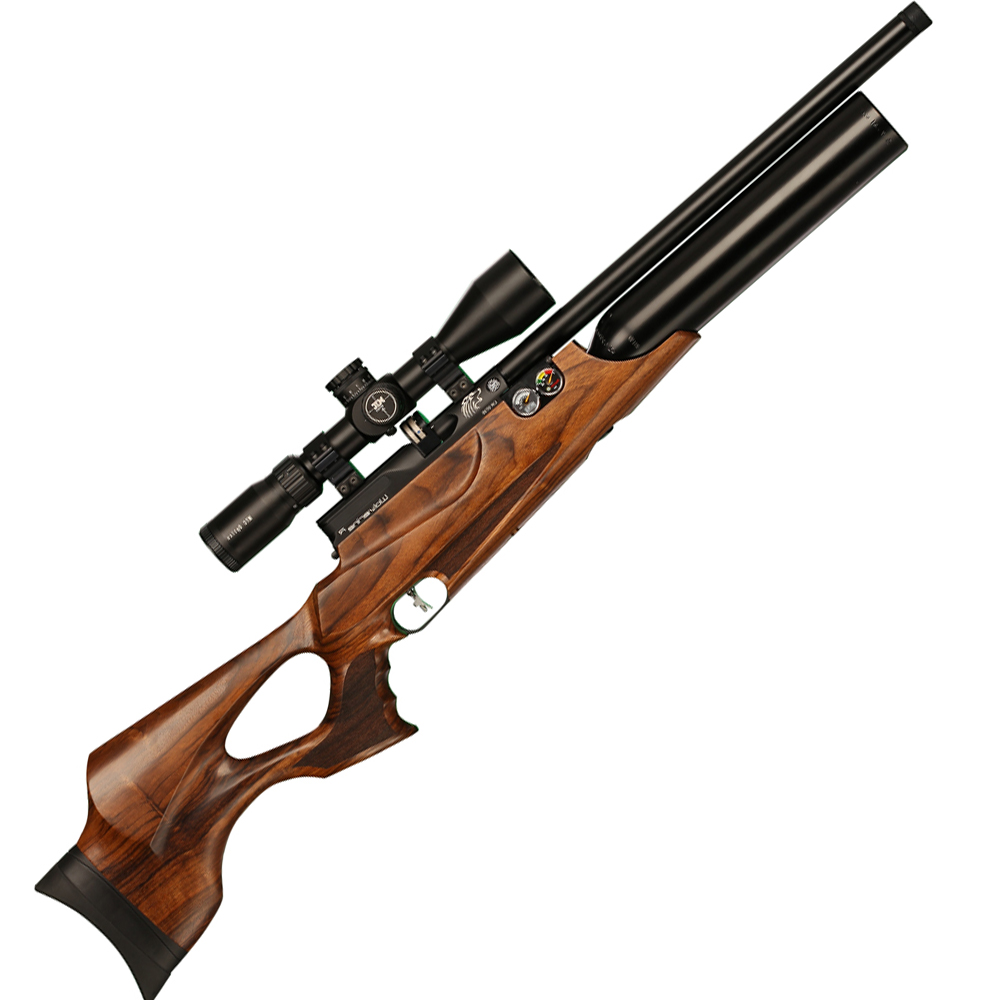
Daystate Wolverine R Hi Lite - Regulated - Walnut Stock - May of London

Weather, Fills, and Seasonal Adjustments

Rain, frost, and dust each ask for slightly different habits. The walnut stock should be wiped after wet outings so that finish is preserved. Seals and the fill probe should be kept clean; wet dirt forced into a 250-bar port is an avoidable failure. In cold weather, a slightly longer warm-up string on the range can be useful so that regulator and valve temperatures settle before grouping is judged.

Fills should be performed with dry, filtered air. A quality hose, a bleed procedure, and a gauge that agrees with the rifle’s own manometer reduce the chance of overfill. Maximum pressure must not be exceeded. After filling, a brief rest allows temperature—and therefore indicated pressure—to stabilise before the first hunting shot is taken.american made air rifles

Summer heat can raise indicated pressure after a fill in a hot vehicle. Therefore, the rifle should be allowed to return to ambient shade before a “top-off” is attempted. Winter storage in an unheated shed can leave condensation on steel parts; a dry cabinet or case is kinder to both metal and walnut.airrifle

Caliber

.177, .22, .25

Reviews

There are no reviews yet.

Be the first to review “Daystate Wolverine R Hi-Lite Regulated Walnut”

Related Products

FAQ

  • Spring-Piston (Break-Barrel or Underlever): Cock by compressing a spring. Reliable, no external air source needed, but can have more recoil (“spring twang”) and require technique to shoot accurately.
  • Pre-Charged Pneumatic (PCP): Filled from a scuba tank, compressor, or pump. High power, low recoil, multiple shots per fill. Popular for precision and hunting.
  • CO₂: Powered by disposable cartridges. Good for pistols and semi-auto/repeaters, but performance drops in cold weather.
  • Multi-Pump Pneumatic: Hand-pumped to build pressure. Versatile but requires effort.
  • Gas Ram (Nitro Piston): Uses compressed gas instead of a metal spring. Smoother than traditional springers.

Calibers: Most common are .177 (4.5mm) for speed/flat trajectory and general use, and .22 (5.5mm) for better hunting knockdown power. Larger “big bore” (.25, .30, .357+) exist for hunting bigger game where legal.

Yes, many modern PCP and springers deliver enough energy for small game (rabbits, squirrels, birds) and even larger game in some areas. Muzzle energy (in ft-lbs or joules) matters more than velocity alone. Always match caliber, pellet weight, and energy to the game and check local hunting regs.

Treat every airgun as if it is loaded.

  • Always point the muzzle in a safe direction.
  • Keep your finger off the trigger until ready to shoot.
  • Know your target and what is beyond it (pellets can ricochet or travel far).
  • Wear eye protection.
  • Store unloaded, out of reach of children/untrained users, and ideally locked.
  • Never shoot at hard surfaces or in areas where pellets could escape your property.

Follow these rules strictly—airguns cause real injuries.

Laws differ dramatically by country, state/province, and even city. Always verify current local laws before buying, owning, transporting, or using an airgun. Age restrictions (often 18+) are common.

Examples (summaries only; check official sources):

  • UK: Air rifles ≤12 ft-lbs (16.3 joules) and pistols ≤6 ft-lbs generally do not require a license (FAC needed above that).
  • USA: Varies by state. Some treat powerful airguns as firearms; others do not. Many states now allow big-game hunting with air rifles.
  • Canada: Some airguns classified as firearms if they exceed velocity/energy thresholds.
  • Australia: Often treated as firearms; licensing/registration required in most states.
  • EU/France/Belgium/etc.: Varies; many allow low-power (<20J) guns freely to adults, with higher power needing permits. Germany has strict ~7.5J limits in some contexts.
  • Other countries: Some have no restrictions below certain energies; others ban or heavily regulate them.

Resources: Wikipedia “Air gun laws”, airgun forums, or official government sites. For travel, research transit laws carefully.

Consider:

  • Purpose: Plinking/backyard → lower power springer or CO₂. Hunting/precision → PCP.
  • Budget: Entry-level springers are affordable; PCPs need a fill system (extra cost).
  • .177 vs .22: .177 easier for beginners/targets; .22 better for hunting.
  • Power source: Convenience vs performance.
  • Test pellets in your gun—accuracy varies.

Buy from reputable dealers and consider warranties.

  • Clean barrel periodically (especially if accuracy drops) with patches and appropriate tools/solvents. Avoid over-oiling.
  • Lubricate moving parts and seals with airgun-specific oil (not general gun oil). Springers need piston seal oil occasionally.
  • Check screws, seals for leaks (PCP), and safety mechanisms regularly.
  • Store in a cool, dry place, ideally in a case. Avoid leaving cocked for long periods.

Follow your model’s manual. Basic care extends life significantly.

International shipping may be available for select products. Customers are responsible for understanding and complying with their local import laws and regulations before ordering.

Yes. Customers are required to confirm their order number through WhatsApp or Live Chat before orders are processed and shipped.

If local laws prevent shipment to your area, your order may be canceled and refunded according to our store policy.

Processing typically takes 1–3 business days after payment confirmation. Delivery times vary depending on destination, carrier, and product availability.


  • Wrong pellets for your barrel/caliber.
  • “Death grip” or poor shooting form (especially with springers—let the gun recoil naturally).
  • Loose scopes or mounts.
  • Ignoring safety or local laws.
  • Over-oiling or shooting with obstructions.


Pellets are the most common projectile (lead or lead-free). Match them to your gun, caliber, and purpose—test several brands as accuracy varies by barrel.

  • Domed (Round-Head): Best all-rounder. Excellent accuracy, ballistic coefficient, and energy retention. Ideal for target shooting, field target, and general hunting (e.g., JSB Exact, Air Arms Diabolo Field, H&N Field Target Trophy).
  • Wadcutter (Flat-Head): Clean holes in paper. Best for close-range target/plinking (under 20-25 yards).
  • Hollow Point: Expands on impact for better energy dump. Good for small game hunting (e.g., Predator Polymag, H&N Terminator).
  • Pointed: More penetration, but often less accurate than domed.
  • Slugs: Heavier, more aerodynamic for high-power PCPs at longer ranges (better for big game where legal).

Tips: Heavier pellets in .22/.25 for hunting (better momentum). Lighter in .177 for speed/flat trajectory. Always check head size fit (e.g., 4.51-4.53mm variants).

Muzzle energy (ft-lbs or joules) matters more than velocity. Ethical shots require precise placement (head/heart-lung) within effective range.

Rough Guidelines (adjust for distance, pellet, and local laws):

  • Small game (squirrels, rabbits, birds): 9-20+ FPE, .177/.22.
  • Medium (raccoons, etc.): 25+ FPE, .22/.25 recommended.
  • Larger game: 40-100+ FPE in .30+ calibers (up to big bore for deer/hogs where permitted).

PCPs dominate serious hunting due to power and shot count. Springers/gas rams work well for small game but require skill. Always prioritize clean kills and check seasons/species rules.

  • Barrel Cleaning: Use a pull-through kit or rod with patches. Avoid brushes that could damage rifling. Clean when accuracy drops or after 500-1000 shots.
  • Lubrication: Airgun-specific silicone oil for seals/O-rings (sparingly—excess causes dieseling in springers). Springers may need piston lube periodically.
  • PCP Specific: Check for leaks (soapy water test), monitor regulator/hammer settings, and keep fill systems clean. Don’t exceed rated pressure.
  • General: Tighten stock screws, inspect for wear, store properly. Chronograph shots to track consistency.

Common Issues:

  • Inconsistent velocity → dirty barrel, bad pellets, or seal problems.
  • Spring “twang” → tuning or proper hold.
  • Low power → worn seals or under/over-pumping.

Toggle Content

  • Scopes: Airgun-rated (hold zero under recoil). 3-9x or 4-12x common.
  • Fill Systems: Hand pumps, compressors, or tanks for PCPs.
  • Safety Gear: Eye/ear protection, targets with backstops.
  • Noise: Airguns quieter than firearms, but moderators help further.

Budget Tip: Start with a quality springer (~$150-400) before investing in PCP setup.

Airgunning offers endless depth—from backyard plinking to precision competition and ethical hunting. Prioritize safety, legality, and practice. If you want specifics (e.g., recommendations for a country, budget, hunting small game, or a particular type like PCP vs springer), let me know for more targeted info! Shoot responsibly.

Tuning improves accuracy, reduces noise/recoil, or increases power (within legal limits).

  • Springers: Lighter springs, guides, seals, or custom tuning kits for smoother shot cycle. “V-Mach” or similar professional tunes popular.
  • PCPs: Regulator tuning, hammer spring adjustments, valve work for efficiency and shot count. Some add electronic systems.
  • Accessories: Suppressors (often unregulated on airguns), better triggers, stocks, and scopes.

Caution: Check laws—power increases may reclassify your gun. DIY only if experienced; professional tuners recommended.

You must be at least 18 years old to purchase any airgun or related accessories from our store. By placing an order, you confirm that you meet the legal age requirements in your state or country.

Yes. Orders may require age verification before processing and shipping. In some cases, we may request a valid government-issued ID to confirm eligibility.