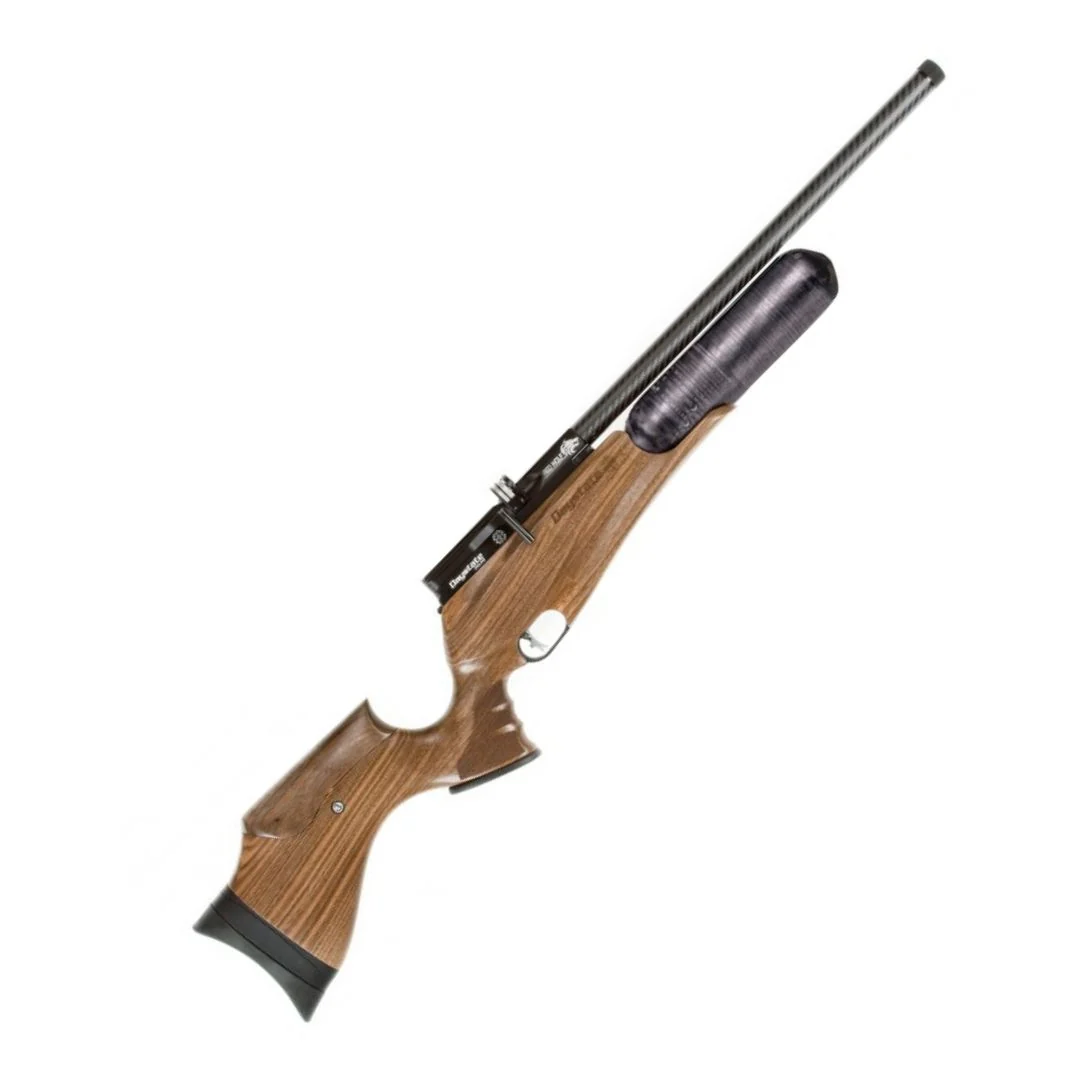
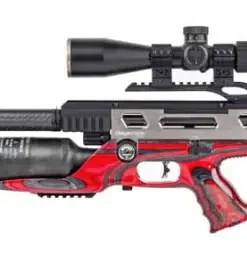
Precision is delivered by the Daystate Wolverine R B-Type Regulated Walnut, a mechanical PCP in which British engineering is paired with a factory-fitted Huma-Air regulator. Consistency is maximised across the charge as air is metered with measured control. Consequently, downrange accuracy is improved while shot count is increased compared with unregulated predecessors. Moreover, classic walnut furniture is combined with a reversible side lever so that shooters of every preference are accommodated.
Why the Daystate Wolverine R B-Type Regulated Walnut Is Chosen
Versatility is offered by a single chassis that accepts a large-capacity alloy buddy bottle. Therefore, extended sessions are supported without constant refill. Furthermore, an ambidextrous thumbhole stock is carved from oiled walnut so that natural pointability is enjoyed by left- and right-handed users alike. In addition, a two-stage match trigger is provided and can be adjusted for weight and stage length. As a result, a clean break is achieved whether target work, hunting, or pest control is undertaken.
Huma-Air Regulation and Shot Consistency
Shot-to-shot variation is reduced because regulated air is supplied at a stable working pressure. Hence, groups remain tight as the bottle is depleted. Likewise, air is used more efficiently, so hundreds of consistent shots are returned from a single fill. Subsequently, more time is spent on the range or in the field and less time is spent at the pump. Dual gauges are mounted on the action so that both reservoir pressure and regulator setting can be monitored at a glance.
Key Features of the Daystate Wolverine R B-Type Regulated Walnut
Highlighted below are the attributes around which the rifle is built:
- Huma-Air regulator — factory-fitted for consistency and efficiency
- B-Type alloy buddy bottle — 400 cc or 500 cc capacity for high shot counts
- Reversible side-lever action — factory-set for left or right operation
- Ambidextrous walnut thumbhole stock — adjustable rubber butt pad and raised comb
- Lothar Walther match-grade barrel — 17 in / 43 cm, shrouded and ½ UNF threaded
- Two-stage mechanical trigger — adjustable for weight and length of pull
- Magazine or magnetic single-shot tray — rapid follow-up or precise single loading
- Manual cross-bar safety with lever-open deactivation
- Fill pressure up to 250 BAR (3,625 psi)
- Overall length 38 in / 96.5 cm; unscoped weight typically 7–8 lb (3.2–3.7 kg)
Besides these core items, an Airstream silencer and sling studs can be specified so that the platform is tailored to the intended use.
Calibres, Power, and Capacity
Choice of calibre is offered so that the rifle can be matched to local law and intended quarry. In .177, approximately 500 shots at 12 ft/lbs (or about 180 shots at 18 ft/lbs FAC) are typically returned from the larger bottle. Meanwhile, in .22, up to 600 shots at 12 ft/lbs or around 150 shots at 30 ft/lbs FAC are commonly quoted. Where .25 is available, roughly 110 shots at 35 ft/lbs are listed. Magazine capacity is generally 13 rounds in .177, 11 in .22, and 10 in .25. Loading is completed either through the rotary magazine or the magnetic single-shot tray, so both rapid fire and careful single-shot work are supported.
Factory energy may be set lower than the maximum quoted so that accuracy with specified ammunition is preserved. Therefore, local FAC or sub-12 requirements should always be confirmed before purchase.
Stock, Handling, and Inclusive Design
Comfort is afforded by a Grade walnut thumbhole stock that is fully ambidextrous. Stippled panels are applied to the pistol grip and forend so that a secure hold is maintained in all conditions. Moreover, the comb is raised for scope use and the butt pad can be adjusted for height so that eye alignment is achieved by shooters of different builds. Equally, the side lever can be reversed at the factory; consequently, left-handed users are not forced into compromise.
Balance is helped by the buddy-bottle layout. Although the steel bottle adds mass compared with a slim tube, the weight is carried forward in a way that many find steady on aim. As a result, the rifle is often described as livelier in the hands than the raw figures suggest.
Practical Use in the Field and on the Range
Hunting and pest control are supported by the regulated consistency and the option of FAC power where permitted. Likewise, HFT and club target work benefit from the match trigger and Lothar Walther barrel. Because so many shots are available from one fill, a full session can often be completed without a mid-day top-up. Thereafter, refill is completed quickly via the supplied probe adaptor.
Safety is addressed by a manual cross-bar catch and by a system that prevents discharge while the lever is open. Nevertheless, safe handling, legal storage, and local airgun regulations remain the responsibility of every owner.
Build Quality and Long-Term Value
The action is produced in England by Daystate and is finished to the standard expected of a flagship mechanical PCP. Furthermore, the Huma-Air regulator is a proven partnership component that can be serviced with readily available kits. In addition, the walnut furniture can be refinished or replaced if required. Consequently, the Daystate Wolverine R B-Type Regulated Walnut is intended as a long-service companion rather than a disposable tool.
Ultimately, regulated performance, generous shot count, and classic walnut presentation are combined in one compact 38-inch package. Therefore, the Daystate Wolverine R B-Type Regulated Walnut is positioned for shooters who want mechanical reliability without sacrificing consistency or style. Responsible ownership, correct fill pressure, and appropriate ammunition will allow the rifle’s potential to be realised for years to come.
Calibres, FAC Power, and Accessories for the Daystate Wolverine R B-Type Regulated Walnut
Calibre selection is offered so that the Daystate Wolverine R B-Type Regulated Walnut can be matched to local law, intended quarry, and preferred pellet weight. Consequently, both sub-12 ft/lbs configurations and higher-output FAC builds are supported on the same regulated chassis. Furthermore, accessories are readily added so that the rifle can be refined for hunting, pest control, or target work without the action itself being altered.
Available Calibres and Typical Magazine Capacity
Choice is commonly provided in .177 (4.5 mm) and .22 (5.5 mm). In addition, .25 (6.35 mm) is frequently listed for the B-Type platform. Therefore, a lighter, flatter-trajectory option is available alongside a heavier-hitting hunting calibre. Magazine capacity is generally arranged as approximately 13 shots in .177, 11 shots in .22, and 10 shots in .25. Meanwhile, a magnetic single-shot tray is supplied so that precision loading can be used when magazine fire is not required.
Pellet selection remains critical. Accordingly, match-grade domed pellets are usually preferred for consistency through the Lothar Walther barrel. Likewise, heavier slugs or hunting designs may be specified on FAC rifles where energy and downrange stability are needed. Because the Huma-Air regulator holds working pressure steady, velocity spread is kept tight once a suitable pellet is found. As a result, grouping is improved across the usable charge rather than only at the start of the fill.
Sub-12 Power Versus FAC Configurations
In many markets a 12 ft/lbs limit is applied unless a Firearms Certificate (FAC) or equivalent licence is held. Hence, factory-set sub-12 versions of the Daystate Wolverine R B-Type Regulated Walnut are widely offered for general sporting use. On a 500 cc bottle, roughly 500 shots at 12 ft/lbs are typically quoted in .177, while up to about 600 shots at 12 ft/lbs are commonly listed in .22. Fill pressure for the B-Type is generally allowed up to 250 BAR (3,625 psi), although some sub-12 setups may be charged to a slightly lower working figure so that regulator efficiency is preserved.
Where FAC is held, higher energy is available. Subsequently, figures around 18 ft/lbs in .177 (about 180 shots), 30 ft/lbs in .22 (about 150 shots), and 35 ft/lbs in .25 (about 110 shots) are frequently published for the B-Type. Energy may still be factory-tuned below the theoretical maximum so that accuracy with specified ammunition is protected. Therefore, the exact output on any individual rifle should be confirmed with the retailer and against local statute before purchase.
Legal compliance cannot be assumed from a model name alone. Moreover, power limits, transport rules, and storage requirements differ by country and sometimes by region. Inclusive practice means every shooter—regardless of experience—is expected to verify certificates, age limits, and permitted uses. In contrast, an FAC rifle used without the correct paperwork exposes the owner to serious legal risk. Responsible ownership is therefore treated as part of the product’s intended use, not an optional extra.
How Power Interacts With the Regulator and Bottle
Shot count and consistency are linked because regulated air is metered at a set pressure. Consequently, FAC rifles still return a useful number of even shots rather than a short, declining curve. Nevertheless, higher energy consumes more air per discharge; hence the lower shot totals listed for 18, 30, and 35 ft/lbs builds. The 400 cc bottle can be specified where a lighter feel is preferred, while the 500 cc bottle is chosen when maximum shots per fill are required. Weight unscoped typically falls in the 7–8 lb (3.2–3.7 kg) range depending on bottle size.
Dual gauges allow both reservoir pressure and regulator setting to be read. As a result, a fill can be stopped at the correct figure and regulator health can be monitored over time. Service kits for the Huma-Air unit are available, so long-term maintenance is possible without the entire action being replaced.
Accessories That Complete the Daystate Wolverine R B-Type Regulated Walnut
Highlighted accessories are commonly paired with this rifle:
- Daystate Airstream (or 0 dB-style) silencer — ½ UNF thread on the shrouded muzzle reduces report for field use
- Spare magazines — extra 10–13 shot mags keep a session moving
- Magnetic single-shot tray — already included on many rifles; extras support dedicated target work
- Sling studs and sling — useful on a 38-inch sporter carried over distance
- Scope and mounts — a quality optic is essential; the raised comb is designed for scoped use
- Fill probe / Foster adaptor and hose — required for 250 BAR charging from a pump, compressor, or dive bottle
- PCP compressor or high-pressure pump — Hill-type electric units or quality hand pumps complete the air system
- Regulator rebuild kit — O-rings and sealing disc for scheduled Huma-Air service
- Upgraded or replacement walnut furniture — factory stocks with dual gauge cut-outs are listed for B-Type actions
- Pellet tin matched to calibre and power — JSB-class domes are a frequent starting point
Besides hardware, a padded case is recommended so that the walnut stock and gauges are protected in transit. Equally, a chronograph is useful after any power or pellet change so that energy remains within the licensed limit.
Matching Calibre, Power, and Accessories to Use
Target and plinking work are often served by a sub-12 .177 or .22 with a silencer and a mid-range scope. Meanwhile, hunting and larger pest species may justify an FAC .22 or .25 together with a robust optic and extra magazines. Inclusive language matters here: the same platform can be set up for a compact club shooter or for a field user who needs more energy, provided the law is followed.
Ultimately, calibre, FAC status, and accessories are not separate afterthoughts. Instead, they are chosen together so that the regulated action, 400/500 cc bottle, and walnut thumbhole stock deliver consistent, legal performance. When those choices are made carefully, the Daystate Wolverine R B-Type Regulated Walnut remains a versatile mechanical PCP for a wide community of shooters.
Daystate, Delta Wolf, Alpha Wolf and Premium PCP Air Rifle Accessories
For shooters researching premium PCP platforms, daystate blackwolf, daystate redwolf, delta wolf, huntsman daystate, and daystate alpha wolf frequently appear among the most searched Daystate-related terms. Whether someone searches for wolf delta, day state, daystate delta wolf, blackwolf, deltaw, daysta, or wants to understand the delta wolf meaning, these rifles are commonly associated with modern PCP engineering, electronic control systems, adjustable configurations, and high-end airgun performance.
People asking what is a delta wolf are generally researching the electronic Daystate platform and how it differs from conventional PCP rifles. Related searches often include electronic wolves, firing cycle, lock time, lock timing, short cocking, cocking ball, index pin, and pin magazine. Searches may also focus on configuration-specific components such as an alpha wolf barrel, stock walnut, safari stock, dima stock, stock replacement, rimfire stocks, or a rifle butt pad.
Daystate Red Wolf, Alpha Wolf and Wolverine Searches
The daystate redwolf family remains closely connected with searches for daystate redwolf price, red alpha wolf, alpha red wolf, and the newer daystate blackwolf platform. Some shoppers may also compare these rifles with the daystate wolverine sapphire, wolverine gun, wolveriner, wolf gun, wolfpack armory wolverine, or even search unusual phrases such as can wolverine go on planes while researching transport rules.
Accessories frequently searched alongside these platforms include a rubber butt, rubber butt pad, butt pad rifle, bradley cheek riser, gecko grips, picatinny bag rider, and buddy bottle cover. Cosmetic or clothing-related search phrases such as red bodywarmer and black snood may also appear alongside broader brand searches.
Magazine-related searches include 177 magazine, mag 177, and 25 magazine, while ammunition research can include 177 pellets types, 5.0 mm pellets, and slug pellet. Because pellet suitability depends on the rifle, barrel, legal power level, and intended range use, compatible ammunition should always be selected according to the manufacturer’s specifications.
PCP Air Systems, Moderators and Thread Accessories
Many enthusiasts researching Daystate rifles also search for air rifle compressed air, compressed air rifle, what are pcp air rifles, and what is a pre charged pneumatic air rifle. These searches relate to the fundamental operating principle of PCP systems, in which stored compressed air is used to power each shot.
Common accessory searches include air gun pc, air gun suppressor, air gun suppressors, airgun moderator, air rifle moderator, 0db, 0db moderator, and 0 db moderator. Buyers may also encounter searches for a hogan decimeater silencer, silencer thread adapter, thread protector rifle, and muzzle thread protector when comparing muzzle accessories and compatible threaded components. Local regulations should always be checked before purchasing or fitting sound-moderating equipment.
Maintenance-related searches often include pcp o ring kit, while tuning-oriented users may look for an ats tuner. Search terms such as unfend can also appear in broad airgun keyword datasets, even when the intended product or meaning is unclear.
M-LOK, Picatinny and Rifle Sling Accessories
Accessory compatibility is another major area of interest. Common searches include mlok to picatinny rail adapter, best m-lok to picatinny rail adapter, m-lok to picatinny adapter, and picatinny m lok adapter. These adapters are often researched by users who want to mount compatible optics, rests, bipods, bags, or other permitted accessories on an appropriate rail system.
Sling-related searches include riffle sling, rigle sling, how to put a gun sling on a rifle, how to put a rifle sling on, how to install a rifle sling, how to put sling on rifle, installing a rifle sling, and attaching a sling to a rifle. Because attachment arrangements differ between stocks, rails, swivels, and chassis systems, the correct mounting points should always be confirmed from the manufacturer’s documentation.
Other general mechanical or unrelated search phrases found within broader keyword datasets include how to put extinguisher call back together, weatherby vanguard trigger adjustment, and 3.55kg in lbs. While these terms may appear in search data, they are not necessarily specific to Daystate PCP rifles.
BRK, Brocock and XR Air Rifle Searches
Alongside Daystate products, many buyers compare models produced under the Brocock and BRK families. Popular searches include brocock ltd, brocock sniper xr, brocock commander xr, pathfinder xr, brk ghost, brocock airguns, brocock commander, brk ghost air rifle, and brk sniper xr.
The brocock sniper xr is often researched by shooters comparing compact PCP platforms, while the brocock commander xr and brocock commander searches generally relate to larger tactical-style PCP configurations. Meanwhile, brk ghost and brk ghost air rifle searches reflect growing interest in BRK-branded PCP systems.
Those comparing local purchasing options may also search fx airgun dealer near me, even when their primary interest is Daystate or Brocock. This reflects the way many airgun shoppers compare several premium manufacturers before deciding which PCP platform, stock configuration, calibre, regulator setup, magazine system, and accessory package best matches their intended sporting use.
Additional Daystate and Airgun Search Terms
Broader searches surrounding these rifles may include model alpha gun, griffin gun, and general comparisons involving a wolf gun or other premium PCP platform. Buyers may also investigate different stock materials, rail systems, moderators, magazines, barrel options, butt pads, cheek risers, thread protectors, and compressed-air accessories before completing a build.
Whether someone begins with daystate redwolf, explores the daystate alpha wolf, compares a daystate delta wolf, investigates the daystate blackwolf, or considers a daystate wolverine sapphire, the most useful approach is to verify model compatibility, calibre, pressure specifications, local regulations, and manufacturer-supported accessories before purchasing replacement components or upgrades.
Practical Use in Everyday Shooting
A regulated mechanical PCP with a large buddy bottle and an ambidextrous walnut thumbhole stock is most useful when it is treated as a working tool rather than a display piece. Consequently, sessions are planned around fill pressure, pellet choice, and the legal power limit that applies on that ground. Furthermore, the side lever and magazine are used so that follow-up shots remain quiet and controlled. Inclusive practice is observed throughout: left- and right-handed shooters, newer club members, and experienced field users are all able to share the same chassis once the lever side and butt-pad height have been set.
Preparing the Rifle Before Leaving Home
A visual check is completed first. Thereafter, residual air is read on the forward gauge while regulator pressure is confirmed on the rear gauge. If the bottle sits well below the intended working band, a fill to the recommended maximum—commonly up to 250 BAR on this bottle style—is carried out with a probe adaptor and a pump or compressor. Meanwhile, magazines are loaded with a single, proven pellet type so that point of impact is not shifted mid-session. A magnetic tray is slipped into a pocket in case single-shot work is preferred on the zeroing board.
Safety is verified next. The cross-bar catch is moved to safe, and the lever-open deactivation is understood so that a discharge cannot occur while the action is open. Equally, a padded slip or hard case is used so that the walnut and gauges are protected in the vehicle. Sling studs, if fitted, allow the rifle to be carried across a field without the forend being gripped the entire way. As a result, fatigue is reduced before the first shot is even fired.
Club Range and Zeroing Sessions
On a formal range, the rifle is typically set on a bag or bipod for the first groups. Because regulated air is delivered at a steady working pressure, the first magazine and the last usable magazine stay closer in velocity than on an unregulated bottle gun. Therefore, zero can be confirmed with fewer wasted shots. A two-stage trigger is adjusted so that the first stage takes up slack and the second stage breaks cleanly; consequently, hold-over on paper is easier to read.
Highlighted habits that keep a range day productive:
- One pellet brand and weight is used for the entire zero
- Chronograph readings are taken after any fill or power change
- Scope turrets are logged so that the same setting can be recovered next visit
- Magazines are numbered so that a damaged rotor is isolated quickly
- A silencer is fitted where club rules allow, reducing blast for neighbouring lanes
In addition, shorter 25–30 metre cards are shot first. Subsequently, 40–50 metre groups are attempted once the hold is stable. Inclusive coaching is straightforward: a new shooter can be talked through the lever cycle without the stock fighting a strong-hand-only layout. Likewise, a taller or shorter user can raise or lower the butt pad so that the comb supports the cheek without craning the neck.
Hunter Field Target and Simulated Field Positions
When HFT-style targets are engaged, kneeling and standing shots become as important as the bench. The thumbhole grip and stippled panels help a gloved hand stay planted. Moreover, the 38-inch overall length remains compact enough for awkward gateways and tight shooting lines. Because the barrel is shrouded and threaded, a compact moderator can be left fitted so that muzzle flip and report stay modest between pegs.
Wind reading still matters. Nevertheless, a consistent muzzle velocity means that a change in group is more likely to be wind or hold than a collapsing power curve. Hence, time on the peg is spent on the flag rather than on guessing whether the bottle is “still good.” Single-shot trays are often preferred on steep or delicate targets so that a pellet is seated with extra care. After a course, magazines are emptied and the action is left on safe before the walk back to the parking field.
Pest Control Around Yards and Outbuildings
Permissions around barns, paddocks, and garden edges reward a quiet, repeatable shot. A sub-12 setup is frequently chosen where a certificate is not held. In that configuration, several hundred shots may be available from a large alloy bottle, so a morning of corvid or rodent work can be finished without a mid-session top-up. A silencer is almost always left on. Consequently, livestock and neighbours are less disturbed.
Approach is planned so that the first shot is taken from cover. The rifle is carried muzzle-down or slung until the firing point is reached. Then the lever is cycled smoothly; a hurried snatch is avoided because the mechanical action already provides a short, positive stroke. If a follow-up is required, the magazine is already indexed. Inclusive field craft includes briefing every person on the permission: no one walks in front of the muzzle, and every shot is accounted for before the party moves on.
Highlighted field checks before a pest outing:
- Local bylaws and landowner rules are confirmed that morning
- Backstops are identified for every likely shooting angle
- Pellets are kept dry and separate from spare magazines
- A small spill kit and pellet tin lid are carried so that lead is not left on soil
- Phone signal and an agreed return time are noted if the ground is remote
Weather changes the plan. Rain is wiped from the walnut and metal before the rifle is cased. Frost is treated with extra care around O-rings and the fill port. After a wet outing, the action is dried and a light oil film is applied where the maker allows, so that the next dawn start is not delayed by a stiff lever.
Hunting on Larger Permissions
Where FAC energy is legally held, heavier pellets and longer shots may be used on appropriate quarry. Shot count falls as energy rises, so a 400 cc or 500 cc bottle is chosen according to how far the walk will be from a vehicle fill. Dual gauges remain useful: the reservoir reading shows how much of the day remains, while the regulator reading confirms that the set pressure has not drifted.
Stalking is helped by the classic sporter outline. The rifle does not present as a large tactical chassis, which can matter when movement along hedges is required. A quality scope with a simple hold-over reticle is usually preferred over a complicated first-focal-plane optic for close-to-mid airgun ranges. After a successful retrieve, the safety is applied before any photograph or bagging takes place. Ethical distance is observed; a regulated rifle still cannot excuse a poorly placed shot.
Travel between permissions is done with the bottle either within a safe residual pressure or fully discharged according to transport rules in that country. Papers, where required, travel with the rifle. Inclusive groups make sure every participant understands which person is licensed for which power level so that rifles are not swapped casually at the tailgate.
Family and Club Introduction Sessions
First shots for a new adult shooter are best taken from a bench or a solid kneeling roll. The reversible lever means a left-handed newcomer is not forced to reach across the action. Trigger weight can be left a little heavier at first so that an unexpected break is less likely. Thereafter, standing shots are added only when groups on paper are already respectable.
Shared use of one rifle is practical because the stock is ambidextrous and the pad is adjustable. A short briefing covers fill pressure, never pointing at anything that is not intended as a target, and how the cross-bar safety is moved. Conversion-focused clubs often keep a printed zero card in the case so that a borrowed optic setting is not lost between members. Pellets are issued from one open tin so that mixed lots do not confuse the day’s results.
Between-Session Care That Protects the Next Outing
After returning home, residual moisture is removed from the barrel crown and fill port. Magazines are emptied; springs are not left compressed for weeks. The walnut is given a light oil only if the finish calls for it. Regulator service is not improvised: when seals eventually age, a proper kit and the published set-pressure figures for that calibre and energy are used, or the work is left to a qualified smith.
Fills from a dirty dive bottle are avoided. Water and grit shorten seal life faster than shot count alone. A dedicated hose and dry, filtered air keep the valve and regulator healthier. Consequently, the large shot potential of the bottle is actually realised instead of being lost to creeping leaks.
Putting a Full Day Together
A realistic day might open with a 20-minute zero confirmation, continue with a club course or a permission walk, and finish with a short pest circuit at last light. Because so many consistent shots are available on a sub-12 fill, that sequence can often be completed on one charge. FAC days are planned more tightly around remaining air. In both cases the same habits apply: one pellet, confirmed gauges, safe muzzle control, and a written note of what worked.
Ultimately, practical success is produced by repetition of small disciplines rather than by any single feature. The regulated action supplies even velocity; the bottle supplies time in the field; the walnut stock and reversible lever supply a fit that more people can use well. When those elements are combined with legal awareness and unhurried shot selection, the rifle earns its keep from the first paper group to the last light of a working permission.
Frequently Asked Questions
Clear answers are provided below so that purchase decisions, legal checks, and first outings can be planned with fewer surprises. Inclusive wording is used throughout, because the same mechanical, regulated buddy-bottle rifle may be shared by left- and right-handed shooters, club beginners, and experienced field users.
General Setup and What This Rifle Is For
What kind of air rifle is being described?
A pre-charged pneumatic with a fully mechanical action is described. A factory regulator is fitted so that each shot is supplied with air at a controlled working pressure. Consequently, velocity remains steadier across the fill than on many unregulated bottle guns. A large alloy reservoir—typically 400 cc or 500 cc—is used. Therefore, long sessions are supported. A side lever cycles the action, and either a rotary magazine or a magnetic single-shot tray can be employed.
Who is this platform intended to suit?
Target shooters, hunters, and pest-control users are all accommodated when calibre and energy are chosen legally. Furthermore, an ambidextrous thumbhole stock and a factory-reversible lever mean that a strong-side preference does not lock anyone out. Newer adults on a club bench can be coached on the same chassis that a permission holder later carries at last light. Conversion is helped when one rifle can cover several roles instead of forcing a second purchase.
Is a scope included?
Optics are almost never included with the rifle itself. A raised comb is already shaped for scoped use, so a quality airgun-rated scope and correctly matched mounts should be budgeted from the start. Equally, a compact moderator is often added because the muzzle is customarily threaded ½ UNF.
Regulator, Fill Pressure, and Shot Count
Why is a regulator considered important?
Air from the main bottle is reduced to a set pressure before it reaches the valve. As a result, early shots and later shots stay closer in speed. Group size on paper is therefore less likely to wander solely because the reservoir is emptying. In addition, air is used more efficiently, so more usable shots are commonly returned from the same fill compared with an otherwise similar unregulated action.
What fill pressure is normally used?
Up to about 250 BAR (3,625 psi) is typically allowed on this bottle style. Some sub-12 setups may be charged a little lower so that the regulator stays in its sweet band. Dual gauges are provided: one reads remaining bottle pressure and the other reads regulator pressure. Hence, a fill can be stopped at the correct figure and regulator health can be watched over months of use.
How many shots can be expected from one fill?
Figures vary with calibre, energy, bottle size, and pellet weight. On a larger 500 cc bottle in a typical 12 ft/lbs setup, several hundred shots are often quoted—commonly in the region of about 500 in .177 and up to around 600 in .22. FAC outputs consume more air per discharge. Subsequently, totals fall to roughly 180 shots at about 18 ft/lbs in .177, about 150 shots at about 30 ft/lbs in .22, and around 110 shots at about 35 ft/lbs in .25 where that calibre is offered. Individual rifles should still be chronographed, because factory tuning and ammunition change the real-world number.
Calibres, Power Limits, and FAC
Which calibres are usually offered?
.177 and .22 are the most common pair. .25 is frequently listed on the same buddy-bottle chassis. Magazine capacity is generally arranged around 13 rounds in .177, 11 in .22, and 10 in .25. A single-shot tray remains available when magazine fire is not wanted.
What is the difference between a 12 ft/lbs rifle and an FAC rifle?
In several countries a 12 ft/lbs ceiling applies unless a Firearms Certificate or equivalent licence is held. Sub-12 versions are therefore sold for general sporting use. Higher energy—often discussed around 18, 30, or 35 ft/lbs depending on calibre—is supplied only where the owner is correctly licensed. Legal limits, storage, transport, and age rules differ by region. Inclusive responsibility means every user confirms local law before a higher-power rifle is ordered or borrowed.
Can factory energy be lower than the brochure maximum?
Yes. Output is sometimes set below the headline figure so that accuracy with specified pellets is protected. Therefore, a chronograph check after purchase is recommended, especially if the rifle will be used close to a legal limit.
Stock, Lever, Trigger, and Inclusive Fit
Is the stock truly usable in either hand?
An ambidextrous thumbhole is carved so that neither a left- nor a right-handed hold is treated as an afterthought. Stippled panels on the grip and forend help a gloved hand stay planted. Moreover, the side lever can be specified for left- or right-side operation at the factory. The rubber butt pad can be adjusted for height so that cheek weld and scope alignment are achieved by shooters of different builds.
How does the trigger feel in practical use?
A two-stage mechanical trigger is fitted and can be adjusted for weight and length of stage. The first stage takes up movement; the second stage is intended to break cleanly. Club users often leave a slightly heavier pull for newcomers, then refine it once dry-fire practice has been completed with an empty, safe rifle.
How large and heavy is the rifle unscoped?
Overall length is typically about 38 inches (96.5 cm) with a 17-inch (43 cm) barrel. Unscoped weight usually falls around 7–8 lb (3.2–3.7 kg), depending on whether a 400 cc or 500 cc bottle is fitted. The mass sits forward on the bottle, which many field shooters find steady rather than clumsy once a sling or a relaxed carry is used.
Accessories, Quiet Use, and Maintenance
Which accessories are most often added first?
- A ½ UNF silencer for field and club lanes where rules allow
- Spare magazines so a session is not stopped by a single rotor
- Scope, mounts, and a simple hold-over reticle matched to airgun ranges
- Fill probe or Foster-style adaptor plus a dry, filtered hose
- Pump or electric compressor rated for the fill pressure
- Sling and studs for longer walks
- Regulator service kit when seals eventually age
- Chronograph for legal energy checks after any change
Besides hardware, a padded case is advised so that walnut and gauges survive vehicle travel.
How should the rifle be looked after between outings?
Residual moisture is wiped from the crown and fill port. Magazines are emptied so springs are not left compressed for weeks. Walnut is oiled only when the finish requires it. Dirty or wet air is kept out of the valve; filtered, dry fills protect regulator seals. When a rebuild is due, published set-pressure figures for that calibre and energy should be followed, or the work should be left to a qualified technician.
Can the regulator be serviced by the owner?
Basic seal kits exist, yet incorrect set pressure will spoil both accuracy and shot count. Consequently, first-time work is often entrusted to a smith who already knows this Huma-style unit. Inclusive clubs sometimes run a supervised maintenance evening rather than leaving a new owner alone with a bag of tiny O-rings.
Field Use, Safety, and Buying Decisions
Is the rifle suitable for hunting and pest control?
Yes, provided energy, calibre, and landowner rules match the quarry. A silencer, a reliable zero, and a clear backstop remain essential. Sub-12 setups handle a great deal of close-to-medium pest work. FAC setups extend range and hitting power only where the licence allows. Ethical distance is not replaced by extra foot-pounds.
What safety features are built in?
A manual cross-bar catch is used. In addition, discharge is prevented while the lever is open. Neither feature replaces muzzle control, a safe backstop, or the habit of treating every rifle as loaded until proven otherwise.
Which pellets should be tried first?
Match-grade domed pellets in a weight suited to the calibre are the usual starting point. After a few tins have been compared on paper and on the chronograph, one lot is standardised so that zero does not drift. Mixed bargain pellets are a common reason groups look worse than the barrel deserves.
How should a first purchase be planned?
Legal status is confirmed first. Then calibre, bottle size, and lever side are chosen. A scope, mounts, silencer, and a way to fill to the correct pressure are budgeted at the same time. A short shop or club visit allows the thumbhole and pad height to be felt before money is committed. Inclusive buying means a left-handed partner or a younger adult in the household is considered when the lever side is specified.
What should be expected on a typical first range day?
Gauges are read, the rifle is set on bags, and a 25–30 metre card is shot before longer distances are attempted. Because regulated air holds velocity, zeroing usually consumes fewer magazines than on a fading unregulated curve. Notes are written on pellet, fill pressure, and turret settings so the next visit starts faster.
When is a different style of rifle a better fit?
A much lighter tube-cylinder carbine may be preferred if every ounce on a long stalk matters. An electronic action may be preferred if programmable power and a screen are wanted. This mechanical, regulated bottle rifle is instead chosen when consistency, high shot count, classic walnut handling, and a serviceable analogue action are valued together..25 caliber brocock sniper xr
Ultimately, good results are produced when fill discipline, pellet consistency, legal energy, and unhurried shot selection are treated as part of the product. The regulator, bottle, lever, and stock only deliver their benefit after those habits are in place.


Reviews
There are no reviews yet.