Precision Is Delivered by the Daystate Wolverine R B-Type Regulated Laminate
Exceptional mechanical PCP performance is embodied by the Daystate Wolverine R B-Type Regulated Laminate. Consequently, consistent velocity, generous shot capacity, and refined handling are combined in one classically proportioned platform. Moreover, the Huma-Air regulator is integrated into the action so that measured air is supplied shot after shot. Therefore, field work, range sessions, and FAC-rated hunting applications can be approached with confidence by shooters of every experience level.
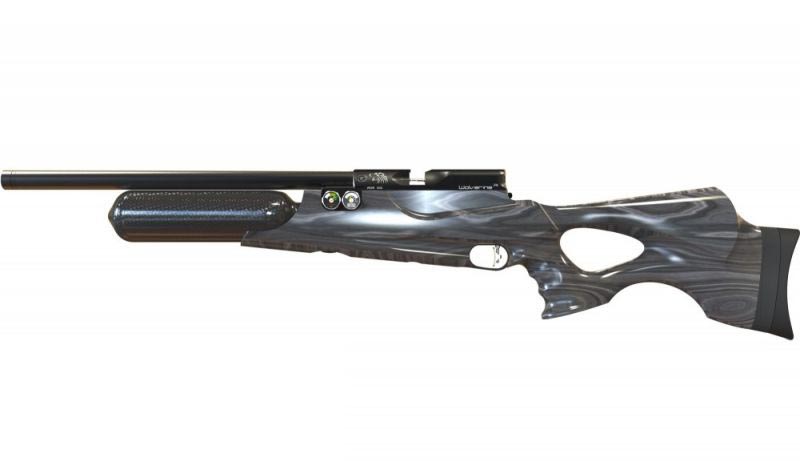
Furthermore, the B-Type buddy-bottle configuration is specified so that a large 400 cc or 500 cc alloy reservoir is carried. As a result, extended sessions are supported without frequent filling. In addition, the grey laminate thumbhole stock is crafted so that an ambidextrous hold is offered to both right- and left-handed users. Meanwhile, a factory-reversible side lever is fitted so that cocking effort remains smooth and low.
Why the Daystate Wolverine R B-Type Regulated Laminate Stands Apart
Above all, regulation is treated as the defining advantage. Accordingly, downstream air is held at a stable working pressure by the Huma unit. Subsequently, shot-to-shot variation is reduced and groups are tightened downrange. Likewise, air is used more efficiently, so more pellets can be sent from a single fill. In parallel, the Harper sling-shot hammer system is retained so that mechanical reliability is preserved without electronic complexity.
Additionally, two gauges are recessed into the stock. Hence, reservoir pressure is monitored on one dial while regulator pressure is confirmed on the Huma-marked face. Thereafter, fill discipline can be maintained and unexpected drop-off can be avoided. Equally important, a 17-inch Lothar Walther barrel is employed so that inherent accuracy is supported at typical airgun distances.
Key Features Highlighted for Clear Comparison
- Huma-Air regulator is fitted so that velocity consistency and extra shots per fill are achieved.
- 400 cc / 500 cc alloy B-Type bottle is installed so that high shot counts are delivered (up to 600 in .22 at 12 ft-lbs).
- Grey laminate ambidextrous thumbhole stock is provided so that a stable, weather-resistant hold is offered to all users.
- Factory-reversible side-lever cocking is included so that left- or right-side operation can be specified.
- 10-shot magazine plus magnetic single-shot tray are supplied so that rapid follow-up or precision loading can be chosen.
- Two-stage mechanical trigger is adjustable for weight and first-stage travel so that a clean break can be tailored.
- Manual cross-bar safety with lever-open deactivation is incorporated so that handling safety is reinforced.
- Dual onboard gauges are positioned so that fill and regulator status remain visible at a glance.
- 1/2 UNF muzzle thread is prepared so that a silencer or moderator can be added where local rules allow.
- Overall length of 96.5 cm (38 in) and unscoped weight of approximately 3.2–3.7 kg are maintained so that a balanced field rifle is presented.
Calibres, Power Levels, and Shot Capacity Explained
Flexibility across legal and FAC power bands is built into the Daystate Wolverine R B-Type Regulated Laminate. Typically, .177 (4.5 mm) and .22 (5.5 mm) are offered at sub-12 ft-lbs where national limits apply. Alternatively, FAC settings of about 18 ft-lbs in .177, 30 ft-lbs in .22, and 35 ft-lbs in .25 can be specified where licensing permits. Importantly, factory energy may be set slightly below the stated maximum so that accuracy with current match ammunition is protected.
Consequently, published shot counts for the B-Type bottle are substantial. In .22, approximately 600 shots at 12 ft-lbs or about 150 shots at 30 ft-lbs can be expected from a full charge. Similarly, in .177, around 500 shots at 12 ft-lbs or 180 shots at 18 ft-lbs are returned. In .25 FAC trim, roughly 110 shots at 35 ft-lbs are available. Fill pressure of up to 250 bar (3,625 psi) is supported on B-Type rifles, although the exact working pressure marked on each rifle should always be observed.
Practical Use in the Field and on the Range
Because regulation flattens the power curve, holdover and wind calls remain predictable from the first magazine to the last usable shots. Therefore, pest control around farm buildings, woodland edges, and paddocks can be conducted with fewer interruptions for filling. Likewise, hunter-field-target and club-range practice benefit when hundreds of consistent pellets can be launched from one charge.
Meanwhile, the laminate thumbhole geometry places the shooting hand close to the bore line, so recoil impulse—already modest on a PCP—is further settled. Moreover, the adjustable butt pad can be moved for height and cast, so cheek weld and eye alignment can be refined for different optics and body sizes. In addition, the reversible side lever keeps the action compact, which helps when the rifle is carried slung or deployed from a hide.
Responsible ownership remains essential. Local airgun laws, FAC requirements, safe backstops, and eye protection must be observed at all times. Furthermore, barrels should be cleaned at sensible intervals, side-lever pivots lightly lubricated, and laminate furniture maintained with appropriate polish so that the finish and action stay serviceable for years.

How Confidence Is Built Into Every Session
Because the action is fully mechanical, batteries and electronic modules are not required. Instead, reliability is entrusted to proven Harper internals and a Huma regulator developed specifically for Daystate. Subsequently, cold-weather hunts and long summer range days can both be faced without concern over power-source failure. At the same time, magazine or single-shot tray loading lets the rifle be adapted from rapid follow-up work to careful one-pellet grouping.
Transitioning from plinking to serious pest work is therefore straightforward. Likewise, moving between sub-12 and FAC configurations is handled at the factory so that legal compliance and barrel harmonics stay matched. As a result, the Daystate Wolverine R B-Type Regulated Laminate is positioned as a long-term platform rather than a short-lived upgrade.
Specifications at a Glance
Overall length is listed at 96.5 cm (38 in). Barrel length is 43 cm (17 in). Cylinder capacity is 400 cc or 500 cc alloy. Unscoped weight is 3.2–3.7 kg (7–8 lb). Loading is by magazine or magnetic single-shot tray. Cocking is by factory-reversible side lever. Fill pressure is up to 250 bar. Trigger is a two-stage mechanical unit adjustable for weight and stage length. Safety is a manual cross-bar with lever-open deactivation. Stock is a grey laminate ambidextrous thumbhole sporter. Options commonly include upgraded furniture, sling studs, and an Airstream-style silencer.
Ready to Be Placed in Capable Hands
Precision, endurance, and classic Daystate build quality are brought together in the Daystate Wolverine R B-Type Regulated Laminate. Therefore, shooters who value mechanical simplicity, regulated consistency, and a high shot count are given a rifle that can be trusted from first fill to last pellet. Inclusive design—ambidextrous stock, reversible lever, adjustable pad—ensures the platform can be shared and fitted across a household or club. When legal power, calibre, and accessories have been confirmed for your region, this regulated B-Type laminate Wolverine is ready to be added to the kit and put to work.
Calibres, FAC Power, and Accessories for the Daystate Wolverine R B-Type Regulated Laminate
Versatility across legal limits and licensed power bands is built into the Daystate Wolverine R B-Type Regulated Laminate. Consequently, pellet choice, energy output, and supporting equipment can be matched to local law, quarry, and shooting discipline. Moreover, the Huma-Air regulator is retained across configurations so that consistency is preserved whether a sub-12 ft-lbs club rifle or an FAC hunting setup is specified. Therefore, informed selection of calibre, FAC rating, and accessories becomes the practical next step after the rifle itself has been chosen.
Calibres That Can Be Specified
Typically, .177 (4.5 mm) and .22 (5.5 mm) are offered as the core pair for the Daystate Wolverine R B-Type Regulated Laminate. In many markets a .25 (6.35 mm) FAC option is also listed. Meanwhile, magazine capacity is aligned with bore size: a 10-shot magazine is commonly supplied, with published figures also noting 13-shot .177, 11-shot .22, and 10-shot .25 magazines on later or region-specific builds. Additionally, a magnetic single-shot tray is included so that bench rest, zeroing, and careful one-pellet work can be completed without a rotary magazine.
Because trajectory and wind drift differ by pellet mass, .177 is frequently selected for target work and longer flat-range sessions at modest energy. Conversely, .22 is widely favoured for general hunting and pest control where extra downrange energy and a slightly heavier pellet are preferred. Subsequently, .25 FAC builds are chosen when larger quarry and higher muzzle energy are licensed. Inclusive language applies here: the same chassis can be ordered to suit right- or left-handed users, so calibre decisions need not be tied to shooting side.
FAC Ratings, Legal Power, and Shot Count
Power is set at the factory to the destination country’s limit or to the FAC figure requested. Importantly, muzzle energy may be tuned slightly below the published maximum so that accuracy with current factory-specified ammunition is protected. In unlicensed or low-power form, approximately 12 ft-lbs is the usual UK-style ceiling. Alternatively, FAC settings associated with the B-Type platform include about 18 ft-lbs in .177, 30 ft-lbs in .22, and 35 ft-lbs in .25. Fill pressure of up to 250 bar (3,625 psi) is supported on B-Type bottles, although the working pressure stamped on each individual rifle must always be observed.
Consequently, shot counts remain a major B-Type advantage. From the 400 cc or 500 cc alloy buddy bottle, around 500 shots at 12 ft-lbs or 180 shots at 18 ft-lbs can be expected in .177. Likewise, about 600 shots at 12 ft-lbs or 150 shots at 30 ft-lbs are quoted in .22. In .25 FAC trim, roughly 110 shots at 35 ft-lbs are returned. Because the Huma regulator meters air, usable shots stay consistent deeper into the charge than on an unregulated action. Therefore, a day’s pest circuit or a long club session can often be completed from a single fill.
Local licensing, transport rules, and storage requirements must be confirmed before any FAC rifle is ordered or collected. Furthermore, proof marks, energy certificates, and seller documentation should be retained. Responsible ownership is expected of every user, regardless of experience.
Accessories That Complete the Platform
A well-chosen accessory list turns the Daystate Wolverine R B-Type Regulated Laminate into a finished field or range tool. First, optics should be matched to calibre and typical distance. Compact 3–12× or 4–16× airgun-rated scopes are commonly mounted for mixed hunting and HFT-style use; higher-magnification target optics can be fitted when the rifle is dedicated to the bench. Quality two-piece or one-piece mounts suited to the dovetail or any aftermarket rail must be used so that zero is held under recoil and temperature change.
Second, a 1/2 UNF muzzle thread is prepared so that a silencer or moderator can be attached where regulations allow. An Airstream-style or Huggett-type can is frequently specified so that report is reduced for farm and woodland work. Third, spare magazines and the magnetic single-shot tray should be carried so that loading style can be switched mid-session. Fourth, a charging kit rated for the rifle’s fill pressure—probe or Foster-style according to the factory fitting—is essential. A quality air tank or compressor with water filtration protects the regulator and valve.
Fifth, sling studs and a comfortable sling aid long walks between permissions. Sixth, an adjustable bipod can be added via a stock or forend rail if one is fitted after purchase; the standard laminate thumbhole is not always rail-ready from the factory. Seventh, a hard case protects the laminate furniture and dual gauges in transit. Eighth, pellet tins should be limited to quality match or hunting pellets that have been tested for grouping in that specific barrel; mixed lots undermine the regulator’s consistency advantage.
Maintenance items belong on the same list. Light grease or oil for the side-lever pivots, a barrel-cleaning kit used after several hundred shots, and laminate-safe polish keep the rifle serviceable. Stock oil is reserved for walnut examples; furniture polish is recommended on laminate outside the grip area.
How Calibre, Power, and Kit Should Be Combined
A coherent package is assembled when energy, pellet, optic, and moderator are chosen together. For example, a .22 12 ft-lbs Daystate Wolverine R B-Type Regulated Laminate with a mid-range scope, compact moderator, spare magazine, and 500 cc bottle suits most UK-style permissions. Meanwhile, an FAC .22 or .25 build with a heavier hunting pellet, higher-power optic, and robust sling is better aligned with licensed larger-quarry work. In both cases the Huma regulator, reversible side lever, and ambidextrous laminate stock remain constant, so the same handling qualities are enjoyed across the power band.
Legal compliance, safe backstops, and eye protection are never optional. When calibre, FAC status, and accessories have been confirmed for the intended country and use, the Daystate Wolverine R B-Type Regulated Laminate can be specified as a complete, consistent, and inclusive shooting system.
Daystate, Delta Wolf, Alpha Wolf and Premium PCP Air Rifle Accessories
For shooters researching premium PCP platforms, daystate blackwolf, daystate redwolf, delta wolf, huntsman daystate, and daystate alpha wolf frequently appear among the most searched Daystate-related terms. Whether someone searches for wolf delta, day state, daystate delta wolf, blackwolf, deltaw, daysta, or wants to understand the delta wolf meaning, these rifles are commonly associated with modern PCP engineering, electronic control systems, adjustable configurations, and high-end airgun performance.
Why are factory shot-count figures described as approximate?
Pellet weight, fill pressure, temperature, regulator setting, and whether the charge is run all the way to the drop-off all affect the total. Published numbers describe typical performance with specified ammunition. A personal chronograph string remains the best record for a given rifle.
Can the same rifle be used by several members of a household or club?
The ambidextrous stock, adjustable pad, and reversible lever are intended to make shared use practical. Length of pull and optic height may still need a quick check when the rifle changes hands. Safety briefings should be repeated for every user.
What accessories complete a first kit?
A matched charging hose and probe, a proven pellet batch, an airgun-rated scope and mounts, a moderator where legal, spare magazines, a sling, a hard case, and basic cleaning materials form a sensible starting list. Insurance and a written record of serial number and FAC status, where applicable, should sit alongside the hardware.
How is consistency verified after a new fill or a barrel clean?
A short chronograph string and a five-shot group at the usual zero distance are sufficient. Large velocity spreads or opened groups suggest pellet mismatch, a fouled bore, or a fill above or below the marked working pressure. The Huma gauge should be glanced at before conclusions are drawn.
Is professional servicing ever required?
Yes. Seals, regulator behaviour, and valve timing benefit from periodic inspection by a technician familiar with this action. Unusual velocity scatter, air leaks, or a safety that does not reset cleanly should be investigated immediately rather than tolerated.
What makes this platform suitable as a long-term rifle?
Mechanical simplicity, a proven regulator partnership, a high-capacity B-Type bottle, and an inclusive laminate stock are combined in one chassis. Calibre and energy can be specified to law and quarry, while accessories can be added without changing the core handling. When legal requirements have been met and a consistent pellet and optic have been chosen, reliable sessions from first fill to last usable shot can be expected.
People asking what is a delta wolf are generally researching the electronic Daystate platform and how it differs from conventional PCP rifles. Related searches often include electronic wolves, firing cycle, lock time, lock timing, short cocking, cocking ball, index pin, and pin magazine. Searches may also focus on configuration-specific components such as an alpha wolf barrel, stock walnut, safari stock, dima stock, stock replacement, rimfire stocks, or a rifle butt pad.
Daystate Red Wolf, Alpha Wolf and Wolverine Searches
The daystate redwolf family remains closely connected with searches for daystate redwolf price, red alpha wolf, alpha red wolf, and the newer daystate blackwolf platform. Some shoppers may also compare these rifles with the daystate wolverine sapphire, wolverine gun, wolveriner, wolf gun, wolfpack armory wolverine, or even search unusual phrases such as can wolverine go on planes while researching transport rules.
Accessories frequently searched alongside these platforms include a rubber butt, rubber butt pad, butt pad rifle, bradley cheek riser, gecko grips, picatinny bag rider, and buddy bottle cover. Cosmetic or clothing-related search phrases such as red bodywarmer and black snood may also appear alongside broader brand searches.
Magazine-related searches include 177 magazine, mag 177, and 25 magazine, while ammunition research can include 177 pellets types, 5.0 mm pellets, and slug pellet. Because pellet suitability depends on the rifle, barrel, legal power level, and intended range use, compatible ammunition should always be selected according to the manufacturer’s specifications.
PCP Air Systems, Moderators and Thread Accessories
Many enthusiasts researching Daystate rifles also search for air rifle compressed air, compressed air rifle, what are pcp air rifles, and what is a pre charged pneumatic air rifle. These searches relate to the fundamental operating principle of PCP systems, in which stored compressed air is used to power each shot.
Common accessory searches include air gun pc, air gun suppressor, air gun suppressors, airgun moderator, air rifle moderator, 0db, 0db moderator, and 0 db moderator. Buyers may also encounter searches for a hogan decimeater silencer, silencer thread adapter, thread protector rifle, and muzzle thread protector when comparing muzzle accessories and compatible threaded components. Local regulations should always be checked before purchasing or fitting sound-moderating equipment.
Maintenance-related searches often include pcp o ring kit, while tuning-oriented users may look for an ats tuner. Search terms such as unfend can also appear in broad airgun keyword datasets, even when the intended product or meaning is unclear.
M-LOK, Picatinny and Rifle Sling Accessories
Accessory compatibility is another major area of interest. Common searches include mlok to picatinny rail adapter, best m-lok to picatinny rail adapter, m-lok to picatinny adapter, and picatinny m lok adapter. These adapters are often researched by users who want to mount compatible optics, rests, bipods, bags, or other permitted accessories on an appropriate rail system.
Sling-related searches include riffle sling, rigle sling, how to put a gun sling on a rifle, how to put a rifle sling on, how to install a rifle sling, how to put sling on rifle, installing a rifle sling, and attaching a sling to a rifle. Because attachment arrangements differ between stocks, rails, swivels, and chassis systems, the correct mounting points should always be confirmed from the manufacturer’s documentation.
Other general mechanical or unrelated search phrases found within broader keyword datasets include how to put extinguisher call back together, weatherby vanguard trigger adjustment, and 3.55kg in lbs. While these terms may appear in search data, they are not necessarily specific to Daystate PCP rifles.
BRK, Brocock and XR Air Rifle Searches
Alongside Daystate products, many buyers compare models produced under the Brocock and BRK families. Popular searches include brocock ltd, brocock sniper xr, brocock commander xr, pathfinder xr, brk ghost, brocock airguns, brocock commander, brk ghost air rifle, and brk sniper xr.
The brocock sniper xr is often researched by shooters comparing compact PCP platforms, while the brocock commander xr and brocock commander searches generally relate to larger tactical-style PCP configurations. Meanwhile, brk ghost and brk ghost air rifle searches reflect growing interest in BRK-branded PCP systems.
Those comparing local purchasing options may also search fx airgun dealer near me, even when their primary interest is Daystate or Brocock. This reflects the way many airgun shoppers compare several premium manufacturers before deciding which PCP platform, stock configuration, calibre, regulator setup, magazine system, and accessory package best matches their intended sporting use.
Additional Daystate and Airgun Search Terms
Broader searches surrounding these rifles may include model alpha gun, griffin gun, and general comparisons involving a wolf gun or other premium PCP platform. Buyers may also investigate different stock materials, rail systems, moderators, magazines, barrel options, butt pads, cheek risers, thread protectors, and compressed-air accessories before completing a build.
Whether someone begins with daystate redwolf, explores the daystate alpha wolf, compares a daystate delta wolf, investigates the daystate blackwolf, or considers a daystate wolverine sapphire, the most useful approach is to verify model compatibility, calibre, pressure specifications, local regulations, and manufacturer-supported accessories before purchasing replacement components or upgrades.
Frequently Asked Questions
What is included when this regulated B-Type laminate rifle is supplied?
A complete mechanical PCP package is typically supplied. Consequently, a grey laminate ambidextrous thumbhole stock, a factory-reversible side lever, a rotary magazine, and a magnetic single-shot tray are included. Additionally, dual pressure gauges are recessed into the stock so that reservoir and regulator readings can be checked at a glance. A two-stage adjustable mechanical trigger and a manual cross-bar safety with lever-open deactivation are fitted as standard. Scope, mounts, silencer, sling, and charging bottle are usually illustrated only and are therefore added separately.
How is the “R” designation explained?
Regulation is denoted by the R suffix. Accordingly, a Huma-Air regulator is installed downstream of the buddy bottle so that a measured volume of air is delivered at a stable working pressure. As a result, shot-to-shot velocity variation is reduced, groups are tightened, and a greater number of usable shots is returned from each fill. Dual gauges make that system visible: one face shows cylinder pressure while the Huma-marked face confirms regulator pressure.
Why is the B-Type bottle configuration chosen?
A large alloy buddy bottle of 400 cc or 500 cc is fitted on B-Type rifles. Therefore, very high shot counts are achieved without moving to a carbon HiLite vessel. Fill pressures of up to 250 bar are supported on this layout, although the exact working pressure marked on each individual rifle must always be observed. Unscoped weight is generally listed between 3.2 kg and 3.7 kg, depending on bottle size.
Which calibres can be ordered?
.177 (4.5 mm) and .22 (5.5 mm) are the core options. In many catalogues a .25 (6.35 mm) FAC variant is also listed. Magazine capacity is aligned with bore: a 10-shot magazine is commonly supplied, with some specifications also quoting 13-shot .177, 11-shot .22, and 10-shot .25 magazines. A magnetic single-shot tray is provided so that zeroing and bench work can be completed one pellet at a time.
What power levels and shot counts can be expected?
Energy is set at the factory to the destination country’s legal limit or to the FAC figure requested. Sub-12 ft-lbs builds are typical where that ceiling applies. FAC figures associated with the B-Type platform include about 18 ft-lbs in .177, 30 ft-lbs in .22, and 35 ft-lbs in .25. Published shot counts from the large alloy bottle are substantial: around 500 shots at 12 ft-lbs or 180 shots at 18 ft-lbs in .177; about 600 shots at 12 ft-lbs or 150 shots at 30 ft-lbs in .22; and roughly 110 shots at 35 ft-lbs in .25 FAC trim. Factory energy may be set slightly below the stated maximum so that accuracy with current ammunition is protected.
Is an FAC version different in handling?
The same mechanical action, laminate thumbhole stock, reversible side lever, and Huma regulator are retained. Consequently, balance and cocking effort remain familiar. Higher energy simply uses more air per shot, so the published FAC shot counts are lower than the sub-12 figures. Licensing, transport, storage, and proof documentation must be confirmed before any FAC rifle is ordered or collected.
Can left-handed shooters use this rifle comfortably?
An ambidextrous thumbhole laminate stock is fitted, and the side lever can be factory-configured or later set for left- or right-side operation. Moreover, the butt pad can be adjusted for height and cast so that eye alignment is refined for different body sizes and optics. Inclusive fit is therefore treated as a design goal rather than an afterthought.
How long and how heavy is the rifle?
Overall length is listed at 96.5 cm (38 in). Barrel length is 43 cm (17 in). Unscoped weight falls in the 3.2–3.7 kg (7–8 lb) band according to bottle choice. A compact field profile is therefore presented even though a large-capacity bottle is carried.
What trigger and safety features are fitted?
A two-stage mechanical trigger is provided and can be adjusted for pull weight and first-stage travel. A manual cross-bar safety is fitted, and deactivation when the side lever is left open is incorporated so that an uncocked or open action is not fired inadvertently. Regular function checks of both trigger and safety are recommended.
Are two gauges really needed?
Yes. Reservoir pressure is shown on one dial so that remaining air can be judged before a session. Regulator pressure is shown on the second, Huma-marked face so that the set working pressure can be confirmed. Unexpected drop-off or a forgotten fill is therefore easier to avoid.
Which pellets work best?
Quality match or hunting pellets that have been grouped in that specific barrel should be used. Mixed or damaged lots undermine the regulator’s consistency advantage. Heavier pellets are generally preferred as energy rises into FAC territory, while lighter match pellets often suit sub-12 target work. A short ladder test at the intended zero distance remains the most reliable way to confirm a batch.
Can a silencer be fitted?
A 1/2 UNF muzzle thread is prepared so that a moderator can be attached where local rules allow. An Airstream-style or similar can is a common upgrade for farm and woodland work. Thread protectors should be kept in place when a can is not fitted.
What charging equipment is required?
A charging kit matched to the factory probe or Foster fitting and rated for the rifle’s fill pressure is essential. Clean, dry air from a quality tank or compressor protects the regulator and valve. The maximum fill marked on the rifle must never be exceeded. Bleed procedure on the charging unit should be followed so that the probe can be removed safely.
How often should the barrel and action be maintained?
Barrel cleaning after several hundred shots is typical, though frequency depends on pellet type and fouling. Side-lever pivots and the cocking shaft should be sparingly lubricated with light grease or oil. Laminate furniture outside the grip area is best maintained with furniture polish; grip areas can be treated more carefully so that purchase is not lost. Walnut examples, if substituted, require stock oil rather than polish.
Is the action electronic?
No. A fully mechanical Harper-type action is used together with the Huma regulator. Batteries and electronic modules are not required. Cold-weather hunts and long range days can therefore be completed without concern over a power-source failure.
Can the rifle be used for hunting and for target work?
Yes. Regulation flattens the power curve, so holdover remains predictable deeper into the charge. Pest control, HFT-style courses, and club-range practice can all be supported. Calibre, energy, optic, and moderator should still be matched to the intended task and to local law.
What optic magnification is recommended?
A 3–12× or 4–16× airgun-rated scope covers most mixed hunting and field-target distances. Higher magnification can be chosen for dedicated bench work. Quality mounts suited to the receiver must be used so that zero is held. Scope and mounts are not normally included in the rifle price.
Are spare magazines worth carrying?
Yes. Follow-up shots in the field are faster when a second magazine is pre-loaded. The magnetic single-shot tray should also be kept in the bag for zeroing and for days when one-pellet discipline is preferred.
Does the laminate stock need special care in wet weather?
Laminate is more dimensionally stable than many solid walnut blanks, yet standing water should still be wiped away. Periodic polish on non-grip surfaces helps the finish. The rifle should not be stored wet in a closed case.
How is the butt pad adjusted?
Height and cast (left/right) can be set with the appropriate hex keys, typically 5 mm and 2.5 mm. Eye alignment behind the chosen optic is the goal. Over-adjustment that leaves the pad insecure should be avoided.
What should be checked before the first fill?
The bleed screw on the charging unit should be closed. The maximum fill pressure marked on the rifle should be read and respected. Both gauges should be observed during the first fill so that regulator and reservoir behaviour are understood. The safety should be confirmed functional before any live pellet is chambered.
Can the side lever be swapped after purchase?
Factory fitting for left- or right-side operation is the cleanest route. Subsequent conversion is possible on this design but should be entrusted to a qualified technician so that timing and lock-up remain correct.
Is a bipod supplied?
A bipod is not standard. Aftermarket rails or studs can be added if a supported firing position is required. The laminate thumbhole forend is not always rail-ready from the factory, so fitting work should be planned rather than forced.
How should the rifle be stored and transported?
Unloaded condition, safety applied, and a quality case are recommended. Air pressure may be left at a moderate level rather than fully empty or at absolute maximum for long storage, following the maker’s handbook. FAC rifles must follow additional licensing and transport rules in the relevant country.
What legal points must be confirmed before purchase?
National energy limits, age restrictions, FAC or equivalent licensing, transport, and storage rules differ by country and sometimes by region. Proof marks and energy certificates should be retained. Safe backstops and eye protection remain mandatory wherever the rifle is used. Inclusive ownership still requires full legal compliance.
Why are factory shot-count figures described as approximate?
Pellet weight, fill pressure, temperature, regulator setting, and whether the charge is run all the way to the drop-off all affect the total. Published numbers describe typical performance with specified ammunition. A personal chronograph string remains the best record for a given rifle.
Can the same rifle be used by several members of a household or club?
The ambidextrous stock, adjustable pad, and reversible lever are intended to make shared use practical. Length of pull and optic height may still need a quick check when the rifle changes hands. Safety briefings should be repeated for every user.
What accessories complete a first kit?
A matched charging hose and probe, a proven pellet batch, an airgun-rated scope and mounts, a moderator where legal, spare magazines, a sling, a hard case, and basic cleaning materials form a sensible starting list. Insurance and a written record of serial number and FAC status, where applicable, should sit alongside the hardware.
How is consistency verified after a new fill or a barrel clean?
A short chronograph string and a five-shot group at the usual zero distance are sufficient. Large velocity spreads or opened groups suggest pellet mismatch, a fouled bore, or a fill above or below the marked working pressure. The Huma gauge should be glanced at before conclusions are drawn.
Is professional servicing ever required?
Yes. Seals, regulator behaviour, and valve timing benefit from periodic inspection by a technician familiar with this action. Unusual velocity scatter, air leaks, or a safety that does not reset cleanly should be investigated immediately rather than tolerated.
What makes this platform suitable as a long-term rifle?
Mechanical simplicity, a proven regulator partnership, a high-capacity B-Type bottle, and an inclusive laminate stock are combined in one chassis. Calibre and energy can be specified to law and quarry, while accessories can be added without changing the core handling. When legal requirements have been met and a consistent pellet and optic have been chosen, reliable sessions from first fill to last usable shot can be expected..25 caliber brocock sniper xr

Reviews
There are no reviews yet.