Daystate, FX Airguns, PCP Rifles, Accessories and Precision Airgun Equipment
For enthusiasts researching premium PCP platforms, accessories, replacement components, and precision shooting equipment, the modern airgun market offers an extensive range of options from brands such as Daystate and FX. Searches for daystate blackwolf, daystate redwolf, delta wolf, huntsman daystate, daystate alpha wolf, wolf delta, day state, and daystate delta wolf frequently come from shooters comparing electronic PCP technology, ergonomic designs, premium construction, and sophisticated firing systems. Traditional styling also remains important, which is why terms such as stock walnut, safari stock, dima stock, rimfire stocks, and stock replacement continue to attract buyers who value both appearance and practical fit.
Among electronically controlled PCP rifles, the daystate alpha wolf, daystate blackwolf, daystate redwolf, and daystate delta wolf are commonly associated with advanced regulation, refined shot management, and a highly consistent firing cycle. Searches such as what is a delta wolf, what is a delta wolf, delta wolf meaning, deltaw, blackwolf, red alpha wolf, alpha red wolf, model alpha gun, model alpha gun, and electronic wolves often reflect buyers trying to understand how Daystate’s electronically managed rifles differ from conventional mechanical PCP systems. Other searches, including daysta, wolf gun, wolverine gun, wolveriner, daystate wolverine sapphire, daystate wolverine sapphire, and wolfpack armory wolverine, demonstrate the broad interest surrounding Wolf-branded and Wolverine-related sporting platforms.
Small ergonomic components can make a substantial difference to comfort and handling. A rifle butt pad, rubber butt, rubber butt pad, and butt pad rifle accessory can improve shoulder contact, while a bradley cheek riser can help support a more consistent head position. Likewise, enthusiasts may research gecko grips, a cocking ball, short cocking, an index pin, pin magazine, lock timing, and lock time when learning about rifle ergonomics, cycling characteristics, and replacement components. Searches for buddy bottle cover and buddy bottle cover also remain relevant for shooters who want to protect external air cylinders from cosmetic wear during transport or field use.
Magazine compatibility is another frequent consideration. Users may search for a 177 magazine, mag 177, 25 magazine, 5.0 mm pellets, 177 pellets types, slug pellet, or a general pellet rifle when comparing ammunition formats and magazine configurations. Pellet selection should always match the manufacturer’s recommended caliber and specifications for the rifle being used. A well-matched magazine and suitable ammunition can support reliable feeding and consistent performance without unnecessary mechanical stress.
PCP equipment relies on compressed air, so searches such as air rifle compressed air, air gun pc, air gun, and air guns are commonly connected with understanding pre-charged pneumatic systems. Owners also frequently search for a pcp o ring kit because seals form an important part of maintaining an air-tight pneumatic system. Maintenance should follow manufacturer-approved procedures, especially for high-pressure components, regulators, cylinders, and valves.
Sound-moderation accessories form another major category. Common search terms include air gun suppressor, air gun suppressors, airgun moderator, air rifle moderator, 0db, 0db moderator, 0 db moderator, 0 db moderator, 0 db moderator, 0 db moderator, and hogan decimeater silencer. Thread-related searches include silencer thread adapter, thread protector rifle, and muzzle thread protector. Compatibility depends on barrel threading, caliber, applicable law, and manufacturer specifications, so owners should verify all requirements before purchasing or fitting any muzzle accessory.
Mounting systems have also become increasingly important as modular fore-ends and accessory rails become more common. Searches for an mlok to picatinny rail adapter, best m-lok to picatinny rail adapter, m-lok to picatinny adapter, picatinny m lok adapter, and picatinny bag rider usually come from shooters wanting greater flexibility when mounting supported accessories. The best adapter is generally one that matches the rifle’s rail specification, uses quality hardware, fits securely, and avoids unnecessary bulk.
Sling-related searches are equally common. Buyers frequently look up how to put a gun sling on a rifle, how to put a rifle sling on, how to install a rifle sling, riffle sling, rigle sling, how to put sling on rifle, installing a rifle sling, and attaching a sling to a rifle. A compatible sling can improve carrying comfort and transportation, but attachment points should always be checked against the rifle manufacturer’s recommendations to avoid damage to the stock or mounting hardware.
The alpha wolf barrel and accessories such as an ats tuner may also interest precision-focused users researching how different rifle configurations are designed. Similarly, terms such as weatherby vanguard trigger adjustment appear in broader shooting-related searches, although trigger systems differ significantly between platforms and should be serviced or adjusted only according to the applicable manufacturer’s safety instructions. Another unusual search phrase, how to put extinguisher call back together, is unrelated to PCP rifle servicing and should be treated according to the specific extinguisher manufacturer’s maintenance guidance rather than general airgun information.
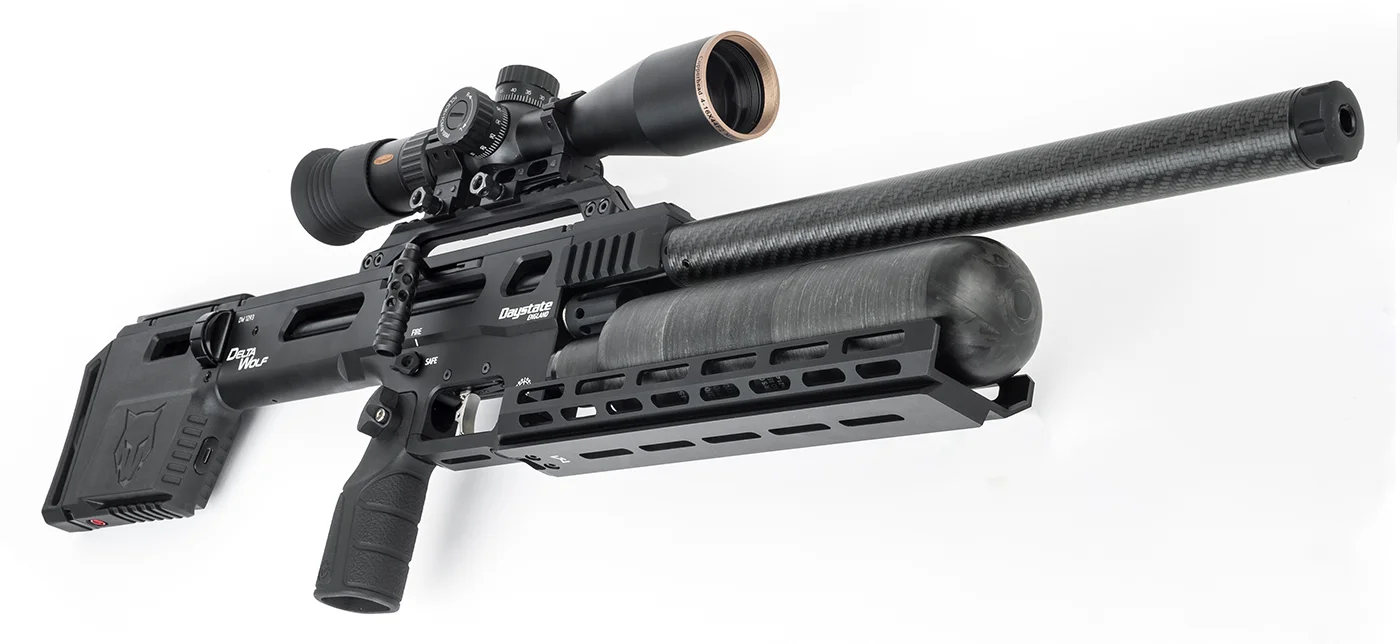
For buyers comparing premium European PCP equipment, daystate redwolf price and daystate redwolf price are common commercial-intent searches. Pricing can vary depending on caliber, stock type, configuration, region, dealer, and included accessories. People may also search fx airgun dealer near me when looking for authorized retailers, parts support, servicing, or warranty assistance.
FX Airguns remains another major name in the PCP market. Popular searches include fx impact m3 .22cal air rifle. 600mm barrel, fx impact m3, fx impact mk3, fx m3 airgun, fx m3, impact m3, and fx impact m3 air rifle. Price-focused searches such as fx impact m3 precio, fx impact m3 precio en usa, and fx impact m3 price indicate strong buyer interest in comparing regional pricing and available configurations. The modular design philosophy associated with the FX Impact family makes it especially attractive to experienced PCP users who prioritize adjustability, ergonomics, accessory compatibility, and high-quality construction.
Potential buyers also encounter less common search phrases such as griffin gun, unfend, black snood, red bodywarmer, and can wolverine go on planes. Airline transport rules for sporting equipment and compressed-air components can differ substantially between carriers and countries, so travelers should always check current airline, airport, customs, and destination regulations before making travel arrangements. Likewise, terms such as 3.55kg in lbs may appear when buyers compare rifle weight specifications across metric and imperial listings.
Whether someone is researching the daystate alpha wolf, daystate blackwolf, daystate redwolf, huntsman daystate, wolf delta, an fx impact m3, or another premium pellet rifle, the most important purchasing factors remain intended use, caliber compatibility, overall weight, stock ergonomics, magazine design, air-cylinder capacity, manufacturer support, and accessory compatibility. Premium PCP ownership is best supported by appropriate maintenance, manufacturer-approved components, secure storage, responsible handling, and compliance with all local laws and transport requirements.
Frequently Asked Questions
Precision electronic PCP ownership is often accompanied by practical questions before a purchase is completed. Consequently, the answers below are written so that features, legal limits, setup, and day-to-day use can be understood without guesswork. Moreover, inclusive language is used throughout, because left- and right-handed shooters, hunters, and range users are all served by the same modular platform.
What type of air rifle is being described?
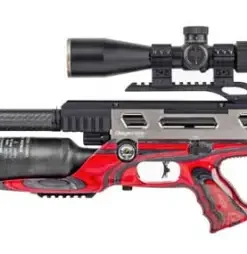
A fully electronic, regulated, pre-charged pneumatic bullpup is presented. Therefore, a conventional hammer spring is not relied upon for valve timing. Instead, a solenoid-driven firing cycle is employed, and an adjustable two-stage electronic trigger is provided. In addition, a colour touchscreen, an onboard chronograph, and Advanced Velocity Technology are combined so that velocity can be requested, monitored, and refined. As a result, a programmable high-power platform is offered rather than a single fixed mechanical tune.
How is Advanced Velocity Technology used in practice?
Shot velocity is measured by the shroud-mounted chronograph, and that data is passed to the onboard processor. Subsequently, factory pellet maps can be selected, a target speed can be entered, and small corrections can be applied in the appropriate operating mode. Likewise, magazine capacity, display brightness, auto power-off, and chrono functions can be set from the butt-mounted screen. Meanwhile, saved profiles can be recalled after a barrel or ammunition change, so zero and power settings do not have to be rebuilt from scratch every time.
Which calibres can be specified?
.177, .22, .25, and .30 are typically listed for the high-power configuration. Furthermore, a quick-change barrel system is provided so that a calibre swap can be completed in a few minutes when the matching bolt and magazine are fitted. Afterward, the corresponding power program can be loaded from memory. Consequently, one chassis can be used for lighter target work or heavier hunting ammunition, provided local energy limits are respected.
How much muzzle energy can be expected?
Published high-power figures are market- and tune-dependent. Typically, energies in the region of about 31–34 ft-lb in .177, about 61–71 ft-lb in .22, about 67–75 ft-lb in .25, and about 95–105 ft-lb in .30 are quoted for the 23-inch barrel. A later Performance variant with a longer barrel and an ultra-fast-flow valve is listed even higher in some catalogues. Nevertheless, factory output may be set below the theoretical maximum so that accuracy with specified pellets or slugs is protected. Importantly, FAC or equivalent licensing and country-specific limits apply, and legal compliance must always be verified before a high-power rifle is ordered or used.
What barrel length and overall size are fitted?
A 600 mm (23 in) ART barrel is normally fitted to the high-power model. Even so, a compact overall length of about 842 mm (33.1 in) is retained because a bullpup layout is used. Unscoped weight of roughly 3.55 kg (7.8 lb) is typically recorded, although optics, a moderator, and a filled bottle will increase the carried mass. Therefore, a long barrel and a 480 cc bottle can still be handled in hides, vehicles, and woodland without the overall package becoming as long as a conventional FAC rifle of similar barrel length.
How is air stored and how high can the bottle be filled?
A removable 480 cc carbon-fibre buddy bottle is fitted. Fill pressure of up to 240 bar (3,480 psi) is accepted through a probe port that is usually hidden under a magnetic cover ahead of the trigger guard. In addition, a Huma-Air regulator and a large secondary plenum are used so that each shot is fed from a stable working pressure. On high-power models, regulator pressure can be adjusted so that pellet or slug weight can be matched. Shot count then varies with calibre, energy setting, and ammunition, and a lower power map will almost always return more shots from the same fill.
Can two magazines be used together?
Yes. A self-indexing cassette magazine is supplied, with typical capacities of 13 rounds in .177, 11 in .22, 10 in .25, and 8 in .30. Moreover, magazines can be inserted from either side, and a second full magazine can be pushed through so that the empty one is displaced and held by magnets. Consequently, a doubled string can be fired before a reload is required. A single-shot tray can also be fitted when precision loading is preferred.
Is the rifle suitable for both left- and right-handed shooters?
An ambidextrous alloy chassis is used. The sidelever can be swapped to the opposite side in about a minute, the cheekpiece and butt pad can be adjusted, and an AR-style safety and pistol grip are laid out so that either hand can operate the controls. Inclusive fit is therefore supported without a dedicated “left-hand only” action being required. Additional PRS-style butt hardware can later be added if a more specialised length of pull or bag-rider setup is wanted.
How does the electronic trigger differ from a mechanical trigger?
Pull weight, stage length, and blade position can all be adjusted, and a very light, repeatable break is typically felt once the unit is set. Because a solenoid releases the valve, lock time is short and creep associated with a mechanical sear is largely removed. An electronic isolation lever is still provided so that the action can be rendered safe. After a session, the safety should be returned to the safe position so that both safety and battery life are protected.
What battery is used and how is it charged?
A proprietary 11.1 V, 800 mAh three-cell Li-Po pack is housed behind the butt plate. The pack should be removed for charging on a compatible balanced charger. Thousands of shots per charge are commonly reported when the safety is used correctly and auto power-off is enabled. Care around pacemakers and magnetic-stripe cards is advised in the handbook because electronics and magnets are present in the stock area.
Can slugs as well as pellets be used?
Slug use is supported on high-power models when regulator pressure, dwell, and target velocity are set for that projectile. Factory maps are often based on Daystate/JSB pellet weights, so a slug tune may need to be built in advanced mode rather than being copied from the nearest pellet preset. Accurate results are then obtained only after grouping tests are completed at the intended range. Ammunition must remain legal for the local energy class.
How are firmware updates applied?
A Data Transfer Device (DTD) adaptor can be purchased so that a Windows PC can be connected. Update files are published by the manufacturer from time to time, and new trigger-board or power-menu behaviour can be installed. Future-proofing is therefore built into the platform, provided the correct adaptor and current files are used. A participating dealer can also apply updates if a home computer is not preferred.
What accessories are commonly added?
A 0 dB silencer, extra magazines, a single-shot loader, bipod, lights, lasers, and a sliding Picatinny intermount are frequently specified. The top rail can be moved so that zero-eye-relief prismatic scopes or large-objective target scopes can be aligned with the adjustable cheekpiece. Side and underslung rails accept hunting or PRS extras. A carbon shroud already reduces muzzle blast, and a moderator can be added where thread and law allow.
How consistent is velocity from shot to shot?
Very low extreme spread is widely reported when sorted ammunition is used and the chronograph-linked system is allowed to work in the intended mode. In reviews, standard deviations of only a few feet per second have been recorded over short strings, and usable FAC strings of several dozen shots have been documented in .25 before regulated pressure falls away. Consistency still depends on fill pressure, regulator setting, pellet quality, and temperature, so a chronograph check after any change remains good practice.
Is the rifle intended for hunting, pest control, or target shooting?
All three roles can be served. Compact length and a rearward balance help in hides and vehicles. Programmable power helps when a smaller quarry or a longer shot is faced, provided the shot remains lawful and humane. On the range, stored profiles, a refined trigger, and a quality ART barrel support grouping work at 50 m and beyond. Inclusive club use is easier because the lever and stock can be set for either shoulder.
What maintenance is normally required?
External metalwork should be kept clean and lightly protected, the fill probe and bottle O-rings should be inspected, and the bottle should be treated as a high-pressure vessel. The battery should be charged on the specified balancer and not left deeply discharged for long periods. Barrel and transfer-port areas should be kept free of debris after a calibre change. Internal electronic service is best left to a trained technician. After any regulator or power change, velocity should be confirmed before the rifle is used in the field.
What legal points should be checked before purchase?
Energy limits, licensing (including FAC or national equivalents), transport, storage, and hunting seasons vary by country and sometimes by region. A rifle that is legal in one market may require a certificate or a lower factory tune in another. Age limits, public-place rules, and magazine restrictions may also apply. Professional advice should be sought locally, and no configuration should be used above the limit that is authorised for that shooter.
What is typically included in the box?
A rifle, at least one magazine, a fill adaptor, basic tools, O-rings, and charging accessories are commonly supplied, though exact contents vary by dealer and market. A case, extra magazines, a moderator, and optics are often sold separately. The sales listing should be read so that “gun only” packages are not confused with ready-to-hunt bundles.
How should a first setup be approached?
The handbook should be read first. The battery should be charged, the bottle should be filled to a safe working pressure, and the correct calibre profile should be selected on the screen. Then a known pellet weight should be entered, a modest velocity target should be chosen, and groups should be shot at a measured distance. Only after a stable zero and a legal energy check are obtained should hunting or competition use begin. Afterward, the safety should be applied and the rifle stored securely.
Why is this platform often chosen over a purely mechanical PCP?
Programmable velocity, live chrono feedback, reversible controls, multi-calibre barrels, and updateable firmware are combined in one compact regulated chassis. Therefore, a long-term system can be built rather than a single-calibre, single-tune rifle. When accessories, ammunition, and legal power are matched with care, a versatile electronic high-power bullpup is ready for range days and lawful field work alike.
Practical Use Scenarios
Field work, range sessions, and shared club days are all supported by a compact electronic high-power bullpup when the rifle is set up with care. Consequently, the notes below describe how the platform can be used from first fill to last safe storage. Inclusive language is used throughout, because left- and right-handed shooters, hunters, and target users can share the same chassis once the lever, cheekpiece, and profiles have been adjusted. Local law, licensed energy, and humane shot placement remain the first consideration in every scene that follows.
Dawn Pest Control Around Buildings and Fields
A first lawful outing is often a quiet dawn circuit of outbuildings, paddock edges, or a permission where rabbits or similar quarry may be taken. Because overall length stays modest despite a long barrel, the rifle can be carried through gates and along fence lines without the muzzle being swept across obstacles. A filled 480 cc bottle is fitted the evening before, and a moderate power map is selected so that extra shots remain available if several opportunities appear in one field.
The electronic safety is kept on until a stable rest is found. Sticks, a gatepost, or a low bipod can be used. After the sight picture is settled, the isolation lever is moved and the light trigger is pressed. Follow-up shots are prepared by the short reversible sidelever, and a second magazine can be pushed through from the opposite side when the first cassette is empty. If the chronograph reading drifts after a cold start, a brief pause is taken and another two-shot confirmation group is fired into a safe backstop before live quarry is addressed.
Clothing layers and gloves should still allow the touchscreen and safety to be reached. A lamp is left off until it is needed so that night vision of the land is not spoiled. When the session ends, the safety is returned to safe, the magazine is removed, and the rifle is cased before any public road is joined.
Woodland Stalking and Hide Work
In woodland, compact balance is valued because most of the mass sits close to the body. A sling or a simple carry can be used between stands. Leaves, brambles, and low branches are less likely to catch a bullpup than a long conventional FAC rifle of similar barrel length. A moderator, where lawful, keeps muzzle blast down so that a second chance in the same ride is not immediately lost.
A hide or high seat favours a rested shot. The adjustable cheekpiece and sliding rail are set so that a compact prismatic or a conventional scope sits without a strained neck. After a quarry is judged to be within a humane range for the chosen calibre and energy, the shot is taken only when a clear backstop exists. Larger calibres and higher maps are reserved for appropriate quarry and licensed use; a reduced map is often chosen for closer work so that meat damage is limited and more shots remain in the bottle.
Wind in rides can be read from grass and leaves. Because velocity can be held more tightly than on an unregulated springer, hold-over is more repeatable once a profile has been proven at 25, 40, and 55 metres on paper. If a barrel kit in another calibre is carried, the change is left for a bench at home rather than being attempted in mud with cold hands.
Vehicle and Farm-Round Use
Permissions that are worked from a truck or utility vehicle suit a short overall package. The rifle can be lifted from a cab rack, a rest can be taken over a door or bonnet bag, and the shot can be completed without a long barrel projecting into the next lane of traffic. Inclusive use is straightforward when a partner prefers the opposite shoulder: the lever can be swapped in about a minute at the tailgate, and the same zero profile can be retained if the optic is not moved.
A second charged bottle can be carried in a padded sleeve. The magnetic fill cover is kept clean of grit so that the probe seals properly at the next stop. After each farm block, the safety is applied and the muzzle is pointed in a safe direction while gates are opened. No loaded rifle should be laid on a public seat or left visible in an unlocked cab.
Formal Range Zeroing and Profile Building
Before any field trip, a measured range session is strongly advised. A full fill is put in, the correct calibre and pellet weight are entered, and a conservative velocity target is chosen. Five-shot groups are then fired at 25 metres to confirm function, then at 50 metres to refine zero. Sorted ammunition from one tin is used so that flyer causes can be separated from rifle causes.
If factory pellet maps are close but not perfect, advanced settings can be used so that dwell and regulator pressure are matched to that lot. Results are written down or stored in a named profile. A second ammunition type—perhaps a heavier pellet or a tested slug—receives its own profile rather than being forced onto the first map. After each change, energy is checked so that the licensed limit is not exceeded.
Bipod, bag, or bench can all be used. The electronic trigger is adjusted only in small steps; a break that feels perfect on the bench can still be too light for winter gloves in a hide. Night mode on the screen is tried if dusk sessions are planned, and auto power-off is enabled so that the pack is not flattened by a forgotten display.

Reviews
There are no reviews yet.