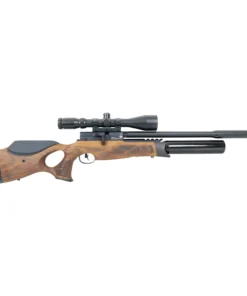
BSA R-12 CLX Pro Walnut – Premium British PCP Air Rifle
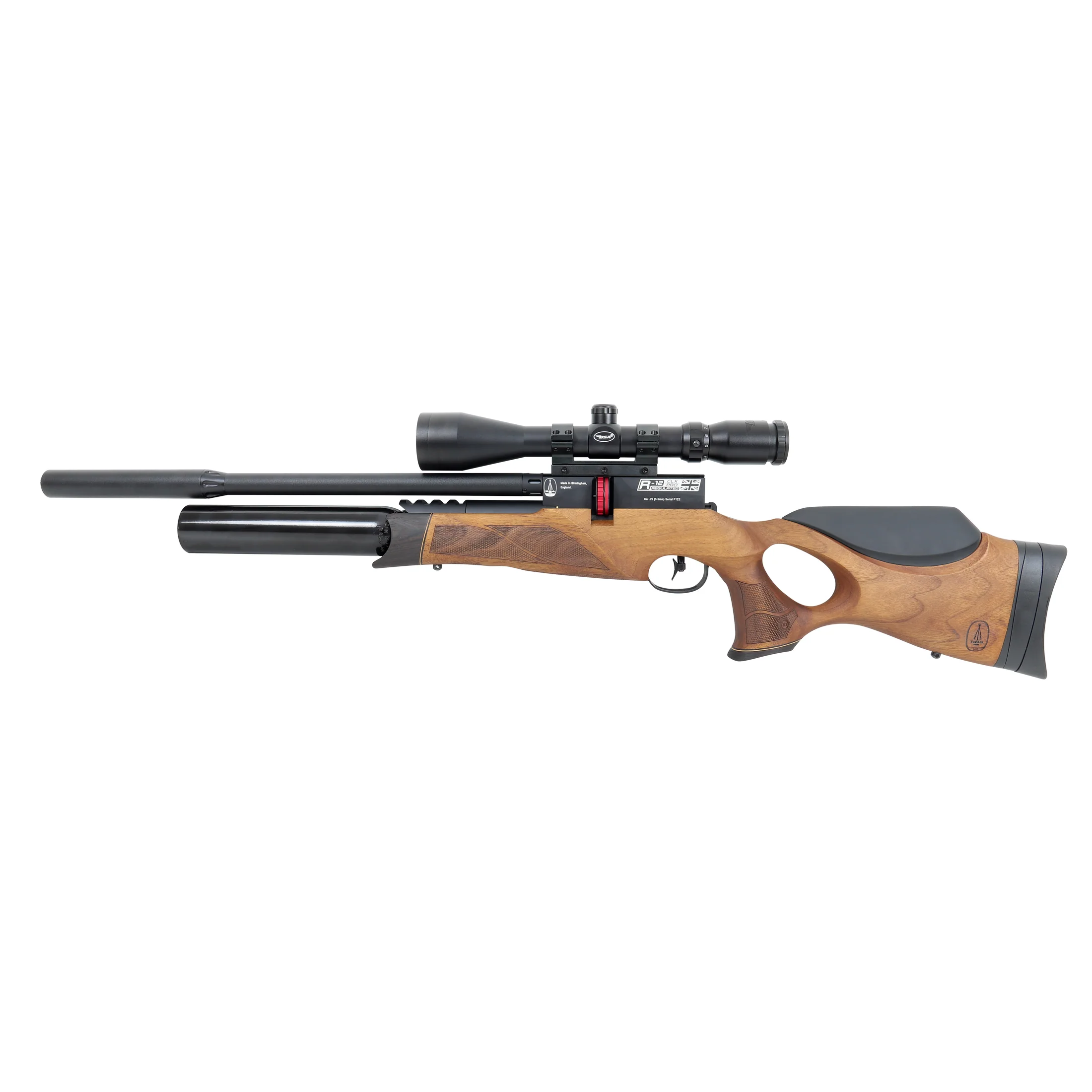
The BSA R-12 CLX Pro Walnut brings traditional British airgun character together with modern PCP engineering, refined ergonomics, and the kind of premium finish expected from a flagship BSA rifle. Designed and manufactured in Birmingham, England, this sophisticated air rifle has been developed for shooters who value consistency, comfort, craftsmanship, and a beautifully balanced shooting platform.
Rather than simply updating an existing platform, BSA has incorporated its newer mono-block architecture, regulated PCP system, smooth side-lever action, multi-shot magazine, and renowned cold hammer-forged barrel technology into the R-12 CLX Pro. Consequently, the rifle feels modern in operation while still retaining the classic visual character associated with BSA’s premium sporting rifles.
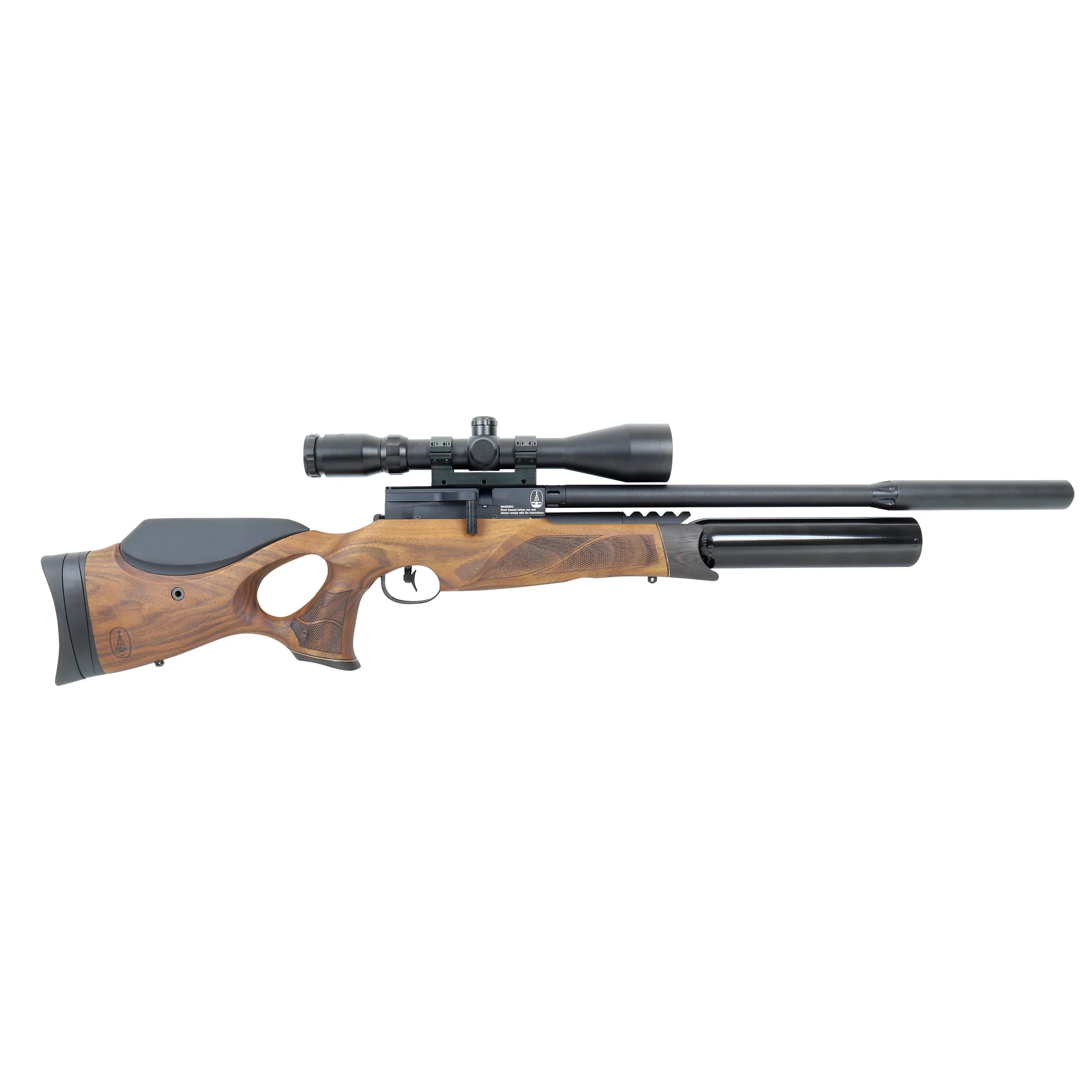
Premium Walnut Thumbhole Stock
One of the most distinctive features of the BSA R-12 CLX Pro Walnut is its beautifully finished walnut thumbhole stock.
Produced around a classic sporting profile, the stock has been designed to provide a secure, natural hold while enhancing the rifle’s premium appearance. Moreover, the thumbhole configuration helps the firing hand remain comfortably positioned around the grip, which contributes to a stable and controlled shooting posture.
A height-adjustable cheekpiece further improves adaptability. Therefore, shooters can refine their head position to suit their preferred optic and shooting stance. Meanwhile, the adjustable butt arrangement provides additional flexibility for different body shapes and shooting styles.
Although synthetic stocks may offer straightforward practicality, genuine walnut gives the R-12 CLX Pro a distinctive character that is difficult to replicate. Grain patterns naturally vary from stock to stock, meaning every rifle can possess its own subtle visual identity.
Designed Around Comfort and Control
Balance plays an important role in any premium sporting air rifle.
For that reason, the BSA R-12 CLX Pro Walnut has been designed to provide a composed shooting position without feeling unnecessarily cumbersome. Its sculpted stock, adjustable cheek support, and ergonomic grip work together to create a platform that feels reassuringly planted.
Additionally, sling and bipod mounting provisions have been incorporated into the design, giving owners additional flexibility when configuring the rifle for their preferred form of shooting.
Regulated PCP Performance
At the heart of the rifle sits a regulated pre-charged pneumatic system.
The regulator has been developed to improve air management and promote consistent power delivery throughout the usable pressure range. As a result, predictable performance can be maintained across a substantial number of shots from a fill.
Equally important, BSA’s newer mono-block platform has been engineered to reduce component complexity while improving efficiency and reliability. That approach gives the BSA R-12 CLX Pro Walnut a cleaner mechanical foundation compared with previous-generation designs.
Smooth Side-Lever Operation
A side-lever action is fitted to the R-12 CLX Pro, providing a smooth and intuitive cycling system.
Instead of relying on a more traditional bolt configuration, the side lever allows the action to be operated comfortably while the rifle remains mounted. Consequently, follow-up shots can be managed efficiently while maintaining a composed position.
The mechanism has also been complemented by a cocked-status indicator, adding useful visual feedback during operation.
12-Shot CLX Magazine System
Convenience is further improved through BSA’s CLX magazine system.
A 12-shot magazine is incorporated, while a visible shot-countdown system allows the remaining pellet count to be monitored easily. Once the final shot has been used, the system also provides mechanical feedback by preventing the probe from moving completely forward, helping the shooter recognise that the magazine requires reloading.
For anyone who prefers uninterrupted shooting sessions, this configuration offers a meaningful advantage over single-shot loading.
BSA Cold Hammer-Forged Barrel
Accuracy has long been associated with BSA’s barrel manufacturing heritage, and that tradition continues with the BSA R-12 CLX Pro Walnut.
A BSA cold hammer-forged barrel is fitted as standard. Because barrel consistency contributes significantly to pellet stability and repeatability, considerable attention has been placed on maintaining precision throughout the platform.
Whether the rifle is being configured for recreational target shooting, range use, or lawful field applications, its barrel system provides the foundation required for dependable accuracy.
Additionally, the standard rifle is commonly listed with a barrel length of approximately 15.5 inches, while overall length is around 40 inches, depending on configuration.
Customer Configurable Shroud System
Another innovative feature is BSA’s CCS – Customer Configurable Shroud.
Rather than locking the owner into a single barrel configuration, the CCS system offers additional flexibility around the shroud and moderator arrangement. Therefore, the rifle can be adapted more easily when different optic or accessory configurations are preferred.
For shooters using larger objective optics, this configurability can be especially useful because additional clearance can be created around the barrel assembly where required.
Clear Pressure Monitoring and Convenient Filling
Managing a PCP rifle becomes easier when pressure information can be read quickly.
Accordingly, the R-12 CLX Pro incorporates an enlarged pressure gauge with a generous viewing area. The quick-fill system is also protected against dirt and debris by a dedicated cover, helping the rifle remain practical during regular use.
Standard UK-market configurations have been listed with a 288cc air bottle, although larger bottle compatibility has also been incorporated into the platform. Exact bottle specification and shot capacity should always be confirmed for the individual model being purchased because international versions may differ.
Refined Adjustable Trigger
Trigger feel can have a major influence on practical shooting consistency.
Therefore, a multi-adjustable trigger system has been retained within the BSA R-12 CLX Pro Walnut platform. Different aspects of the trigger position can be adjusted to better suit personal preference, helping users achieve a comfortable and repeatable finger placement.
Combined with the adjustable stock geometry, this creates a rifle that can be tailored more effectively around the individual shooter rather than forcing everyone into one fixed configuration.
BSA R-12 CLX Pro Walnut Key Features
- Premium walnut thumbhole stock
- Designed and manufactured in Birmingham, England
- Regulated PCP operating system
- New-generation mono-block action
- Smooth side-lever cocking system
- 12-shot CLX magazine
- Integrated magazine shot-countdown window
- Cocked-status indicator
- BSA cold hammer-forged barrel
- Customer Configurable Shroud system
- Height-adjustable cheekpiece
- Adjustable butt configuration
- Multi-adjustable trigger
- Large, easy-to-read pressure gauge
- Protected quick-fill arrangement
- Sling and bipod mounting provisions
- Standard 288cc bottle on commonly listed UK configurations
- Approximately 15.5-inch barrel
- Approximately 40-inch overall length
- Premium sporting design with modern PCP engineering
Why Choose the BSA R-12 CLX Pro Walnut?
For shooters searching for a premium PCP rifle that combines traditional styling with modern engineering, the BSA R-12 CLX Pro Walnut presents a compelling package.
Its walnut thumbhole stock gives the rifle an unmistakably classic appearance. Meanwhile, the regulated action, side-lever mechanism, CLX magazine, configurable shroud, adjustable ergonomics, and BSA-manufactured barrel introduce the technology expected from a contemporary flagship PCP.
Just as importantly, the rifle has been developed around usability rather than specifications alone. Controls have been positioned logically, stock adjustments allow personalisation, magazine status can be monitored easily, and air pressure can be checked at a glance.
Consequently, the R-12 CLX Pro feels equally at home as a carefully selected premium air rifle for regular range sessions or lawful field use where local regulations permit.
British Heritage Meets Modern Engineering
BSA’s history gives the R-12 CLX Pro a strong traditional foundation, yet this model has clearly been designed with modern shooters in mind.
During development, the R-12 platform reportedly underwent extensive testing involving more than 50,000 test shots, reflecting the manufacturer’s emphasis on refinement and reliability. The result combines BSA’s recognisable sporting-rifle identity with a significantly updated mechanical architecture.
From the walnut stock and adjustable ergonomics to the regulated PCP action and cold hammer-forged barrel, each major element has been selected to contribute toward a refined overall shooting experience.
A Flagship PCP with Distinctive Character
Ultimately, the BSA R-12 CLX Pro Walnut is designed for buyers who want more than a basic PCP platform.
It combines visual elegance, adjustability, multi-shot convenience, efficient regulated performance, British manufacturing heritage, and BSA’s established barrel technology within one premium package.
For enthusiasts seeking a rifle that looks as refined as it feels, the walnut version is particularly appealing. Traditional materials provide the character, while contemporary engineering supplies the performance.
The result is a distinctive flagship PCP air rifle that successfully bridges classic BSA styling with the technology demanded by today’s airgun enthusiast.
Calibre, muzzle-energy limits, licensing requirements, permitted uses, bottle configuration, and delivery rules vary by country and jurisdiction. Buyers should confirm the exact specification and comply with all applicable local laws before purchase or use.
BSA R-12 CLX Pro Walnut Calibres, FAC, Power, Recommended Scope and Accessories
The BSA R-12 CLX Pro Walnut has been designed as a premium PCP air rifle that can be configured around different shooting requirements, local regulations, and personal preferences. Therefore, choosing the correct calibre, power level, optic, and supporting accessories can make a significant difference to the overall shooting experience.
Because laws governing airguns vary considerably between countries and regions, buyers should always confirm the exact specification of the rifle being supplied. Likewise, FAC-rated versions, higher-energy configurations, and permitted hunting uses must only be selected where they are lawful.
Available Calibres for the BSA R-12 CLX Pro Walnut
The BSA R-12 CLX Pro Walnut is commonly offered in popular sporting airgun calibres such as .177 and .22, although availability may vary depending on the market and distributor.
.177 Calibre
The .177 calibre is widely chosen by target shooters because its lighter pellets generally produce a flatter trajectory at normal air-rifle distances.
As a result, holdover corrections can be easier to manage, particularly when shooting paper targets, knock-down targets, or other precision-oriented disciplines. Moreover, .177 pellets are widely available in many different weights and designs, giving shooters plenty of options for testing what performs best through their individual barrel.
For recreational target shooting, plinking, and precision practice, .177 can be an excellent match for the R-12 CLX Pro.
However, pellet selection should still be tested carefully. Even premium barrels can show preferences for particular pellet weights, head sizes, or profiles.
.22 Calibre
The .22 calibre is another very popular choice and is often preferred by shooters who want a heavier pellet with greater retained momentum.
Compared with .177, .22 pellets normally travel more slowly at equivalent legal energy levels. Therefore, the trajectory is generally more curved. Nevertheless, experienced shooters often appreciate the heavier projectile characteristics and the calibre’s traditional popularity for lawful pest-control and field applications.
For anyone who prefers a slightly heavier pellet and is comfortable accounting for trajectory, the .22 version of the BSA R-12 CLX Pro Walnut can be a very capable option.
Sub-12 ft-lb and FAC Power Options
One of the most important purchasing considerations is the rifle’s power classification.
In the United Kingdom, many air rifles are sold in configurations below the legal threshold that would require a firearm certificate. For rifles, this commonly means a muzzle energy below 12 ft-lb. However, laws differ in Scotland, Northern Ireland, and other jurisdictions, so local requirements must always be checked before ownership or use.
A sub-12 ft-lb BSA R-12 CLX Pro Walnut can be particularly attractive for recreational shooting, club use, target practice, and lawful pest control where permitted.
Because the rifle uses a regulated PCP system, shot-to-shot consistency can be maintained effectively when the rifle is properly filled, maintained, and paired with suitable ammunition.
FAC Versions
Higher-powered versions may be available in certain markets and are often described as FAC-rated or high-power configurations.
In the UK, an air rifle exceeding the relevant legal muzzle-energy threshold generally requires the appropriate Firearm Certificate. Therefore, buyers should never assume that a high-power configuration can legally be purchased or possessed without licensing.
FAC-rated versions may offer increased velocity and energy, although exact figures depend on calibre, tune, barrel configuration, pellet weight, and the factory specification supplied for the particular market.
Additionally, higher power does not automatically mean better practical accuracy. Instead, the most important factors are consistency, pellet compatibility, precise zeroing, shooter technique, and selecting a power level appropriate for the intended use.
Choosing the Right Power Level
For target shooting, a lower-powered regulated setup is often more than sufficient.
Meanwhile, licensed shooters using the rifle for lawful field applications may prefer an FAC configuration where additional retained energy is required and legally permitted.
Regardless of power level, the rifle should always be used with a safe backstop, known target distance, and complete awareness of what lies beyond the target.
Recommended Scope for the BSA R-12 CLX Pro Walnut
A premium rifle benefits considerably from a well-matched optic.
For general use, a 3-12×44, 4-16×44, or 4-16×50 scope can provide an excellent balance between field of view, magnification, size, and low-light performance.
3-12×44 Scope
A 3-12×44 scope is a strong all-round choice.
At lower magnification, a wide field of view is maintained, while 12x magnification provides enough detail for careful target work at typical air-rifle distances.
This configuration also avoids making the rifle unnecessarily top-heavy.
4-16×44 or 4-16×50 Scope
For shooters who prefer additional magnification, a 4-16×44 or 4-16×50 optic may be more suitable.
The additional magnification can be particularly useful when shooting smaller targets, evaluating pellet groups, or working at longer distances.
Scopes with side-focus or adjustable parallax are especially useful on PCP air rifles because they allow the image and reticle to be focused more accurately at airgun distances.
Recommended optic features include:
- 3-12x or 4-16x magnification
- 44mm to 50mm objective lens
- Side-focus or adjustable parallax
- Fine Mil-Dot or half-Mil reticle
- Clear turret markings
- Quality multi-coated glass
- Strong one-piece or two-piece mounts
- Low-profile design where possible
The final scope height should also be matched to the adjustable cheekpiece so a natural head position can be maintained.
Recommended Accessories
The correct accessories can make the BSA R-12 CLX Pro Walnut even more practical and enjoyable to use.
Spare Magazines
An additional CLX magazine is one of the most useful accessories for regular shooters.
Rather than stopping frequently to reload the same magazine, a spare can be prepared beforehand and exchanged when needed.
Bipod
A quality bipod can be useful when shooting from a bench or supported prone position.
However, the rifle should only be fitted with accessories compatible with its mounting system, and excessive weight should be avoided.
PCP Charging Equipment
Because this is a pre-charged pneumatic rifle, a suitable charging system will be required.
Common options include:
- High-pressure hand pump
- Approved diving cylinder
- PCP charging bottle
- Compatible fill adapter
- Regulated compressor designed for PCP use
All charging equipment should be rated for the required pressure and used according to the manufacturer’s instructions.
Rifle Slip or Hard Case
A padded rifle slip or hard case helps protect the walnut stock, optic, barrel, and action during transport and storage.
Because walnut can be marked more easily than some synthetic materials, additional protection is especially worthwhile.
Cleaning and Maintenance Equipment
A basic airgun maintenance kit should include suitable cleaning materials, lint-free cloths, approved lubricants, and barrel-cleaning equipment appropriate for air rifles.
Harsh chemicals and excessive lubrication should be avoided unless specifically recommended by BSA.
Building a Balanced BSA R-12 CLX Pro Walnut Setup
A well-configured BSA R-12 CLX Pro Walnut does not need to be overloaded with accessories.
Instead, the best setup is usually built around a quality scope, secure mounts, reliable charging equipment, suitable pellets, one or two spare magazines, and protective storage.
For target-focused users, a .177 version paired with a clear 4-16x optic can provide an excellent precision-oriented combination.
Alternatively, shooters who prefer .22 may choose a slightly lower-magnification field scope to preserve balance and handling.
Ultimately, calibre and power should be chosen around legal requirements and the intended shooting discipline rather than maximum performance figures alone. When correctly configured, the BSA R-12 CLX Pro Walnut offers a refined, adaptable platform capable of delivering the consistency, ergonomics, and premium character expected from a flagship British PCP air rifle.
AirMaks, Umarex, PCP Air Rifles and Modern Airgun Options
The modern airgun market offers an increasingly broad selection of platforms for recreational shooting, target practice, sporting applications, and lawful pest-management duties. Buyers researching premium European PCP rifles frequently encounter names such as airmaks krait, airmaks, airmak, air marks, and air max krait. These search terms are commonly associated with compact, regulated PCP designs that emphasize accuracy, adjustability, handling, and efficient use of compressed air.
Airgun enthusiasts researching European terminology may also encounter komprimiran zrak, a phrase connected with compressed-air equipment in several European-language searches. Other related searches include airrams, airma, arm max, max arms, max air gun, gunmax, mav max, uramax, and even less conventional terms such as airmaxsex. Although these phrases may represent different manufacturers, spelling variations, or exploratory searches, they demonstrate the wide range of terminology people use when researching modern air-powered equipment online.
AirMaks KRAiT and Katran PCP Platforms
Among shooters comparing contemporary Czech PCP designs, the airmaks krait family attracts attention because of its compact configuration and adaptable shooting platform. Searches such as airmaks krait .22 official often come from buyers specifically researching the .22-calibre configuration, manufacturer specifications, or authorized product information.
Another search variation, krayt30, may appear when users are researching particular KRAiT configurations or calibre-related information. Because specifications can differ according to market, configuration, and local legislation, individual product details should always be checked against current manufacturer documentation.
AirMaks is also closely associated with the Katran platform. Searches including airmaks katran, airmaks katran .22, katran, katran air rifle, akatran, and katran llc indicate strong interest in this family of PCP rifles. The Katran line is generally researched by shooters interested in lightweight construction, adjustable features, compact handling, and PCP performance.
The popularity of these platforms also highlights the reputation of czech gun manufacturers, particularly within the European precision-airgun sector. Czech engineering has become increasingly visible among enthusiasts looking for well-machined components, regulated actions, ergonomic stocks, and modern PCP configurations.
What Does PCP Air Rifle Mean?
For newcomers asking what does pcp air rifle mean, PCP stands for pre-charged pneumatic. A PCP air rifle stores compressed air in an onboard reservoir. When the trigger is operated, a measured quantity of stored air is released to propel the pellet.
Unlike spring-powered designs, PCP rifles do not require a large spring or gas ram to be compressed before every shot. Consequently, recoil can be relatively low, while repeatability and shooting comfort can be improved. The exact performance depends heavily on the rifle, calibre, regulator, projectile, pressure settings, and applicable legal restrictions.
Manufacturers and air gun makers now offer PCP equipment ranging from compact recreational platforms to sophisticated sporting rifles. Buyers may also come across air arm in searches while comparing manufacturers and product categories.
Air Rifles for Pest and Vermin Management
One important area of airgun research involves pest control with air rifles. Where local law permits it, an appropriately powered and accurately configured air rifle may be used for certain pest-management applications. However, humane dispatch, a safe backstop, correct projectile selection, suitable energy, landowner authorization, and compliance with local hunting or pest-control regulations remain essential.
People searching for an air rifle for pest control often prioritize accuracy and consistency rather than power alone. Similarly, searches for air rifle pest control typically focus on equipment that can deliver predictable shot placement at appropriate distances.
Choosing the best air rifle for pest control therefore depends on the intended quarry, legal power limits, shooting distance, calibre, environment, and shooter competence. The same principle applies when comparing vermin control guns. There is no universally ideal configuration because legal and practical requirements vary significantly between jurisdictions.
A pellet gun for pest control should be selected only when its power and accuracy are suitable for the lawful intended application. Buyers searching for the best pellet gun for pest control should place particular emphasis on reliable precision, appropriate ammunition, and responsible shot selection rather than simply choosing the highest available muzzle energy.
Umarex Airguns and Popular Platforms
Beyond AirMaks, umarex airguns represent one of the most extensively searched categories in recreational and sporting airguns. American buyers frequently search umarex usa or umarexusa when looking for product information, support, specifications, and locally available models.
The broader range of umarex air rifles includes PCP, CO2, spring-powered, and other air-powered platforms. One popular compact PCP search is umarex notos, while umarex notos carbine and the shorter search term notos are regularly used by people comparing compact PCP configurations.
Larger PCP platforms generate searches such as umarex gauntlet, umarex gauntlet 2, and umarex gauntlet 30. Other PCP-related searches include umarex origin, umarex zelos, and the cartridge-based umarex komplete. More specifically, buyers researching its .22 configuration may search umarex komplete ncr .22.
At the higher-energy end of the airgun market, search terms include umarex hammer, umarex hammer .50 caliber, umarex hammer carbine, and the general category 50 cal air rifle. Another specialized search is umarex primal 20, which relates to large-calibre airgun equipment intended for markets where such equipment is legally permitted.
Umarex Pistols, BB Guns, and Replica Platforms
Umarex is equally well known for replica pistols and CO2-powered recreational equipment. General phrases such as umarex bb gun, bb gun, bbgun, bb gun pistol, metal bb gun, pellet pistol, and co2 pellet pistols are frequently used by buyers comparing different recreational shooting formats.
Glock-licensed models produce particularly strong search interest. Examples include umarex glock, umarex glock 17, umarex glock 17 gen 5, umarex glock 19, and the highly specific umarex glock 19 gen3 .177 caliber bb gun air pistol. Related searches include glock 19 bb gun and glock 19x bb gun, while umarex glock 19x is often searched by enthusiasts wanting a replica inspired by the crossover Glock configuration.
Airsoft users employ similar terminology, including airsoft glock, airsoft glock 19, glock 17 airsoft, airsoft glock 17, glock airsoft gun, glock airsoft gas, and the unusual combined search phrase airsoft pistol.umarex dx17. Although BB and airsoft platforms can look similar externally, their ammunition, operating systems, intended uses, and performance characteristics can differ substantially.
T4E and Training-Oriented Airgun Searches
The umarex t4e family represents another significant product category. Searches such as umarex tr50, umarex hdr 50, and umarex t4e smith are frequently associated with training-oriented or recreational marker platforms, depending on local classification and regulations.
Technical searches can become very specific. For example, umarex p2p dr50 how many joules reflects buyers attempting to determine the muzzle-energy rating of a particular platform. Energy specifications should always be confirmed for the exact regional version because manufacturers may offer different configurations for different legal markets.
Another search phrase, umarex smith, may be used by customers researching Smith & Wesson-licensed replicas distributed through Umarex.
Break-Barrel and Sporting Airguns
Traditional break-barrel designs remain popular because they do not require a separate high-pressure filling system. The umarex trevox is one example frequently researched by pistol enthusiasts. Searches for loading umarex trevox break barrel .177 generally come from owners wanting to understand the basic loading process and calibre configuration.
A related category is umarex pistol break barrel, which helps shoppers distinguish manually cocked designs from CO2 and PCP pistols. Another product appearing in searches is amazon umarex browning 800 express, commonly associated with buyers comparing Browning-branded break-barrel air pistols and retailer availability.
The umarex fusion 2 is another airgun searched by recreational shooters, while umarex synergis elite attracts attention among buyers researching repeating pellet-rifle systems.
Specialty Umarex Models and Replica Equipment
Umarex’s catalog extends well beyond conventional pellet rifles. Historical-style replica searches include umarex mp40 and umarex legends, while modern firearm-inspired replicas generate searches such as umarex mp5 and umarex hk heckler.
Other categories include the umarex shotgun, although the exact meaning can differ according to the model and regional catalog. Likewise, searches for umarex h may be incomplete or exploratory searches entered by customers looking for a particular H-series or Hammer-related product.
Specialized arrow-launching platforms are commonly searched under both umarex airsaber and umarex air saber. These are distinct from ordinary pellet rifles and should always be evaluated according to their intended sporting application and applicable regulations.
Understanding Buyer Search Terms
Not every search phrase represents an established product. Terms such as hamster with gun may represent novelty searches, memes, images, or unrelated content rather than a recognized airgun model. Consequently, shoppers should verify product names before assuming every search result refers to genuine equipment.
Likewise, variations in spelling are common throughout the airgun industry. Whether someone searches for AirMaks products, Umarex equipment, PCP systems, replicas, or traditional pellet guns, reliable manufacturer information remains more valuable than relying solely on loosely matched search terms.
Ultimately, choosing the right airgun should involve examining intended use, calibre, ergonomics, accuracy, legal classification, available power level, ammunition compatibility, servicing, and manufacturer support. Whether the search begins with a premium Czech PCP rifle or a recreational Umarex platform, an informed comparison provides a much stronger foundation for selecting equipment that fits the shooter’s lawful needs.
Practical Use Scenarios
The BSA R-12 CLX Pro Walnut has been developed as a refined PCP platform that can adapt well to several legitimate shooting environments. Its regulated action, multi-shot magazine, ergonomic walnut stock, adjustable cheekpiece, side-lever mechanism, and consistent barrel system make it particularly well suited to shooters who value repeatability, comfort, and practical control.
Because airgun laws differ between jurisdictions, every use should remain within local legal requirements, licensing conditions, approved locations, and safe shooting practices. However, within those boundaries, this rifle can serve effectively across a wide range of recreational, sporting, training, and field-oriented scenarios.
Precision Target Shooting
One of the most natural uses for this rifle is precision target shooting.
The regulated PCP system is especially valuable in this setting because shot-to-shot consistency matters when group size is being evaluated. A rifle that delivers predictable pressure and repeatable velocity gives the shooter a more stable foundation from which to judge technique, pellet selection, scope setup, and environmental conditions.
The adjustable stock also contributes significantly. A properly positioned cheekpiece allows the shooter to establish a repeatable head position behind the scope, while the adjustable butt configuration can improve shoulder placement. These small ergonomic refinements become particularly important when firing multiple groups during a longer range session.
In addition, the side-lever action makes reloading relatively smooth without forcing the shooter to completely disturb position between shots. When supported from a bench, sandbag, or bipod, this helps create a consistent firing rhythm.
For paper targets, pellet testing, zero confirmation, and group analysis, the rifle offers the stability expected from a premium PCP platform.
Benchrest Practice
Benchrest shooting places a strong emphasis on repeatability, ammunition testing, and precise scope alignment.
In this environment, the rifle’s weight, stock shape, regulated action, and adjustable features can work together particularly well. The shooter can settle the rifle into a stable support, refine body position, and concentrate on trigger control rather than fighting an awkward stock geometry.
A medium- to high-magnification scope can also be paired effectively with the platform when the rifle is used primarily from a bench. Side-focus or adjustable-parallax optics can be especially useful, since target distances in airgun shooting are often shorter than those typically encountered with centrefire rifles.
Benchrest practice can also help owners determine which pellet performs best through their individual barrel. Different pellet weights, head sizes, and designs may behave differently, even in rifles of the same model. Therefore, controlled bench testing is one of the most practical ways to establish the most consistent ammunition choice.
Recreational Plinking
Not every session needs to be competitive.
For informal shooting at approved ranges or safe private facilities, the rifle can provide a highly enjoyable plinking experience. The multi-shot magazine means that the shooter does not need to reload after every shot, while the smooth side-lever action keeps the session moving at a comfortable pace.
Reactive targets, approved knock-down targets, steel targets designed specifically for airguns, and traditional paper targets can all create varied practice sessions when used safely.
The value of a premium PCP rifle in recreational use lies in how easy it is to shoot consistently. Instead of spending every session correcting for unpredictable performance, the shooter can focus on improving technique, experimenting with positions, and simply enjoying the shooting experience.
For users who regularly spend extended periods at the range, the ergonomic stock can also reduce fatigue compared with a poorly fitted rifle.
Standing Shooting Practice
Standing shooting can expose weaknesses in balance, grip, and stock fit.
The BSA R-12 CLX Pro Walnut is particularly interesting in this scenario because the rifle has been designed with practical ergonomics rather than a purely bench-oriented layout.
When shooting from a standing position, balance becomes critical. A rifle that feels overly muzzle-heavy or poorly proportioned can become tiring very quickly. By contrast, a well-balanced PCP can be mounted more naturally and controlled with less unnecessary muscular tension.
The thumbhole stock encourages a secure firing-hand position, while the adjustable cheekpiece helps maintain a repeatable sight picture. Although standing shooting is more demanding than supported shooting, it can be an excellent way to develop control, breathing discipline, and trigger technique.
This type of practice is particularly useful for shooters who want to improve general marksmanship rather than focusing exclusively on bench-supported accuracy.
Kneeling and Supported Field Positions
Kneeling, sitting, and supported field positions are common in practical airgun training and field-target style shooting.
These positions demand more from the stock than benchrest shooting because the rifle must remain comfortable across several different body angles. The adjustable cheekpiece and ergonomic grip can help the rifle transition between positions without forcing the shooter into an unnatural alignment.
When a tree, post, shooting stick, or other approved support is available, the rifle can be steadied effectively while maintaining a relatively compact firing position.
The side-lever action is also beneficial because the shooter can cycle the rifle without making large movements. That becomes useful when position stability matters and the aim is to remain settled between shots.
For shooters who practice realistic positional shooting, the rifle’s combination of adjustability and balance can provide a clear advantage over more basic fixed-stock platforms.
Field Target and Hunter-Style Competition
The rifle can also be well suited to field-target inspired shooting disciplines where local competition rules allow its configuration.
Field target shooting typically places emphasis on range estimation, scope use, positional technique, and precise shot placement on small reactive targets. In such situations, a consistent PCP action and accurate barrel are particularly valuable.
A side-focus scope may be used where permitted to help assess target distance, while the rifle’s adjustable cheekpiece can support the high-mounted optics often seen in precision airgun competition.
However, the ideal setup depends on the specific competition class. Some disciplines restrict power, accessory type, support equipment, or shooting position. Therefore, competitors should always confirm the event rules before configuring the rifle.
For club-level target events, the platform offers enough adjustability to be tuned around the individual shooter without requiring extensive modification.
Pellet Testing and Rifle Setup
Another practical use scenario involves ammunition testing and equipment setup.
A new PCP rifle should not simply be paired with the first pellet available and assumed to be optimised. Instead, owners can use structured range sessions to compare several quality pellets under controlled conditions.
Group size, point-of-impact consistency, feeding reliability, and performance at different distances can all be recorded.
The rifle’s regulated action makes this process more meaningful because pressure variation is reduced compared with an unregulated system. Therefore, differences between pellet types can be assessed with greater confidence.
Scope setup can also be refined during these sessions. Eye relief, cheekpiece height, magnification preference, parallax adjustment, and zero distance can all be configured around the shooter.
Once the rifle has been properly set up, future shooting sessions become more predictable and efficient.
Training New Shooters
Under qualified adult supervision and in accordance with applicable laws, the rifle can also be used as part of structured marksmanship training.
The low recoil characteristic of PCP systems makes them easier to manage than many spring-powered rifles. Because there is no strong spring recoil cycle, beginners can focus more easily on basic principles such as safe handling, sight alignment, breathing, trigger control, and follow-through.
That said, the rifle should not be treated casually simply because recoil is low. It remains a powerful projectile-launching device and should always be handled with the same safety discipline applied to any air rifle.
A controlled range environment is the best place for new shooters to learn. Targets should be placed against a suitable backstop, shooting distances should be clearly defined, and muzzle direction should remain controlled at all times.
The adjustable stock can be helpful when accommodating shooters with different body dimensions, although proper fit should always be checked before use.
Club Range Use
For shooters who regularly visit an airgun club, the rifle provides a versatile platform that can be used across several range activities.
During one session, it may be used for precision paper targets. During another, it may be used for positional shooting or reactive targets. The ability to mount a quality optic, use a multi-shot magazine, and configure the stock around the shooter makes it suitable for this variety.
The walnut stock also gives the rifle a traditional appearance that many enthusiasts appreciate, while the internal PCP system provides modern performance.
A protective gun case or padded slip is recommended when transporting the rifle to and from a club. This becomes especially important with walnut, since natural wood can show scratches or dents more easily than a rugged synthetic stock.
Lawful Pest-Control Applications
Where airgun pest control is legal and the shooter has permission, suitable power, appropriate competence, and a safe backstop, the rifle may also be used for certain field-control applications.
The key requirement is always responsible shot selection.
A humane shot must never be attempted without confidence in range, target identification, pellet performance, and the area beyond the target. The shooter must also understand the legal status of the species involved and whether airgun use is permitted in that location.
In this context, the rifle’s regulated action and accurate barrel can help provide the consistency needed for precise shooting. However, mechanical accuracy alone is not enough. Field judgement, responsible distance limits, suitable ammunition, and ethical decision-making remain essential.
Where a shot is uncertain, unsafe, obstructed, or beyond the shooter’s proven ability, it should not be taken.
Farm and Property Management
On rural properties where lawful airgun use is permitted, a PCP rifle can sometimes form part of broader pest-management practices.
Such use may involve addressing approved pest species around barns, feed stores, agricultural land, or other controlled areas. However, the environment must be evaluated carefully because buildings, livestock, vehicles, roads, neighbouring property, and hard surfaces can all create additional risks.
A reliable backstop is essential.
The compact operating system and relatively low mechanical disturbance of a PCP can make the rifle practical in controlled property-management situations, but safety must remain the first priority.
Owners should also store the rifle securely when it is not in use, particularly in areas where other people have access to the property.
Zeroing Before Field Use
Before any field-oriented use, the rifle should first be zeroed at a controlled range.
Zeroing allows the shooter to confirm point of impact at a known distance and understand how the pellet trajectory behaves beyond that distance. Because pellet trajectory is affected by calibre, pellet weight, muzzle energy, sight height, and environmental conditions, each rifle-and-ammunition combination must be treated individually.
Once the primary zero has been established, the shooter can confirm impact at shorter and longer distances.
This process helps create a practical understanding of holdover and point-of-impact changes without relying on assumptions.
For responsible field shooting, that knowledge is far more valuable than simply increasing magnification or power.
Long Practice Sessions
The rifle is also well suited to shooters who spend extended periods at the range.
During long sessions, poor ergonomics become increasingly noticeable. A badly positioned cheekpiece, awkward trigger reach, or unsuitable scope height can create discomfort and reduce concentration.
The adjustable stock helps minimise these problems by allowing the rifle to be configured more closely around the shooter.
A regulated PCP action also helps maintain consistency across a useful number of shots, depending on calibre, power level, bottle configuration, and fill pressure.
For extended sessions, owners may benefit from bringing spare magazines, appropriate charging equipment, additional pellets, and a basic maintenance kit.
Scope Evaluation and Optic Testing
Owners who regularly change or evaluate scopes can also use this rifle as a stable optic-testing platform.
Because the rifle is capable of consistent groups when correctly set up, changes in point of impact, reticle usability, parallax performance, eye relief, and turret tracking can be assessed more effectively.
A 3-12×44 scope may be ideal for general use, while a 4-16×44 or 4-16×50 model may provide more detail for precision range work.
The adjustable cheekpiece helps accommodate different scope heights, which is especially useful when changing between low and medium mounting systems.
A Versatile All-Round PCP Platform
Ultimately, the strongest practical advantage of the BSA R-12 CLX Pro Walnut is versatility.
It can be configured as a refined target rifle, a comfortable club-range platform, a recreational plinker, a competition-oriented PCP, or a lawful field rifle depending on specification and local regulations.
Its walnut stock provides traditional styling, while the regulated action, side-lever system, multi-shot magazine, adjustable ergonomics, and modern PCP architecture give it the practicality expected from a contemporary premium air rifle.
For shooters who want one rifle capable of handling several legitimate shooting disciplines, this platform offers an appealing balance of performance, refinement, comfort, and adaptability.
Whether it is being used for careful benchrest groups, positional training, recreational target shooting, competition practice, or approved field applications, the rifle is best appreciated when configured correctly and used within sensible limits.
A well-chosen scope, suitable pellet, correct zero, secure backstop, and disciplined shooting technique will always contribute more to practical success than chasing maximum power alone.
That combination of mechanical consistency and responsible setup is what allows the rifle to perform at its best across real-world shooting scenarios.





Reviews
There are no reviews yet.