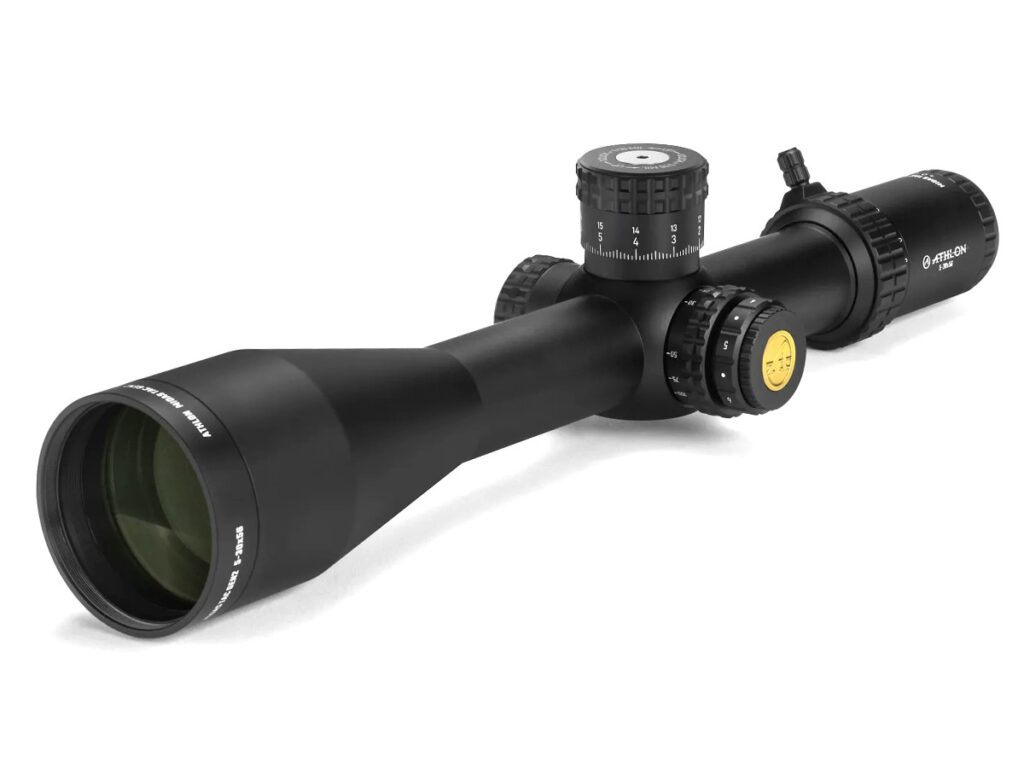
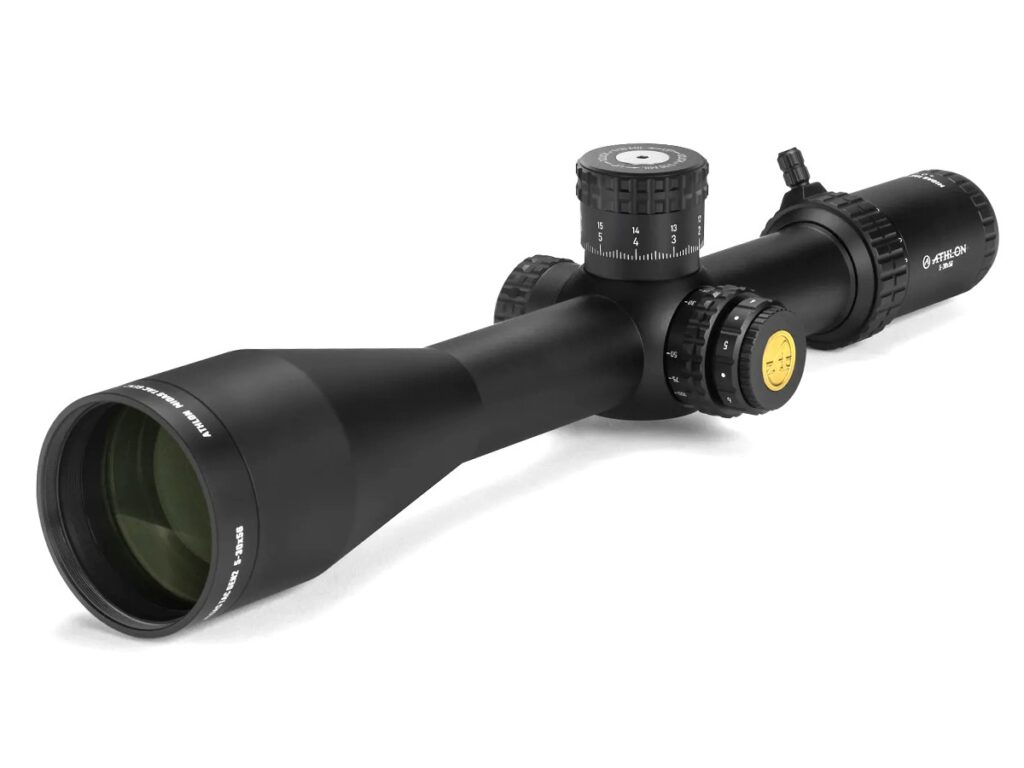
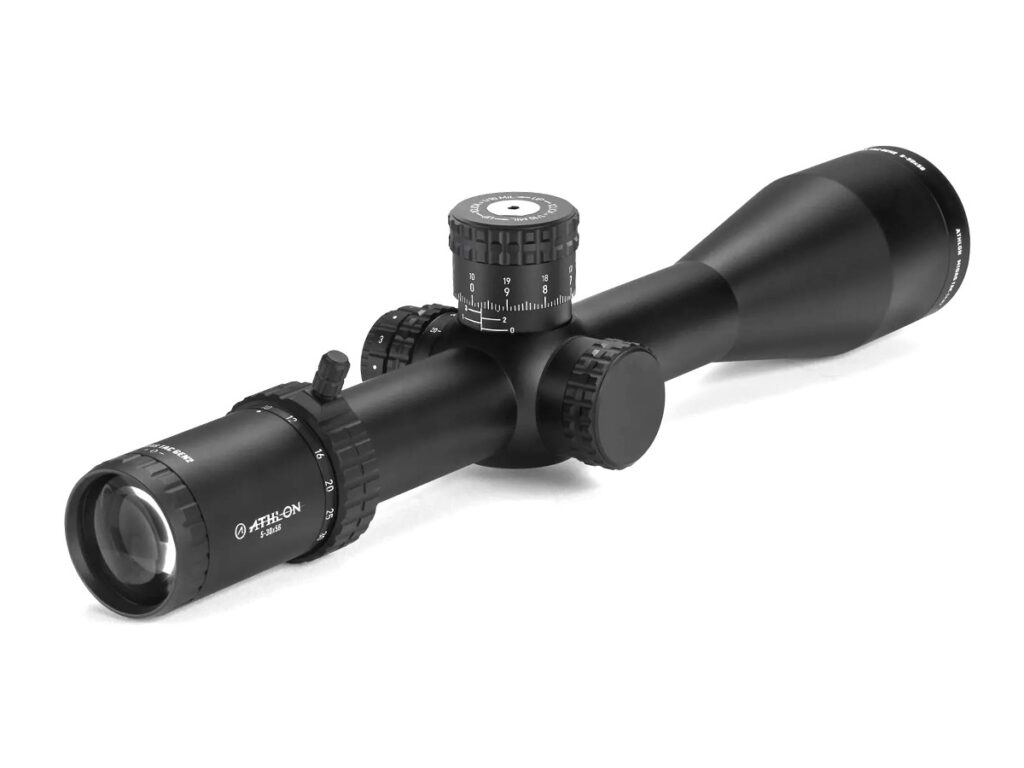
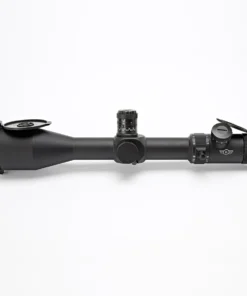
Athlon Optics Midas TAC Gen2 – Premium Precision Riflescope for Long-Range Accuracy and Tactical Performance
Athlon Optics Midas TAC Gen2 – Advanced Optical Clarity, Precision Engineering, and Reliable Performance
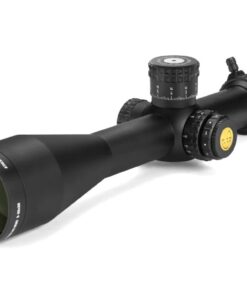
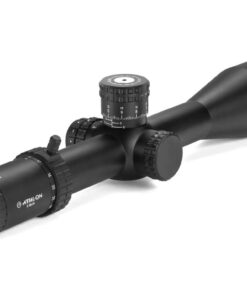
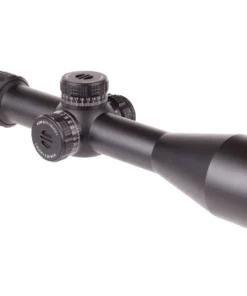
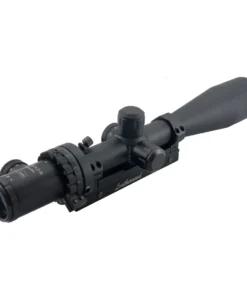
The Athlon Optics Midas TAC Gen2 has been engineered for shooters who demand exceptional optical clarity, dependable adjustment systems, and consistent performance. Designed for precision target shooting, competitive disciplines, and hunting applications, this second-generation riflescope combines advanced optical technology with rugged construction and intuitive controls.
Additionally, enhanced image definition has been delivered through high-definition glass, while excellent light transmission has been supported by advanced fully multi-coated lenses. As a result, targets can be observed with improved sharpness, balanced contrast, and more natural colour reproduction.
Furthermore, the riflescope has been developed to accommodate various shooting environments, including established outdoor ranges, woodland hunting locations, and demanding field conditions. Its first focal plane reticle provides consistent angular measurements across the magnification range, making the optic particularly appealing to shooters who value repeatable observations and precise adjustments.
Unlike conventional entry-level optics, the Athlon Optics Midas TAC Gen2 has been equipped with several advanced features normally associated with more expensive precision riflescopes. Therefore, a compelling combination of performance, durability, and practical value has been achieved.
Key Features and Benefits of the Athlon Optics Midas TAC Gen2
The following features have been incorporated into the Midas TAC Gen2 range to provide a refined optical experience.
- High-Definition HD Glass: Improved image clarity, colour accuracy, and contrast have been prioritised through specialised low-dispersion optical elements.
- First Focal Plane Reticle: Consistent reticle subtensions have been maintained throughout the magnification range.
- Advanced Fully Multi-Coated Lenses: Light transmission has been enhanced, while unwanted reflections have been reduced.
- Precision Zero Stop: A dependable reference point has been provided for returning the elevation turret to its established zero.
- High-Precision Erector System: Reliable internal adjustment performance has been supported through precision engineering.
- Side Parallax Adjustment: Convenient focusing controls have been incorporated to improve target-image clarity and minimise parallax error.
- Aircraft-Grade Aluminium Construction: Structural strength and durability have been prioritised without unnecessary design complexity.
- XPL Protective Lens Coating: Additional protection against dirt, oil, and external contaminants has been provided.
- Argon-Purged Optical System: Internal fogging resistance has been improved through controlled gas purging.
- Waterproof and Shockproof Construction: Dependability has been reinforced for challenging outdoor conditions.
- MIL and MOA Configurations: Different adjustment and reticle preferences have been accommodated across selected models.
- Lifetime Warranty: Long-term ownership confidence has been supported by Athlon’s lifetime warranty.
Superior HD Glass and Advanced Optical Performance
Exceptional Image Clarity Across Different Magnification Settings
Outstanding optical performance has been made a central feature of the Athlon Optics Midas TAC Gen2.
Through carefully selected high-definition glass, chromatic aberration has been reduced, while image sharpness and colour fidelity have been improved. Consequently, finer target details can be distinguished more easily under suitable viewing conditions.
Moreover, advanced fully multi-coated lenses have been applied to improve transmission through the optical system. By reducing undesirable reflections, additional clarity and brightness have been supported, particularly when natural lighting becomes less favourable.
For precision target shooters, clear image definition is particularly important. Target edges, markings, and surrounding details must be identified accurately, especially when high magnification is being used.
Similarly, hunters may benefit from a clearer view of terrain, vegetation, and distant objects during legal daylight or low-light hunting periods.
Advanced Lens Protection for Long-Term Reliability
Durability has also been considered throughout the optical design.
Athlon’s XPL protective coating has been incorporated to help protect exposed lens surfaces against oil, dirt, and environmental contaminants.
As a result, routine cleaning can be simplified, while the optical surfaces receive additional protection during regular outdoor use.
Nevertheless, appropriate lens-care procedures should always be followed to prevent unnecessary damage to the protective coatings.
First Focal Plane Reticle for Consistent Precision
Accurate Reticle Measurements at Every Magnification
The Athlon Optics Midas TAC Gen2 has been developed with a first focal plane, or FFP, reticle system.
With this configuration, the apparent reticle size changes alongside the magnified image. Therefore, its angular subtensions remain consistent throughout the magnification range.
This feature is especially valuable in precision shooting disciplines, where repeatable measurements and accurate visual references are required.
Furthermore, etched-glass reticles have been incorporated for reliable visibility and carefully defined aiming references.
Depending on the selected configuration, MIL-based or MOA-based reticles may be supplied, allowing shooters to select the measurement system they prefer.
MIL and MOA Reticle Options
Different adjustment preferences have been accommodated across the product family.
MIL configurations use milliradian-based measurements, which are commonly preferred in many precision rifle competitions and long-range shooting disciplines.
MOA configurations, meanwhile, use minute-of-angle measurements and may be preferred by shooters already familiar with traditional angular adjustment systems.
Importantly, the exact reticle pattern should be verified against the selected model before purchase, as several configurations have been offered within the range.
Precision Zero Stop and Reliable Turret Adjustments
Consistent Mechanical Performance
A precision zero-stop mechanism has been integrated into the Athlon Optics Midas TAC Gen2 to support repeatable elevation adjustments.
After the riflescope has been correctly zeroed according to the manufacturer’s instructions, a mechanical reference point can be established.
Consequently, returning to the original elevation setting can be made more straightforward, reducing uncertainty during range sessions.
Additionally, exposed elevation turrets have been provided for convenient adjustment access, while capped windage turrets have been used to help protect against unintended changes.
The high-precision erector system has also been engineered to support consistent internal movement and dependable adjustment tracking.
Convenient Side Parallax Control
A side-focus parallax adjustment system has been incorporated into the riflescope.
Through this feature, the relationship between the target image and reticle can be refined at different viewing distances.
As a result, apparent reticle movement caused by changes in eye position can be minimised when the adjustment has been set correctly.
Moreover, the adjustment control can be accessed without significantly altering the normal shooting position.
Rugged Aircraft-Grade Aluminium Construction
Built for Outdoor Shooting Environments
The Athlon Optics Midas TAC Gen2 has been constructed with a one-piece aircraft-grade aluminium tube.
Through this construction, structural integrity has been reinforced, while dependable alignment between optical components has been prioritised.
Furthermore, waterproof and shockproof characteristics have been incorporated to accommodate demanding environmental conditions.
An argon-purged interior has also been provided to reduce the likelihood of internal fogging caused by temperature changes.
Therefore, dependable optical performance can be maintained across a variety of suitable outdoor environments when the riflescope has been correctly installed and maintained.
Practical Design and Comfortable Viewing
Comfort and usability have been addressed through an accessible control arrangement and carefully considered optical geometry.
Depending on the chosen model, eye relief of approximately 3.54 to 3.7 inches has been specified.
Additionally, different tube diameters and magnification ranges have been provided to accommodate varying mounting requirements and shooting preferences.
However, compatible rings and mounting hardware must be selected according to the precise model specifications.
Available Magnification Options and Technical Specifications
Several versions have been introduced within the Athlon Optics Midas TAC Gen2 series, allowing different optical requirements to be accommodated.
| Model |
Objective Lens |
Main Tube |
Reticle Type |
| Midas TAC Gen2 HD 4-16×44 |
44 mm |
30 mm |
FFP MIL |
| Midas TAC Gen2 HD 6-24×50 |
50 mm |
30 mm |
FFP MIL / MOA |
| Midas TAC Gen2 UHD 5-30×56 |
56 mm |
34 mm |
Illuminated FFP MIL / MOA |
Choosing the Right Configuration
The 4-16×44 HD configuration has been developed for shooters who prefer a versatile magnification range and comparatively lighter equipment.
Alternatively, greater magnification has been offered by the 6-24×50 HD, making it an attractive option for precision range shooting and detailed target observation.
For customers seeking a wider magnification range and UHD optical elements, the 5-30×56 UHD configuration has been designed to provide a more advanced feature package.
Notably, illumination is included on the listed 5-30×56 UHD variants, whereas the listed 4-16×44 and 6-24×50 HD versions use non-illuminated reticles.
Ideal Applications and Practical Advantages
Precision Target Shooting and Competition
The Athlon Optics Midas TAC Gen2 has been designed to accommodate precision-oriented shooting activities.
At organised shooting ranges, its clear optical image, FFP reticle, and repeatable adjustment controls can support consistent target observation.
Additionally, the zero-stop feature can simplify adjustment management during structured practice sessions.
Hunting and Outdoor Observation
For lawful hunting activities, versatile magnification and weather-resistant construction have been provided.
Consequently, surrounding terrain and potential targets can be observed more clearly under appropriate conditions.
Furthermore, the robust aluminium housing and protective lens coatings make the riflescope a practical option for repeated outdoor use.
Why Choose the Athlon Optics Midas TAC Gen2?
A strong combination of optical quality, mechanical precision, and practical durability has been achieved throughout this second-generation riflescope range.
Rather than concentrating exclusively on magnification, attention has been directed toward several characteristics that influence everyday usability, including image clarity, reticle consistency, turret repeatability, and environmental resistance.
Moreover, different reticle systems and magnification configurations have been introduced to accommodate individual preferences.
For buyers seeking a capable precision optic without automatically moving into the highest-priced product category, considerable value can be found in the Midas TAC Gen2 lineup.
Order the Athlon Optics Midas TAC Gen2 Today
Upgrade your optical equipment with the Athlon Optics Midas TAC Gen2, a precision riflescope designed around clear viewing, dependable mechanical controls, and durable construction.
Whether a versatile 4-16×44 model, a higher-magnification 6-24×50 configuration, or a feature-rich 5-30×56 UHD version is preferred, an option has been provided for different shooting requirements.
Explore the available Athlon Optics Midas TAC Gen2 configurations today and select the riflescope that best matches your optical requirements, mounting setup, and preferred reticle system.
Athlon Optics Midas TAC Gen2 – Compatible Calibres, FAC Regulations, Power Ratings, Recommended Scope Configurations and Essential Accessories
Compatible Rifle Calibres and Airgun Applications
The Athlon Optics Midas TAC Gen2 has been designed as a precision optical sight suitable for installation on compatible rifles across different shooting disciplines. Although the riflescope does not possess a calibre of its own, its versatile optical system has been developed to accommodate various firearm and air rifle platforms when suitable mounting equipment is used.
Additionally, its high-definition glass, first focal plane reticle, and precision adjustment mechanisms have been incorporated to support accurate target observation and repeatable optical alignment.
Different calibres may be accommodated depending on the rifle’s recoil characteristics, mounting system, and manufacturer’s compatibility recommendations.
Common rifle and airgun calibres include:
- .177 (4.5 mm): Frequently selected for precision air rifle target shooting and recreational range practice.
- .22 (5.5 mm): Widely used in air rifles and rimfire platforms, offering compatibility with various shooting disciplines.
- .25 (6.35 mm): Commonly encountered in higher-energy PCP air rifles designed for appropriate field applications.
- .30 (7.62 mm): Used in selected large-calibre PCP air rifles and other compatible platforms.
- .223 Remington: Associated with various centrefire rifles used in recognised target shooting disciplines.
- .308 Winchester: Commonly encountered in precision rifle competitions and established target shooting environments.
- 6.5 Creedmoor: Frequently selected for sporting and long-range target rifle applications.
Importantly, calibre compatibility must not be confused with guaranteed recoil resistance. Therefore, the exact riflescope model, rifle platform, and mounting equipment should be checked before installation.
FAC and Non-FAC Air Rifle Compatibility
For customers using air rifles, FAC and non-FAC classifications should be understood before choosing an appropriate optical setup.
In England and Wales, air rifles exceeding 12 foot-pounds of muzzle energy generally require a firearm certificate. Meanwhile, air rifles operating at or below the applicable threshold may be held without a firearm certificate, subject to other legal restrictions.
However, different requirements apply in Scotland and other jurisdictions, so local legislation must always be consulted.
The Athlon Optics Midas TAC Gen2 is an optical accessory rather than an air rifle. Consequently, its installation does not independently change a rifle’s FAC classification or muzzle energy.
For non-FAC air rifles, the following benefits may be appreciated:
- Clear target identification during organised range sessions.
- Consistent reticle measurements across available magnification settings.
- Convenient side parallax adjustment.
- Dependable optical alignment when suitable mounts are installed.
- Improved visibility of small target markings under appropriate lighting.
Similarly, FAC-rated air rifles may be paired with compatible Midas TAC Gen2 configurations, provided their recoil and mounting requirements have been satisfied.
Power Ratings, Muzzle Energy and Optical Performance
The Athlon Optics Midas TAC Gen2 does not generate muzzle energy or projectile velocity. Instead, magnification power and optical quality have been provided to assist target observation.
For air rifle users, the following muzzle-energy categories may be encountered:
| Rifle category |
Typical muzzle energy |
| Low-power target air rifles |
Approximately 6–10 joules |
| UK non-FAC air rifles |
Up to 12 ft-lb (approximately 16.3 J) |
| FAC-rated air rifles |
Above 12 ft-lb in England and Wales |
| Higher-energy PCP rifles |
Varies considerably by model and calibre |
These figures describe the rifle, not the scope.
Furthermore, optical magnification should be distinguished from rifle power. A 6-24×50 riflescope, for example, provides adjustable magnification between six and twenty-four times, while its 50 mm objective lens helps collect the light used to form the viewed image.
Therefore, improved viewing detail may be achieved without any alteration to the rifle’s actual mechanical performance.
Recommended Athlon Midas TAC Gen2 Scope Configurations
Athlon Midas TAC Gen2 HD 4-16×44
The 4-16×44 configuration has been designed for shooters seeking flexible magnification and a practical optical setup.
A comparatively broad field of view can be obtained at lower magnification, while greater target detail becomes available at higher settings.
Additionally, its 30 mm main tube and first focal plane reticle make it suitable for compatible precision air rifles and sporting rifles.
This configuration may be preferred for regular target practice, outdoor range activities, and general-purpose precision observation.
Athlon Midas TAC Gen2 HD 6-24×50
Greater magnification has been incorporated into the 6-24×50 HD configuration, making it particularly attractive for target shooters who require detailed observation at established ranges.
Furthermore, a 50 mm objective lens, precision zero-stop mechanism, and adjustable side parallax system have been provided.
Its 30 mm main tube accommodates compatible mounting rings, while its high-definition optical system supports clear target identification.
Athlon Midas TAC Gen2 UHD 5-30×56
For shooters seeking an advanced optical configuration, the 5-30×56 UHD has been developed with a wider magnification range and a larger objective lens.
An illuminated first focal plane reticle has also been included in selected configurations.
Moreover, the 34 mm main tube requires appropriately sized rings, making careful mounting compatibility checks essential.
Recommended Accessories for Athlon Optics Midas TAC Gen2
Essential Mounting and Optical Protection Accessories
Several accessories may be selected to improve convenience, protect the riflescope, and support reliable installation.
Recommended accessories include:
- Precision Scope Rings: Correctly sized 30 mm or 34 mm rings should be selected according to the model.
- Compatible Scope Mount: A stable mounting platform should be matched to the rifle’s rail or receiver.
- Protective Flip-Up Lens Covers: Additional protection against dust and accidental contact may be provided.
- Scope Bubble Level: Rifle cant can be identified more easily during controlled target practice.
- Quality Lens Cleaning Kit: Suitable cleaning materials help preserve optical coatings.
- Riflescope Sunshade: Compatible sunshades may reduce unwanted glare in bright conditions.
- Padded Rifle Case: Additional protection during lawful transportation and storage can be provided.
- Manufacturer-Approved Torque Tools: Correct fastener tension can be achieved according to mounting instructions.
Why Invest in Compatible Accessories?
Reliable riflescope performance depends on more than optical quality alone. Correct installation, suitable mounting hardware, and routine maintenance all contribute to long-term usability.
Consequently, carefully selected accessories can help preserve mechanical alignment and reduce unnecessary wear.
Falcon Scope, Falcon Optics, Element Titan 3-18×50 and Precision Rifle Optics: Complete Buying Guide
Discover Falcon Scope Technology and Modern Precision Optics
Choosing the right falcon scope can transform the viewing experience for target shooters, outdoor enthusiasts, and precision optics users. Modern optical technology combines high-quality glass, adjustable magnification, durable construction, and advanced reticle systems to support clear observation across different distances.
Whether researching falcon optics, falcon optical, falcon vision, or falcon tactical equipment, understanding individual product specifications remains essential. Different optic companies manufacture equipment for competitive target shooting, hunting, observation, thermal imaging, and specialist applications.
The Falcon Optical Systems product range includes competition-oriented riflescopes, while other manufacturers offer digital and thermal solutions. Consequently, buyers should distinguish traditional optical scopes from electronic observation equipment before comparing features.
Falcon Optics and Popular Optical Configurations
Falcon Optical Systems produces riflescopes designed for demanding precision applications. Its competition-oriented products include high-magnification options featuring specialized turret adjustments and optical systems.
Popular search terms include:
- falcon 10×50 and 10 x50 configurations for fixed-magnification optical research.
- falcon xl and falcon sp for model identification and compatibility searches.
- falcon 40 and 30 falcon when researching unidentified Falcon-related equipment.
- falcon claw and falconclaw for accessories or products requiring brand verification.
- tactical falcon and falcon arm when comparing tactical accessories and related equipment.
- falcon receiver when identifying device-specific components.
- falcon scanner and falcon thermal for electronic observation equipment.
Because similarly named products may belong to unrelated manufacturers, confirming the exact model is always recommended.
Understanding Rifle Scope Magnification and Objective Lens Sizes
Comparing 3-18×50, 4.5-18 and High-Magnification Scopes
Optical magnification determines how large a distant subject appears through a scope. For example, 3-18 magnification provides an adjustable viewing range suitable for diverse observation and sporting applications.
Searches for 3×18, 3×18 scope, 3-18 scopes, and 3:18 often relate to variable-magnification optics. Meanwhile, 4.5 x 18, 4.5 18, 4x-18, and 18 scope reflect interest in alternative magnification ranges.
Consumers comparing nightforce 3-18 equipment with the best 3-18 scopes should examine optical clarity, adjustment consistency, weight, eye relief, and warranty coverage.
Similarly, numerical searches such as 18x-4, 60x 3 50x 5, 3/5/25, and 3 5 25 should be checked against manufacturer specifications rather than interpreted automatically as verified optical configurations.
Understanding 50mm and 60mm Objective Lenses
An objective lens collects incoming light and contributes to image brightness and resolution. Common measurements include 50mm and 60mm, although overall image quality depends on glass composition, coatings, magnification, and environmental conditions.
Buyers sometimes search for how big is 50 x 60 or what size is 50 x 60. These measurements require context because 50 x 60 could describe physical dimensions rather than magnification.
Other numerical search variations include 25 x .50, 500 x 50, 500×60, 510 50, 50×0, 36x 50, 1/4×40, .25×50, 800 x 50, 60 x50, .50 x 10, 50x.05, 7.5 x 50, 50x 05, .25 x 50, 50 600, and 1050 x 5.
Furthermore, searches such as 10:50, scope50, and xoi50.com may represent alternative notation, incomplete model references, or unrelated websites. Therefore, these strings should never substitute for documented optical specifications.
Element Titan 3-18×50: Premium Optical Performance
Why the Element Titan 3-18×50 Deserves Attention
The element titan 3-18×50 is a versatile first-focal-plane riflescope designed around a broad magnification range and precision adjustment system.
Also searched as element titan 3 18×50, this model combines a 34mm main tube, 50mm objective lens, illuminated reticle, and adjustable parallax.
Its notable features include:
- 3-18x magnification: Supports flexible viewing across different distances.
- 50mm objective: Provides substantial light-gathering area.
- 34mm main tube: Accommodates a wide internal adjustment range.
- First-focal-plane reticle: Maintains consistent angular subtensions throughout magnification changes.
- Precision turrets: Support repeatable elevation and windage adjustments.
- HD glass: Helps minimize optical distortion and improve image definition.
- Weather-resistant construction: Supports operation in challenging outdoor conditions.
The manufacturer’s published specifications include 150 MOA of elevation adjustment, a mechanical zero-stop, and parallax adjustment beginning at 10 yards.
Consequently, this optic is worth considering when comparing premium variable-magnification scopes. Element Optics official specifications.
Chromatic Aberration and Optical Image Quality
Understanding chromatic aberration scope performance helps buyers evaluate image sharpness. Chromatic aberration appears as unwanted colored fringes around contrasting objects.
High-quality glass and effective lens coatings can reduce these imperfections, improving visual definition.
Likewise, users researching element ll should verify whether the search refers to a specific product generation, model designation, or accessory.
Falcon Thermal Imaging, Red Dot Optics and Electronic Sensors
Advanced Falcon Vision and Thermal Observation
Modern thermal equipment detects infrared radiation rather than depending entirely on visible light.
For users exploring falcon thermal, this distinction is important because thermal imaging and conventional optical magnification serve different purposes.
Some searches also mention elbit falcon and elbit falcon red dot. However, the precise manufacturer and model must be established before making compatibility or performance claims.
Additionally, falcon sensor manual searches generally indicate a need for operating instructions, sensor calibration information, maintenance guidance, or technical support.
Related search terms such as falke optics and optical camp may point toward alternative optic brands or specialist optical applications.
Even accessories marketed under unrelated product categories, including the falconeye patriot convertible bluetooth headset, require independent compatibility checks.
How Far Can a Falcon See?
The question how far can a falcon see can refer either to the bird’s remarkable natural eyesight or the observation distance of an optical device.
For riflescopes, useful viewing distance depends on magnification, atmospheric clarity, objective lens performance, and the size of the observed subject. No universal distance rating applies to every Falcon-branded device.
Rifle Rangefinders and Advanced Distance-Measuring Technology
Choosing a Rifle Rangefinder and Integrated Optics
A rifle rangefinder measures distance using optical or electronic technology. Modern laser devices can provide fast measurements and improve distance awareness in sporting and observation environments.
Common product searches include rifle range finder, laser range finder for rifle, rangefinder scope for rifle, and rangefinding rifle scope.
Additionally, scopes with rangefinders built in combine observation and distance measurement within a single optical platform.
A picatinny mounted rangefinder, sometimes described as a picatinny range finder, uses a compatible rail interface for attachment.
Other configurations include a weapon mounted range finder, while the abbreviation wmlrf commonly refers to a weapon-mounted laser rangefinder.
Electronic Ballistic Calculators and Distance Systems
A weapon mounted ballistic calculator can combine measured distance with programmed ballistic information, depending on its design.
Products associated with arken wmlrf searches include Arken’s weapon-mounted ranging equipment. Its TargetLock TL3000 incorporates laser-ranging and ballistic calculation capabilities. Arken Optics official product information.
Meanwhile, element rf searches may relate to Element Optics rangefinding products. Buyers should confirm the exact model, intended purpose, and accessories before purchasing.
Rifle Scope Mounts, Rings and Precision Accessories
Understanding Picatinny and Dovetail Scope Mounts
Choosing the correct mounting system is essential for secure installation and optical alignment.
A dovetail scope mount connects compatible optics to a dovetail-style rail, while dovetail rings provide alternative mounting arrangements.
Similarly, dovetail scope mounts and 30mm dovetail scope rings must match both the optic tube diameter and rail dimensions.
For Picatinny systems, popular options include picatinny scope mounts, picatinny scope rings, 30mm scope mount picatinny, and 30mm picatinny scope rings.
Buyers should confirm tube size, ring height, rail compatibility, and appropriate installation specifications.
Diving Board Mounts and Scope Accessories
Specialist mounting configurations include a 34mm diving board mount, 34mm scope mount with diving board, diving board scope mount, and 30mm diving board mount.
A scope diving board generally describes an elevated accessory mounting platform integrated with or attached to a compatible optical mounting system.
An element mount may provide a manufacturer-specific mounting solution, while a turret wheel can assist with handling or adjustment on compatible scopes.
Protective Covers for Optical Equipment
Protecting lenses helps preserve optical performance during transportation and storage.
Popular protective accessories include:
- tenebraex scope caps for compatible objective and ocular lenses.
- tenebraex scope covers for additional lens protection.
- allen neoprene scope cover for cushioning and shielding an optic during storage or transport.
Choosing the Right Falcon Scope and Optical Accessories
Selecting an effective optical system requires more than comparing magnification numbers. Glass quality, mechanical reliability, reticle design, mounting compatibility, environmental resistance, and manufacturer support all influence long-term satisfaction.
Whether researching Falcon optics, Element Titan models, advanced rangefinding technology, or protective accessories, prioritize verified product specifications over ambiguous search terminology.
For the best purchasing experience, compare authentic manufacturer documentation, confirm compatibility, and choose equipment suited to your intended sporting or observation application.
Precision Optics Designed for Lasting Value
The Athlon Optics Midas TAC Gen2 combines advanced glass technology, dependable adjustment controls, and robust construction in a versatile optical platform.
Whether paired with a suitable non-FAC air rifle, a legally owned FAC-rated PCP rifle, or a compatible sporting firearm, excellent optical versatility can be achieved through appropriate model selection.
Choose the Athlon Optics Midas TAC Gen2 and complete your setup with compatible mounting rings, protective accessories, and optical maintenance equipment for dependable long-term performance.
Frequently Asked Questions (FAQs)
1. What makes a high-quality precision riflescope different from a standard optical sight?
A high-quality precision riflescope is distinguished by its optical clarity, mechanical reliability, durable construction, and consistent adjustment capabilities. Unlike basic optical sights, premium models are typically manufactured with advanced lens coatings, carefully engineered internal components, and enhanced environmental protection.
Furthermore, improved image definition is provided through specialised glass elements, while unwanted reflections are reduced by advanced coatings. Consequently, clearer target observation can be achieved under suitable lighting conditions.
Additionally, premium adjustment systems are designed to provide repeatable elevation and windage corrections. Greater confidence can therefore be maintained during organised range sessions.
Durability is equally important. By incorporating strong aluminium housings, weather-resistant seals, and protective lens treatments, reliable performance can be supported throughout extended periods of use.
2. What is the advantage of high-definition glass in a riflescope?
High-definition glass has been developed to reduce optical distortion and improve image quality. Through specialised glass elements, chromatic aberration can be minimised, allowing finer details to appear more clearly.
Moreover, improved colour reproduction and contrast are typically achieved, making target edges and surrounding objects easier to distinguish.
Although image quality depends on the complete optical system rather than glass alone, high-quality elements contribute significantly to overall viewing performance.
Therefore, shooters who regularly observe small targets or require detailed image recognition may appreciate the advantages of advanced optical glass.
3. How does a first focal plane reticle work?
A first focal plane reticle is positioned within the optical system so that its apparent size changes alongside the magnified image.
As magnification is increased, the reticle appears larger. Conversely, its apparent size decreases when magnification is reduced.
However, the angular measurements represented by its markings remain consistent throughout the magnification range.
As a result, reticle subtensions can be interpreted without relying on one specific magnification setting.
This configuration is particularly appreciated in precision target shooting, where consistent angular references are considered valuable.
Nevertheless, reticle visibility may differ depending on magnification, lighting conditions, and the specific pattern selected.
4. What is the difference between first focal plane and second focal plane optics?
The primary difference is determined by the position of the reticle within the optical system.
In first focal plane designs, reticle markings maintain their angular relationship to the target as magnification changes.
In contrast, second focal plane reticles appear to remain the same size while the target image is magnified.
Consequently, the angular values represented by a second focal plane reticle are normally accurate at a specified magnification.
Both configurations offer practical advantages.
First focal plane optics are often preferred for consistent angular measurements, whereas second focal plane designs may be appreciated for maintaining an easily visible reticle at lower magnification.
Ultimately, the appropriate choice depends on individual preferences, shooting discipline, and intended application.
5. Why are fully multi-coated lenses important?
Fully multi-coated lenses are designed to improve light transmission and reduce unwanted surface reflections.
Whenever light passes through an uncoated glass surface, some of it may be reflected rather than transmitted.
Therefore, specialised anti-reflective coatings are applied to improve the amount of useful light reaching the viewer.
Furthermore, optical contrast can be enhanced, while internal reflections and glare may be reduced.
These improvements are especially valuable when natural light becomes less favourable.
However, overall brightness is also influenced by magnification, objective diameter, exit pupil, optical design, and environmental conditions.
6. What is a zero-stop mechanism, and why is it useful?
A zero-stop mechanism is a mechanical feature that provides a repeatable reference point for an elevation adjustment turret.
Once the optical sight has been properly configured according to the manufacturer’s instructions, a defined reference position can be established.
Consequently, returning to the original elevation setting becomes more convenient.
This feature is particularly appreciated during structured target shooting activities where adjustment repeatability is important.
Additionally, the likelihood of losing track of the original reference position may be reduced.
Nevertheless, the exact operation of a zero-stop system differs between manufacturers and models. The supplied instructions should therefore be followed carefully.
7. What is parallax adjustment on a riflescope?
Parallax adjustment is provided to reduce apparent movement between the reticle and target image when the viewer’s eye position changes.
This optical effect can occur when the target image is not focused in the same plane as the reticle.
By incorporating an adjustable focusing mechanism, the relationship between these optical elements can be refined.
Furthermore, target-image sharpness may be improved at different viewing distances.
Side-mounted adjustment controls are particularly convenient because they can be accessed without significantly changing the normal viewing position.
However, parallax correction and image focus are related but distinct considerations. Both should be evaluated when assessing optical performance.
8. Can a precision riflescope be used on PCP air rifles?
Yes. Many precision riflescopes can be installed on compatible pre-charged pneumatic air rifles.
However, suitability depends on several factors, including the mounting rail, scope tube diameter, recoil characteristics, and available clearance.
PCP air rifles generally produce different recoil behaviour from traditional spring-piston systems.
Consequently, an optic suitable for one air rifle platform should not automatically be assumed suitable for every other platform.
Furthermore, compatible mounting hardware should be selected according to the manufacturer’s recommendations.
When correctly matched, a precision optical sight can provide clear viewing and consistent reticle references for organised target practice.
9. Are high-magnification riflescopes suitable for low-powered air rifles?
High magnification may be useful on low-powered air rifles, especially when small targets are being observed at established shooting ranges.
However, increased magnification does not increase projectile energy, velocity, or the mechanical capability of the rifle.
Instead, it enlarges the viewed target image.
Additionally, higher magnification often reduces field of view and exit pupil size, making careful eye positioning more important.
Therefore, practical magnification requirements should be considered alongside viewing distance, lighting conditions, and target size.
A versatile magnification range may provide greater flexibility than relying exclusively on the highest available setting.
10. Does a riflescope affect FAC classification or muzzle energy?
No. A conventional optical sight does not determine the firearm certificate classification of a rifle or change its muzzle energy.
In England and Wales, air rifles exceeding 12 foot-pounds of muzzle energy generally fall within firearm certification requirements.
However, licensing arrangements vary by jurisdiction, and different rules apply in Scotland.
The classification of a particular rifle is determined by applicable legislation and its technical characteristics.
Consequently, customers should verify local legal requirements before acquiring or using regulated equipment.
An optical accessory should always be evaluated separately from the licensing obligations associated with the firearm or air rifle itself.
11. What is the difference between MIL and MOA adjustments?
MIL and MOA are angular measurement systems commonly used in precision optics.
A milliradian, usually abbreviated as MIL or MRAD, represents one-thousandth of a radian.
Meanwhile, one minute of angle represents one-sixtieth of a degree.
Both systems allow angular measurements to be expressed consistently.
However, the numerical values and adjustment increments differ.
Neither system is inherently more accurate than the other when properly manufactured and used.
Instead, preference is generally influenced by familiarity, reticle design, competition requirements, and the adjustment conventions already used by the shooter.
For convenience, matching reticle and turret measurement systems are often preferred.
12. What is the benefit of a larger objective lens?
A larger objective lens can collect more light, potentially supporting a larger exit pupil at a given magnification.
As a result, comfortable viewing may be maintained at higher magnification settings under suitable conditions.
However, a larger objective does not automatically guarantee superior image brightness or optical quality.
Lens coatings, glass quality, internal construction, magnification, and environmental lighting also contribute to the final image.
Furthermore, larger objective lenses generally increase overall dimensions and may require higher mounting rings.
Therefore, an appropriate balance between light-gathering capability, optical size, weight, and rifle compatibility should be considered.
13. Why are 30 mm and 34 mm main tubes used?
Different main tube diameters are incorporated to accommodate the internal mechanical design of a riflescope.
A 30 mm tube is widely used in sporting and precision optical equipment.
Meanwhile, a 34 mm tube can provide additional internal space for particular erector systems and adjustment assemblies.
However, a larger tube does not automatically provide greater image brightness.
Brightness is primarily influenced by the optical system, objective lens, magnification, and exit pupil.
Moreover, mounting rings must match the specified tube diameter exactly.
Incorrectly sized mounting hardware should never be used because the scope body or installation stability may be compromised.500x 50

Reviews
There are no reviews yet.