Air Arms S510T Tactical – Precision, Control and Modern PCP Performance
The Air Arms S510T Tactical has been developed for shooters who want the proven precision of the S510 platform combined with a highly adaptable tactical configuration. British engineering has been combined with a regulated PCP system, smooth side-lever action, modular mounting points and adjustable ergonomics. Consequently, excellent control can be maintained whether the rifle is being used for target shooting, competition, field practice or other lawful sporting applications.
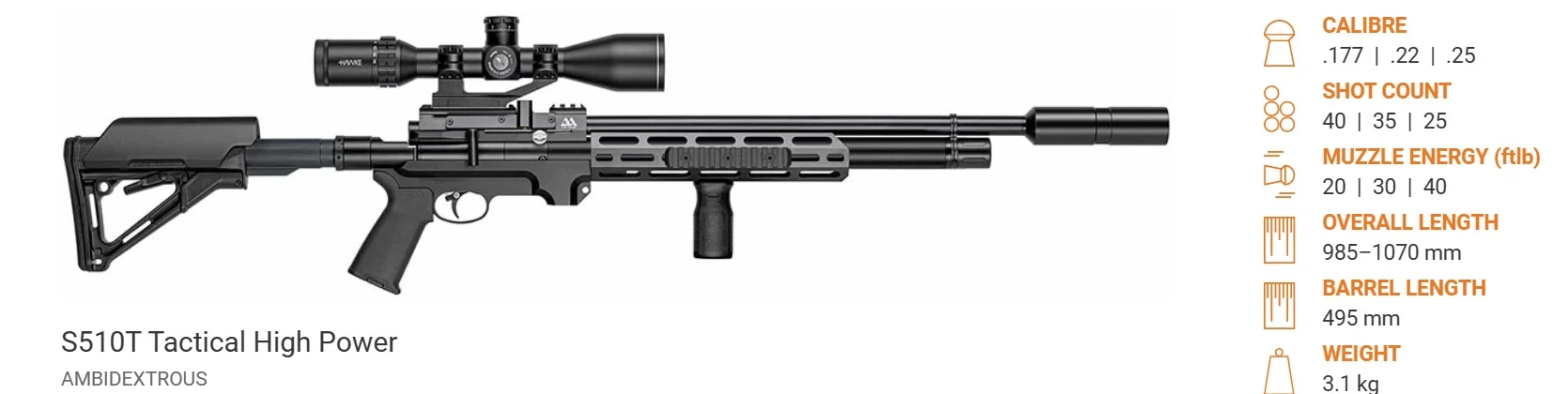
Rather than being treated simply as a visually different S510, the tactical platform has been designed around adaptability. A modern chassis is provided, while M-Lok mounting points and a Picatinny optics rail are incorporated. Therefore, the rifle can be configured around individual shooting preferences without sacrificing the refined operation for which the S510 platform has become known.
Why Choose the Air Arms S510T Tactical?
Consistency has been placed at the centre of the Air Arms S510T Tactical design. An internal regulator is used so that air pressure can be controlled more consistently from shot to shot. As a result, velocity variation can be reduced and predictable performance can be maintained throughout a shooting session.
Furthermore, the established S510 side-lever mechanism has been retained. Smooth cycling is therefore provided without unnecessary disruption to the shooting position. Two 10-shot rotary magazines are supplied by Air Arms, allowing shooting sessions to be continued with fewer interruptions.
At the same time, excellent adaptability has been incorporated into the chassis. M-Lok slots are positioned around the fore-end, while a Picatinny-standard optics rail is provided. Consequently, compatible sporting accessories and optics can be fitted according to the intended setup.
Key Air Arms S510T Tactical Features
- Regulated PCP system for improved shot-to-shot consistency
- Smooth side-lever action for convenient cycling
- Two 10-shot rotary magazines supplied as standard
- Lothar Walther barrel for dependable precision
- Adjustable tactical stock for improved fit and control
- Tactical pistol-grip configuration
- M-Lok accessory mounting system
- Picatinny optics mounting rail
- Carbine-style configuration for manoeuvrable handling
- Ambidextrous tactical design
- .177, .22 and .25 calibre options, depending on power configuration
- Sub-12 ft-lb and higher-power FAC configurations, depending on model and market
- Integrated moderation system
- British-engineered Air Arms construction
Refined Accuracy and Regulated Performance
Precision is expected from a premium PCP rifle, and the Air Arms S510T Tactical has been engineered around repeatability. A Lothar Walther barrel is paired with regulated air delivery so that consistent performance can be maintained across successive shots.
Because pressure is managed by the internal regulator, a more predictable power curve can be produced. Therefore, less attention has to be given to changing cylinder pressure during normal use. Instead, greater concentration can be placed on technique, sight picture and trigger control.
Furthermore, a true two-stage trigger system is incorporated. The trigger arrangement has been designed to provide a clearly defined release, while adjustment is available for experienced users. Any trigger adjustment should, however, be performed according to the manufacturer’s instructions because incorrect adjustment can affect safe operation.
Smooth S510 Side-Lever Operation
One of the defining characteristics of the S510 platform has been preserved in the Tactical model: its smooth side-lever action.
Instead of a conventional bolt arrangement, the side lever is positioned for convenient cycling. As a result, the action can be operated with relatively little disturbance to the shooting position. Moreover, the 10-shot rotary magazine system allows successive pellets to be indexed efficiently.
Two magazines are supplied by the manufacturer. Therefore, extended range sessions can be managed conveniently while the familiar S510 operating system is retained.
Tactical Ergonomics Designed Around the Shooter
Comfort can influence consistency, particularly during longer shooting sessions. For that reason, adjustability has been built into the Air Arms S510T Tactical platform.
A CTR-style adjustable stock is fitted, allowing length of pull to be adapted to the shooter and shooting position. Meanwhile, the tactical grip arrangement provides a stable interface between the shooter and rifle.
Because the configuration is ambidextrous, the platform can also accommodate a broad range of users. Consequently, whether shooting from a bench, prone position or supported stance, the rifle can be configured for improved comfort and repeatability.
M-Lok and Picatinny Accessory Compatibility
Versatility is further increased through the mounting architecture.
M-Lok slots are incorporated into the fore-end, while the optics interface follows the Picatinny standard. Therefore, compatible accessories can be positioned according to individual requirements.
For example, a suitable bipod, sling attachment or other lawful sporting accessory can be integrated without turning the rifle into a permanently fixed configuration. Likewise, compatible optics can be mounted through the Picatinny system.
This modular approach means the rifle can be adapted as shooting disciplines and preferences change.
Air Arms S510T Tactical Calibre Options
Different calibre choices are provided according to the specific model and power level.
The .177 calibre is offered for shooters who value a relatively flat trajectory and precision-oriented performance. Meanwhile, .22 calibre provides a versatile balance between projectile weight and trajectory. For appropriate higher-power configurations, .25 calibre is also available.
According to Air Arms, the sub-12 ft-lb S510 Tactical Carbine is offered in .177 and .22, while FAC configurations are offered in .177, .22 and .25. Local laws, licensing requirements and power restrictions should always be checked before purchase or use.
Efficient PCP Shot Capacity
Air efficiency is another important advantage of the regulated platform.
For current sub-12 ft-lb configurations, Air Arms states that approximately up to 100 shots in .177 and up to 90 shots in .22 can be achieved. FAC versions have different expected shot counts depending on calibre and configuration.
Actual performance can vary according to factors such as pellet choice, temperature and regulator efficiency. Nevertheless, the regulated air system has been designed so that useful consistency and efficiency can be maintained throughout the fill.
Air Arms S510T Tactical Calibres, FAC Power and Accessories
The Air Arms S510T Tactical has been designed around versatility, allowing different calibre and power configurations to be selected according to the shooter’s intended sporting use and applicable local regulations. In addition, its tactical chassis provides extensive accessory compatibility, making the rifle adaptable for target shooting, range practice and other lawful air-rifle disciplines.
Available Air Arms S510T Tactical Calibres
Calibre selection can have a significant influence on trajectory, pellet choice and overall shooting characteristics. Consequently, the correct configuration should be selected according to the intended application rather than appearance alone.
For standard UK sub-12 ft-lb configurations, the Air Arms S510T Tactical is offered in .177 and .22 calibre. Meanwhile, higher-powered FAC configurations may also be available in .25 calibre, depending on the market.
.177 calibre is frequently selected when a relatively flat trajectory and precision-focused shooting characteristics are preferred. Because .177 pellets are generally lighter, useful velocity can be achieved while remaining within the rifle’s applicable power specification.
Alternatively, .22 calibre provides a popular balance between pellet weight, efficiency and trajectory. It can therefore be selected by shooters who prefer a heavier projectile while retaining the refined characteristics of the regulated S510 platform.
For suitable FAC configurations, .25 calibre provides another option. Heavier pellets can be used in this configuration, although the rifle’s exact specification and legal requirements should always be verified before purchase.
Air Arms S510T Tactical FAC Models
The term FAC is commonly used in the UK for air rifles producing power above the statutory non-FAC limit. Therefore, an FAC-rated S510T Tactical should not be confused with the standard sub-12 ft-lb version.
Higher-powered configurations are manufactured for markets and users where the appropriate licensing or legal conditions have been satisfied. Depending on the specific version, FAC models can be offered in .177, .22 and .25 calibre.
Because power regulations vary substantially between countries and sometimes between regions, an FAC configuration should always be selected according to the laws applicable at the rifle’s destination and place of use.
Furthermore, factory specifications should be checked for the exact rifle being purchased. Power levels should not be assumed solely from calibre because different factory configurations may be supplied for different markets.
Regulated PCP Power Delivery
Consistent power delivery is one of the principal advantages provided by the Air Arms S510T Tactical.
Compressed air is stored within the rifle’s air cylinder. However, rather than allowing changing cylinder pressure to directly influence every shot, an internal regulator is used to manage the pressure delivered to the firing system.
As a result, more consistent shot-to-shot performance can be produced throughout the usable portion of the fill.
For UK users, standard non-FAC versions are configured to remain within the applicable legal power limit. FAC versions, by comparison, are configured for higher output and are subject to the relevant licensing requirements.
No attempt should be made to modify a standard rifle beyond its lawful specification. Manufacturer-approved configurations and qualified servicing should always be used.
Accessory Compatibility
A major advantage of the Air Arms S510T Tactical is provided by its modular tactical chassis. Unlike a traditional sporting stock, mounting interfaces have been incorporated so that compatible equipment can be fitted without compromising the rifle’s basic ergonomics.
Picatinny Optics Mounting
A Picatinny rail is incorporated for mounting compatible optics. Consequently, shooters are provided with a widely supported mounting standard when selecting an appropriate riflescope or other lawful sighting system.
The selected optic should be matched to the intended shooting discipline, while suitable rings or mounts should be used to maintain secure alignment.
M-Lok Accessory Mounting
M-Lok mounting points are incorporated into the tactical fore-end. Therefore, compatible accessories can be positioned according to individual preferences.
Potential sporting accessories can include:
- Compatible riflescope and mounting system
- M-Lok bipod or bipod adapter
- Sling and sling mounting hardware
- Shooting rest accessories
- Additional Air Arms magazines
- Pellet storage equipment
- Protective rifle case
- Approved PCP filling equipment
- Cleaning and maintenance equipment
- Manufacturer-compatible replacement components
The modular layout means unnecessary accessories do not have to be permanently attached. Instead, equipment can be selected around the intended shooting environment.
Magazines and Shooting Accessories
The S510T Tactical uses the established Air Arms 10-shot rotary magazine system, with two magazines supplied with the rifle according to the manufacturer’s current specification. Additional compatible magazines can therefore be useful for shooters who regularly spend extended periods at the range.
Properly fitting pellets should always be selected according to calibre and manufacturer recommendations. Likewise, different pellet designs may produce different results, so accuracy should be evaluated safely with the specific rifle rather than assuming that one pellet will perform identically in every barrel.
PCP Filling and Maintenance Equipment
Because the Air Arms S510T Tactical is a pre-charged pneumatic rifle, an appropriate source of clean, dry, high-pressure air is required.
Compatible filling equipment should always meet the manufacturer’s pressure specifications. The rifle’s manual should be consulted before filling, servicing or replacing pressure-related components.
Regular maintenance should also be kept straightforward. Suitable cleaning products, approved lubricants and protective storage equipment can help preserve the rifle, while internal high-pressure servicing should be left to appropriately qualified technicians.
Choosing the Right S510T Tactical Configuration
Ultimately, the ideal Air Arms S510T Tactical configuration will depend on calibre preference, local power restrictions and intended sporting use.
A .177 or .22 sub-12 ft-lb model can be selected where the UK non-FAC configuration is appropriate. Meanwhile, FAC versions in .177, .22 or .25 may be considered where higher-powered air rifles are legally permitted and the required authorisation has been obtained.
Combined with its regulated PCP system, adjustable tactical stock, Picatinny optics rail and M-Lok accessory interface, the platform provides considerable flexibility. As a result, the rifle can be configured around the shooter while its fundamental S510 precision and smooth operating characteristics are retained.
Important: calibre availability, FAC specifications, muzzle energy and supplied accessories can vary by country and individual model. Current manufacturer specifications and applicable local laws should therefore be confirmed before purchase.
A Versatile Premium PCP Platform
Ultimately, the Air Arms S510T Tactical combines traditional S510 engineering with a distinctly modern, modular format. Accuracy has been supported by the Lothar Walther barrel, consistency has been enhanced through regulation, and operation has been streamlined through the proven side-lever system.
Meanwhile, greater personalisation has been made possible through the adjustable stock, tactical grip, M-Lok fore-end and Picatinny optics rail. Therefore, the rifle can be configured around different shooters and sporting disciplines rather than forcing every user into the same fixed setup.
For buyers seeking a premium regulated PCP with British engineering, smooth operation, adaptable ergonomics and modern tactical styling, the Air Arms S510T Tactical provides a sophisticated evolution of the established S510 platform.
Please note: optics shown in manufacturer imagery are illustrative and are not included unless specifically stated by the seller. Availability, calibre, power output and licensing requirements can also vary by market. Always comply with applicable local airgun laws and safe-handling requirements.
Air Rifles, PCP Systems, Calibers, Target Shooting and Popular Models
The world of air arms, air guns, and precision shooting equipment covers everything from recreational target shooting to sporting applications. For newcomers asking what is an air gun, what is an air rifle, what is air rifle, what is a air rifle, what is a airgun, what is an airgun, or what are airguns, the basic principle is straightforward. An air gun uses compressed gas or air to propel a projectile rather than relying on the combustion system associated with conventional firearms.
Understanding how does an air gun work, how does air gun work, how do air guns work, how does an air rifle work, how does air rifle work, and how do air rifle work can help buyers distinguish between the different operating systems available. Depending on the design, power can be supplied by a spring piston, compressed air cylinder, CO2 cartridge, or another pneumatic mechanism.
PCP Air Rifles and Compressed-Air Systems
One of the most popular categories is the pre-charged pneumatic platform. Searches such as what is a pcp air rifle, what is a pcp airgun, what is pcp air rifle, what is a pcp air gun, what is a pcp rifle, what is pcp rifle, what are pcp air rifles, and what is a pre charged pneumatic air rifle all relate to the same fundamental technology. A PCP rifle stores compressed air inside a reservoir and releases a controlled quantity each time the rifle is fired.
For shoppers researching pcp gun meaning, pcp rifle meaning, or pcp air rifle meaning, PCP simply refers to a pre-charged pneumatic system. Air is normally added using a pcp hand pump, dive cylinder, or pcp air compressor. Consequently, an air compressed gun or air compressor rifle can deliver consistent performance without requiring the shooter to manually compress a spring before every shot.
Some searches also include pcp bb gun, although many PCP platforms are primarily designed around pellets rather than traditional BB ammunition. Understanding the intended ammunition is therefore important before selecting accessories, magazines, or loading equipment.
.177 Caliber, .22 Caliber and Pellet Selection
Caliber choice is one of the most frequently researched subjects among airgun buyers. The .177 caliber remains extremely popular for recreational shooting and precision target applications. Products described as a 177 air rifle, 177 bullet, or even 177 cal darts may appear during searches, although ammunition compatibility always needs to be checked against the manufacturer’s specifications.
Questions including 177 or 22, 177 cal vs 22, 177 caliber vs 22, .177 caliber vs .22, .177 pellet vs .22 pellet, and .22 vs .177 pellet generally focus on differences in projectile size, trajectory, energy, and intended use. A smaller .177 pellet is commonly chosen for paper targets and precision shooting, whereas larger calibers may be selected for applications where additional projectile mass is desired.
Understanding bb gun pellet sizes is equally important because BBs and pellets are not automatically interchangeable. Before purchasing ammunition, shooters should confirm the caliber and projectile type specified for their particular pellet rifle, pellet pistol, or bb gun.
Air Arms Rifles and Popular Models
Among established manufacturers, air arms products remain widely searched by enthusiasts interested in precision PCP and spring-powered platforms. Well-known searches include air arms s510, s510, air arms s410, aa s400, pro sport air arms, prosport air arms, tx 200, and tx200.
Variations such as air arm and airarm are also commonly entered by shoppers searching for the brand. Buyers looking specifically for regulated sporting configurations may encounter the air arms s510 ultimate sporter .177 sub 12, a phrase frequently associated with UK-oriented searches for the S510 platform.
Each Air Arms model has its own action, stock design, power configuration, caliber options, and intended shooting environment. Therefore, specifications should always be checked against the exact version being considered rather than assumed from another model in the same family.
FX Impact M3, FX Maverick and Modern PCP Platforms
Premium PCP research frequently includes the fx maverick and the fx impact m3. Buyers may also search for fx impact mk3, fx m3 airgun, fx m3, impact m3, or fx impact m3 air rifle while comparing generations and configurations.
More specific searches such as fx impact m3 .22cal air rifle. 600mm barrel focus on caliber and barrel-length combinations. Meanwhile, international shoppers may search fx impact m3 precio, fx impact m3 precio en usa, or fx impact m3 price when researching current market pricing.
Because FX platforms can be produced in multiple barrel lengths, calibers, power settings, and regional configurations, buyers should verify the exact specification offered in their country before ordering.
Break-Barrel Air Rifles
Another major category is the break barrel air rifle. Anyone asking what is a break barrel air rifle or what is a break barrel pellet gun is usually referring to a rifle in which the barrel is hinged downward to cock the internal powerplant and expose the breech for loading.
Break-barrel designs remain popular because they can provide a self-contained shooting system without an external compressor or air bottle. Models such as a gamo pellet gun are frequently encountered by buyers exploring this category.
Learning how to load pellet gun equipment properly is particularly important. Pellets should match the manufacturer’s recommended caliber and should be loaded in accordance with the owner’s manual while the rifle is pointed in a safe direction and handled under normal shooting-range safety procedures.
CO2, Pellet Pistols and Other Airgun Types
Not every airgun uses PCP or spring power. A co2 powered pellet rifle, for example, uses replaceable CO2 cartridges as its propellant source. CO2 systems can be found in rifles and handguns intended for recreational shooting, training, and target use.
People researching air pistol uses or general pellet gun uses will encounter equipment intended for target practice, recreational plinking, skills training, competition, and other lawful sporting activities. A pellet pistol can offer a compact platform, while rifles generally provide a longer sight radius and additional stability.
Search terms such as pelet guns are also common misspellings of pellet guns and can still represent useful search intent when website content is designed to answer frequently asked buyer questions naturally.
Target Shooting and Airgun Practice
One of the most established uses of airguns is target shooting with air rifles. Dedicated air guns for target shooting may emphasize accuracy, adjustable stocks, match triggers, regulated air delivery, and compatibility with precision optics.
Likewise, airgun target practice and airgun for target practice are common search topics among people looking for an accessible way to develop shooting fundamentals. Proper backstops, eye protection, safe handling practices, and suitable ranges should always be used.
The practical range of air rifle equipment varies considerably according to caliber, muzzle energy, projectile selection, environmental conditions, and the rifle itself. As a result, buyers should use manufacturer specifications and local range rules rather than assuming that every air rifle performs identically.
Hunting Air Rifles and Appropriate Use
Some shooters research air rifles for hunting, hunting air rifles, best air rifle for hunting, pellet gun for rabbits, or even the informal phrase rats gun when looking for equipment designed for lawful pest-control or hunting applications.
Suitability depends heavily on local law, caliber, projectile energy, quarry species, shot placement requirements, and humane hunting standards. Questions such as can a bb gun kill a fox should therefore not be treated simply as equipment-selection questions. Legal restrictions and animal-welfare requirements should be checked first, and low-powered BB guns are not appropriate substitutes for equipment legally and ethically suitable for a particular species.
Similarly, searches for air rifles for deer hunting and big game hunting with air rifle involve specialized legal and ballistic requirements. Large-bore systems such as a 72 caliber air rifle or products associated with bluegrass big bore illustrate how different big-bore pneumatic platforms can be from conventional small-caliber pellet rifles. Local hunting regulations must determine whether such equipment may legally be used.
Frequently Asked Questions
What type of air rifle is this?
This model is a pre-charged pneumatic (PCP) air rifle built around a regulated air system and a modern tactical chassis. Compressed air is stored within the rifle and used to propel each pellet. Because the system is regulated, consistent air delivery is maintained across the usable portion of the fill. Consequently, predictable shot-to-shot performance can be achieved while the smooth operation associated with the S510 platform is retained.
Which calibres are available?
Calibre availability depends on the power configuration and market in which the rifle is supplied. Standard UK sub-12 ft-lb versions are commonly offered in .177 and .22 calibre, while higher-powered FAC configurations may additionally be available in .25 calibre.
Because each calibre produces different ballistic characteristics, the intended shooting discipline should be considered before a version is selected. Local regulations should also be checked because calibre and power availability can vary considerably between jurisdictions.
What is the difference between .177 and .22?
The primary difference is pellet diameter and the range of projectile weights normally associated with each calibre.
A .177 pellet is smaller and generally lighter. Consequently, it is commonly selected for precision-oriented target shooting and applications where a relatively flat trajectory is desirable.
A .22 pellet is larger and normally heavier. Different trajectory characteristics are therefore produced, while a broad selection of pellet designs remains available.
Neither calibre should automatically be regarded as superior. Instead, the appropriate option should be chosen according to the intended lawful sporting application, local power regulations and individual shooting preferences.
Is a .25 calibre version available?
A .25 calibre configuration may be available in higher-powered versions intended for markets where such specifications are permitted. However, it should not be assumed that every retailer or jurisdiction offers this configuration.
Before ordering, the exact calibre, factory power specification and licensing requirements should therefore be confirmed.
What does FAC mean?
Within the UK, FAC refers to a Firearm Certificate. An air rifle exceeding the statutory non-FAC muzzle-energy threshold is subject to firearm-certificate requirements.
Consequently, standard sub-12 ft-lb and FAC versions represent different legal and technical configurations. Higher-powered models should only be purchased and possessed where the required authorisation has been obtained.
Outside the UK, different terminology and power restrictions may apply. Local regulations should always be checked rather than assuming that UK classifications apply internationally.

Is the rifle regulated?
Yes. A regulator is incorporated into the PCP system.
Instead of allowing declining cylinder pressure to directly determine every shot, regulated air delivery is used to provide a more consistent operating pressure. As a result, velocity consistency can be improved throughout the useful portion of the air charge.
This characteristic is particularly valuable during precision shooting because predictable performance helps the shooter concentrate on sight alignment, trigger control and technique.
How many shots can be expected from one fill?
Shot count depends on calibre, power configuration, environmental conditions and the individual rifle.
Air Arms indicates that current UK sub-12 ft-lb configurations can provide approximately up to 100 shots in .177 and up to 90 shots in .22. Higher-powered FAC versions generally have different shot counts because more compressed air can be consumed with each shot.
These figures should be regarded as manufacturer specifications rather than guarantees for every shooting situation.
What type of magazine is used?
A 10-shot rotary magazine system is used. The magazine allows multiple pellets to be loaded before shooting begins, after which the side-lever action is used to cycle the mechanism between shots.
According to the current manufacturer specification, two magazines are supplied with the rifle. Additional compatible magazines may also be purchased where available, which can be convenient during extended range sessions.
How does the side-lever action work?
A side-lever mechanism is used instead of a conventional bolt arrangement.
The system has been designed to provide smooth and convenient cycling while reducing unnecessary disturbance to the shooting position. Once the rifle has been operated according to the manufacturer’s instructions, the magazine indexes the next pellet for the subsequent shot.
The mechanism is one of the established characteristics of the S510 platform and contributes to its refined operating feel.
What barrel is fitted?
A Lothar Walther barrel is incorporated into the platform. Lothar Walther barrels have been widely used within precision air-rifle manufacturing, and the barrel is an important component of the rifle’s overall accuracy system.
However, practical accuracy is influenced by more than the barrel alone. Pellet selection, optics, shooting technique, environmental conditions and equipment setup can all influence results.
Does it come with a scope?
A scope should not be assumed to be included unless it is specifically identified as part of the retailer’s package.
Manufacturer photographs may show the rifle with optics for illustrative purposes. Therefore, the product listing should always be checked carefully to establish exactly what is supplied.
When optics are purchased separately, compatible mounts should also be selected.
What type of scope mounting system is provided?
A Picatinny optics rail is incorporated into the tactical configuration.
Because Picatinny is a widely supported mounting standard, numerous compatible optic-mounting solutions are available. Nevertheless, ring diameter, optic dimensions, eye relief and mounting height should be considered when choosing a setup.
Correct installation should also be maintained so that the optic remains secure and properly aligned.
Does it support M-Lok accessories?
Yes. M-Lok mounting interfaces are incorporated into the fore-end.
Consequently, compatible sporting accessories can be attached without requiring a traditional fixed accessory arrangement. Depending on the intended range setup, suitable bipod adapters, sling attachment points and other compatible equipment can be considered.
Only accessories appropriate for the rifle and lawful in the relevant jurisdiction should be installed.
Can a bipod be fitted?
Yes, an appropriate bipod can be fitted by using compatible mounting hardware.
The exact adapter required will depend on the bipod design. Because M-Lok interfaces are provided, an appropriate M-Lok-compatible mounting solution can usually be selected.
A correctly positioned bipod can provide a stable supported shooting platform, particularly during bench and prone target shooting.
Is the stock adjustable?
An adjustable tactical stock is incorporated into the design. Consequently, the rifle can be adapted to accommodate different body dimensions, clothing and shooting positions.
Correct stock adjustment can contribute significantly to repeatability. When length of pull and head position are comfortable, a more consistent relationship between the shooter, trigger and optic can be maintained.
Is the rifle suitable for left-handed shooters?
The tactical platform has been designed with ambidextrous usability in mind. Therefore, both left- and right-handed shooters can potentially achieve a comfortable setup.
Individual preferences still vary, so anyone with specific ergonomic requirements should examine the controls and stock arrangement before purchase where possible.
What trigger system is fitted?
A two-stage adjustable trigger is provided.
A two-stage system allows initial trigger movement to be separated from the final release point, providing a more defined feel during precision shooting. Adjustment should always remain within manufacturer specifications.
Trigger components are safety-critical parts. Consequently, inappropriate modification should be avoided, and professional servicing should be used whenever uncertainty exists.
What is required to fill the rifle?
As a PCP system, the rifle requires a suitable source of clean, dry, high-pressure compressed air.
Approved filling equipment should be used according to the manufacturer’s instructions. Depending on the owner’s setup and applicable specifications, an appropriate charging system can be selected.
The stated maximum filling pressure must never be exceeded, and pressure-related components should be inspected and maintained correctly.
Is a manual pump suitable?
A compatible high-pressure PCP hand pump may be usable where it meets the required specifications. However, filling effort and convenience should be considered.
Regardless of the filling method selected, clean and dry air is important because moisture contamination can adversely affect high-pressure pneumatic equipment.
Manufacturer guidance should therefore be followed whenever filling equipment is selected.
Is it suitable for target shooting?
Yes. Precision target and recreational range shooting are among the applications for which a regulated PCP platform can be particularly well suited.
The combination of regulated air delivery, a quality barrel, adjustable ergonomics and a two-stage trigger supports repeatable shooting. Furthermore, compatible optics and supporting equipment can be selected according to the specific target discipline.
Is it suitable for beginners?
It may be suitable for a responsible new PCP shooter who has received appropriate instruction and understands safe air-rifle handling. However, it is a premium, adjustable platform, so some features may be more sophisticated than those found on basic entry-level rifles.
New owners should become familiar with PCP filling procedures, pressure limits, magazine operation, safe storage and applicable laws before use.
Does pellet choice affect accuracy?
Yes. Different pellet weights, shapes and manufacturing tolerances can produce different results from the same barrel.
Therefore, accuracy should be evaluated using appropriate quality pellets of the correct calibre. Once a pellet that performs consistently has been identified, using the same type can help maintain predictable results.
Only ammunition specifically intended and suitable for the rifle should be used.
How should the rifle be maintained?
Routine care should include keeping external surfaces clean, protecting the rifle from excessive moisture and storing it securely in appropriate environmental conditions.
The manufacturer’s recommended maintenance intervals should be followed. Furthermore, only suitable products should be applied to seals and other components.
Because a PCP rifle contains high-pressure components, internal servicing should not be improvised. Qualified technicians or authorised service facilities should be used when pressure-system maintenance or significant repairs are required.
Can the power be modified?
The rifle should be maintained in its lawful factory configuration unless changes are specifically permitted, professionally performed and compliant with applicable regulations.
Power limits can have significant legal implications. A seemingly small modification could potentially change the legal classification of an air rifle in some jurisdictions.
For that reason, manufacturer-approved servicing and local legal requirements should always take priority over aftermarket power modification.
What accessories are useful for the complete setup?
A suitable optic and compatible mounting hardware will often form the starting point for a range-oriented configuration. Depending on individual requirements, a bipod, sling, additional magazines, secure rifle case, appropriate PCP filling equipment and maintenance products may also be considered.
Accessories should be selected for practical value rather than simply being added because mounting space is available. A carefully configured rifle can remain balanced, comfortable and easier to handle.
Why is this platform different from a traditional sporting PCP?
The principal distinction is its combination of established S510 engineering with a modular tactical chassis.
Traditional sporting rifles frequently use conventional wood or synthetic stocks with comparatively limited accessory mounting options. By contrast, this platform incorporates an adjustable tactical stock, pistol-grip arrangement, Picatinny optics mounting and M-Lok interfaces.
Consequently, greater flexibility is provided while the regulated PCP operating system, smooth side-lever mechanism and precision-oriented characteristics of the S510 family are retained.
What should be checked before ordering?
The exact calibre, factory power specification, included accessories and legal classification should be confirmed before an order is placed.
Local ownership, licensing, transportation and storage regulations should also be reviewed because airgun laws vary significantly between countries and regions.
Finally, the retailer’s package contents should be checked carefully. Optics and accessories shown in promotional photographs are not necessarily included. By confirming these details beforehand, the correct factory configuration and accessory package can be selected for the intended lawful sporting use.
Licensing and UK Airgun Regulations
Legal requirements differ considerably by jurisdiction. UK-oriented searches frequently include do you need a licence for air rifle, air rifle certificate uk, and 22 rifle uk license. However, the rules governing air rifles, conventional .22 firearms, certificates, age restrictions, possession, transportation, and power limits are not identical.
Consequently, buyers should confirm current legislation with the relevant licensing authority before purchasing or using any regulated equipment. Particular attention should also be paid to whether a rifle is configured below or above applicable power thresholds.
Sportsman, Gamo and Other Popular Searches
Beyond specialist PCP manufacturers, buyers may encounter products such as the sportsman 900 while comparing recreational air rifles. Searches for a gamo pellet gun are also common because Gamo offers numerous spring-powered and pneumatic models across different price points and configurations.
The broader search for best air guns can include everything from affordable recreational platforms to sophisticated regulated PCP rifles. Rather than treating one design as universally superior, buyers should compare caliber, intended application, weight, stock ergonomics, power source, shot capacity, charging equipment, availability of spare parts, and local legal requirements.
Airgun Safety, Home Use and Responsible Ownership
Searches for air guns for home defense do appear online, but an airgun should not automatically be assumed to be suitable for defensive use. Laws vary significantly, and airguns can cause serious injury. Secure storage, lawful ownership, training, safe handling, and avoidance of unnecessary confrontation remain essential.
Whether someone owns an air rifle, pellet rifle, bb gun, or PCP platform, the equipment should always be treated as capable of causing injury. A secure backstop should be used for recreational shooting, the muzzle should remain pointed in a safe direction, and manufacturer instructions should be followed carefully.
Ultimately, understanding the differences between PCP rifles, break-barrel systems, CO2 equipment, caliber choices, and individual models makes it easier to compare the extensive range of modern airguns. From Air Arms platforms to FX rifles and recreational pellet guns, careful specification checking, responsible handling, lawful use, and suitable ammunition selection remain central to getting the right equipment for the intended purpose.
Practical Use Scenarios
The combination of a regulated PCP system, adjustable tactical chassis, smooth side-lever action and modular accessory mounting makes this rifle suitable for several lawful sporting environments. Rather than being restricted to one style of shooting, the platform can be configured around different positions, distances and range conditions. Consequently, shooters can adapt their setup while retaining familiar controls and consistent handling.
Precision Target Shooting at the Range
A controlled target range represents one of the most natural environments for this platform. When repeatable accuracy is required, consistent air delivery becomes particularly valuable because unnecessary variation between shots can be reduced.
From a supported bench position, the adjustable stock can be configured to provide a comfortable length of pull. Meanwhile, an appropriately mounted scope can be positioned to establish natural eye relief and a repeatable sight picture.
Because the rifle uses a regulated pneumatic system, attention can remain focused on breathing, trigger control and shooting technique. Furthermore, the two-stage trigger provides a defined release that can complement precision-oriented range shooting when correctly adjusted within manufacturer specifications.
For shooters working through groups on paper targets, the multi-shot magazine also reduces interruptions. The side lever can be operated between shots, while a consistent position can largely be maintained.
Benchrest Shooting
Benchrest practice places considerable emphasis on stability and repeatability. Therefore, the tactical fore-end and accessory mounting system can be particularly useful in this environment.
A compatible bipod or suitable front support can be incorporated where permitted. Once the rifle has been supported correctly, unnecessary movement can be reduced while groups are evaluated.
This type of setup can also be useful when comparing different pellets. Several suitable pellet types can be tested under controlled conditions, allowing group consistency to be evaluated rather than relying purely on advertised specifications.
Because individual barrels can show preferences for particular pellet designs and weights, controlled bench testing provides a practical way to identify a suitable combination.
Recreational Range Sessions
Not every shooting session needs to be competition focused. For recreational range use, convenient handling and straightforward operation can be equally important.
The side-lever action allows the mechanism to be cycled smoothly, while the rotary magazine provides multiple shots before reloading is required. Consequently, less time can be spent repeatedly handling individual pellets during an ordinary range session.
Additional compatible magazines may also be carried where appropriate. However, every magazine should be loaded and handled according to the manufacturer’s safety instructions.
The adjustable stock is another useful feature when the rifle is shared between authorised shooters at a supervised range. Different users can require different lengths of pull, and the stock can be repositioned accordingly.
Prone Shooting Practice
When shooting from a prone position, rifle fit can have a significant influence on comfort and consistency. The adjustable tactical configuration allows the stock position to be adapted so that excessive stretching or compression can be avoided.
A compatible bipod may also be attached through appropriate mounting hardware. Consequently, a stable front support can be established without requiring the rifle to be permanently configured for prone use.
Optic position should also be considered carefully. Proper eye relief should be maintained so that a natural head position can be achieved behind the scope.
Through repeated practice, shooters can work on body alignment, breathing and smooth trigger operation while maintaining a stable supported position.
Standing and Positional Target Practice
Although supported shooting can demonstrate the mechanical precision of a rifle, unsupported practice introduces additional challenges.
During standing target practice, balance becomes especially important. Accessories should therefore be selected carefully because unnecessary equipment can add weight or change the rifle’s handling characteristics.
The adjustable stock can be configured around the shooter’s stance, while the pistol-grip arrangement provides a consistent interface with the trigger hand. Consequently, the rifle can be adapted for different positional exercises without requiring permanent modifications.
Kneeling and seated positions can also be practised where range rules permit. By maintaining the same basic platform across multiple positions, familiarity with the rifle’s controls can gradually be developed.
Optics Setup and Zero Confirmation
A dedicated range session can be used to establish and confirm an optic setup.
Because a Picatinny mounting interface is provided, compatible scope mounts can be selected according to the optic being used. Correct mounting height, eye relief and secure installation should be established before live firing begins.
Once the optic has been professionally or correctly installed, zero can be confirmed at an appropriate approved range distance. Subsequent groups can then be used to verify repeatability.
Any optic adjustment should be performed in accordance with the optic manufacturer’s instructions and within a safe shooting environment with an appropriate backstop.
Across these practical scenarios, versatility remains one of the platform’s defining characteristics. It can be configured for precision bench shooting, recreational target sessions, prone practice, positional training and controlled pellet evaluation without fundamentally changing the rifle.
At the same time, responsible operation remains essential. Suitable eye protection, a secure backstop, correct PCP filling equipment and compliance with range rules should always be maintained. Local laws governing ownership, power limits, transportation and use must also be followed.
When properly configured for its intended lawful application, the rifle provides a combination of regulated consistency, adaptable ergonomics, smooth operation and modular accessory compatibility that can support both recreational shooting and structured precision practice.


Reviews
There are no reviews yet.