We Deliver Airguns Directly To Your Door
SKU N/A Category

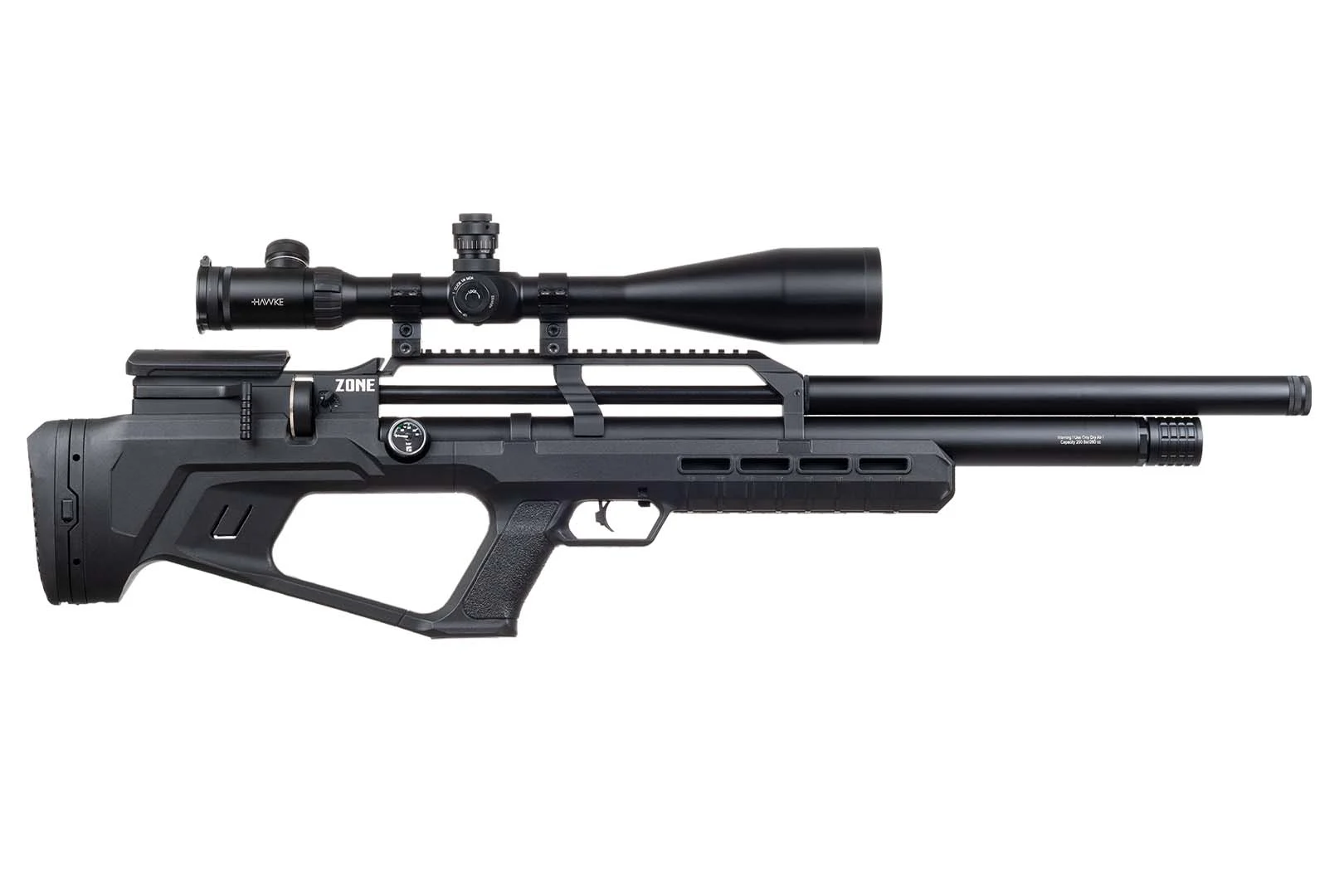
Reximex Zone Synthetic

$470.00

The Reximex Zone Synthetic bullpup is a great choice for all shooters who want a quality PCP air rifle with a regulator for a reasonable price.

The stock of the Zone is very comfortable and lightweight to stop fatigue out in the field. The stock has an adjustable rubber buttpad for giving the shooter an opportunity to adjust handling & comfort.

Reximex Zone Synthetic Features:

  • Caliber – .177  |  .22
  • Magazine Capacity – .177 – 14  |  .22 – 12
  • Number of Shots – .177 – 75  |  .22 – 65
  • Air Tube Volume – 260cc
  • Filling Pressure – 250 BAR
  • Stock – Bullpup Design High Quality Synthetic Stock
  • Adjustable Butt Pad (Valid on synthetic versions)
  • Overall Length – 900mm (35,4″)
  • Barrel Length – 580mm (22,8”)
  • Weight – 3.3 kg (7.27lbs)
  • Regulator – Standard


Included with this Rifle 

  • 2 magazines
  • Weaver/Picatinny scope rail
  • Threaded for use with 1/2″ UNF moderators
  • Fill probe
  • 1 year warranty

Reximex Zone Synthetic delivers compact bullpup performance in a regulated PCP platform that is engineered for consistent results and practical field use.

Precision, control, and everyday reliability are combined in this tactical synthetic model so that shooters of varying experience levels can enjoy dependable accuracy without unnecessary complexity.

Compact Bullpup Design Built for Control

A stylish bullpup layout is employed so that overall length is kept to approximately 900 mm while a full 580 mm precision-rifled barrel is retained. Balance is therefore improved and maneuverability in confined spaces or during extended sessions is enhanced.

The high-quality synthetic stock is formed with an ambidextrous thumbhole configuration. Comfort is further increased through the inclusion of an adjustable rubber butt pad that permits length-of-pull and height customization. Fatigue is consequently reduced during prolonged range sessions or field use.

Weather resistance and durability are provided by the synthetic construction, allowing the rifle to be used confidently in varied outdoor conditions.

Regulated PCP Performance and Air Efficiency

Consistent shot-to-shot velocity is achieved through the regulated pre-charged pneumatic system. A 260 cc aircraft-grade 7075 aluminum air tube is fitted and is designed for a maximum fill pressure of 250 bar. Residual pressure is readily monitored via the built-in main air gauge, while regulator status is displayed on a dedicated regulator gauge.

Power is controlled by an adjustable transfer-port knob. Output can therefore be dialed down for higher shot counts or set for the required energy level, depending on the chosen caliber and local regulations. Approximate shot counts of around 75 in .177 and 65 in .22 are typically obtained within the optimal pressure window when suitable pellets are used.

Quiet operation is supported by the integrated SilentForce sound moderator that is built into the barrel shroud. Additional suppression can be added because the muzzle is threaded ½″ UNF.

Calibres, FAC Ratings, Power and Accessories

A choice of pellet diameters is offered so that the intended task can be matched to trajectory, energy transfer and magazine capacity. Consequently, versatility is retained across target work, pest control and higher-output field use where regulations allow.

Available Calibres and Magazine Capacity

Three common airgun calibres are supplied. In .177 (4.5 mm), a 14-shot rotary magazine is fitted and a flatter trajectory is typically obtained, which is often preferred for paper targets and longer-range practice. By comparison, .22 (5.5 mm) is paired with a 12-shot magazine and is widely selected when a balance of carry, impact and shot count is required. Meanwhile, .25 (6.35 mm) uses a 10-shot magazine and is favoured when greater pellet mass and energy delivery are desired for larger pests or short-range field work.

Precision rifling is employed in each barrel so that pellet stability is supported. Furthermore, a single-shot tray is included, allowing individual loading when maximum consistency is sought. Detachable magazines are stored in the onboard compartment, therefore follow-up shots can be prepared without extra pouches being carried.

Approximate shot counts within the optimal pressure window are commonly reported near 75 rounds in .177, 65 in .22 and 55 in .25 on regulated fills, although actual results remain dependent on pellet weight, temperature, fill pressure and the power setting that has been selected.

FAC Considerations and Legal Power Levels

Power output is governed by local law. In many UK retail configurations, sub-12 ft/lb energy is factory-set so that the rifle may be owned without a Firearm Certificate, provided all other legal conditions are met. Typical UK-legal figures in the region of 10.8–11.8 ft/lb are therefore encountered on regulated examples.

Higher-output versions are also produced for markets and users where a Firearm Certificate (FAC) or equivalent authorisation is held. On those FAC-rated examples, substantially greater muzzle energy can be delivered—figures in the region of the mid-teens to around 40 ft/lb have been published depending on calibre, pellet and tune. Ownership, transport and use of FAC air rifles remain subject to certificate conditions, secure storage rules and local restrictions. Confirmation of the exact specification on the individual rifle is always required before purchase or use.

Inclusive compliance is encouraged: energy limits, permitted quarry and transport rules should be verified for every jurisdiction, because the same platform can be supplied in both low-power and high-power forms.

Power Adjustment and Regulated Performance

An adjustable transfer-port knob is provided so that output can be reduced or increased within the mechanical range of the valve. As a result, shot count can be extended at lower settings, while more energy can be applied when legal limits and the task require it. Multiple indexed positions are typically available, allowing a repeatable setting to be restored after the knob has been moved.

Regulation is built in, therefore velocity spread across a usable string is kept narrow compared with many unregulated designs. Chronograph tests on sub-12 ft/lb examples have shown modest total spreads over long strings when quality pellets are used. Residual cylinder pressure remains visible on the main gauge, while regulator status is shown on the dedicated regulator gauge, so fill planning can be completed before a session begins.

Maximum fill pressure is specified at 250 bar into the 260 cc aluminium tube. Many users elect a slightly lower working fill to reduce long-term stress on seals; either approach should follow the manufacturer guidance supplied with the rifle.

Accessories, Optics and Practical Add-Ons

A 22 mm Picatinny top rail is fitted as standard, allowing a wide range of scopes, red-dots and mounts to be attached. Lower Picatinny or M-LOK sections on the forend accept bipods, lights or other field accessories. Additionally, the muzzle is threaded ½″ UNF, so a second detachable moderator can be fitted after the integrated SilentForce shroud when extra quietness is wanted—provided overall length and legal moderator rules are observed.

Standard kit commonly includes two rotary magazines, a quick-fill probe, a single-shot tray, tools and spare O-rings. Optional extras frequently chosen by owners include:

  • Compact or high-magnification scopes matched to calibre and typical distance
  • Quality mounts and bubble levels for consistent zero
  • Secondary ½″ UNF sound moderators
  • Bipods or shooting sticks attached via M-LOK or rail
  • Spare magazines and padded cases
  • Hand pumps, bottles or compressors rated for 250 bar fills
  • Slings and rail-mounted sling points where permitted

Pellet selection remains as important as hardware. Domed competition pellets are often used for groups and longer shots, while heavier or hunting-profile designs may be chosen in .22 and .25 when energy transfer is the priority. Chronograph checks after any power change are recommended so that the new setting is confirmed.

Through calibre choice, legal power configuration, the onboard adjuster and a practical accessory interface, the rifle can be specified for club use, field work or FAC-level applications. Responsible matching of energy, ammunition and add-ons to the intended role remains the foundation of safe, effective performance.

Key Features at a Glance

  • Regulated PCP system with power-adjustable transfer port
  • 260 cc aluminum air cylinder (250 bar maximum fill)
  • Precision-rifled 580 mm barrel for accuracy
  • Integrated SilentForce moderator plus ½″ UNF muzzle thread
  • Ambidextrous synthetic thumbhole stock with adjustable butt pad
  • 2-way interchangeable side-lever action
  • Detachable rotary magazines: 14-shot (.177), 12-shot (.22), 10-shot (.25)
  • 22 mm Picatinny top rail and M-LOK handguard sections
  • 4-way adjustable trigger shoe and ergonomic trigger safety
  • Spare magazine storage compartment in the stock
  • Quick-fill probe and two magazines supplied as standard

Accuracy, Handling, and Practical Application

Exceptional pellet placement is promoted by the combination of a regulated valve, quality barrel, and stable platform. The side-lever cocking system is positioned for convenient operation and can be swapped for left- or right-handed preference. Follow-up shots are therefore kept rapid when the multi-shot magazine is employed, while a single-shot tray remains available for precision work.

Mounting of optics is simplified by the full-length Picatinny rail. Accessory attachment points on the M-LOK forend further expand configuration options for bipods, lights, or other equipment.

Target shooting, informal range practice, and light pest-control duties are all supported by the balanced handling characteristics and adjustable power. The compact dimensions make the Reximex Zone Synthetic particularly suitable where a full-length traditional rifle would prove cumbersome.

Inclusive Design for a Wide Range of Shooters

An ambidextrous stock and reversible side lever ensure that both left- and right-handed users can operate the rifle comfortably. Adjustable butt-pad geometry allows the fit to be tailored to different body sizes and shooting positions. Inclusive language and practical ergonomics are therefore reflected in the overall design so that a broader group of enthusiasts can enjoy the platform.

Reximex Zone Synthetic

Responsible ownership is encouraged through clear pressure gauges, a positive safety, and the ability to reduce power when circumstances require it. Legal compliance should always be verified according to local regulations, and appropriate safety practices must be observed at all times.gunseek

Why the Reximex Zone Synthetic Stands Out

Value is delivered through a feature set that includes regulation, power adjustment, integrated moderation, and a modern synthetic stock at an accessible price point. Reliability is reinforced by solid construction and thoughtful details such as the spare-magazine compartment and quick-fill system.reximex rpa.yivli av tüfeği

Whether the goal is consistent groups on the range or practical field performance, the Reximex Zone Synthetic is positioned as a capable, user-friendly choice. Exploration of available calibers and complementary optics or accessories is recommended so that the rifle can be configured for individual needs.reximex airguns.fps to joules calculator.fps to ft lbs

High-quality materials, regulated consistency, and thoughtful ergonomics are brought together in this compact PCP bullpup. The result is a versatile air rifle that rewards careful setup and responsible use while remaining approachable for shooters seeking reliable performance.reximex rp.reximex throne gen 2.reximex mitos.sbs12.reximex throne gen2.airgun calculator

Practical Use Scenarios

A wide range of field and range applications is supported by the compact regulated platform, allowing consistent performance to be maintained across varied conditions and shooter preferences.

Target Practice and Formal Range Sessions

Precision work on paper targets or reactive plates is facilitated by the regulated valve system, through which velocity consistency is preserved across extended strings. Shot-to-shot variation is minimized, so that group sizes remain tight even after dozens of rounds have been discharged.

Adjustment of the power knob is performed prior to the session, enabling energy levels to be matched to the intended distance and pellet weight. Lower settings are selected when longer strings are required, while higher outputs are chosen for 50-yard or greater ranges.

The adjustable butt pad is positioned according to individual length of pull, ensuring that a stable cheek weld and natural point of aim are achieved by shooters of differing stature. Consequently, fatigue is reduced during multi-hour sessions.

Multi-shot magazines are loaded in advance and stored in the integrated compartment, allowing rapid changes to be completed without interruption of the firing rhythm. Follow-up shots are therefore delivered smoothly via the side-lever action.

Optics mounted on the Picatinny rail remain secure under repeated recoil cycles, and the overall balance of the bullpup layout contributes to reduced muzzle movement between shots.

Informal Plinking and Skill Development

Casual backyard or club plinking sessions are accommodated where local regulations permit. The integrated sound moderator keeps report levels subdued, minimizing disturbance to surrounding areas.

Power can be dialed down substantially, producing lower energy levels that remain suitable for close-range reactive targets while extending the number of shots available from a single fill.

Ambidextrous handling characteristics ensure that both left- and right-handed participants can operate the rifle comfortably without modification. Newcomers and experienced enthusiasts alike find the trigger safety and positive lever action straightforward to manage.

Progressive skill-building drills—such as offhand groups, kneeling positions, or timed strings—are supported by the lightweight synthetic stock and stable platform. Improvements in technique are therefore encouraged over successive sessions.

Pest Control Applications

Effective management of small pests around agricultural buildings, gardens, or rural properties is enabled by the combination of accuracy, quiet operation, and adjustable power.

The compact overall length permits the rifle to be carried and deployed in restricted spaces such as outbuildings or dense vegetation. A stable shooting position is more readily assumed because of the rear-weighted balance.

Consistent velocity across the usable pressure curve allows pellet impact energy to remain predictable at typical pest-control distances. Placement of shots is consequently more reliable when vital zones must be targeted humanely.

The shrouded barrel and optional secondary moderator further reduce the sound signature, decreasing the likelihood that remaining animals will be alarmed after the first shot. Magazines can be pre-loaded with appropriate ammunition so that multiple opportunities are available without reloading delays.

Weather-resistant synthetic furniture ensures that performance is retained during damp or dusty conditions commonly encountered in outdoor pest work.

Light Hunting and Fieldcraft Scenarios

Opportunities for taking small game species are supported within legal frameworks and ethical guidelines. The regulated system delivers the repeatable energy needed for clean, humane dispatch at moderate ranges.

Maneuverability through woodland edges, hedgerows, or agricultural margins is improved by the shortened overall dimensions. The rifle can be brought to the shoulder quickly when fleeting chances appear.

An adjustable stock allows the fit to be refined for prone, sitting, or kneeling positions that may be required during still-hunting or ambush tactics. Comfort is maintained even when extended periods are spent waiting for suitable opportunities.

Quiet operation assists in preserving the natural behavior of quarry. After a shot is taken, the side lever can be cycled with minimal disturbance, preparing the rifle for a potential follow-up if necessary.

Fill status is monitored via the pressure gauges so that the remaining shot count can be estimated accurately before a hunt begins.

Competition-Style and Hunter Field Target Practice

Although not purpose-built solely for formal competition, the platform lends itself well to practice for hunter field target and similar disciplines. Consistent regulation helps maintain the narrow velocity window preferred for precise trajectory calculation.

Power adjustment permits the rifle to be set at the exact energy level required by club rules or personal preference. Once dialed in, the setting remains stable throughout a course of fire.

The Picatinny rail accepts a wide variety of scopes and mounts commonly used in positional shooting. Parallax and magnification can be optimized for the mixture of close and distant targets typical of field courses.

Shooting from improvised rests, freehand, or supported positions is facilitated by the ergonomic stock geometry. The adjustable pad helps maintain consistent eye alignment with the optic across different stances.

All-Weather and Extended Outdoor Use

Durability of the synthetic stock and aluminum air cylinder allows the rifle to be carried in rain, humidity, or dusty environments without degradation of function. Surface finishes resist corrosion when basic maintenance is observed.

Temperature fluctuations have limited effect on regulated output compared with unregulated designs, so that point of impact remains more predictable from morning to afternoon sessions.

Long fills are supported by the 260 cc capacity, reducing the frequency with which a pump or tank must be accessed during a full day afield.

Spare magazines stored onboard keep the shooter prepared for unexpected opportunities without the need to carry additional cases.

Inclusive Training and Shared Use

Groups of mixed experience levels can share the same rifle because the stock and lever are configurable for different users. Length of pull and butt height are adjusted between individuals in seconds.

Instructional sessions benefit from the clear pressure gauges and positive safety, which provide visual and tactile feedback for new shooters. Safe handling habits are reinforced through straightforward controls.

Reduced power settings create a lower-recooil environment that is less intimidating for beginners while still delivering realistic feedback on technique.

Left-handed participants require no special adaptation, as the ambidextrous layout and reversible lever accommodate natural preferences.

Maintenance and Session Preparation Considerations

Prior to any practical use, the air system is filled to the recommended pressure and gauges are inspected. Magazines are loaded with pellets of consistent weight and shape known to perform well in the barrel.

Optics are checked for secure mounting and zero is confirmed at the intended primary distance. The power dial is set according to the planned activity and legal limits.

After the session, residual pressure is noted and the rifle is stored in a secure, dry location. Basic cleaning of the exterior and inspection of the moderator and threads help preserve long-term reliability.

Transition Between Different Roles

The same platform can move fluidly from a morning pest-control task to an afternoon range session simply by altering the power setting and changing ammunition if desired. No tools are required for these adjustments.

Fieldcraft skills developed during hunting or pest work transfer directly to positional shooting practice, while the accuracy gained on the range improves ethical field performance.

Shooters progressing from spring-powered or CO₂ platforms often find the regulated consistency and multi-shot capability accelerate skill development.

Safety and Responsible Deployment Across Scenarios

Safe backstops and awareness of surroundings remain essential in every application. The positive trigger safety is engaged whenever the rifle is not actively in use.

Local laws governing energy limits, permitted quarry, and transport are observed at all times. The ability to reduce power provides an additional tool for remaining within regulatory boundaries.

When the rifle is carried in public or vehicle, it is secured and unloaded in accordance with best practice.

Through thoughtful configuration of power, fit, and accessories, the platform adapts to the specific demands of each practical scenario while maintaining the core attributes of consistency, quiet operation, and compact handling. Extended enjoyment and improved results are therefore obtained by matching the rifle’s capabilities to the requirements of the task at hand.
Reximex Zone Synthetic

Bintac, AEA Airguns, PCP Platforms and Model Terminology

Bintac and AEA Airguns are names commonly associated with large-caliber PCP airgun discussions, including models and search terms such as bintac t9, bintac, bintac llc, bin tac, bintacllc, aea airguns, bintac t 50, bintac m50, bintac mcar, bintac t50, and bintac s45.

Enthusiasts researching these platforms may also encounter terminology including bintac t9 full auto, bintac mcar air rifle, bintac mcar 457, bintac m50 pistol, bintac t50 extreme, bintac m50 pump action, aea bintac t50 extreme, and automatic air gun. These terms generally describe particular configurations, operating systems, calibers, or model families and should always be understood in the context of applicable local airgun laws and safe handling requirements.

AEA Harpoon and Related Search Terms

The AEA Harpoon family is frequently discussed alongside phrases such as bintac aea harpoon, aea harpoon, aea harpoon magnum, aea harpoon gun, aea harpoon cartridge, aea .50 harpoon, aea harpoon air gun, harpoon air gun, and the commonly mistyped aa harpoon.

Because specifications can differ between generations and configurations, prospective researchers should verify caliber, energy output, compatible air systems, ammunition type, and manufacturer documentation rather than relying solely on model-name searches.

AEA Megalodon and Large-Caliber PCP Airguns

Another commonly researched platform is the AEA Megalodon, appearing under terms including aea megalodon, megalodon air rifle, aea megalodon 58 cal, aea megalodon .58 cal, aea megalodon air rifle, and aea megalodon 50 caliber.

Large-caliber PCP platforms are also associated with broader terms such as air powered 50 cal rifle, air tank for pcp airguns, and airgun shotgun. Because high-powered PCP equipment can store substantial compressed-air pressure and generate significant projectile energy, tanks, fittings, valves, and charging equipment should be used only within their certified operating limits.

AEA Defender and Terminator Platforms

Other AEA terminology includes aea defender, aea defender 2, aea defender 3, aea terminator, aea terminator gen 3, and the broader phrase aea guns. Different generations may vary substantially in action type, dimensions, magazine arrangement, air capacity, caliber, and operating pressure.bintac t9 amazon

Anyone comparing these systems should therefore check the exact model designation and generation before comparing technical specifications.bintac t50 for sale

PCP Air Systems and Supporting Equipment

PCP airguns depend on compressed-air storage systems. Search terms such as anti air tanks and air tank for pcp airguns may refer to high-pressure cylinders or charging equipment. Only pressure-rated equipment designed for the intended system should be used.

Other broad search phrases, including bee bee gun rifle, airgun shotgun, and automatic air gun, describe different categories of air-powered equipment rather than one standardized product type.zeus 72 cal air rifle price

Additional Large-Caliber Airgun Terminology

Researchers may also encounter terms including zeus 72 cal air rifle, b&w m50, bintac t9, bintac m50, bintac t50, bintac s45, and bintac mcar. Model names alone do not establish compatibility, legality, operating pressure, caliber, or performance, so manufacturer documentation remains the appropriate source for technical specifications.aea megalodon for sale.reximex lieva.bintac m50 for sale.aea harpoon price.bintac s45 for sale.aea harpoon for sale

For all Bintac, AEA Airguns, and large-caliber PCP systems, safe storage, responsible handling, appropriate protective equipment, and compliance with local laws should remain central considerations.reximex accura pcp air rifle.bintac t9 price.aea megalodon 50 cal price

Frequently Asked Questions

Clear answers are provided below so that common concerns about calibre choice, legal power, filling, handling and accessories can be resolved before a purchase is made. Inclusive guidance is offered for left- and right-handed users, newer shooters and experienced field users alike.

What calibres are offered and how should one be chosen?

Three pellet diameters are typically available. A flatter trajectory and higher magazine capacity are associated with .177, which is frequently selected for paper targets and longer practice distances. Greater pellet mass and a widely used balance of carry and impact are associated with .22, which remains a popular all-round choice. Heavier projectiles and stronger short-range energy transfer are associated with .25, which is often preferred for larger pests where regulations allow.

Magazine capacities of fourteen, twelve and ten shots are matched to those calibres in order. A single-shot tray is also supplied, so individual loading can be used when maximum consistency is required. Pellet weight, local energy limits and the intended distance should all be considered before a calibre is finalised.

Reximex Zone Synthetic

Is a Firearm Certificate required?

Ownership rules depend on the energy level that has been factory-set or later tuned, and on the laws of the country or region of use. In many UK retail examples, output is held below twelve foot-pounds so that a Firearm Certificate is not required, provided all other legal conditions are met. Higher-output versions exist for authorised FAC holders and for export markets where greater energy is lawful.

Certificate conditions, secure storage and transport rules must be observed whenever an FAC-rated specification is held. Confirmation of the exact power of the individual rifle is always recommended, because the same platform can be supplied in both low-power and high-power form.

How is power adjusted and how consistent is the output?

An indexed transfer-port control is fitted so that energy can be reduced or increased within the mechanical range of the valve. Lower settings are used when longer strings are wanted or when reduced report and recoil are preferred. Higher settings are selected when legal limits and the task require more energy.

Regulation is built into the action, therefore velocity variation across a usable string is kept relatively narrow when quality pellets are used. Residual cylinder pressure is shown on the main gauge, while regulator status is displayed on a dedicated gauge. Chronograph checks after any change of setting remain the most reliable way to confirm the new output.

Caliber

.177, .22, .25

Reviews

There are no reviews yet.

Be the first to review “Reximex Zone Synthetic”

Related Products

FAQ

  • Spring-Piston (Break-Barrel or Underlever): Cock by compressing a spring. Reliable, no external air source needed, but can have more recoil (“spring twang”) and require technique to shoot accurately.
  • Pre-Charged Pneumatic (PCP): Filled from a scuba tank, compressor, or pump. High power, low recoil, multiple shots per fill. Popular for precision and hunting.
  • CO₂: Powered by disposable cartridges. Good for pistols and semi-auto/repeaters, but performance drops in cold weather.
  • Multi-Pump Pneumatic: Hand-pumped to build pressure. Versatile but requires effort.
  • Gas Ram (Nitro Piston): Uses compressed gas instead of a metal spring. Smoother than traditional springers.

Calibers: Most common are .177 (4.5mm) for speed/flat trajectory and general use, and .22 (5.5mm) for better hunting knockdown power. Larger “big bore” (.25, .30, .357+) exist for hunting bigger game where legal.

Yes, many modern PCP and springers deliver enough energy for small game (rabbits, squirrels, birds) and even larger game in some areas. Muzzle energy (in ft-lbs or joules) matters more than velocity alone. Always match caliber, pellet weight, and energy to the game and check local hunting regs.

Treat every airgun as if it is loaded.

  • Always point the muzzle in a safe direction.
  • Keep your finger off the trigger until ready to shoot.
  • Know your target and what is beyond it (pellets can ricochet or travel far).
  • Wear eye protection.
  • Store unloaded, out of reach of children/untrained users, and ideally locked.
  • Never shoot at hard surfaces or in areas where pellets could escape your property.

Follow these rules strictly—airguns cause real injuries.

Laws differ dramatically by country, state/province, and even city. Always verify current local laws before buying, owning, transporting, or using an airgun. Age restrictions (often 18+) are common.

Examples (summaries only; check official sources):

  • UK: Air rifles ≤12 ft-lbs (16.3 joules) and pistols ≤6 ft-lbs generally do not require a license (FAC needed above that).
  • USA: Varies by state. Some treat powerful airguns as firearms; others do not. Many states now allow big-game hunting with air rifles.
  • Canada: Some airguns classified as firearms if they exceed velocity/energy thresholds.
  • Australia: Often treated as firearms; licensing/registration required in most states.
  • EU/France/Belgium/etc.: Varies; many allow low-power (<20J) guns freely to adults, with higher power needing permits. Germany has strict ~7.5J limits in some contexts.
  • Other countries: Some have no restrictions below certain energies; others ban or heavily regulate them.

Resources: Wikipedia “Air gun laws”, airgun forums, or official government sites. For travel, research transit laws carefully.

Consider:

  • Purpose: Plinking/backyard → lower power springer or CO₂. Hunting/precision → PCP.
  • Budget: Entry-level springers are affordable; PCPs need a fill system (extra cost).
  • .177 vs .22: .177 easier for beginners/targets; .22 better for hunting.
  • Power source: Convenience vs performance.
  • Test pellets in your gun—accuracy varies.

Buy from reputable dealers and consider warranties.

  • Clean barrel periodically (especially if accuracy drops) with patches and appropriate tools/solvents. Avoid over-oiling.
  • Lubricate moving parts and seals with airgun-specific oil (not general gun oil). Springers need piston seal oil occasionally.
  • Check screws, seals for leaks (PCP), and safety mechanisms regularly.
  • Store in a cool, dry place, ideally in a case. Avoid leaving cocked for long periods.

Follow your model’s manual. Basic care extends life significantly.

International shipping may be available for select products. Customers are responsible for understanding and complying with their local import laws and regulations before ordering.

Yes. Customers are required to confirm their order number through WhatsApp or Live Chat before orders are processed and shipped.

If local laws prevent shipment to your area, your order may be canceled and refunded according to our store policy.

Processing typically takes 1–3 business days after payment confirmation. Delivery times vary depending on destination, carrier, and product availability.


  • Wrong pellets for your barrel/caliber.
  • “Death grip” or poor shooting form (especially with springers—let the gun recoil naturally).
  • Loose scopes or mounts.
  • Ignoring safety or local laws.
  • Over-oiling or shooting with obstructions.


Pellets are the most common projectile (lead or lead-free). Match them to your gun, caliber, and purpose—test several brands as accuracy varies by barrel.

  • Domed (Round-Head): Best all-rounder. Excellent accuracy, ballistic coefficient, and energy retention. Ideal for target shooting, field target, and general hunting (e.g., JSB Exact, Air Arms Diabolo Field, H&N Field Target Trophy).
  • Wadcutter (Flat-Head): Clean holes in paper. Best for close-range target/plinking (under 20-25 yards).
  • Hollow Point: Expands on impact for better energy dump. Good for small game hunting (e.g., Predator Polymag, H&N Terminator).
  • Pointed: More penetration, but often less accurate than domed.
  • Slugs: Heavier, more aerodynamic for high-power PCPs at longer ranges (better for big game where legal).

Tips: Heavier pellets in .22/.25 for hunting (better momentum). Lighter in .177 for speed/flat trajectory. Always check head size fit (e.g., 4.51-4.53mm variants).

Muzzle energy (ft-lbs or joules) matters more than velocity. Ethical shots require precise placement (head/heart-lung) within effective range.

Rough Guidelines (adjust for distance, pellet, and local laws):

  • Small game (squirrels, rabbits, birds): 9-20+ FPE, .177/.22.
  • Medium (raccoons, etc.): 25+ FPE, .22/.25 recommended.
  • Larger game: 40-100+ FPE in .30+ calibers (up to big bore for deer/hogs where permitted).

PCPs dominate serious hunting due to power and shot count. Springers/gas rams work well for small game but require skill. Always prioritize clean kills and check seasons/species rules.

  • Barrel Cleaning: Use a pull-through kit or rod with patches. Avoid brushes that could damage rifling. Clean when accuracy drops or after 500-1000 shots.
  • Lubrication: Airgun-specific silicone oil for seals/O-rings (sparingly—excess causes dieseling in springers). Springers may need piston lube periodically.
  • PCP Specific: Check for leaks (soapy water test), monitor regulator/hammer settings, and keep fill systems clean. Don’t exceed rated pressure.
  • General: Tighten stock screws, inspect for wear, store properly. Chronograph shots to track consistency.

Common Issues:

  • Inconsistent velocity → dirty barrel, bad pellets, or seal problems.
  • Spring “twang” → tuning or proper hold.
  • Low power → worn seals or under/over-pumping.

Toggle Content

  • Scopes: Airgun-rated (hold zero under recoil). 3-9x or 4-12x common.
  • Fill Systems: Hand pumps, compressors, or tanks for PCPs.
  • Safety Gear: Eye/ear protection, targets with backstops.
  • Noise: Airguns quieter than firearms, but moderators help further.

Budget Tip: Start with a quality springer (~$150-400) before investing in PCP setup.

Airgunning offers endless depth—from backyard plinking to precision competition and ethical hunting. Prioritize safety, legality, and practice. If you want specifics (e.g., recommendations for a country, budget, hunting small game, or a particular type like PCP vs springer), let me know for more targeted info! Shoot responsibly.

Tuning improves accuracy, reduces noise/recoil, or increases power (within legal limits).

  • Springers: Lighter springs, guides, seals, or custom tuning kits for smoother shot cycle. “V-Mach” or similar professional tunes popular.
  • PCPs: Regulator tuning, hammer spring adjustments, valve work for efficiency and shot count. Some add electronic systems.
  • Accessories: Suppressors (often unregulated on airguns), better triggers, stocks, and scopes.

Caution: Check laws—power increases may reclassify your gun. DIY only if experienced; professional tuners recommended.

You must be at least 18 years old to purchase any airgun or related accessories from our store. By placing an order, you confirm that you meet the legal age requirements in your state or country.

Yes. Orders may require age verification before processing and shipping. In some cases, we may request a valid government-issued ID to confirm eligibility.
