Calibres, FAC Power, and Accessories for the Hatsan Blitz Full Auto PCP
A clear understanding of calibre choice, FAC-level power, and supporting accessories is required before the Hatsan Blitz Full Auto PCP is selected. Consequently, performance, legal classification, and field usefulness can be matched to the intended role. Moreover, inclusive guidance is offered so that newcomers and experienced shooters alike can compare options without unnecessary jargon.
Available Calibres and Typical Roles
Three principal calibres are offered for the Hatsan Blitz Full Auto PCP: .22 (5.5 mm), .25 (6.35 mm), and .30 (7.62 mm). Therefore, pellet weight, trajectory, and terminal energy can be balanced against magazine capacity and shot count.
- .22 calibre is frequently chosen when a flatter trajectory and a higher magazine capacity of 21 pellets are preferred. Up to approximately 1,050 fps with lead pellets (and higher figures with suitable lead-free pellets) is published, while around 36 ft-lbs (49 J) of energy is produced. Up to 130 shots at optimal velocity are available from a 250 BAR fill. As a result, small-game work, pest control at moderate ranges, and high-volume practice are commonly associated with this chambering.
- .25 calibre is selected when a middle path between speed and impact is desired. A 19-shot magazine is used. Published figures of about 970 fps and 41 ft-lbs (56 J) are given, with up to 110 optimal-velocity shots per fill. Consequently, slightly heavier pellets can be driven with useful authority for pests and small- to medium-sized quarry where local rules allow.
- .30 calibre is specified when maximum listed energy is prioritised. A 16-shot magazine is fitted. Approximately 730 fps and 53 ft-lbs (71.8 J) are quoted, with up to 100 shots at optimal velocity. Hence, this option is often considered for closer-range work in which pellet mass and energy are valued more than a flatter path.
Velocity and energy may vary by as much as 20 percent because pellet weight, shape, temperature, and elevation all influence results. Furthermore, full-auto strings consume air more quickly than measured semi-auto shots, so the published optimal-velocity counts should be treated as a planning guide rather than a guarantee in every session.
FAC Classification and Power Context
In the United Kingdom, air rifles that produce more than 12 ft-lbs of muzzle energy are classified as firearms and are subject to Firearms Certificate (FAC) requirements. Because the Hatsan Blitz Full Auto PCP is listed at approximately 36, 41, and 53 ft-lbs depending on calibre, FAC status is typically applied to factory-power examples. Therefore, lawful possession, storage, transport, and use must follow the conditions printed on the certificate.
Elsewhere in Europe and beyond, national limits, hunting seasons, permitted quarry, and rules on select-fire or full-automatic airguns differ widely. Consequently, local legislation must be verified before purchase, import, or field use. Inclusive, responsible ownership is emphasised: power figures are provided for information only and must not be treated as legal advice. Additionally, a minimum of about 100 BAR remaining pressure is required before the gas-operated semi-auto or full-auto cycle is enabled, so fill discipline is part of both safety and performance.
Power is generated by a 580 cc carbon-fibre bottle filled to a maximum of 250 BAR (3,625 PSI). An integral colour-coded manometer is fitted so that pressure can be checked at a glance. A fill probe is included so that charging from a suitable compressor or high-pressure cylinder can be completed. Hand pumps are generally impractical for a 250 BAR fill of this volume; therefore, a compressor or scuba-style supply is normally planned as part of the accessory package.
Accessories That Complete the Platform
A practical accessory list is recommended so that the Hatsan Blitz Full Auto PCP can be used immediately and expanded later.
- Magazines and loading tools: Two SwingLoad rotary magazines are supplied. Spare magazines are strongly advised because full-auto strings empty a drum quickly. A winding tool is stored in the stock so that magazines can be prepared in the field.
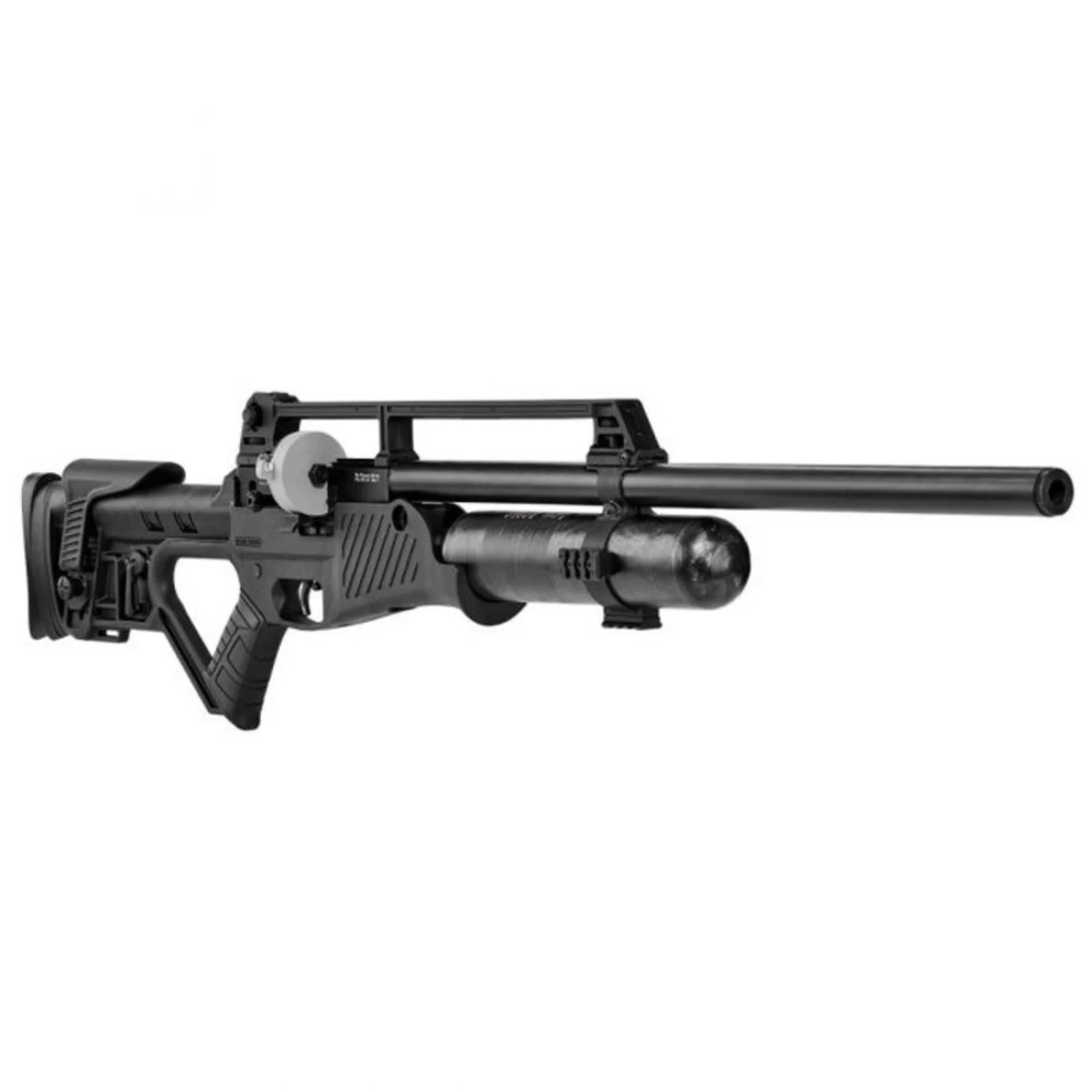
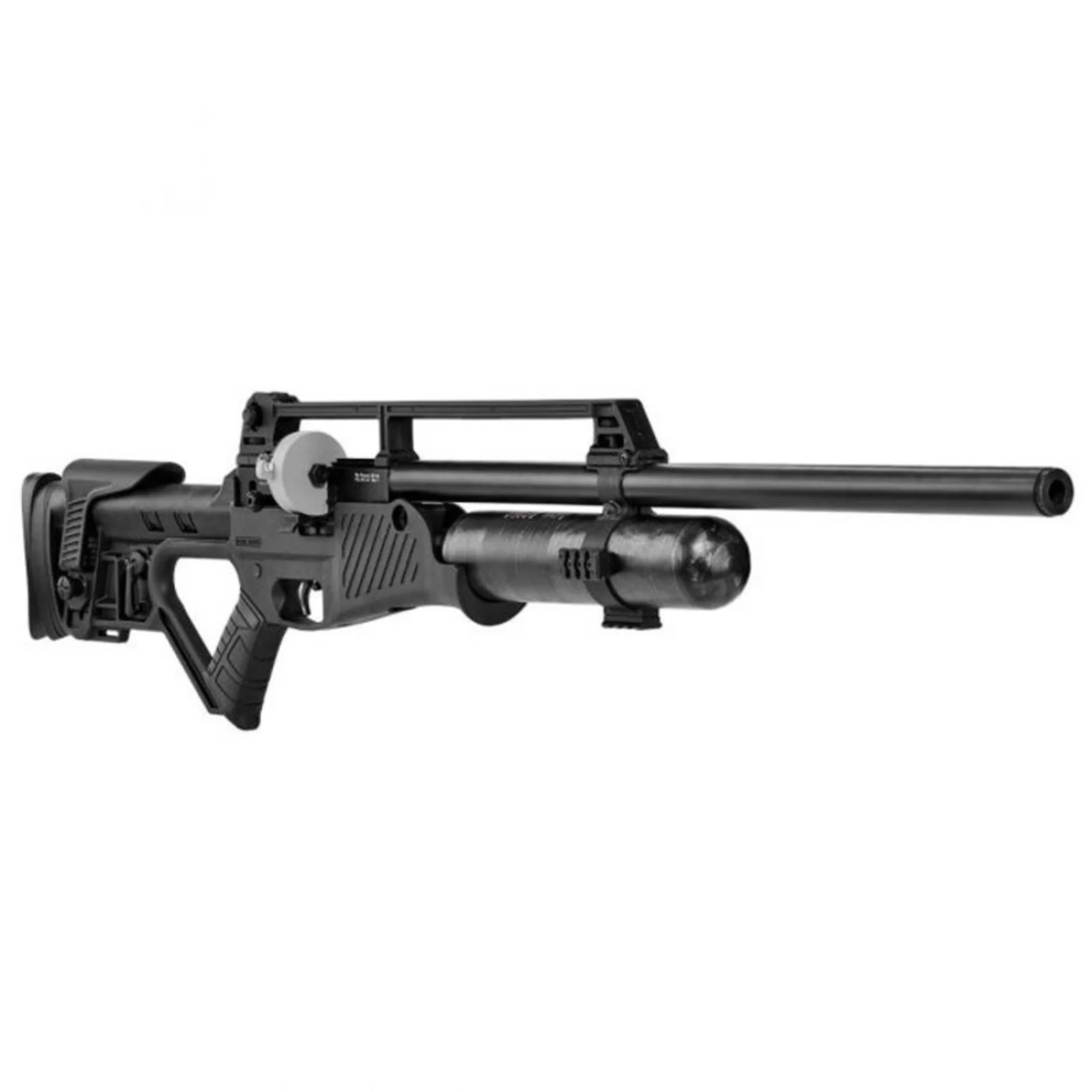
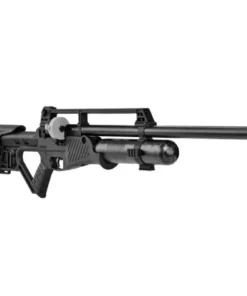
- Optics and iron sights: A combination 11 mm dovetail and 22 mm Weaver/Picatinny rail is provided on the receiver. A removable carry handle with adjustable open sights is included so that the rifle can be used before a scope is fitted. A robust airgun-rated optic with appropriate mounts is commonly added for hunting or precision practice.
- Forearm rails and support gear: Three Picatinny rails surround the forearm bottle so that a bipod, weapon light, laser, or vertical grip can be attached. Integrated sling swivels allow a two-point sling to be fitted for carry and stability.
- Sound management: A QuietEnergy fully shrouded, rifled, and choked 23-inch barrel is fitted as standard so that report is reduced. Where a muzzle thread is present on a given example, an additional moderator may be considered if local law permits. Thread specifications should be confirmed on the individual rifle before a silencer is purchased.
- Fill and air support: A 250 BAR-capable compressor or filled cylinder, plus the supplied probe and appropriate hoses or adapters, should be regarded as essential rather than optional. Dry, clean air only must be used. Concentrated oxygen or other reactive gases must never be introduced.
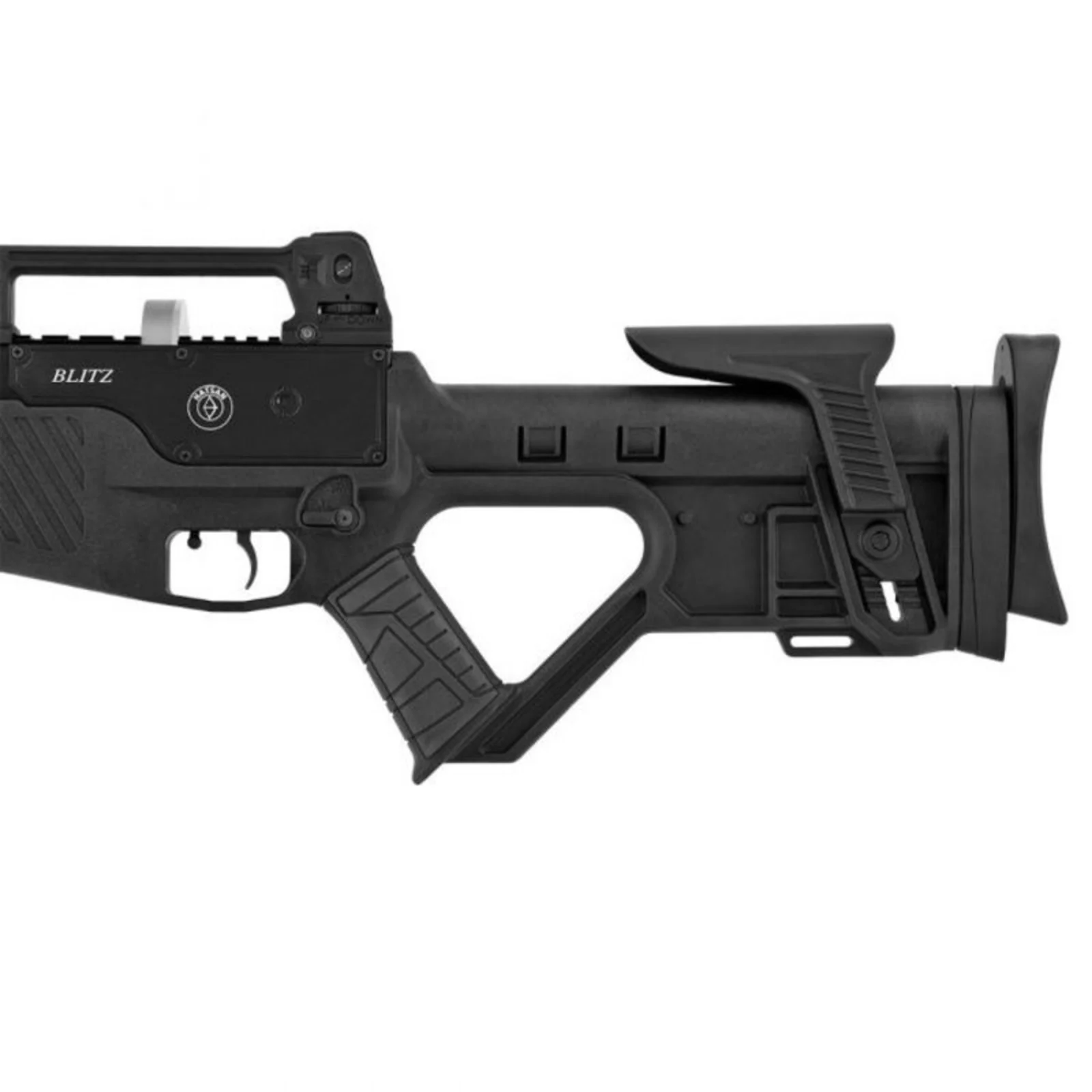
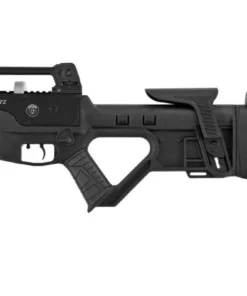
- Comfort and control: The elevation-adjustable cheek rest and the elevation- and angle-adjustable rubber butt pad can be set so that a consistent cheek weld is obtained with either iron sights or a scope. Rubberised grip panels are already fitted; additional gloves or rail covers may be added for long sessions.
- Maintenance and range kit: Quality pellets matched to calibre, a cleaning kit suitable for a shrouded PCP barrel, spare seals if recommended by the maker, hearing and eye protection, and a secure case complete a responsible outfit.
When calibre, FAC-level power, and accessories are planned together, the Hatsan Blitz Full Auto PCP can be configured for semi-auto precision or controlled full-auto volume. Inclusive practice remains the same for every user: legal limits are respected, the manual safety is used, the muzzle is kept in a safe direction, and only appropriate targets and quarry are engaged.
Explore the Hatsan Air Rifle Range: PCP, Spring-Piston, Bullpup, and Semi-Auto Airguns
For shooters comparing a hatsan air rifle, the Hatsan lineup covers everything from traditional spring-powered platforms to modern hatsan pcp designs, compact bullpups, semi-automatic systems, and specialized large-bore models. Whether someone is researching an entry-level air rifle, premium PCP equipment, target-oriented air rifles, or replacement components, the broader range of air rifle options associated with hatsanusa and hatsan usa provides many configurations to compare.
Hatsan Blitz and Semi-Automatic PCP Platforms
The hatsan blitz remains one of the most recognizable names among Hatsan PCP platforms. Searches for hatsan blitz full automatic, hatsan blitz bullpup, hatsan blitz 30 cal, and hatsan blitz .30 cal commonly come from enthusiasts comparing high-capacity PCP designs and different caliber configurations. Alternative searches such as hatsun blitz and hatzan blitz may also appear when shoppers are looking for the same product family.
The term blitz guns is sometimes used more broadly when discussing this platform, while phrases such as blitz 777 may appear in related product searches. Buyers comparing a 30 cal air rifle with smaller-caliber platforms should always review the model specifications, local regulations, intended sporting application, and compatible ammunition before choosing an air gun.
Another notable semi-auto platform is the hatsan sortie. The hatsan sortie tact semi-auto pcp configuration combines compact handling with PCP operation, while hatsan sortie tact searches are frequently associated with tactical-style variants. Owners may additionally look for hatsan sortie accessories when configuring optics, magazines, maintenance components, or other compatible equipment. Likewise, buyers searching for a semi auto pellet gun may compare the Sortie with the invader auto and other semi-automatic PCP designs.
Hatsan Bullpup and PCP Air Rifles
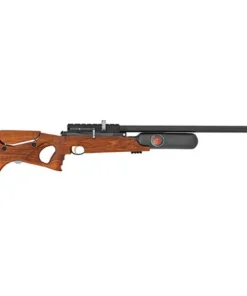
Hatsan produces several PCP configurations for shooters who prefer compact ergonomics without giving up barrel length. The hatsan bullboss is one example, while the bullmaster represents another recognizable bullpup-style platform. The hatsan hercules family is associated with higher-capacity PCP configurations, and the hatsan hercules bully provides a compact bullpup alternative within that broader design category.
The hatsan flash is another widely recognized PCP platform. Because hatsan flash configurations can vary, buyers should compare caliber, stock style, barrel arrangement, pressure system, and included equipment before purchase. The hatsan flashpup qe offers a bullpup-inspired format and is often considered by customers wanting a shorter overall rifle.
Other PCP-related searches include the hatsan invader, hatsan factor rc, and hatsan neutron star. Each platform serves a somewhat different purpose, which means specifications rather than appearance alone should determine which airguns are most appropriate for a particular type of sporting or recreational shooting.
Hatsan Jet 2 and Compact PCP Options
The hatsan jet 2 has attracted attention among customers looking for compact PCP versatility. Because the hatsan jet 2 may be configured differently depending on market and package, shoppers should verify the exact specifications supplied by the retailer. Searches for jet ii generally refer to the same Jet-series concept, while hatsan jet 2 accessories may include compatible magazines, optics solutions, carrying equipment, seals, and manufacturer-approved replacement components.
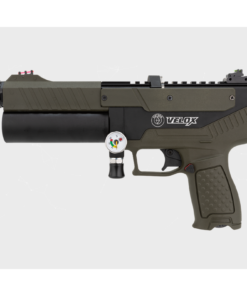
The hatsan velox is another compact platform that may appeal to customers researching modern PCP systems. However, compatible equipment should always be verified against the precise model designation rather than assuming accessories interchange across different Hatsan products.
Classic Hatsan Spring and Gas-Ram Air Rifles
Not every Hatsan buyer wants PCP equipment. Traditional spring-piston and gas-ram designs remain an important part of the catalog. The hatsan model 95 is among the best-known examples, while searches for hatsan mod 95 and simply mod 95 usually refer to the same established platform.
The hatsan 125 is another familiar full-size option. Meanwhile, the hatsan 135 is commonly researched by shooters interested in larger, more substantial break-barrel platforms. The hatsan 135 vortex air rifle incorporates Hatsan’s Vortex gas-piston concept, while the hatsan 135 carnivore is associated with larger-caliber configurations. Searches for a hatsan big bore carnivore rifle are similarly connected with users comparing large-bore air-powered platforms.
Additional traditional models include the hatsan mod 65, which appears in searches from buyers interested in full-size sporting configurations. The hatsan airtact air rifle, commonly shortened to hatsan airtact, represents another accessible platform. The hatsan zada also broadens the selection for customers comparing break-barrel designs.
Big-Bore Hatsan Models and Specialty Platforms
For customers researching large-bore PCP technology, the hatsan piledriver is one of Hatsan’s best-known specialized platforms. Large-bore air rifles occupy a different category from a conventional .177 caliber air pellet gun, so caliber, projectile compatibility, operating pressure, legal restrictions, and intended sporting use should all be carefully reviewed.
The hatsan harpoon is another specialized product name associated with Hatsan’s air-powered lineup. Because it functions differently from a conventional pellet rifle, buyers may encounter the phrase arrow launcher while researching this category.
These specialized products should not automatically be compared with a traditional pallet gun or standard pellet rifle because their operating systems, projectiles, dimensions, and intended uses can be substantially different.
Refurbished Hatsan Air Rifles and Replacement Parts
Budget-conscious customers sometimes search for hatsan refurbished equipment or refurbished air rifles. A refurbished product can offer good value when its condition, inspection history, seals, pressure system, warranty coverage, and included accessories are clearly disclosed.
Existing owners may instead require hatsan aftermarket parts. When replacing magazines, seals, fill probes, stocks, mounts, or other components, compatibility should always be matched to the precise rifle generation and caliber. Similar-looking parts should never automatically be assumed to fit every Hatsan platform.
Product names such as 1000x.25 may also appear when shoppers compare model or caliber-specific configurations, so confirming the manufacturer’s exact designation is particularly important.
Scopes, Pellets, and Air Rifle Accessories
Optics are another major consideration when configuring an air rifle. A basic 4×20 optic may be encountered in entry-level packages, and the term 4×20 is therefore frequently seen alongside airgun searches. However, optic selection should ultimately reflect the rifle’s mounting system, recoil characteristics, shooting distance, and intended use.
Pellet selection also matters. Products such as h&n field target trophy are widely recognized among airgun enthusiasts, while h&n field target trophy bleifrei refers to a lead-free option within that product family. Individual rifles may prefer different pellet weights and shapes, so consistency and accuracy should be evaluated with the manufacturer’s recommendations in mind.
The term crow magnum may also appear when users research heavier hunting-oriented pellet designs or related airgun ammunition. Ammunition compatibility must always be checked against the specific caliber and manufacturer’s specifications.
Choosing Between PCP, CO2, and Spring-Powered Airguns
A modern air pellet gun can use several different power systems. A PCP system stores compressed air inside a reservoir, while a spring-piston rifle relies on mechanical energy generated during cocking. A co2 pellet rifle, by contrast, uses carbon dioxide cartridges or a compatible CO2 supply.
Each system offers different advantages. PCP rifles may provide low recoil and repeatable operation, while spring-powered rifles avoid the need for external filling equipment. CO2 systems can offer convenient operation in compatible platforms, although performance may vary with temperature.
Customers researching the air rifle range should therefore consider much more than velocity figures. Ergonomics, caliber, overall length, weight, filling equipment, magazine design, maintenance requirements, noise level, available service support, and local regulations can all affect long-term ownership.
Hatsan Models for Different Airgun Preferences
With platforms such as the hatsan blitz, hatsan sortie, hatsan hercules, hatsan bullboss, hatsan flash, hatsan invader, hatsan piledriver, hatsan jet 2, hatsan velox, hatsan factor rc, hatsan airtact, and hatsan model 95, Hatsan covers a broad spectrum of airgun categories.
Some customers may prioritize a traditional sporting rifle, whereas others may prefer a compact PCP or bullpup. Shooters interested in sniper long style configurations may focus more strongly on stock ergonomics, optics mounting, stability, and longer-range target capability rather than simply choosing the most powerful model.
Meanwhile, terms such as econ ii may appear in accessory or product-related searches depending on the equipment being compared. Compatibility should always be established using the exact manufacturer and model specification.
Ultimately, selecting among hatsan air guns should begin with the intended application. A lightweight .177 caliber rifle may suit recreational target shooting, while a larger PCP platform can serve a very different sporting role. Models such as the hatsan blitz .30 cal, hatsan blitz 30 cal, or other 30 cal air rifle configurations should therefore be evaluated according to their specifications, local law, appropriate shooting environment, and intended lawful use.
From the compact jet ii and hatsan jet 2 to the established hatsan mod 95, powerful hatsan 135, specialized hatsan harpoon, and modern semi-auto PCP platforms, the Hatsan catalog gives airgun enthusiasts an extensive selection. Comparing specifications carefully helps buyers identify the right air rifle while ensuring that pellets, optics, filling equipment, magazines, and accessories remain correctly matched to the chosen platform.
Frequently Asked Questions
What firing modes are offered, and how is the change made?
Both semi-automatic and fully automatic fire are offered through a selectable mode switch. After the switch is rotated to the semi-automatic position, a single pellet is released each time the trigger is pressed, and the next pellet is then chambered by the air-operated cycle. When the switch is moved to the full-automatic position, pellets continue to be discharged for as long as the trigger is held and ammunition remains in the magazine. A cyclic rate of about one thousand rounds per minute can be reached under suitable pressure. Batteries are not required, because the cycle is driven by compressed air. A remaining pressure of approximately 100 BAR is needed before either automatic mode will function reliably.
Which calibres can be chosen, and how should a calibre be matched to a task?
Three chamberings are commonly listed: .22 (5.5 mm), .25 (6.35 mm), and .30 (7.62 mm). A flatter trajectory and a 21-pellet magazine are associated with .22, which is often preferred for small pests, practice, and moderate-range work. A middle balance of pellet mass and speed is associated with .25 and a 19-pellet magazine. Greater listed energy and a 16-pellet magazine are associated with .30, which is frequently considered when impact at closer ranges is prioritised. Local hunting and power rules must be checked before any calibre is used on quarry. Inclusive advice is offered: the “best” calibre is the one that matches legal limits, typical shooting distance, and the pellets that will actually be stocked.
How much power is produced, and how is FAC status understood?
Published muzzle energy figures of about 36 ft-lbs in .22, 41 ft-lbs in .25, and 53 ft-lbs in .30 are given for lead pellets under stated test conditions. In the United Kingdom, air rifles that exceed 12 ft-lbs are treated as firearms and are normally held on a Firearms Certificate, with storage and use conditions attached. Elsewhere, national energy limits, licensing, and rules on select-fire airguns differ. Therefore, official local guidance must be consulted; these notes are informational only and are not legal advice. Velocity and energy may vary by as much as 20 percent because pellet weight, shape, temperature, and altitude all influence results.
How many shots can be expected from one fill?
A 580 cc carbon-fibre bottle filled to a maximum of 250 BAR (3,625 PSI) is used. Published counts at optimal velocity are approximately 130 shots in .22, 110 in .25, and 100 in .30. “Optimal velocity” is generally understood as the portion of the fill that remains within a useful percentage of maximum speed. Full-automatic strings consume air faster than measured semi-automatic shots, so field counts are often lower when long bursts are fired. An integral colour-coded manometer is fitted so that remaining pressure can be observed before a session is started.
How is the rifle filled, and is a hand pump practical?
A fill probe is supplied so that charging from a suitable high-pressure compressor or scuba-style cylinder can be completed. Dry, clean air only must be used. Concentrated oxygen or other reactive gases must never be introduced, because a serious hazard would be created. A 250 BAR fill of this bottle volume is rarely practical with a stirrup pump, so a compressor or charged cylinder is normally planned as essential equipment. Overfilling beyond the marked maximum must be avoided.
What magazines are supplied, and how is reloading handled?
Two detachable SwingLoad rotary magazines are included. Capacities of 21, 19, and 16 pellets are listed for .22, .25, and .30 respectively. A winding tool is stored in the stock so that magazines can be prepared without extra kit being carried. Spare magazines are strongly recommended, because a full-automatic burst can empty a drum in seconds. Pellets of excessive length should not be forced; a maximum projectile length of about 12 mm is commonly cited for these magazines.
Is a regulator fitted?
A regulator is not listed as standard on this platform. Shot-to-shot velocity therefore follows the declining pressure curve of the bottle. More consistent groups in semi-automatic mode are usually obtained when a mid-fill pressure band is used and when identical pellets are selected. Full-automatic fire will show greater variation as pressure falls. A compressor with a reliable gauge and disciplined fill habits help keep performance predictable.
How is accuracy supported by the barrel and sights?
A 585 mm (23-inch) precision-rifled and choked barrel is enclosed in a QuietEnergy shroud so that pellet stability is improved and report is reduced. Open sights on a removable carry handle are supplied, with elevation adjustment at the front and adjustment for windage and elevation at the rear. A combination 11 mm dovetail and 22 mm Weaver/Picatinny rail is provided on the receiver so that a scope or red-dot sight can be mounted. Airgun-rated optics and correctly fitting rings should be chosen, because not every Weaver-style mount seats perfectly on every combination rail.
What accessory rails and support options are present?
Three Picatinny rails are positioned around the forearm bottle so that a bipod, light, laser, or vertical grip can be attached. Integrated sling swivels allow a two-point sling to be fitted. An elevation-adjustable cheek rest and an elevation- and angle-adjustable rubber butt pad are provided so that length of pull and eye alignment can be tailored. Rubberised pistol-grip panels are already fitted. Inclusive fitting is encouraged: small adjustments to comb height often improve comfort for shooters of different stature more than a change of optic alone.
How loud is the report, and can a moderator be added?
A medium report is typically described because a full shroud and integrated QuietEnergy system are already fitted. An extra moderator may be considered only where a muzzle thread is confirmed on the individual rifle and where local law permits additional silencing. Thread pitch must be verified before a silencer is purchased. Hearing protection is still recommended during full-automatic strings, even when a shroud is present.
What are the size and weight figures?
An overall length of 1,150 mm (45.2 inches) and an average weight of about 4 kg (8.8 lbs) without optic or accessories are published. The platform is therefore substantial. A sling, a rested position, or a bipod is often preferred for longer sessions. Vehicle transport and secure storage should be planned around the length of the assembled rifle and any fitted optic.
For which uses is this platform commonly chosen?
Semi-automatic fire is used when a single, careful shot is required. Full-automatic fire is used when volume, training tempo, or rapid follow-up on multiple pests is required and is lawful. Recreational plinking, range practice, and pest control are the roles most often described. Hunting use is lawful only where airguns of this energy, calibre, and action type are permitted for the quarry and season in question. Inclusive language is used because both new and experienced shooters can start in semi-automatic mode and add volume fire only after safe handling is established.
Are batteries or electronics required?
No batteries are required for cycling. The action is gas-operated. Reliability in cold or remote conditions is therefore less dependent on electrical parts. Mechanical cleanliness, correct lubrication as specified by the maker, and adequate air pressure remain the factors that keep the cycle working.
What maintenance is recommended?
The action and magazine path should be kept free of grit and crushed pellets. Periodic cleaning of the barrel, within the limits of a shrouded design, is advised. Seals and the breech area should be inspected if cycling becomes inconsistent, especially after dusty sessions or after a sudden change from full-automatic to semi-automatic-only behaviour. Only manufacturer-approved lubricants and dry air should be used. A log of fills and shot counts helps wear to be noticed early.
Which pellets are recommended?
Domed or hunting pellets of a weight suited to the chosen calibre are generally preferred for field use. Lightweight lead-free pellets may produce higher published velocities in .22 and .25, but grouping and terminal performance must be confirmed on paper before they are relied upon. Magazines and the transfer port are designed around a limited pellet length. Mixed brands in one magazine should be avoided if consistent cycling is required.
How should the safety be used?
A manual safety switch is fitted. The safety should be applied whenever the rifle is not being fired, during magazine changes, and during transport. The muzzle must be kept pointed in a safe direction at all times. Full-automatic mode multiplies the number of projectiles that can leave the barrel in a short interval, so backstops, target integrity, and bystander positions must be checked with extra care. Eye and hearing protection should be worn by everyone on the firing line.
What should be known before a first purchase?
A 250 BAR air source, quality pellets, at least one spare magazine, and a plan for legal storage are needed in addition to the rifle itself. An optic is optional at first because open sights are supplied, yet most users add a scope for hunting or precision practice. Local licensing, energy limits, and rules on automatic fire must be confirmed in writing where possible. Inclusive, conversion-focused advice remains simple: the platform rewards shooters who treat air, magazines, and the mode switch as a system rather than as isolated parts.
Can the stock be adjusted for different shooters?
Yes. Comb height can be raised or lowered so that a consistent cheek weld is obtained with iron sights or a scope. The rubber butt pad can be moved for height and angle so that recoil sensation and length of pull are improved. These adjustments should be made before groups are judged, because a poor weld is often mistaken for a barrel or pellet problem.
What is included in a typical carton?
Two magazines, a magazine winding tool stored in the stock, a fill probe, and a carry handle with open sights are commonly listed. Exact contents can vary by market and retailer, so the packing list on the invoice should be checked. A compressor, extra magazines, a sling, and an optic are usually purchased separately.
How should full-automatic fire be practised safely?
Short, controlled bursts are preferred over long dumps. A confirmed backstop, a clear downrange area, and a magazine that is known to be loaded with the correct pellets are required before the mode switch is moved. Trigger discipline in semi-automatic mode should be established first. Inclusive range etiquette applies to every shooter: volume fire is a privilege that depends on the same safety rules used for a single shot.



Reviews
There are no reviews yet.