Gamo Coyote PCP Gun – Design, Construction and Product Overview
The Gamo Coyote PCP Gun is a pre-charged pneumatic air rifle developed by Gamo. Traditional stock styling is combined with compressed-air technology, and a conventional rifle configuration is maintained throughout its construction. The model is associated with recreational target shooting in controlled environments where airgun ownership and use are legally permitted.
Gamo Coyote PCP Gun – Key Product Features
-
Pre-charged pneumatic (PCP) operating system
-
Traditional wooden stock configuration
-
Multi-shot magazine system
-
Integrated compressed-air reservoir
-
Conventional bolt-action design
-
Rifled barrel construction
-
Provision for compatible optical equipment
-
Model-dependent calibre configurations
-
Manufacturer-designed trigger mechanism
-
Integrated safety mechanism
Traditional Design and Construction
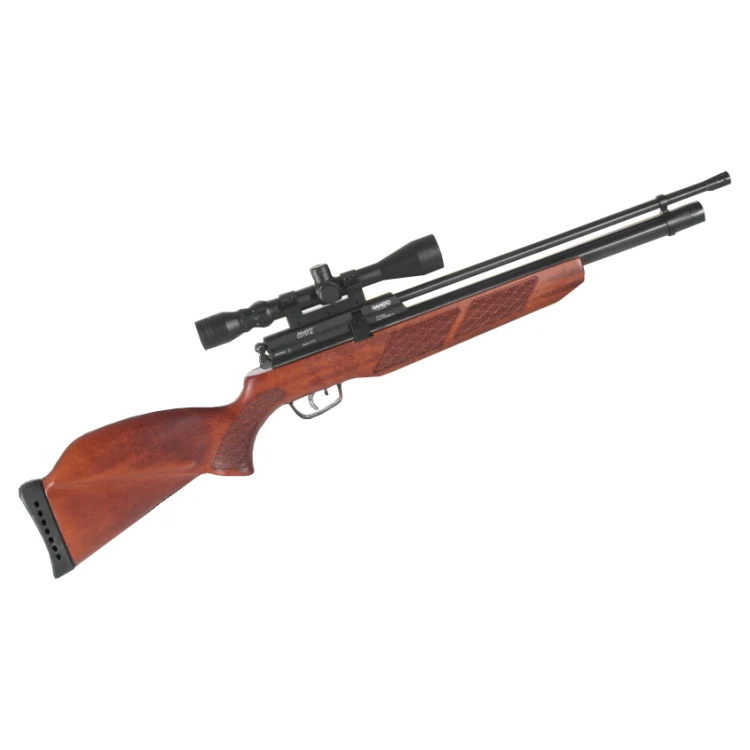
A traditional appearance is maintained through the wooden stock associated with the standard Coyote model. Furthermore, the stock is shaped around a conventional rifle configuration, while the compressed-air reservoir is positioned beneath the barrel.
Considerable attention is given to the relationship between the stock, action and external components. Additionally, the appearance is distinguished from the synthetic and tactical-style configurations found on certain other PCP air rifles.
Wooden Stock Configuration
A natural wood finish is incorporated into the standard configuration. However, variations in wood grain, surface appearance and colour may be observed between individual units.
The stock provides the supporting structure around the mechanical assembly. Moreover, its external finish should be protected from excessive moisture, prolonged sunlight and unsuitable cleaning chemicals.
Pre-Charged Pneumatic Technology
Compressed air is stored within an integrated reservoir rather than being generated through a conventional spring-piston mechanism. Consequently, the Gamo Coyote PCP Gun is classified within the pre-charged pneumatic airgun category.
The operating system is designed around factory-specified pressure limitations. Therefore, all inspection, servicing and reservoir maintenance should be conducted in accordance with the manufacturer’s documentation.
Product Information and Responsible Ownership
Before the Gamo Coyote PCP Gun is handled or used, the relevant manufacturer instructions should be reviewed. Appropriate eye protection, secure storage and a suitable controlled shooting environment should also be provided.
Furthermore, the applicable laws governing airgun possession, transportation and use must be observed. Local restrictions may vary according to jurisdiction, calibre, power classification and the owner’s age.
Technical Documentation
The following information should be confirmed against the documentation supplied with the particular model:
-
-
Factory power classification
-
Reservoir pressure limitations
-
-
Overall dimensions and weight
-
-
Manufacturer-approved maintenance requirements
Specification note: Exact configurations have not been independently verified here and may vary by market and production version.
Calibre Configurations, FAC Classification, Power and Accessories
Several technical considerations are associated with pre-charged pneumatic air rifles, including calibre designation, power classification, optical equipment and accessory compatibility. Furthermore, differences may be encountered between regional versions because manufacturing specifications and legal requirements vary internationally.
Understanding Calibre Configurations
Calibre refers to the nominal internal diameter of the barrel and the corresponding projectile designation. Different calibre configurations may be distributed depending on the intended market and applicable legislation.
Common air rifle calibre classifications include:
-
.177 (4.5 mm): A widely recognised airgun calibre.
-
.22 (5.5 mm): Another commonly encountered pneumatic air rifle calibre.
-
.25 (6.35 mm): A larger calibre designation available on certain PCP platforms.
However, not every calibre is necessarily offered for every model or market. Therefore, the manufacturer’s markings and official technical documentation should be consulted to establish the exact configuration.
FAC and Non-FAC Classification
FAC stands for Firearm Certificate in the context of British firearms legislation. Certain air rifles are classified differently according to their muzzle energy and the jurisdiction in which they are possessed.
In Great Britain, the commonly referenced threshold for air rifles is 12 foot-pounds of muzzle energy. Air rifles exceeding this threshold generally require a Firearm Certificate, although separate licensing requirements and regional differences must also be considered.
Furthermore, different regulations are applied internationally. A configuration that may be legally possessed without a firearm certificate in one jurisdiction could be restricted in another.
Understanding Air Rifle Power Ratings
Muzzle energy is commonly expressed in joules (J) or foot-pounds (ft-lb). These measurements are used to describe projectile energy and may also be referenced when legal classifications are determined.
The declared factory power rating should be confirmed through the manufacturer’s official documentation. Additionally, unauthorised adjustments to the pneumatic system should be avoided because mechanical safety, warranty coverage and legal compliance may be compromised.
Optical Equipment Compatibility
Optical equipment may be supported through the mounting interface incorporated into the rifle’s construction. Nevertheless, compatibility should be confirmed by an authorised technician or manufacturer representative.
The following characteristics may be referenced when optical equipment is documented:
-
Optical magnification classification
-
-
Mounting interface dimensions
-
Manufacturer compatibility information
-
External construction and finish
-
Protective and Maintenance Accessories
Appropriate protective accessories should be incorporated into responsible ownership arrangements. Moreover, manufacturer-approved maintenance products should be used to preserve the external condition of the equipment.
Protective Equipment
-
-
Secure, lockable storage cabinet
-
Protective transportation case
-
Manufacturer-approved external cleaning cloth
-
Protective storage covering
-
Original instruction and maintenance manual
Storage and Transportation Accessories
A suitable protective case may be used to reduce exposure to dust, moisture and accidental surface damage during lawful transportation. Furthermore, secure storage arrangements should be provided to prevent unauthorised access.
All applicable transportation regulations should be followed, particularly when equipment is transported across international borders.
Manufacturer-Approved Maintenance
Regular inspection should be performed according to the manufacturer’s recommendations. Pressurised components should only be serviced by appropriately qualified technicians.
Additionally, original documentation should be retained so that technical specifications, inspection requirements and warranty conditions can be referenced whenever necessary.
AirMaks Krait, Katran, Umarex Airguns and PCP Air Rifles: Complete Guide to Models, Features and Accessories
Exploring Modern Air Rifles and Compressed Air Technology
The modern air rifle market continues to expand as manufacturers introduce innovative designs, improved air-management systems, ergonomic configurations, and versatile shooting platforms. Consequently, enthusiasts researching airmaks krait, airmaks katran, and umarex airguns can discover a broad selection of recreational, competitive, and specialist air-powered equipment.
Compressed air, also described as komprimiran zrak in several European languages, plays an essential role in pre-charged pneumatic technology. Unlike conventional spring-powered systems, PCP rifles store compressed air inside a dedicated reservoir. This arrangement supports consistent operation without requiring a spring-powered piston for every shot.
What Does PCP Air Rifle Mean?
Many beginners ask, what does pcp air rifle mean? PCP stands for Pre-Charged Pneumatic, a system in which compressed air is stored inside the rifle before use.
Air-powered technology is also discussed alongside airrams, which use gas-piston mechanisms rather than conventional coiled springs. Each operating system offers different characteristics concerning maintenance, handling, and shooting experience.
Furthermore, customers searching for max air gun, air arm, arm max, or max arms often encounter broad terminology used across online marketplaces. Understanding manufacturer identities and product specifications is therefore essential.
AirMaks Krait: Compact Czech Airgun Engineering
The airmaks krait represents the modern bullpup approach to PCP air rifle construction. Its compact configuration makes it particularly interesting to enthusiasts who value ergonomic handling, adjustable components, and technical design.
Among established czech gun manufacturers, AirMaks has developed recognition for its pneumatic platforms. Searches involving airmaks, airmak, airma, and air marks may reflect different spellings or attempts to identify the manufacturer.
AirMaks Krait .22 Official Product Research
Customers researching airmaks krait .22 official information should consult verified manufacturer specifications before comparing individual configurations.
Additionally, searches for air max krait, krayt30, and mav max may appear alongside related model comparisons, although these terms should not automatically be treated as official product names.
Buyers should consider the following features:
- Ergonomic configuration: Compact designs and adjustable contact points.
- Air reservoir: Capacity, approved working pressure, and filling requirements.
- Trigger system: Factory adjustment options and safety provisions.
- Optics compatibility: Appropriate mounting systems and available rail space.
- Service support: Replacement seals, manuals, and manufacturer-approved components.
- Regional compliance: Local regulations governing ownership and use.
AirMaks Katran: Traditional Rifle Design and Versatility
The airmaks katran offers a contrasting configuration for customers who prefer conventional rifle ergonomics.
Interest in the airmaks katran .22 frequently involves questions about stock design, manufacturer specifications, available accessories, and maintenance requirements.
Similarly, the terms katran, katran air rifle, and akatran can appear in product searches. However, accurate model identification remains important because abbreviated terms may generate unrelated results.
Some customers also encounter katran llc while researching business names. This term should be distinguished from verified AirMaks manufacturer information.
Comparing AirMaks and Other Airgun Makers
When evaluating established air gun makers, consumers should prioritize documented specifications, warranties, spare-parts availability, and legitimate distribution channels.
Searches for gunmax, airmaxsex, and uramax can also produce ambiguous or unrelated results. Therefore, original manufacturer documentation offers a more dependable basis for product comparisons.
Umarex Air Rifles and Popular Pneumatic Platforms
Umarex air rifles cover multiple categories, including PCP systems, CO2-powered models, spring-powered equipment, and recreational designs.
The broader umarex usa product range includes platforms serving different experience levels and shooting disciplines. Customers may also use umarexusa when searching for the company’s American website.
Umarex Notos, Gauntlet, Origin and Zelos
The umarex notos has attracted interest as a compact PCP platform, while the umarex notos carbine and notos search terms often appear in discussions about portable recreational air rifles.
Meanwhile, the umarex gauntlet family includes several configurations designed around pre-charged pneumatic technology.
Related searches include umarex gauntlet 2 and umarex gauntlet 30, reflecting interest in different generations and calibre options.
Other recognizable models include umarex origin, umarex zelos, and umarex fusion 2.
For consumers exploring alternative operating systems, umarex komplete and umarex komplete ncr .22 are additional product terms worth researching through official documentation.
Umarex Synergis Elite and Trevox
The umarex synergis elite belongs to a different recreational air-rifle category, while the umarex trevox is associated with break-barrel air-pistol designs.
Queries such as umarex pistol break barrel and loading umarex trevox break barrel .177 indicate a need for manufacturer-approved operating instructions. Owners should consult the correct manual for loading, unloading, handling, and routine inspection.
Umarex Glock Replicas, BB Guns and Airsoft Pistols
Recreational enthusiasts frequently compare the umarex glock collection with other licensed replica platforms.
Popular search terms include glock bb gun, glock 19 bb gun, umarex glock 19, and umarex glock 19x.
The umarex glock 19 gen3 .177 caliber bb gun air pistol is another specific product description encountered in online catalogues.
Additionally, consumers researching the umarex glock 17, umarex glock 17 gen 5, and glock 19x bb gun should verify whether a listing describes a BB pistol or an airsoft replica.
Airsoft Glock and CO2 Replica Differences
An airsoft glock typically belongs to a different recreational category from a metal-BB air pistol.
Searches involving airsoft glock 19, glock 17 airsoft, airsoft glock 17, glock airsoft gun, and glock airsoft gas commonly relate to airsoft equipment and its approved operating systems.
Meanwhile, metal bb gun, bbgun, bb gun, bb gun pistol, and co2 pistol replica are broader product-search terms.
An airsoft pistol should never be assumed to share the same ammunition, operating pressure, or safety requirements as a conventional BB pistol.
Additional Umarex Replica Models
The umarex legends collection includes historically styled recreational replicas. Searches for umarex mp40, umarex mp5, and umarex hk heckler reflect interest in recognizable historical or licensed designs.
Similarly, umarex smith, umarex t4e smith, umarex dx17, and umarex h can appear in catalogue searches, although abbreviated names require careful verification.
Umarex T4E and Specialist Air-Powered Equipment
The umarex t4e family occupies a distinct market category from conventional precision pellet rifles.
Customers researching umarex tr50, umarex hdr 50, and umarex p2p dr50 how many joules should review the exact product generation and regional specification. Energy ratings can vary across versions and markets.
Likewise, searches for umarex hammer, umarex hammer .50 caliber, umarex hammer carbine, and 50 cal air rifle involve specialised big-bore equipment rather than ordinary recreational pellet pistols.
Other specialist product terms include umarex primal 20, umarex shotgun, umarex airsaber, and umarex air saber.
Because these platforms have different legal classifications and safety considerations, manufacturer guidance and applicable local regulations should always be consulted.
Pellet Pistols, CO2 Systems and Recreational Equipment
A pellet pistol may use spring, pneumatic, or CO2 power depending on its design.
Meanwhile, co2 pellet pistols are often selected for recreational target shooting because they offer straightforward cartridge-based operation.
Customers researching umarex bb gun options may also encounter listings such as amazon umarex browning 800 express. Retailer descriptions should always be checked against authentic manufacturer information.
Pest Control With Air Rifles: Responsible Product Selection
Interest in pest control with air rifles continues among property owners seeking information about lawful wildlife-management equipment.
Search phrases such as air rifle for pest control, air rifle pest control, pellet gun for pest control, and vermin control guns reflect this specialised market.
However, the best air rifle for pest control cannot be determined from brand popularity alone. Laws, species protections, animal-welfare requirements, and local permissions must first be considered.
Likewise, the best pellet gun for pest control should never be selected without verifying whether airgun use is lawful and appropriate. Licensed pest-management professionals can advise on humane and compliant approaches, including nonlethal prevention.
Choosing Reliable Airgun Information Online
Online searches sometimes produce unusual phrases such as hamster with gun, which may refer to internet humour rather than genuine airgun products. Such unrelated content should not influence purchasing decisions.
Whether comparing AirMaks PCP rifles, Umarex replicas, recreational pistols, or compressed-air accessories, customers benefit from accurate listings, transparent specifications, verified model identification, and reliable after-sales support.
Ultimately, informed purchasing depends on matching the product’s legitimate intended purpose with its documented features, applicable regulations, and safe operating requirements.
Frequently Asked Questions (FAQs)
1. What type of air rifle is this model?
This model is classified as a pre-charged pneumatic (PCP) air rifle. Compressed air is contained within an integrated reservoir, distinguishing its operating system from conventional spring-powered air rifles. A traditional stock and mechanical action are incorporated into its overall construction. Furthermore, specific configurations may differ depending on the country in which the model is distributed.
2. What material is used for the stock?
A traditional wooden stock is generally incorporated into the standard model. A natural appearance is provided by the wood grain, although minor differences in colour and texture may be observed between individual examples. Additionally, the wooden surface should be protected against excessive moisture, extreme temperatures and unsuitable cleaning products.
3. Is this air rifle manufactured with a magazine system?
A multi-shot magazine system is incorporated into the standard design. However, magazine specifications may differ according to the particular calibre and production version. Consequently, the manufacturer’s documentation should be consulted whenever replacement components are required. Only compatible and manufacturer-approved components should be used.
4. Is compressed air used instead of a traditional spring?
Yes. Compressed air is used as the primary energy source within the pneumatic operating system. Unlike conventional spring-piston designs, a separate compressed-air reservoir is incorporated into the construction. Nevertheless, the reservoir must be maintained and inspected according to the safety requirements established by the manufacturer.
5. Can this model be legally owned in every country?
Airgun ownership is regulated differently across individual countries and jurisdictions. In certain locations, licensing, registration and minimum age requirements may be imposed. Moreover, additional restrictions may be applied according to the model’s power classification. Therefore, current local regulations should always be consulted before ownership or transportation is considered.
6. Is a safety mechanism incorporated into the design?
A safety mechanism is incorporated into the model’s construction. Nevertheless, complete reliance should never be placed on a mechanical safety device. Responsible handling practices must be maintained at all times. Furthermore, the air rifle should always be treated as potentially loaded, regardless of the perceived condition of its mechanical components.
7. How should the wooden stock be maintained?
The external wooden surfaces should be protected from excessive humidity, direct sunlight and prolonged exposure to water. A soft, dry cloth may be used for general surface cleaning. However, abrasive materials and aggressive chemical products should be avoided. Manufacturer-approved maintenance procedures should be followed to protect the original finish.
8. Is professional servicing required?
Professional servicing may be required when mechanical wear, air leakage or component damage is identified. Because pressurised components are incorporated into the design, internal repairs should be conducted by a qualified technician. Additionally, unauthorised disassembly should be avoided, as damage, personal injury or warranty invalidation could result.
9. Can the air reservoir be replaced?
Reservoir replacement may be possible depending on the model’s construction and manufacturer support. Nevertheless, pressurised components must never be removed or modified without appropriate professional expertise. Any replacement should be performed by an authorised service provider using approved components. The manufacturer’s specified inspection and replacement intervals should also be observed.
10. Is protective equipment required during use?
Suitable eye protection should be worn whenever airguns are handled in an active shooting environment. Furthermore, additional protective equipment may be required under the rules of individual shooting facilities. Appropriate safety procedures should be communicated to everyone present, while unauthorised access to the shooting area should be prevented.
11. Can this model be stored outdoors?
Outdoor storage is generally discouraged because damage may be caused by moisture, dust and changing environmental conditions. Instead, a secure, dry storage location should be provided. Unauthorised access must be prevented, particularly where children are present. Moreover, all applicable storage regulations and manufacturer recommendations should be observed.
12. Are replacement components available?
Replacement components may be supported through authorised manufacturer service networks. Nevertheless, availability may be influenced by production dates, regional distribution arrangements and the exact model configuration. Compatibility should always be professionally confirmed before any mechanical component is replaced. Unapproved modifications should not be performed.
13. Is the original manufacturer’s manual important?
Yes. Essential safety information, maintenance requirements and model-specific technical details are included within the original manufacturer’s manual. Consequently, the documentation should be retained throughout the product’s ownership period. If uncertainty is experienced regarding a particular component, guidance should be obtained from the manufacturer or an authorised technician.
14. Can this model be transported internationally?
International transportation is subject to the regulations imposed by the departure, transit and destination countries. Additionally, separate restrictions may be imposed by airlines, courier companies and customs authorities. Relevant legal requirements must therefore be confirmed before transportation is arranged. Pressurised equipment may also be subject to specific transport regulations.
15. Is the external finish identical on every unit?
Minor differences may be observed between individual units, particularly where natural wooden materials are used. Variations in grain patterns, colour and surface texture are normal characteristics of wood. Furthermore, manufacturing revisions may be introduced over time. Accordingly, the appearance of a particular unit should be assessed individually.
16. What should be done if an air leak is detected?
Use should be discontinued immediately whenever unexpected air leakage is detected. The affected equipment should be kept in a secure location, and assistance should be requested from a qualified technician. Moreover, improvised repairs and unauthorised adjustments must be avoided because additional risks may be created by pressurised components.
17. Is a manufacturer warranty provided?
Warranty coverage may be provided according to the manufacturer’s regional policies and the conditions under which the product was originally distributed. However, coverage periods and exclusions may vary. Consequently, the original warranty documentation should be retained, while any servicing requirements and reporting procedures should be carefully reviewed.
18. Can the mechanical components be modified?
Unauthorised mechanical modifications are discouraged. Safety, legal compliance and structural integrity may be compromised when factory-designed components are altered. Furthermore, warranty coverage may be invalidated. Any necessary mechanical work should therefore be performed by an appropriately qualified professional following manufacturer-approved procedures.
19. How should the air rifle be protected against corrosion?
Exposure to excessive moisture and unsuitable environmental conditions should be minimised. External surfaces should be maintained according to the manufacturer’s care instructions. Additionally, signs of corrosion should be assessed by a qualified technician, particularly when damage is observed around pressurised or mechanically important components.
20. Is this model suitable for indoor environments?
Use should be restricted to appropriately designed and legally authorised shooting facilities. Ordinary residential rooms should not be assumed to provide suitable conditions. Furthermore, the safety of occupants, neighbouring properties and surrounding areas must be considered. All facility-specific safety requirements should be followed without exception.
21. Can the product be handled by children?
Access by children must be controlled in accordance with applicable laws and recognised safety requirements. Secure storage should be provided, and unauthorised handling must be prevented. Furthermore, age restrictions should be respected, and any permitted supervised activity must be conducted within an appropriate and lawful environment.
22. Does regular inspection help maintain its condition?
Regular professional inspection may help mechanical deterioration, corrosion and damaged components to be identified. Particular attention should be given to the condition of pressurised equipment. Nevertheless, inspection intervals should be determined from the manufacturer’s official recommendations rather than assumed from the appearance of the product.
23. Can damaged components continue to be used?
Damaged components should not be used. Mechanical failure or unexpected pressure release may be caused by deterioration, impact damage or inappropriate repairs. Therefore, use must be discontinued whenever structural damage is suspected. A professional assessment should be obtained before the equipment is returned to service.
24. Are all regional versions manufactured identically?
Differences may be introduced to comply with regional regulations and distribution requirements. Consequently, variations in technical specifications, markings and supplied documentation may be encountered. Information relating to a particular unit should therefore be confirmed using its original manufacturer identification and regional documentation.
25. How important is responsible ownership?
Responsible ownership is considered essential whenever pneumatic airguns are possessed, stored or transported. Appropriate precautions must be maintained, legal restrictions must be respected, and access by unauthorised individuals must be prevented. Above all, manufacturer instructions and established safety practices should be followed throughout the product’s service life.
Practical Use Scenarios
Recreational Target Shooting in Controlled Environments
Recreational target shooting is widely recognised as a structured sporting activity through which concentration, patience and personal discipline can be developed. Within an appropriately authorised shooting facility, participants can be introduced to established safety procedures and responsible equipment handling.
Furthermore, a controlled environment is provided through designated shooting areas, protective barriers and clearly established facility regulations. Unnecessary risks can consequently be reduced when these requirements are respected.
Before any recreational session is undertaken, the condition of the equipment should be professionally assessed. Suitable protective equipment should also be provided, while all participants should be informed about the relevant safety procedures.
Participation in Organised Sporting Activities
Organised shooting activities are frequently conducted through registered sporting clubs and authorised recreational facilities. Through these organisations, structured supervision and established safety standards are provided.
Moreover, participants may be introduced to sporting regulations, equipment inspection requirements and responsible ownership practices. A greater understanding of sporting etiquette can consequently be developed.
Depending on the facility, specific membership requirements may be imposed. Therefore, eligibility, local legislation and participation requirements should be confirmed beforehand.
Development of Personal Discipline
Considerable emphasis is placed on patience, concentration and emotional control within structured sporting environments. Through supervised participation, greater awareness of personal responsibility may be developed.
Additionally, unnecessary distractions should be minimised, while instructions provided by qualified supervisors must be followed carefully. A respectful attitude towards other participants should also be maintained.
Rather than being viewed solely as recreational entertainment, organised participation may be recognised as an opportunity for personal development and responsible decision-making.
Supervised Educational Activities
Educational opportunities may be provided through authorised sporting organisations where the principles of responsible ownership are explained. Particular attention can be given to equipment classifications, mechanical safety and applicable legislation.
Furthermore, participants may be introduced to the importance of protective equipment and secure storage arrangements.
All educational activities should be conducted under appropriate supervision. Consequently, unauthorised handling and inappropriate experimentation must be prevented.
Understanding Pneumatic Engineering
An educational appreciation of compressed-air technology may be developed through the examination of manufacturer-provided documentation.
Various engineering principles are associated with pneumatic equipment, including pressure containment, material selection and mechanical construction. Additionally, the importance of professionally maintained seals and structurally sound components can be recognised.
Nevertheless, internal components should never be dismantled for informal experimentation. Professional expertise must be obtained whenever technical inspection or servicing is required.
Participation in Sporting Club Events
Social interaction may be encouraged through participation in recognised sporting club events. Opportunities for discussion, education and responsible recreational engagement can be provided within these organised environments.
Furthermore, established codes of conduct are generally maintained by sporting organisations. Consequently, respectful communication and compliance with facility rules are expected from all participants.
Before attendance is arranged, registration requirements and equipment restrictions should be confirmed. Additionally, relevant transportation and storage regulations must be respected.
Responsible Equipment Ownership at Home
When sporting equipment is retained at a private residence, considerable importance must be placed on secure storage.
A suitable lockable storage arrangement should be provided, while access by unauthorised individuals must be prevented. Furthermore, exposure to excessive moisture, temperature fluctuations and direct sunlight should be minimised.
Ordinary residential spaces should not be assumed to provide suitable conditions for shooting activities. Instead, authorised facilities should be used whenever recreational participation is intended.
Seasonal Storage and Equipment Preservation
During periods when recreational activities are not undertaken, appropriate storage conditions should be maintained.
Environmental deterioration may be reduced when excessive humidity, dust and unsuitable temperatures are avoided. Additionally, external wooden surfaces should be protected against prolonged exposure to damaging environmental conditions.
Manufacturer-approved storage recommendations should always be followed. Moreover, periodic professional inspections may be arranged to identify potential deterioration before the equipment is returned to service.
Transportation to Authorised Facilities
When transportation to an authorised sporting facility is arranged, appropriate legal requirements must be observed.
A suitable protective case may be used to minimise accidental external damage. Furthermore, transportation documentation should be retained whenever required by local regulations.
Different restrictions may be imposed across national and regional boundaries. Consequently, transportation requirements should be independently confirmed before any journey is undertaken.
Special attention should also be given to regulations associated with pressurised equipment.
Professional Equipment Inspection
Regular professional inspection is considered an important element of responsible ownership. Through appropriate assessment, external damage, material deterioration and mechanical defects may be identified.
Furthermore, potential concerns associated with compressed-air containment can be assessed by qualified technicians.
Whenever unusual mechanical behaviour or visible damage is detected, recreational activities should be discontinued. An authorised service provider should subsequently be consulted before further use is considered.
Preservation of Wooden Components
Natural wooden components may be affected by environmental conditions throughout their service life. Consequently, appropriate care should be provided to preserve their external appearance and structural condition.
Excessive moisture, abrasive cleaning materials and unsuitable chemical treatments should be avoided. Additionally, prolonged exposure to direct sunlight should be minimised wherever possible.
Manufacturer-approved external maintenance procedures should be followed. Through suitable preservation practices, unnecessary surface deterioration may be reduced.
Development of Sporting Etiquette
A respectful sporting environment can be maintained when established behavioural expectations are observed. Attention should be given to the instructions provided by supervisors, while the personal space and safety of other participants must be respected.
Moreover, equipment should never be handled without appropriate authorisation.
Through consistent adherence to sporting etiquette, an orderly recreational environment may be established. Consequently, participation can be conducted with greater consideration for the safety and comfort of everyone present.
Equipment Documentation and Record Keeping
Original manufacturer documentation should be retained throughout the ownership period. Important information concerning legal classification, maintenance requirements and warranty provisions may be contained within these documents.
Additionally, professional inspection records and relevant ownership documentation should be securely maintained.
When servicing is required, accurate records may be provided to qualified technicians. Consequently, the identification of the original configuration and previous maintenance history may be simplified.
Participation During Different Seasons
Recreational activities may be organised throughout different seasons, depending on facility availability and environmental conditions.
However, additional precautions may be required during periods of excessive rainfall, humidity or extreme temperatures. Furthermore, facility restrictions may be introduced whenever unsuitable environmental conditions are experienced.
The condition of protective equipment and storage arrangements should also be reviewed periodically.
Responsible Participation in Outdoor Facilities
Outdoor sporting facilities may be operated under specific safety regulations and environmental requirements. Clearly designated boundaries and controlled access should be maintained by facility operators.
Furthermore, recreational activities should be restricted to authorised areas. Surrounding properties, wildlife, public pathways and neighbouring communities must be protected from unnecessary risks.
All instructions issued by facility supervisors should be observed, while activities should be discontinued whenever unsafe conditions are identified.
Understanding Regional Legal Requirements
Different legal classifications may be applied to pneumatic sporting equipment across international markets. Depending on the jurisdiction, licensing, registration, age restrictions and transportation requirements may be imposed.
Consequently, current legislation should be reviewed before ownership or recreational participation is considered.
Furthermore, assumptions based on regulations from another country should be avoided. Accurate information should instead be obtained through relevant government authorities or qualified legal professionals.
Safe Management Around Children and Visitors
Additional precautions must be maintained whenever children or visitors are present within a household where sporting equipment is stored.
Unauthorised access should be prevented through suitable security arrangements. Furthermore, storage keys and access mechanisms should be controlled by responsible adults.
Appropriate awareness of household safety should be maintained without encouraging unsupervised handling. Through responsible storage arrangements, unnecessary exposure to hazardous equipment can be reduced.
Warranty and Aftercare Considerations
Warranty documentation should be reviewed so that applicable coverage conditions can be understood. Certain exclusions may be applied when unauthorised modifications, inappropriate maintenance or accidental damage are identified.
Additionally, professional servicing requirements may be specified by the manufacturer.
Whenever a mechanical concern is experienced, assistance should be obtained through an authorised service provider. Original documentation and relevant inspection records should also be retained for future reference.
Environmental Responsibility
Environmental responsibility should be maintained whenever organised recreational activities are undertaken.
Waste materials should be disposed of through appropriate channels, while unnecessary contamination of natural environments must be prevented. Furthermore, local conservation regulations and facility-specific environmental policies should be respected.
Recreational participation should never be conducted in a manner that places protected wildlife, neighbouring communities or public spaces at unnecessary risk.
Long-Term Ownership and Maintenance Planning
A structured maintenance approach may be established throughout the ownership period. Professional inspection appointments can be arranged according to manufacturer recommendations, while relevant documentation should be retained.
Additionally, secure storage arrangements should be periodically reviewed to ensure that appropriate conditions are maintained.
Consideration should also be given to potential material deterioration over time. Consequently, professional assessment should be requested whenever concerns regarding structural integrity are identified.
Responsible Participation as a Long-Term Recreational Activity
When sporting activities are undertaken over an extended period, continued attention should be given to safety awareness, legal compliance and personal responsibility.
Furthermore, changes in regional legislation and facility regulations should be monitored. Appropriate educational opportunities may also be provided through recognised sporting organisations.
Above all, recreational participation should be conducted within authorised environments where established safety procedures, responsible behaviour and professional supervision are maintained.

Reviews
There are no reviews yet.