Gamo Maxxim Elite Swarm Tactical Multishot Kit – Features, Specifications and Design Overview
Gamo Maxxim Elite Swarm Tactical Multishot Kit Overview
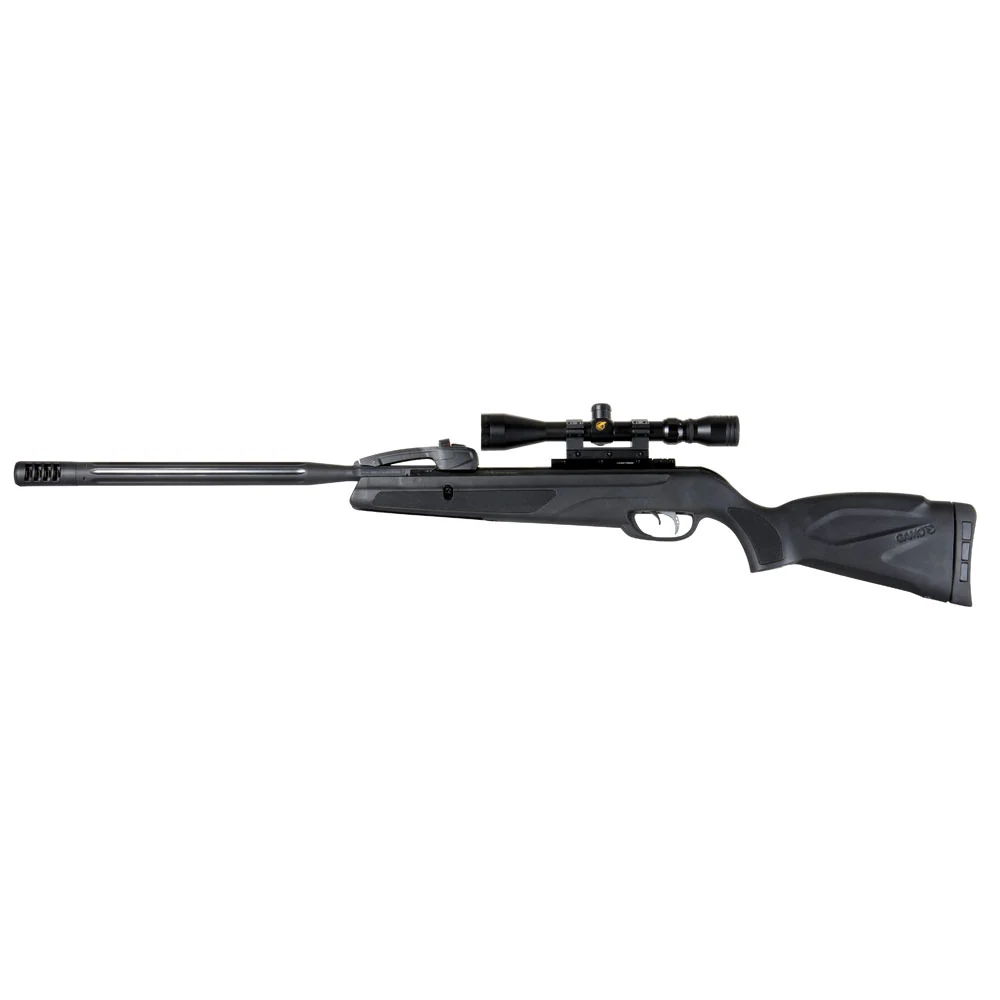
The Gamo Maxxim Elite Swarm Tactical Multishot Kit is a gas-ram-powered, break-barrel air rifle package developed by Spanish airgun manufacturer Gamo. A distinctive combination of a 10-shot magazine system, synthetic tactical stock, integrated barrel shroud, and telescopic sight is incorporated into its design.
Unlike conventional single-shot break-barrel air rifles, the Maxxim Elite Swarm Tactical uses a magazine-fed loading arrangement. Consequently, the operating mechanism differs from traditional break-barrel models, although manual cocking is still required between shots.
Additionally, a durable black synthetic stock is fitted, giving the rifle its recognizable tactical appearance. The configuration is intended to accommodate both right-handed and left-handed users through an ambidextrous stock design.
Key Product Features and Specifications
- Manufacturer: Gamo
- Product Name: Gamo Maxxim Elite Swarm Tactical Multishot Kit
- Air Rifle Type: Break-barrel air rifle
- Power System: Gas-ram / Gas Ram System (GRS)
- Available Calibres: .177 (4.5 mm) and .22 (5.5 mm)
- Magazine Capacity: 10 pellets per magazine
- Included Magazines: Two 10-shot magazines
- Stock Material: Black synthetic polymer
- Stock Configuration: Ambidextrous tactical design
- Cheekpiece: Fixed, non-adjustable
- Barrel: Shrouded barrel
- Optical Sight: Gamo 3–9×40 scope
- Scope Mounts: Included in commonly listed kits
- Safety Mechanism: Manual safety
- Trigger: Two-stage adjustable trigger, as described in published reviews
- Overall Length: Approximately 114–117 cm, depending on specification source
- Weight: Approximately 2.9 kg in a published Tactical model review
- Power Rating: Varies according to market, calibre, and configuration
Specifications should be checked against the exact manufacturer’s product code. Package contents and regulatory power limits may vary by country.
Gas-Ram Technology and Mechanical Design
Understanding the Gamo Gas Ram System
A gas-ram powerplant is incorporated into the Gamo Maxxim Elite Swarm Tactical Multishot Kit instead of the conventional coiled mainspring arrangement found in many traditional break-barrel rifles.
Within this mechanism, compressed gas is used as part of the internal energy-storage system. As a result, a different mechanical operating cycle is produced compared with conventional spring-piston designs.
Furthermore, the rifle remains manually operated. Electrical power, disposable CO₂ cartridges, and external PCP charging equipment are not required for its standard operating mechanism.
The gas-ram system represents one of the principal engineering characteristics distinguishing this model from other airgun categories.
Break-Barrel Configuration
A conventional break-barrel architecture is retained despite the addition of a magazine system.
The barrel assembly and loading mechanism are integrated into a manually operated platform. Meanwhile, the internal gas-ram system supplies the energy associated with the firing cycle.
Because the air rifle is mechanically powered, its configuration differs significantly from pre-charged pneumatic systems that rely on a refillable high-pressure air reservoir.
Gamo Multishot Magazine System
Integrated 10-Shot Magazine Design
The Gamo Maxxim Elite Swarm Tactical Multishot Kit features a 10-shot magazine arrangement associated with Gamo’s Swarm product family.
A rotary magazine is positioned above the breech within a dedicated magazine-support assembly. Additionally, two magazines are commonly supplied in the complete kit, providing a combined magazine capacity of 20 pellets.
Although multiple pellets can be held in the magazines, the rifle is not a semi-automatic firearm. A separate manual cocking cycle is required for each shot.
This distinction is important when comparing multishot break-barrel systems with other airgun operating mechanisms.
Magazine Compatibility Considerations
Magazine compatibility is determined by the rifle’s model generation, calibre, and specified magazine design.
Consequently, magazines intended for other Gamo Swarm variants should not automatically be assumed to be interchangeable.
Only components approved for the exact model and calibre should be considered compatible. Furthermore, the manufacturer’s instructions should be consulted when identifying replacement magazines.
Tactical Synthetic Stock and External Construction
Black Polymer Stock
A black synthetic polymer stock is fitted to the Tactical version of the Maxxim Elite Swarm.
In contrast to the wooden-stock Maxxim Elite variants, the Tactical configuration uses a molded synthetic exterior. As a result, its appearance and material characteristics differ from those of traditional beech-stock models.
The stock incorporates a fixed cheekpiece and rear butt pad. Moreover, its ambidextrous design accommodates different dominant-hand preferences.
Importantly, the Tactical version should not be confused with selected wooden-stock variants featuring an adjustable cheekpiece.
Surface Texture and Grip Areas
Textured grip surfaces are incorporated into the stock’s exterior design.
Additionally, the molded construction provides a consistent black finish across the main stock assembly. The polymer material also differs from natural wood in its moisture response and routine surface-care requirements.
However, synthetic construction does not eliminate the need for regular inspection, appropriate storage, or responsible maintenance.
Barrel Shroud and Optical Components
Full-Length Barrel Shroud
A shrouded barrel configuration is included on the Gamo Maxxim Elite Swarm Tactical Multishot Kit.
The surrounding shroud forms part of the rifle’s recognizable exterior profile. Furthermore, it is associated with Gamo’s sound-moderating design approach.
Actual sound levels depend on the specific configuration, ammunition, environment, and measurement conditions. Therefore, claims of completely silent operation should not be made.
Included 3–9×40 Scope
A Gamo 3–9×40 telescopic sight is commonly included with the complete package.
The numerical designation identifies a variable magnification range of three to nine times and a nominal objective-lens diameter of 40 millimetres.
Scope mounts are also generally supplied with the kit. Nevertheless, the exact optic and mounting components should be confirmed against the individual retailer’s package specification.
Additionally, a scope-only sighting arrangement is identified in published descriptions of the Tactical model.
Calibre Options and Market Variations
.177 and .22 Configurations
The Gamo Maxxim Elite Swarm Tactical is listed in both .177 and .22 calibre configurations.
The .177 version is associated with a nominal pellet diameter of 4.5 mm, whereas the .22 version uses a nominal diameter of 5.5 mm.
These calibre designations identify different pellet dimensions rather than different stock designs.
Furthermore, the magazine and ammunition specifications must correspond to the calibre marked on the individual rifle.
Power Ratings and Regional Requirements
Air rifle power ratings are influenced by regional product configurations and applicable regulations.
For example, certain UK listings describe models with an approximate muzzle-energy rating of 11.5 ft-lb. However, the exact rating should not be generalized to every internationally distributed version.
Accordingly, product identification, legal classification, and manufacturer’s documentation should be verified for the intended market.
Maintenance, Storage and Responsible Ownership
Routine Exterior Care
Regular exterior care is recommended for maintaining the condition of the synthetic stock and exposed metal surfaces.
Dust and ordinary surface contaminants can be removed using appropriate non-abrasive materials. Meanwhile, unsuitable solvents should be avoided because they may damage polymer components or protective finishes.
Any internal servicing should be performed according to the manufacturer’s instructions or by a qualified airgun technician.
Safe Storage Practices
The Gamo Maxxim Elite Swarm Tactical Multishot Kit should always be treated as a potentially dangerous airgun.
Whenever it is not in authorized use, it should be unloaded, secured against unauthorized access, and stored in accordance with local laws.
In addition, the magazines and pellets should be kept securely, especially where children or other unauthorized individuals might gain access.
Relevant licensing, transport, age-restriction, and ownership requirements must also be checked before possession or use.
Calibres, FAC Power, Scope Specifications and Compatible Accessories
Available Calibres: .177 and .22
Two principal calibre configurations are offered for this multishot gas-ram air rifle: .177 (4.5 mm) and .22 (5.5 mm). Although both variants share the same general tactical appearance, their barrel dimensions, magazine specifications, and compatible pellets differ.
.177 Calibre (4.5 mm)
The .177 configuration features a nominal barrel calibre of 4.5 mm and is designed for compatible .177 airgun pellets.
Furthermore, the magazine system is manufactured to accommodate the corresponding projectile diameter. As a result, magazines intended for other calibres should not be treated as interchangeable.
Important specifications include:
- Calibre: .177 / 4.5 mm
- Powerplant: Gas-ram system
- Magazine Capacity: 10 pellets
- Operating Mechanism: Manual break-barrel
- Stock: Black synthetic polymer
- Power Rating: Dependent on regional configuration
.22 Calibre (5.5 mm)
Alternatively, the .22 configuration accommodates pellets with a nominal diameter of 5.5 mm.
While the external rifle design remains similar, the internal barrel dimensions and compatible magazine components differ from the .177 version.
Key characteristics include:
- Calibre: .22 / 5.5 mm
- Powerplant: Gas-ram mechanism
- Magazine Capacity: 10 pellets
- Barrel: Shrouded construction
- Stock Design: Ambidextrous synthetic
- Power Rating: Subject to manufacturer and regional specifications
FAC and Non-FAC Power Configurations
What Does FAC Mean?
FAC stands for Firearm Certificate, a term associated with firearms licensing in Great Britain.
In England and Wales, an air rifle exceeding 12 foot-pounds of muzzle energy is generally classified as requiring a firearm certificate, subject to the applicable legal framework.
Consequently, the term FAC does not describe a universal international power rating. Instead, it identifies a legal classification relevant to particular jurisdictions.
Different requirements apply in Scotland and Northern Ireland, where airgun licensing rules must also be considered.
Standard Power Specifications
Certain UK-market configurations are described as operating below the 12 ft-lb threshold.
However, the precise factory-rated muzzle energy can vary between product versions and manufacturing specifications.
Additionally, power ratings advertised for other Gamo models should not automatically be attributed to this rifle.
For accurate product information, the exact factory specification should be confirmed using the individual product code.
FAC-Rated Versions
Higher-powered air rifles may fall within FAC-regulated categories in jurisdictions using that classification.
Nevertheless, the availability of a higher-powered version of this exact model should be verified rather than assumed.
Factory-authorized configurations, legal classifications, and manufacturer documentation must be considered when evaluating any such designation.
Unauthorized power modifications should be avoided because they can create mechanical hazards and change the rifle’s legal status.
Included Optical Sight and Scope Compatibility
Factory-Supplied Gamo 3–9×40 Scope
A Gamo 3–9×40 telescopic sight is commonly included with the complete package.
The scope designation identifies its optical characteristics:
- Magnification: Variable 3× to 9×
- Objective Lens Diameter: 40 mm
- Scope Type: Telescopic optical sight
- Mounting Hardware: Commonly supplied with the kit
- Manufacturer: Gamo
Furthermore, published product descriptions identify a one-piece mount in certain packages.
The factory scope represents an important part of the complete kit specification, although the contents should always be verified against the particular retailer’s product listing.
Replacement Scope Considerations
Before selecting a replacement optical component, its manufacturer-approved compatibility should be established.
Particular attention should be given to the mounting interface, available clearance, and compatibility with the recoil characteristics of a gas-ram break-barrel air rifle.
Additionally, warranties and installation requirements should be reviewed.
Rather than assuming all telescopic sights are interchangeable, the manufacturer’s approved accessory information should be used to identify suitable replacements.
Recommended Maintenance and Storage Accessories
Protective Rifle Case
A padded rifle case provides protection during lawful transportation and storage.
Furthermore, suitable interior padding helps protect external finishes and optical components from incidental contact.
Case dimensions should be checked against the complete rifle, including any fitted scope.
Secure Storage Cabinet
A lockable cabinet or appropriate security-rated storage container is an important accessory for responsible ownership.
In addition, access should be restricted to authorized individuals.
Local legal requirements should determine the appropriate storage arrangement.
Microfiber Cleaning Cloth
A soft microfiber cloth can be used for routine exterior cleaning.
Moreover, suitable non-abrasive cleaning materials help preserve the appearance of the synthetic stock and exposed surfaces.
Manufacturer-approved cleaning products should be selected to avoid damage to protective finishes.
Protective Optical Lens Covers
Compatible lens covers help shield the telescopic sight’s exposed glass surfaces from dust and incidental contact.
However, the correct dimensions must be established before selecting replacement covers.
Compatible Replacement Magazines
Replacement magazines must correspond to the exact model generation and calibre.
Because magazine designs differ between Gamo product generations, compatibility should be verified using the manufacturer’s replacement-part references.
Essential Product and Accessory Summary
| Component |
Specification |
| Available calibres |
.177 and .22 |
| Power system |
Gas ram |
| Magazine system |
10-shot multishot |
| Commonly supplied scope |
Gamo 3–9×40 |
| Scope mounting |
Included in many kit configurations |
| FAC classification |
Depends on power rating and jurisdiction |
| Stock construction |
Synthetic polymer |
| Maintenance accessory |
Non-abrasive cleaning cloth |
| Storage accessory |
Lockable cabinet |
| Transport accessory |
Appropriately sized protective case |
Final Considerations
Understanding the relationship between calibre, factory power rating, optical components, and accessory compatibility is essential when reviewing this rifle’s technical specifications.
Both calibre variants retain the platform’s recognizable gas-ram mechanism and magazine-fed break-barrel architecture. Nevertheless, their ammunition and magazine requirements remain distinct.
Moreover, regional power restrictions may affect which configurations are legally available.
Finally, suitable protective accessories, manufacturer-approved replacement components, and secure storage arrangements contribute to responsible long-term ownership.
For complete accuracy, the individual rifle’s product code, factory documentation, and applicable local regulations should always take precedence over generalized specifications.
Gamo Maxxim Elite Swarm Tactical Multishot Kit – Final Overview
The Gamo Maxxim Elite Swarm Tactical Multishot Kit combines several recognizable features of the Gamo Swarm family within a single break-barrel configuration.
Its gas-ram powerplant, 10-shot magazine system, black polymer stock, fixed cheekpiece, barrel shroud, and commonly supplied 3–9×40 scope define the product’s principal characteristics.
Furthermore, the availability of .177 and .22 variants reflects different calibre specifications within the same general product family.
For accurate product identification, particular attention should be given to the rifle’s exact model designation, magazine generation, calibre, regional power rating, and included kit components.
Together, these details provide a comprehensive technical overview of the Gamo Maxxim Elite Swarm Tactical Multishot Kit and distinguish it from conventional single-shot break-barrel air rifles and other Gamo Swarm models.
FX Airguns, PCP Air Rifles, Hatsan Models and Modern Airgun Platforms
Modern airguns cover a wide range of platforms, from a basic pellet gun or BB gun to sophisticated regulated PCP airguns designed for target shooting, sporting applications, and long-range precision. Buyers researching an air rifle and air pistol collection will often encounter manufacturers such as FX and Hatsan because both companies offer extensive selections of air rifles, accessories, configurations, and caliber choices.
FX Airguns Sweden and the FX PCP Rifle Range
FX Airguns has become strongly associated with Swedish airgun engineering. Searches for fx airguns sweden, fx airguns sverige, fxairguns, and fx usa commonly lead enthusiasts toward the manufacturer’s extensive PCP lineup. In the American market, fx airguns usa is another widely searched phrase when people are researching available models, specifications, support, and accessories.
Among fx air rifles, the Impact family remains particularly recognizable. Searches frequently include fx impact, f x impact, fx impact m4, fx m4, impact m4 air rifle, and impact m4 500mm when comparing current configurations. The modular design philosophy associated with the Impact platform has helped make the fx air rifle range popular among shooters who appreciate adjustability and configurable PCP systems.
Earlier generations remain widely researched as well. The fx impact m3, impact m3, fx impact mk3, fx m3, and fx m3 airgun continue to attract attention from owners comparing generations or researching replacement components.
Caliber-specific searches include fx impact m3 .22cal air rifle, fx impact m3 .22cal air rifle. 600mm barrel, and the more general fx impact m3 air rifle. People comparing international pricing may also search fx impact m3 precio, fx impact m3 precio en usa, or fx impact m3 price before checking local regulations, specifications, and availability.
Beyond the Impact series, the FX catalog includes several distinctive designs. The fx leopard and fx leopard airgun are frequently researched alongside fx leopard .22 pcp specs by users interested in specifications and configuration details.
Other notable searches include fx drs, fx drs tactical, fx drs classic, and fx drs pro. These terms reflect interest in the different DRS configurations and their intended shooting styles.
The wider FX family also includes models such as the fx king, fx wildcat, fx panthera, and fx dreamline. Collectively, these platforms demonstrate the variety available to anyone researching a premium pcp air rifle, pellet rifle, or configurable precision air gun.
Some enthusiasts also search fx outdoors when researching outdoor shooting equipment and related products, while marketplaces and information sources such as guns.com may appear during broader online research.
Understanding Pellet Guns and PCP Air Rifles
A traditional pellet gun uses shaped pellets rather than conventional firearm ammunition. The broader term pellet guns can describe spring-powered, CO₂-powered, pneumatic, and PCP platforms.
A PCP air rifle stores compressed air inside a reservoir. This system can provide consistent pressure across multiple shots depending on the rifle’s regulator, reservoir capacity, caliber, and power configuration.
For shooters comparing ammunition sizes, .177 caliber remains one of the most common options. Larger configurations are also available, including the increasingly searched 30 cal air rifle category.
Some users accidentally search pallet gun when looking for pellet-powered equipment. Regardless of terminology, specifications such as energy output, caliber, barrel length, intended range, and local legal requirements should always be reviewed before use.
The practical range of air rifle platforms varies significantly. Pellet weight, velocity, environmental conditions, barrel design, optics, and shooter technique can all affect useful range and accuracy.
Hatsan Air Rifle and PCP Platforms
The hatsan air rifle lineup covers traditional spring-powered designs as well as modern PCP systems. Searches such as hatsanusa, hatsan usa, hatsan air guns, and hatsan pcp are commonly used by enthusiasts researching the company’s models.
One of the most recognizable platforms is the hatsan blitz. Search variations include hatsun blitz, hatzan blitz, hatsan blitz full automatic, hatsan blitz 30 cal, and hatsan blitz .30 cal. Specifications and legal classifications can vary by market, so owners should verify the rules applicable in their jurisdiction.
Another frequently researched model is the hatsan model 95, also searched as hatsan mod 95 and mod 95. This traditional air rifle platform remains familiar to shooters interested in conventional stock designs.
The hatsan 125 is another established model, while the hatsan 135 family attracts shooters researching powerful spring-piston platforms. Related searches include hatsan 135 vortex air rifle, hatsan 135 carnivore, and hatsan big bore carnivore rifle.
Hatsan Sortie, BullBoss and Bullpup Designs
Compact and semi-automatic PCP designs form another part of Hatsan’s catalog. The hatsan sortie is commonly researched alongside hatsan sortie tact, hatsan sortie tact semi-auto pcp, and hatsan sortie accessories.
Bullpup enthusiasts may encounter the hatsan bullboss, bullmaster, and hatsan hercules bully. Their compact layouts are designed to reduce overall length while maintaining useful barrel dimensions.
Other PCP models include the hatsan flash, hatsan flashpup qe, and hatsan invader. These rifles provide additional choices for people comparing conventional and bullpup PCP configurations.
Hatsan Hercules, Piledriver and Large-Caliber Platforms
For people researching larger airgun platforms, hatsan hercules and hatsan piledriver often appear in search results. Large-bore air rifles differ considerably from standard .177 and .22 pellet rifles in projectile size, power output, air consumption, and intended application.
The hatsan harpoon is associated with specialized projectile launching, while an arrow launcher represents another distinct air-powered category. Such equipment can be subject to different legal rules depending on location, so local regulations should be checked before ownership or use.
Additional Hatsan Models
The Hatsan catalog extends well beyond its best-known rifles. The hatsan airtact and hatsan airtact air rifle provide another entry point into the brand’s conventional rifle selection.
Other searches include hatsan zada, hatsan neutron star, hatsan factor rc, hatsan velox, and hatsan jet 2. Each platform serves a somewhat different role, making specifications such as caliber, reservoir capacity, operating system, barrel configuration, and overall dimensions important comparison points.
Shoppers researching discounted equipment may also encounter hatsan refurbished listings or broader searches for refurbished air rifles. Condition, warranty coverage, seals, regulators, reservoirs, and service history should be checked carefully when evaluating previously used or factory-refurbished equipment.
Airgun Optics, Pellets and Accessories
Accessories can significantly affect how an air rifle is configured. A compact 4×20 optic may suit basic shooting applications, while more advanced PCP rifles are frequently paired with adjustable optics.
Pellet choice also matters. Products such as h&n field target trophy bleifrei provide an option for shooters specifically researching lead-free projectile designs. Pellet diameter, weight, head size, and barrel compatibility should all be considered when evaluating accuracy.
Terms such as econ ii may also appear when researching airgun-related equipment and accessories. Compatibility should always be verified against the exact manufacturer, model, and specification rather than relying solely on a product name.
Comparing FX and Hatsan Air Guns
FX and Hatsan approach the modern air rifle market from different directions. FX is particularly well known for highly configurable PCP platforms such as the Impact, Panthera, Wildcat, Dreamline, Leopard, DRS, and King. Hatsan, meanwhile, maintains an exceptionally broad range spanning spring-powered rifles, PCP systems, bullpups, semi-automatic platforms, and larger-caliber airguns.
Whether researching an FX Impact M3, FX Impact M4, FX DRS, Hatsan Blitz, Hatsan Sortie, Hatsan Hercules, or another platform, specifications should be compared carefully. Caliber, operating pressure, reservoir capacity, barrel length, projectile compatibility, optics mounting, overall dimensions, energy output, and regional legal requirements can all influence which configuration is appropriate for a particular lawful sporting or target-shooting application.
Frequently Asked Questions About Calibres, FAC Power, Scopes and Accessories
1. What calibre options are available for this air rifle?
Two principal calibre options are available: .177 (4.5 mm) and .22 (5.5 mm). Both configurations incorporate the same general gas-ram-powered, break-barrel architecture, although their barrel dimensions and ammunition compatibility differ.
Furthermore, each version requires magazines specifically designed for its calibre. Consequently, components manufactured for one calibre should not be assumed compatible with the other.
Regional availability may also vary because airgun regulations and distributor inventories differ between countries.
Before selecting a particular version, the manufacturer’s identification markings and technical documentation should be reviewed to confirm its exact specifications.
2. What is the difference between .177 and .22 calibre?
The primary distinction involves projectile diameter. A .177 airgun uses nominally 4.5 mm pellets, whereas a .22 airgun uses nominally 5.5 mm pellets.
Additionally, the compatible barrels and magazines are manufactured to accommodate these different dimensions.
Although both calibre configurations can share an identical external design, their technical specifications should be evaluated separately.
Importantly, calibre alone does not establish muzzle energy, accuracy, or legal classification. These characteristics also depend on the particular factory configuration and applicable regulatory requirements.
3. What does FAC mean in air rifle specifications?
FAC stands for Firearm Certificate. In Great Britain, the term is commonly associated with air rifles that fall under firearm certification requirements.
In England and Wales, air rifles exceeding 12 foot-pounds of muzzle energy generally require firearm certification under the applicable legal framework.
However, the term should not be interpreted as an internationally standardized power category.
Furthermore, Scotland and Northern Ireland operate under different airgun licensing arrangements.
Therefore, legal classification should always be established according to the jurisdiction in which the equipment will be possessed or used.
4. Is every version classified as an FAC air rifle?
No. Different airgun configurations may be manufactured with different factory power ratings.
Certain models distributed in the United Kingdom are specifically configured to comply with applicable energy limits. Meanwhile, versions supplied in other markets may have different published specifications.
Nevertheless, higher-powered configurations of this particular model should not be assumed to exist without manufacturer confirmation.
The exact product code, factory documentation, and relevant national legislation should be examined before determining whether certification is required.
5. What is the maximum power output?
A single universal maximum power rating should not be assigned without confirming the exact factory configuration.
Published figures can vary because of regional restrictions, model revisions, and different testing conditions.
Furthermore, muzzle energy and projectile velocity represent different measurements and should not be confused.
Muzzle energy is typically expressed in joules or foot-pounds, whereas velocity is generally expressed in metres or feet per second.
For reliable information, the manufacturer’s published specifications for the exact model and market should be consulted.
6. Can the power rating be changed?
Internal components are designed to operate within the manufacturer’s specified mechanical limits.
Consequently, unauthorized modifications can affect safety, reliability, regulatory classification, and warranty coverage.
Additionally, gas-ram assemblies contain pressure-bearing components that should not be dismantled or altered without appropriate professional expertise.
Any servicing should be performed by qualified personnel following official manufacturer procedures.
Local legislation may also regulate alterations affecting an air rifle’s classification.
7. Does the package include a telescopic scope?
A 3–9×40 telescopic sight is commonly included with the complete kit.
This optical designation describes a variable magnification range of three to nine times and a nominal objective-lens diameter of 40 mm.
Furthermore, mounting hardware is included in many published package configurations.
However, retailers may offer different accessories or packaging arrangements.
Therefore, the exact contents should be confirmed using the manufacturer’s product code and the distributor’s official package description.
8. What does 3–9×40 mean on a scope?
The first two numbers describe the optical magnification range.
Specifically, 3× represents three-times magnification, while 9× indicates nine-times magnification.
Meanwhile, the number 40 identifies the nominal diameter of the objective lens in millimetres.
These figures describe optical characteristics rather than the mechanical power of the air rifle.
Additionally, image quality depends on other factors, including lens construction, optical coatings, and environmental lighting.
Consequently, magnification alone should not be treated as a complete measure of optical performance.
9. Can a different scope be fitted?
Replacement optical components may be compatible when they meet the relevant manufacturer’s mounting and equipment specifications.
However, compatibility should not be assumed simply because two scopes appear similar.
Mounting dimensions, installation clearance, and suitability for the mechanical characteristics of the platform should be reviewed.
Furthermore, some optical products are designed for operating conditions different from those encountered with spring-piston or gas-ram mechanisms.
A qualified technician or manufacturer-authorized service provider can confirm appropriate compatibility without relying on guesswork.
10. Are scope mounts included?
Many published kit descriptions identify mounting hardware among the supplied accessories.
Nevertheless, the exact contents may vary between countries, distributors, and product revisions.
Additionally, the supplied mounting arrangement should not automatically be assumed identical across every package.
For this reason, the manufacturer’s official kit inventory provides the most reliable reference.
When replacement components are required, their compatibility should be established against the exact rifle and optic specifications.
11. What maintenance accessories are suitable?
Routine exterior maintenance can generally be supported by non-abrasive cleaning materials, soft microfiber cloths, and appropriate protective storage accessories.
Furthermore, manufacturer-approved cleaning products help reduce the risk of damage to synthetic surfaces and protective finishes.
However, internal mechanical servicing requires additional expertise.
Gas-ram components, trigger assemblies, and pressure-bearing mechanisms should not be opened or modified without qualified assistance.
The official owner’s manual should always determine which maintenance procedures are appropriate for the user.
12. Is a protective case necessary?
A suitably sized protective case is recommended for lawful transportation and general protection.
The case should accommodate the complete equipment without placing excessive pressure on exposed components.
Additionally, protective padding can reduce incidental contact damage during movement.
Nevertheless, a soft transport case should not automatically be considered an adequate substitute for secure long-term storage.
Relevant legislation may require specific storage or transportation arrangements.
A lockable cabinet or other legally compliant security system may therefore be necessary.
13. Are additional magazines available?
Replacement magazines may be available through authorized parts suppliers and specialist distributors.
However, compatibility depends on the exact model generation and calibre.
A magazine designed for another version may differ in its dimensions or internal mechanical arrangement.
Furthermore, similar external appearances do not guarantee interchangeability.
For this reason, replacement-part identification should be based on official product documentation rather than visual similarity alone.
Damaged or incorrectly matched magazines should not be used.
14. Can .177 and .22 magazines be interchanged?
No. Magazines should correspond to the designated calibre and compatible model generation.
Because .177 and .22 pellets differ in diameter, their magazines are manufactured with different dimensional requirements.
Additionally, magazine-feed designs may vary between product generations.
Using an unsuitable component can cause mechanical problems and create unsafe conditions.
Therefore, only manufacturer-approved replacement magazines should be considered compatible.
The rifle’s identification markings and official parts references should be checked before obtaining replacement components.
15. Does the gas-ram mechanism require an external compressor?
No. The standard mechanical system operates without the external charging equipment associated with pre-charged pneumatic air rifles.
Instead, the internal gas-ram assembly forms part of the self-contained mechanical power system.
Furthermore, disposable CO₂ cartridges are not required for normal operation.
This distinction separates gas-ram technology from PCP and CO₂-based airgun platforms.
Nevertheless, the absence of external charging equipment does not mean that internal components can be serviced without specialist knowledge.
The manufacturer’s servicing restrictions should always be followed.
16. Is the included scope waterproof?
Water-resistance specifications depend on the exact optical model supplied with the package.
Although certain telescopic sights feature protective sealing, waterproof performance should not be assumed without supporting manufacturer documentation.
Furthermore, resistance to occasional moisture exposure differs from suitability for prolonged immersion.
Protective lens covers and appropriate storage conditions can help limit unnecessary environmental exposure.
After contact with moisture, the equipment should be inspected according to manufacturer guidance.
Excessive humidity and unsuitable storage environments should be avoided.
17. How should the rifle and accessories be stored?
The equipment should be unloaded and secured against unauthorized access whenever it is not in lawful use.
A suitable locked storage cabinet is generally preferable to leaving equipment accessible in an unsecured location.
Additionally, pellets and magazines should be secured appropriately.
Moisture, extreme heat, and corrosive environments should also be avoided.
Where licensing conditions impose additional requirements, those requirements must be followed.
Routine external inspections can help identify visible deterioration before it develops into a more significant maintenance concern.
18. Are original replacement parts preferable?
Manufacturer-approved replacement parts provide a more reliable basis for establishing compatibility.
Components designed for unrelated models may have different dimensions, mechanical characteristics, or material specifications.
Furthermore, unauthorized substitutions can affect equipment safety and warranty coverage.
Original part numbers should therefore be compared with the manufacturer’s technical documentation.
When uncertainty exists, confirmation from an authorized service provider is advisable.
The same principle applies to magazines, stock components, optical mounts, and internal mechanical assemblies.
19. Does the air rifle require a licence?
Licensing requirements depend on the country and, in some cases, the region in which the equipment is possessed.
In England and Wales, certain higher-powered air rifles are subject to firearm certification.
Scotland has a separate air weapon licensing framework, while Northern Ireland operates under its own firearms legislation.
Other countries may impose different restrictions based on energy, calibre, age, or intended use.
Consequently, a specification considered unrestricted in one jurisdiction may be regulated elsewhere.
Current local laws should always be verified with the appropriate authority.
20. What should be confirmed before choosing compatible accessories?
The first consideration is the exact manufacturer designation and product identification code.
Next, calibre and model generation should be verified because these details influence magazine and replacement-part compatibility.
Additionally, the dimensions and specifications of optical components should be reviewed.
Maintenance products should be approved for the relevant materials, while protective cases should provide sufficient internal space.
Finally, secure storage and transportation arrangements must comply with applicable legislation.
These considerations help establish accurate compatibility information and support responsible equipment ownership.
Practical Use Scenarios and Real-World Applications
1. Supervised Recreational Target Shooting
One of the most commonly discussed applications of this type of air rifle is recreational target shooting in a controlled environment. Designated shooting ranges provide structured spaces where equipment can be handled under established safety procedures.
Furthermore, supervised environments allow participants to become familiar with the characteristics of different airgun technologies while following appropriate range rules.
The manually operated break-barrel mechanism and magazine system distinguish this platform from conventional single-shot designs. Nevertheless, each shot requires an individual cocking cycle, and the magazine does not provide automatic operation.
In addition, eye protection, appropriate supervision, and secure equipment handling remain essential during authorized recreational activities.
For beginners, participation through an established shooting club can provide a structured introduction to range etiquette, equipment identification, and responsible ownership.
2. Organized Airgun Club Activities
Airgun clubs frequently provide opportunities for enthusiasts to participate in structured recreational activities and educational sessions.
Within these settings, different types of air rifles may be examined, compared, and discussed under supervision.
For example, gas-ram systems can be compared with conventional spring-piston and pre-charged pneumatic designs to understand their mechanical differences.
Similarly, multishot magazine arrangements can be studied alongside traditional single-shot loading systems.
However, club eligibility rules and equipment restrictions may differ. Therefore, acceptance of a particular rifle should always be confirmed with the organizers before attending an event.
Additionally, some clubs impose limitations on muzzle energy, ammunition types, and permitted equipment categories.
3. Understanding Break-Barrel Airgun Technology
The mechanical architecture provides an example of modern break-barrel engineering.
Unlike PCP equipment, the powerplant does not depend on an external compressed-air cylinder for standard operation. Instead, an internally contained gas-ram assembly forms part of the firing mechanism.
Furthermore, a magazine-fed loading system has been incorporated without changing the manually operated nature of the platform.
This combination can be examined during equipment demonstrations or technical education sessions.
For instance, an instructor may explain the differences between magazine capacity, operating cycle, calibre, and power source without conducting live-fire demonstrations.
As a result, the platform can serve as a useful reference when discussing the diversity of modern airgun designs.
4. Controlled Indoor Range Environments
Indoor airgun ranges offer regulated environments for authorized recreational shooting.
Nevertheless, acceptance of a particular air rifle depends on the range’s operating rules, ventilation provisions, projectile containment systems, and equipment restrictions.
Some facilities permit only specific energy levels or airgun categories. Consequently, approval should be obtained before bringing personally owned equipment.
Furthermore, suitable eye protection and compliance with range officer instructions are essential.
Airgun pellets can also introduce lead-exposure concerns when lead-containing ammunition is used. Proper ventilation, hygiene, and facility procedures therefore remain important.
The presence of a telescopic sight or multishot magazine does not override any safety or operating requirements established by the range.
5. Outdoor Shooting Range Participation
Outdoor ranges provide another regulated setting in which authorized airgun activities may take place.
Unlike uncontrolled open spaces, established ranges generally incorporate designated firing areas, protective boundaries, and defined safety procedures.
Environmental factors such as rain, dust, humidity, and temperature changes can influence equipment care.
Furthermore, outdoor facilities may impose specific requirements relating to permissible airguns and projectile containment.
Participants should verify that their equipment falls within the facility’s accepted specifications.
After authorized activities, exposed exterior surfaces should be inspected for moisture and visible contamination.
Appropriate cleaning and secure storage help maintain the condition of the stock, exposed metal surfaces, and optical accessories.
6. Educational Demonstrations of Gas-Ram Systems
Gas-ram technology is an important topic in discussions of modern airgun engineering.
During a supervised technical presentation, the mechanism can be compared conceptually with conventional spring-powered systems.
A compressed-gas assembly is used as part of the internal energy-storage mechanism, whereas traditional spring-piston designs rely on a mechanical mainspring.
Furthermore, the differences between gas-ram, PCP, and CO₂ systems can be explained without disassembling pressure-bearing components.
Technical demonstrations should use unloaded, secured equipment or purpose-built educational models.
Because internal assemblies can retain significant stored energy, unauthorized dismantling should never form part of an informal demonstration.
Qualified instructors and manufacturer-approved educational materials provide a more appropriate foundation for this type of activity.
7. Learning About Optical Equipment
The commonly supplied 3–9×40 telescopic sight introduces several optical concepts that can be explored in an educational setting.
For example, magnification and objective-lens diameter are two separate characteristics used to describe a telescopic sight.
Additionally, optical quality depends on factors beyond the numerical magnification range, including lens construction, coatings, and lighting conditions.
During non-firing demonstrations, learners can examine how optical specifications are communicated through manufacturer documentation.
The compatibility of optical components with different equipment platforms can also be discussed at a general technical level.
However, any replacement or servicing should follow manufacturer guidance, particularly when mechanical recoil characteristics affect accessory suitability.
8. Comparing Synthetic and Wooden Stock Materials
Material comparison is another practical educational application.
The black synthetic stock offers a useful contrast to traditional wooden air rifle stocks.
Unlike natural wood, molded polymer does not display grain patterns and generally requires different surface-care products.
Furthermore, synthetic materials respond differently to moisture, temperature, impact, and certain chemicals.
These characteristics can be considered when discussing equipment construction, maintenance, and product durability.
Nevertheless, no stock material is completely resistant to environmental damage.
For example, unsuitable solvents may deteriorate polymer finishes, while prolonged exposure to excessive heat may affect some synthetic components.
Manufacturer-recommended care remains important regardless of material selection.
9. Equipment Inspection and Condition Assessment
Routine visual inspection forms an important part of responsible equipment ownership.
Before authorized handling, the external condition of the stock, exposed metal surfaces, protective components, and optical accessories can be assessed.
Visible cracks, damaged fittings, corrosion, or unusual wear should be treated as reasons for further professional evaluation.
Additionally, equipment that has been dropped or exposed to significant impact may require inspection by an appropriately qualified technician.
Internal mechanical checks should not be improvised.
Instead, the manufacturer’s servicing instructions should determine which maintenance procedures are appropriate for the owner and which require professional attention.
Documenting the condition of equipment can also support warranty records and long-term maintenance planning.
10. Long-Term Storage at Home
Secure home storage is a practical responsibility associated with airgun ownership.
Whenever the equipment is not in lawful use, it should be unloaded and secured against unauthorized access.
A suitable locked cabinet or other legally compliant storage arrangement provides a more appropriate solution than leaving the rifle unattended in an accessible location.
Furthermore, pellets and magazines should be stored securely.
Environmental conditions should also be considered. Excessive humidity can contribute to corrosion, while unsuitable temperatures may affect certain synthetic materials.
Periodic external condition checks can help identify storage-related deterioration.
Local legal requirements should always determine the minimum acceptable security measures.
11. Lawful Transportation to Organized Activities
Transportation requirements vary between jurisdictions.
When equipment is taken to an authorized club, shooting range, or professional service provider, applicable laws governing secure carriage must be followed.
A protective case can help prevent external damage during lawful transportation.
Additionally, the equipment should be unloaded and secured according to local requirements.
Separate restrictions may apply to public transport, border crossings, and travel between administrative regions.
Therefore, travelers should verify relevant legislation before transporting airguns.
A protective case does not independently establish legal permission to carry regulated equipment.
12. Equipment Maintenance Workshops
Professional maintenance workshops provide a controlled environment for examining the condition of mechanical equipment.
For gas-ram-powered airguns, qualified technicians can evaluate whether components require servicing under manufacturer-approved procedures.
Furthermore, external corrosion, damaged stock components, and accessory wear can be assessed.
A professional workshop may also identify whether replacement parts correspond to the correct model generation.
Nevertheless, the internal gas-ram assembly should not be treated as an ordinary user-serviceable component.
Pressure-bearing mechanisms and safety-critical assemblies require specialized expertise.
Retaining maintenance documentation can be valuable for warranty considerations and responsible long-term ownership.
13. Product Photography and Equipment Documentation
Airgun retailers, collectors, and technical publications often require accurate product photographs and specifications.
A controlled photography environment can be used to document the stock design, barrel shroud, magazine housing, and included accessories.
Furthermore, photographs can illustrate differences between available calibre configurations without making unsupported claims about performance.
A neutral background, clear lighting, and accurate labeling help communicate product details effectively.
However, photographs should never misrepresent the condition or configuration of the actual item.
Any equipment prepared for photography must remain unloaded and safely secured.
Serial numbers and other identifying details should be handled appropriately when images are published online.
14. Comparing Different Airgun Power Systems
Different airgun technologies can be examined through comparative technical education.
Gas-ram, conventional spring-piston, CO₂, and PCP systems use different methods of storing and delivering mechanical energy.
Furthermore, their external equipment requirements differ.
For example, PCP systems commonly involve a refillable compressed-air reservoir, while CO₂-powered equipment may use replaceable cartridges.
A gas-ram break-barrel system incorporates its own mechanical power assembly.
Understanding these distinctions helps readers interpret technical specifications accurately.
Nevertheless, product performance cannot be established from the power-system category alone.
Manufacturer testing information and exact model specifications remain essential for meaningful comparisons.
15. Understanding Regional Power Regulations
Airgun ownership is influenced by national and regional legislation.
For example, muzzle-energy thresholds form part of the regulatory framework governing certain air rifles in England and Wales.
Other jurisdictions apply different classifications, licensing requirements, and restrictions.
Consequently, a product description prepared for an international audience should distinguish factory specifications from legal categories.
Furthermore, the term FAC should not be presented as a universal international standard.
Before possession, transportation, or participation in organized activities, the applicable rules should be confirmed with the relevant authority.
Responsible ownership requires attention to both technical specifications and legal obligations.
16. Responsible Ownership Over Time
Long-term ownership involves more than understanding the initial product specifications.
Secure storage, routine exterior care, documentation, and appropriate professional servicing all contribute to responsible equipment management.
Furthermore, owners should retain the manufacturer’s instructions, warranty information, and identification details.
Changes in local legislation may also affect licensing or storage requirements.
Therefore, periodic review of applicable regulations is advisable.
Where equipment is no longer required, its transfer or disposal should be handled through lawful and authorized channels.
Ultimately, responsible ownership depends on safe handling, accurate technical information, compliance with local regulations, and respect for the potential hazards associated with air-powered projectile equipment.
Final Overview of Practical Applications
This gas-ram multishot platform illustrates several important developments in modern break-barrel air rifle engineering.
Its magazine arrangement, synthetic stock, shrouded barrel, and commonly supplied telescopic sight provide useful subjects for technical comparison and product documentation.
Furthermore, organized recreational environments, supervised education, professional servicing, and responsible storage represent important contexts in which the equipment may be encountered.
Every practical application should remain consistent with manufacturer guidance, applicable regulations, and established safety procedures.
By understanding the equipment’s construction, limitations, and responsibilities, readers can develop a more complete appreciation of its technical design and lawful ownership considerations.


Reviews
There are no reviews yet.