REXIMEX PRETENSIS THUNDER WHITE CERAKOTE – PCP Air Rifle, Features, Specifications & Design
REXIMEX PRETENSIS THUNDER WHITE CERAKOTE – Modern PCP Engineering and Distinctive Sporting Design
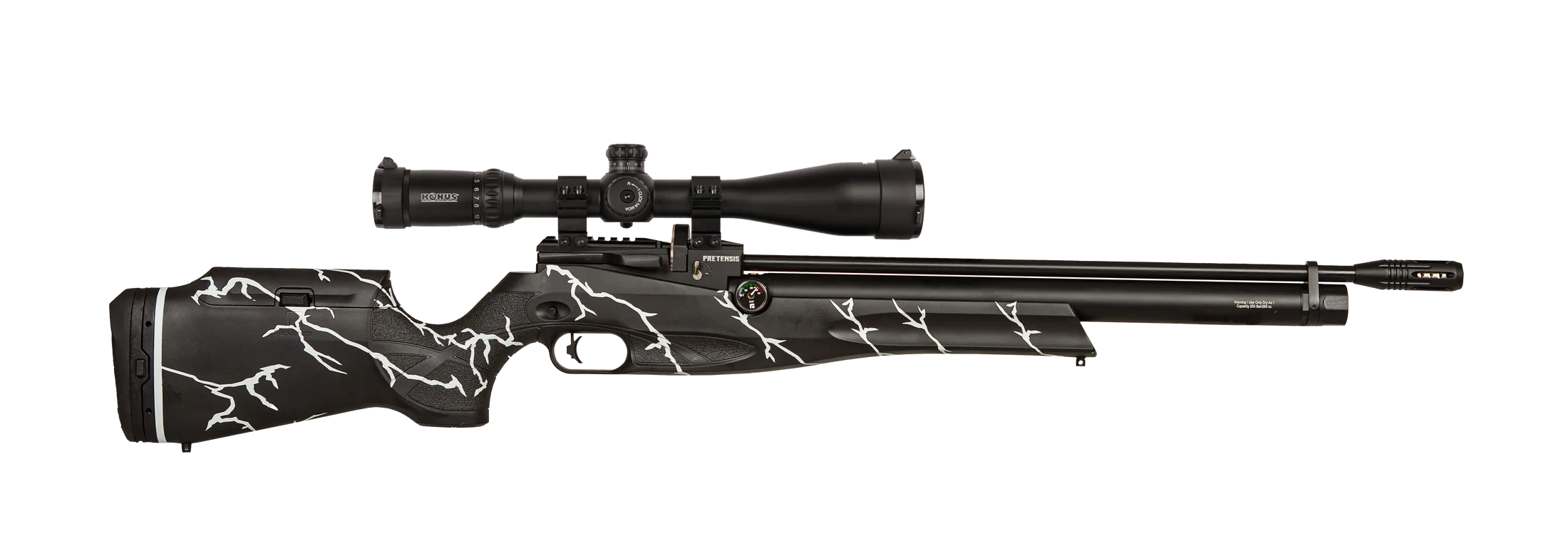
The REXIMEX PRETENSIS THUNDER WHITE CERAKOTE is presented as a full-length, pre-charged pneumatic (PCP) air rifle featuring distinctive black-and-white styling, a synthetic sporting stock, and an integrated compressed-air system. Manufactured by Turkish airgun producer Reximex, this model has been designed around traditional sporting-rifle proportions while incorporating modern pneumatic components.
Furthermore, the Thunder White Cerakote edition is distinguished by its contrasting exterior treatment. A bold white pattern is displayed against darker surfaces, creating an identifiable appearance within the Pretensis product family.
Alongside its distinctive finish, several adjustable ergonomic components are included. Consequently, the rifle’s physical configuration can be adapted to accommodate different preferences and body proportions.
In addition, a 260cc compressed-air cylinder, multi-shot magazine system, manual safety, and adjustable two-stage trigger are included in published specifications.
Key Features and Technical Specifications
The following specifications have been reported for the Thunder White Cerakote configuration. However, regional versions and individual production batches may differ.
Highlighted Product Features
- Manufacturer: Reximex
- Model: Pretensis Thunder White Cerakote
- Airgun Type: Pre-Charged Pneumatic (PCP) air rifle
- Origin: Turkey
- Available Calibres: .177 (4.5mm), .22 (5.5mm), and selected .25 (6.35mm) versions
- Finish: Thunder White Cerakote styling
- Stock Material: Synthetic, soft-touch sporting stock
- Air Cylinder Capacity: 260cc
- Published Fill Pressure: 200 bar for referenced configurations
- Magazine Capacity: 14 rounds (.177), 12 rounds (.22), or 10 rounds (.25)
- Trigger: Adjustable two-stage system
- Safety: Manual safety mechanism
- Cocking Mechanism: Right-side lever
- Cheekpiece: Adjustable
- Buttpad: Adjustable
- Sling Attachments: Pre-installed swivel studs
- Muzzle Thread: 1/2-inch UNF
- Overall Length: Approximately 105cm in one published specification
- Published UK Power: Approximately 11.3 ft-lbs for a referenced version
- Shot Count: Up to 210 shots under specified retailer test conditions
Note: Airgun configuration, output, magazine capacity, and included equipment should be verified against the exact model and regional specification.
Thunder White Cerakote Finish and Exterior Construction
Distinctive Black-and-White Appearance
A recognizable visual identity is established through the Thunder White exterior pattern. In contrast to conventional single-colour synthetic rifles, contrasting light and dark sections are incorporated into the finish.
Moreover, the Cerakote designation is associated with a protective coating system commonly used on sporting equipment and metal components. Nevertheless, the exact coated surfaces should be confirmed for each production version.
The rifle’s exterior is complemented by its synthetic stock, which is shaped around a conventional full-length sporting profile.
As a result, a contemporary appearance is combined with familiar stock geometry.
Synthetic Stock and Surface Characteristics
A synthetic construction is used for the stock, while a soft-touch surface is identified in retailer descriptions.
Compared with untreated natural timber, synthetic materials generally require different surface-care procedures and are less dependent on wood-conditioning products.
Additionally, the contrasting finish gives the model a distinctive appearance without fundamentally changing the established Pretensis silhouette.
PCP Air System and Cylinder Characteristics
260cc Compressed-Air Reservoir
The pneumatic operating system is supported by a 260cc air reservoir positioned beneath the barrel.
Compressed air is stored within this cylinder and subsequently used by the rifle’s internal firing mechanism.
Unlike spring-powered airguns, a PCP mechanism is operated using a stored supply of compressed air rather than a spring-and-piston compression cycle for each discharge.
Furthermore, the published reservoir capacity provides a useful reference when comparing the physical specifications of different Pretensis variants.
A maximum filling pressure of 200 bar has been identified in retailer documentation for this configuration. However, the pressure indicated on the individual rifle and in its manufacturer documentation must always be followed.
Published Shot-Count Information
A potential shot count of up to 210 has been advertised under specific conditions for certain versions.
Nevertheless, that figure should not be interpreted as a guaranteed result across every calibre, pressure level, or configuration.
Actual shot counts may be affected by differences in factory settings, air-pressure conditions, mechanical configuration, and testing methods.
Therefore, published figures are best understood as reference data rather than universal performance guarantees.
Adjustable Stock and Ergonomic Design
Adjustable Cheekpiece
An adjustable cheekpiece is incorporated into the stock design.
Through this component, the stock’s contact geometry can be modified to accommodate different users.
Furthermore, adjustments are particularly relevant where individual facial proportions and equipment configurations differ.
The availability of this feature distinguishes the model from sporting stocks featuring entirely fixed cheekpieces.
Adjustable Buttpad
A corresponding level of adaptability is provided by the adjustable buttpad.
With this feature, the shoulder-contact arrangement can be modified according to the stock’s available adjustment range.
Additionally, the full-length design provides conventional sporting-rifle proportions.
Together, these features contribute to the model’s configurable ergonomic layout.
Trigger, Safety, and Magazine System
Adjustable Two-Stage Trigger
A two-stage trigger assembly is specified for the Pretensis Thunder White Cerakote.
Within this mechanism, two separate stages of trigger movement are provided as part of its mechanical design.
Furthermore, adjustability is included in the published product description.
Any adjustment should be undertaken only in accordance with the manufacturer’s instructions and applicable safety requirements.
Manual Safety Mechanism
A manually operated safety mechanism is incorporated into the rifle.
However, a mechanical safety should never be treated as a substitute for safe handling, secure storage, or appropriate supervision.
The rifle should always be regarded as capable of discharging until its condition has been safely verified.
Multi-Shot Magazine Configuration
Different magazine capacities are associated with the available calibre configurations.
For example, 14-round capacity is specified for .177, while 12-round capacity is identified for .22. Selected .25 versions are listed with 10-round magazines.
Consequently, the supplied magazine should be checked against the exact calibre and production variant.
Maintenance, Storage, and Ownership Considerations
General Exterior Care
Routine care should be performed according to the manufacturer’s recommendations.
Additionally, the synthetic stock and coated exterior should be cleaned only with products confirmed as compatible with their respective materials.
Harsh solvents, abrasive compounds, and unsuitable chemicals should be avoided where finish compatibility has not been established.
Safe Storage and Inspection
The rifle should be stored securely, with unauthorized access prevented.
Likewise, its compressed-air system should be examined and serviced according to the manufacturer’s documentation.
Any suspected mechanical defect should be assessed by a qualified airgun technician.
Furthermore, applicable licensing, age restrictions, transportation rules, and local airgun regulations should be reviewed before ownership or use.
Product Overview
The REXIMEX PRETENSIS THUNDER WHITE CERAKOTE is characterized by its full-length synthetic sporting stock, contrasting Cerakote styling, 260cc pneumatic reservoir, and adjustable ergonomic components.
In addition, the multi-shot magazine configuration, two-stage trigger, and manual safety are identified among its principal mechanical features.
Overall, the Thunder White edition represents a distinctive visual variation within the Reximex Pretensis range, with technical specifications that should be matched to the exact calibre and regional configuration.
Its combination of contemporary materials, recognizable styling, and documented PCP components provides a comprehensive basis for understanding the model’s construction and features.
Frequently Asked Questions (FAQs)
1. What type of air rifle is this model?
This model is classified as a pre-charged pneumatic (PCP) air rifle, meaning compressed air is stored inside an integrated reservoir and used to operate the firing mechanism. Unlike conventional spring-powered airguns, a separate compressed-air supply is provided before operation.
Furthermore, modern PCP technology is commonly associated with consistent mechanical operation, reduced spring-related vibration, and rechargeable air reservoirs. Nevertheless, individual characteristics depend on the specific manufacturer’s configuration.
Its full-length synthetic stock, adjustable ergonomic components, and distinctive exterior styling distinguish it from many conventional designs.
Additionally, the combination of traditional rifle proportions and modern pneumatic construction makes its engineering particularly interesting to airgun enthusiasts.
2. What calibres are available?
Several calibre configurations are associated with this product family, including .177 (4.5mm), .22 (5.5mm), and selected .25 (6.35mm) versions.
However, not every calibre is necessarily distributed in every country. Availability may be influenced by regional regulations, manufacturer production schedules, and importer specifications.
Moreover, magazine capacity, factory power classification, and other technical characteristics can vary between configurations.
Therefore, the precise calibre should always be confirmed through the manufacturer’s markings, product documentation, and authorized retailer specifications.
3. What makes the exterior finish distinctive?
A visually recognizable appearance is provided through the contrasting white and dark surface treatment. Rather than relying on a conventional single-colour exterior, a contemporary decorative pattern is incorporated into the rifle’s overall presentation.
Furthermore, Cerakote coatings are generally associated with specialized protective surface treatments. However, the precise coated components and finish characteristics should be verified against the relevant manufacturing specification.
In addition, the pattern complements the stock’s modern contours and the rifle’s traditional full-length proportions.
Consequently, an identifiable sporting appearance is achieved without requiring an unconventional overall design.
4. Is the stock manufactured from wood or synthetic material?
A synthetic sporting stock is specified for this configuration. Unlike natural wooden stocks, synthetic constructions are produced using manufactured materials rather than solid timber.
As a result, routine maintenance requirements may differ from those associated with traditional wood finishes.
Furthermore, the external design incorporates a soft-touch surface according to published product descriptions.
Synthetic construction also allows distinctive decorative treatments and molded ergonomic contours to be incorporated into the stock.
Nevertheless, the material should still be protected from excessive heat, incompatible cleaning chemicals, and unnecessary physical damage.
5. Does the rifle feature an adjustable cheekpiece?
Yes. An adjustable cheekpiece is included among the published ergonomic features.
This component allows certain aspects of the stock’s cheek-contact position to be modified within the limits provided by the manufacturer.
Additionally, individual facial proportions and personal preferences can be accommodated more effectively than with an entirely fixed cheekpiece.
However, the available adjustment range should be confirmed through the official documentation.
For safety and reliability, modifications beyond the manufacturer’s approved settings should be avoided.
6. Is an adjustable buttpad included?
An adjustable buttpad is identified as part of the stock configuration.
Through this feature, the shoulder-contact arrangement can be modified within its intended mechanical range.
Furthermore, the adjustment system contributes to the stock’s overall versatility across users with different physical proportions.
Unlike fixed stock components, adjustable parts provide additional flexibility without requiring permanent changes to the original construction.
Nevertheless, all locking mechanisms should remain securely positioned, and the manufacturer’s instructions should be followed whenever adjustments are made.
7. What is the air-cylinder capacity?
A compressed-air reservoir with a published capacity of approximately 260cc is associated with this configuration.
The reservoir is integrated beneath the barrel and forms part of the PCP operating system.
Furthermore, the specified capacity indicates the internal air-storage volume rather than the amount of usable shooting energy.
Actual performance characteristics depend on the manufacturer’s mechanical configuration and applicable factory settings.
Additionally, replacement or servicing of pressurized components should be performed only using approved parts and qualified technical assistance.
8. What is the maximum filling pressure?
A maximum filling pressure of approximately 200 bar has been reported for referenced versions.
However, the individual rifle’s pressure markings and official manufacturer’s instructions must take precedence over general online specifications.
Because compressed-air systems contain substantial stored energy, incorrect pressures or unsuitable equipment can create serious hazards.
Consequently, the reservoir should never be exposed to pressures beyond its approved rating.
Moreover, damage, corrosion, unusual leakage, or suspected component defects should be assessed by a qualified professional before further use.
9. How many shots can be obtained from one air fill?
Published retailer information has referenced shot counts reaching approximately 210 under particular conditions.
Nevertheless, this figure should not be interpreted as a guaranteed result for every configuration.
Differences in calibre, mechanical settings, factory power classification, reservoir pressure, and testing conditions can influence actual results.
Furthermore, manufacturers and retailers may use different methods when reporting shot-count figures.
Therefore, any advertised number should be evaluated alongside the exact version’s technical documentation rather than considered an unconditional specification.
FX Airguns, PCP Air Rifles, Hatsan Models and Modern Airgun Platforms
Modern airguns cover a wide range of platforms, from a basic pellet gun or BB gun to sophisticated regulated PCP airguns designed for target shooting, sporting applications, and long-range precision. Buyers researching an air rifle and air pistol collection will often encounter manufacturers such as FX and Hatsan because both companies offer extensive selections of air rifles, accessories, configurations, and caliber choices.
FX Airguns Sweden and the FX PCP Rifle Range
FX Airguns has become strongly associated with Swedish airgun engineering. Searches for fx airguns sweden, fx airguns sverige, fxairguns, and fx usa commonly lead enthusiasts toward the manufacturer’s extensive PCP lineup. In the American market, fx airguns usa is another widely searched phrase when people are researching available models, specifications, support, and accessories.
Among fx air rifles, the Impact family remains particularly recognizable. Searches frequently include fx impact, f x impact, fx impact m4, fx m4, impact m4 air rifle, and impact m4 500mm when comparing current configurations. The modular design philosophy associated with the Impact platform has helped make the fx air rifle range popular among shooters who appreciate adjustability and configurable PCP systems.
Earlier generations remain widely researched as well. The fx impact m3, impact m3, fx impact mk3, fx m3, and fx m3 airgun continue to attract attention from owners comparing generations or researching replacement components.
Caliber-specific searches include fx impact m3 .22cal air rifle, fx impact m3 .22cal air rifle. 600mm barrel, and the more general fx impact m3 air rifle. People comparing international pricing may also search fx impact m3 precio, fx impact m3 precio en usa, or fx impact m3 price before checking local regulations, specifications, and availability.
Beyond the Impact series, the FX catalog includes several distinctive designs. The fx leopard and fx leopard airgun are frequently researched alongside fx leopard .22 pcp specs by users interested in specifications and configuration details.
Other notable searches include fx drs, fx drs tactical, fx drs classic, and fx drs pro. These terms reflect interest in the different DRS configurations and their intended shooting styles.
The wider FX family also includes models such as the fx king, fx wildcat, fx panthera, and fx dreamline. Collectively, these platforms demonstrate the variety available to anyone researching a premium pcp air rifle, pellet rifle, or configurable precision air gun.
Some enthusiasts also search fx outdoors when researching outdoor shooting equipment and related products, while marketplaces and information sources such as guns.com may appear during broader online research.
Understanding Pellet Guns and PCP Air Rifles
A traditional pellet gun uses shaped pellets rather than conventional firearm ammunition. The broader term pellet guns can describe spring-powered, CO₂-powered, pneumatic, and PCP platforms.
A PCP air rifle stores compressed air inside a reservoir. This system can provide consistent pressure across multiple shots depending on the rifle’s regulator, reservoir capacity, caliber, and power configuration.
For shooters comparing ammunition sizes, .177 caliber remains one of the most common options. Larger configurations are also available, including the increasingly searched 30 cal air rifle category.
Some users accidentally search pallet gun when looking for pellet-powered equipment. Regardless of terminology, specifications such as energy output, caliber, barrel length, intended range, and local legal requirements should always be reviewed before use.
The practical range of air rifle platforms varies significantly. Pellet weight, velocity, environmental conditions, barrel design, optics, and shooter technique can all affect useful range and accuracy.
Hatsan Air Rifle and PCP Platforms
The hatsan air rifle lineup covers traditional spring-powered designs as well as modern PCP systems. Searches such as hatsanusa, hatsan usa, hatsan air guns, and hatsan pcp are commonly used by enthusiasts researching the company’s models.
One of the most recognizable platforms is the hatsan blitz. Search variations include hatsun blitz, hatzan blitz, hatsan blitz full automatic, hatsan blitz 30 cal, and hatsan blitz .30 cal. Specifications and legal classifications can vary by market, so owners should verify the rules applicable in their jurisdiction.
Another frequently researched model is the hatsan model 95, also searched as hatsan mod 95 and mod 95. This traditional air rifle platform remains familiar to shooters interested in conventional stock designs.
The hatsan 125 is another established model, while the hatsan 135 family attracts shooters researching powerful spring-piston platforms. Related searches include hatsan 135 vortex air rifle, hatsan 135 carnivore, and hatsan big bore carnivore rifle.
Hatsan Sortie, BullBoss and Bullpup Designs
Compact and semi-automatic PCP designs form another part of Hatsan’s catalog. The hatsan sortie is commonly researched alongside hatsan sortie tact, hatsan sortie tact semi-auto pcp, and hatsan sortie accessories.
Bullpup enthusiasts may encounter the hatsan bullboss, bullmaster, and hatsan hercules bully. Their compact layouts are designed to reduce overall length while maintaining useful barrel dimensions.
Other PCP models include the hatsan flash, hatsan flashpup qe, and hatsan invader. These rifles provide additional choices for people comparing conventional and bullpup PCP configurations.
Hatsan Hercules, Piledriver and Large-Caliber Platforms
For people researching larger airgun platforms, hatsan hercules and hatsan piledriver often appear in search results. Large-bore air rifles differ considerably from standard .177 and .22 pellet rifles in projectile size, power output, air consumption, and intended application.
The hatsan harpoon is associated with specialized projectile launching, while an arrow launcher represents another distinct air-powered category. Such equipment can be subject to different legal rules depending on location, so local regulations should be checked before ownership or use.
Additional Hatsan Models
The Hatsan catalog extends well beyond its best-known rifles. The hatsan airtact and hatsan airtact air rifle provide another entry point into the brand’s conventional rifle selection.
Other searches include hatsan zada, hatsan neutron star, hatsan factor rc, hatsan velox, and hatsan jet 2. Each platform serves a somewhat different role, making specifications such as caliber, reservoir capacity, operating system, barrel configuration, and overall dimensions important comparison points.
Shoppers researching discounted equipment may also encounter hatsan refurbished listings or broader searches for refurbished air rifles. Condition, warranty coverage, seals, regulators, reservoirs, and service history should be checked carefully when evaluating previously used or factory-refurbished equipment.
Airgun Optics, Pellets and Accessories
Accessories can significantly affect how an air rifle is configured. A compact 4×20 optic may suit basic shooting applications, while more advanced PCP rifles are frequently paired with adjustable optics.
Pellet choice also matters. Products such as h&n field target trophy bleifrei provide an option for shooters specifically researching lead-free projectile designs. Pellet diameter, weight, head size, and barrel compatibility should all be considered when evaluating accuracy.
Terms such as econ ii may also appear when researching airgun-related equipment and accessories. Compatibility should always be verified against the exact manufacturer, model, and specification rather than relying solely on a product name.
Comparing FX and Hatsan Air Guns
FX and Hatsan approach the modern air rifle market from different directions. FX is particularly well known for highly configurable PCP platforms such as the Impact, Panthera, Wildcat, Dreamline, Leopard, DRS, and King. Hatsan, meanwhile, maintains an exceptionally broad range spanning spring-powered rifles, PCP systems, bullpups, semi-automatic platforms, and larger-caliber airguns.
Whether researching an FX Impact M3, FX Impact M4, FX DRS, Hatsan Blitz, Hatsan Sortie, Hatsan Hercules, or another platform, specifications should be compared carefully. Caliber, operating pressure, reservoir capacity, barrel length, projectile compatibility, optics mounting, overall dimensions, energy output, and regional legal requirements can all influence which configuration is appropriate for a particular lawful sporting or target-shooting application.
10. Does the model include a multi-shot magazine?
Yes. A detachable multi-shot magazine system is associated with this product family.
Published capacities include approximately 14 rounds for .177, 12 rounds for .22, and 10 rounds for selected .25 configurations.
However, the correct capacity depends on the specific calibre and production version.
Additionally, supplied magazine quantities may differ between regional packages.
For this reason, the included equipment should be confirmed through the retailer’s official package listing.
Only manufacturer-approved magazine components should be considered for the corresponding configuration.
11. What type of trigger mechanism is fitted?
An adjustable two-stage trigger is identified in published specifications.
Two distinct stages of trigger travel are incorporated into this mechanical design.
Furthermore, the inclusion of adjustable components reflects the manufacturer’s emphasis on configurable sporting equipment.
Nevertheless, trigger assemblies are safety-critical mechanisms, and unauthorized modifications may compromise reliable operation.
Consequently, adjustments should be restricted to procedures explicitly approved by the manufacturer.
Where professional servicing is required, assistance should be obtained from a qualified airgun technician.
12. Is a manual safety mechanism provided?
Yes. A manual safety mechanism forms part of the rifle’s specified equipment.
However, the presence of a mechanical safety does not eliminate the possibility of accidental discharge.
Therefore, appropriate handling procedures, secure storage, and constant awareness of the rifle’s condition remain essential.
Additionally, the device should be inspected according to the manufacturer’s recommendations.
If unusual resistance, inconsistent operation, or mechanical damage is observed, the rifle should be withdrawn from use until examined by a qualified professional.
13. Does the rifle have a threaded muzzle?
A 1/2-inch UNF muzzle thread has been identified in published specifications for relevant configurations.
However, individual regional variants may differ in their supplied muzzle components and threading arrangements.
Furthermore, laws concerning muzzle accessories vary considerably between jurisdictions.
Consequently, compatibility and legal requirements should always be confirmed through official documentation and qualified local authorities.
The presence of a threaded muzzle should not be interpreted as confirmation that every commercially available accessory is compatible or legally permitted.
14. What are the approximate dimensions?
An overall length of approximately 105cm has been published for one referenced configuration.
However, minor dimensional differences may arise between versions, production batches, or externally fitted components.
Furthermore, product dimensions should be distinguished from packaging measurements, which may include protective materials and transport accessories.
For accurate storage, transportation, or inventory planning, official product measurements should be consulted.
Where precise dimensions are essential, direct confirmation from the manufacturer or authorized distributor is recommended.
15. Is this model suitable for first-time airgun owners?
Suitability depends on the owner’s experience, training, local regulations, and ability to manage pressurized equipment safely.
PCP air rifles require familiarity with compressed-air safety, responsible handling, secure storage, and routine inspection.
Furthermore, additional equipment and maintenance considerations may be involved compared with simpler airgun mechanisms.
Therefore, recognized safety instruction is strongly recommended for individuals unfamiliar with PCP systems.
Before any purchase, applicable age restrictions, licensing requirements, and legal responsibilities should also be reviewed.
16. Can the rifle be used for recreational target shooting?
Recreational target shooting is one of the sporting activities commonly associated with PCP air rifles.
However, use must be limited to suitable, legally authorized locations with appropriate safety arrangements.
Furthermore, local restrictions may apply to the possession, transportation, and discharge of airguns.
A controlled environment, approved backstop, and suitable supervision are essential safety considerations.
In addition, users should comply with all applicable range rules and organizational requirements.
The legality of recreational shooting should never be assumed solely from the product’s classification as an air rifle.
17. How should the exterior finish be maintained?
Exterior maintenance should follow the manufacturer’s recommended cleaning procedures.
Generally, compatible non-abrasive materials are preferred for preserving coated and synthetic surfaces.
Furthermore, aggressive solvents and harsh cleaning products should be avoided unless their suitability has been confirmed.
After exposure to moisture, the exterior should be inspected and cared for according to the relevant maintenance instructions.
Additionally, the rifle should be kept away from unnecessary impacts and unsuitable storage conditions.
Any unusual finish deterioration should be evaluated before chemical treatments or refinishing products are applied.
18. Does the compressed-air reservoir require periodic inspection?
Yes. Compressed-air reservoirs and related components require appropriate inspection and maintenance.
Although service intervals depend on the manufacturer and applicable regulations, pressure-containing equipment should never be treated as maintenance-free.
Furthermore, visible corrosion, abnormal leakage, impact damage, or uncertainty about a reservoir’s condition should be regarded seriously.
Where examination or servicing is necessary, an appropriately qualified technician should be consulted.
Only approved replacement components should be used, and the manufacturer’s inspection requirements should be observed.
19. Are replacement parts and accessories available?
Replacement-part availability depends on the manufacturer, authorized distributors, individual production versions, and regional stock arrangements.
Certain components may be listed separately, while others may be supplied only through approved service channels.
Furthermore, compatibility cannot be established solely through a similar external appearance.
Consequently, original part numbers and exact model identifiers should be verified before replacements are selected.
For safety-related components, professional assessment and manufacturer-approved parts are especially important.
20. What should be checked before purchasing?
Several details should be verified before a purchase is finalized.
First, the exact calibre and regional power classification should be confirmed through official product information.
Additionally, the stated package contents, warranty arrangements, stock configuration, and finish should be reviewed.
Furthermore, applicable ownership restrictions and documentation requirements must be considered.
The seller’s legitimacy, return policy, and after-sales support should also be assessed.
Finally, confirmation of the manufacturer’s product markings and serial identification helps establish that the supplied item corresponds to the advertised specification.
21. Does this model require special storage conditions?
Secure, responsible storage is essential for all air rifles.
The product should be kept in a suitable locked storage arrangement, with access restricted to authorized individuals.
Additionally, the manufacturer’s instructions should be followed regarding environmental conditions and compressed-air storage.
Excessive heat, moisture, and unsuitable chemical exposure should be avoided.
Furthermore, local laws may impose specific requirements concerning locked cabinets, transportation cases, and access by minors.
These requirements should be checked before ownership.
22. Is the rifle supplied with a manufacturer warranty?
Warranty coverage depends on the country, distributor, retailer, and specific sales agreement.
A manufacturer’s warranty may be provided through approved distribution channels, although terms and exclusions can vary.
Furthermore, unauthorized modifications or incorrect servicing may affect available coverage.
Before purchase, the warranty period, proof-of-purchase requirements, and authorized repair arrangements should be examined.
Where international shipping is involved, the availability of local warranty support should also be confirmed.
23. What distinguishes this edition from other variations in the product family?
Its contrasting decorative treatment is among the most recognizable distinguishing features.
Additionally, the familiar synthetic stock design, adjustable ergonomic components, and integrated PCP system are retained as central elements of the platform.
Nevertheless, cosmetic differences should not automatically be interpreted as evidence of different internal performance specifications.
Factory variations may exist independently of external colours or finish names.
Therefore, comparisons should be based on official manufacturer data for the exact versions under consideration.
24. Why is manufacturer documentation important?
Official documentation provides essential information concerning component identification, operating limitations, approved maintenance, and safety requirements.
Furthermore, product families may contain several variations that share similar names or appearances.
Without exact model documentation, general retailer descriptions can sometimes create uncertainty about technical details.
Consequently, the manufacturer’s instructions should be considered the primary reference for ownership and maintenance.
Where documentation is incomplete or contradictory, clarification should be obtained from an authorized distributor rather than relying on assumptions.
25. What should be expected from the overall product design?
A contemporary sporting appearance is combined with established full-length rifle proportions.
The contrasting exterior finish creates a distinctive identity, while the synthetic stock provides a manufactured alternative to natural timber.
Furthermore, adjustable cheekpiece and buttpad components are incorporated into the ergonomic arrangement.
A rechargeable compressed-air reservoir and multi-shot magazine are also included within the documented platform.
Overall, the design is characterized by its combination of modern materials, configurable stock geometry, and conventional PCP architecture.
For prospective owners, the most important considerations remain accurate model identification, manufacturer-approved maintenance, legal compliance, and responsible handling.
Why This PCP Air Rifle Stands Out: Design, Ownership Benefits, Responsible Use, and Essential Care
Understanding the Purpose Behind Its Design
Modern pre-charged pneumatic air rifles have been developed to combine compressed-air technology, ergonomic engineering, and durable sporting materials. Within this category, full-length models with adjustable stock components represent an established approach to accommodating different physical preferences.
Furthermore, a distinctive exterior finish can provide visual individuality without changing the fundamental operating principles of the equipment. In this configuration, traditional sporting proportions are combined with a contrasting finish and contemporary synthetic construction.
However, the overall value of an air rifle should not be assessed solely by its appearance. Manufacturing quality, verified specifications, manufacturer support, safety provisions, maintenance requirements, and compliance with local legislation must also be considered.
Consequently, understanding why particular features are included, how the equipment should be cared for, and where responsible ownership is permitted provides a more complete perspective.
1. Why Synthetic Construction Is Important
Material Durability and Everyday Maintenance
A synthetic stock is used instead of traditional natural timber. This material choice provides several practical differences in handling, storage, and maintenance.
For example, wooden stocks may require specialized conditioning products, particularly when exposed to changing humidity levels. By comparison, synthetic stocks generally require different exterior-care procedures and are not dependent on traditional wood-conditioning treatments.
Additionally, manufactured stock materials allow molded contours and decorative surface treatments to be incorporated during production.
Although synthetic construction can offer practical advantages, no stock material should be considered entirely resistant to physical damage.
Excessive heat, impacts, incompatible chemicals, and prolonged exposure to unsuitable environmental conditions can still affect its appearance and structural integrity.
Why the Exterior Finish Deserves Attention
A specialized decorative finish contributes to the overall appearance of the equipment.
Furthermore, protective surface treatments are often selected because of their resistance to certain types of wear and environmental exposure.
Nevertheless, the exact protection provided depends on the coating formulation, application method, treated substrate, and maintenance conditions.
Therefore, assumptions about corrosion resistance or chemical compatibility should be avoided unless the manufacturer’s technical documentation confirms them.
2. Why Adjustable Ergonomics Matter
The Purpose of an Adjustable Cheekpiece
An adjustable cheekpiece is incorporated to provide flexibility in the stock’s facial-contact geometry.
Because physical proportions differ from one person to another, fixed stock dimensions may not provide the same degree of comfort to every individual.
Furthermore, an adjustable component can accommodate variations within its manufacturer’s approved range.
This contributes to a more adaptable product configuration without requiring permanent changes to the original stock.
However, adjustment mechanisms should never be forced beyond their mechanical limits.
Understanding the Adjustable Buttpad
The buttpad forms part of the stock’s shoulder-contact assembly.
In this design, an adjustable arrangement allows certain aspects of that contact surface to be modified.
Moreover, the feature illustrates how contemporary sporting equipment increasingly incorporates configurable ergonomic components.
Regular examination of the adjustment hardware is important because loose or damaged components may affect the equipment’s condition.
Where unusual movement or mechanical damage is identified, professional inspection should be arranged.
3. Why Compressed-Air Technology Requires Particular Attention
Understanding the Stored-Air System
A PCP mechanism relies on compressed air stored inside a dedicated reservoir.
Unlike a conventional spring-piston system, compressed air is supplied from a reservoir that is separate from the mechanical trigger assembly.
Furthermore, this arrangement introduces maintenance responsibilities associated with pressure-containing equipment.
The reservoir, seals, valves, and related components must remain within the manufacturer’s approved specifications.
Consequently, compressed-air equipment should never be treated as maintenance-free.
Why Pressure Limits Must Be Respected
Every pressurized reservoir is subject to design and operating limitations.
These limits are established to protect the integrity of the pressure-containing components and the wider system.
Exceeding a manufacturer’s stated pressure rating can create serious hazards, including component failure.
Additionally, damaged or incorrectly serviced air systems may present risks even when their exterior appearance seems normal.
For these reasons, official pressure markings and manufacturer documentation must always take precedence over generalized online information.
Any suspected defect should be examined by a qualified professional.
4. Why Responsible Ownership Matters
Safety as an Essential Ownership Responsibility
Air rifles are capable of causing serious injury. Therefore, responsible ownership must be treated as a fundamental requirement rather than an optional precaution.
Secure storage, appropriate supervision, compliance with local law, and adherence to manufacturer instructions form the foundation of safe ownership.
Furthermore, a manually operated safety mechanism does not replace proper handling practices.
Mechanical safety devices may fail or become damaged, and their presence should never justify careless behavior.
Why Legal Compliance Is Necessary
Airgun regulations differ substantially between countries and sometimes between regions within the same country.
Depending on local legislation, restrictions may apply to power classification, minimum ownership age, licensing, transportation, storage, and permitted sporting activities.
Consequently, legal requirements should be established before purchase or use.
In addition, international ownership or transportation may involve customs rules, import permits, and other regulatory obligations.
Where uncertainty exists, clarification should be obtained from the appropriate authority.
5. How to Care for the Exterior Finish
Routine Surface Cleaning
Exterior care should begin with the manufacturer’s cleaning recommendations.
For many compatible coated surfaces, a clean, soft, non-abrasive cloth may be appropriate for removing light dust and fingerprints.
However, the suitability of cleaning materials must be confirmed before they are applied.
Furthermore, aggressive chemical products should not be used merely because they are marketed as general-purpose cleaning agents.
Certain solvents can damage decorative finishes, synthetic materials, adhesives, or protective coatings.
Therefore, only approved cleaning products should be considered.
Protecting Against Scratches and Surface Damage
A finished surface can be marked by abrasive particles, rough contact materials, or unnecessary friction.
For this reason, equipment should be handled and stored in a way that limits contact with sharp objects and unsuitable surfaces.
Additionally, accumulated dirt should not be rubbed aggressively across decorative coatings.
Any visible finish damage should be assessed before refinishing or chemical treatment is attempted.
The manufacturer’s guidance should remain the primary reference for preserving the original appearance.



Reviews
There are no reviews yet.