We Deliver Airguns Directly To Your Door
SKU N/A Category

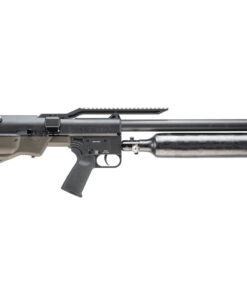
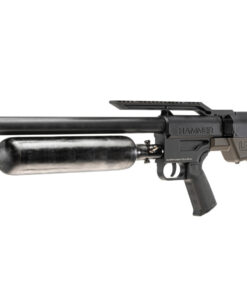
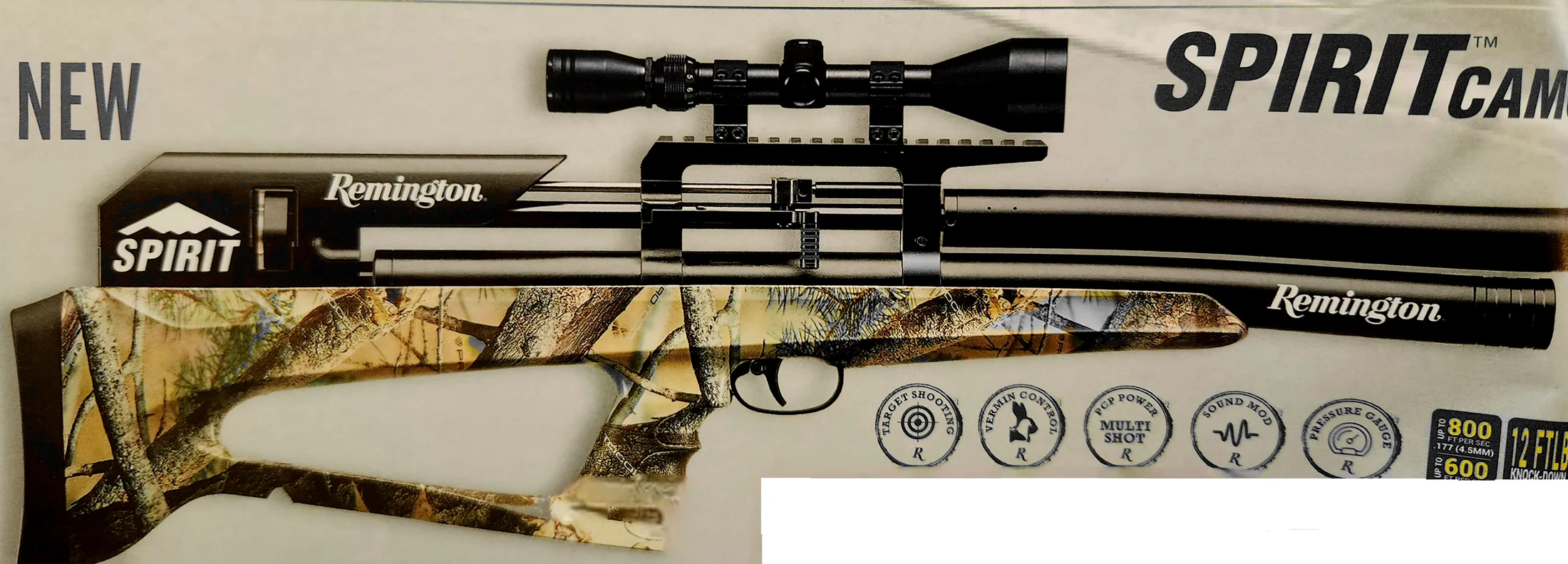
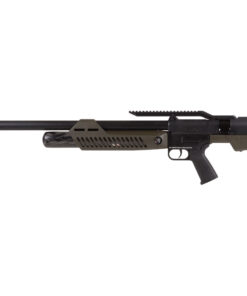
Remington Spirit Camo

$580.00

The Spirit™, the first regulated PCP bull pup from Remington®

This full sized, well-balanced rifle is ideal for both vermin control and target shooting.

The ergonomic designed stock is very popular in comfort when shooting, and the thumbhole gives a strong area with the styled grip.

The precision made rifled barrel has a side lever action with a very unique, sturdy customised bolt, is multi shot controlled and to finish has a 1/2” UNF threaded sound moderator.

The high quality pressure gauge is clear and accurate, with a max fill pressure of 200 bar.

There is a manual safety in the trigger guard, are all made from metal for superb control.

Action MULTI SHOT SIDE LEVER
Type PCP
Stock Synthetic (high grade)
Trigger Two stage (adjustable)
Length (total) 67cm
Weight 2.4kg
  • Manual safety

Remington Spirit Camo PCP Air Rifle – Features, Specifications and Design Overview

Remington Spirit Camo PCP Air Rifle Overview

The Remington Spirit Camo PCP Air Rifle is presented as a camouflage-finished version of Remington’s Spirit pre-charged pneumatic (PCP) bullpup platform. A compact layout, regulated air system, ergonomic stock configuration, and multi-shot mechanism are associated with the Spirit range.

Unlike conventional full-length rifle configurations, the bullpup arrangement is designed with the action positioned farther toward the rear. Consequently, a shorter overall profile is achieved without relying on an equally short barrel.

Within the Spirit family, several practical design features are combined, including a pressure gauge, side-lever mechanism, adjustable trigger, and manual safety.

However, the exact camouflage finish and its availability should be verified against the manufacturer’s SKU before the product is listed as a separate variant.

Key Features and Product Highlights

The following features are documented for the Remington Spirit PCP platform:

  • Power System: Internally regulated pre-charged pneumatic mechanism.

  • Configuration: Compact bullpup design.

  • Stock: Ergonomic synthetic thumbhole stock on standard synthetic versions.

  • Action: Multi-shot side-lever mechanism.

  • Barrel: Precision-manufactured rifled barrel.

  • Trigger: Adjustable two-stage trigger.

  • Maximum Fill Pressure: 200 bar.

  • Pressure Gauge: Integrated air-pressure indicator.

  • Manual Safety: Trigger-guard-mounted safety mechanism.

  • Muzzle: 1/2-inch UNF threaded configuration.

  • Overall Length: Approximately 67 cm.

  • Weight: Approximately 2.3–2.4 kg, depending on the listed configuration.

  • Available Calibres: .177 (4.5 mm) and .22 (5.5 mm) are documented within the Spirit range.

These general specifications are supported by published Spirit listings, although an individual camouflage model may differ.

Sunderland Airguns
+2

Regulated PCP Air System

Internally Regulated Air Delivery

A pre-charged pneumatic operating system is incorporated into the Spirit series. Instead of being powered by a conventional spring-and-piston mechanism, compressed air is stored within an integrated reservoir.

Furthermore, an internal regulator is used to manage the pressure delivered by the air system. Through this arrangement, variations in output pressure may be reduced across the regulator’s operating range.

Nevertheless, consistent pellet velocity cannot be guaranteed solely by the presence of a regulator. Actual performance may also be affected by pellet characteristics, mechanical condition, and the particular power configuration.

Air Reservoir and Pressure Monitoring

A maximum filling pressure of 200 bar is specified for the documented Spirit models.

Additionally, an integrated pressure gauge is provided so that reservoir pressure can be observed. As a result, the remaining compressed-air supply can be monitored without relying entirely on shot counting.

Approved filling procedures, compatible equipment, and manufacturer-specified pressure limits must always be followed.

Bullpup Construction and Camouflage Styling

Compact Overall Configuration

The distinctive bullpup arrangement is one of the principal characteristics of the Spirit platform.

Within this configuration, the action is positioned toward the rear of the stock. Accordingly, the complete rifle is constructed around a relatively compact overall length.

An approximately 67 cm length is specified for standard Spirit variants. This dimension is particularly relevant when comparisons are being made between traditional rifle layouts and bullpup constructions.

Moreover, balance and handling characteristics are influenced by the location of the action, reservoir, barrel, and stock components.

Camouflage Stock Appearance

A camouflage finish may be used to distinguish a particular product configuration from standard black synthetic models.

In a camouflage-themed design, contrasting colours and irregular patterns are generally employed to create a visually distinctive external appearance.

However, the camouflage material, coating method, colour combination, and precise stock construction should be confirmed for the actual item.

An unverified finish should not be described as factory-applied, weatherproof, or scratch-resistant without supporting manufacturer documentation.

Rifled Barrel and Multi-Shot Mechanism

Precision-Made Rifled Barrel

A rifled barrel is incorporated into the documented Spirit platform.

Inside the barrel, spiral rifling is provided to impart rotational stability to a compatible pellet. Consequently, the barrel forms an important part of the overall mechanical design.

Nevertheless, accuracy depends on multiple factors, including the ammunition used, condition of the barrel, consistency of the air system, and shooting environment.

No specific grouping measurement should be presented as guaranteed unless independently supported by controlled testing.

Side-Lever Action

A multi-shot side-lever mechanism is featured in the Remington Spirit range.

Through this mechanism, the rifle’s loading system is operated using a side-mounted lever. Furthermore, a customised bolt design is described in published manufacturer information.

Magazine capacity may vary between models and calibres. Therefore, an exact shot capacity should be included only after the specific version has been confirmed.

Adjustable Trigger and Manual Safety

Two-Stage Trigger Assembly

An adjustable two-stage trigger is specified for documented Spirit configurations.

With a two-stage arrangement, the trigger movement is divided into distinct stages before release. Consequently, adjustment provisions may be available within the manufacturer’s specified limits.

Any adjustment should be performed strictly in accordance with the official manual and relevant safety procedures.

Integrated Safety Mechanism

A manual safety is positioned within the trigger-guard area on the documented Spirit design.

Although a mechanical safety device is provided, safe handling practices remain essential. The mechanism should never be treated as a substitute for secure storage, responsible supervision, or proper muzzle discipline.

Construction Materials and External Features

Synthetic Stock Configuration

A synthetic stock is specified for the standard Spirit range.

Compared with traditional timber construction, synthetic materials are generally less susceptible to certain moisture-related dimensional changes. However, actual durability depends on the material formulation and manufacturing quality.

Additionally, a thumbhole section is incorporated into the standard stock design. Through this arrangement, a defined gripping area is provided as part of the rifle’s ergonomic configuration.

Metal Components and Threaded Muzzle

Metal components are used in several operating assemblies. Meanwhile, a 1/2-inch UNF threaded muzzle is listed among the platform specifications.

Any fitted muzzle accessory must be legally permitted, dimensionally compatible, and approved for the specific configuration.

Maintenance, Inspection and Storage

Routine Condition Checks

Regular condition inspections are recommended for pneumatic equipment.

Before maintenance is undertaken, the manufacturer’s procedures should be consulted. Particular attention should be given to the pressure system, visible seals, external fasteners, and any signs of damage.

Additionally, unauthorised modifications to pressure-bearing components should be avoided.

Responsible Long-Term Storage

For extended storage, a secure location should be selected where unauthorised access can be prevented.

Furthermore, the product should be protected from excessive heat, humidity, and physical impact.

The manufacturer’s instructions concerning reservoir pressure during storage should be followed rather than assuming that complete depressurisation is always required.

Technical Specifications Summary

Feature Documented Spirit specification
Manufacturer Remington
Model family Spirit
Operating system Regulated PCP
Design Bullpup
Action Multi-shot side lever
Common calibres .177 and .22
Maximum fill pressure 200 bar
Trigger Adjustable two-stage
Stock Synthetic thumbhole
Barrel Rifled
Overall length Approximately 67 cm
Weight Approximately 2.3–2.4 kg
Safety Manual
Camouflage finish Requires variant verification

The figures above are based on published Spirit model specifications rather than a separately authenticated Camo SKU.

Sunderland Airguns
+2

Remington Spirit Camo PCP Air Rifle – Product Summary

The Remington Spirit Camo PCP Air Rifle can be described within the wider Spirit PCP family, whose defining characteristics include regulated pneumatic operation, a bullpup layout, a multi-shot side-lever mechanism, and an ergonomic stock design.

Furthermore, technical features such as the adjustable trigger, integrated pressure gauge, and rifled barrel are documented across standard versions.

Before final publication, the camouflage finish, calibre, supplied accessories, power rating, and manufacturer part number should be verified for the exact product being advertised.

Brocock BRK and Benjamin Air Rifles: Complete Guide to PCP Technology, Precision, Calibres and Accessories

Discover the Engineering Behind Brocock Airguns and Benjamin Air Rifles

Modern airgun technology has transformed recreational target shooting, competitive marksmanship, and precision air-powered sporting equipment. Today, manufacturers combine advanced pneumatic systems, ergonomic construction, and innovative engineering to produce dependable shooting platforms. Among the established names in this industry, brocock ltd and Benjamin continue to attract attention from enthusiasts seeking technical sophistication and reliable performance.

The evolution of brocock airguns reflects a strong emphasis on compact designs, efficient compressed-air systems, and consistent shot delivery. Similarly, the Benjamin product range offers numerous configurations, from traditional pellet rifles to specialized pneumatic platforms.

Whether researching a compressed air rifle, comparing a conventional pellet gun, or exploring advanced sporting equipment, understanding the available technologies helps buyers make informed decisions.

Brocock BRK Air Rifles: Innovation and Precision Engineering

Brocock Sniper XR and BRK Sniper XR

The brocock sniper xr represents an important development in regulated pneumatic rifle engineering. Featuring a semi-bullpup configuration, adjustable ergonomics, and a sidelever operating system, this model emphasizes handling convenience and mechanical consistency.

Additionally, the brk sniper xr incorporates a regulated air-delivery system designed to reduce variations between successive shots. Its adjustable stock components provide flexibility for different shooting positions.

For enthusiasts researching the .25 caliber brocock sniper xr, calibre selection deserves particular attention. The larger pellet diameter offers different projectile characteristics compared with smaller calibres, while energy output and shot capacity depend on the specific configuration.

The sniper xr also offers an example of how modern engineering combines compact dimensions with adjustable controls.

Brocock Commander XR and BRK Commander

Another noteworthy platform is the brocock commander xr, which combines a tactical-inspired stock configuration with pneumatic engineering.

The brocock commander has attracted interest from enthusiasts who appreciate adjustable furniture, modular features, and consistent operation.

Similarly, buyers researching brk ghost and Commander models often compare ergonomics, overall dimensions, available calibres, and compatible accessories.

Searches for brocock commander xr price should be evaluated using current retailer listings because pricing varies according to country, configuration, condition, and included equipment.

BRK Ghost Air Rifle: Modern Design and Customization

The brk ghost air rifle represents a distinctive approach to modern PCP rifle design. Its bullpup layout places major operating components within a compact overall configuration while retaining a full-length barrel arrangement appropriate to the model.

Furthermore, the BRK Ghost offers adjustable ergonomic components and a mechanical design intended to support controlled operation.

Owners researching ghost accessories should pay attention to manufacturer compatibility, factory specifications, and approved replacement components.

A replacement ghost handle, for example, should be checked against the exact model and production variant before purchase.

Likewise, a magpul sl k buttpad is a product-specific accessory reference rather than a guarantee of compatibility with every rifle stock.

Pathfinder XR and Compact BRK Models

The pathfinder xr offers another example of the manufacturer’s emphasis on compact pneumatic platforms.

Buyers researching the brk pathfinder, brk pathfinder xr, or general pathfinder air rifle specifications should compare verified product dimensions, stock arrangements, and applicable power ratings.

The brk concept xr is another model worth examining when comparing compact sporting rifles.

While these designs share elements of the manufacturer’s engineering philosophy, each has its own configuration and intended handling characteristics.

For anyone comparing several platforms, factors such as overall weight, trigger characteristics, stock adjustment, and service support are more useful than appearance alone.

What Are PCP Air Rifles and How Do They Work?

New enthusiasts frequently ask, what are pcp air rifles?

The abbreviation PCP means precharged pneumatic, referring to an air-powered system that stores compressed air in a pressurized cylinder or reservoir.

Consequently, understanding pcp rifle meaning helps explain the operating principles behind modern pneumatic sporting rifles.

Other common searches include what does pcp mean in air rifles, what is pcp air rifle, what is a pcp air rifle, and what is a pre charged pneumatic air rifle.

All describe the same general operating technology.

Likewise, what is a pcp air gun and pcp air rifle meaning refer to compressed-air propulsion rather than spring-powered or carbon-dioxide systems.

A pcp rifle stores energy before firing, whereas a break barrel pellet gun typically compresses a spring or gas ram through a cocking action.

This distinction also explains why a pneumatic gun, gun pneumatic, and pneumatic weapons may refer to several different mechanisms, depending on the context.

Modern pcp air rifles often feature pressure regulators, adjustable triggers, and specialized magazines. Nevertheless, operating pressure, energy output, and maintenance requirements vary substantially between models.

Essential Accessories and Equipment Compatibility

Properly selected accessories contribute to equipment suitability and long-term maintenance.

For example, the 0db moderator and 0 db moderator are search variations referring to a sound-moderating accessory. Actual sound reduction depends on the individual device, rifle configuration, and applicable legal requirements.

Meanwhile, a pcp o ring kit may contain replacement seals for specified components. Seal dimensions, materials, and pressure ratings must match the manufacturer’s requirements.

Optics are another consideration. A buyer researching how to connect scope equipment should first confirm the mounting-rail standard and the compatibility of the selected mounting system.

The mtc copperhead 4 16×44 is one example of an optical sight that may appear in airgun accessory searches.

Separately, what does prc stand for in guns is a terminology question commonly encountered during broader firearm research. PRC often refers to Precision Rifle Cartridge, which is distinct from PCP pneumatic technology.

Some searches also include bro air, a broad term that may appear alongside BRK and Brocock product research without identifying a specific manufacturer model.

Benjamin Air Rifles: Traditional Performance and Modern Pneumatic Technology

Benjamin Marauder and Popular PCP Models

The benjamin air rifle range encompasses numerous designs developed for different shooting preferences. From conventional air pellet gun platforms to specialized pneumatic systems, the manufacturer offers equipment for recreational and sporting applications.

Among its recognized products, the benjamin marauder has established a strong presence in PCP airgun discussions.

The benjamin marauder pcp and benjamin marauder pcp air rifle are associated with regulated or unregulated configurations, depending on model and generation. Similarly, the benjamin marauder air rifle is frequently considered by enthusiasts researching accurate pneumatic equipment.

Buyers comparing the benjamin marauder .25, benjamin marauder 22, and benjamin marauder regulated variants should verify the exact specifications rather than assume identical performance.

The benjamin marauder pistol provides another distinct option for enthusiasts interested in compact air-powered platforms.

Additionally, searches for benjamin pellet, benjamin pellet gun, and benjamin air pistol reflect the manufacturer’s broader presence in the sporting airgun market.

For owners of older equipment, benjamin air rifle repair should involve model identification, manufacturer-approved parts, and qualified servicing of pressurized components.

Benjamin Bulldog and Big-Bore Airguns

The benjamin bulldog is associated with the development of larger-calibre PCP platforms.

In particular, the benjamin bulldog 457 belongs to the big-bore category, while the bulldog 357 represents another calibre designation within the family.

Those researching benjamin bulldog 457 20 joules should distinguish search terminology from verified factory specifications, since this phrase does not establish an official 20-joule configuration.

More broadly, big bore air guns differ from conventional small-calibre pellet rifles in projectile dimensions, pressure-system requirements, and applicable regulations.

A hunting air rifle or hunting pellet gun must also be evaluated according to local laws, permitted activities, and the manufacturer’s intended application.

Benjamin Trail, Prowler and Break-Barrel Models

Traditional spring and gas-piston airguns remain popular alongside pneumatic equipment.

The benjamin prowler and benjamin trail np are examples associated with conventional sporting air-rifle designs.

Likewise, the benjamin np trail xl and benjamin air rifle 22 break barrel appear frequently in searches involving gas-piston technology.

The phrase benjamin break may also describe general interest in the manufacturer’s break-barrel products.

Enthusiasts comparing a benjamin 22 caliber pellet rifle with PCP alternatives should consider the differences in cocking mechanism, maintenance, recoil behavior, and operating requirements.

Benjamin Airbow Technology and Arrow-Launching Systems

The benjamin airbow belongs to a specialized category that uses compressed air to propel compatible arrows rather than conventional pellets.

Also called an air bow, airbow, arrow gun, air bow rifle, or air bow gun, this equipment differs substantially from standard pellet platforms.

The benjamin pioneer airbow helped establish the manufacturer’s presence in this category.

More recent searches for benjamin airbow m600, benjamin m600 airbow, and the general benjamin bow category reflect interest in advanced arrow-launching technology.

An airbow rifle may also be compared with an air powered crossbow, although their propulsion mechanisms and equipment requirements are different.

The M600 is a distinct PCP-powered arrow launcher with manufacturer-specific arrows and components.

Benjamin Airguns
+1


Understanding Pellet Gun Calibres and Power Ratings

Airgun buyers frequently compare .177 pellet guns, 177 pellet guns, a 22 pellet gun, and a .25 pcp air rifle.

Each calibre has its own projectile characteristics, compatible ammunition, and model-specific performance limits.

Similarly, searches for a high powered pellet gun, high power pellet gun, or pellet rifle 1500 fps should be assessed carefully. Advertised velocity alone does not establish accuracy, suitability, or energy output.

A bolt action pellet gun describes a particular loading or cycling arrangement rather than a specific power system.

Other familiar categories include the bb gun rifle, air gun rifle, airrifle, and the broader grouping of air rifle and air pistol equipment.

In comparison, co2 pellet guns use carbon dioxide cartridges, while PCP platforms rely on stored high-pressure air.

The search term m357 may refer to different products and requires model confirmation before any technical comparison.

Choosing the Right Airgun and Understanding Online Availability

Buyers asking can i buy air rifles online should first investigate local restrictions, age requirements, licensing obligations, and shipping regulations.

Rules vary significantly by jurisdiction, especially for higher-powered equipment and specialized arrow-launching platforms.

Whether comparing benjamin air rifles or modern BRK sporting platforms, reliable model specifications, lawful ownership, and qualified maintenance remain essential considerations.

The Brocock product family includes established Sniper XR, Commander XR, Pathfinder XR, Concept XR, and Ghost designs, while the manufacturer’s newer range includes updated XR2 variants.

Brocock
+2


Ultimately, selecting appropriate air-powered sporting equipment involves balancing ergonomics, engineering quality, compatible accessories, and long-term support. Understanding the distinctions between compressed-air systems, gas-piston mechanisms, and specialized arrow platforms makes product comparisons clearer and more informative.

A well-informed buying decision begins with accurate technical information, clearly identified models, and responsible equipment ownership.
Caliber

.177, .22

Reviews

There are no reviews yet.

Be the first to review “Remington Spirit Camo”

Related Products

FAQ

  • Spring-Piston (Break-Barrel or Underlever): Cock by compressing a spring. Reliable, no external air source needed, but can have more recoil (“spring twang”) and require technique to shoot accurately.
  • Pre-Charged Pneumatic (PCP): Filled from a scuba tank, compressor, or pump. High power, low recoil, multiple shots per fill. Popular for precision and hunting.
  • CO₂: Powered by disposable cartridges. Good for pistols and semi-auto/repeaters, but performance drops in cold weather.
  • Multi-Pump Pneumatic: Hand-pumped to build pressure. Versatile but requires effort.
  • Gas Ram (Nitro Piston): Uses compressed gas instead of a metal spring. Smoother than traditional springers.

Calibers: Most common are .177 (4.5mm) for speed/flat trajectory and general use, and .22 (5.5mm) for better hunting knockdown power. Larger “big bore” (.25, .30, .357+) exist for hunting bigger game where legal.

Yes, many modern PCP and springers deliver enough energy for small game (rabbits, squirrels, birds) and even larger game in some areas. Muzzle energy (in ft-lbs or joules) matters more than velocity alone. Always match caliber, pellet weight, and energy to the game and check local hunting regs.

Treat every airgun as if it is loaded.

  • Always point the muzzle in a safe direction.
  • Keep your finger off the trigger until ready to shoot.
  • Know your target and what is beyond it (pellets can ricochet or travel far).
  • Wear eye protection.
  • Store unloaded, out of reach of children/untrained users, and ideally locked.
  • Never shoot at hard surfaces or in areas where pellets could escape your property.

Follow these rules strictly—airguns cause real injuries.

Laws differ dramatically by country, state/province, and even city. Always verify current local laws before buying, owning, transporting, or using an airgun. Age restrictions (often 18+) are common.

Examples (summaries only; check official sources):

  • UK: Air rifles ≤12 ft-lbs (16.3 joules) and pistols ≤6 ft-lbs generally do not require a license (FAC needed above that).
  • USA: Varies by state. Some treat powerful airguns as firearms; others do not. Many states now allow big-game hunting with air rifles.
  • Canada: Some airguns classified as firearms if they exceed velocity/energy thresholds.
  • Australia: Often treated as firearms; licensing/registration required in most states.
  • EU/France/Belgium/etc.: Varies; many allow low-power (<20J) guns freely to adults, with higher power needing permits. Germany has strict ~7.5J limits in some contexts.
  • Other countries: Some have no restrictions below certain energies; others ban or heavily regulate them.

Resources: Wikipedia “Air gun laws”, airgun forums, or official government sites. For travel, research transit laws carefully.

Consider:

  • Purpose: Plinking/backyard → lower power springer or CO₂. Hunting/precision → PCP.
  • Budget: Entry-level springers are affordable; PCPs need a fill system (extra cost).
  • .177 vs .22: .177 easier for beginners/targets; .22 better for hunting.
  • Power source: Convenience vs performance.
  • Test pellets in your gun—accuracy varies.

Buy from reputable dealers and consider warranties.

  • Clean barrel periodically (especially if accuracy drops) with patches and appropriate tools/solvents. Avoid over-oiling.
  • Lubricate moving parts and seals with airgun-specific oil (not general gun oil). Springers need piston seal oil occasionally.
  • Check screws, seals for leaks (PCP), and safety mechanisms regularly.
  • Store in a cool, dry place, ideally in a case. Avoid leaving cocked for long periods.

Follow your model’s manual. Basic care extends life significantly.

International shipping may be available for select products. Customers are responsible for understanding and complying with their local import laws and regulations before ordering.

Yes. Customers are required to confirm their order number through WhatsApp or Live Chat before orders are processed and shipped.

If local laws prevent shipment to your area, your order may be canceled and refunded according to our store policy.

Processing typically takes 1–3 business days after payment confirmation. Delivery times vary depending on destination, carrier, and product availability.


  • Wrong pellets for your barrel/caliber.
  • “Death grip” or poor shooting form (especially with springers—let the gun recoil naturally).
  • Loose scopes or mounts.
  • Ignoring safety or local laws.
  • Over-oiling or shooting with obstructions.


Pellets are the most common projectile (lead or lead-free). Match them to your gun, caliber, and purpose—test several brands as accuracy varies by barrel.

  • Domed (Round-Head): Best all-rounder. Excellent accuracy, ballistic coefficient, and energy retention. Ideal for target shooting, field target, and general hunting (e.g., JSB Exact, Air Arms Diabolo Field, H&N Field Target Trophy).
  • Wadcutter (Flat-Head): Clean holes in paper. Best for close-range target/plinking (under 20-25 yards).
  • Hollow Point: Expands on impact for better energy dump. Good for small game hunting (e.g., Predator Polymag, H&N Terminator).
  • Pointed: More penetration, but often less accurate than domed.
  • Slugs: Heavier, more aerodynamic for high-power PCPs at longer ranges (better for big game where legal).

Tips: Heavier pellets in .22/.25 for hunting (better momentum). Lighter in .177 for speed/flat trajectory. Always check head size fit (e.g., 4.51-4.53mm variants).

Muzzle energy (ft-lbs or joules) matters more than velocity. Ethical shots require precise placement (head/heart-lung) within effective range.

Rough Guidelines (adjust for distance, pellet, and local laws):

  • Small game (squirrels, rabbits, birds): 9-20+ FPE, .177/.22.
  • Medium (raccoons, etc.): 25+ FPE, .22/.25 recommended.
  • Larger game: 40-100+ FPE in .30+ calibers (up to big bore for deer/hogs where permitted).

PCPs dominate serious hunting due to power and shot count. Springers/gas rams work well for small game but require skill. Always prioritize clean kills and check seasons/species rules.

  • Barrel Cleaning: Use a pull-through kit or rod with patches. Avoid brushes that could damage rifling. Clean when accuracy drops or after 500-1000 shots.
  • Lubrication: Airgun-specific silicone oil for seals/O-rings (sparingly—excess causes dieseling in springers). Springers may need piston lube periodically.
  • PCP Specific: Check for leaks (soapy water test), monitor regulator/hammer settings, and keep fill systems clean. Don’t exceed rated pressure.
  • General: Tighten stock screws, inspect for wear, store properly. Chronograph shots to track consistency.

Common Issues:

  • Inconsistent velocity → dirty barrel, bad pellets, or seal problems.
  • Spring “twang” → tuning or proper hold.
  • Low power → worn seals or under/over-pumping.

Toggle Content

  • Scopes: Airgun-rated (hold zero under recoil). 3-9x or 4-12x common.
  • Fill Systems: Hand pumps, compressors, or tanks for PCPs.
  • Safety Gear: Eye/ear protection, targets with backstops.
  • Noise: Airguns quieter than firearms, but moderators help further.

Budget Tip: Start with a quality springer (~$150-400) before investing in PCP setup.

Airgunning offers endless depth—from backyard plinking to precision competition and ethical hunting. Prioritize safety, legality, and practice. If you want specifics (e.g., recommendations for a country, budget, hunting small game, or a particular type like PCP vs springer), let me know for more targeted info! Shoot responsibly.

Tuning improves accuracy, reduces noise/recoil, or increases power (within legal limits).

  • Springers: Lighter springs, guides, seals, or custom tuning kits for smoother shot cycle. “V-Mach” or similar professional tunes popular.
  • PCPs: Regulator tuning, hammer spring adjustments, valve work for efficiency and shot count. Some add electronic systems.
  • Accessories: Suppressors (often unregulated on airguns), better triggers, stocks, and scopes.

Caution: Check laws—power increases may reclassify your gun. DIY only if experienced; professional tuners recommended.

You must be at least 18 years old to purchase any airgun or related accessories from our store. By placing an order, you confirm that you meet the legal age requirements in your state or country.

Yes. Orders may require age verification before processing and shipping. In some cases, we may request a valid government-issued ID to confirm eligibility.