KRAL KNIGHT WALNUT – Premium PCP Air Rifle with Turkish Walnut Stock and Advanced Shooting Features
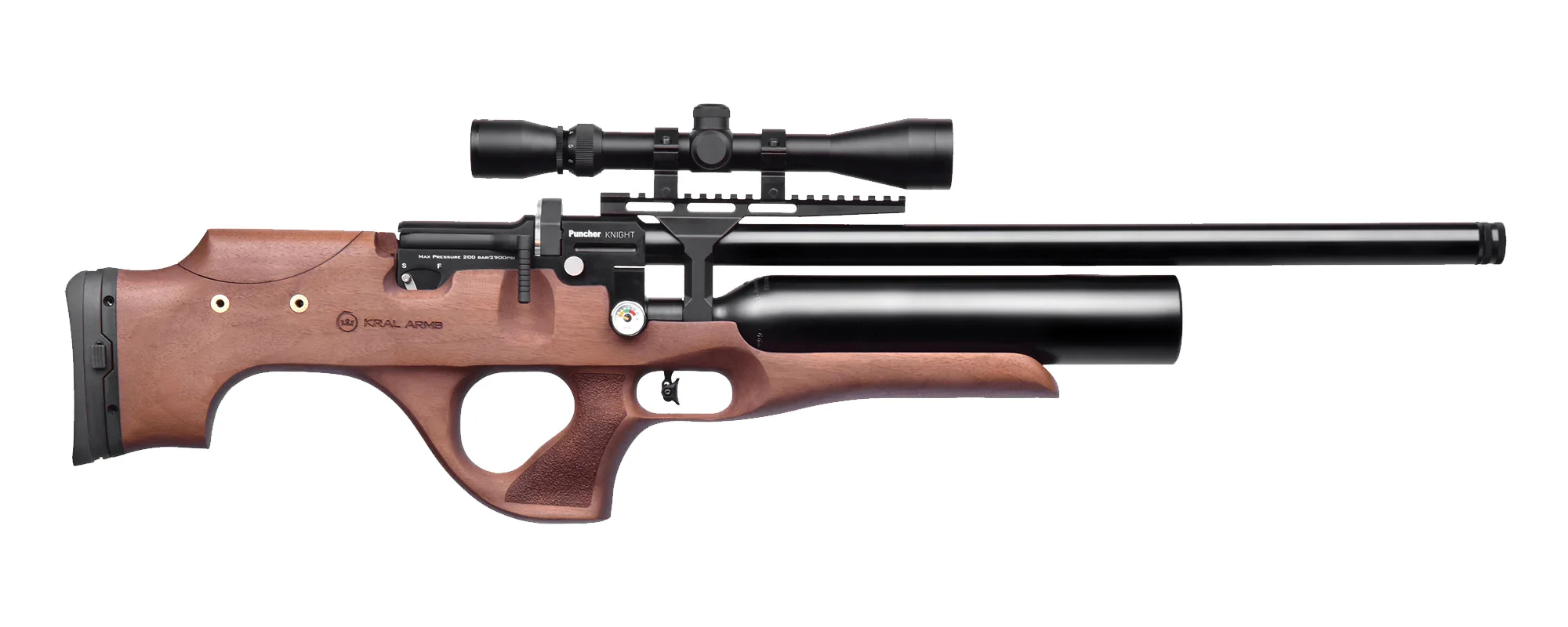
The KRAL KNIGHT WALNUT is distinguished by its combination of traditional Turkish craftsmanship, modern PCP technology, and carefully engineered sporting features. Designed by Kral Arms, this pre-charged pneumatic air rifle is recognized for its beautifully finished walnut stock, distinctive semi-bullpup configuration, and versatile shooting platform.
Furthermore, attention has been given to handling comfort, mechanical consistency, and practical adjustability. A substantial 500cc air reservoir is incorporated into the design, while a fully shrouded barrel and adjustable stock components contribute to its refined construction.
Whether the rifle is being evaluated for recreational target shooting, precision practice, or sporting use where legally permitted, its features deserve careful consideration.
Premium Turkish Walnut Stock and Distinctive Craftsmanship
Beautiful Natural Wood Finish
A genuine Turkish walnut stock is fitted to the KRAL KNIGHT WALNUT, giving the rifle an elegant appearance that is enhanced by the natural character of the wood.
Unlike synthetic alternatives, each walnut stock is distinguished by its individual grain patterns, warm tones, and distinctive surface characteristics. Consequently, a traditional sporting appearance is achieved without sacrificing the contemporary styling associated with the Knight series.
Moreover, the stock is complemented by dark metal components, resulting in a visually balanced design. The combination of natural wood and modern mechanical construction creates an unmistakable appearance.
Ergonomic Design and Adjustable Comfort
Considerable attention has been directed toward shooter comfort and adaptable positioning. An adjustable cheekpiece is incorporated into the stock, allowing different shooting preferences and body proportions to be accommodated.
Additionally, an adjustable buttpad is provided, making personalized positioning possible. The rifle’s compact overall profile is achieved through its semi-bullpup-inspired arrangement.
As a result, the traditional walnut exterior is complemented by modern ergonomic features.
Advanced Pre-Charged Pneumatic Technology
Consistent Compressed-Air Operation
A pre-charged pneumatic system is employed within the KRAL KNIGHT WALNUT. Instead of relying on a conventional spring-powered mechanism, energy is supplied through a compressed-air reservoir.
Furthermore, a large-capacity 500cc aluminum air bottle is incorporated into the platform. A maximum filling pressure of 250 bar is specified by the manufacturer.
Through this arrangement, a substantial compressed-air supply is made available for sporting sessions, although actual shot counts are influenced by caliber, power configuration, environmental conditions, and ammunition characteristics.
Smooth Side-Lever Action
A side-lever mechanism is featured as part of the rifle’s operating system. The design is complemented by a detachable rotary magazine and an adjustable trigger assembly.
Moreover, a manual trigger safety is included, while the trigger shoe can be adjusted for individual fit.
These components demonstrate the emphasis placed on functionality and mechanical adaptability throughout the Knight series.
Precision-Oriented Barrel Construction
Fully Shrouded Rifled Barrel
A 58cm rifled barrel is incorporated into the rifle’s design. Additionally, a full-length barrel shroud is provided as part of the manufacturer’s configuration.
The barrel assembly is engineered for pellet-based sporting applications, while the rifle’s overall arrangement is intended to accommodate recreational and precision-oriented shooting disciplines.
Nevertheless, accuracy is affected by ammunition selection, maintenance condition, environmental factors, and individual shooting technique. Therefore, specific grouping performance should not be assumed without controlled testing.
Integrated Optics Mounting Platform
A 22mm Picatinny mounting rail is included on the rifle. This standardized interface is designed to accommodate compatible sporting optics and approved accessories.
Consequently, different configurations can be considered according to individual preferences and applicable regulations.
Optical equipment is not necessarily included with the standard rifle package, so the supplied configuration should be verified.
Key Features of the KRAL KNIGHT WALNUT
The following characteristics are identified in the manufacturer’s published specifications:
- Premium Turkish Walnut Stock: Natural hardwood construction with distinctive grain patterns.
- PCP Air System: Compressed-air operation with a 500cc reservoir.
- 250-Bar Maximum Fill Pressure: Manufacturer-specified reservoir pressure rating.
- Side-Lever Action: Incorporated into the rifle’s mechanical design.
- Fully Shrouded Barrel: A 58cm rifled barrel with an integrated shroud.
- Adjustable Cheekpiece: Designed to accommodate different positioning preferences.
- Adjustable Buttpad: Additional fitting flexibility is provided.
- Adjustable Trigger Assembly: Personalization is supported through multiple adjustment points.
- Detachable Rotary Magazine: Magazine capacity varies according to caliber.
- 22mm Picatinny Rail: Compatibility with suitable optics mounting equipment.
- Manual Safety: A dedicated safety mechanism is incorporated.
- Multiple Caliber Configurations: Manufacturer-listed versions include .177, .22, and .25.
Technical Specifications
Manufacturer-Listed Product Details
| Specification |
Details |
| Manufacturer |
Kral Arms |
| Model |
Puncher Knight W |
| Stock Material |
Turkish Walnut |
| Power System |
Pre-Charged Pneumatic |
| Action |
Side Lever |
| Caliber Options |
.177, .22, .25 |
| Barrel Length |
580mm |
| Overall Length |
875mm |
| Air Reservoir |
500cc |
| Maximum Fill Pressure |
250 Bar |
| Magazine Capacity |
14 / 12 / 10 shots |
| Optics Rail |
22mm Picatinny |
| Average Walnut Model Weight |
Approximately 4.0kg |
| Safety |
Manual |
| Barrel Construction |
Fully Shrouded |
Specifications are based on published manufacturer information. Regional models and production configurations may differ.
Modern Engineering Meets Traditional Walnut Styling
A Distinctive Sporting Rifle Design
Traditional stock craftsmanship is combined with contemporary compressed-air engineering throughout the Knight W platform.
In particular, the wooden stock provides a classic appearance, while the mechanical components reflect the manufacturer’s modern PCP design approach.
Furthermore, adjustment features have been incorporated to accommodate a variety of individual preferences.
This combination makes the rifle noteworthy among sporting airguns that pair traditional materials with modern technical features.
Versatile Caliber Availability
Several factory caliber options are listed by Kral Arms, including 4.5mm, 5.5mm, and 6.35mm.
However, power ratings and permitted configurations vary between jurisdictions. Some regional models are supplied in restricted-output configurations, while others may require additional licensing or authorization.
Therefore, the exact model specification and applicable local requirements should always be confirmed before acquisition or use.
Maintenance, Care, and Long-Term Ownership
Preserving the Walnut Stock
The appearance of the natural wooden stock can be preserved through appropriate maintenance and careful storage.
Excessive moisture, prolonged direct sunlight, and sudden temperature changes should be avoided. Additionally, approved wood-care products should be selected according to manufacturer recommendations.
Regular visual inspections are encouraged, while mechanical servicing should be entrusted to suitably qualified professionals.
Responsible Compressed-Air Equipment Care
Compressed-air equipment requires particular attention to pressure ratings, filling components, and manufacturer-approved servicing procedures.
Consequently, compatible equipment should always be used, and unauthorized modifications should be avoided.
Proper storage and adherence to the owner’s manual are essential for safe, responsible ownership.
Why the KRAL KNIGHT WALNUT Stands Out
A distinctive combination of walnut craftsmanship, adjustable ergonomics, and PCP engineering is represented by the KRAL KNIGHT WALNUT.
Instead of being defined by appearance alone, the model is distinguished by its compressed-air platform, generous reservoir capacity, integrated mounting rail, and carefully considered stock adjustments.
Equally important, its natural walnut construction provides a classic sporting aesthetic that contrasts with the predominantly synthetic styling of many contemporary alternatives.
For enthusiasts comparing sporting air rifle designs, the model offers an opportunity to evaluate both traditional craftsmanship and modern mechanical features within a single platform.
Final Overview – KRAL KNIGHT WALNUT
The KRAL KNIGHT WALNUT PCP Air Rifle brings together traditional Turkish walnut styling and a modern sporting-airgun platform. Its adjustable stock, side-lever mechanism, fully shrouded barrel, and substantial compressed-air reservoir are among its defining characteristics.
Furthermore, its range of factory configurations allows applicable technical specifications and local legal requirements to be considered before a model is selected.
With its distinctive appearance and manufacturer-documented features, the Knight W remains a recognizable example of Kral Arms’ approach to combining traditional materials with contemporary PCP engineering.
KRAL KNIGHT WALNUT Calibres, FAC Power, Recommended Scopes and Essential Accessories
The KRAL KNIGHT WALNUT is offered in several calibre configurations, allowing different sporting preferences and regional requirements to be accommodated. Its pre-charged pneumatic system is complemented by a large compressed-air reservoir, an adjustable stock, and a dedicated optics mounting platform.
Furthermore, an understanding of calibre availability, FAC classifications, power specifications, and compatible accessories is essential when evaluating this rifle. Although its fundamental design is shared across the range, particular specifications can vary according to the selected model and intended market.
Available Calibres and Their Characteristics
.177 Calibre (4.5mm)
The .177 calibre configuration is commonly associated with recreational target shooting and established sporting-airgun disciplines.
Because pellets in this calibre are comparatively small and lightweight, their ballistic characteristics differ from those of larger-diameter alternatives. Nevertheless, actual performance is determined by the complete combination of pellet design, rifle configuration, and factory power rating.
Additionally, .177 ammunition is widely represented within the sporting-airgun market, making it a familiar choice among target-shooting enthusiasts.
The manufacturer’s listed magazine capacity for this calibre is 14 pellets.
.22 Calibre (5.5mm)
A .22 calibre version is also included in the manufacturer’s Knight range. This configuration uses larger-diameter projectiles than the .177 variant and is commonly encountered across recreational PCP shooting applications.
Furthermore, different pellet weights and designs are available within this calibre category. Such variation makes it important for owners to follow manufacturer instructions regarding suitable ammunition.
Compared with the .177 version, a 12-shot magazine capacity is specified for the .22 configuration.
Importantly, calibre selection should be guided by local legislation, the manufacturer’s documentation, and the sporting discipline for which the rifle is intended.
.25 Calibre (6.35mm)
The .25 calibre version represents the largest of the three commonly published configurations.
A larger projectile diameter distinguishes this variant, while its individual ballistic characteristics depend on the manufacturer’s power specification and the ammunition being used.
Additionally, its magazine capacity is listed as 10 pellets. As with the other configurations, compatibility with the supplied magazine and factory chamber dimensions must be confirmed.
Overall, each calibre is associated with different projectile dimensions, magazine capacities, and ammunition characteristics.
FAC and Non-FAC Power Classifications
Understanding FAC Air Rifle Requirements
In the United Kingdom, the term FAC refers to a Firearm Certificate. In England and Wales, air rifles exceeding the generally applicable 12 ft-lb muzzle-energy limit are normally subject to firearm certification.
Consequently, a higher-powered factory configuration must not be assumed to be available for unrestricted ownership.
Different regulations apply in Scotland and Northern Ireland, while legislation in other countries may use entirely different classifications.
Therefore, licensing obligations should always be verified with the relevant local authority before purchase or possession.
Sub-12 ft-lb Configurations
Where officially supplied and certified for the applicable market, a sub-12 ft-lb version may be subject to different licensing requirements from a higher-powered variant.
However, the presence of an adjustable power mechanism does not automatically mean every rifle is approved or certified for unrestricted use.
The actual factory designation, measured muzzle energy, and applicable legal requirements remain decisive.
Factory Power Specifications
The manufacturer’s published Knight specifications include several power ratings across the available calibre range. These ratings should be treated as model-dependent technical information rather than universal guarantees.
Additionally, muzzle energy and pellet velocity are separate measurements. Muzzle energy is expressed in joules or foot-pounds, while velocity is generally expressed in metres per second or feet per second.
Variations in factory configuration and ammunition characteristics can affect recorded performance.
For accurate product listings, the specific rifle’s official documentation should be used to confirm its declared output.
Recommended Scopes and Optics Compatibility
Sporting Scope Considerations
A 22mm Picatinny rail is incorporated into the rifle’s factory design, providing an established mounting interface for compatible optical equipment.
For general recreational target shooting, a 3–9×40 sporting scope may be considered. Meanwhile, a 4–12×40 model provides a different magnification range for shooters who prefer additional visual detail.
Variable-magnification optics are available from manufacturers such as Hawke, MTC Optics, and Vortex. However, particular combinations should be selected according to manufacturer compatibility instructions, eye-relief requirements, and relevant sporting-range regulations.
Importantly, the manufacturer’s catalogue describes the scope as optional rather than standard equipment. Therefore, optical accessories should not be advertised as included unless confirmed for the actual retail package.
Recommended Accessories and Supporting Equipment
Essential Equipment for Responsible Ownership
Several supporting accessories may be considered when evaluating the rifle’s ownership and maintenance requirements.
- Approved PCP Filling Equipment: Equipment rated for the rifle’s specified 250-bar maximum filling pressure.
- Compatible Filling Adapter: A manufacturer-approved connection suitable for the supplied rifle.
- Protective Rifle Case: Designed to protect the equipment during lawful transportation and storage.
- Secure Lockable Storage: Appropriate for preventing unauthorized access.
- Safety Glasses: Suitable protective eyewear for supervised sporting activities.
- Manufacturer-Approved Cleaning Supplies: Products appropriate for maintaining the barrel and exterior surfaces.
- Walnut Stock Care Products: Suitable wood-care materials for preserving the natural finish.
- Compatible Spare Magazine: A factory-approved magazine matching the rifle’s specific calibre.
Maintenance and Storage Accessories
A cleaning cloth, suitable protective case, and approved maintenance materials can contribute to responsible long-term ownership.
Furthermore, equipment exposed to moisture should be inspected and cared for according to the manufacturer’s recommendations.
Any servicing involving pressurized components should be performed by a qualified professional rather than attempted without appropriate authorization and technical training.
Final Considerations for Calibre, Power and Accessories
The KRAL KNIGHT WALNUT combines multiple factory calibre options, a 500cc compressed-air reservoir, adjustable sporting features, and an optics-compatible mounting rail.
Additionally, its FAC classification must be assessed according to the actual factory power rating and the legislation applicable to the owner.
Ultimately, accurate specification verification, approved accessories, and responsible maintenance remain important considerations when selecting or owning this distinctive Turkish walnut PCP air rifle.
Brocock BRK and Benjamin Air Rifles: Complete Guide to PCP Technology, Precision, Calibres and Accessories
Discover the Engineering Behind Brocock Airguns and Benjamin Air Rifles
Modern airgun technology has transformed recreational target shooting, competitive marksmanship, and precision air-powered sporting equipment. Today, manufacturers combine advanced pneumatic systems, ergonomic construction, and innovative engineering to produce dependable shooting platforms. Among the established names in this industry, brocock ltd and Benjamin continue to attract attention from enthusiasts seeking technical sophistication and reliable performance.
The evolution of brocock airguns reflects a strong emphasis on compact designs, efficient compressed-air systems, and consistent shot delivery. Similarly, the Benjamin product range offers numerous configurations, from traditional pellet rifles to specialized pneumatic platforms.
Whether researching a compressed air rifle, comparing a conventional pellet gun, or exploring advanced sporting equipment, understanding the available technologies helps buyers make informed decisions.
Brocock BRK Air Rifles: Innovation and Precision Engineering
Brocock Sniper XR and BRK Sniper XR
The brocock sniper xr represents an important development in regulated pneumatic rifle engineering. Featuring a semi-bullpup configuration, adjustable ergonomics, and a sidelever operating system, this model emphasizes handling convenience and mechanical consistency.
Additionally, the brk sniper xr incorporates a regulated air-delivery system designed to reduce variations between successive shots. Its adjustable stock components provide flexibility for different shooting positions.
For enthusiasts researching the .25 caliber brocock sniper xr, calibre selection deserves particular attention. The larger pellet diameter offers different projectile characteristics compared with smaller calibres, while energy output and shot capacity depend on the specific configuration.
The sniper xr also offers an example of how modern engineering combines compact dimensions with adjustable controls.
Brocock Commander XR and BRK Commander
Another noteworthy platform is the brocock commander xr, which combines a tactical-inspired stock configuration with pneumatic engineering.
The brocock commander has attracted interest from enthusiasts who appreciate adjustable furniture, modular features, and consistent operation.
Similarly, buyers researching brk ghost and Commander models often compare ergonomics, overall dimensions, available calibres, and compatible accessories.
Searches for brocock commander xr price should be evaluated using current retailer listings because pricing varies according to country, configuration, condition, and included equipment.
BRK Ghost Air Rifle: Modern Design and Customization
The brk ghost air rifle represents a distinctive approach to modern PCP rifle design. Its bullpup layout places major operating components within a compact overall configuration while retaining a full-length barrel arrangement appropriate to the model.
Furthermore, the BRK Ghost offers adjustable ergonomic components and a mechanical design intended to support controlled operation.
Owners researching ghost accessories should pay attention to manufacturer compatibility, factory specifications, and approved replacement components.
A replacement ghost handle, for example, should be checked against the exact model and production variant before purchase.
Likewise, a magpul sl k buttpad is a product-specific accessory reference rather than a guarantee of compatibility with every rifle stock.
Pathfinder XR and Compact BRK Models
The pathfinder xr offers another example of the manufacturer’s emphasis on compact pneumatic platforms.
Buyers researching the brk pathfinder, brk pathfinder xr, or general pathfinder air rifle specifications should compare verified product dimensions, stock arrangements, and applicable power ratings.
The brk concept xr is another model worth examining when comparing compact sporting rifles.
While these designs share elements of the manufacturer’s engineering philosophy, each has its own configuration and intended handling characteristics.
For anyone comparing several platforms, factors such as overall weight, trigger characteristics, stock adjustment, and service support are more useful than appearance alone.
What Are PCP Air Rifles and How Do They Work?
New enthusiasts frequently ask, what are pcp air rifles?
The abbreviation PCP means precharged pneumatic, referring to an air-powered system that stores compressed air in a pressurized cylinder or reservoir.
Consequently, understanding pcp rifle meaning helps explain the operating principles behind modern pneumatic sporting rifles.
Other common searches include what does pcp mean in air rifles, what is pcp air rifle, what is a pcp air rifle, and what is a pre charged pneumatic air rifle.
All describe the same general operating technology.
Likewise, what is a pcp air gun and pcp air rifle meaning refer to compressed-air propulsion rather than spring-powered or carbon-dioxide systems.
A pcp rifle stores energy before firing, whereas a break barrel pellet gun typically compresses a spring or gas ram through a cocking action.
This distinction also explains why a pneumatic gun, gun pneumatic, and pneumatic weapons may refer to several different mechanisms, depending on the context.
Modern pcp air rifles often feature pressure regulators, adjustable triggers, and specialized magazines. Nevertheless, operating pressure, energy output, and maintenance requirements vary substantially between models.
Essential Accessories and Equipment Compatibility
Properly selected accessories contribute to equipment suitability and long-term maintenance.
For example, the 0db moderator and 0 db moderator are search variations referring to a sound-moderating accessory. Actual sound reduction depends on the individual device, rifle configuration, and applicable legal requirements.
Meanwhile, a pcp o ring kit may contain replacement seals for specified components. Seal dimensions, materials, and pressure ratings must match the manufacturer’s requirements.
Optics are another consideration. A buyer researching how to connect scope equipment should first confirm the mounting-rail standard and the compatibility of the selected mounting system.
The mtc copperhead 4 16×44 is one example of an optical sight that may appear in airgun accessory searches.
Separately, what does prc stand for in guns is a terminology question commonly encountered during broader firearm research. PRC often refers to Precision Rifle Cartridge, which is distinct from PCP pneumatic technology.
Some searches also include bro air, a broad term that may appear alongside BRK and Brocock product research without identifying a specific manufacturer model.
Benjamin Air Rifles: Traditional Performance and Modern Pneumatic Technology
Benjamin Marauder and Popular PCP Models
The benjamin air rifle range encompasses numerous designs developed for different shooting preferences. From conventional air pellet gun platforms to specialized pneumatic systems, the manufacturer offers equipment for recreational and sporting applications.
Among its recognized products, the benjamin marauder has established a strong presence in PCP airgun discussions.
The benjamin marauder pcp and benjamin marauder pcp air rifle are associated with regulated or unregulated configurations, depending on model and generation. Similarly, the benjamin marauder air rifle is frequently considered by enthusiasts researching accurate pneumatic equipment.
Buyers comparing the benjamin marauder .25, benjamin marauder 22, and benjamin marauder regulated variants should verify the exact specifications rather than assume identical performance.
The benjamin marauder pistol provides another distinct option for enthusiasts interested in compact air-powered platforms.
Additionally, searches for benjamin pellet, benjamin pellet gun, and benjamin air pistol reflect the manufacturer’s broader presence in the sporting airgun market.
For owners of older equipment, benjamin air rifle repair should involve model identification, manufacturer-approved parts, and qualified servicing of pressurized components.
Benjamin Bulldog and Big-Bore Airguns
The benjamin bulldog is associated with the development of larger-calibre PCP platforms.
In particular, the benjamin bulldog 457 belongs to the big-bore category, while the bulldog 357 represents another calibre designation within the family.
Those researching benjamin bulldog 457 20 joules should distinguish search terminology from verified factory specifications, since this phrase does not establish an official 20-joule configuration.
More broadly, big bore air guns differ from conventional small-calibre pellet rifles in projectile dimensions, pressure-system requirements, and applicable regulations.
A hunting air rifle or hunting pellet gun must also be evaluated according to local laws, permitted activities, and the manufacturer’s intended application.
Benjamin Trail, Prowler and Break-Barrel Models
Traditional spring and gas-piston airguns remain popular alongside pneumatic equipment.
The benjamin prowler and benjamin trail np are examples associated with conventional sporting air-rifle designs.
Likewise, the benjamin np trail xl and benjamin air rifle 22 break barrel appear frequently in searches involving gas-piston technology.
The phrase benjamin break may also describe general interest in the manufacturer’s break-barrel products.
Enthusiasts comparing a benjamin 22 caliber pellet rifle with PCP alternatives should consider the differences in cocking mechanism, maintenance, recoil behavior, and operating requirements.
Benjamin Airbow Technology and Arrow-Launching Systems
The benjamin airbow belongs to a specialized category that uses compressed air to propel compatible arrows rather than conventional pellets.
Also called an air bow, airbow, arrow gun, air bow rifle, or air bow gun, this equipment differs substantially from standard pellet platforms.
The benjamin pioneer airbow helped establish the manufacturer’s presence in this category.
More recent searches for benjamin airbow m600, benjamin m600 airbow, and the general benjamin bow category reflect interest in advanced arrow-launching technology.
An airbow rifle may also be compared with an air powered crossbow, although their propulsion mechanisms and equipment requirements are different.
The M600 is a distinct PCP-powered arrow launcher with manufacturer-specific arrows and components.
Understanding Pellet Gun Calibres and Power Ratings
Airgun buyers frequently compare .177 pellet guns, 177 pellet guns, a 22 pellet gun, and a .25 pcp air rifle.
Each calibre has its own projectile characteristics, compatible ammunition, and model-specific performance limits.
Similarly, searches for a high powered pellet gun, high power pellet gun, or pellet rifle 1500 fps should be assessed carefully. Advertised velocity alone does not establish accuracy, suitability, or energy output.
A bolt action pellet gun describes a particular loading or cycling arrangement rather than a specific power system.
Other familiar categories include the bb gun rifle, air gun rifle, airrifle, and the broader grouping of air rifle and air pistol equipment.
In comparison, co2 pellet guns use carbon dioxide cartridges, while PCP platforms rely on stored high-pressure air.
The search term m357 may refer to different products and requires model confirmation before any technical comparison.
Choosing the Right Airgun and Understanding Online Availability
Buyers asking can i buy air rifles online should first investigate local restrictions, age requirements, licensing obligations, and shipping regulations.
Rules vary significantly by jurisdiction, especially for higher-powered equipment and specialized arrow-launching platforms.
Whether comparing benjamin air rifles or modern BRK sporting platforms, reliable model specifications, lawful ownership, and qualified maintenance remain essential considerations.
The Brocock product family includes established Sniper XR, Commander XR, Pathfinder XR, Concept XR, and Ghost designs, while the manufacturer’s newer range includes updated XR2 variants.
Ultimately, selecting appropriate air-powered sporting equipment involves balancing ergonomics, engineering quality, compatible accessories, and long-term support. Understanding the distinctions between compressed-air systems, gas-piston mechanisms, and specialized arrow platforms makes product comparisons clearer and more informative.
Frequently Asked Questions (FAQs)
1. What makes this PCP air rifle different from other models?
A distinctive combination of traditional craftsmanship and contemporary compressed-air technology is provided by this model. Unlike conventional spring-powered alternatives, a pre-charged pneumatic mechanism is incorporated to deliver performance according to the manufacturer’s factory specifications.
Additionally, natural hardwood construction gives the stock a refined appearance, while adjustable ergonomic components contribute to handling comfort. A large compressed-air reservoir is also integrated into the platform.
Furthermore, the side-lever action, detachable magazine, and integrated optics rail distinguish its overall design. These characteristics make it an interesting option for enthusiasts who appreciate classic materials alongside modern sporting equipment.
2. Is this suitable for beginners?
Although several user-friendly features are incorporated, suitability depends on the prospective owner’s experience, training, physical capabilities, and understanding of compressed-air equipment.
Beginners should receive appropriate instruction from a qualified professional before handling any sporting airgun. In addition, local ownership requirements must be understood and followed.
Supervised participation at an approved shooting facility is generally preferable for individuals developing basic safety and equipment-handling knowledge.
Ultimately, proper training and responsible supervision are considerably more important than the appearance or advertised features of any particular model.
3. What calibre options are available?
Three principal calibre configurations are identified in the manufacturer’s published product information: 4.5mm, 5.5mm, and 6.35mm.
Each version accommodates a different projectile diameter and is associated with its own magazine capacity.
Moreover, ammunition characteristics vary depending on construction, weight, and manufacturer. Therefore, only projectiles that are compatible with the specific factory configuration should be considered.
The exact calibre should always be confirmed from the product marking, official documentation, and retailer specifications.
4. How does the compressed-air system operate?
Stored compressed air is used as the energy source instead of a traditional mechanical mainspring.
An integrated pressure reservoir is incorporated into the rifle, while internal mechanical components regulate its operation according to the factory design.
Consequently, the system requires suitable compressed-air equipment and careful adherence to the manufacturer’s operating instructions.
Because high-pressure systems involve specific safety considerations, unauthorized adjustments or repairs should be avoided.
Qualified servicing is recommended whenever concerns arise regarding pressure retention, seals, valves, or other internal components.
5. What is the capacity of the air reservoir?
A 500cc compressed-air reservoir is specified for the manufacturer’s standard configuration.
This capacity describes the internal volume available for storing compressed air. However, it does not directly indicate how many shots will be produced during a shooting session.
Actual performance depends on factors such as factory power output, calibre, environmental conditions, and the pressure range within which the equipment operates.
Additionally, different market-specific configurations may have different operating characteristics.
The reservoir and associated components should always be maintained according to the manufacturer’s instructions.
6. What is the maximum filling pressure?
A maximum filling pressure of 250 bar is listed in the manufacturer’s specifications.
This figure represents the stated upper pressure limit for the relevant factory reservoir configuration and should never be exceeded.
Furthermore, filling accessories must be appropriately rated and compatible with the equipment.
High-pressure compressed-air systems should be inspected regularly, and any damaged or questionable components should be assessed by qualified personnel.
Manufacturer-approved servicing and responsible storage are especially important for maintaining safe operating conditions.
7. How many shots can be expected from a full reservoir?
An exact shot count cannot be guaranteed without information about the particular factory configuration.
Calibre, muzzle energy, operating pressure, and mechanical efficiency can all influence the number of usable shots available.
Moreover, a larger reservoir does not automatically guarantee identical performance across different versions.
Published performance figures should therefore be regarded as configuration-specific estimates rather than universal guarantees.
Prospective buyers should request manufacturer documentation for the exact variant being considered.
8. Is a telescopic sight included with the purchase?
Optical equipment is not necessarily included with the standard factory package.
Although an integrated mounting rail is provided, the scope and mounting hardware may be supplied separately.
Additionally, retailers sometimes advertise different product bundles that include selected accessories.
Therefore, the contents of the individual listing should be reviewed before purchase.
A clear package description should identify whether any optics, mounting components, protective equipment, or other accessories are supplied.
9. What type of optics mounting system is provided?
A 22mm Picatinny mounting interface is incorporated into the factory design.
This standardized system is widely recognized within the sporting optics industry.
Nevertheless, compatibility must be assessed for the specific optical equipment and mounting hardware being considered.
Different accessories may have distinct mounting dimensions, weight considerations, and manufacturer requirements.
Therefore, optical compatibility should be confirmed through the relevant technical documentation rather than assumed from rail appearance alone.
10. Is the stock made from genuine wood?
Natural Turkish walnut is specified as the stock material for this version.
Walnut has traditionally been associated with sporting equipment because of its distinctive grain, attractive coloration, and established use in wooden stock construction.
Moreover, natural variation means that individual stocks may display slightly different grain patterns, tones, and visual characteristics.
Such differences are normal properties of genuine wood rather than manufacturing defects.
Appropriate maintenance is recommended to preserve the finish and general appearance over time.
11. Can the cheekpiece and buttpad be adjusted?
An adjustable cheekpiece and buttpad are identified among the manufacturer’s stock features.
These components are intended to accommodate different positioning preferences and physical proportions.
Additionally, ergonomic adjustability can contribute to a more personalized sporting experience.
However, adjustments should remain within the manufacturer’s approved specifications.
Any uncertainty regarding mechanical fit or component security should be referred to an appropriately qualified professional.
12. Is the trigger adjustable?
An adjustable trigger assembly is included in the published specifications.
Such adjustability is intended to accommodate factory-approved preferences and individual ergonomic requirements.
Nevertheless, trigger mechanisms are safety-critical components and should not be modified outside the manufacturer’s instructions.
Unauthorized changes may compromise reliability, mechanical security, or safe operation.
For this reason, servicing and technical adjustments are best evaluated by a qualified gunsmith or authorized service technician.
13. What is the magazine capacity?
Magazine capacity varies according to the calibre configuration.
The manufacturer’s published specifications identify capacities of 14 shots for 4.5mm, 12 shots for 5.5mm, and 10 shots for 6.35mm.
These capacities are associated with the standard detachable rotary magazine system.
Moreover, magazines from different configurations should not be assumed to be interchangeable.
Replacement components should be checked against the exact model and calibre designation before purchase.
14. Does this model have a safety mechanism?
A manual safety mechanism is incorporated into the factory design.
However, a mechanical safety should never be regarded as a substitute for responsible handling, proper supervision, or secure storage.
All sporting airguns should be treated as potentially capable of causing serious injury.
Additionally, handling procedures should always follow the manufacturer’s published safety instructions.
Safe storage, appropriate training, and compliance with local legislation remain essential responsibilities.
15. Is a licence required for ownership?
Licensing obligations depend on the country, region, age of the owner, and particular factory power configuration.
In England and Wales, air rifles exceeding the generally applicable 12 ft-lb muzzle-energy threshold normally require a Firearm Certificate.
Different requirements apply in Scotland and Northern Ireland, while other countries maintain their own air-weapon regulations.
Furthermore, restrictions may apply to acquisition, transportation, storage, and use.
Consequently, current legal requirements should be verified with the relevant authority before any transaction or transfer.
16. What is the difference between FAC and lower-powered versions?
In the United Kingdom, FAC refers to a Firearm Certificate, which may be required for certain airgun configurations depending on their legal classification.
A lower-powered version may fall under different ownership arrangements from a higher-powered model.
However, classification depends on the actual muzzle energy and the law applicable in the relevant jurisdiction.
Factory specifications must therefore be checked carefully.
A product’s appearance, calibre, or name alone cannot establish whether certification is required.
17. How heavy is the rifle?
The walnut-stock version is listed at approximately 4.0 kilograms in published manufacturer information.
However, exact weight may differ slightly because of natural wood variation and changes in factory configuration.
Additionally, attached accessories may increase the overall assembled weight.
Prospective owners should consider the published dimensions and handling characteristics when assessing ergonomic suitability.
The manufacturer’s stated weight should be treated as an approximate product specification unless an individual item has been measured.

Reviews
There are no reviews yet.