Air Arms S510 Carbine Walnut – Premium PCP Air Rifle with Precision Engineering and Classic Walnut Stock
Product Description – Air Arms S510 Carbine Walnut
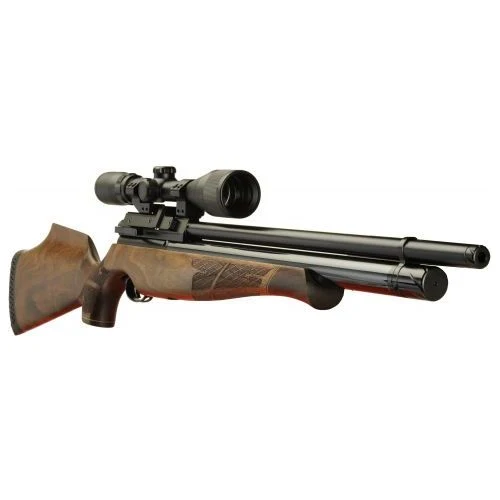
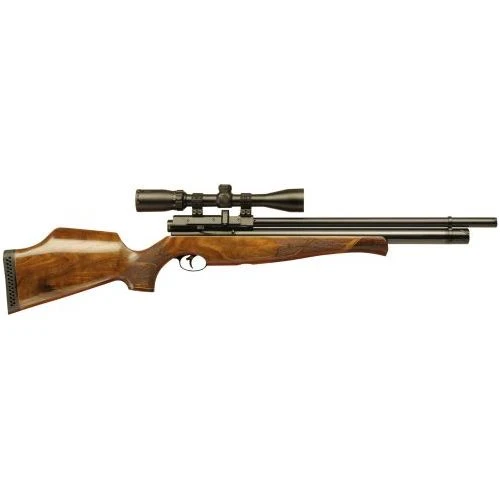
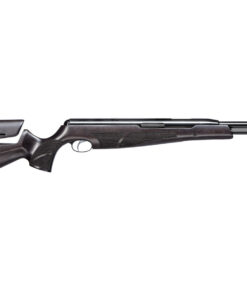
The Air Arms S510 Carbine Walnut is a British-engineered pre-charged pneumatic (PCP) air rifle distinguished by its traditional walnut stock, smooth side-lever action, and precision-focused construction. Developed within the established Air Arms S500 platform, this compact sporter combines classic craftsmanship with modern pneumatic engineering. Consequently, its design is associated with controlled operation, consistent mechanical performance, and a refined shooting experience.
Furthermore, the rifle features a fully shrouded barrel, an adjustable two-stage trigger, and a detachable rotary magazine. These components are integrated into a balanced carbine configuration suitable for organized target shooting and other lawful sporting applications.
Unlike full-length configurations, the carbine incorporates shorter overall dimensions. Nevertheless, its traditional stock profile and established action design remain characteristic of the S510 family.
Key Features and Technical Highlights
-
Manufacturer: Air Arms, United Kingdom
-
Model: S510 Carbine Walnut
-
Power System: Pre-charged pneumatic (PCP)
-
Stock: Traditional walnut sporter
-
Action: Side-lever operated
-
Magazine: 10-shot detachable rotary magazine
-
Available Calibres: .177 (4.5 mm) and .22 (5.5 mm)
-
Barrel: Precision-engineered, fully shrouded Lothar Walther barrel
-
Trigger: Adjustable two-stage design
-
Safety: Manual trigger-mounted safety
-
Air Pressure Monitoring: Integrated manometer
-
Air Filtration: In-line 20-micron filter on applicable configurations
-
Power Configurations: Sub-12 ft-lb and FAC-rated versions, depending on specification
-
Regulation: Regulated and unregulated variants
-
Primary Applications: Authorized target shooting, recreational marksmanship, and sporting use
These features are documented across the manufacturer’s current S510 collection. Exact specifications vary by production version and configuration.
Classic Walnut Stock and Traditional British Craftsmanship
Natural Walnut Finish and Distinctive Appearance
One of the most recognizable features of this model is its traditional wooden stock. Rather than adopting an entirely synthetic exterior, the rifle incorporates natural walnut, providing the individual grain patterns and warm coloring associated with traditional sporting firearms.
Moreover, walnut is valued for its appearance and established use in precision sporting equipment. Each natural stock may display different grain characteristics, making cosmetic variation a normal feature of the material.
Additionally, the stock is shaped around a conventional sporter profile, providing a familiar layout for shooters accustomed to traditional rifle ergonomics.
Balanced Carbine Construction
The shortened carbine format is intended to provide a more compact alternative to a full-length sporting rifle. As a result, the rifle presents a different balance and handling profile while retaining the recognizable S510 action.
Equally importantly, stock fit, overall dimensions, and shooting posture can influence individual comfort. Therefore, suitability should be assessed against the specific model’s measurements and the user’s physical requirements.
The natural wood should also be protected against prolonged moisture exposure and unsuitable storage conditions.
Advanced PCP Engineering and Mechanical Consistency
Pre-Charged Pneumatic Operating System
The Air Arms S510 Carbine Walnut operates through a pre-charged pneumatic mechanism. Compressed air is stored in a dedicated cylinder and released through an internal valve system during firing.
Unlike spring-piston air rifles, this platform does not depend on a conventional mainspring being compressed for each shot. Instead, energy is supplied by the stored compressed air.
Furthermore, the internal firing valve has been engineered to manage air delivery. Consistent valve behavior is an important factor in repeatable pneumatic performance, although actual results depend on the rifle’s condition, configuration, and ammunition.
Regulated and Unregulated Configurations
Different members of the S510 family are offered with regulated or unregulated pneumatic systems.
In regulated configurations, a pressure regulator controls the supply of air to the firing mechanism. Consequently, a more consistent operating pressure may be maintained over part of the usable fill range.
By comparison, unregulated configurations use a more direct pressure system with fewer internal pressure-management components.
Neither arrangement should be assumed to apply to every walnut-stocked carbine. Therefore, the model identification and manufacturer specifications should be checked before any technical claims are published.
Precision Barrel and Smooth Side-Lever Mechanism
Fully Shrouded Lothar Walther Barrel
A fully shrouded Lothar Walther barrel is incorporated into the S510 design. This component is associated with precision manufacturing and repeatable mechanical performance.
Furthermore, the surrounding shroud forms part of the rifle’s integrated barrel assembly. Its construction helps distinguish the S510 from rifles featuring entirely exposed barrels.
Nevertheless, practical accuracy cannot be determined by barrel branding alone. Ammunition quality, equipment condition, environmental conditions, and shooter proficiency also influence results.
Side-Lever Loading System
Instead of a conventional bolt-action arrangement, the rifle features a side-lever mechanism. This design operates the action and accommodates the magazine-fed loading system.
Additionally, the detachable rotary magazine provides a nominal capacity of ten pellets. The manufacturer’s current S510 description identifies two magazines as standard with its listed configurations, although package contents should always be verified for a particular product.
Moreover, the side-lever assembly forms a characteristic part of the rifle’s mechanical design and distinguishes it from earlier bolt-operated models in the wider Air Arms range.
Adjustable Trigger and Integrated Safety Features
Two-Stage Trigger Assembly
An adjustable two-stage trigger is included as part of the platform’s precision-oriented construction. The trigger assembly provides a distinct mechanical arrangement compared with simpler single-stage systems.
However, adjustments should only be performed in accordance with the manufacturer’s instructions or by an appropriately qualified professional.
Importantly, the trigger system should never be regarded as a substitute for responsible handling and established range safety procedures.
Manual Safety and Pressure Monitoring
A manually operated safety mechanism is located near the trigger assembly on applicable configurations.
Additionally, an integrated pressure gauge allows the cylinder’s indicated pressure to be checked. Pressure monitoring is essential because pneumatic systems must remain within the manufacturer’s specified operating limits.
Only approved filling equipment and procedures should be used, and internal pressure-bearing components should be serviced by qualified personnel.
Calibre Availability and Power Classification
.177 and .22 Calibre Versions
The standard walnut-stocked carbine is listed in .177 and .22 calibre configurations.
Both calibres belong to established air-rifle categories, although the corresponding pellets differ in diameter, mass, and ballistic characteristics.
Furthermore, the selected calibre must match the exact rifle specification. Ammunition of an incorrect calibre should never be introduced into the action.
Sub-12 ft-lb and FAC Models
Air Arms lists sub-12 ft-lb and higher-power FAC configurations within the S510 family.
In Great Britain, firearms licensing requirements depend on the relevant jurisdiction and the specific rifle’s legal classification. Rules differ between England, Wales, Scotland, and other countries.
Consequently, legal ownership, transportation, storage, and use requirements should always be established before acquisition or operation.

Practical Ownership and Maintenance Considerations
Appropriate Sporting Environments
The platform is associated with organized target practice, recreational shooting, and authorized sporting activities.
However, shooting should take place only in lawful environments with suitable backstops and appropriate supervision where necessary.
Furthermore, eye protection, muzzle discipline, and positive target identification remain essential regardless of the rifle’s power rating.
Long-Term Care and Storage
Routine inspection and proper storage are important aspects of pneumatic rifle ownership.
Exterior metal surfaces should be protected from corrosion, while walnut surfaces should be maintained with products appropriate for finished gunstocks.
Similarly, seals, pressure components, magazines, and other mechanical assemblies should be inspected and serviced according to the manufacturer’s maintenance schedule.
Finally, the rifle should be stored securely, unloaded, and protected from unauthorized access.
Air Arms S510 Carbine Walnut – Product Overview
The Air Arms S510 Carbine Walnut brings together traditional British stockmaking aesthetics and established PCP air-rifle engineering. Its walnut sporter stock, fully shrouded barrel, side-lever action, rotary magazine, and adjustable trigger define its technical identity.
Furthermore, the availability of multiple calibre, power, and regulation configurations illustrates the broader flexibility of the S510 platform. However, individual specifications should always be verified against the exact production variant.
Overall, this carbine represents a distinctive combination of traditional presentation, modern pneumatic construction, and precision-oriented sporting design.
Air Arms S510 Carbine Walnut – Calibres, FAC Power, Performance, Recommended Scopes and Essential Accessories
The Air Arms S510 Carbine Walnut combines established British PCP engineering with a choice of calibres, power configurations, and compatible sporting accessories. Furthermore, its precision-manufactured barrel, traditional walnut stock, and smooth side-lever mechanism provide a refined platform for recreational target shooting and authorized sporting activities.
Whether a standard sub-12 ft-lb configuration or an FAC-rated version is being considered, understanding the available specifications is essential. Additionally, appropriate optics, approved filling equipment, and protective accessories contribute to responsible ownership and long-term equipment care.
Available Calibres – .177 and .22 Air Rifle Specifications
.177 Calibre (4.5 mm) – Precision and Target Shooting
The .177 calibre Air Arms S510 Carbine Walnut is offered as part of the manufacturer’s standard product collection. This established 4.5 mm calibre is widely associated with recreational target shooting and organized air-rifle disciplines.
Furthermore, .177 pellets generally have a smaller diameter and lower mass than comparable .22 pellets. Nevertheless, actual ballistic behavior depends on projectile design, muzzle velocity, and operating conditions.
Key characteristics:
- Calibre: .177 / 4.5 mm
- Ammunition: Compatible .177 airgun pellets
- Application: Recreational and organized target shooting
- Mechanism: Pre-charged pneumatic
- Magazine capacity: 10 pellets
- Power options: Sub-12 ft-lb and designated FAC configurations
Consequently, the .177 model provides a familiar choice for sporting enthusiasts who participate in disciplines where smaller-calibre air rifles are permitted.
.22 Calibre (5.5 mm) – Traditional Sporting Versatility
Alternatively, the .22 calibre Air Arms S510 Carbine Walnut features a larger 5.5 mm bore. This configuration remains popular within the broader sporting airgun market.
In addition, .22 pellets are commonly available in several weights and profiles, although only correctly specified ammunition should be used.
Key characteristics:
- Calibre: .22 / 5.5 mm
- Ammunition: Compatible .22 airgun pellets
- Application: Authorized sporting and recreational shooting
- Magazine capacity: 10 pellets
- Barrel: Precision-manufactured Lothar Walther
- Available versions: Standard and designated FAC configurations
Importantly, the .177 and .22 models share the recognized S510 platform, but their exact performance figures are not interchangeable.
FAC Versions, Power Output and Legal Classification
Standard Sub-12 ft-lb Power Configuration
The standard UK-market S510 Carbine is available in a sub-12 ft-lb configuration, representing a nominal muzzle-energy class below approximately 16.3 joules.
Furthermore, its pneumatic system is designed around a particular factory specification. The rifle’s output should therefore be checked against its documentation rather than assumed from its external appearance.
Standard power characteristics:
- Nominal classification: Below 12 ft-lb
- Equivalent threshold: Approximately 16.3 joules
- Available calibres: .177 and .22
- Powerplant: PCP compressed-air mechanism
- Operation: Side-lever, magazine-fed action
In England and Wales, qualifying air rifles below the relevant legal threshold are generally subject to different licensing rules from higher-powered firearms. However, separate requirements apply in Scotland, Northern Ireland, and other jurisdictions.
FAC High-Power Air Rifle Configurations
FAC refers to a Firearm Certificate in the British firearms-licensing context. Consequently, FAC-rated S510 variants are subject to stricter legal controls than qualifying lower-powered air rifles.
Additionally, Air Arms offers higher-power S510 configurations, including the Carbine Xtra Superlite family. The wider S510 range also includes .25 calibre FAC models, but .25 should not automatically be listed as an option for the standard S510 Carbine Walnut.
Because muzzle-energy specifications differ between versions, no single FAC energy figure accurately represents every S510 Carbine Walnut configuration.
Therefore, factory documentation, proof markings, and the applicable licensing authority should be consulted before selecting, transferring, or using an FAC-rated model.
PCP Air Efficiency, Shot Count and Pressure Management
Expected Shots per Air Fill
Air efficiency represents another important consideration for S510 owners. However, actual shot count depends on calibre, regulator specification, factory power rating, pellet characteristics, and operating conditions.
According to Air Arms’ published S510 guidance, approximate shot counts include:
Standard unregulated, sub-12 ft-lb:
- .177 calibre: 70–90 shots
- .22 calibre: 60–80 shots
Regulated configurations:
- .177 calibre: Up to 100 shots
- .22 calibre: Up to 90 shots
FAC-rated configurations:
- .177 calibre: Approximately 40–60 shots
- .22 calibre: Approximately 35–50 shots
These are manufacturer guidance figures rather than guaranteed outputs. Furthermore, filling pressure limits must be checked against the exact model’s instructions.
Recommended Scopes for the Air Arms S510 Carbine Walnut
Quality Sporting Optics and Mount Compatibility
A suitable riflescope may be paired with the rifle for authorized target-shooting applications. The traditional S510 action uses an 11 mm dovetail mounting arrangement, unlike the Picatinny-equipped Tactical version.
Consequently, correctly sized mounts are essential. Furthermore, eye relief, scope weight, and optical clarity should be considered before purchasing.
Suggested scope options for compatibility assessment:
- Hawke Vantage 3-9×40 AO: A compact sporting optic with adjustable-objective functionality.
- Hawke Airmax 3-12×40: An airgun-oriented optical option with variable magnification.
- Hawke Vantage 4-16×50 AO: A larger objective configuration for recreational target-range applications.
- Hawke Airmax Compact 4-16×44: A compact-format option that may complement the carbine’s proportions.
Nevertheless, scope-mount clearance, objective dimensions, and individual eye relief should be confirmed by a qualified retailer.
Recommended Accessories and Ownership Essentials
Practical Equipment for Maintenance and Storage
Appropriate accessories contribute to safe storage, transport, inspection, and routine maintenance. Moreover, genuine replacement components and manufacturer-approved equipment help preserve the rifle’s original specifications.
Recommended accessories:
- Protective rifle case: Helps protect the walnut stock and external components during lawful transportation.
- Trigger lock or secure storage cabinet: Supports responsible storage and prevents unauthorized access.
- Manufacturer-approved filling equipment: Provides a compatible compressed-air supply when operated according to official instructions.
- Correct filling adaptor: Must match the precise rifle configuration.
- Protective shooting glasses: Essential safety equipment for sporting environments.
- Approved cleaning equipment: Supports appropriate barrel and exterior maintenance.
- Walnut stock-care products: Help maintain the appearance and finish of natural wood.
- Genuine Air Arms magazines: Provide factory-compatible replacement magazine options.
- Pellet storage containers: Keep compatible ammunition organized and protected.
Additionally, any pressure-related repairs or internal servicing should be undertaken by appropriately qualified technicians.
Conclusion – Calibre Selection, Power and Accessories
The Air Arms S510 Carbine Walnut provides a distinctive combination of traditional walnut craftsmanship, modern PCP operation, and established British airgun engineering.
Furthermore, its .177 and .22 calibre options, standard and FAC configurations, and compatibility with quality sporting optics make the S510 family a versatile range of precision-oriented equipment.
Ultimately, confirmed factory specifications, correctly matched accessories, and responsible maintenance practices remain essential to obtaining reliable service and preserving this premium air rifle over time.
Diana Air Rifles and Western Airguns: Complete Guide to Precision, Performance, Models, and Airgun Technology
Discovering Diana Air Rifles and Their Reputation for Quality
The world of precision airguns continues to attract enthusiasts who value engineering quality, shooting consistency, and dependable performance. Among established manufacturers, diana air rifles have developed a recognizable identity through traditional craftsmanship, innovative mechanisms, and a diverse product collection. Whether researching a diana air rifle for recreational target shooting or comparing the different models available, understanding the brand’s history provides an excellent starting point.
Throughout the years, the rws diana air rifle category has attracted considerable attention from enthusiasts familiar with the longstanding relationship between Diana products and RWS branding. Consequently, searches for rws diana, diana rws, and air rifle diana often involve comparisons between older models, contemporary releases, and different regional product names.
Additionally, the term diana pellet gun covers several different configurations designed for sporting and recreational applications. Each model offers distinct characteristics, including variations in weight, powerplant design, handling, and sight arrangements.
For customers researching airgun ownership, evaluating mechanical reliability, manufacturer documentation, and intended use remains essential.
Diana 34 Series: Traditional Design and Modern Developments
The diana 34 remains one of the manufacturer’s most recognizable model families. Its longstanding reputation has encouraged continued interest in the diana model 34, particularly among enthusiasts who appreciate conventional spring-piston engineering.
Similarly, the diana 34 air rifle has become a familiar reference in conversations about break-barrel mechanisms and traditional sporting rifles.
Owners of older equipment may encounter the designation diana rws 34, while product listings sometimes use rws diana 34 to describe historically associated versions.
Other searches, including diana r34, frequently reflect abbreviated product naming rather than a completely separate model.
Furthermore, the diana 34 ems introduced a more modular approach to an established platform. Its Easy Modular System provides a distinctive identity within the manufacturer’s product collection.
For enthusiasts evaluating sight configurations, diana 34 ems fiber optic sights represents another important research topic. Nevertheless, specifications should always be checked against the precise model and production version.
Exploring Classic Diana Models and Magnum Air Rifles
Beyond the 34 series, several older and specialist designs maintain a place in airgun history.
The diana 35 represents a traditional model that collectors and experienced owners continue to research. Meanwhile, searches for diana 2 may refer to historic equipment requiring careful model identification.
More powerful spring-piston designs include the diana 350 magnum, widely recognized as part of the company’s performance-oriented product heritage.
The diana 350 magnum air rifle, also searched as 350 magnum diana, demonstrates the manufacturer’s longstanding interest in high-performance spring-powered technology.
Additionally, the diana rws 460 magnum is associated with a different fixed-barrel, underlever design.
The diana mod 48, diana 48, and rws diana model 48 are commonly connected with sidelever-operated air rifles. Such systems offer a different shooting experience from conventional break-barrel platforms.
Another notable model is the diana 54, which became associated with specialized recoil-management technology.
Research into hunting diana models should consider legal requirements, appropriate sporting applications, and the importance of responsible equipment selection.
Modern Diana PCP Rifles and Compact Air Pistols
Pre-charged pneumatic technology has expanded the manufacturer’s portfolio beyond conventional spring-powered equipment.
For example, the diana stormrider has become a recognizable entry in the company’s PCP rifle collection. Its design appeals to enthusiasts interested in compressed-air operation and modern airgun handling.
Similarly, the diana outlaw gen 2 is a useful search phrase for people investigating Outlaw versions and potential generational differences. However, the exact designation should be confirmed with official product documentation.
The diana r22, commonly presented as the diana r22 or R-22, offers another product family to examine when comparing current sporting rifle designs.
Other models include the diana 250, also known as the diana 250 air rifle, and the diana two fifty, providing additional options within the manufacturer’s wider catalog.
For compact shooting equipment, the diana air pistol category introduces different handling characteristics.
Examples include the diana lp8, sometimes searched as lp8 diana, alongside the diana airbug and diana bandit black.
Owners may also research diana chaser accessories and diana chaser parts when identifying compatible replacement components or manufacturer-approved additions.
Meanwhile, broad phrases such as diana r and nerf diana should be interpreted carefully because they do not necessarily identify a specific Diana airgun model.
Western Airguns and American PCP Engineering
Another important part of the sporting airgun industry involves western airguns, a manufacturer associated with American-designed and assembled PCP equipment.
Research into western air guns, western air gun, and airguns usa frequently reflects interest in domestic manufacturing, contemporary designs, and specialist sporting platforms.
Although searches for western arms, western firearm, western firearms, or western arms shotgun may appear alongside PCP terminology, these phrases can refer to different product categories or manufacturers.
Therefore, brand identification is important when comparing american made air rifles and specialist compressed-air equipment.
The company’s catalog includes several distinctive platforms, particularly the western rattler, western sidewinder, and western mordax families.
These products highlight how modern pneumatic engineering can accommodate multiple configurations, calibers, and operating systems.
Western Rattler Bullpup and Big-Bore Models
The western rattler bullpup is associated with a compact rifle layout that places much of the action behind the trigger.
Consequently, the western rattler air gun attracts attention from enthusiasts researching unconventional rifle configurations.
Common variations and search phrases include western rattler 357, 357 rattler, and western rattler 45, which relate to different caliber categories.
Similarly, searches for 357 air rifle and .35 cal air rifle often involve comparing big-bore pneumatic platforms and the practical differences between manufacturer specifications.
Interest in the western rattler bullpup for sale and western rattler bullpup amazon illustrates how customers research distribution channels, although listing availability and seller authorization require independent verification.
Another significant product is the western big bore bushbuck 45.
Research into bushbuck air rifle price often involves questions about configuration, warranty coverage, and included accessories rather than price alone.
Within the wider category, terms such as big bore pellet gun, big game air guns, and bullpup air rifle describe distinct equipment characteristics.
Because these models can produce substantial energy, responsible storage, suitable facilities, and applicable legal restrictions deserve particular attention.
Western Mordax and Mordax Venom Technology
Compact PCP engineering is represented by the western airguns mordax, a platform associated with modern controls and adaptable handling.
The western mordax pcp designation highlights its compressed-air operating system, while mordax airgun and mordax air gun remain common alternative search terms.
The western mordax venom expands this product family with additional design features and a different air-storage arrangement.
Consequently, both mordax venom and western airguns mordax attract interest from people comparing compact pneumatic platforms.
Manufacturer documentation identifies the Mordax Venom as a selectable semi-automatic and fully automatic design, subject to applicable legal restrictions.
Although the phrase desert scorpion pistol is associated with Mordax branding, buyers should distinguish marketing terminology from official model identification.
Likewise, mordax air gun price should be considered alongside configuration, legal classification, support, and warranty information.
Searches involving venom arms and serpent arms may describe unrelated businesses or terminology and should not automatically be treated as official Western product names.
Western Sidewinder and Additional Airgun Technology
The western sidewinder provides another example of contemporary PCP design.
Searches for sidewinder gun, sidewiner, and western sidewinder compact may involve different product references, spelling variations, or configuration questions.
For accurate identification, owners should consult original documentation before relying on marketplace descriptions.
In addition, sidewinder length is an important consideration when comparing dimensions, storage arrangements, and handling comfort.
People searching for a sidewinder k7a-00008 manual should verify that the document genuinely corresponds to their exact equipment, rather than assuming similarly named products share instructions.
Elsewhere, edgun west and edgunwest are additional search expressions encountered in the broader airgun marketplace, but they should not be confused with Western Airguns branding.
Selecting Suitable Airguns and Understanding Caliber Categories
Different sporting applications require different design priorities. An accurate pellet rifle may emphasize consistent grouping, comfortable handling, and repeatable operation rather than maximum advertised velocity.
Similarly, the phrase long range air rifle should encourage realistic evaluation of manufacturer specifications, environmental conditions, and properly supervised target facilities.
A 4.5mm air gun generally refers to the .177-caliber category, commonly encountered in recreational and precision-target contexts.
Meanwhile, pcp guns use stored compressed air, distinguishing them from conventional spring-powered systems.
The broader category of semi automatic pellet gun describes a particular operating arrangement, although availability and legality differ between jurisdictions.
Search terms such as lethal air guns and steel penetrating full auto airgun highlight the importance of treating powerful pneumatic equipment as potentially dangerous rather than harmless recreational devices.
Likewise, anyone investigating air pistols for hunting must understand local restrictions, humane considerations, and the limitations of the equipment involved.
Finding Reliable Airgun Information and Responsible Ownership
Enthusiasts frequently use phrases such as air guns near me, air gun dealers near me, air rifle dealers, air rifle online, and az air guns while researching local retailers, product information, and specialist services.
However, availability should never replace proper consideration of local legislation, age requirements, safe storage, and verified manufacturer support.
Searches for air gun for semi truck may relate to vehicle-carried equipment, making transportation regulations and secure storage particularly important.
Furthermore, the question where do bullets land when shot in air addresses a serious safety issue: projectiles discharged upward eventually return to earth and can cause severe injuries or death. Never fire a projectile into the air.
Ultimately, choosing sporting equipment responsibly involves understanding its design, limitations, and lawful use.
Whether comparing classic Diana engineering with modern Western pneumatic technology, informed research helps enthusiasts appreciate manufacturing quality while prioritizing safety, reliability, and responsible participation in shooting sports.
Frequently Asked Questions (FAQs)
1. What makes this PCP air rifle different from conventional air rifles?
This premium pre-charged pneumatic air rifle is distinguished by its combination of traditional craftsmanship, precision engineering, and advanced mechanical construction. Unlike conventional spring-powered air rifles, its firing mechanism relies on compressed air stored within an integrated cylinder. Consequently, operation does not depend on the repeated compression of a mainspring.
Furthermore, the smooth side-lever action, precision-manufactured barrel, and adjustable two-stage trigger contribute to its sophisticated sporting design. The natural wooden stock provides an elegant appearance, while the compact configuration offers an alternative to longer sporting rifles.
Additionally, the manufacturer’s established engineering reputation makes the platform recognizable among experienced airgun enthusiasts.
2. Is this model suitable for beginners?
Yes, responsible beginners who have received appropriate safety instruction may become familiar with this type of equipment. However, pre-charged pneumatic systems require additional knowledge regarding compressed-air handling, storage, and maintenance.
For example, owners must understand the manufacturer’s recommended filling procedures, pressure limitations, and routine inspection requirements. Moreover, appropriate supervision is particularly important for individuals with limited shooting experience.
Although the mechanical action is designed for straightforward operation, safe handling remains essential. Therefore, introductory instruction through a recognized shooting club or qualified professional is recommended.
3. Which calibres are available?
The standard sporting configuration is commonly offered in .177 (4.5 mm) and .22 (5.5 mm).
Both calibres are established within recreational airgun shooting, although they differ in pellet diameter, projectile mass, and ballistic characteristics.
Additionally, certain members of the wider product family may be manufactured in other calibres. Nevertheless, availability depends on the exact model designation, production configuration, and regional market.
Importantly, only ammunition matching the rifle’s specified calibre should be used. An incorrect pellet diameter may cause mechanical problems or create unsafe operating conditions.
4. What is the difference between .177 and .22 calibre?
The primary difference concerns projectile diameter and the characteristics of the compatible ammunition.
The .177 calibre uses a smaller projectile measuring approximately 4.5 mm in diameter. Conversely, the .22 calibre accommodates a larger 5.5 mm projectile.
Furthermore, pellet weight and design vary within each calibre. These differences influence projectile behavior, although the actual performance depends on the rifle’s factory specification and environmental conditions.
Neither calibre should automatically be regarded as universally superior. Instead, suitability depends on the shooting discipline, applicable regulations, and individual requirements.
5. What does PCP mean?
PCP stands for Pre-Charged Pneumatic, referring to an airgun system powered by compressed air stored before use.
Rather than relying on a conventional spring-piston mechanism, the internal valve system releases a controlled quantity of compressed air during firing.
Furthermore, the system incorporates dedicated pressure-bearing components that require proper inspection and maintenance.
Because high-pressure air is involved, only manufacturer-approved filling equipment should be used. Additionally, pressure limits must never be exceeded, and internal pressure-system repairs should be entrusted to qualified technicians.
6. How many pellets can the magazine hold?
The standard rotary magazine accommodates ten pellets.
This detachable magazine forms part of the established side-lever operating system. Furthermore, the manufacturer commonly supplies two magazines with certain new configurations, although included accessories may vary by retailer, market, and production package.
Before purchasing a replacement, the magazine’s calibre and compatibility should be verified.
Additionally, genuine replacement magazines are preferable where manufacturer compatibility is required. Appropriate storage helps protect the magazine mechanism from contamination, physical damage, and unnecessary wear.
7. Does the rifle have a regulated air system?
Regulated and unregulated configurations exist within the product family.
A regulated system incorporates a pressure-management component designed to supply air at a controlled pressure under specified operating conditions.
Conversely, an unregulated system operates without a separate pressure regulator performing that function.
Both arrangements have established uses in PCP engineering. However, the presence of a regulator should never be assumed from the external appearance of the rifle.
Consequently, the precise production version and technical documentation must be checked before describing an individual example as regulated.
8. What is the purpose of the side-lever action?
The side-lever action provides the mechanical means of operating the loading system.
Unlike a traditional bolt configuration, the mechanism incorporates a lever positioned alongside the action. This design is characteristic of several modern sporting PCP platforms.
Furthermore, its construction reflects the manufacturer’s emphasis on mechanical refinement and established operating principles.
The mechanism should always be kept clean and inspected according to the official maintenance instructions. If resistance, damage, or unusual movement becomes apparent, use should be discontinued until the equipment has been professionally inspected.
9. What type of barrel is installed?
A precision-manufactured Lothar Walther barrel is associated with this model family.
Additionally, the barrel is enclosed within a shrouded assembly, giving the rifle its recognizable sporting appearance.
Barrel manufacturing quality is important because dimensional consistency and mechanical construction contribute to the overall design.
However, actual accuracy depends on several additional factors, including ammunition quality, maintenance condition, and the shooting environment.
Therefore, no particular accuracy figure should be guaranteed without verified testing under clearly defined conditions.
10. Can a telescopic sight be fitted?
Yes, compatible sporting optics can be mounted using the appropriate mounting interface.
The traditional configuration commonly features an 11 mm dovetail rail, although other models within the wider range may use different mounting systems.
Furthermore, the dimensions and weight of an optic should be evaluated alongside the rifle’s stock geometry and available mounting clearance.
Correctly matched mounts are especially important because incompatible components may damage the equipment.
For this reason, compatibility should be confirmed with a qualified sporting-equipment retailer before purchase.
11. Is the walnut stock made from genuine wood?
Yes, the traditional walnut-stocked configuration uses natural walnut.
Consequently, individual examples can display distinctive grain patterns, variations in coloration, and subtle differences in surface appearance.
Moreover, walnut has a long history in the manufacture of traditional sporting stocks because of its appearance and woodworking characteristics.
Nevertheless, natural wood requires suitable care. Excessive moisture, direct heat, prolonged sunlight, and unsuitable cleaning chemicals may affect its finish.
Manufacturer-approved wood-care products and appropriate indoor storage are therefore recommended for preserving its appearance.
12. How much does the rifle weigh?
Weight depends on the precise configuration, stock variation, and installed accessories.
As a general reference, traditional S510 Carbine configurations are commonly listed at approximately 3 kg without additional optics, although the manufacturer’s exact figure should be checked for the specific version.
Furthermore, the installation of a scope and mounts increases the assembled weight.
Because natural walnut also varies in density, small differences between individual stocks are possible.
Therefore, published measurements should be treated as model-specific specifications rather than guaranteed weights for every example.
13. What is the difference between a carbine and a full-length air rifle?
A carbine generally features a more compact overall design than its full-length counterpart.
This difference may involve barrel length, air-cylinder dimensions, balance, or other structural characteristics.
Furthermore, a compact design can influence the equipment’s handling and storage requirements. However, a shorter overall length does not automatically establish a particular level of accuracy or mechanical quality.
Actual performance depends on the complete factory configuration.
Consequently, comparisons should be based on verified manufacturer specifications rather than assumptions about barrel length alone.
14. Does this model require a firearm certificate?
Licensing requirements depend on the jurisdiction, muzzle-energy classification, and exact configuration.
In England and Wales, qualifying air rifles below the applicable power threshold are generally treated differently from higher-powered firearms. However, Scotland and Northern Ireland have distinct legal requirements.
Furthermore, FAC-rated configurations require the relevant legal authorization where applicable.
Other countries may impose additional restrictions concerning possession, importation, transportation, and use.
Therefore, owners and prospective purchasers should consult the relevant licensing authority before making any purchase or ownership decisions.

Reviews
There are no reviews yet.