Weihrauch HW100 BPK – Compact Bullpup PCP Air Rifle Built for Precision
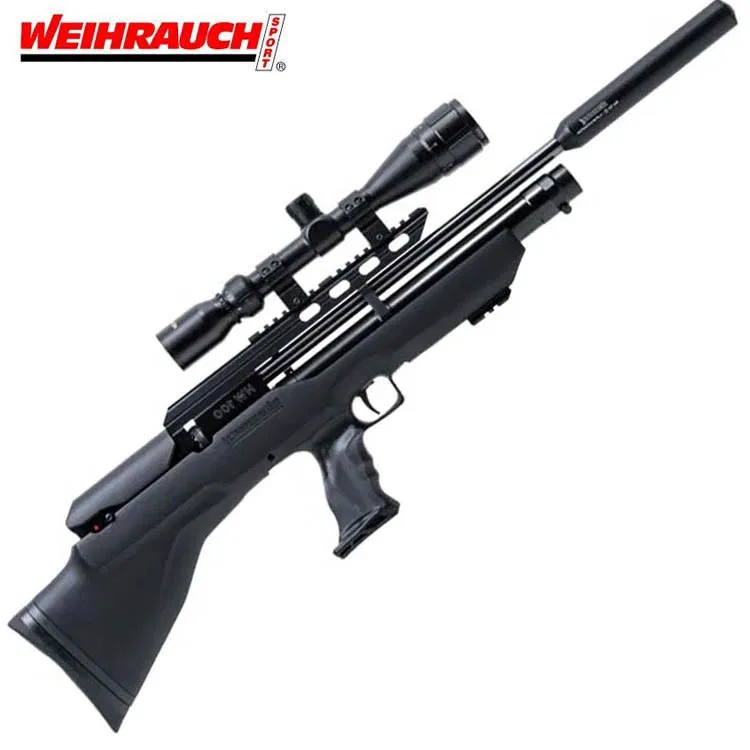
The Weihrauch HW100 BPK combines compact bullpup handling with the proven engineering associated with the HW100 platform. Designed as the shorter carbine-style member of Weihrauch’s bullpup family, this pre-charged pneumatic air rifle delivers a remarkably controlled shooting experience while keeping overall dimensions manageable.
Rather than simply shortening a conventional rifle, Weihrauch has configured the action around a bullpup layout. Consequently, much of the rifle’s operating system is positioned farther rearward. The result is a compact platform that can be carried, shouldered, and repositioned with noticeably less unnecessary length.
At the same time, the characteristics that made the HW100 series popular have been retained. A smooth repeating system is provided, a two-stage adjustable match trigger is fitted, and a detachable rotary magazine allows follow-up shots to be prepared efficiently.
For shooters who value German engineering, dependable mechanical operation, compact dimensions, and refined ergonomics, the Weihrauch HW100 BPK represents an attractive premium PCP option.
Weihrauch HW100 BPK Compact Bullpup Design
One of the defining characteristics of the Weihrauch HW100 BPK is its shortened bullpup configuration.
Because the action is positioned behind the trigger area, useful barrel length can be retained without creating the long proportions normally associated with a conventional rifle. Therefore, maneuverability can be improved considerably.
This characteristic becomes particularly useful when the rifle is carried through restricted spaces, moved around farm buildings, transported in a suitable case, or handled from a seated shooting position.
Furthermore, the weight is positioned closer to the shooter. As a result, the rifle can feel more centralized in the hands rather than excessively front-heavy.
The ambidextrous stock design also broadens usability. Both right-handed and left-handed shooters can obtain a natural hold, while the pistol-grip configuration provides positive control.
Soft-Touch Stock and Practical Ergonomics
A black soft-touch finish gives the rifle a distinctive contemporary appearance while providing a secure gripping surface.
Meanwhile, the elevated cheek position works naturally with a telescopic sight. Since this rifle has been designed primarily around optical sighting equipment rather than traditional open sights, the stock geometry supports a comfortable head position behind the scope.
The compact shape also allows the rifle to be mounted quickly.
Consequently, less movement may be required when transitioning from carrying the rifle to establishing a stable shooting position.
Precision-Focused PCP Performance
Consistency sits at the heart of the HW100 platform.
Compressed air is used to propel each pellet, meaning the shot cycle is essentially free from the spring vibration associated with traditional spring-powered air rifles. Therefore, the sight picture can remain comparatively settled throughout the firing process.
In addition, controlled air delivery helps provide repeatable velocity across the usable portion of the air charge.
That consistency can translate into predictable pellet trajectories when an appropriate pellet has been selected and the rifle has been correctly zeroed.
The result is a system suited to deliberate target shooting, recreational range use, and other lawful applications where repeatability matters.
High-Quality Barrel System
Accuracy is supported by Weihrauch’s established barrel manufacturing experience.
Each pellet is guided through a precision barrel before leaving the muzzle, while the rigid PCP action minimizes unnecessary movement during the firing cycle.
However, pellet selection remains important.
Different barrels may show preferences for particular pellet weights, head sizes, and designs. Therefore, testing several reputable pellet options can help determine which ammunition performs most consistently in an individual rifle.
Smooth Sidelever Repeating Action
Fast, controlled cycling is provided through the HW100 repeating mechanism.
Rather than breaking the barrel or operating a conventional bolt after every shot, the shooter operates the sidelever to cock the rifle and index the magazine.
This arrangement creates a fluid shooting sequence.
Once familiarity has been developed, the system can be operated without significantly disturbing the established shooting position.
Furthermore, the positive mechanical feel helps provide clear feedback during each cycle.
14-Shot Rotary Magazine
A 14-shot rotary magazine is used within the Weihrauch HW100 BPK platform. Current Weihrauch specifications identify a 14-pellet capacity for the HW100 X-BP/BPK family.
This capacity reduces the frequency with which individual pellets must be manually loaded.
For target sessions, that means more time can be spent concentrating on shooting technique. During appropriate field use, meanwhile, convenient magazine operation allows a second shot to be prepared without a lengthy loading procedure.
Careful magazine loading is still recommended. Pellets should be positioned correctly and should not be damaged while being inserted.
Two-Stage Adjustable Match Trigger
Trigger quality can significantly influence practical precision, and the Weihrauch HW100 BPK is fitted with a two-stage adjustable match trigger.
The first stage allows controlled movement before the firing point is reached.
Afterward, the second stage provides a clearly defined release point.
Such separation can help the shooter build a repeatable trigger technique because the firing point can be anticipated without requiring excessive trigger pressure.
Current manufacturer information continues to specify a two-stage match trigger with manual safety for the HW100 X bullpup range.
Manual Safety System
A manual safety is incorporated into the rifle.
Nevertheless, a mechanical safety should never replace correct handling practices. The muzzle should always remain pointed in a safe direction, the trigger should remain untouched until a shot is intended, and local airgun regulations should always be observed.
PCP Air System and Efficient Charging
Compressed air is stored within the rifle’s removable air cylinder.
Traditional HW100 BPK versions have commonly used a 200-bar operating system, while the newer HW100 X-BPK generation has been upgraded to an aluminium cylinder rated for 250-bar filling pressure.
Because specifications vary according to production generation, market, and configuration, the markings and manual supplied with the exact rifle should always determine the correct maximum filling pressure.
A pressure gauge allows the remaining cylinder pressure to be monitored.
Meanwhile, quick-fill equipment simplifies recharging when used with appropriate high-pressure filling equipment.
Improved HW100 X-BPK Air System
The current HW100 X platform introduces several refinements over earlier configurations.
According to Weihrauch, the redesigned model uses a lighter aluminium air cylinder, a revised regulator, a 250-bar maximum filling pressure, and at least a 50% increase in firing capacity compared with the preceding system.
These developments make the latest generation especially appealing to shooters who want longer sessions between fills.
Compact Dimensions for Easier Handling
Compact dimensions are one of the strongest reasons to consider the Weihrauch HW100 BPK.
Earlier published specifications list the carbine bullpup at approximately 735 mm overall length, with a 310 mm barrel and weight around 3.3 kg, depending on configuration.
Current HW100 X variants have been further revised, so exact dimensions can vary according to power specification and production version.
Even so, the underlying advantage remains unchanged: substantial barrel performance can be packaged into a considerably shorter overall rifle.
As a result, the BPK can be easier to manage where conventional full-length PCP rifles feel cumbersome.
Scope-Mounting Flexibility
Optical sights form an important part of the HW100 BPK shooting system.
Depending on generation and specification, mounting options can include a Picatinny arrangement or an 11 mm prism configuration. The current HW100 X platform is offered with alternative Picatinny or 11 mm scope-mounting arrangements.
This flexibility allows the rifle to be configured with anything from a compact lightweight optic to a more advanced variable-magnification scope.
Correct ring height should be selected carefully.
A scope mounted excessively high may compromise cheek position, whereas a setup mounted too low could create clearance problems around the action or objective lens.
Why Choose the Weihrauch HW100 BPK?
The rifle stands out because compact dimensions have not been pursued at the expense of refinement.
Instead, several established HW100 characteristics have been brought together within a shorter bullpup platform.
Product highlights include:
- Compact bullpup configuration for improved maneuverability
- Pre-charged pneumatic operating system
- Smooth repeating sidelever action
- 14-shot rotary magazine
- Two-stage adjustable match trigger
- Ambidextrous stock design
- Soft-touch stock finish
- Integrated pressure monitoring
- Quick-fill compatible air system
- Manual safety
- Scope-ready mounting system
- Compact carbine-length barrel arrangement
- Balanced weight distribution
- Available in multiple calibre configurations depending on market
- Modern HW100 X versions feature a redesigned regulator and 250-bar aluminium cylinder
Built for Shooters Who Value Control and Consistency
Not every shooter wants the longest rifle available.
For many users, a compact rifle offers practical advantages that become obvious as soon as the platform is shouldered.
The Weihrauch HW100 BPK places much of its mass close to the body, making directional changes feel controlled. Likewise, the short overall package can be easier to stabilize from seated, kneeling, supported, or standing positions.
Nevertheless, compactness alone would offer little value without dependable performance.
That is where the HW100 architecture becomes especially important.
Smooth cocking, a refined trigger, regulated air delivery on relevant models, and a precision-oriented barrel system combine to create a platform focused on repeatability.
Premium Engineering in a Practical Bullpup Platform
Attention has clearly been placed on making the Weihrauch HW100 BPK feel like a purpose-built rifle rather than a conventional PCP compressed into a smaller stock.
Controls are positioned for convenient operation, the stock has been configured around scope use, and the repeating mechanism supports efficient shooting.
Additionally, the compact layout can make storage and transportation more convenient when compared with substantially longer sporting rifles.
For users upgrading from a traditional break-barrel rifle, the transition into a refined PCP platform can be significant. Recoil characteristics are reduced, cocking effort between shots is minimal, and magazine-fed operation creates a smoother overall shooting rhythm.
Experienced PCP owners, meanwhile, may appreciate the BPK because it provides these familiar benefits in a particularly compact format.
Weihrauch HW100 BPK – A Refined Choice for the Serious Airgun Shooter
Ultimately, the Weihrauch HW100 BPK delivers a compelling blend of accuracy-oriented engineering, compact handling, mechanical refinement, and premium build quality.
Its bullpup configuration reduces unnecessary overall length while retaining the operating characteristics that have made the HW100 family widely respected.
Meanwhile, the adjustable two-stage trigger contributes to controlled shot release. The repeating sidelever system keeps operation smooth, while the 14-shot magazine provides convenient multi-shot functionality.
Add an ambidextrous stock, practical scope-mounting options, compressed-air efficiency, and the latest HW100 X refinements, and the result becomes a highly capable compact PCP platform.
For shooters searching for a premium bullpup that prioritizes consistency, handling, ergonomics, and proven German engineering, the Weihrauch HW100 BPK deserves serious consideration.
Whether it is being configured for precision range sessions, recreational shooting, or another lawful airgun application, the rifle provides the controlled performance and compact dimensions expected from a modern Weihrauch PCP.
Weihrauch HW100 BPK Calibres, FAC Power, Recommended Scope and Accessories
Selecting the right configuration for the Weihrauch HW100 BPK can make a significant difference to accuracy, handling, and overall shooting enjoyment. Because this compact bullpup PCP rifle is available in several calibre and power configurations, buyers can choose a setup that suits target shooting, recreational use, or other lawful applications.
The current HW100 X-BPK platform is offered by Weihrauch in .177, .20, and .22 calibre. Earlier HW100 BPK specifications commonly listed .177 and .22 as the principal options, with .20 sometimes available by special order. Consequently, availability should always be confirmed for the market in which the rifle is being purchased.
Weihrauch HW100 BPK .177 Calibre
The .177 calibre option is an excellent choice for shooters who prioritize a relatively flat trajectory and precise shot placement.
Because .177 pellets are generally lighter than larger-calibre alternatives, they can achieve higher velocities at equivalent energy levels. Therefore, less holdover may be required across typical air-rifle distances when compared with heavier pellets.
Target shooters often appreciate this characteristic because the trajectory is forgiving when estimating modest changes in distance.
Furthermore, the smaller pellet diameter helps make .177 particularly suitable for precision-oriented recreational shooting.
For regulated-power markets such as the UK, .177 versions may be supplied close to the legal sub-12 ft-lb limit while remaining below the threshold that would require the appropriate firearm certification.
Weihrauch HW100 BPK .20 Calibre
The .20 calibre occupies an interesting position between .177 and .22.
Its pellets are heavier than typical .177 ammunition while generally retaining a flatter trajectory than many .22 combinations. As a result, shooters who enjoy a compromise between velocity, retained energy, and pellet weight may find .20 especially appealing.
However, pellet selection is not as extensive as it is for .177 and .22.
For that reason, anyone choosing this calibre should first ensure that suitable quality ammunition can be obtained consistently in their region.
When correctly matched with the barrel, a quality .20 pellet can deliver excellent accuracy and predictable downrange performance.
Weihrauch HW100 BPK .22 Calibre
For shooters who prefer a heavier projectile, .22 calibre is one of the most popular HW100 BPK configurations.
The larger pellet usually carries greater mass and can retain energy effectively. Consequently, .22 is often selected for lawful field use where local regulations permit it.
At equivalent muzzle energy, its trajectory will generally be more curved than .177. Nevertheless, once the shooter understands the correct holdover for different distances, highly consistent accuracy can still be achieved.
The smooth PCP firing cycle also makes the heavier calibre easy to manage because significant spring recoil is absent.
FAC and Higher-Power Weihrauch HW100 BPK Versions
The term FAC is commonly used in the UK to describe an air rifle producing more than 12 ft-lb of muzzle energy, for which the appropriate Firearm Certificate is generally required.
Therefore, an FAC-version HW100 BPK should only be purchased, possessed, configured, or used where legally permitted.
Higher-power versions may be available in certain international markets, although exact muzzle energy depends on calibre, factory specification, national regulations, and distributor configuration.
Rather than assuming that every rifle produces the same output, buyers should check the specification of the individual rifle before purchase.
A standard UK-market example of the earlier HW100 BPK was tested at approximately 11.6 ft-lb, illustrating the typical sub-12 ft-lb configuration.
Higher energy does not automatically mean better accuracy. Pellet quality, barrel compatibility, regulator consistency, trigger technique, and scope setup can be equally important.
For that reason, the most appropriate power level should be selected according to the intended lawful use rather than simply choosing the highest available output.

PCP Power System and Air Capacity
Modern HW100 X-BPK models use a redesigned regulated PCP system and an aluminium air cylinder rated for a maximum 250-bar filling pressure.
According to Weihrauch, the updated system provides at least 50% greater firing capacity than the previous generation while also reducing rifle weight. The improved regulator has additionally been developed to increase consistency from shot to shot.
Earlier HW100 BPK rifles used a 200-bar filling system, so owners should always follow the markings and instructions supplied with their exact rifle rather than assuming that every HW100 BPK uses the same pressure specification.
Recommended Scope for the Weihrauch HW100 BPK
A compact variable-power optic is generally the best match for the short bullpup configuration.
For general target shooting, a 3-12×44 or 4-16×44 scope provides an excellent balance between magnification, field of view, and overall size.
Shooters who spend more time on precision targets may prefer a 4-16×50 or similar configuration, although extremely large optics can reduce some of the handling advantages provided by the compact bullpup design.
A scope with an adjustable objective or side-focus parallax system is particularly useful at air-rifle distances.
Recommended features include:
- 3-12×44 or 4-16×44 magnification range
- Adjustable parallax or side focus
- Fine mil-dot or equivalent holdover reticle
- Clear multi-coated lenses
- Low-profile target turrets
- Compact overall dimensions
- Quality scope mounts matched to the rifle’s rail
Current HW100 X models can be configured with either Picatinny mounting or an 11 mm prism rail, so the correct rings must be selected for the particular rifle.
Recommended Weihrauch HW100 BPK Accessories
A carefully selected accessory package can make the rifle easier to use and maintain without unnecessarily increasing weight.
A quality padded rifle case should be considered essential for appropriate storage and transport. Meanwhile, additional genuine magazines can make longer shooting sessions more convenient because the HW100 system uses a 14-shot rotary magazine.
A suitable PCP charging source will also be required. Depending on personal preference, this can include a high-pressure hand pump or properly rated compressed-air cylinder used with compatible filling equipment.
A pellet selection pack is another worthwhile addition because individual barrels can show a preference for specific pellet weights and head dimensions.
Useful accessories include:
- Spare 14-shot magazines
- Padded bullpup rifle case
- PCP hand pump or charging cylinder
- Correct filling adaptor
- Quality scope and matching rings
- Pellet selection pack
- Shooting rest or support bag
- Protective lens caps
- Approved cleaning equipment
- Replacement seals and maintenance items where appropriate
When these accessories are matched carefully to the rifle, the Weihrauch HW100 BPK becomes an even more versatile shooting platform. Whether selected in .177, .20, or .22 calibre, a properly configured rifle combines compact bullpup handling, regulated PCP consistency, dependable magazine operation, and premium Weihrauch engineering.
Gamo Air Rifles, PCP Airguns, Pellet Pistols and Modern Airgun Systems
Choosing the right gamo air rifle depends on how the rifle will be used, the preferred caliber, the powerplant, and the shooter’s experience level. Gamo produces a broad range of recreational, target, and sporting airguns, so buyers searching for a gamo pellet gun, gamo air rifles, or a traditional gamo pellet rifle can compare several operating systems before deciding which configuration best fits their needs.
One of the most familiar designs is the break barrel air rifle. This platform remains popular because it combines straightforward operation with a self-contained powerplant. Shooters comparing high powered air rifles or a high power air rifle should consider much more than headline velocity. Pellet weight, caliber, barrel length, trigger quality, consistency, and shooting conditions all affect practical performance.
Models chambered as a gamo 177 configuration are frequently selected for target shooting and recreational use because .177 pellets generally offer a flatter trajectory than heavier calibers. Likewise, a gamo break barrel rifle provides the simplicity many shooters want without the need for a separate compressed-air charging system.
Break-Barrel Rifles and Pistols
People researching the best air rifles frequently encounter spring-powered and gas-piston break-barrel platforms. Search terms such as brake barrel bb gun are also common, although pellet rifles and BB guns are technically different categories and may use different ammunition and barrel designs.
Compact airguns include the break barrel pellet pistol, break barrel air pistol, and break barrel pistol. Larger-caliber searches may include a 22 caliber break barrel air pistol, while buyers may also look for a break action pellet pistol, the best break barrel pellet pistol, or a 22 pellet pistol for recreational shooting.
Power-oriented shoppers sometimes search for the most powerful break barrel pellet gun. However, raw velocity should never be the only specification considered. Accuracy, appropriate ammunition, safe handling, and local laws are equally important. A phrase such as bee bee gun pistol may be used informally by shoppers, but users should confirm whether a particular handgun actually fires steel BBs, lead pellets, or another compatible projectile.
Gamo Swarm Multi-Shot Air Rifles
Gamo’s magazine-fed break-barrel systems have helped popularize multi-shot operation in a category that historically required a pellet to be loaded manually after every shot.
The gamo swarm magnum 10x gen3i is closely associated with this concept, while searches for the gamo swarm magnum, gamo swarm maxxim gen 3, and swarm magnum gen3i reflect interest in different Swarm generations and configurations. Another commonly researched model is the gamo swarm magnum pro 10x gen3i.
The broader gamo magnum gen3i category appeals to shooters who want high-energy break-barrel performance together with magazine-fed convenience. Gamo’s multi-shot technology is also frequently found through searches for gamo 10x, multi shot pellet gun, gamo swarm, gamo swarm 10x, and pellet gun with magazine.
A magazine system can make repeated target sessions more convenient because pellets can be prepared before shooting begins. Nevertheless, users should always verify magazine compatibility, pellet length, pellet diameter, and model generation before ordering replacements.
Gamo Arrow PCP Air Rifles
Shooters interested in pre-charged pneumatic technology may encounter the gamo arrow range. The gamo arrow pcp combines a PCP powerplant with a lightweight sporting format, while the full term gamo arrow pcp air rifle is commonly used when comparing it with conventional spring or gas-piston rifles.
Related searches include pcp arrow guns, arrow rifle, pcp arrow gun, arrow rifles, and arrow air rifle. These phrases generally reflect interest in compact PCP-style sporting rifles rather than traditional break-barrel platforms.
Caliber-specific buyers may search for a gamo arrow .22, while the gamo arrow classic may appeal to shooters looking for another Arrow-series configuration.
PCP technology uses stored compressed air rather than relying on a spring or piston being compressed for each shot. This can produce a smooth firing cycle, reduced mechanical movement, and consistent shot-to-shot performance when the rifle is properly filled and maintained.
Understanding PCP Airguns
A pcp air rifle uses a reservoir filled with high-pressure air. PCP stands for precharged pneumatic, and the technology is widely used in modern sporting and precision airguns.
Searches for pcp air rifles, pcp rifle, pcp guns, pcp rifles, and pcp air gun generally refer to this same basic operating principle. Some buyers describe the platform as an air rifle compressed air system, while others search for a pcp pellet rifle or use the reversed phrase rifle pcp.
PCP rifles usually require additional filling equipment such as a suitable hand pump, compressor, or certified high-pressure cylinder. Users should follow the manufacturer’s recommended fill pressure because overfilling a reservoir can be unsafe and may also reduce performance.
Gas-Piston and Lever-Operated Airguns
A common beginner question is what is a gas piston air rifle. Instead of using a traditional coiled steel spring, a gas-piston system compresses gas inside a sealed cylinder. When the trigger is released, the piston moves rapidly and compresses air behind the pellet.
Other mechanical airgun designs include under lever air rifles, the singular underlever air rifle, and the alternative spelling under lever air rifle. In these designs, a separate lever positioned beneath the barrel is used to cock the mechanism.
Shooters may also research a side lever air gun or side lever air rifle, where the cocking lever operates from the side of the receiver. These fixed-barrel layouts can provide a different shooting experience compared with conventional break-barrel systems.
Search terms such as lever action pellet gun, air gun thumb lever, and lever action air rifle can refer to several different mechanisms, so buyers should check the specific manufacturer’s action type rather than assuming every lever-operated airgun works identically.
Gamo Shadow and High-Velocity Searches
Long-running Gamo product lines continue to generate searches including gamo shadow 1000, shadow 1000 gamo, and gamo 1000 shadow. Another associated search phrase is 1000/4.5, which is often used by shoppers researching 4.5 mm or .177-class air rifles.
Velocity-focused buyers may also search for a gamo 1800 fps air rifle. Advertised velocity can vary according to pellet composition and weight, so actual shooting performance may differ when standard lead pellets are used.
Likewise, shoppers researching gamo 1800 fps air rifle price should compare the exact model number, caliber, powerplant, bundled optic, warranty, and regional specification rather than relying solely on a velocity figure.
Other unusual search terms such as shotgun pellet gun may describe an airgun with styling inspired by a shotgun rather than a conventional pellet rifle. Searches for pellet guns that can kill should be approached from a safety perspective: airguns are not toys, and even relatively modest-powered models can cause severe or fatal injuries. Every airgun should therefore be handled with the same disciplined muzzle and trigger control expected of potentially dangerous sporting equipment.
Air Pistols, Pellet Pistols and CO2 Systems
The air pistol category includes many different operating systems, and modern air pistols may use springs, gas pistons, CO2 cartridges, or pre-charged pneumatic reservoirs.
For pellet-firing handguns, common searches include pellet pistols, pellet pistol, pistol pellet gun, pellet handgun, pellet gun pistol, pellet gun pistols, pistol air, and air pellet pistol.
CO2-powered handguns form another major category. A co2 pistol typically uses a disposable carbon-dioxide cartridge to propel BBs or pellets. Buyers may also search for pistol co2, co2 pistols, or the commonly mistyped c02 pistol.
Related searches include co2 air pistols, co2 gun, c02 guns, guns co2, and co 2 gen. Regardless of spelling, the key consideration is ammunition compatibility and the correct cartridge type specified by the manufacturer.
CO2 performance can be affected by ambient temperature because pressure changes as the cartridge becomes warmer or colder. For that reason, shooters should expect some variation in velocity during different environmental conditions.
Target Shooting and 10-Meter Airgun Use
Precision shooting requires appropriate targets and a safe backstop. A 10m rifle is generally associated with structured 10-meter air-rifle shooting, where accuracy, repeatability, shooting position, and trigger control are emphasized.
Recreational shooters may use pellet gun targets, while rifle users commonly search for air rifle targets, targets for air rifle, and airgun targets. The term air gun targets is another broad variation covering both rifle and pistol applications.
Dedicated practice setups can include air rifle shooting targets and airgun shooting targets designed to provide clear aiming points and easy scoring. Depending on the shooting discipline, an air rifle target may use small scoring rings intended for precision practice.
Handgun shooters may choose air pistol targets, whereas a pellet rifle target should be paired with a backstop capable of safely containing the pellets used by the particular rifle.
Airgun Cleaning and Maintenance
Regular airgun maintenance helps preserve reliability, accuracy, and safe function. Although airguns generally require less bore cleaning than many powder-burning firearms, seals, external metalwork, fasteners, magazines, and moving components still need periodic inspection.
A pellet rifle cleaning kit can contain cleaning rods, pull-through systems, suitable patches, and other airgun-safe tools. Likewise, a pellet gun cleaning kit can help remove accumulated debris when cleaning is genuinely required.
Proper air gun maintenance also involves checking stock screws, inspecting seals, keeping optics securely mounted, and following the manufacturer’s lubrication guidance. Excessive oil should be avoided because unsuitable lubricants can damage seals or cause unwanted combustion inside some spring-piston airguns.
For PCP equipment, reservoir condition, fill fittings, O-rings, and pressure gauges should also be inspected periodically. Magazine-fed models should be kept clean so pellets feed smoothly without deformation.
Ultimately, the best choice depends on the intended use. A traditional break-barrel rifle offers simplicity, a Gamo Swarm platform adds multi-shot convenience, and a PCP system provides a smoother firing cycle with an external filling requirement. Comparing caliber, powerplant, ergonomics, ammunition, maintenance demands, and safe target equipment makes it much easier to select an airgun that delivers dependable performance for responsible recreational or target shooting.
Frequently Asked Questions
What type of air rifle is this model?
This model is a pre-charged pneumatic air rifle built around a compact bullpup layout. Instead of using a traditional full-length stock configuration, the action is positioned farther back toward the shooter. As a result, overall length is reduced while a useful barrel length can still be retained. This design can make the rifle easier to handle in confined shooting positions, from benches, or during general field use where local regulations permit. The PCP system also provides a smooth firing cycle because compressed air is used rather than a conventional spring-powered mechanism.
What makes the bullpup design useful?
A bullpup configuration places much of the action behind the trigger area. Consequently, the rifle can remain relatively short without requiring an extremely short barrel. This design improves maneuverability and can make the rifle feel more compact when shouldered. Weight is also positioned closer to the shooter, which may help create a balanced feeling during supported and unsupported shooting. For anyone who finds traditional full-length PCP rifles cumbersome, the shorter configuration can provide a noticeable advantage.
Which calibres are normally available?
Depending on the market and production version, common options can include .177, .20, and .22 calibre. Availability may differ between countries and distributors, so buyers should always check the exact specification before ordering. The .177 option is often favored for a relatively flat trajectory, while .22 is commonly selected by shooters who prefer a heavier pellet. The .20 option provides an intermediate choice between the two. Each calibre can perform very accurately when matched with suitable pellets.
Which calibre is best for target shooting?
For many precision-oriented target applications, .177 is a popular choice. Because lighter pellets can travel at higher velocities at the same muzzle-energy level, the trajectory is often flatter than that of heavier alternatives. Therefore, small errors in distance estimation may have less effect on the point of impact. However, accuracy ultimately depends on the individual barrel, pellet selection, scope setup, shooting technique, and environmental conditions. A well-matched .20 or .22 setup can also produce excellent results.
Is .22 calibre suitable for general shooting?
Yes, .22 is widely used for recreational and lawful field applications. Heavier pellets generally retain energy well and can provide stable performance when matched correctly to the barrel. However, their trajectory is usually more curved than that of .177 pellets at similar muzzle energy. For that reason, shooters should become familiar with the correct aim points at different distances. A properly zeroed scope and consistent pellet choice can make this process considerably easier.
Is this rifle available in higher-power versions?
Higher-power configurations may be offered in some markets. Exact muzzle energy depends on the country, calibre, factory specification, and distributor. Regulations concerning air-rifle power vary significantly, so the legal requirements of the area where the rifle will be owned and used should always be checked beforehand. In jurisdictions where licensing is required above a specific energy threshold, the appropriate authorization must be obtained before purchasing or possessing a higher-output version.
Does more power automatically improve accuracy?
No. Higher muzzle energy does not automatically produce better accuracy. Precision is influenced by several factors, including barrel quality, pellet consistency, regulator performance, trigger control, scope alignment, shooting position, and wind conditions. In many situations, a correctly tuned lower-energy setup can be exceptionally accurate. Buyers should therefore choose an appropriate legal power level for their intended use rather than assuming that the highest available output will always provide the best performance.
How does the PCP system work?
A PCP system stores compressed air inside a dedicated cylinder. When the rifle is fired, a carefully controlled amount of air is released to propel the pellet through the barrel. Because no heavy spring or piston moves during the shot, recoil and vibration are greatly reduced compared with many spring-powered rifles. This creates a smoother firing cycle and can make accurate shooting easier. The cylinder must periodically be refilled using compatible high-pressure charging equipment.
What pressure should the air cylinder be filled to?
The correct filling pressure depends on the exact production generation. Some earlier versions use a lower maximum filling pressure, while more recent configurations may use a higher-rated aluminium cylinder. The pressure printed on the rifle, air cylinder, or manufacturer documentation should always be followed. Exceeding the specified pressure can damage equipment and create a serious safety risk. Only suitable high-pressure filling equipment and properly rated connectors should be used.
How many shots can be expected from one fill?
Shot count varies according to calibre, energy level, regulator setup, cylinder size, and production version. Lower-energy configurations generally provide more shots per fill than higher-powered versions because less compressed air is consumed with each shot. Newer regulated systems may also offer improved efficiency. Instead of relying on a single advertised number, users should monitor actual performance with their chosen pellets and operating pressure.
Does the rifle have a magazine?
Yes. A rotary magazine system is used, allowing multiple pellets to be loaded before the shooting session begins. This makes follow-up shots more convenient compared with loading a single pellet manually after every discharge. The magazine should always be loaded carefully to avoid damaging pellet skirts or seating pellets incorrectly. Genuine or properly compatible spare magazines can be useful for longer range sessions.
Is a single-shot tray available?
Depending on the exact model and accessory availability, a single-shot loading option may be available separately. Some target shooters prefer single loading because it allows every pellet to be handled individually before firing. This can also be useful when testing different pellet types or conducting detailed accuracy comparisons. Buyers should confirm compatibility before purchasing any loading tray or aftermarket accessory.
What type of cocking system is used?
A sidelever repeating action is used. This design allows the shooter to cock the action and index the magazine with a relatively short movement. Compared with some traditional bolt-action PCP systems, a sidelever can feel smoother and faster during repeated shooting. The lever should always be operated fully and deliberately to ensure correct magazine indexing and reliable loading.
Is the trigger adjustable?
Yes, the rifle is designed around a refined two-stage trigger system. A two-stage design allows the shooter to take up the first stage before reaching a more clearly defined second-stage release. This can help promote consistent trigger control. Any trigger adjustments should be made carefully and according to the manufacturer’s instructions. Excessively light or incorrect adjustment can create unsafe operating conditions.
Does the rifle have a safety mechanism?
A manual safety system is included. However, the safety should never be treated as a substitute for correct handling. The muzzle should always be kept pointed in a safe direction, the trigger should remain untouched until the shooter is ready to fire, and the rifle should be handled as though it is loaded whenever its status is uncertain. Safe storage practices should also be followed at all times.
What type of scope works well with this rifle?
Compact variable-magnification scopes are generally a good match for the short bullpup format. Common choices include 3-12×44 and 4-16×44 optics. These provide enough magnification for many target and recreational applications without adding excessive bulk. A model with adjustable parallax or side focus can be particularly useful because air-rifle shooting often takes place at shorter distances than traditional centerfire rifle shooting.
Can a large scope be fitted?
A larger optic can usually be fitted if appropriate mounts and clearance are available. However, an oversized scope may reduce some of the handling advantages offered by the compact platform. The objective bell, turret dimensions, eye relief, and ring height should all be considered. In many cases, a medium-sized optic provides a better overall balance between magnification, weight, and maneuverability.
Which scope mounts are required?
Mount requirements depend on the rail fitted to the particular rifle. Different generations or configurations may use either a dovetail-style rail or a Picatinny-type system. Buyers should identify the rail before ordering rings. Correct ring height is also important because the optic must provide comfortable eye alignment while maintaining adequate clearance above the action.
What pellets should be used?
High-quality domed pellets are a sensible starting point for most accuracy testing. However, individual barrels can show strong preferences for certain pellet weights, diameters, or brands. The best approach is to test several reputable options under controlled conditions and compare group sizes. Once a particularly accurate pellet has been identified, using the same type and batch can help improve consistency.
Does the barrel need frequent cleaning?
PCP barrels generally do not require aggressive or excessive cleaning. In fact, unnecessary cleaning can sometimes disturb a barrel that is already shooting accurately. If accuracy suddenly deteriorates, the barrel can be inspected and cleaned carefully using suitable airgun-safe equipment. Abrasive products, improper rods, or excessive force should be avoided. Manufacturer guidance should always be followed.



Reviews
There are no reviews yet.