FX Maverick Black Sniper FAC
The FX Maverick Black Sniper FAC has been developed for experienced airgun enthusiasts who value consistency, adjustability, premium engineering, and the distinctive modular design associated with FX Airguns. Rather than being built around a conventional PCP layout, this rifle has been designed around a sophisticated dual-regulator system, generous air capacity, and the longer Sniper configuration.
Throughout the platform, versatility has been prioritized. Consequently, the rifle can be configured around different shooting preferences, compatible calibres, and ammunition choices where local legislation permits. Furthermore, its tactical-style aluminium chassis provides a modern appearance while supporting a stable and adaptable shooting platform.
For shooters looking for a premium FAC-rated PCP with extensive adjustment potential, the FX Maverick Black Sniper FAC provides an impressive combination of engineering, capacity, refinement, and recognizable FX styling.
Advanced Dual-Regulator PCP Engineering
One of the defining characteristics of the FX Maverick Black Sniper FAC is its dual AMP regulator arrangement.
Instead of air pressure being controlled through only one regulator, pressure is managed progressively through two Adjustable Match Precision regulators. As a result, a controlled supply of regulated air can be maintained before each shot is released.
Furthermore, the regulators have been designed to work together with the rifle’s substantial power plenum. On the Maverick platform, an 89cc plenum has been incorporated, allowing a generous volume of regulated air to be stored between shots.
Because consistency is extremely important in any high-quality PCP platform, this arrangement represents one of the Maverick’s most distinctive technical features.
Designed Around Consistent Performance
A predictable air supply is supported by the combined regulator and plenum configuration. Consequently, repeatable performance can be achieved across a properly configured shooting session.
At the same time, the system has been engineered with adjustability in mind. Therefore, experienced users can have the rifle professionally configured for an appropriate ammunition setup and legal power requirement.
FX Maverick Black Sniper FAC Long-Barrel Configuration
The Sniper edition is distinguished from shorter Maverick configurations by its extended format.
A 700mm barrel is commonly specified for the Sniper model, while a large 580cc carbon-fibre air bottle is fitted to support extended shooting sessions.
Because additional air capacity is available, interruptions for refilling can be reduced compared with smaller-bottle configurations.
Moreover, the longer format gives the rifle the purposeful profile expected from the Maverick Sniper series.
Large 580cc Air Bottle
A major advantage of the Sniper configuration is provided by its large removable air bottle.
With approximately 580cc of capacity available, substantial shot counts can be supported depending on calibre, setup, operating pressure, ammunition, and environmental conditions.
Published FAC efficiency figures for the Sniper configuration include approximately:
- .22 calibre – up to 270 shots
- .25 calibre – up to 170 shots
- .30 calibre – up to 90 shots
Actual results can vary according to individual rifle configuration and power settings.
FX Smooth Twist X Barrel Platform
Precision-oriented barrel technology has long been associated with FX Airguns, and the Maverick platform continues that approach.
An FX Smooth Twist X-based barrel system is incorporated into the platform. More importantly, interchangeable barrel liners can be used, allowing compatible liner options to be selected when different ammunition characteristics are preferred.
Consequently, additional flexibility is provided without requiring the entire rifle platform to be replaced.
Interchangeable Calibre Capability
Another important benefit is provided by the modular calibre system.
Compatible calibre components can be changed, allowing the same basic rifle platform to accommodate different approved configurations. Therefore, long-term versatility is increased for experienced owners who understand the relevant setup procedures and legal requirements.
Any calibre conversion, regulator adjustment, or significant mechanical configuration should, however, be completed in accordance with FX guidance and applicable local laws.
External Adjustment Features
Convenient adjustment has been incorporated into the Maverick design.
A rear-mounted power adjuster is provided for hammer-spring control, while the platform has also been designed around FX’s externally adjustable regulator technology.
Because these systems affect rifle performance, adjustments should always be carried out responsibly and within the applicable legal power limits.
Nevertheless, the presence of these controls gives the FX Maverick Black Sniper FAC the level of configurability expected from a premium FX platform.
High-Capacity Magazine System
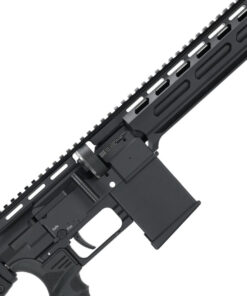
A high-capacity removable magazine system is supplied with the Maverick platform.
Loading has been simplified through the removable faceplate design. Consequently, pellets can be organized efficiently before the magazine is installed.
For extended range sessions, this arrangement provides additional convenience because unnecessary interruptions can be minimized.
Tactical Aluminium Chassis
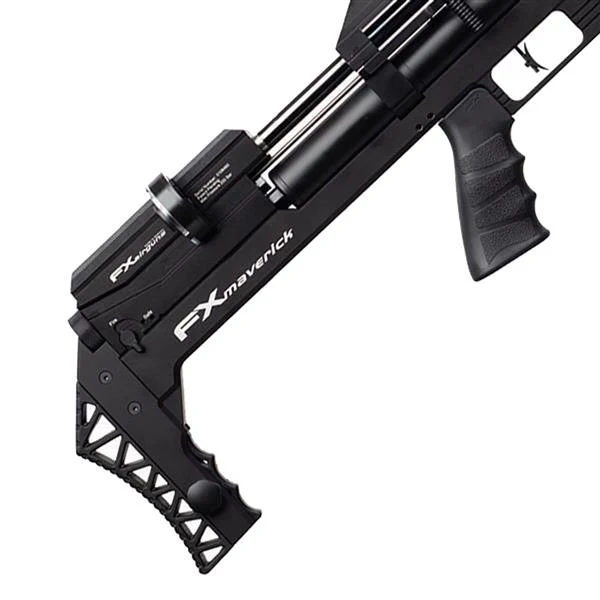
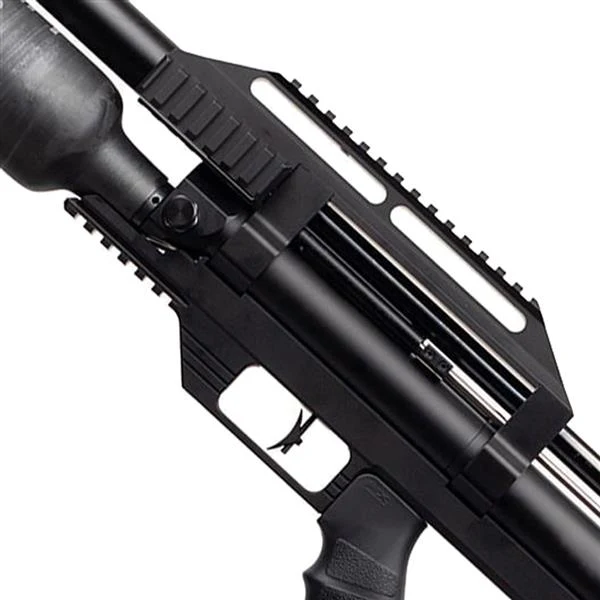
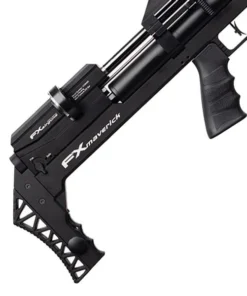
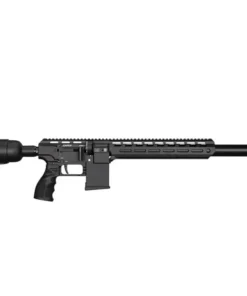
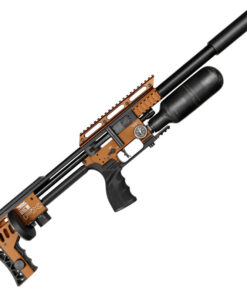
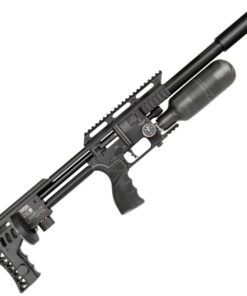
A modern aluminium chassis gives the FX Maverick Black Sniper FAC its distinctive appearance.
Rather than a traditional sporting stock, the rifle has been built around a rigid tactical-style framework. As a result, accessory mounting and ergonomic configuration can be approached with greater flexibility.
The black finish also gives the rifle a clean, understated appearance that complements scopes, mounts, bipods, and other compatible sporting accessories.
Practical Ergonomics
Comfort has not been overlooked.
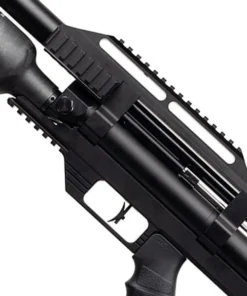
Controls have been positioned with practical handling in mind, while the forward side-lever cocking arrangement helps maintain an efficient operating sequence. In addition, the adjustable trigger system allows the interface to be configured to suit individual preferences.
Because shooter dimensions and preferences differ considerably, this adjustability can provide a meaningful ergonomic advantage.
Key Features of the FX Maverick Black Sniper FAC
- Premium FX Airguns PCP platform
- Dual AMP regulator configuration
- Large 89cc power plenum
- 580cc carbon-fibre air bottle
- 700mm Sniper-format barrel
- FX Smooth Twist X barrel technology
- Interchangeable barrel-liner system
- Compatible calibre-conversion capability
- External rear hammer-spring adjustment
- High-capacity removable magazine
- Forward-positioned side-lever action
- Modern black aluminium chassis
- Adjustable Match-style trigger
- Accessory-friendly configuration
- 1/2 UNF threaded barrel on commonly listed UK configurations
- Designed for experienced FAC airgun owners
Built for the Enthusiast Who Values Adjustability
Not every PCP rifle has been created around extensive configuration options. However, the Maverick platform has been designed specifically with adaptability as one of its core characteristics.
Whether attention is being given to ergonomics, calibre configuration, barrel-liner selection, air management, or accessory compatibility, numerous options are available within the FX ecosystem.
Consequently, the rifle can remain relevant as an owner’s preferences develop.
Furthermore, the strong aftermarket and accessory ecosystem surrounding FX rifles means that compatible components can often be sourced without abandoning the original platform.
Why Choose the FX Maverick Black Sniper FAC?
A compelling combination of premium manufacturing, sophisticated air management, modular construction, and substantial air capacity is offered by the FX Maverick Black Sniper FAC.
Instead of concentrating on only one feature, the platform has been developed as a complete system. Dual regulators are combined with the substantial plenum, while the long Sniper configuration is paired with a high-capacity carbon-fibre bottle.
Likewise, barrel liners can be changed, compatible calibres can be configured, and external controls have been incorporated for experienced users.
For this reason, considerable flexibility is provided within a single premium PCP platform.
Premium Engineering With Long-Term Versatility
When a premium air rifle is being selected, long-term adaptability can be just as valuable as immediate performance.
With the Maverick, future configuration options have been built directly into the platform. Therefore, changing preferences do not necessarily require an entirely different rifle.
Additionally, the robust aluminium chassis and modular component system contribute to a purposeful design that has become strongly associated with contemporary FX rifles.
Order the FX Maverick Black Sniper FAC
For experienced shooters seeking a feature-rich, FAC-rated PCP platform, the FX Maverick Black Sniper FAC stands out through its dual-regulator technology, large air capacity, extended Sniper configuration, interchangeable barrel system, and substantial adjustment potential.
Its sophisticated engineering has been combined with practical ergonomics and an unmistakably modern FX appearance. As a result, a premium air rifle platform is provided for enthusiasts who value refinement, consistency, modularity, and long-term flexibility.
Choose the FX Maverick Black Sniper FAC when a configurable FX platform, premium construction, generous air capacity, and advanced PCP engineering are priorities.
Important: FAC-rated air rifles are legally controlled in many jurisdictions. Availability, ownership, power limits, transfer procedures, and permitted use should always be verified against the laws applicable in your location before purchase or configuration.
Calibres, FAC Power and Accessories for the FX Maverick Black Sniper FAC
The FX Maverick Black Sniper FAC is designed as a highly configurable PCP platform, and this flexibility is especially noticeable in its calibre options, FAC-oriented power capability, air-management system, and accessory compatibility. Because the rifle has been engineered around the FX modular ecosystem, experienced owners can configure it for different shooting disciplines while remaining within the legal requirements that apply in their jurisdiction.
Available Calibres
The FX Maverick Black Sniper FAC is commonly available in several popular PCP calibres, including:
- .177 calibre
- .22 calibre
- .25 calibre
- .30 calibre
Availability can vary between markets and distributors, while local firearms legislation can also determine which versions may legally be purchased or owned.
.177 Calibre
The .177 version is typically chosen by shooters who value a relatively flat trajectory, modest pellet weight, and efficient air consumption. Because smaller projectiles require less air volume than larger calibres, excellent shot counts can generally be achieved from the Maverick’s large 580cc carbon-fibre bottle.
For target-focused applications and precision shooting where .177 is permitted, this calibre can provide an efficient and familiar setup.
.22 Calibre
Among the most versatile choices, .22 is frequently selected because it offers a useful balance between projectile weight, trajectory, efficiency, and available ammunition.
When the FX Maverick Black Sniper FAC is configured in .22, the rifle benefits from the substantial 89cc power plenum and dual-regulator system while still delivering strong efficiency from the large air reservoir.
As a result, .22 can be suitable for owners who want an adaptable configuration without moving immediately into the larger-bore options.
.25 Calibre
For shooters who prefer heavier ammunition, the .25-calibre configuration provides another step upward in projectile mass.
The larger calibre can benefit from the Maverick’s substantial regulated air supply. Consequently, the rifle’s power-management architecture becomes especially useful because greater airflow can be required to drive heavier pellets or compatible projectiles efficiently.
Although shot count will generally be lower than in .177 or .22, the large 580cc bottle helps compensate for the increased air consumption.
.30 Calibre
The .30-calibre version represents one of the larger commonly offered configurations for the Maverick Sniper platform.
Because heavier ammunition normally requires considerably more air, the Maverick’s 89cc plenum and dual AMP regulator arrangement become particularly relevant in this configuration.
Nevertheless, owners should remember that larger calibre and higher-output configurations are subject to stricter legal controls in many countries.
FAC Configuration
The term FAC refers to a firearm-certificate level configuration in jurisdictions where air rifles above a prescribed muzzle-energy threshold are legally classified differently from lower-powered versions.
For example, in the United Kingdom, air rifles exceeding the applicable non-FAC legal limit normally require the appropriate firearms certification. Therefore, the FX Maverick Black Sniper FAC should be treated as a regulated product wherever local law places restrictions on higher-powered airguns.
Power limits, licensing categories, storage rules, age restrictions, transportation requirements, and permitted uses differ significantly between countries and regions.
Accordingly, buyers should always verify the law that applies specifically to their location before ordering, possessing, modifying, or using an FAC-rated air rifle.
Power and Air Management
A major strength of the FX Maverick Black Sniper FAC lies in its sophisticated air-management system.
Two Adjustable Match Precision regulators are incorporated into the design. Instead of relying on only one stage of regulation, air pressure is managed progressively before reaching the firing system.
Furthermore, an 89cc power plenum provides a substantial volume of regulated air before each shot.
This arrangement helps the rifle support demanding FAC configurations while maintaining repeatability when correctly set up.
580cc Carbon-Fibre Bottle
The Sniper version is commonly supplied with a large 580cc carbon-fibre air bottle.
Because higher-powered PCP rifles consume more compressed air than lower-powered configurations, this generous reservoir provides an important practical advantage.
Depending on calibre, ammunition, regulator pressure, hammer-spring setting, environmental conditions, and other factors, shot count can vary significantly.
Therefore, published shot-count figures should always be treated as approximate rather than guaranteed.
External Power Adjustment
Another important characteristic of the Maverick platform is its external adjustment capability.
A rear-mounted hammer-spring adjuster allows the mechanical setup to be tuned, while the adjustable regulator system provides additional flexibility.
However, these controls should not be treated as casual adjustment features. Changes can alter muzzle energy and may change the rifle’s legal classification.
Consequently, major tuning should be carried out only by competent users or qualified technicians and always within applicable legal limits.
Recommended Accessories
The FX Maverick Black Sniper FAC can be combined with a broad range of compatible shooting accessories.
Scope and Mounts
A quality riflescope is one of the most important additions.
Because the Sniper configuration is designed around a longer, precision-oriented platform, many owners select optics with suitable magnification and clear target definition.
Compatible scope rings or mounts should be selected according to the rail system and optic tube diameter.
Bipod
A bipod can provide additional stability during supported shooting.
The Maverick’s tactical-style chassis allows compatible mounting solutions to be used, although the exact adapter or rail section should always be checked before purchase.
Moderator or Suppressor
Where legally permitted, a compatible moderator may be installed on appropriate threaded configurations.
Commonly listed UK versions are frequently supplied with 1/2 UNF threading, although the exact barrel termination should be confirmed for the individual rifle.
Local laws concerning moderators or suppressors must also be checked carefully.
Spare Magazines
Additional magazines can make longer shooting sessions more convenient.
Instead of stopping frequently to reload the same magazine, several magazines can be prepared beforehand.
Filling Equipment
A suitable high-pressure filling system is required for PCP operation.
Typical options include:
- High-pressure hand pumps
- Diving cylinders
- PCP compressors
- Compatible fill probes or adapters
- Pressure-rated hoses and fittings
Only equipment designed for the required working pressure should be used.
Pellets and Compatible Projectiles
Different barrels and liners can show preferences for different ammunition.
For this reason, owners often test several reputable pellet types to determine which option provides the best consistency in their individual rifle.
Any projectile selected should match the approved calibre and configuration.
A Flexible FAC Platform
Overall, the FX Maverick Black Sniper FAC combines multiple calibre options, generous compressed-air capacity, sophisticated regulation, a large power plenum, and extensive accessory compatibility.
Whether configured in .177, .22, .25, or .30 calibre, the platform provides considerable flexibility for experienced owners.
At the same time, responsible ownership remains essential. Because FAC power levels and configuration changes can have legal consequences, all adjustments, accessories, calibre conversions, and power settings should comply with the laws that apply in the owner’s location.
For shooters seeking a premium, modular PCP platform with extensive configuration possibilities, the FX Maverick Black Sniper FAC offers a highly adaptable foundation that can be complemented with optics, bipods, additional magazines, filling equipment, and other compatible shooting accessories.
FX Airguns, PCP Air Rifles, Hatsan Models and Modern Airgun Platforms
Modern airguns cover a wide range of platforms, from a basic pellet gun or BB gun to sophisticated regulated PCP airguns designed for target shooting, sporting applications, and long-range precision. Buyers researching an air rifle and air pistol collection will often encounter manufacturers such as FX and Hatsan because both companies offer extensive selections of air rifles, accessories, configurations, and caliber choices.
FX Airguns Sweden and the FX PCP Rifle Range
FX Airguns has become strongly associated with Swedish airgun engineering. Searches for fx airguns sweden, fx airguns sverige, fxairguns, and fx usa commonly lead enthusiasts toward the manufacturer’s extensive PCP lineup. In the American market, fx airguns usa is another widely searched phrase when people are researching available models, specifications, support, and accessories.
Among fx air rifles, the Impact family remains particularly recognizable. Searches frequently include fx impact, f x impact, fx impact m4, fx m4, impact m4 air rifle, and impact m4 500mm when comparing current configurations. The modular design philosophy associated with the Impact platform has helped make the fx air rifle range popular among shooters who appreciate adjustability and configurable PCP systems.
Earlier generations remain widely researched as well. The fx impact m3, impact m3, fx impact mk3, fx m3, and fx m3 airgun continue to attract attention from owners comparing generations or researching replacement components.
Caliber-specific searches include fx impact m3 .22cal air rifle, fx impact m3 .22cal air rifle. 600mm barrel, and the more general fx impact m3 air rifle. People comparing international pricing may also search fx impact m3 precio, fx impact m3 precio en usa, or fx impact m3 price before checking local regulations, specifications, and availability.
Beyond the Impact series, the FX catalog includes several distinctive designs. The fx leopard and fx leopard airgun are frequently researched alongside fx leopard .22 pcp specs by users interested in specifications and configuration details.
Other notable searches include fx drs, fx drs tactical, fx drs classic, and fx drs pro. These terms reflect interest in the different DRS configurations and their intended shooting styles.
The wider FX family also includes models such as the fx king, fx wildcat, fx panthera, and fx dreamline. Collectively, these platforms demonstrate the variety available to anyone researching a premium pcp air rifle, pellet rifle, or configurable precision air gun.
Some enthusiasts also search fx outdoors when researching outdoor shooting equipment and related products, while marketplaces and information sources such as guns.com may appear during broader online research.
Understanding Pellet Guns and PCP Air Rifles
A traditional pellet gun uses shaped pellets rather than conventional firearm ammunition. The broader term pellet guns can describe spring-powered, CO₂-powered, pneumatic, and PCP platforms.
A PCP air rifle stores compressed air inside a reservoir. This system can provide consistent pressure across multiple shots depending on the rifle’s regulator, reservoir capacity, caliber, and power configuration.
For shooters comparing ammunition sizes, .177 caliber remains one of the most common options. Larger configurations are also available, including the increasingly searched 30 cal air rifle category.
Some users accidentally search pallet gun when looking for pellet-powered equipment. Regardless of terminology, specifications such as energy output, caliber, barrel length, intended range, and local legal requirements should always be reviewed before use.
The practical range of air rifle platforms varies significantly. Pellet weight, velocity, environmental conditions, barrel design, optics, and shooter technique can all affect useful range and accuracy.
Hatsan Air Rifle and PCP Platforms
The hatsan air rifle lineup covers traditional spring-powered designs as well as modern PCP systems. Searches such as hatsanusa, hatsan usa, hatsan air guns, and hatsan pcp are commonly used by enthusiasts researching the company’s models.
One of the most recognizable platforms is the hatsan blitz. Search variations include hatsun blitz, hatzan blitz, hatsan blitz full automatic, hatsan blitz 30 cal, and hatsan blitz .30 cal. Specifications and legal classifications can vary by market, so owners should verify the rules applicable in their jurisdiction.
Another frequently researched model is the hatsan model 95, also searched as hatsan mod 95 and mod 95. This traditional air rifle platform remains familiar to shooters interested in conventional stock designs.
The hatsan 125 is another established model, while the hatsan 135 family attracts shooters researching powerful spring-piston platforms. Related searches include hatsan 135 vortex air rifle, hatsan 135 carnivore, and hatsan big bore carnivore rifle.
Hatsan Sortie, BullBoss and Bullpup Designs
Compact and semi-automatic PCP designs form another part of Hatsan’s catalog. The hatsan sortie is commonly researched alongside hatsan sortie tact, hatsan sortie tact semi-auto pcp, and hatsan sortie accessories.
Bullpup enthusiasts may encounter the hatsan bullboss, bullmaster, and hatsan hercules bully. Their compact layouts are designed to reduce overall length while maintaining useful barrel dimensions.
Other PCP models include the hatsan flash, hatsan flashpup qe, and hatsan invader. These rifles provide additional choices for people comparing conventional and bullpup PCP configurations.
Hatsan Hercules, Piledriver and Large-Caliber Platforms
For people researching larger airgun platforms, hatsan hercules and hatsan piledriver often appear in search results. Large-bore air rifles differ considerably from standard .177 and .22 pellet rifles in projectile size, power output, air consumption, and intended application.
The hatsan harpoon is associated with specialized projectile launching, while an arrow launcher represents another distinct air-powered category. Such equipment can be subject to different legal rules depending on location, so local regulations should be checked before ownership or use.
Additional Hatsan Models
The Hatsan catalog extends well beyond its best-known rifles. The hatsan airtact and hatsan airtact air rifle provide another entry point into the brand’s conventional rifle selection.
Other searches include hatsan zada, hatsan neutron star, hatsan factor rc, hatsan velox, and hatsan jet 2. Each platform serves a somewhat different role, making specifications such as caliber, reservoir capacity, operating system, barrel configuration, and overall dimensions important comparison points.
Shoppers researching discounted equipment may also encounter hatsan refurbished listings or broader searches for refurbished air rifles. Condition, warranty coverage, seals, regulators, reservoirs, and service history should be checked carefully when evaluating previously used or factory-refurbished equipment.
Airgun Optics, Pellets and Accessories
Accessories can significantly affect how an air rifle is configured. A compact 4×20 optic may suit basic shooting applications, while more advanced PCP rifles are frequently paired with adjustable optics.
Pellet choice also matters. Products such as h&n field target trophy bleifrei provide an option for shooters specifically researching lead-free projectile designs. Pellet diameter, weight, head size, and barrel compatibility should all be considered when evaluating accuracy.
Terms such as econ ii may also appear when researching airgun-related equipment and accessories. Compatibility should always be verified against the exact manufacturer, model, and specification rather than relying solely on a product name.
Comparing FX and Hatsan Air Guns
FX and Hatsan approach the modern air rifle market from different directions. FX is particularly well known for highly configurable PCP platforms such as the Impact, Panthera, Wildcat, Dreamline, Leopard, DRS, and King. Hatsan, meanwhile, maintains an exceptionally broad range spanning spring-powered rifles, PCP systems, bullpups, semi-automatic platforms, and larger-caliber airguns.
Whether researching an FX Impact M3, FX Impact M4, FX DRS, Hatsan Blitz, Hatsan Sortie, Hatsan Hercules, or another platform, specifications should be compared carefully. Caliber, operating pressure, reservoir capacity, barrel length, projectile compatibility, optics mounting, overall dimensions, energy output, and regional legal requirements can all influence which configuration is appropriate for a particular lawful sporting or target-shooting application.
Practical Use Scenarios
A high-performance PCP rifle becomes most useful when its design is matched carefully to the shooting environment, the intended discipline, the chosen ammunition, and the experience level of the shooter. In practical use, a long-format regulated rifle can provide a stable platform for target work, field practice, controlled pest management where lawful, and precision-oriented recreational shooting.
Rather than being treated as a single-purpose platform, this type of rifle can be adapted to several different situations. Its larger air capacity, adjustable ergonomics, regulated firing system, and compatibility with common shooting accessories all contribute to that versatility.
Precision Target Shooting
One of the most natural applications is precision target shooting.
When a shooter is working from a bench or another supported position, consistency becomes extremely important. Small changes in hold, pressure, trigger control, or sight picture can affect the point of impact. Therefore, a stable and predictable rifle setup is highly valuable.
A regulated PCP system can help create repeatable shot characteristics across a shooting session. As a result, the shooter can focus more closely on breathing, trigger technique, sight alignment, and ammunition performance instead of constantly compensating for changing rifle behavior.
The longer configuration can also feel particularly stable when the rifle is supported properly.
A quality scope may be added to help the shooter identify small aiming points clearly. Similarly, a compatible bipod or shooting rest can provide additional support during extended target sessions.
Different pellet types can also be evaluated from the bench. Because individual barrels may show preferences for particular pellet weights or designs, controlled target testing allows several options to be compared under similar conditions.
Group size, consistency, wind response, and point of impact can then be evaluated carefully.
For recreational target shooters, this process can become an important part of understanding the rifle rather than simply firing repeated shots.
Long-Range Recreational Target Practice
Another practical situation involves longer-range target practice where the activity is legal and carried out on an appropriate range.
Longer distances introduce additional variables.
Wind becomes more influential, pellet drop becomes more noticeable, and small aiming errors can become increasingly significant. Consequently, careful range estimation and a consistent shooting position become more important.
A precision-oriented PCP platform can be useful in this environment because the shooter is given a repeatable system with which to study these variables.
Instead of simply aiming higher and hoping for the correct result, shooters can learn how their chosen ammunition behaves at different distances.
Targets can be positioned at multiple known ranges, and the point of impact can then be recorded.
For example, a shooter may confirm a zero at one distance and subsequently observe the trajectory at several longer ranges.
This type of structured practice helps create a more complete understanding of the rifle and ammunition combination.
Environmental conditions should also be recorded.
Temperature, wind direction, wind speed, and shooting angle can all influence results.
Therefore, long-range target practice can become as much an exercise in observation and discipline as it is in mechanical accuracy.
Benchrest Practice
Benchrest shooting provides an especially suitable environment for evaluating a rifle’s mechanical consistency.
Because much of the human movement can be reduced through the use of a stable rest, the shooter can concentrate on the rifle, scope, pellets, and shooting technique.
A front rest or bipod can support the fore-end, while a rear bag may be used where permitted by the range.
The rifle should be positioned consistently for every shot.
Trigger control should also remain smooth.
Instead of pulling abruptly, gradual pressure can be applied until the shot breaks cleanly.
This approach allows performance to be assessed more accurately and can help the shooter identify whether an inconsistent group is being caused by ammunition, environmental conditions, equipment setup, or technique.
Shooting Range Training
Regular range practice can also be used to develop safer and more consistent handling habits.
Before any shooting session begins, the rifle should be inspected, the correct ammunition should be confirmed, and the air system should be checked.
The muzzle should always remain pointed in a safe direction.
Once positioned on the firing point, the shooter can work through a structured practice routine.
A session might begin with a few confirmation shots, followed by groups at different distances.
Later, positional practice can be introduced.
Although supported shooting is often the easiest way to evaluate accuracy, practical skills can also be developed from seated, kneeling, or other permitted positions.
Each position changes the way the rifle is supported.
Consequently, shooters can learn how body position affects stability and point of impact.
A consistent range routine can also make equipment problems easier to identify.
For example, unexpected changes in grouping may indicate that scope mounts require inspection, air pressure has fallen outside the preferred operating range, or a different batch of ammunition behaves differently.
By observing these details carefully, shooters can keep their equipment in better working order.
Field Target and Similar Sporting Use
Where regulations and competition rules allow, a configurable PCP rifle may also be used for various field-style target disciplines.
These activities often combine accuracy with range estimation, positional shooting, and environmental awareness.
Unlike conventional benchrest shooting, targets may be positioned at different distances and angles.
Therefore, the shooter must adapt continuously.
A stable rifle platform can provide a useful foundation for this type of practice.
However, overall success still depends heavily on the shooter’s ability to read the environment.
Wind is particularly important.
Even a relatively light crosswind can move a pellet away from the intended point of impact at longer distances.
As a result, shooters often learn to observe vegetation, flags, and other environmental indicators.
The experience gained from these disciplines can improve general shooting technique.
Controlled Pest Management Where Legal
In some jurisdictions, appropriately licensed air rifles may be used for lawful pest-control activities.
Any such use should be approached responsibly and only where the shooter has the required permissions, experience, and legal authority.
Before the rifle is used, the target species must be identified correctly.
Local regulations should also be checked because protected species, seasonal restrictions, landowner permission, licensing requirements, and equipment rules can differ considerably between regions.
A safe backstop is essential.
The shooter must also understand what lies beyond the intended target.
This becomes particularly important around agricultural buildings, farm equipment, roads, footpaths, livestock, and residential areas.
For responsible pest management, unnecessary shots should never be taken.
Instead, the objective should be careful shot selection and safe positioning.
The rifle should already have been tested thoroughly with the chosen ammunition before it is used outside a controlled range environment.
Its point of impact should be known at the expected distances.
If environmental conditions become unsuitable or a safe shot is not available, the correct decision is simply not to fire.
Farm and Agricultural Property Use
Where legal authority exists, air rifles may sometimes be used on farms or rural properties for controlled pest-management duties.
The environment can present unique challenges.
Buildings, machinery, fencing, animals, workers, and neighboring properties may all be nearby.
Therefore, shooting positions should be selected with considerable care.
A well-planned location can provide a stable firing position and a reliable backstop.
Temporary shooting stations can also be established where appropriate.
For example, a stable bench or supported position may be used if it offers a clear and safe field of view.
However, the shooting area should always be reassessed before each session because people, animals, vehicles, and equipment can move.
Regular communication with the property owner is also important.
Everyone involved should understand where shooting may take place and when it is permitted.
This reduces confusion and helps support responsible use.
Equipment Testing and Ammunition Comparison
Another valuable use scenario involves systematic equipment testing.
Not every pellet performs identically in every barrel.
Consequently, shooters can compare several compatible ammunition types to determine which provides the most consistent results.
Testing should be carried out from a stable position.
The same distance should be used for each comparison, while wind conditions should remain as similar as possible.
Several groups can be fired with each ammunition type.
Instead of judging performance from a single group, averages can be considered.
Velocity testing may also be carried out with appropriate equipment.
A chronograph can help the shooter understand consistency between shots without requiring any modification to the rifle.
Recorded information can include pellet type, pellet weight, air pressure, group size, and environmental conditions.
Over time, these records can become a useful reference.
Scope Setup and Zero Confirmation
Optic setup represents another important practical activity.
After a compatible scope has been mounted correctly, the rifle can be zeroed at an appropriate distance.
The initial process should always take place in a safe shooting environment.
Once the approximate point of impact has been established, small adjustments can be made to bring the group toward the desired aiming point.
Several confirmation groups should then be fired.
A single shot should not normally be treated as sufficient evidence that the zero is correct.
Afterward, the zero can be checked periodically.
Transport, accidental impacts, loose mounting hardware, or environmental changes can occasionally affect point of impact.
Therefore, responsible shooters often confirm their zero before any important shooting session.
Bipod-Supported Shooting
A compatible bipod can make the rifle easier to stabilize in many practical situations.
On a range, it can provide a repeatable front support.
In suitable field environments, it may also allow the rifle to be supported safely from the ground or another stable surface.
However, the bipod should be positioned carefully.
The surface underneath it should remain firm enough to prevent movement during the shot.
Consistent pressure should also be applied.
If the rifle is loaded differently against the bipod for every shot, point-of-impact changes may occur.
Therefore, repeatable technique remains important even when mechanical support is being used.
Recreational Shooting Sessions
Not every shooting session needs to be focused on competition or formal testing.
A precision PCP rifle can also provide an enjoyable recreational shooting experience at a suitable range or lawful private shooting area.
Reactive targets designed specifically for airgun use can add variety.
Paper targets can also be arranged at several distances.
Different shooting positions can then be practiced throughout the session.
Recreational shooting can provide an opportunity to improve technique without the pressure of competition.
Nevertheless, normal safety procedures should always remain unchanged.
Eye protection, secure target placement, safe backstops, and responsible rifle handling should be treated as standard requirements.
Training New Skills
Experienced shooters can also use structured practice to improve specific technical skills.
For example, one session may focus primarily on trigger control.
Another may concentrate on consistent head position behind the scope.
Breathing technique, follow-through, wind estimation, and positional stability can all be practiced individually.
Separating these skills can make improvement easier to measure.
Instead of trying to correct every aspect of technique simultaneously, one area can be developed at a time.
Over several sessions, those improvements can then be combined into a more consistent overall shooting process.
Maintenance and Pre-Session Preparation
Practical use begins before the first shot is fired.
The rifle should be checked before each session.
Air pressure should remain within the manufacturer’s recommended operating range.
Optic mounts should be secure, while the magazine and filling equipment should be inspected for obvious damage.
The correct calibre ammunition must always be used.
After shooting, the rifle should be stored safely and in accordance with local legal requirements.
Moisture, dirt, and debris should also be removed from external surfaces where necessary.
Routine inspection helps protect the equipment while reducing the likelihood of avoidable problems during future sessions.
A Versatile Platform for Different Shooting Environments
Ultimately, the greatest practical advantage of a configurable precision PCP system lies in its versatility.
Target shooters can use it for carefully controlled grouping and ammunition testing.
Range users can develop shooting technique across different distances.
Experienced shooters may practice wind estimation and positional control.
Where the law permits, properly licensed users may also employ the rifle for responsible pest management.
Across all of these situations, consistent preparation remains essential.
The correct ammunition should be selected, the rifle should be inspected, the optic should be confirmed, and the shooting environment should be evaluated before firing begins.
When those fundamentals are followed, a well-configured PCP platform can provide a stable, adaptable, and rewarding shooting experience across a wide variety of lawful applications.
Why This Rifle Is a Better Choice
Choosing a premium PCP rifle is not only about power or appearance. A better choice should offer consistency, adaptability, build quality, practical handling, and enough flexibility to remain useful as shooting preferences develop. This rifle stands out because those qualities have been brought together in one highly capable platform.
Rather than focusing on a single advantage, the design combines a sophisticated air-management system, a large air reservoir, a long precision-oriented configuration, adjustable features, and broad accessory compatibility. Because of this balance, the rifle can suit experienced shooters who want more control over their setup without constantly changing equipment.
A Better Choice for Consistency
One of the strongest reasons to choose this rifle is the level of consistency that can be supported by its regulated PCP system.
Repeatability matters because a rifle that behaves predictably allows the shooter to concentrate on technique instead of compensating for changing performance. When air pressure is managed efficiently, shot-to-shot behavior can remain more stable throughout a properly configured shooting session.
This consistency can be especially valuable during target practice, ammunition testing, and longer range sessions.
Instead of wondering whether a change in point of impact has been caused by the rifle, the shooter can pay closer attention to wind, trigger control, body position, and sight picture.
As a result, the platform can provide a more confidence-inspiring shooting experience.
Advanced Dual-Regulator Design
Another major reason for choosing this rifle is the dual-regulator arrangement.
Many PCP rifles rely on a single stage of regulation. Here, air pressure is managed progressively through two regulator stages before being delivered to the firing system.
This design helps create a controlled supply of air for each shot.
Furthermore, the large plenum complements the regulator system by providing a substantial volume of regulated air when required.
The benefit is not simply increased output. More importantly, the entire air system has been designed to work as a coordinated platform.
For experienced users who value refined PCP engineering, this represents a significant advantage.
Large Air Capacity for Longer Shooting Sessions
Frequent refilling can interrupt a productive shooting session.
For that reason, the large carbon-fibre air bottle is another important advantage.
A substantial air supply allows more shooting to be completed before the rifle needs to be refilled. Actual shot count will always depend on calibre, ammunition, pressure, setup, and environmental conditions, but the larger reservoir provides a useful foundation for good efficiency.
This becomes especially beneficial during extended range visits.
Instead of carrying out repeated refills, more time can be spent shooting, testing ammunition, confirming zero, or practicing technique.
Consequently, the rifle becomes more practical for enthusiasts who regularly spend long periods at the range.
Long Configuration for a Stable Shooting Platform
The longer configuration provides another reason to consider this rifle over shorter alternatives.
A long barrel setup can create a stable, balanced feel when used from a bench, bipod, or other supported shooting position.
The extended format also suits shooters who prioritize precision-oriented applications.
When combined with a suitable optic and stable support, the rifle can become a very capable platform for careful target work.
Although compact rifles can be more convenient in confined spaces, the longer design offers its own advantages for shooters who prefer stability and a more substantial shooting position.
Therefore, the correct choice ultimately depends on the type of shooting being planned.



Reviews
There are no reviews yet.