AirMaks Arms Katran-B Long Extra High Power
AirMaks Arms Katran-B Long Extra High Power PCP Air Rifle
The AirMaks Arms Katran-B Long Extra High Power has been developed as part of AirMaks Arms’ bottle-fed Katran-B PCP platform. A combination of modular construction, regulated air delivery, adjustable ergonomics, and a long-format configuration has been incorporated into the design. Consequently, the rifle is positioned for experienced users who require a configurable PCP platform for lawful sporting and target-shooting applications.
Throughout the rifle, lightweight aluminium components have been extensively used. At the same time, stability has been supported by the longer configuration and substantial air reservoir. Therefore, a practical balance between handling, shot capacity, and equipment compatibility has been achieved.
Furthermore, the Katran-B platform has been designed around an easily operated side-lever action. The lever can be configured for right- or left-side operation on applicable configurations, allowing the shooting setup to be adapted to individual preference.
Long-Format Katran-B Design
A distinctive profile has been created by the longer barrel configuration and bottle-style air reservoir. Rather than being based around a conventional cylinder-only layout, the AirMaks Arms Katran-B Long Extra High Power uses the Katran-B bottle architecture.
As a result, extended shooting sessions can be accommodated more conveniently than with many smaller-reservoir platforms. Meanwhile, the overall rifle remains relatively streamlined because the bottle, receiver, handguard, and stock have been integrated into one coherent layout.
Adjustable Folding Stock System
An aluminium folding stock is fitted to applicable synthetic-stock versions of the Katran-B. Moreover, length adjustment has been incorporated so that the shooting position can be adapted to different users.
An adjustable cheekpiece is also provided. Therefore, eye alignment with an installed optic can be refined more easily.
Similarly, the butt pad can be adjusted to improve shoulder placement. Because individual shooting positions vary considerably, these adjustments can make the platform easier to configure consistently.
Regulated PCP Operating System
A regulated pre-charged pneumatic system has been incorporated into the Katran-B platform. Air delivery can therefore be managed more consistently throughout the usable pressure range.
A regulator is listed by current Katran-B retailers, while some listings specifically identify a Huma-Air regulator. Consequently, shot-to-shot consistency has been made a central part of the rifle’s operating architecture.
Because PCP rifles depend on controlled compressed-air delivery, regulation can be particularly useful for repeatable target shooting. Nevertheless, actual performance will depend on the exact calibre, factory configuration, projectile, environmental conditions, and market-specific specification.
Side-Lever Action
A side-lever cocking mechanism is positioned close to the trigger area. Consequently, cycling the action can be completed without excessive movement away from the shooting position.
In addition, right- or left-side lever configuration is supported by the Katran-B design. Therefore, the control layout can be adapted more effectively for different users.
The action is also supported by an anti-double-feed system. This feature is intended to reduce the possibility of a second pellet being chambered accidentally after the action has already been cycled.
Two-Stage Adjustable Trigger
A two-stage trigger system is fitted to the platform. External adjustment is provided on listed Katran-B specifications, allowing the trigger characteristics to be configured within the manufacturer’s permitted settings.
Consequently, a predictable trigger release can be established for sporting and precision target use.
At the same time, all adjustments should be completed in accordance with the manufacturer’s manual. Factory safety parameters should always be retained.
Modular Aluminium Handguard
An aluminium handguard has been fitted to the AirMaks Arms Katran-B Long Extra High Power. On current Katran-B specifications, nine KeyMod mounting slots are provided along with accessory-mounting capability.
Therefore, compatible sporting accessories can be positioned without requiring major alterations to the rifle.
The handguard also contributes to the modern appearance of the platform. Meanwhile, aluminium construction helps unnecessary bulk to be limited.
20 MOA Picatinny Optics Rail
A 20 MOA Picatinny rail is incorporated into the Katran-B platform. Consequently, a wide selection of compatible sporting optics and mounting systems can be accommodated.
This arrangement is particularly useful on a configurable PCP platform because optic choice can be matched to the user’s intended lawful shooting discipline.
Nevertheless, suitable rings and mounts should always be selected for the optic being installed.
Key Product Highlights
- Katran-B bottle-fed PCP configuration
- Long-format platform
- Regulated compressed-air system
- Folding aluminium stock on applicable versions
- Length-adjustable stock
- Adjustable cheekpiece
- Adjustable butt pad
- Ergonomic AR-style grip configuration
- Side-lever action
- Right/left configurable side lever
- Two-stage adjustable trigger
- Anti-double-feed mechanism
- Aluminium handguard
- Nine-slot KeyMod accessory interface on listed versions
- 20 MOA Picatinny optics rail
- Multi-shot magazine system
- Threaded muzzle interface on listed configurations
- Supplied case on certain retailer specifications
Multi-Shot Magazine System
Multi-shot magazines are supported by the Katran-B family. Retailer specifications currently list magazine capacities of 18 shots in .177, 16 shots in .22, and 14 shots in .25 for applicable versions.
Therefore, repeated target strings can be completed without manually loading an individual pellet for every shot.
A magazine holder is also included on some synthetic-stock Katran-B configurations. Consequently, spare magazines can be kept conveniently on the rifle where the factory specification provides this feature.
Ergonomics and Handling
Considerable attention has been given to adjustability throughout the Katran-B platform. The stock length, cheekpiece position, butt-pad position, side-lever orientation, and optic arrangement can all contribute to the final shooting setup.
As a result, the AirMaks Arms Katran-B Long Extra High Power can be configured around different body proportions and shooting positions.
Furthermore, the pistol-grip layout provides a familiar hand position for users accustomed to modern sporting rifle ergonomics.
Barrel and Muzzle Configuration
A precision barrel system is used throughout the Katran family. Some current retailer listings identify a CZ barrel with a 1:17.7 twist rate on Katran-B configurations.
In addition, a 1/2-inch UNF muzzle thread is listed on several current versions. Consequently, compatible legal muzzle accessories can be fitted where permitted by local law.
Because exact barrel dimensions and specifications can differ among Long, LHP, XHP, calibre, and market-specific versions, the specification supplied with the individual rifle should be treated as authoritative.
Built Around Adaptability
Perhaps the most distinctive characteristic of the AirMaks Arms Katran-B Long Extra High Power is its modular approach.
Rather than forcing every user into a single fixed configuration, numerous ergonomic and accessory interfaces have been incorporated. Therefore, the rifle can be configured for different lawful sporting environments while its underlying PCP architecture remains unchanged.
At the same time, the bottle-fed design provides a substantial compressed-air supply, while the regulator supports repeatable air management.
Extra High Power Configuration and Legal Requirements
The Extra High Power designation distinguishes this model from lower-energy Katran-B configurations. However, exact muzzle energy should not be assumed from the model name alone because factory specifications can vary by calibre and destination market.
Furthermore, higher-energy air rifles can require certificates, licences, registration, dealer transfer, or other legal controls depending on jurisdiction.
For example, UK retailer listings separate certain Katran-B configurations into sub-12 ft-lb and FAC classifications. Consequently, buyers and owners should verify the specific legal classification of the exact rifle before possession, transfer, transport, or use.
AirMaks Arms Engineering
AirMaks Arms has developed the Katran family around configurable PCP architecture, modular ergonomics, regulated air delivery, and modern accessory mounting.
Within that family, the AirMaks Arms Katran-B Long Extra High Power represents a long-format, bottle-fed configuration intended for markets where its power class can legally be owned and used.
As a result, an adjustable sporting platform is provided in which ergonomics, compressed-air capacity, magazine operation, optics mounting, and modular accessory support have all been integrated into the overall design.
For anyone researching this specific configuration, the exact calibre, factory energy rating, barrel specification, reservoir specification, and legal classification should always be confirmed against the manufacturer’s documentation or an authorised dealer before purchase or use.
AirMaks Krait, Katran PCP Air Rifles, Umarex Airguns, Pest Control and Shooting Systems
The world of AirMaks Krait, AirMaks Katran, PCP air rifles, and modern airgun systems continues to attract shooters interested in precision, hunting, target practice, and pest control applications. Buyers searching for what is a PCP air rifle, what does PCP air rifle mean, what is a PCP airgun, what is a PCP air gun, or what are PCP air rifles are generally looking for information about pre-charged pneumatic technology. A PCP air rifle uses stored compressed air to deliver consistent power, accuracy, and repeatable shot performance compared with traditional spring-powered systems.
AirMaks Krait PCP Air Rifle and Katran Air Rifle Platforms
The AirMaks Krait is a modern PCP platform designed for shooters who want accuracy, compact handling, and adjustable performance. Searches such as AirMaks Krait, Air Max Krait, AirMaks Krait .22, AirMaks Krait .22 official, AirMaks Krait PCP, AirMaks Krait air rifle, and Krayt30 are commonly associated with this rifle family.
The AirMaks Katran represents another popular PCP air rifle platform from AirMaks. Search terms including AirMaks Katran, AirMaks Katran .22, Katran air rifle, Katran PCP rifle, and Katran LLC relate to shooters researching compact and high-performance pneumatic rifles. These platforms are often compared by buyers looking for precision shooting, hunting capability, and reliable air delivery systems.
PCP Air Rifles, Compressed Air Systems and Technology
A PCP rifle works by storing compressed air inside an onboard reservoir before releasing controlled air pressure to propel a pellet. Searches such as PCP rifle meaning, PCP air rifle meaning, PCP guns, PCP rifle, compressed air rifle, compressed air guns, air powered rifle, and komprimiran zrak all relate to pneumatic shooting technology.
Charging equipment is also an important part of PCP ownership. Many shooters search for PCP hand pump, PCP air compressor, air compressor rifle, and accessories designed to refill PCP reservoirs safely and efficiently.
Air Rifle Pest Control and Vermin Control Applications
Many shooters research air rifle for pest control, air rifle pest control, pest control with air rifles, best air rifle for pest control, pellet gun for pest control, and best pellet gun for pest control when looking for suitable equipment for lawful pest management.
Products such as AirMaks Krait and AirMaks Katran may appear in searches related to vermin control guns, vermin control air rifles, and accurate pellet shooting platforms because PCP rifles can offer consistent velocity, adjustable power settings, and precision accuracy when used responsibly.
Umarex Airguns, Air Rifles and CO2 Platforms
The Umarex brand is widely searched by enthusiasts looking for recreational airguns, training platforms, and replica-style products. Popular searches include Umarex USA, UmarexUSA, Umarex airguns, Umarex air rifles, Umarex Notos, Umarex Gauntlet, Umarex Gauntlet 2, Umarex Gauntlet 30, Umarex Hammer, Umarex Hammer .50 caliber, and Umarex Hammer Carbine.
Other frequently searched Umarex models include Umarex Origin, Umarex Primal 20, Umarex Zelos, Umarex Fusion 2, Umarex Komplete, Umarex Komplete NCR .22, Umarex Air Saber, Umarex Airsaber, Umarex Trevox, Umarex MP40, Umarex MP5, Umarex Legends, Umarex T4E, Umarex HDR 50, and Umarex TR50.
Calibres, FAC, Power and Accessories
Calibre Options for the AirMaks Arms Katran-B Long Extra High Power
The AirMaks Arms Katran-B Long Extra High Power is built around the higher-output Katran bottle platform, where calibre selection is particularly important because projectile weight, intended shooting discipline, legal classification, and factory configuration can all affect performance.
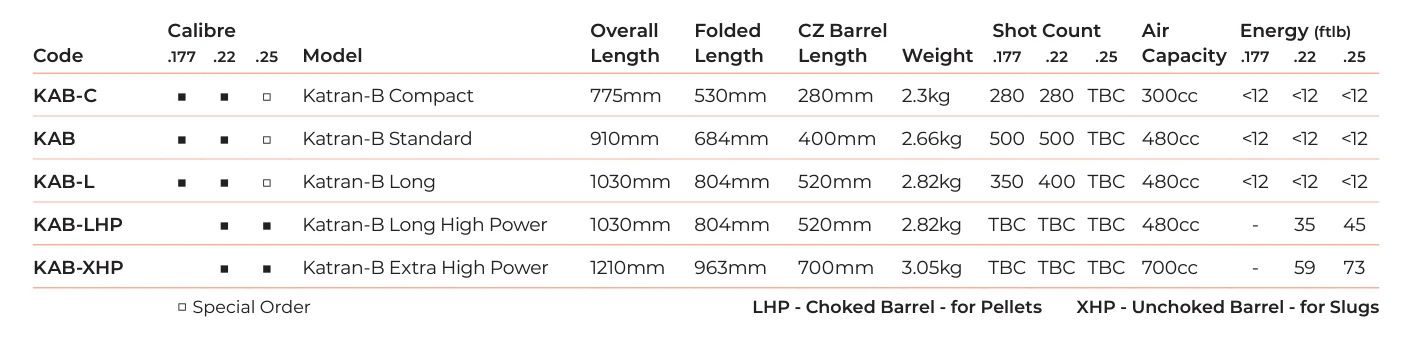
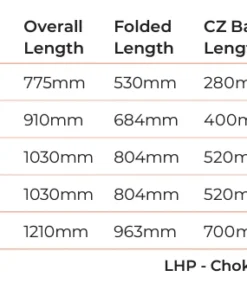
For the current high-power long-bottle Katran platform, AirMaks lists .22 / 5.5 mm, .25 / 6.35 mm, and .30 / 7.62 mm configurations on the Katran LB HP. A 520 mm non-choked CZ barrel is used, while the rifle is paired with a 660 cc buddy bottle rated to 300 bar.
.22 / 5.5 mm
The .22 calibre configuration provides a useful balance between projectile availability, magazine capacity, air consumption, and higher-output PCP performance.
On the current Katran LB HP specification, the .22 magazine accommodates 16 shots.
Because .22 projectiles are lighter than comparable .25 or .30 ammunition, this calibre can be selected where a flatter-feeling trajectory and relatively efficient use of the available compressed air are desired. Actual results, however, will depend on the projectile, factory tune, regulator configuration, atmospheric conditions, and legal power setting.
.25 / 6.35 mm
A larger .25 calibre option is also provided on the Katran high-power platform.
In this configuration, the factory magazine is listed with a 14-shot capacity.
The larger projectile diameter allows heavier ammunition to be used than would normally be selected in .22. Consequently, .25 is frequently considered when users want a middle ground between the relatively lighter .22 configuration and the heavier .30 version.
Because projectile mass and design vary significantly, specific velocity or muzzle-energy figures should always be taken from the exact rifle configuration rather than assumed from calibre alone.
.30 / 7.62 mm
At the upper end of the current Katran LB HP range, .30 / 7.62 mm is offered.
The corresponding magazine is listed with a 12-shot capacity.
This calibre is designed around substantially heavier projectiles and therefore represents the most specialised configuration of the three. Increased air demand should also be expected compared with smaller calibres.
For that reason, the 660 cc buddy bottle becomes especially relevant because greater onboard air capacity can help support the high-power platform during extended shooting sessions.
FAC and High-Power Classification
The term FAC is commonly encountered when air rifles are sold in the United Kingdom. It refers to an air rifle configuration that falls above the UK’s non-FAC energy threshold and therefore requires the appropriate firearm certification.
Consequently, an AirMaks Arms Katran-B Long Extra High Power should not automatically be treated as equivalent to a sub-12 ft-lb air rifle.
Power classification can vary by country and sometimes by calibre or individual rifle specification. Therefore, the exact legal category should be verified before purchase, ownership, transfer, transport, or use.
The manufacturer identifies the Katran LB HP as a dedicated high-power PCP configuration, using a non-choked 520 mm barrel and a large 660 cc bottle.
Power Configuration
Rather than publishing one universal energy figure for every Katran high-power configuration, AirMaks provides an external velocity regulation screw operated through the hammer spring on the Katran LB HP. A pressure regulator is also incorporated into the rifle.
Therefore, exact output should be regarded as configuration-dependent rather than represented by a single figure.
Several variables can affect measured muzzle energy, including:
- Calibre
- Projectile mass
- Projectile design
- Factory specification
- Regulator setup
- Hammer-spring configuration
- Barrel configuration
- Available reservoir pressure
- Ambient temperature
- Market-specific legal restrictions
Any adjustment should remain within the manufacturer’s guidance and the applicable legal limit for the jurisdiction in which the rifle is possessed or used.
High-Capacity 660 cc Air Bottle
A significant part of the high-power Katran configuration is the 660 cc buddy bottle.
AirMaks specifies a maximum operating pressure of 300 bar for the Katran LB HP bottle system.
Because higher-output PCP rifles generally consume more compressed air per shot, additional reservoir volume is particularly useful. The larger bottle helps provide the air supply required by the longer barrel and heavier-projectile configurations.
Nevertheless, actual shot count will vary according to calibre, tune, projectile and regulator setting.
Barrel Configuration
A 520 mm non-choked CZ barrel is specified for the Katran LB HP.
The non-choked design is associated with the rifle’s high-power specification and is intended to support the projectile types used with this platform.
Because different Katran models use different barrel arrangements, specifications from the standard Katran-B should not automatically be applied to the Long High-Power model.
Accessory Compatibility
The AirMaks Arms Katran-B Long Extra High Power has also been designed around a configurable accessory platform.
20 MOA Picatinny Optics Rail
A 20 MOA Picatinny rail is included along the top of the rifle.
Therefore, compatible sporting optics can be mounted using appropriate Picatinny rings or mounts.
Depending on the intended shooting discipline, compatible accessories may include:
- Variable-magnification riflescopes
- Fixed-power target optics
- Picatinny-compatible scope rings
- Bubble levels
- Lens caps
- Sunshades
Optic selection should be matched to the rifle’s lawful intended use and the shooter’s individual requirements.
KeyMod Handguard
An aluminium handguard incorporating nine KeyMod slots is fitted to the Katran LB HP.
Consequently, compatible accessory interfaces can be positioned along the fore-end.
Common sporting accessories may include:
- Bipod adapters
- Sling attachment points
- Additional compatible rail sections
- Shooting-rest interfaces
- Hand stops
- Carrying accessories
Muzzle Accessories
A 1/2-inch UNF muzzle thread is provided by AirMaks on the Katran LB HP.
This allows compatible legal muzzle accessories to be attached where permitted. Thread specification should always be checked before an accessory is fitted.
Magazines
Factory magazine capacity depends on calibre:
- .22 / 5.5 mm – 16 shots
- .25 / 6.35 mm – 14 shots
- .30 / 7.62 mm – 12 shots
These capacities are listed directly by AirMaks for the current Katran LB HP platform.
Additional magazines can therefore be useful for sporting sessions where repeated target strings are being completed.
Recommended Supporting Equipment
A PCP rifle also requires suitable supporting equipment for routine lawful use and maintenance. Depending on the owner’s setup, useful compatible items may include an approved high-pressure filling system, suitable fill adapter, protective rifle case, cleaning equipment, spare magazines, correctly rated seals, compatible optics and a suitable shooting rest.
However, components should always be selected according to the manufacturer’s published specifications.
Overall, the AirMaks Arms Katran-B Long Extra High Power combines .22, .25 and .30 calibre availability with a regulated high-power PCP action, 520 mm non-choked barrel, 660 cc 300-bar buddy bottle, adjustable ergonomics and extensive accessory compatibility. This combination allows the platform to be configured for different lawful sporting applications while preserving the modular characteristics associated with the AirMaks Katran range.
BB Guns, Pellet Pistols and Airsoft Replica Searches
Alongside rifles, many customers search for compact air-powered platforms including BB guns, BB gun pistols, pellet pistols, and CO2 pellet pistols. Related searches include metal BB gun, CO2 pistol replica, airsoft pistol, airsoft Glock, airsoft Glock 17, airsoft Glock 19, Glock BB gun, Glock airsoft gun, and Glock air pistol.
Umarex replica searches frequently include Umarex Glock, Umarex Glock 17, Umarex Glock 17 Gen 5, Umarex Glock 19, Umarex Glock 19X, Glock 19 BB gun, and Glock 19X BB gun.
Air Rifle Shooting, Accuracy and Performance
Modern shooters compare airguns based on accuracy, power delivery, ammunition compatibility, and intended use. Searches for accurate pellet rifle, powerful air rifle, air rifle online, air rifle dealers, air gun makers, air gun manufacturers, and best airguns reflect the growing interest in precision pneumatic systems.
Whether researching an AirMaks Krait, AirMaks Katran, Umarex air rifle, or another PCP platform, buyers should consider caliber selection, air capacity, regulator performance, barrel quality, available accessories, maintenance requirements, and local regulations before choosing a system.
Practical Use Scenarios
The AirMaks Arms Katran-B Long Extra High Power is best understood as a configurable PCP platform intended for experienced users who value consistency, adjustability, extended air capacity, and a stable shooting format. In practical use, its longer configuration, bottle-fed air system, regulated action, adjustable stock, side-lever mechanism, and accessory interfaces make it especially well suited to structured target sessions and other lawful sporting environments where repeatability matters.
Rather than being limited to one narrow purpose, the rifle can be adapted to several shooting scenarios. Each situation places different demands on the user and the equipment, so the rifle’s adjustable features become particularly useful when the setup is changed between bench use, club shooting, extended practice sessions, supported shooting positions, or precision-oriented target work.
Benchrest and Supported Target Shooting
One of the most natural environments for this rifle is supported target shooting from a bench.
Because the rifle is built around a relatively substantial long-format PCP configuration, stability can be prioritized when the front of the rifle is supported by a suitable rest or compatible bipod. The shooter can then concentrate on sight picture, trigger control, breathing, and consistency rather than spending unnecessary effort holding the full weight of the rifle unsupported.
Before a shooting session begins, the adjustable stock can be configured to create a repeatable shoulder position. The cheekpiece can then be aligned with the optic so that the same head position can be reproduced from shot to shot.
This consistency is particularly valuable during accuracy testing.
For example, different commercially available pellets may be evaluated on paper targets to determine which option groups most consistently with the individual rifle. Because PCP rifles can respond differently to projectile weight and design, testing should be carried out methodically.
Targets can be placed at a lawful and properly supervised distance, several controlled groups can be fired, and the results can then be compared.
Rather than judging performance from a single group, several groups can be used to identify a repeatable trend.
Precision Practice at an Approved Range
The rifle is also suited to structured precision practice at an approved shooting range.
During this type of session, the objective is usually not speed. Instead, repeatability is prioritized.
A stable shooting position can be established first. The optic can then be checked for correct eye relief, and the stock adjustment can be verified before firing begins.
Because the platform is regulated, its air-delivery system is intended to support consistency throughout the usable pressure range. Consequently, a shooter can concentrate on maintaining the same technique throughout a longer series of shots.
For practical training, targets with clearly defined aiming points can be used.
Groups may be fired in sets, with each set being evaluated before the next one begins. Factors such as grip pressure, shoulder contact, cheek position, and trigger movement can then be kept as consistent as possible.
Over time, this type of structured shooting can help users identify whether changes in group size are being caused by technique, environmental conditions, optics, ammunition selection, or equipment setup.
Extended Range Sessions
The larger bottle configuration becomes particularly useful during longer shooting sessions.
Instead of repeatedly interrupting practice to refill a small reservoir, a higher-capacity air system can reduce the frequency of filling, depending on calibre, factory setup, and operating pressure.
This can be especially convenient at clubs or ranges where filling equipment is located away from the firing point.
For example, a shooter may plan several separate target exercises during one visit. The first portion of the session may be used for checking the optic. The second may involve accuracy testing, while the final portion may involve controlled shooting from different supported positions.
In such circumstances, having a substantial onboard air supply can make the session more efficient.
Nevertheless, reservoir pressure should still be monitored carefully. The rifle should not be operated outside the pressure range specified by the manufacturer, and only filling equipment designed for the appropriate PCP pressure should be used.
Optic Setup and Zero Confirmation
Another practical use scenario involves configuring and checking a sporting optic.
The Picatinny rail allows compatible mounts and scopes to be installed, making the rifle suitable for users who want to build a dedicated target setup.
Once an optic has been correctly mounted, initial adjustment can be completed from a stable position. A large, clearly marked target is usually more useful during this stage because point-of-impact changes can be seen more easily.
Small corrections can then be made according to the optic manufacturer’s instructions.
After the desired zero has been established, several confirmation groups should be fired rather than relying on a single shot.
This process can be repeated after transporting the rifle, changing mounts, replacing an optic, or making a significant change to the shooting setup.
Regular confirmation is particularly useful because even a high-quality optic system should not simply be assumed to have retained its previous setting after equipment changes.
Testing Different Commercial Pellets
A practical PCP setup can also involve comparing factory-made ammunition.
Two projectiles that share the same nominal calibre may perform differently because weight, skirt dimensions, head size, shape, material, and manufacturing tolerances can vary.
Consequently, careful testing can be useful.
A controlled comparison can be carried out by using the same target distance and the same supported position for every group. Only one variable should ideally be changed at a time.
For example, one pellet type can be tested through several groups before another is introduced.
Group consistency can then be compared.
This approach is more informative than switching repeatedly between different pellets after only one or two shots.
It also allows the shooter to select ammunition based on actual repeatable results from the individual rifle rather than relying entirely on another person’s experience.
Club and Recreational Target Shooting
The rifle can also be used for recreational target sessions at suitable clubs and private facilities where local regulations permit its power classification.
In this environment, targets can range from conventional paper designs to approved reactive targets specifically intended for airgun use.
The adjustable stock becomes useful when the same rifle is being configured for different shooting positions.
For example, a seated position may require a slightly different stock setup from a conventional bench position.
Likewise, optic height and cheekpiece position should be coordinated so that the user’s head remains naturally aligned with the sight.
The goal should be comfort without compromising safe handling.
Because the rifle uses a multi-shot magazine, target strings can be completed conveniently without loading one pellet individually after every shot. However, the rifle should still be handled as loaded whenever a magazine is installed, and normal range procedures should always be followed.
Supported Outdoor Target Sessions
Where lawful and where a safe shooting area has been established, the rifle may also be used for outdoor target practice.
Outdoor use introduces more variables than indoor shooting.
Wind, temperature, lighting, humidity, and uneven terrain can all influence the shooting experience.
For this reason, a controlled outdoor target session can be useful for understanding how equipment performs under conditions that differ from a sheltered range.
Targets should always be positioned with a safe backstop and in an area where access can be controlled.
The shooter should also verify that the energy classification of the rifle is lawful for the location in which it is being used.
During outdoor practice, the rifle’s accessory mounting system can accommodate compatible support equipment such as a legal sporting bipod or sling attachment.
These accessories can make supported shooting more stable without requiring permanent modification of the rifle.
Shooting From Seated and Supported Positions
Not every practical session needs to be conducted from a formal shooting bench.
A seated supported position can also be used for target practice where permitted.
In this scenario, the rifle may be rested using an appropriate support rather than being held entirely unsupported.
The adjustable butt pad and cheekpiece become especially relevant because body position changes when the shooter moves lower to the ground.
The rifle should be adjusted so that the optic can be viewed naturally without forcing the head downward or stretching the neck excessively.
A consistent position should then be established before firing begins.
This is useful for users who want to practice maintaining accuracy outside a standard bench configuration while still keeping the session controlled and repeatable.
Evaluating Trigger Control
The adjustable two-stage trigger also creates an opportunity for structured shooting practice.
Rather than focusing purely on group size, a session can be dedicated to improving trigger control.
The first stage can be taken up smoothly while the sight remains on the target. The final release can then be completed without disturbing the rifle’s alignment.
Repeated practice can help the shooter identify whether shots are being pulled because of excessive hand movement or inconsistent pressure.
Any mechanical trigger adjustment, however, should remain within the manufacturer’s permitted specifications.
The safety function should never be compromised in pursuit of a lighter trigger feel.
Monitoring Air Pressure During Practice
A high-capacity PCP system still requires disciplined pressure management.
Before a range session, the reservoir pressure should be checked.
During extended use, the pressure should also be monitored periodically.
This helps the shooter understand approximately how many useful shots are available under the current configuration.
Because .22, .25, and .30 calibre setups can consume different amounts of air, one universal shot-count figure should not be assumed.
Projectile weight, power configuration, regulator setting, temperature, and other variables can change air consumption considerably.
Recording the number of shots fired between fills can therefore provide useful information about the individual rifle.
Transporting the Rifle to the Range
Practical ownership also includes safe transport.
Before the rifle is placed into a case, it should be handled in accordance with local law and the manufacturer’s safety procedures.
Magazines and ammunition should be managed appropriately, while optics and accessories should be protected from impact.
A suitable padded hard or soft case can help protect the rifle during normal transport.
Care should also be taken around the air bottle and filling components.umarex hk heckler
Although PCP reservoirs are designed to operate at very high pressure, they should still be treated as precision pressure vessels.
They should not be subjected to unnecessary impact, excessive heat, unauthorized modification, or incompatible fittings.
Storage Between Shooting Sessions
After target shooting has been completed, the rifle should be stored securely.airsoft pistol.umarex dx17
Local rules concerning high-power air rifles can vary considerably, especially where FAC or equivalent certification applies.
Secure storage should therefore be planned around the legal requirements of the user’s jurisdiction.
Before storage, the exterior can be inspected for moisture, dirt, or debris.
Optical lenses can be protected with covers, while the rifle can be kept in an environment that avoids excessive humidity.
The manufacturer’s recommendations should be followed regarding reservoir pressure during storage.umarex pistol break barrel
Periodic inspection can also help identify damaged seals, loose mounting hardware, worn accessories, or other maintenance requirements before the next shooting session.amazon umarex browning 800 express
A Configurable Platform for Methodical Shooting
Ultimately, the most practical strength of the AirMaks Arms Katran-B Long Extra High Power is its ability to be configured around a controlled shooting routine.umarex glock 19 gen3 .177 caliber bb gun air pistol
At the bench, its adjustable ergonomics can support a repeatable position. During extended sessions, its large air supply can reduce interruptions. When optics are being evaluated, the stable platform and mounting rail can support consistent testing. Likewise, its magazine system can make structured target strings more convenient.glock airsoft gas.umarex p2p dr50 how many joules
However, performance is best approached methodically.amazon umarex browning 800 express
A reliable shooting routine should begin with a safe range, suitable backstop, confirmed legal compliance, properly installed equipment, compatible factory ammunition, and an appropriate filling system.czech gun manufacturers.loading umarex trevox break barrel .177
From there, variables can be tested one at a time.
By combining consistent technique with careful equipment setup, the rifle can be used effectively for lawful precision practice, recreational target shooting, supported outdoor sessions, ammunition evaluation, optic verification, and extended range training.
For users who prefer a substantial bottle-fed PCP with adjustable ergonomics and a long-format configuration, the platform offers considerable flexibility while remaining centered on controlled, responsible sporting use.umarex shotgun
Practical Use Scenarios
The AirMaks Arms Katran-B Long Extra High Power is best understood as a configurable PCP platform intended for experienced users who value consistency, adjustability, extended air capacity, and a stable shooting format. In practical use, its longer configuration, bottle-fed air system, regulated action, adjustable stock, side-lever mechanism, and accessory interfaces make it especially well suited to structured target sessions and other lawful sporting environments where repeatability matters.
Rather than being limited to one narrow purpose, the rifle can be adapted to several shooting scenarios. Each situation places different demands on the user and the equipment, so the rifle’s adjustable features become particularly useful when the setup is changed between bench use, club shooting, extended practice sessions, supported shooting positions, or precision-oriented target work.
Benchrest and Supported Target Shooting
One of the most natural environments for this rifle is supported target shooting from a bench.
Because the rifle is built around a relatively substantial long-format PCP configuration, stability can be prioritized when the front of the rifle is supported by a suitable rest or compatible bipod. The shooter can then concentrate on sight picture, trigger control, breathing, and consistency rather than spending unnecessary effort holding the full weight of the rifle unsupported.
Before a shooting session begins, the adjustable stock can be configured to create a repeatable shoulder position. The cheekpiece can then be aligned with the optic so that the same head position can be reproduced from shot to shot.
This consistency is particularly valuable during accuracy testing.
For example, different commercially available pellets may be evaluated on paper targets to determine which option groups most consistently with the individual rifle. Because PCP rifles can respond differently to projectile weight and design, testing should be carried out methodically.
Targets can be placed at a lawful and properly supervised distance, several controlled groups can be fired, and the results can then be compared.
Rather than judging performance from a single group, several groups can be used to identify a repeatable trend.
Precision Practice at an Approved Range
The rifle is also suited to structured precision practice at an approved shooting range.
During this type of session, the objective is usually not speed. Instead, repeatability is prioritized.
A stable shooting position can be established first. The optic can then be checked for correct eye relief, and the stock adjustment can be verified before firing begins.
Because the platform is regulated, its air-delivery system is intended to support consistency throughout the usable pressure range. Consequently, a shooter can concentrate on maintaining the same technique throughout a longer series of shots.
For practical training, targets with clearly defined aiming points can be used.
Groups may be fired in sets, with each set being evaluated before the next one begins. Factors such as grip pressure, shoulder contact, cheek position, and trigger movement can then be kept as consistent as possible.
Over time, this type of structured shooting can help users identify whether changes in group size are being caused by technique, environmental conditions, optics, ammunition selection, or equipment setup.
Extended Range Sessions
The larger bottle configuration becomes particularly useful during longer shooting sessions.
Instead of repeatedly interrupting practice to refill a small reservoir, a higher-capacity air system can reduce the frequency of filling, depending on calibre, factory setup, and operating pressure.
This can be especially convenient at clubs or ranges where filling equipment is located away from the firing point.
For example, a shooter may plan several separate target exercises during one visit. The first portion of the session may be used for checking the optic. The second may involve accuracy testing, while the final portion may involve controlled shooting from different supported positions.
In such circumstances, having a substantial onboard air supply can make the session more efficient.
Nevertheless, reservoir pressure should still be monitored carefully. The rifle should not be operated outside the pressure range specified by the manufacturer, and only filling equipment designed for the appropriate PCP pressure should be used.
Optic Setup and Zero Confirmation
Another practical use scenario involves configuring and checking a sporting optic.
The Picatinny rail allows compatible mounts and scopes to be installed, making the rifle suitable for users who want to build a dedicated target setup.
Once an optic has been correctly mounted, initial adjustment can be completed from a stable position. A large, clearly marked target is usually more useful during this stage because point-of-impact changes can be seen more easily.
Small corrections can then be made according to the optic manufacturer’s instructions.
After the desired zero has been established, several confirmation groups should be fired rather than relying on a single shot.
This process can be repeated after transporting the rifle, changing mounts, replacing an optic, or making a significant change to the shooting setup.
Regular confirmation is particularly useful because even a high-quality optic system should not simply be assumed to have retained its previous setting after equipment changes.
Testing Different Commercial Pellets
A practical PCP setup can also involve comparing factory-made ammunition.
Two projectiles that share the same nominal calibre may perform differently because weight, skirt dimensions, head size, shape, material, and manufacturing tolerances can vary.
Consequently, careful testing can be useful.
A controlled comparison can be carried out by using the same target distance and the same supported position for every group. Only one variable should ideally be changed at a time.
For example, one pellet type can be tested through several groups before another is introduced.
Group consistency can then be compared.
This approach is more informative than switching repeatedly between different pellets after only one or two shots.
It also allows the shooter to select ammunition based on actual repeatable results from the individual rifle rather than relying entirely on another person’s experience.
Club and Recreational Target Shooting
The rifle can also be used for recreational target sessions at suitable clubs and private facilities where local regulations permit its power classification.
In this environment, targets can range from conventional paper designs to approved reactive targets specifically intended for airgun use.
The adjustable stock becomes useful when the same rifle is being configured for different shooting positions.
For example, a seated position may require a slightly different stock setup from a conventional bench position.
Likewise, optic height and cheekpiece position should be coordinated so that the user’s head remains naturally aligned with the sight.
The goal should be comfort without compromising safe handling.
Because the rifle uses a multi-shot magazine, target strings can be completed conveniently without loading one pellet individually after every shot. However, the rifle should still be handled as loaded whenever a magazine is installed, and normal range procedures should always be followed.
Supported Outdoor Target Sessions
Where lawful and where a safe shooting area has been established, the rifle may also be used for outdoor target practice.
Outdoor use introduces more variables than indoor shooting.
Wind, temperature, lighting, humidity, and uneven terrain can all influence the shooting experience.
For this reason, a controlled outdoor target session can be useful for understanding how equipment performs under conditions that differ from a sheltered range.
Targets should always be positioned with a safe backstop and in an area where access can be controlled.
The shooter should also verify that the energy classification of the rifle is lawful for the location in which it is being used.
During outdoor practice, the rifle’s accessory mounting system can accommodate compatible support equipment such as a legal sporting bipod or sling attachment.
These accessories can make supported shooting more stable without requiring permanent modification of the rifle.
Shooting From Seated and Supported Positions
Not every practical session needs to be conducted from a formal shooting bench.
A seated supported position can also be used for target practice where permitted.
In this scenario, the rifle may be rested using an appropriate support rather than being held entirely unsupported.
The adjustable butt pad and cheekpiece become especially relevant because body position changes when the shooter moves lower to the ground.
The rifle should be adjusted so that the optic can be viewed naturally without forcing the head downward or stretching the neck excessively.
A consistent position should then be established before firing begins.
This is useful for users who want to practice maintaining accuracy outside a standard bench configuration while still keeping the session controlled and repeatable.
Evaluating Trigger Control
The adjustable two-stage trigger also creates an opportunity for structured shooting practice.
Rather than focusing purely on group size, a session can be dedicated to improving trigger control.
The first stage can be taken up smoothly while the sight remains on the target. The final release can then be completed without disturbing the rifle’s alignment.
Repeated practice can help the shooter identify whether shots are being pulled because of excessive hand movement or inconsistent pressure.
Any mechanical trigger adjustment, however, should remain within the manufacturer’s permitted specifications.
The safety function should never be compromised in pursuit of a lighter trigger feel.
Monitoring Air Pressure During Practice
A high-capacity PCP system still requires disciplined pressure management.
Before a range session, the reservoir pressure should be checked.
During extended use, the pressure should also be monitored periodically.
This helps the shooter understand approximately how many useful shots are available under the current configuration.
Because .22, .25, and .30 calibre setups can consume different amounts of air, one universal shot-count figure should not be assumed.
Projectile weight, power configuration, regulator setting, temperature, and other variables can change air consumption considerably.
Recording the number of shots fired between fills can therefore provide useful information about the individual rifle.
Transporting the Rifle to the Range
Practical ownership also includes safe transport.
Before the rifle is placed into a case, it should be handled in accordance with local law and the manufacturer’s safety procedures.
Magazines and ammunition should be managed appropriately, while optics and accessories should be protected from impact.
A suitable padded hard or soft case can help protect the rifle during normal transport.50 cal air rifle
Care should also be taken around the air bottle and filling components.
Although PCP reservoirs are designed to operate at very high pressure, they should still be treated as precision pressure vessels.
They should not be subjected to unnecessary impact, excessive heat, unauthorized modification, or incompatible fittings.
Storage Between Shooting Sessions
After target shooting has been completed, the rifle should be stored securely.
Local rules concerning high-power air rifles can vary considerably, especially where FAC or equivalent certification applies.
Secure storage should therefore be planned around the legal requirements of the user’s jurisdiction.umarex smith
Before storage, the exterior can be inspected for moisture, dirt, or debris.umarex bb gun
Optical lenses can be protected with covers, while the rifle can be kept in an environment that avoids excessive humidity.
The manufacturer’s recommendations should be followed regarding reservoir pressure during storage.
Periodic inspection can also help identify damaged seals, loose mounting hardware, worn accessories, or other maintenance requirements before the next shooting session.umarex notos carbine
A Configurable Platform for Methodical Shooting
Ultimately, the most practical strength of the AirMaks Arms Katran-B Long Extra High Power is its ability to be configured around a controlled shooting routine.air marks
At the bench, its adjustable ergonomics can support a repeatable position. During extended sessions, its large air supply can reduce interruptions. When optics are being evaluated, the stable platform and mounting rail can support consistent testing. Likewise, its magazine system can make structured target strings more convenient.umarex synergis elite
However, performance is best approached methodically.hamster with gun
A reliable shooting routine should begin with a safe range, suitable backstop, confirmed legal compliance, properly installed equipment, compatible factory ammunition, and an appropriate filling system.airrams
From there, variables can be tested one at a time.
By combining consistent technique with careful equipment setup, the rifle can be used effectively for lawful precision practice, recreational target shooting, supported outdoor sessions, ammunition evaluation, optic verification, and extended range training.max air gun
For users who prefer a substantial bottle-fed PCP with adjustable ergonomics and a long-format configuration, the platform offers considerable flexibility while remaining centered on controlled, responsible sporting use.umarex t4e smith.airmaxsex.uramax.arm max












Reviews
There are no reviews yet.